
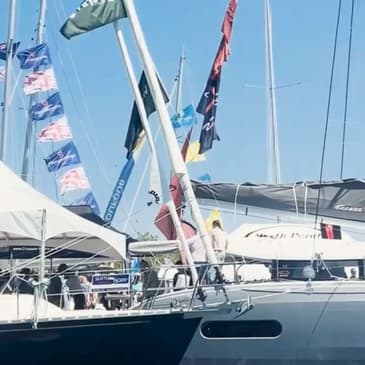
Special Edition presented in partnership with the Annapolis Spring Sailboat Show: In this special sponsored episode of Sailfaster, we’re setting course for City Dock, Annapolis, to give you an inside look at the Annapolis Spring Sailboat Show, happening April 25–27. First, we sit down with Mary Ewenson, president of Annapolis Boat Shows, to get the scoop on everything to expect at this year’s show—from exciting new boat debuts to can’t-miss seminars, hands-on classes, family-friendly fun, and more. Then, we spotlight two standout boats you’ll find at the show: the BirdyFish, an innovative foiling dinghy making waves, and the beloved Flying Scot, a true classic with lasting appeal. Settle in for this exclusive preview of one of spring’s biggest sailing events!
[00:00:09] Hello everybody and welcome to a special edition of the Sailfaster Podcast. Now this episode is brought to you in partnership with Annapolis Spring Sailboat Show. This dedicated episode is going to take you inside the Annapolis Spring Sailboat Show, which is coming up on April the 25th to the 27th at City Dock Annapolis. Firstly, we're going to chat to Mary Ewinson, who is the president of Annapolis Boat Shows. And Mary's going to walk us through the multitude of exciting things happening in the world.
[00:00:39] the show from new boats and must-see seminars and classes, events and special guests and family-friendly activities. Coming up after that, we're going to zoom into two of the many standout boats you'll find at the show. Firstly, the innovative birdie fish foiling dinghy, which is a really, really interesting new boat. And also the timeless flying Scott, which has its iconic charm of its own. But first, here's Mary on what to expect at this year's Annapolis Sailboat Show.
[00:01:14] So Mary, a spring sailboat show is such a great way to kick off the sailing season. I can't wait to go. But what makes the spring sailboat show different and special for you?
[00:01:25] The spring show is focused on getting ready to get out there for the current season. So we do have new boats at the spring show, but we also have a lot of pre-owned boats. So somebody can buy a boat and take it. I mean, you could leave on the boat of your dreams from that show.
[00:01:44] We also have some really cool educational opportunities at the spring sailboat show. We have free seminars right on the show grounds and a first sail workshop for somebody who has never tried sailing could come and do 45 minutes in the classroom, hour and a half on the water, just trying it out. Yeah. And inexpensive, just try before you buy kind of program.
[00:02:09] And this year, our spring sailboat show will be right down in Eagle Alley. Usually in the spring, we're out off the end of Susan Campbell Park. But this spring, we're down in Eagle Alley. So we're adjacent to the Chop Tank. We're going to have a no-wake zone, which is tastings of local wine and spirits. Chain mixers will be there. And then the Chop Tank is setting up a beer garden for us. So that's super fun. Right dockside, right alongside all of the boats.
[00:02:39] So it's a different thing for us. We have a little bit more space for that kind of thing. There'll be live music. I think that will be a ton of fun. Mary, let's talk about logistics. I know it's coming up at the end of this month. What's the exact dates and times? So the show runs Friday, April 25th to Sunday, April 27th. It opens each morning at 10 a.m. And Friday and Saturday, we are open until 6. And then Sunday, we close a little bit early, just at 5 o'clock.
[00:03:09] Tickets are available online at AnnapolisBoatShows.com. And they are $20 each and $15 for military. And it's AnnapolisBoatShowsWithAnS.com. That's a really good value as well, isn't it? It's great. What's parking like around there? Any hints or tips on that?
[00:03:29] You know the P word, parking. Parking is great, actually. There is a whole new garage right off of Main Street. Super easy in and out. And then all the garages downtown, if that one is full, they run a free circulator bus. Super. I was looking through the schedule for the weekend and you've packed so many things into a boat show weekend.
[00:03:55] You have seminars on sailing and racing and classes on safety and parties and expert panels and dozens of exhibitors. But with so much going on the show, what are you most looking forward to? I'm a racing sailor. So I am super excited. At this show, we have boats ranging from as small as 15 feet up to 80 feet long. I mean, just all these crazy, amazing boats, a gorgeous Hylus 54. I mean, all this great stuff happening.
[00:04:23] But what I am most excited about, we're going to have the Birdie Fish, which is a foiling boat. And I got the opportunity to go out on a Birdie Fish when I was down at Foiling Week in Pensacola. And wow, it was just terrific. So that boat will be there to see. We have the Flying Sky, the Viper, Melgus 15, Lightning, Minicat, Happy Cat, the RS Quest, the Tora.
[00:04:47] So there's this nice, cool area of small size racing boats with really competitive fleets. And I think there will also be some representatives from those fleets on hand to talk about what it's like to be in the Lightning fleet. Why would you want to sail a Melgus 15? You know, it is foiling for you. I would say the answer to that question is yes. But yeah. Having been on the Birdie, you know, I saw the, I saw videos of the Birdie Fish.
[00:05:17] And we're going to talk to Hardy a little bit later from the importing company. It looks amazing because it looks like almost like a normal dinghy with foils. And it looks really interesting. It's really interesting. And it was very comfortable for me. Now, I sail a Vipers, which is sort of a kill-assisted dinghy. I'm very comfortable on a dinghy. But it was easy to move around on. And then when it was up foiling, it just felt pretty stable to me.
[00:05:46] I didn't know what to expect. Yeah. Yeah. And then also on land, you have, I think you've got a session on the racing rules of sailing and the changes to them with Bill Simon, right? Yes. Yeah. Yeah. I was, I'm glad you asked about that because we have some really fun events that I'm very excited about. Bill Simon is an expert on the rules and he is doing a presentation Sunday afternoon at two in our seminar area.
[00:06:13] I saw his seminar a week ago at Eastport Yacht Club and I'm really excited he's going to come do that for us. He'll have the whiteboard with the boats and move them around. You can ask questions. And what's great is the timing is it's at two o'clock and you can roll right from that over to Spinsheet's crew party over at Eastport Yacht Club at four on Sunday. So we did time it that way intentionally and it worked out with everybody's schedule. So I'm really excited about that. And it's a free seminar once you're in the show.
[00:06:43] A couple of other really cool racing things happening. John Tahansky, who's been a sailing coach for many years on the bay and who I've had the pleasure of sailing with. He competes every year in this Everglades Challenge, which is a crackers crazy event. They go 300 miles in all kinds of different vessels. So he is coming to present on that Friday afternoon.
[00:07:08] And it happens to finish just before your very cool podcast, live podcast that you're going to do at the show. That's definitely a tough act to follow. But we're going to talk about how to get into sailboat racing for the first time. And I've got a couple of fellow panelists there who've got some really interesting points of view. But I do know that Florida race, the Everglades race guy, I have a friend in Florida who does it every year. It's quite a journey. It's a very, very interesting thing to do. So I'm looking forward to that.
[00:07:38] But the rules presentation, I mean, there have been a couple of critical changes in the J1 and Fife League. We're still talking about, you know, like the sort of subtle changes to room to tack, a room at the mark. I can't wait to listen to the conversation around that. I think you also have Dawn Riley as well, don't you? She's been on the podcast before, wasn't she? Yeah. It's a pretty all-star lineup, actually. I'm really excited. For me. Again, I mean, oh, no, including you.
[00:08:07] I mean, we invited you with good reason. Yeah. Dawn Riley is doing this cool collaboration tour and she's taken it to a bunch of different towns. I spoke to some friends who attended in Hampton and it was just amazing. It's all about how to put together a really competitive campaign, how to run a campaign.
[00:08:26] Say you're trying to go to the North Americans or you want to go to the Olympics or do the ocean race or, you know, who knows what, some single-handed thing or just get to the next level in match racing or team racing. That takes a lot more than just being a good sailor. And so she's doing a two-parts here event. One is going to be Saturday late afternoon. I believe it starts at four. The other will be Sunday morning at nine. And the four o'clock in the afternoon is for competitors.
[00:08:55] And anybody's welcome to come. Even if you're just thinking about how to step your game up the next level. I can tell you that when my husband was trying to do a Finn campaign and he was campaigning, trying to get to the Olympic trials, trying to get to the Olympics. If somebody had told me that there would be someone as knowledgeable as Dawn Riley standing up to give advice on how to go about this whole thing, we'd have driven 500 miles for it.
[00:09:22] I mean, I think every person who's trying to do one of these things, they feel like they're making it up as they go along. They're starting from scratch. So she's doing that session. And then Sunday morning is for organizers and supporters of campaigns. So organizers of regattas. How do you run a first-rate regatta? And the idea is to collaborate, get representatives from a lot of different organizations. So I am so excited about that. We've got space for 60 people per session.
[00:09:52] You have to sign up in advance. So you have to go to the Annapolis Spring Sailboat Show website or to annapolisboatshows.com, navigate to that. But I would tell you a little secret. If you sign up for that, there's also a really nice discount for doing that and going to the Spring Sailboat Show. There are probably a handful of people in the world with her experience of managing America's Cup campaigns, managing the Whitbread campaign and all that sort of thing. So she's a great speaker.
[00:10:21] So I'm absolutely signing up for that. I think I'm going to have to sort of move into Annapolis because there's just so much going on that weekend. I don't know why you live anywhere else. I don't live far away, but certainly it would save me. We also do have one other presentation on how to be great crew. The Annapolis Sailing School is putting that on. And that, I believe, is on Sunday as well.
[00:10:46] There are a lot of people out there who are very good sailors who are maybe not quite sure, hey, I want to try racing and I'm worried I won't be good at it. There are just some really nice tips that the instructors from the sailing school, they're experts on this. So, again, I think we've got a lot of really cool racing stuff. I think your audience is mostly, you know, people like me who love to get out there and try to go faster, at least go faster than the guy next to us. Yeah, I love that.
[00:11:15] So, so much of this show then is about sailboat racing, about encouraging people to either join the crew and also to think about campaigning for regattas. There's something for everybody here, isn't there? I love hearing you say so much about racing because we've really made an effort to add a lot more racing because there's still, there's a ton of day sailing and cruising. I mean, there's something for every kind of sailor. But I think for racers, there's just so many opportunities.
[00:11:41] And then we have all these great not-for-profits at the event that Brendan Sailing and Crab and Sail Beyond Cancer, Valhalla, and then sailing clubs. And so for people who would like to volunteer, there are a lot of racing programs who need some extra racing supporters. So, Mary, we got only a couple of weeks ago before the show. Really excited. Can't wait to be there. Thank you for taking the time to unpack all the things you've got going on at that show.
[00:12:11] Thank you. We are so excited about it. And if you want to get a taste of what's going to be there, if your listeners want to, go to the website. We've got the list of exhibitors posted, the full seminar list, which I only named a few of them. And then in just about a week and a half or so, we'll post the show guide. We're sharing those on the Boat Show website, in the Boat Show Facebook feed, and in our emails.
[00:12:38] Because, you know, we want everyone to come to town, go racing, go for a sail, go to the boat show, go to the spin sheet crew party, and enjoy Annapolis. And remind us of the website again. Sure. The website is annapolisboatshows.com. And from there, just navigate to the Spring Sailboat Show tab, and you can find all the information about the show. And buy tickets. Fantastic. Thank you, Mary. And next, we're going to talk to a couple of the exhibitors from the show. Excellent. They're awesome.
[00:13:08] So, we'll see you at the show, Pete. Thank you. So, next, we're going to be talking to Hardy Peters of East Coast Sailboats about the birdie fish, which is a really interesting foiling dinghy from France that you'll be able to see at the Annapolis Spring Sailboat Show. Hey, Hardy, there's a ton of excitement around the birdie fish.
[00:13:35] You know, I've seen rave reviews online and seen the videos of it in action. You know, I can see why it's very exciting. And for those who haven't seen it in action yet, could you tell us about the birdie fish? What makes it stand out from other boats in the class? Sure. I mean, I think the birdie fish does stand out from other boats from the simple fact that it's more accessible to a lot more sailors from the simple fact that it's a scout-style boat with very, very apparent foils. You can see the pink foils coming out of the water.
[00:14:05] It's an easy boat to sail. It's a boat that's not intimidating like some of the other boats that sail on T-foils on a single file, like the moth and the wasp or that sort of stuff. You spend a lot of time in the water learning how to do it. Versus this boat, I think the appeal is mostly the fact that you can literally jump on this boat and within 30 minutes be foiling relatively easily.
[00:14:26] And it's a really interesting design because it looks like a dinghy, you say, sort of scow dinghy with those two SailGP America's Cup type and more America's Cup type of foils. It makes it look really, really interesting. But it sails as a displacement boat as well as a foiling boat, right? Correct. It actually sails pretty well upwind as a displacement boat as well, too. The race version has three different sails. You've got your main, you've got a very good size gym, and then you also have the gennaker as well, too.
[00:14:56] And you can literally sail upwind with that gennaker. It's a code zero, super flat, easy to get up there. You don't have to be a super athlete to do it. That boat as a model sails relatively well going in displacement boat. Yeah. And then after about eight knots, you're no longer displacing. You're up and flying. It's that simple. Eight knots of wind speed or eight knots of boat speed? Eight knots of boat speed. What kind of sailor is the birdie fish designed for?
[00:15:25] Is it a boat for newcomers to foiling? Is it also exciting for experienced racers as well? I know it comes in two versions, right? There's a base version and a race version. Correct. It does come in two versions. It does appeal to a wide variety of sailors. And we're actually have a, what we call a club version for kids that has just the main and jib that's going to be coming out. We actually have the sails outside of my office door right here. We're going to be testing it out this spring.
[00:15:55] And it's basically a very large gennaker. But it's briefable so that we can put kids out there and have them. I think the birdie fish appeals to a variety of sailors. You can put somebody on there who, in my experience, I've gotten clients who are big boat sailors who've never really done a lot of dinghy sailing. And within 45 minutes, we'd have them foiling 15 and 16 knots. We also had a plenum week in Pensacola this last month.
[00:16:23] And we had a wide variety of sailors, folks who had never really foiled that much to professional sailors who were on the boat. And so the appeal to that wide range of people is that it gives them a chance to, first of all, learn how to foil the boat and get up there and have the chance to do so.
[00:16:41] And then you have those very experienced sailors that can get out there and you can start tweaking that boat to where you're sailing, you're foiling upwind, you're jiving, you're doing a lot of different maneuvers there up on foils. And it satisfies them because it gives you that foiling. It gives you the speed and gives you the challenge to do it. Yeah, I saw some of the videos. It could have been from Pensacola where you're explaining to some of the sailors there about how to operate the boat and so on.
[00:17:09] And it did look amazingly straightforward as well, or maybe just the way you explained it, it sounded really straightforward. And I think that's really important because foiling is the future. You often hear that, especially from younger sailors who are into foiling. But it looks really intimidating to try that. So this looks really interesting. It's much less complex. It seems to be much less intimidating. That's presumably the message behind and the reason for the design, right?
[00:17:38] Yes, no, it definitely is. I mean, the boat is not very intimidating at all. I mean, it's actually quite exciting to look at the boat. You see it as a nice deep cockpit. It's very comfortable. The self-regulating foils make it very easy to get out there and foil. And as you go faster and faster, the boat becomes more and more stable. So you can literally get out there, hike a little bit to get up.
[00:18:01] And once you're up, depending on what you're doing and how you want to do it and how high you want to go up to the wind, you get to be sitting there having a conversation with somebody. And I was out with some folks that were testing the boat at one time. And we're sitting there doing 16, 17 knots, talking about the boat and talking about other boats until we almost hit the sandbar. But anyway, that's a different story. We tacked around really quick, got back up on plane, and it was that simple.
[00:18:30] So it's really not a very intimidating boat. I had a young lady at Pensacola who had never been foiling before, and she got on there. She was very nervous and got on there. And she came out with the biggest smile on her face. She was about 15 years old. Her parents had let her come out with us as a test. And she was like, she came back every day. Can I go again? Can I go again? It was that much. She really, really enjoyed it. So I have to ask you, you mentioned self-regulating foils. What are they?
[00:18:58] So the way the foils work is that they're what I call a J-foil coming out like that. And so basically it's a combination of weight and lift. And so when it comes to self-regulating, if you have a certain amount of weight in there, it will go up only so far. Because just like an airplane wing, foils operate the same way. You have your pressure of pushing from the bottom and you have your vacuum on top.
[00:19:25] So as water goes over that, it creates a vacuum or creates lift on those things. So as the foil comes up out of the water, you've got less and less foil in the water. That's why those foils are sticking so far out. You have less and less foil in the water. So it becomes a process of at a certain point, you have a certain amount of lift. You have a certain amount of weight. It's self-regulated. It's not going to go any higher. It's not going to go any lower. Okay.
[00:19:50] I also have to ask, when you tack, are you able to keep it on the foils or does it drop down? Technically, not yet. Could you do it? Yes. Because she's a skidder, what I call a skidder. I mean, you have two main foils out here and you have your T-foil in the back. So she's a tripod. Okay. If you jam that runner over too hard, guess what's going to happen? You're going to spin out. Just like you would in a car on ice. Same concept.
[00:20:19] It's very responsive. So when you're steering, you're moving a half inch at a time. So when you go to tack, if you throw it over too far, you're going to spin out. So you have to keep that speed up to do that tack. Yeah. Yeah. So not yet, but close. Giant? Absolutely. Absolutely. So because you're just gliding through a turn, it's not too hard. The first few trials of some of those America's Cut boats, it took them a while to figure out
[00:20:46] how to stay on the foils in a turn, but that's really interesting. Hardy, what's the response been like in the U.S. so far? Where are you seeing the most interest? Is it clubs or trading centers or individual owners? What's going on? It's a little bit of both. We're looking at individual owners getting the clubs excited about it. We have three locations now where we have boats and clubs, so that's going to be Mission Bay out in California. We have some, actually four because we have one up in San Francisco.
[00:21:17] And we have a boat down at Pensacola Yacht Club that actually lives there now where we had the foiling week. And then when we were there with the boats, we had a set of boats at one point in time there between owners and charters and a group called the Magenta Project. Mission Bay has some. Miami Yacht Club or Coral Reef Yacht Club has a boat down there. And we're going to be going down there May 3rd to do demos and work with the owner as well, too.
[00:21:45] He has not done a lot of foiling before, so we're going to go down and train him. And we're also going to bring some boats with us and have folks at the Miami Yacht Club try to boat as well, too. So a combination of boat. You have to get the individuals excited about it so that the clubs can start looking at this boat, too. Our dealer out in California, Bale, ILA, they just were doing some stuff with the SailGP folks out there. And they do what they call foiling Fridays as well, too.
[00:22:12] So they get out with a whole bunch of different foiling vessels at the same time. We're going to be at the Annapolis Boat Show in the spring. We had a great display last fall. People's reaction was like, wow, look at this thing. You know, it's great. Oh, I bet. The pink foils don't hurt. You know, it does stand out. We'll be back there again this spring. We're actually taking a boat to a new owner in Annapolis at one of the yacht clubs tomorrow. He's going to get his boat on Saturday.
[00:22:39] And we're going to do some rigging and some demos as well, too. So you're going to start seeing this boat in a lot of different places. So, yes, it's got a lot of interest and a lot of excitement. Yeah. And the venues you've mentioned, they really range from high winds to quite light winds generally. So I'm just curious about what kind of wind speed you need to get it foiling. And I'm sure it depends on weight. Weight is a factor. And then you're looking probably about eight knots of boat speed.
[00:23:06] So we've had the boats foiling five to seven knots. You can put the code zero out and get up and do pretty good. And, you know, obviously it's not a very fast flow, but you're foiling. Yeah. It's not high either because it goes back to that self-regulating. The more surface area you have, the more weight you have, the more surface area you have. You need speed to make that happen. So as you get close to eight knots, you know, you start foiling at a normal level. That boat foils about two feet off the water.
[00:23:35] So you're kind of way up there. So chop is not really much of an issue. We've been out. I think top speed right now is over 27 knots. One of the European dealers just did that last weekend. But, yeah, it's fun. And, I mean, you get out there. It's a scow. It's very comfortable. It's a nice deep cockpit. You've got a lot of real estate in there to move around. The foils are not adjustable.
[00:24:03] So you use your body weight to move around. You have a little adjustment on the rudder to get your kind of slight bow down position, which is what those boats like, because it creates that lift on the main floor, and you're able to get that correct pitch on the boat. And then the rest of it's just fighting weight. And you said earlier that there is a single-handed version coming out. Yes, the Bertie Fish S. Yeah, they will be out probably May, June.
[00:24:33] We'll have a Bertie Fish S available for testing. Looking forward to seeing you and the Bertie Fish at the Annapolis Spring Sailboat Show in a couple of weeks. Is that the next opportunity for people to come and see and try it? Will people try it, or is it just more seeing it on the stand? At the spring show, we're going to be just showing the boat. In the fall show, we're going to be demoing both the Bertie Fish and the Bertie Fish S. Yeah, I can't wait. I really want to try one of these. Having seen the video, it looks really good.
[00:25:03] So where can people go, Hardy, to learn a little bit more about their Bertie Fish before they come to the show even? So you can go to our website, eastcoastsaleboats.com. Look up Boiling, look up Bertie Fish. We'll have the boat there. And then also, Bertie Fish France has a brand new website out there as well, too. They will have some really good information on it. There's some stuff on Instagram and Facebook and some really good videos out there. But if anybody has any questions, we're always here to answer them
[00:25:31] as well as anybody wanting to try. We can either hook you up with an owner or we can set up a demo. We're here based out of the Outer Banks of North Carolina. There was always wind here. And we do what we call experience type sailing. It's basically a half-day charred. And obviously, we hope you go home with that. Yeah. I can't wait to do that. I'm definitely going to sign up for that.
[00:25:57] It looks like it looks a lot faster and more maneuverable than my normal J105. Hardy, great to see you. Thanks for joining. Looking forward to seeing you at the Annapolis Spring Sailor Show. Yep. We're looking forward to being there. Thank you very much. Okay. Right now, we're going to talk about one of the classic racing dinghies, which is the Flying Scot. And there's no one better to have that discussion with
[00:26:27] than Kerry Andrews, who is the president of the Meriden-based Flying Scot Company. Kerry, great to see you. Thank you for having me. Yeah, it's a pleasure. So the Flying Scot, which will be at the Annapolis Boat Show, is a really interesting history, right? Sandy Douglas was the original designer. He also, I was reading, designed the Thistle, you know, another very famous boat. And was, I also learned, a contemporary of Uffa Fox, who was the great UK designer.
[00:26:57] So anyway, the Flying Scot is a, as everybody knows, a very popular 19-foot fractally rigged dinghy. It's hand-built, hand-crafted in GRP. We were talking, oh, you corrected me that the right number that's been built is over 6,000 now, with hundreds of fleets up and down the country. That's about right, yeah? Yeah, we've been in continuous production since 1957, which I think is fairly unique in the small one-design market now.
[00:27:26] As you said, Sandy designed the Thistle. He also designed the Highlander. And then the Flying Scot was his third, final one. And the interesting thing about the Scot is she was designed from the beginning to be a production fiberglass boat. And right at the time, she was one of the first that started as fiberglass and has always been. So it's allowed us to really keep the boats very, very consistent, which really helps with the strength of the one-design aspect of it. It has been a labor of love for a long time.
[00:27:55] We've been doing it in Maryland here since 1957. And we're very much enjoying watching her continue to grow with families as they enjoy it. And it's a bit of a family company, right? Your dad bought it, is that right? Yes, yeah. So my father, Sandy delivered him the first Flying Scot that was in our family. And then he started working for the company as a teenager, giving sailing lessons. He got bit by the bug and just never stopped sailing. And so they hired him on, kind of went through,
[00:28:25] bought the company in 1990. And then I grew up, therefore, sailing. I think my mom sailed her last regato and she was like eight months pregnant on me or something crazy. And I started sailing with my dad by myself at four. And I've never stopped. I just, I love it. It's been something that we've done as a family. And so, yeah, when my parents were ready to kind of step back a little bit, it just made perfect sense for my husband and I to come and take over. He's a big sailor too.
[00:28:55] He was a thistle sailor and a Highlander sailor. So I had to bring him over to the Scot. But he is a wonderful sailor in his own right. And he's been a huge asset to us. And we're really enjoying doing the business together like my parents did. Yeah, wonderful. And you'll pass it down, do you think? My oldest, he's only eight, but he says that that's on his horizon that he would be interested in doing it. So brilliant, brilliant. It's a great, obviously a great boat for families. What do you think the enduring appeal
[00:29:25] of the Flying Scot is? What makes it so popular, do you think? She ticks a lot of boxes that you usually have to kind of do an either or when you're looking at a sailboat, right? Like, oh, if I want a really high performance boat, I might have to sacrifice comfort or I might have to sacrifice stability. And if I want a really comfy, cushy cruising boat, well, now I have to give up some performance. And so she really walks that line in a way that others have imitated, but I think she really actually fits the bill.
[00:29:55] So she's extremely stable. So she's a very popular learning boat. She's a very popular family boat. We have tons of camps and learn-to-sail programs that use the boat. She's very simple. So, you know, Sandy actually was the way he said he wanted people to spend their time sailing her, not rigging her. So he very purposely made her to be just a simple, put a pin in, the four stays together, you're done kind of thing. And she also though is a beautifully, she's got that planing haul. So you get her on a two-sailed reach
[00:30:23] and she pops up and it's almost like a power boat. The water's shooting out the sides and it's super fun. She's very responsive. She's got a big main sail. So she's very easy to sail, but she also keeps it interesting. So you can go racing in a one design, hardcore fleet on Saturday and then Sunday take the family out, gunk holing for a cruise and it's the same boat. She does all of those things. And so I think that's where she has longevity
[00:30:51] because people buy one to learn to sail. They learn to sail. Now they're racing. And so I always say she's a boat that grows with you. You don't necessarily grow out of her. I was watching some of the videos that actually have you in them and watching you tack and so on. It does look really straightforward. I mean, you're an expert sailor. You're going to make it look straightforward. But it looked like it's easier to get across the boat, but the rigging was pretty simple
[00:31:19] in terms of the access to control lines and so on. So it sounds great. Have you noticed any similarities in the type of people who sail the flight, Scott? Yeah, I think she's a very popular boat, I would say for families. Also a lot of couples. We have a championship that's actually, a national championship that's dedicated just for married couples because she's a very popular two-up boat. And I will say it's one of the hardest
[00:31:48] national championships we do. Like the talent is out of this world and it's just super fun. But yeah, so she's a draw to that, I think because you can sail her two-up very comfortably. She is, Sandy kind of under-canvassed her. You know, the spinnaker is only 200 square feet. It's a symmetrical spinnaker. And he did that intentionally because he had that vision that two people could sail it. You don't have to drag four people to a regatta. Your expenses go way up. Also, it's a nice little getaway.
[00:32:18] I know my husband and I enjoy being able to go to a regatta together. But she is big enough, you know, if our oldest wants to come with us. So she's definitely a huge draw to families. You know, we have a lot of father-son teams that sail together too. A lot of, you know, parent-kid teams. I did it, you know, I started racing when I was four with my dad. And so I think that she lends herself, you know, to that. She's also, like I said, she's a big learn boat. So she's very popular. Sailing camps, clubs.
[00:32:49] She's also, because she's recreational, you know, we have a few, like the Navy base, Clonico. They have some just for recreational purposes. So she kind of, I don't know that I could pigeonhole it into a specific type of person that sails them. We're pretty blessed because it does run the gamut, brings all kinds of people to our events, which makes it super fun to get to know everybody and kind of go across the board. Yeah. I saw you just had the midwinters at Fort Walton Yacht Club, which is my yacht club down on the sunny,
[00:33:18] emerald coast of Florida. How did that go? Well, I think the sun, I think only made an appearance for one day. Unfortunately, a weather system kind of put a literal damper on the sailing. They only got one race in, but they had, they actually had to cap participation at 54 boats. And so it was a great time. People came as far, I know we had boats from Massachusetts, boats from Wisconsin. So kind of all around, big group came in. And what's really cool about the Flying Scott class is the people that sailed them. We just,
[00:33:48] we genuinely enjoy spending time together. So while it's a bummer to not go sailing, we really enjoy the time to, to, to visit with each other. You know, I think half of my, our wedding was Flying Scott sailors in attendance because we're just a big family. And so, yeah. So while the sailing was a little bit disappointing, we always can make it a good time with the off the water, visiting and catching up and stuff. Yeah. It's a lovely club down there. And the. Beautiful. It was probably John Ferris, who is excellent. Excellent.
[00:34:17] What's your advice for somebody looking to buy and sort of get into a one design fleet? Thoughts on best locations, friendliest people, where would you, where would you start? Really? The cool thing with the Scott is you really can't go wrong. We have, I would say the majority of our concentration of fleets is kind of up and down the East coast, just because we do produce them in Maryland. There are some fleets out West, but it gets, it's a little pricey to get a boat out there. So they're not as prevalent. Okay. So I'm really looking forward to seeing you
[00:34:46] in the Flying Scott at the upcoming Annapolis Spring Sailboat Show. Thanks for spending a little bit of time with us. Well, I'm not sure about you, but it certainly whetted my appetite for the show. Can't wait. It's Annapolis Spring Sailboat Show. It's April 25th to 27th. It's at city.annapolis, Maryland. And to learn more, just go to annapolisboatshows.com and you can find the dedicated pages forward slash spring sailboat shows with all the information there.
[00:35:16] Hope to see you at the show.