
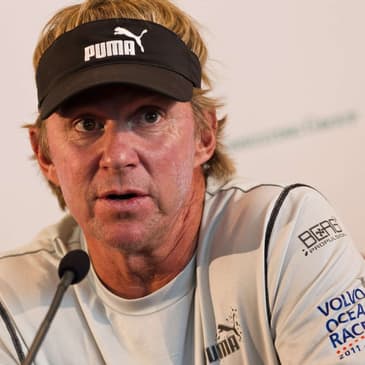
In part two of my conversation with Ken Read — President of North Sails, multi-time world champion, and one of the most respected figures in sailing — we dive into some great America’s Cup stories (including more Dennis Conner gold), his advice on raceboat preparation and priorities, and his bold vision for transforming regattas into something more fun, efficient, and family-friendly. We pick up the conversation with Ken sharing thoughts on his all-time favourite boats to drive.
[00:00:07] Hi everybody, welcome to part two of my chat with Ken Read. Ken is the president of North Sailes, he's a multi-time world champion as you all know, and one of the most respected names in our sport. In the second part of my conversation with Ken, he talks about racing in the America's Cup, which includes some more great Dennis Connor stories. He gave me some great advice on preparing
[00:00:32] a race boat and what to prioritize. And he also talks about his revolutionary thoughts on how to make regattas more fun, more efficient, and family friendly, and what he's doing to advance that agenda with Ray Wolf and the New York Yacht Club. So here we go, we're going to pick up the conversation as we were talking about the subject of his favorite boats. Here we go.
[00:01:01] I know you've sailed on some wonderful boats, Stars and Stripes, the Volvo Ocean Race, and Comanche as well. Was the one that you loved driving and were they all very, very different or were the principles all the same? I think the principles for the most are the same. How they react and how they respond and how you have to kind of work at it to make them go top speeds are very different. You know, Comanche, there's nothing like that boat, a windy reach or downwind, or we had some of the best helms people
[00:01:29] in the world on that boat. And I remember blowing hard. It was actually the day that we broke the 24 hour speed record. And we're just ripping across the North Atlantic Ocean heading for England. And it's blowing, you know, 25, 28, you know, it's boat speed weather. We got the right sails up. Everything's perfect. And the driver, all of a sudden, the boat's going faster. The more we heal, the boat's going faster and faster. But to the point of we're sailing along at kind of 30, 30,
[00:01:57] 30 degrees a heel, blowing 30, 30 degrees a heel going about 30, you know, so it's, it feels pretty edgy. He's got two fingers on the wheel back there too. Matter of fact, I think he smoked cigarettes and he was like, you know, smoking a cigarette and two fingers on the wheel, boats all fetched up at about 35 degrees, water everywhere. And there's just nothing
[00:02:19] like it. When we went, the TP 52, uh, transport, it was called the Transpac 52 class, uh, back in about 2000 when four or five of them got built on the West coast. And then it kind of started to fizzle out. And I got three owners to build brand new far boats. That was kind of the modern, that it was kind of the, the modern version of where we are today with the TP 52 class. That boat, that far,
[00:02:49] uh, that kind of first kind of second generation TP 52, um, that really paved the way for the modern TP 52 class. I'm very proud of that. First of all, I'm very proud of starting to figure out that the box rule had, had some real legs that could, I mean, anybody who sells a TP 52, no matter whether it's the very best or just kind of an okay one gets off the boat going, holy crap, is that a nice boat to sail?
[00:03:19] It's just an amazing boat to sail. And then the third one, you know, there's nothing like an Etchells going upwind, you know, it's just, it's just a freight train and, uh, you get dialed in and the three of you are kind of leaning your butts over the side. I have some amazing photos of the good old days and sailing Etchells and, and I loved, I loved my time in the Etchells. And the only reason I still don't sail Etchells is because big boats kind of took my time away. But, uh, those three boats,
[00:03:48] and you notice I keep the J24 off, God bless Rod Johnstone, but any boat that you have to sail, any keel boat, you got to sail dead flat with Lee Helm. It is not the, I couldn't make the list. And that's how you had to sail those boats, dead flat with Lee Helm. I had Jeff on, Jeff Johnstone on the podcast, just published it this week. And, uh, he was talking about the, the first J24 and being, you know, made in the garage. I didn't, I didn't, uh, I didn't know
[00:04:14] that. Um, I do want to talk about America's Cup because you, it's fantastic what, what you did there. So, so you were helming Stars and Stripes at the different boats in both campaigns, 2000, 2003, America's Cup for Dennis Conner. How did the relationship with Dennis Conner come about? Well, there's two stories that some people might've heard one or both, but I got a phone call one day
[00:04:39] at the loft, the person in the front office, all of a sudden a buzzer rings and it's Dennis Conner's on line too. And I had as many sarcastic friends as the rest of us. Right. And so I'm like, all right. And I, I, I just assumed that it was my dear friend, Brad Demio. So I took up the phone. All right, Demi, Brett, what do you want? And that's what we call them. And, uh, it's like, hi, uh, Ken, this is Dennis Conner. I'm like, yeah, whatever, Dem. So are we going to meet for a beer after work?
[00:05:07] Are we not, you know, what's going on? And, and there's a long pause. It's like, Ken, this is Dennis Conner. I'm like, you gotta be flippin' kidding me. He said, I'm in town. I'm in Newport. I want to take you to lunch. I'm like, okay, great. And I'm still not sure if it's Dennis. It's going to show. Sure enough, about half an hour later, he walks up the stairs and, and he's, um, I walk out of my office and we go to lunch and he sprung it on me that, um, Chris Dixon was
[00:05:36] skippering his boat, his in, in the, what was the Whitbread at the time? I believe it was the Whitbread or I don't think it was the Volvo yet. Um, Toshiba. Yeah. Toshiba. And I think it was the Toshiba campaign. It might've been their next one. Anyway, he said, uh, Chris is my guy. He's going to drive the boat. I'd like you to be the tactician. Cause I see that you're doing really good
[00:06:00] things in this class and this class. And, and he said, I hear you're the guy. And I'm like, all right, well, let me think about it. I remember going home and my wife and I started talking about it. It's New Zealand and you know, everything that came, we didn't have kids at the time or our daughter at time. About a week and a half later, something happened between him and Dixon. Dixon was all of a sudden poof out of the picture. And I remember, I remember all of a sudden the phone rang again.
[00:06:29] And this time I didn't think it was a crank call. It was him. And he said, uh, he said, well, you're now the driver. Does that change? Does that make it easy? I said, yes, it makes it easy. Uh, done. I meant, and we started there and that was it. It was unbelievable. Oh. And then, so, but we didn't have a boat. He didn't even have the money yet. He wasn't even sure if he was going to be able to pull it off. So that summer I started selling at Jules and we won the North Americans, I think the year before, and we were gearing up for the North Americans that summer.
[00:06:59] And we sailed the regatta against each other up in Marblehead. And he called up, he said, I want to buy a set of your, and at that, that time it was soft set sales. I want to buy a set of your sales. If you're winning with these things and he buys everybody's sales, he's got a thousand sets of sales. So we went up, we spent a day kind of training up in Marblehead and then, um, had the first day. And I think I was, I don't know, Judd Smith. I forget who was winning after the first day. And we came in and we had a beer that night and I walked over to him and he goes,
[00:07:29] come here. And, and you got used to, we used to call it getting cornered, not conned, but cornered. And he would kind of turn you into a corner and pin you in there. And he would talk at you. And by the way, here's a legend talking at you. So talk at me. And he said, I think you are the best sailor in the world. I said, Jesus, where did that come from? Um, he goes, because your sales are so bad
[00:07:57] that if you can actually win with them, you must be the best sailor in the world. It's like, wow, I don't know how to take this, but, uh, okay, I guess. And then we just kept going from there. You know, we just kept going from there. It was, it was quite a, to call my Dennis Connor experience a roller coaster, I think is doing a disservice to a good roller coaster ride. It was
[00:08:20] pretty, it was pretty crazy. So in America's Cup 2000, um, the boat you were driving, um, USA 55 was reportedly not as fast as Prada nor America one. And, um, and both those boats along with team New Zealand probably had, were thought to have superior design, uh, better funded, deeper talent
[00:08:44] pools and so on. Yet you still reached the semifinals, the Louis Vuitton. And, um, so did it feel to you that you had to massively outperform the other competitors, sort of sheer sailing ability and tactical calls to overcome the boat speed issues? Was that apparent to you? Okay. So that's a very good question. And it's, it fortunately it plays back to a couple of, a few answers ago, but, um, at the
[00:09:12] beginning, the first two rounds, first round and a half, um, we absolutely sailed how you just described the ladder. Like we have to sail with our hair on fire and we gotta, we gotta be perfect and we gotta do everything right because we're not as fast. And then we decided, well, why don't we get faster? Okay. Let's just quit pissing about it and, and let's get faster. Let's figure this out. And we used to,
[00:09:37] uh, we tried all kinds of interesting things and we worked on balance and we worked on sail shape and it was mostly in house that we were doing. It wasn't like we were buying new sales. Um, and then the second part of it is let's just, let's just sell better than people. And we realized, we realized about halfway through the second round that we had a really maneuverable boat, like a super maneuverable boat.
[00:10:03] And, um, Peter, uh, Peter Holmberg, we had a great, great afterguard, Peter Holmberg and, uh, and Peter Eisler. And then Tom Whedon joined us. And I remember, uh, it was one start against the French. And by the way, I could, this is something about sailors that we can remember everything once. It's it. And after the dial up, they peel, we peel down and, and tried to hook them right away.
[00:10:31] And Holmberg looked at, and Holmberg said, I remember him saying out loud, he's starting to figure this shit out because he was a really good match racer. And we used to go match race etchels against each other all the time to practice. And all of a sudden it's like our boat, we can turn this thing. We can get ourselves in position to, to, to start. And then, and then we realized in a, in a breeze, we were actually quite good. We were one of the better boats in a breeze.
[00:10:55] And, uh, so the combination of being competent in a breeze, it got to be breezier as, as that kind of, summer, that Kiwi summer went on. And the fact that we weren't, I didn't, we didn't mind being aggressive with that boat and the, in the pre-start those three factors all of a sudden, it's like, Hey, we can win today. No matter what we were racing against, we can, we can win today. And, and once you start getting that feeling, that confidence, uh, then you got a couple
[00:11:23] rabbits to pull out of the hat like that. No excuse. Off you, off you go. Let's go. I suppose in, in, uh, match racing, if you have that maneuverability and you get the good start, right? Then from, from then on, you hopefully can start dictating the race to even somebody with greater boat speed. I remember, um, when I was commentating, we would do all kinds of kind of analysis and it was like 80 something percent of races were one on the first cross, you know? So,
[00:11:52] you know, it's a really high number. And so happening today, isn't it in the America's Cup today? Yeah. Yeah. It always will. And, and, um, and, but in my day, the first cross could happen 10 minutes into the race. It could be a drag race to the left corner. You know, it's a little different now that the first cross happens about 30 seconds after, after the start, but still it's, it's the old adage
[00:12:17] of get ahead and get your elbows out. It was the same. Not nothing. Nothing was different then. Get a better start. Hopefully you can leg it out to the first cross. And not that it was easy after that, but you certainly made life a little more bearable for yourself. So I'm interested in the fact that Dennis Conner's on the boat at this point, right? I mean, he never, never was on the boat. Oh, I didn't know that. So he was unsure. Otherwise I was thinking that, did you ever feel that he was
[00:12:42] going to try and grab the wheel from you? Yeah. In the second campaign, he grabbed the wheel one day. And, uh, because he thought I wasn't sailing very well. So, um, that morning he called me up and said, I'm going to sail today. No, he was going to be the hero against the boat that had never won a single race yet in the entire series. Then he came in, he kind of looked at me and said, that's how you do it. So yes, we won the race that day, but that was the only day he was ever on the boat during my two
[00:13:11] campaigns. That was an extraordinary campaign that, that, um, New Zealand on NZL 60 just, just blew everybody else away. I mean, that was, that was a moment for the New Zealand nation, a little bit like Australia in HE3, right? That captured the, the, the nation. And it doesn't seem that the America's Cup has since in the United States captured the imagination that it did back in,
[00:13:35] uh, in 83 and probably 87, which is sort of interesting. Although I want to move to 2003, which is when Alinghi won. So, um, at the time, did the 2003 campaign feel like the watershed moment in America's Cup history that we now recognize it to be. And I'm thinking about the, not just Alinghi being the first European team to win, but that injection of sort of billionaire money and corporate
[00:14:04] funding technology and somewhat the end to national teams, right? Where people sort of defected to other, to other teams. Did it palpably feel to you like the old model, um, was being overtaken by billionaire funded efforts? Just curious about that, whether you've realized at the time. Well, listen, the, the America's Cup has always been won by time and money, right? Time and money
[00:14:29] usually buys you, if you do it right, time and money buys you the right people and the right people put everything in place. Uh, so I don't think the billionaire quotient was any different, you know, big difference was, so in 2000, I believe there were four or five American teams. Um, because I remember we all, uh, um, President Clinton came to New Zealand for some big thing
[00:14:56] and he and Chelsea, um, were, were in New Zealand. We all had all five teams lined up and we all met them. And I think, uh, uh, Don, Don Riley's program, American true, America true brought one of their boats over and the skippers of each of the programs, uh, were given a section of the boat and President Clinton came down and introduced himself and, and, uh, and each of us were given a section of the boat
[00:15:24] to explain to him what the section was. And I was in, I was in the coffee, I was, I was to explain to him what the coffee grinders did, you know, what the grinders did. So I had him, I had him spinning the wheels on the other side of me on the other side. I'm like, Oh Jesus, don't hit this guy in the jaw and knock them out. You know? So I'm going to have, I'm going to have secret service shoving guns up my, you know what? So anyway, um, and by the way, a little side to that is I'll never forget.
[00:15:53] He met everybody and then he went up and he met each of the teams because each of the teams were sitting together, but it wasn't just teams, it was teams and families. So literally hundreds of people that he met and stars and stripes is the last of the five teams. And by the time he got down to me, to our team, I was standing kind of off to the side. Hello. Hi everybody. How you doing? Stars and stripes, Dennis, nice to meet you, everything else. And he walks by, he comes over to me. He goes,
[00:16:19] so Ken, do you play golf? So after meeting hundreds of people, he, he remembered your name. It was, I, I, I'm still kind of blown away to, to this day. So thing with stars and stripes in 2000 and 2003 is we were 100% American team. And that was really important to Dennis. In fact, you know, a guy
[00:16:43] named Morgan Trubovich might've been, I, you know, all due respect to Mike Topa and Billy Trankel, but he, he might've been as good or a trimmer as we had in the whole program. And he's a Kiwi. He wasn't, he didn't say, oh, you know, we, we were all American all the time. So that, that part went away after Dennis, you know, that, that, that part clearly went away. So this multinational, you know,
[00:17:09] they're trying to get back to it now, but let's face it, it's still pretty multinational. Yeah. Some teams did well enough, didn't they? Some teams did have more. Yeah. But you know, 2003, 2007, I think 2007 would be considered, you know, kind of the big, that, that, that rivaled 87, 87. I don't know how many teams were in 87. It's almost the same. I think there were 11 teams,
[00:17:32] maybe in two, in 2007, uh, in, in Valencia and, uh, in, in so many ways. And so many people have this opinion when a Lingi kind of screwed up the deed of gift after that 2007 campaign, they took it maybe a little more nonchalantly. I'm probably going to get in trouble by, with Brad Budworth for saying
[00:17:57] this, but, um, the fact that that went to court killed those days of America's Cups. They, they had a 90 footer class. In fact, uh, I was sailing with George David on the, uh, the 90 footer Rambler at the time we were doing a lot of offshore stuff and, and it was a water, water ballasted 90 footer. And they actually called like, Hey, would George consider, um, selling the boat? Cause I think that
[00:18:24] was kind of a model boat that they were looking at, um, for, for the future of what the cup was going to be. So much more high performance, something like that. It was kind of before the, the days of canting keels, um, candy kills were just starting to come into it, but it was going to stay in model halls. It would be. And I think it had a real potential of continuing to grow and expand, but that, that court battle and what ensued, it'll never be the same. It went from a sport from
[00:18:54] with foul weather gear to a sport with wetsuits. And by the way, there's nothing wrong. There's nothing wrong with that, but it's a wetsuit sport and it's going to be in the air. And that genie has left the bottle and it ain't going back. Yeah. This is, this is going to be the highest of high performance from now on. But part of me still wonders at, you know, in 2007 to the, to the D to gift, if that had gone to 90 foot model halls, what would the America's cup look like today compared to
[00:19:23] what it does look like today? It always kind of intrigues me. Of course, we'll never know. I was in Valencia a couple of years ago, um, in the summer. My son had a program there. I passed a very full on looking America's cup hole on the side of the marina and it was covered in graffiti. And I was like, that's got to be an America's cup. Uh, it was, but it was uncared for. It was quite sad. So Ken, let's pretend for a moment that I've got incredibly ridiculously lucky.
[00:19:50] And you've said to me, I'll be in Annapolis this weekend. If you want somebody to jump on your boat for the spring regatta, I'm there. So say that happened, take me through what you'd be asking me about this. This is a J one doesn't really matter what time of boat, you know, J boat. Um, what would you ask me about? What would you be sort of prioritizing at the dock? First of all,
[00:20:12] uh, that day's weather and rig setup. So, you know, the boat you described is a boat with very limited sail choices, right? You got a jib, a main and a kite as limited as it gets. And therefore, when you, people think that, uh, one design classes, for example, with really limited, uh,
[00:20:35] sail, sail choices like that, uh, are simple. Well, they're actually the most complex boats in the world to sail because you have to take a jib, for example, from zero to 30 knots, right? Which is near impossible. So essentially you have a jib that you have to try to fool into, um, performing in each of those conditions. And that has to do with obviously, uh, tensions around the three corner
[00:21:03] triangle, how tight, but head stay sag, head stay tension, uh, position, uh, lead position, uh, sheet twist. So you, you can't sail a boat like a J one Oh five without understanding all of that perfectly. And are your lowers loose enough? Is, is the side sag and the mast enough for that given day? Um, really, are you loose enough in light air? Are you tight enough in a breeze? Can we get, can we get enough?
[00:21:30] Can we get more backstay on than my, my buddy next door to me at the top end of the range without turning the mainsail inside out? Um, what is turning your mainsail inside out? How, you know, how, how close to the edge are, should you be to click, to turning the mainsail inside out at the top end in order to get head stay tension. So it, a boat like yours, it's about that sort of weather
[00:21:52] slash rig preparation. Cause again, it sounds simple, you know, Melgus 24s, J seventies, J one Oh fives. It sounds simple that, that there's only a three, three sale inventory to get you through the whole thing. It is the most complex way to ever sale because you have to be so good at everything else in order to fool those sales into being what they probably aren't for that given day.
[00:22:21] One thing I've learned, um, last year actually was that you have the, um, tuning guide, whether you're on North sales or quantum. And I found that we sailed faster, uh, you know, a couple of turns, uh, tighter in every condition and the tuning guide. And, um, you know, would say to me, cause I'd say, Oh, the, the boat, um, seemed to go better with the rig tighter. And his point was,
[00:22:47] it's not really the boat, it's your driving style that suits that just, which I didn't really understand, but. And it might be up here too, you know, you had a good, a really good leg and you didn't quite get it as loose as you wanted that day. Listen, the day that we learned that you could essentially spin all the shrouds off of a J 24 in super light air. Um, my, my brother forgot to put the pins. He was
[00:23:11] doing the bow and, and, uh, we started a race and we had loosened the rig up. And by the end of the race that this, we didn't even notice it at time, but the shrouds are flapping in the breeze. And we won that. We had never been fast in light air. We won that race by a leg. I mean, it was, it was not even close. So we're like, what the hell just said, Hey, the mat, there's like one
[00:23:38] turn. There was like one turn left on one of this shroud. So it, it was right on the verge of falling over the side because he forgot to put the damn pins in. And, um, so I'd rather be lucky than good every once in a while too. But then it got in my head that if we weren't that loose and in light air, if we, if we were that loose in light air, we were going to be a rocket ship. Same thing for you. You had a leg where, Hey, we were actually tighter than the tuning guide. If it works up there,
[00:24:04] then it works, you know, because perfection, perfection is the enemy of good enough. Right. And I'm, I'm a firm believer in that phrase. And if, if you're happy, if you're happy in your brain, then, then it worked. So we're at the race course, it's the spring one design. You're with us. I'm driving. You're helping me. What would we be talking about as we approach the start of like a typical windward, leeward race? It's the last minute. It's the last 30 seconds.
[00:24:34] What would you be talking to me about? Well, prior to that, we'd talk to you about where are you comfortable starting? Some people love to win the boat in some people, they just started the pen almost no matter what. Is there a, is there a spot on the line that you, as the driver are comfortable with? Cause if I try to talk you into a position that I might be happy with and that you're not, you're not quite happy with, it's not going to work. It'll be quite
[00:25:04] different for you and me. Yeah. So, so, so I'm, we're going to first talk about that. Where, where are you comfortable? And then let's say you're comfortable at the weather end. Okay. Do you mind starting to below the pack at the weather end? Okay. Because I, I, I'd like to get down the line a little bit because the first shift we think is coming from the left of the currents better on the left side or for some, for some odd reason. And so we'd have that conversation and to finally,
[00:25:31] we can both visualize here comes the pack. They're at the boat. We're going to come in, we're going to do a last second leap out, you know, kind of a port end approach start. And let's try to play it in your mind several times over again. So nothing is a surprise. Now there's going to be inevitably a couple of surprises. Somebody's going to try to take that hole. Somebody's going to be behind you. Somebody's got, you know, so there'll always be some last minute,
[00:25:54] um, back and forth, but as long as we're both on the same page as the general theory of what we're trying to do and why we're trying to do it. Um, then we've got a pretty good chance of success. Yeah. I think that visualization thing is really important to me probably for other drivers as well. I need to know the plan is to head up there and take that, that tack at 45 seconds to leave out, hopefully somebody, I need to be able to visualize that and know where it is. And of course,
[00:26:24] it's always quite difficult because it's not like the surface of a play, you know, playing field where you can actually see the penalty area of it. So when you're starting a sailboat race, it's water with no discernible features whatsoever. There's no physical line. So I have to go and, um, and practice that a couple of times to sort of figure out this is the hundred square meters of water that we need to be in that point. Nothing wrong with that. But by the way, I think, um,
[00:26:50] we're in for a bit of a, there's evolution and there's revolution and we're in a revolutionary time. This like Vakaros and Velocitec and, and, uh, companies like that. Yeah. That is, that's changing starting. I think we're going to see as people start to understand how to use that more. And I'm sure some people have already thought this through far more than me, but starting styles might change
[00:27:16] because of that technology. It's really interesting. And some of the classes I know who were addicted to it will never turn back. They are totally committed to it and, and off they go. It's really, it, that's, that's changing the sport that for sure, that's going to change the sport. In the J-105 fleet three in Annapolis, we're about to do a test of the Vakaros system. And it sort of occurred to me that, that does that then democratize if you like the start. So, uh, it's going to be
[00:27:46] really interesting to see if it does compress performance a little bit amongst the fleet. And which is, I think is a good thing. Well, I think, I think it's going to change sailing styles because now instead of a positioning thing, it might be, it might be an acceleration thing, you know, that all of a sudden the people who can accelerate better are going to, because everybody's going to be boom, boom, boom, level up. Nobody's over the line early, but everybody's much closer to the line. You don't have that midline sag kind of takes the pressure off the bow person to say,
[00:28:16] you know, one boat length, half a boat length, stuff like that. Technically you don't have a person on the bow anymore and you just read the box, you know, and it's, and, and, and who accelerates quicker, who can, who can get off the line quicker. So it's definitely going to change things. Yeah, I get that. You sort of move on to what's the next competitive part of that race that, uh, that people can differentiate themselves on. Okay. So Ken, in your current role, is there anything you'd like to see change about sailing or racing, or in fact, the community of sailors?
[00:28:44] Thank you for teaming that up. I'm not sure if this is planned or not, but so as I've said many times to whoever wants to listen to me, I got so sick of Wimber Lourdes and kind of the standard regatta that I sailed around the world two and a half times. I think the sport needs a jolt. These regattas need to be more fun. They're expensive. They're time consuming. Um, there's barriers of entry. How can we break down all these barriers and just simply make regattas more fun?
[00:29:13] So I got sick of complaining about it. And, um, God bless Commodore J. Cross, the New York Yacht Club, of which I'm a proud member, uh, went to him last summer and started to talk about, I wanted to kind of put a little committee together on how we can maybe improve the regatta experience. And to step back, the person, the person who I'm sailing 100 footers with this boat called V, we're racing in Antigua next week.
[00:29:43] Um, he came into this as literally a brand new sailor. I had a sunfish as my first boat. His first race boat is a hundred foot, uh, maxi. Um, and so, so a little different perspective. So let's just, let's start that. By the way, I told him that story. I'm like, you know, my first boat was a sunfish and he's like, what the hell's a sunfish? So that's, that's kind of where
[00:30:07] we were at. But he started to talk about, is that it? Is that what we get for this regatta? You know, I get to walk down the dock, hang out with the boys and girls during the day and then get off and leave. Oh, there's a social, maybe there's a beer tent or a, another boring owner's dinner or something like that. And he's like, is this it? So it really got me thinking, is this it?
[00:30:33] And I think these regattas are super stale. So Commodore Cross said, all right, you don't want to complain about it. You want to do something about it? Here you go. Do something about it. So we put together a little, what we call task force at the New York Yacht Club. And we set out a three pronged attack on the, the regatta. And we use, we're going to use the New York Yacht Club annual regatta, which is the oldest running regatta, I think in North America, uh, this summer in June.
[00:31:03] As a test platform. And we're going to change a lot of stuff. And the first thing is expectations. We're going to manage expectations, the pros, the sailors, we're racing. We're not wasting time anymore. In fact, I don't even want to put a postponement flag on the race committee boats. We're going to pre-schedule the night before you're going to know where your racing circle is and what time you're racing the next day. And it might be one or two in the afternoon, by the way. And if so, hang out with your family during the morning. Imagine that if you got to actually hang out with
[00:31:33] your family, go play 18 holes a golf, whatever you want to do. But we're too far. We're way beyond not having the ability to schedule, let's call it with a 90 percent percentile chance of being right or wrong. Uh, when racing should actually happen in the course of the day. The amount of time we have all had sitting on a boat waiting for wind is off the charts staggering and let, we can stop it. We
[00:32:03] can literally stop it tomorrow. So, so first of all, managing expectations, we're going to reach out to the pros and we're going to reach out to the owners and the crews before this regatta and tell them, here's what to expect. If there's a 20 degree wind shift in the last minute before the race start, we're not postponing. Start, start the freaking race. Um, if it's almost a reach to the first weather mark, well, guess what? Best sailors are still going to figure out how to probably get there
[00:32:29] first or God forbid, if somebody else want to race, gee, that, that would be a real shame. And by the way, we're going to shift mark number two and it's going to turn into a windwardwardward again. We're going to figure out how to keep the race circles closer, closer by. So we're not traveling by engine an hour and a half out to the race circle. Um, how about if you started a race and raced out to the race circle? How about if you started a race and raced in from your race circle?
[00:32:55] Um, there is, we've got a 27 page PowerPoint presentation that we presented to the trustees. And to the sailing committee and we're getting real traction that we're going in. Oh, and by the way, we're also going to have, um, we're going to have, I'm tired of the excuse. We lose like 28 to 40 year olds because, oh, there's so much competition for young people's times and families and soccer and
[00:33:25] everything else. God forbid we invited the family to the event. Well, I mean, what if the nicest facility maybe in North America Harbor court said, Hey, families, come on in because we're going to have little kid races and we're going to do this and, and husbands who are with your kids or we're going to have a junior regatta along the same time as the senior regatta. There's no reason we can't make these regattas more fun again, because they're too expensive,
[00:33:52] too time consuming, and people aren't getting enough bang for their buck. So thank goodness for the New York Yacht Club. They have, um, I think we're pretty close to being able to, um, officially get the wheels turning. We're going to reach out to all the pros in the area and say, it's not going to be a perfect beat. It's probably not going to be a perfect starting line, but we're going to start on time every single day. If it's blowing five knots and the boat is moving and it's big wind shifts, guess what? That's called sailboat racing.
[00:34:20] Yeah. Yeah. Let's go. I think we got the opportunity to try to do something special. If it works here, there's no reason. And by the way, none of these things are earth shattering. And very often, a lot of the things we're talking about have been used in bits and pieces around the world. I don't know if anybody's put it all into one package and had kind of a, a, uh, uh, a big change like this, or, or at least attempting to do something like this.
[00:34:47] Yeah. Um, it's been a lot of work and a bunch of really good people helped out a bunch of talented people, a bunch of great sailors, a bunch of people who run regattas. It's been, it's been fun and I'm kind of proud of the work we've done. And I just, I hope, I hope we can do something to help change regattas going forward. It sounds fantastic. And did you say you've got a pilot regatta planned? Yeah. So, so one of the big things we decided to do was not try to do a over, you know,
[00:35:16] an overly ambitious, like, okay, all the regattas, the New York, I think they do 14 big events a year. They, you know, they could do team racing. They do ORC racing in one design, PHRF, all kinds of different classics, all kinds of different stuff. Let's not try to fit everything into this new box. This one kind of multi-circle regatta kind of ticks a lot of what we're trying to do
[00:35:39] here. So, so the annual regatta, I think it's the second weekend of June will be, you know, the first good shot at it. And the other thing, by the way, there's one more thing. Race PROs and race organizers are terrified to make mistakes these days because they're getting inundated
[00:36:03] with, with, Hey, I'm in the wrong class. Hey, my rating sucks. Hey, um, we should have started earlier. We should have started later. I'm telling them owners aren't, owners aren't allowed to call anymore. You're not allowed to rally for whatever class use common sense for classes. Displacement boats go with displacement boats, semi-planing boats go with semi, you know, semi-displacement with semi-displacement and planning boats with planning boats. That's it. That's the way it's going to be.
[00:36:28] There's no arguing. Not a single boat owner was on our, uh, task force because God bless them. And I've been in this position a million times before they can't help, but do what's best for their boat, their program and their crew. So guess what you're thinking out of the equation. We're going to create something so fun. You're going to want to come versus having to lobby for whatever may be in the
[00:36:53] best interest of you. So, um, uh, this has been fun. I actually, we did a talk. Oh, Ray, your, your, your friend, Ray Wolf has been kind of my counterpart in crime and this whole thing and putting this group together. And he's been a huge help. And, uh, we spoke to the sailing committee last night at the New York Yacht Club. We spoke to the trustees, uh, uh, in the executive board a couple of weeks ago
[00:37:19] down in New York and I'm pretty sure they're going to, they're going to consider doing this whole package, which I'm very happy about. And, and hopefully, and the goal is then to trickle it through the world. Let's make it fun for owners to show up again. Cause like I said, it's not cheap. It's time consuming. Let's open up the rules again to get more kids on board. I, I sailed, I raced with my father every single weekend when I was five, six, seven, eight years old,
[00:37:47] every weekend. There's no way he was leaving the house without me. So why aren't we doing that more? Let's loosen up the rules. Let's get more kids on board. There's a lot to be done, but I think, uh, fortunately I give Commodore Cross, uh, kudos here. He he's, he's a risk taker and he doesn't mind kind of stirring things up. And I think this could stir it up in a positive way. So, so Ken, um, thank you. This has been a brilliant, fascinating conversation. Uh, you were very generous with your,
[00:38:14] with your time and your anecdotes. I really appreciate it. And, uh, thank you for, um, spending the time with a sail faster. We're going to do more of these things as a sport. We got to spread the word. We got to, yeah, keep it, keep this fun, keep it entertaining, get more people into it. There's no reason why that can't happen. So thanks for, thanks for putting this together. Yeah, absolute pleasure. Thank you. Thank you. Thank you.