
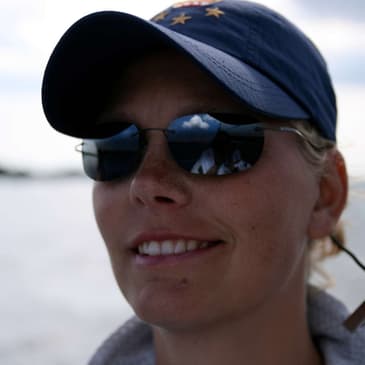
This episode features an engaging conversation with two-time Danish match racing champion Marie Klok Crump. She shares how a pivotal high school experience ignited her passion for match racing, propelling her to international rankings in just two years. We explore the precision and intensity of match racing, the art of mastering chaos, and the crucial role of teamwork and communication in high-stakes competition. Marie offers sharp insights into pre-start tactics, mark roundings, and balancing speed with strategic control. From staying calm under pressure to adapting in dynamic environments, this episode is packed with lessons for both sailors and anyone navigating fast-paced, high-stress situations!
[00:00:08] Hello everybody and welcome to Sailfaster, which as you know is the podcast where we try and unpack what makes top sailors sail faster than others. And of course to hear more episodes of Sailfaster, go to Apple Podcasts or Amazon Music or Spotify and just simply search for Sailfaster. I've also started uploading them to a YouTube channel. So either way or both, please subscribe to hear more from top sailors who are steeped in one design.
[00:00:38] Fine Racing, Offshore Racing, America's Cup, SailGP. And to add to that list today, we're going to spend some time talking about match racing, which I think is a fascinating part of the sport. And to do so, we have with us Marie Klopp-Crump, who is an expert match racer. Originally from Aarhus, Denmark and now living in Annapolis, Marie has been a top notch women's match racer since the mid nineties, ranking as high as number two in the women's world match racing circuit.
[00:01:08] And was twice the Danish match race champion and Prince of Wales finalist. Marie also pursued an Olympic campaign in the England women's keelboat for Athens 2004. Following her competitive match racing career, Marie focused on one design fleet racing in small and large keelboats, including representing the Royal Danish Yacht Club in the inaugural New York Yacht Club Invitational Cup.
[00:01:33] As the only female skipper, also winning the J80 North American Championship twice and achieving podium finishes in several world championships alongside her husband and brother.
[00:01:45] She continues to race in one design fleet and the occasional team racing, Thursday night racing and major championships when she can fit it into her schedule.
[00:01:55] So Marie, welcome to SailFast. I'm super happy that we finally got this together.
[00:02:00] Yeah, thanks for having me. And it's a lot of fun to talk about sailing. So thank you.
[00:02:06] Yeah, great as always. So I've given a little bit of about our origin story there, but how do you first start sailing?
[00:02:13] I got started really early. I think I was barely six. My dad was heavily involved. He was really the first person in our family that got into sailing. He got very involved and competed heavily. And there were so many fantastic stories from that, from his journey.
[00:02:30] So from a very young age, I was really, really intrigued to get into sailing.
[00:02:35] So I really started very young, probably too young, because my ambitions were greater than my courage.
[00:02:40] And so I started in the Opti. I also stopped and took a long break. I would go sailing on family boats, just cruising, wind surfing and so forth.
[00:02:50] I was one of those kids that really did not like being alone in an Opti dinghy in a really, really dark Danish winter with the industrial harbor, having ferries and other things zipping in and out around us.
[00:03:02] So that was really my start. And I got really interested again later on in high school.
[00:03:08] So you got back into it, but when did you start doing match racing?
[00:03:12] I had a love for sailing, but really, I think it was my, what here would be the equivalent to my sophomore year in high school.
[00:03:21] My dad was involved in starting up a bunch of the match race centers in Scandinavia, and I was down on the marina.
[00:03:26] And I see these junior sailors, so teens coming in, and they're having so much fun.
[00:03:32] They're having water fights. They are like three or four people on a yingling, which is a three-person boat.
[00:03:37] And they're just yiggling and having fun and coming in after a day of practicing.
[00:03:42] And I remember just looking at that thinking, huh, it can be like that too.
[00:03:46] And I pretty much like right away, I just dove right in.
[00:03:50] And, you know, I guess two years later, we were, I was like on the ranking list and in match racing.
[00:03:56] And I had a couple fortunate events happen in that process too, but that was really it.
[00:04:03] So it's not to say I hadn't sailed, but I was not your typical, you know, gone through the dinghies all the way up.
[00:04:10] And I like to share that because some people think they can't learn late in life.
[00:04:15] And for sure, there are things that you pick up, second nature.
[00:04:18] But if you're ready to learn and you're interested in something and you're willing to then put the time in that it takes,
[00:04:24] I think we're all capable of getting pretty proficient.
[00:04:29] Yeah, I hope so.
[00:04:30] Having taken up J105 racing late in life and also tried to play the bloody cello as well, which is just as difficult.
[00:04:38] But match racing, what was the appeal for you?
[00:04:42] Or what is the appeal for you of match racing?
[00:04:45] I could jump into match racing.
[00:04:47] I had a pretty good sense for sailing a boat to make a boat go fast.
[00:04:51] And so this is back in 1992, the Barcelona Olympics, and one of the best televised Olympics in my lifetime, at least, when it comes to sailing.
[00:05:02] Because they're right off the breakwater right there in Barcelona.
[00:05:05] That was, they were using the gyro cameras.
[00:05:08] It was like state of the art at the time for sailing.
[00:05:11] And, I mean, they had the Jesper Barank, who won the gold medal, but barely eked in from the fleet race.
[00:05:18] The format back then in the Solings were you do fleet race and then the top teams would go on to a match race around Robin.
[00:05:25] I can't remember if it's eight boats or whatever, but he just barely made it in.
[00:05:29] And basically from that moment on was sort of the whole underdog story.
[00:05:32] And, of course, he was Danish, so we're watching it.
[00:05:34] It's getting televised.
[00:05:35] Just like in the U.S., it's hard to get TV and television anywhere.
[00:05:39] But this was getting so much coverage.
[00:05:41] And it was just so intriguing.
[00:05:45] And this was exactly how I had returned back into sailing.
[00:05:48] And there's just something about that intensity, the one-on-one, there's no excuse.
[00:05:52] You know, it's just you.
[00:05:53] It's not, oh, we picked the wrong side.
[00:05:56] And that half of the fleet, you know, it went upside down and so forth.
[00:06:00] It was literally, it's you and the other boat.
[00:06:02] Whether you win by 10 minutes or one second, it makes no difference.
[00:06:05] You just have to beat that other boat.
[00:06:07] It just really spoke to me.
[00:06:08] And then there's an element of mastery, right?
[00:06:12] Because mass racing more so than anywhere else is about making less mistakes than your
[00:06:17] competitor.
[00:06:17] Of course, that's true across the board.
[00:06:19] But there are other factors that sort of even it out over an hour, an hour and a half long
[00:06:24] race.
[00:06:24] Here, you got at best 20 minutes.
[00:06:27] In many cases, it's more like 16 minute races.
[00:06:29] And so every split second or every crossing you miss or any bad job or bad tack really translates
[00:06:38] right away into visible change, right?
[00:06:40] Or there's an immediate consequence.
[00:06:43] So I think it was that.
[00:06:44] And it was obviously, you know, it was the thing at the time, at least where I grew up.
[00:06:49] It got a lot of attention and it was easy to get to.
[00:06:52] You go down, you practice for two hours, you put the boat away and that's it.
[00:06:56] Yeah.
[00:06:56] The intensity of it is really interesting.
[00:06:58] It's more like a doubles tennis match where you're on constantly because the boats, from
[00:07:03] what I've seen from match racing, they're always covering each other or covering each manoeuvres.
[00:07:08] Have you ever been in a situation where you sort of split sides and somebody's sailed on the
[00:07:12] right?
[00:07:12] Just as common, is it?
[00:07:13] Yeah, it is.
[00:07:14] It is.
[00:07:15] And that's where, you know, it's where fleet race and match race and team race, obviously,
[00:07:20] all play in.
[00:07:21] We use the same indicators, right?
[00:07:24] And there are different times.
[00:07:25] I mean, whether it's because you feel maybe you're losing ground in an attacking duel or
[00:07:29] a diving duel, you're looking for that opportunity of, is there an advantage on one side of the
[00:07:34] course or the other?
[00:07:35] Do I want to, if I want to take a breather, prefer to do it probably on a lift attack more
[00:07:40] so than going in the wrong direction.
[00:07:41] So all these components still play in.
[00:07:44] But it is, it is, it's over much quicker.
[00:07:46] And so that intensity only have to apply yourself for 20 minutes and then lots of lessons learned
[00:07:53] after that.
[00:07:54] And then you go back out and do it again.
[00:07:55] What does it take to win at match racing?
[00:07:58] I get fundamentally me to boat speed itself.
[00:08:01] Yeah.
[00:08:01] What are the sort of the, what makes winning at match racing a little bit apart from winning
[00:08:07] in fleet racing?
[00:08:09] There's not much time to think, right?
[00:08:11] So you have to pretty much act.
[00:08:13] I mean, you've got to think and act very quickly.
[00:08:15] And it takes a lot of practice.
[00:08:17] You go out and practice and practice, practice maneuvers.
[00:08:19] You practice particular situations with other boats, whether it's, I mean, you kind of practice
[00:08:25] chaos.
[00:08:25] You go out and practice.
[00:08:27] You don't go out and practice.
[00:08:28] Of course you practice good tacks, good sets, good stouses and jibes.
[00:08:32] But what you really want to practice are the ones where you're way overstretched to the
[00:08:36] lay line.
[00:08:37] And you now have to jive.
[00:08:38] And you've got to still get the kite down by, well, still getting back over to the mark
[00:08:42] and not hit the other boat and so forth.
[00:08:44] So those chaos moments is what sets you apart when it gets really competitive.
[00:08:49] Because two teams that are equally good will be right next to each other all the time.
[00:08:55] And so if you can't eke out on speed, if you can't do anything else, then it comes down
[00:08:59] to those encounters and how do you manage in those encounters.
[00:09:02] And it's really pretty.
[00:09:03] Do you ever get to sail your own race or is it always so tactically conscious of your
[00:09:09] competitor that that's very difficult?
[00:09:10] No, you absolutely do.
[00:09:11] You absolutely do.
[00:09:12] The start is really important.
[00:09:13] The start is really important because obviously if you start control, if you win the start,
[00:09:18] it is truly a win-loss scenario.
[00:09:20] It's a lot easier, as we all know, to be in the front, even in a fleet race.
[00:09:23] But you do get to respond to the other boat.
[00:09:26] You do get to sail your own race and control it.
[00:09:28] The trailing boat, of course, also have some initiative in, you know, all things equal.
[00:09:33] The race course is square.
[00:09:35] There's the start line is square.
[00:09:38] Same pressure, all that stuff.
[00:09:39] Not major shifts on the race course.
[00:09:42] You know, there's a level of control that the trailing boat can have because they can
[00:09:46] initiate things.
[00:09:47] And then it comes into who has better tax.
[00:09:49] You know, maybe you have to do multiple right after each other, who has speed after the
[00:09:53] tax and so forth.
[00:09:55] But yeah, for sure, the boat that wins the start controls the race.
[00:09:58] Yeah, which is, I mean, we saw that in the recent American Cup in Barcelona, right?
[00:10:02] You don't have that in fleet race too, right?
[00:10:04] But you have, there's more factors because there's some other boat that possibly could
[00:10:10] come out of just having better, you know, clear air or less tax.
[00:10:15] I'm going to make a guess here.
[00:10:16] I'm probably wrong.
[00:10:17] But in fleet racing, boat speed is everything.
[00:10:20] I'm sure that's true of match racing as well.
[00:10:22] But presumably there's a premium on getting up to boat speed.
[00:10:25] The fastest you can accelerate out of tacks to boat speed, because you may have to, you
[00:10:29] may only have a few seconds that you're on one tack.
[00:10:33] So I'm going to guess that you must practice a lot of that sort of transition from one tack
[00:10:38] to another to getting up to speed as fast as you can.
[00:10:41] Yeah.
[00:10:41] Yeah, absolutely.
[00:10:42] And it's really, it's practicing the patience because you get into this very heated situation
[00:10:48] and you're keenly aware of when that other boat tack, we want to tack, but still to be
[00:10:54] able to slow, slow, slow everything down.
[00:10:57] So yes, they're tacking now, but instead of just putting the helm over, am I sure this is,
[00:11:03] you know, do you have another two seconds to make sure you are going fast?
[00:11:06] You're tacking.
[00:11:07] Maybe they've, you know, it's a Lee bow or something like that.
[00:11:11] You dare, you dare to like, you know, foot just long enough to get that speed back up
[00:11:17] so you can come up and build into, you know, a damaging position for the boat that you just
[00:11:22] leave out.
[00:11:23] So it's very, it's, it's, I think the most challenging part is the adrenaline, I mean,
[00:11:28] your heart's pumping, the adrenaline is there and you kind of want to just, you, you, you
[00:11:32] kind of want to rush it and just be done with that position you were imagining in your
[00:11:36] head, right?
[00:11:37] But you have to just sort of, while all that is happening in what seems warp speed, you
[00:11:42] really have to just be calm and just do the maneuvers in sort of a calm manner, even though
[00:11:47] it's forensic.
[00:11:48] Is that the sort of person you are?
[00:11:50] Are you able to absorb enormous amount of data calmly and make, you know, sort through the
[00:11:56] chaos and make decisions?
[00:11:57] Is that who you are as a person?
[00:11:59] I guess it's trying to figure out what, what, what part of the inputs and so to speak
[00:12:04] data, what data is going to matter in this moment.
[00:12:07] And that's not to say that I haven't like been totally flustered.
[00:12:10] Everybody gets to that point, but it's definitely something that you practice at.
[00:12:14] It's, it's accepting that you are in a chaotic situation.
[00:12:18] I've been in, in high growth businesses, my entire professional career and no days ever
[00:12:24] the same.
[00:12:24] And, you know, major strategic or tactical changes are happening on a really on a quarterly
[00:12:30] basis.
[00:12:31] And so you have to sort of be prepared to adapt to that and also not look back too much.
[00:12:38] It's a matter of trying to train yourself to really get to the core.
[00:12:42] What's the information that matters right now?
[00:12:44] And then act because you really have no time to like ponder it.
[00:12:48] Yeah.
[00:12:48] I find it really interesting that people who are able to see patterns in chaos very quickly
[00:12:53] is a gift because my wife's an entrepreneur.
[00:12:57] That's absolutely her.
[00:12:59] That's not me.
[00:13:00] You know, people are quite different from that.
[00:13:02] So I can see how in the, you know, in your career environment and in those sorts of high
[00:13:07] growth, you know, data heavy companies, how you've been successful in that as well.
[00:13:11] One thing you've talked to me about a couple of days ago was the sort of delineation of
[00:13:17] responsibilities on the crew that you have somebody who perhaps is, is sort of seeing
[00:13:21] the bigger picture while you were focusing on that, you know, your, your immediate competitor.
[00:13:27] Do you swap those roles or do you always have somebody on board who can see the bigger picture
[00:13:31] and tell you, you know what, I know what's happening over here with the competitor, but we
[00:13:35] really need to be on this side of the course.
[00:13:36] Yeah.
[00:13:37] Speaking of like an ideal crew combination, I would have, I would always be boat on boat.
[00:13:43] I can't tell someone in match racing when to attack or jive because the moment it comes
[00:13:47] out of my mouth, the window has closed.
[00:13:49] So on my own boat with my crew, I'll be talking.
[00:13:53] I'll be trying to give them a heads up to it's most like next maneuvers, most likely attack.
[00:13:58] Right.
[00:13:58] But I could say that we still got to jive.
[00:14:00] They just have to feel the boat and they just know if the boat's bearing away, I'm easing
[00:14:03] out.
[00:14:04] Right.
[00:14:04] They just, it's just happening.
[00:14:06] And, and then obviously I'll try to say what, what we're doing.
[00:14:09] Right.
[00:14:09] So they sort of get confirmation of that maneuver.
[00:14:12] The, the, the, the big picture person is typically a tactician.
[00:14:15] So I would have a tactician, me and the tactician would look at, you know, before the pre-start,
[00:14:20] we get all the lines.
[00:14:21] We get, we get timing to the line and we get timing around the committee boat, for example.
[00:14:26] I want to know, is that going to take me a minute to get around this?
[00:14:29] Because remember, match racing is all about you're either chasing or you're being chased.
[00:14:33] Right.
[00:14:33] So the two boats are just in, you know, spinning around and it's all just a matter of positioning
[00:14:38] to be able to pull the trigger and go to the line in the favorite position when the gun
[00:14:43] goes.
[00:14:43] And so having someone who is continuing to look up the race course and saying the right
[00:14:48] is still favorite.
[00:14:49] Very similar to what a tactician would do in a, in a fleet race.
[00:14:53] Right.
[00:14:53] You talk about your pre-start there and where do you really want to go?
[00:14:56] And so it's the same, it's the same effort.
[00:14:59] It's the same activity.
[00:15:00] And then we're on the race course.
[00:15:02] It's someone who can sort of pop up and still keep an eye on, okay, we've been, we've been
[00:15:07] in this tacking duel, like we've taken six tacks and every single time our long, sort
[00:15:13] of our long leg where we picking up speed is possibly on, on a head attack.
[00:15:17] And that's, that is not a favor for us right now.
[00:15:19] Right.
[00:15:19] That's kind of a big picture person who looks around for that.
[00:15:22] And also who's thinking about what we are experiencing on this upwind.
[00:15:26] Remember, I mean, I've been in races, we've done talking about 16 minute races, right?
[00:15:31] We've done 28 tacks on the upwind leg.
[00:15:34] I'm just so focused on communicating with the team, looking at the other boat, dialing
[00:15:38] in and making the boat as fast as possible through all those maneuvers that I may not have
[00:15:42] noticed that, you know, wind has shifted a little bit.
[00:15:45] So in order for us to keep our advantage, when we get to the windward mark, a jibe sets
[00:15:50] what we need to do, or what we fought so hard for in that upwind leg is going to be gone.
[00:15:54] The moment they come around, even if the two boat lengths behind us, they come around the
[00:15:58] jibe first, it's pretty much equalized.
[00:16:00] I mean, that's a beautiful, beautiful part about match racing is sometimes the strongest
[00:16:05] position is if it's a tight race, the strongest position is the trailing boat downwind
[00:16:09] because you can initiate everything and you cast so much more shadow than the boat in front
[00:16:13] of you can defend.
[00:16:15] And so the tactician is incredibly important to just sort of try to keep track of what's
[00:16:23] going on when everybody else on the boat and the trimmers and so forth are just busy just
[00:16:28] responding to what's going on and sailing a boat as fast as they can.
[00:16:31] In any sailing team, you need to have obviously good coordination, good communication.
[00:16:37] But in this case, though, when you don't have, as you said earlier, you don't have time
[00:16:41] to call out, we're going to tack because maybe it turns into a jibe.
[00:16:44] Having people that you absolutely trust, who totally understand, as you can say, who
[00:16:49] can feel the boat must be a prerequisite for being successful at match racing.
[00:16:53] Yeah, it takes a lot of practice as a team, for sure.
[00:16:56] Right.
[00:16:56] And I mean, I will typically still tack or say tack or jibing, but I'm not going to say
[00:17:01] ready about tacking, you know, or counting down.
[00:17:05] I am going to expect the team to just, the moment I say tacking, it's going to, and many
[00:17:09] times, particularly in the pre-start, you're not sailing the boat always the fastest way.
[00:17:14] Sometimes it's just a matter of just slamming it over to get into a very certain position
[00:17:18] where you're now controlling the other boat.
[00:17:19] And then you worry about, okay, let's not lose the speed here so we can continue to control
[00:17:23] them.
[00:17:24] So, yeah, it's a matter of having everybody act as one.
[00:17:31] I think that's the goal for any team, any sport.
[00:17:36] But in match racing, for sure, it's extremely, it's critical.
[00:17:42] You said recently that, I think you said there was, in match racing, you have more focus on
[00:17:47] the ley lines pre-start than you do in fleet racing.
[00:17:51] Why is that?
[00:17:52] So, when you're in match racing, if you imagine, if you imagine the starting line, the windward
[00:17:57] mark, and then really perpendicular to that from the committee boat and the, and the pin
[00:18:02] end, they're basically lines going straight up, right?
[00:18:05] So there's an eight with the, with the, the starting line being that, that bar in between
[00:18:09] the two verticals.
[00:18:10] Both for starting, it's important to know, cause you have to, you enter in at four minutes.
[00:18:15] You can't enter it.
[00:18:16] You can enter in anytime after four minutes, but you're having a disadvantage because the
[00:18:20] other boat is in the box, so to speak.
[00:18:22] You cannot be in there anytime before that because you will, or right in the moment, right?
[00:18:28] At four minutes, cause you'll get a penalty.
[00:18:30] So same thing as you come, as you approach the starting line again, after your pre-start,
[00:18:35] the starboard lay line to either the committee boat or to the pin end.
[00:18:40] If it's just you and another boat and the other boat's on starboard tack, they can keep you
[00:18:44] from starting.
[00:18:45] If they know where that lay line is and they are sitting on that lay line timed in a way,
[00:18:50] then they can bear away.
[00:18:51] They can, they can do, they can go ahead to win.
[00:18:53] They can do all kinds of things to keep you, you from starting.
[00:18:56] And so knowing where those two lay lines are, knowing where the port tack lay lines to both
[00:19:01] of those marks, so to speak, are a two.
[00:19:04] And then really understand that when, when you are outside any of that, when you came in,
[00:19:07] you are in the red zone and it's even something that's being communicated.
[00:19:11] Typically it would be my team.
[00:19:12] It was most often be the, the bowman.
[00:19:15] So that person will typically be talking and telling me time back to the line.
[00:19:19] They will, they will tell me if all of a sudden we like, we're getting close to red zone,
[00:19:24] meaning, okay, now we, there may be no way back here because in some cases you just, you
[00:19:29] start, you know, you try, if you are being controlled by the other boat, you try to run
[00:19:33] away and somewhat create distance.
[00:19:35] That's where the speed comes back in.
[00:19:37] And you're trying to make sure, can I be faster so I can create separation and I can
[00:19:41] somewhat come back around on a starboard tack and I can take control of my own race
[00:19:45] again.
[00:19:46] So it's just a situational awareness of where are we, but, but yes, the standard routine
[00:19:51] for us would go out, we'll run the line.
[00:19:53] We know how long the line is both from the boat to the pin, from the pin to the boat.
[00:19:58] We'll get all four lay lines.
[00:19:59] As I said before, my, I might find, um, if it's a boat that's anchored out there, I want
[00:20:04] to know what's the distance from that boat to another position.
[00:20:06] Or some of it is even just to, you know, just refresh or tune in my sense of timing for
[00:20:15] that day.
[00:20:16] Right.
[00:20:16] Cause the weather, and, and, you know, the wind, the, the wind may increase or drop down.
[00:20:21] So every time I feel like, okay, um, the environment has changed.
[00:20:25] So let's, let's reset.
[00:20:26] Cause we kind of, you, you are just going to act on instinct, right?
[00:20:29] We don't use like velocity tech or any of these things.
[00:20:32] You got to know where that line is and go.
[00:20:33] So there are times when you sort of lift your head up and sort of assess the environment.
[00:20:39] Uh, and then you, you presumably dive back down into the back end.
[00:20:42] Yeah.
[00:20:42] So it's many times with match racing, you're lucky because you're in your, near land.
[00:20:46] So you will have, um, fixed points on land.
[00:20:50] And that's part of it.
[00:20:51] It's the old fashioned way of doing lay lines, right?
[00:20:53] Making sure you say, okay, if I'm to the left of that chimney over there or that green
[00:20:57] tree that's high on the, on the hill, I know I'm in trouble.
[00:21:00] So it's, it's some of those fixed points where, you know, you can quickly turn around and say,
[00:21:04] okay, I generally know where I am.
[00:21:06] Yeah.
[00:21:07] So how does match racing then transfer to fleet racing?
[00:21:11] Are there, are there big advantages that you can take to a fleet racing course just based
[00:21:17] on your match racing experience and skills?
[00:21:20] Yeah, I think there are many.
[00:21:21] Um, as a driver, it really helps me to get out of tight situations.
[00:21:28] Obviously mark roundings.
[00:21:29] First of all, I have no problem going very close to other boats.
[00:21:32] I know if I can swing the bow inside or not, because I just have that experience.
[00:21:36] In some cases you get a good start.
[00:21:37] Other times you, you got to fight a little bit for, you know, to take making an okay
[00:21:41] start into a great start.
[00:21:43] And, and so I think the ability to just switch into the, okay, I am just one-on-one with this
[00:21:48] other boat and I have to, I have to just eke out every single, uh, inch I can.
[00:21:54] So, I mean, there's, there's, I think there's a focus I can turn on in some of those moments.
[00:21:58] Those moments when you are very, very close to other boats, like mark roundings, the start,
[00:22:03] especially, this is your area of comfort that you understand what it takes to the game of
[00:22:10] inches to get away from somebody.
[00:22:11] You know, you know, it matters right in that moment.
[00:22:13] And, and, and I can sort of just switch into that mindset and say, I got to, I got to really,
[00:22:18] really focus here.
[00:22:19] I'm just making the boat go fast.
[00:22:21] I like to think I do that all the way around the race course, but the reality is you can't
[00:22:24] be that intense for over an hour.
[00:22:27] When you're in those moments, you can tell right away, um, how you're doing.
[00:22:31] I think the hardest part is, you know, when you're having an encounter with the other
[00:22:34] boat to like decide you're going to let them go or not.
[00:22:37] I, it was a, that was definitely a transition for me for years.
[00:22:40] As I said before, matriculation is very much about practicing the chaos, right?
[00:22:44] It's easy as a team when you're out there practicing around a, you know, again, just a
[00:22:49] windward leeward course, boat handling, boat handling, boat handling to just sort of go
[00:22:53] through the motions.
[00:22:54] And, oh, here's the leeward mark.
[00:22:55] We're taking this spinnaker down.
[00:22:57] And people know it has to happen fast.
[00:22:59] And the adrenaline is pumping.
[00:23:00] And they kind of lose the feeling of the boat.
[00:23:04] Um, you've probably been in that situation in light air and everybody's just going really
[00:23:09] fast.
[00:23:10] And the gyps collapsing or it didn't get pulled up.
[00:23:13] Or if you're not focused on what part of the boat is bringing you forward at any given
[00:23:18] time and prioritizing that.
[00:23:20] And then maybe just doing that move a little slower because I don't want to like, it's
[00:23:24] light air.
[00:23:25] And now I'm like, I just trying to come around and leeward mark and build speed so I can build
[00:23:30] point.
[00:23:31] And, you know, you just got like the Tasmanian devil on the bow, just yanking the spinnaker
[00:23:36] down.
[00:23:36] And the jib loses all air or everybody's so hyped up.
[00:23:41] They just pulled the jib all the way in.
[00:23:42] Now you're like over trimmed and now you got to ease and now you get back up to speed.
[00:23:45] So I think it's, it's back to what I said before, it's, it's staying in tune and staying
[00:23:50] calm, even in those chaotic moments as a team and be okay, let's, let's respond to the way
[00:23:57] the boat is, is turning and reacting and not just like, let me just do that as quickly as
[00:24:02] I can, even though speed matters.
[00:24:03] Do you think you have an inbuilt advantage when you're approaching a crowded mark because
[00:24:09] of your maturation experience?
[00:24:11] And, and what are you looking for and how do you go through that process of, of entering
[00:24:16] and leaving a mark successfully?
[00:24:18] I, if it's just me and a, and a few boats, I probably have a significant advantage because
[00:24:23] that's a very similar situation as I would get in maturation.
[00:24:27] I can, I can deal with that.
[00:24:28] I think one of those pinwheel, you know, big cluster mark roundings are difficult for everybody,
[00:24:35] right?
[00:24:35] Cause you've got to sail your boat and you've got to, you've been overlapped with like seven
[00:24:39] of them and how do you communicate to all of them?
[00:24:40] So I think when I do it well, what works is I'm acutely aware of whether or not that
[00:24:48] situation is gonna pop up, right?
[00:24:51] As we, as everybody converging into the mark, I'll be clear to communicate with the other
[00:24:54] boats.
[00:24:54] If I believe I'm going to have room or not room so that, cause once we get down there,
[00:24:59] everybody's screaming and yelling, but just make it very clear that that's, you know,
[00:25:03] the overlap's been established.
[00:25:04] You have to give me room so that I can turn and the rest of the team can focus on, on, on
[00:25:08] sailing boat and get around the mark.
[00:25:10] And then I think the other thing is you can, you can never be too early.
[00:25:15] A lot more, if you come into situations like that, uh, other than the odd occasion, I would
[00:25:20] say if this is a leeward, it's typically harder on the, on the, on the leeward mark, right?
[00:25:26] Because you got the spinnaker up, you can't see everything.
[00:25:29] Just take the spinnaker down.
[00:25:29] You know, you have so much more maneuverability in most cases.
[00:25:34] Um, and, and you've got more eyes, more hands available to like take advantage and maybe
[00:25:41] just sneak into one little hole.
[00:25:43] Let's say you're rounding the mark and you can tack right away.
[00:25:45] So it's really trying to think early and prepare so that, that you have, you just have more
[00:25:51] options.
[00:25:52] And there's certainly times where then we took it down too early and you just sort of
[00:25:56] sit there and it's like, Oh yeah, that was too early.
[00:25:58] It happens.
[00:25:59] But I would, I would, I would bet you that more mark groundings are lost, so to speak,
[00:26:04] because people start too late and never anticipate, never anticipate something gets stuck.
[00:26:10] Right.
[00:26:10] And that's, it's for me and my team, it's always a game to like, see how fast can we set
[00:26:15] a spinnaker?
[00:26:16] How fast can we get down?
[00:26:17] All these other things.
[00:26:18] And how perfect can we do the boat handling?
[00:26:20] But we also know that regardless of how well we do all that and run the lines, there
[00:26:25] is going to be a kink in a, in a sheet or in a halyard or something at some point.
[00:26:30] And you got to just be ready to deal with that and have a little room to survive.
[00:26:35] Yeah, I get that as a driver as well.
[00:26:37] If you get the shoot down earlier, it's just one less distraction as you're approaching
[00:26:43] that, say at the gate.
[00:26:44] Well, yeah, because you not only can you see, you can't see as much and also you are constricted
[00:26:50] in now what you can do.
[00:26:51] You can't just move the boat, right?
[00:26:53] Jiff and man alone, you can, you can do a lot of things, but I mean, I'm obviously not
[00:26:57] saying take this spinnaker down 10 boat lengths before, but it's knowing,
[00:27:00] I think it's, it's knowing what is your team capable as a team, right?
[00:27:05] And making sure that you give enough time to accomplish that.
[00:27:08] Whether or not that is the most perfect, you know, mark rounding, douse and timing, what
[00:27:14] were the fastest you can be?
[00:27:15] No, but it has to fit to the team, right?
[00:27:17] You have to sail, you have to sail to the ability of the combined team, or you're just
[00:27:22] going to, you're going to push yourself much further back in the, in the pack.
[00:27:25] I would think the other major benefit you get from match racing is just intimate knowledge
[00:27:30] of the rules of racing.
[00:27:33] I know that match racing has slightly different rules, but just very quickly realize, shit,
[00:27:38] we just lost right away, or now we got right away back again, or it's going to go back
[00:27:42] to us.
[00:27:42] Yeah, yeah, for sure.
[00:27:43] Yeah.
[00:27:43] That's, that's, you're absolutely right.
[00:27:46] It's probably one of those things I take for granted.
[00:27:47] I mean, we are out there when you match race, you use the rules as, as a sword, right?
[00:27:53] Versus the shield.
[00:27:54] In fleet racing, you're sort of trying to protect yourself to have that give and get,
[00:27:58] but in match racing, you very actively use them to either, you know, get a better position
[00:28:06] than the other, than your competitor.
[00:28:08] In some cases to draw a foul.
[00:28:10] Typically when you go deliberately to draw a foul on another boat, at least in my experience,
[00:28:15] I end up getting it because you just get too aggressive, but you, you're trying to draw
[00:28:18] in situations where you're clearly in control and you're now using the rules against the
[00:28:24] other boat.
[00:28:24] And so, yeah, I, I've just done those thousands and thousands of times.
[00:28:28] So I see two boats and I have a, I have a situation, you know, in my head and I know
[00:28:32] what to do.
[00:28:33] And, and, and match racing, because we have a tons of, you know, you, you go through call
[00:28:37] books, like, how do you call this?
[00:28:38] How do you call that?
[00:28:39] And that I think is something that's very transferable to fleet races because the rules around marks
[00:28:44] and things like that are very, I mean, they're universal.
[00:28:47] There's not much difference in that.
[00:28:49] Just a basic right away.
[00:28:50] Are there any drills that you do in match racing that you think are really, really helpful
[00:28:54] for fleet racing?
[00:28:56] I know just sheer boat handling, you know, driving, dowsing, raising, but is there anything
[00:29:03] that you think, oh, that's a, that's a really good exercise that fleet racers don't normally
[00:29:08] do, but for match races, match races do.
[00:29:10] I'm just curious about that.
[00:29:11] Yeah, well, first of all, I don't know how many fleet racers really go out and do drills.
[00:29:16] Go watch any kind of high school sailing or any other dinghies that are out there and
[00:29:19] they'll do a lot of drills and you can do those in, in, in, in, in queue boats too.
[00:29:24] One, one that I've always enjoyed is basically like a, I don't know what you call a follow
[00:29:30] the leader kind of thing.
[00:29:32] And it's basically, imagine just a starting line, two buoys, right?
[00:29:34] And there may be 30 seconds apart or something, whatever size boat it is, it takes 30 seconds
[00:29:38] to get from one mark and you're basically reaching, right?
[00:29:41] So back and forth, you, so, so on, on one leg, you're reaching on, um, you know, whatever
[00:29:47] it's orbital port tack.
[00:29:48] And then you got to tack around the mark and then reach back to the other mark and you
[00:29:53] jive.
[00:29:53] So you get two maneuvers in there.
[00:29:55] It gives you mark roundings, right?
[00:29:57] And the idea is that you want to get closer and closer to that other boat, but you can
[00:30:02] really see, you know, as a team, whether or not you're catching up to the other boat,
[00:30:07] whether or not you're losing and you're inside of that same area.
[00:30:10] So you, I mean, pretty much have the same wind, right?
[00:30:13] Same conditions.
[00:30:14] So it's a, it's a boat speed and maneuver drill at the same time.
[00:30:19] It's a lot of fun, right?
[00:30:20] Cause you're like chasing someone down and essentially you're both chasing each other because
[00:30:24] you're, you know, depends on where you're at what point you say, who's, who's in front
[00:30:27] and who's ahead.
[00:30:28] But you, all you're trying to do is close that gap.
[00:30:30] That's a great exercise.
[00:30:32] Uh, just timing exercises.
[00:30:34] Want to get that feeling of when is the boat almost stopped and how long does it take for
[00:30:39] me to get it accelerating?
[00:30:40] It's just, it's sort of getting that constant feeling and then pulling the trigger.
[00:30:44] The drills like that, that I think are great.
[00:30:46] Get another boat out along with you and just do, you know, just go on one tack and do speed.
[00:30:52] Right.
[00:30:53] And it's, it's a little boring for some people on the boat maybe, but it's important.
[00:30:57] And, uh, and you also get an opportunity to practice your communication.
[00:31:02] How do we talk about the other boat?
[00:31:03] You know, what am I seeing around us?
[00:31:05] I mean, there's always, there's always something to do.
[00:31:08] I had, uh, now a really good friend of mine, I was doing a Rolex, um, international
[00:31:13] kill boat championship back in the, uh, late nineties.
[00:31:17] Um, there were five, we were six people in a J24, which is a lot of people on a J24.
[00:31:23] There really isn't enough.
[00:31:24] There aren't enough jobs for everybody there.
[00:31:26] And so she would basically be the person that called a weight, right?
[00:31:32] You know, two up, three up, whatever.
[00:31:34] I remember getting on the boat.
[00:31:35] I was a tactician.
[00:31:36] I got on the, on the boat and I was so impressed with how she filled her entire race day.
[00:31:42] Really focused on that.
[00:31:43] She was a very, very, very capable, very accomplished sailor.
[00:31:46] That happened to be her job on that team that day.
[00:31:49] And she could have just sort of been a passenger, but she really contributed to the team with
[00:31:53] what she could at different times in looking around and giving more information and, and
[00:31:58] sort of just like, what else is not being done?
[00:32:00] What else can I contribute with?
[00:32:02] Right.
[00:32:02] So I think.
[00:32:03] Great advice.
[00:32:04] Yeah.
[00:32:04] I mean, I think going out and just doing speed practice, you can start chattering on the
[00:32:08] rail or you can try to, you know, just practice.
[00:32:10] How do I stay engaged for an hour when sometimes these legs get pretty long?
[00:32:14] Maybe I'm behind and we don't know if we can catch up.
[00:32:17] You know, everybody like really dials in.
[00:32:19] You'll, you'll notice how much faster you start sailing.
[00:32:21] Is there anything that does not transfer well from match racing to fleet racing?
[00:32:27] And what I mean by that, is there anything that you do just instinctively in match racing
[00:32:31] that when you get onto fleet racing, like, oh yeah, I'm going to, I need to do less of
[00:32:35] that.
[00:32:35] I get the, you know, being, you know, having that instinct to be in boat on boat maneuvers,
[00:32:39] but is there anything else that you think I need to suppress that instinct because it's
[00:32:44] a different type of racing?
[00:32:45] I really, the only thing I can think of is just, it's a, it's a shift in mindset because
[00:32:49] you can't, of course you can be aggressive, but it's a different kind.
[00:32:52] You're now in a, in a group of a lot of boats, right?
[00:32:55] So you kind of have to just find your spot versus it's not a win or lose mentality, me
[00:33:00] or them, right?
[00:33:01] That's what you go into match racing.
[00:33:03] It's like, the only way this is going to go well is if I cross the finish line first,
[00:33:07] right?
[00:33:07] And so it's in the pre-start is everything else in fleet race.
[00:33:10] You really have to, you just have, you have to maneuver in a different way around everybody.
[00:33:14] And that's in the start.
[00:33:15] That's, that's up the race course, as I said before, right?
[00:33:18] I mean, you, you, you have to decide, is it really important for me right now to make
[00:33:23] that boat tack just because I can, or because I can tack on them?
[00:33:27] Is that where I want to go, right?
[00:33:28] Is it, is it playing into my overall strategy?
[00:33:31] I mean, match racing, you don't have to think about that.
[00:33:33] You just do it because anything you can do to push them back, the better off you are.
[00:33:38] It's sailing.
[00:33:39] It's all the same things.
[00:33:40] You're just sort of applying it in a slightly different discipline.
[00:33:43] So, so Marie, I find that the transition from tack to tack or from jibe to jibe, I take
[00:33:50] quite a long time getting back into the sort of the groove and, and sort of understanding
[00:33:55] where I am on the, on the, on the race course on that particular tack.
[00:33:59] I probably take longer than other sailors do because I just don't have that enough experience.
[00:34:04] Any, any advice there you have for somebody like me on that?
[00:34:08] I mean, a common technique that I'll still, I mean, I'll still use today, whether it's
[00:34:13] a new boat, whether it's just different conditions of the day is to find some kind of a fixed
[00:34:20] point.
[00:34:20] If I, if I'm sailing near land where I can do that, so I get dialed in, right?
[00:34:24] I know this is about the angle that I got to come out on.
[00:34:28] And then you sort of go from there, right?
[00:34:30] But you're not coming off 10 degrees too low or 10 degrees too high and sort of trying
[00:34:33] to feel your way in.
[00:34:35] So you can kind of, you go through the tack and then you, you, you land it there.
[00:34:39] It happened.
[00:34:40] I think it helps a lot with asymmetrical spinnakers because the angles are so different depending
[00:34:45] on, on the, on the wind velocity, like the pressure you have in the kite, right?
[00:34:49] Do you want to come out hot?
[00:34:50] And you know, that's part of even going out, warming up from a race is sort of like feeling
[00:34:55] is this right?
[00:34:56] Is that right?
[00:34:56] And then as you do that, I also, I sort of try to count internally, you know, as you
[00:35:02] go through.
[00:35:03] So I, I'm very aware of whether or not I'm have the same sort of speed of my rate of turn
[00:35:10] or speed of which I turn.
[00:35:12] In some cases it can also be that you might need a little more help from the, from the
[00:35:16] head sail, right?
[00:35:17] Maybe just as just a little bit of a, of a, of a, um, back winding of the jib.
[00:35:22] So this forces the bow over and the moment it, it kind of, if it's released at the right
[00:35:28] time, the boat's on the tack, it's on the new tack is five degrees below the new tack.
[00:35:33] And as they pull the jib in, you have power in the bow, right?
[00:35:37] If you have, and, and so you have that instant bite, but in, in most other conditions, you want
[00:35:43] to just have a little bit of a push and it, it, I feel, um, that it just sort of loads
[00:35:49] up the helm and you get to feel much quicker when the helm is loaded up a little bit and
[00:35:54] then you're going to just dial in.
[00:35:55] So, um, those, those are, that's what goes through my head.
[00:36:00] Uh, when I, when I do tacks and jives and that, I think just you do a few of those and
[00:36:06] it helps get you dialed in for the day.
[00:36:07] No, that's good.
[00:36:08] Uh, I had some advice on the last race about as soon as you feel the boat loading up, then
[00:36:13] you're on course.
[00:36:14] And that was sort of new to me in a way, because I had taken like a fixed reference.
[00:36:18] Okay.
[00:36:19] I can see that's about 80 degrees, that lighthouse or that, that house over there.
[00:36:24] But I, I then switched into as soon as you feel the boat load up, that's probably it,
[00:36:29] which was really, really helpful.
[00:36:30] And you're right about going downwind as well.
[00:36:32] As the wind gets lighter, you have to remember, oh, that's right.
[00:36:35] I need to come out at a hotter angle than I can.
[00:36:38] A little hotter before you then come down.
[00:36:40] And it's, yeah, I, I, I would, I meant to say, regardless of how experienced a sailor
[00:36:45] you are, you still got to go out and just like get that feeling for the day.
[00:36:50] Right.
[00:36:50] And then, and also as things progress or change during the day, you, you, you want to come
[00:36:54] back and just confirm.
[00:36:55] But I think if I had to break it down, those are the things that are going through my head.
[00:36:59] It's like several, it's, it's a couple of data points that you pull together, right?
[00:37:03] It's like, okay, that's why it felt good.
[00:37:04] Like this is possible, but I'm doing well.
[00:37:06] You know, that's really interesting, Marie, because pre-race, we will go upwind, we'll
[00:37:10] get the, as a tuning right, do we get the angles right?
[00:37:13] And, and then we'll do a raise, spinnaker and dows, and we'll probably do a couple of
[00:37:18] jibes.
[00:37:18] But mainly I think so the crew gets into, in tune with the day.
[00:37:22] And also just to make sure that, hey, we got any, anything rigged incorrectly that
[00:37:27] we can't get the shoot up and down, that sort of thing.
[00:37:29] But I hadn't really thought about using that time for me to get a feel for, especially
[00:37:34] downwind angles.
[00:37:35] So I'm going to take that away and use that next time, probably disastrously, but it doesn't
[00:37:41] matter.
[00:37:42] So Marie, what other advice do you have for perhaps somebody like me in relatively new
[00:37:47] to competitive sailing?
[00:37:48] I would say try to sail every single position on the boat.
[00:37:52] It makes you a better sailor all around.
[00:37:54] It makes me a better skipper knowing how hard it is to get a, get the spinnaker pole
[00:37:59] on and a symmetrical spinnaker when you were reaching or the sheets aren't being east or
[00:38:05] whatever.
[00:38:05] It makes me a better trimmer and, and, you know, really all the way around to understand
[00:38:10] the boat.
[00:38:10] So if you want to have the boat sail as if it's one person, everybody needs to know.
[00:38:15] They don't have to be the best at every single position, but they need to understand what
[00:38:19] it is.
[00:38:20] And I think it cuts down a tremendous amount of static and yelling at each other and doing
[00:38:25] the things at the wrong time.
[00:38:28] You really, you can actually see, you can feel, you know what needs to happen.
[00:38:32] So I would say absolutely.
[00:38:33] You know, in one of the practice nights that you go out with your, with your crew, rotate,
[00:38:38] sail for 10 minutes in one position, then rotate again.
[00:38:41] And that also gives you opportunity to have to teach someone else the job that you do.
[00:38:46] Right.
[00:38:46] So you asked me a lot of questions and some of these things I take for granted, but when
[00:38:49] you have to show someone else, then you learn something in the process too.
[00:38:55] Then in addition to that, you take that beyond your own boat and you ask questions, you ask
[00:39:00] the other competitors, what did you guys do?
[00:39:02] What was your, how were you tuned today?
[00:39:04] And, and I think sailing is still very much of a, of a, um, a Corinthian and collegial
[00:39:11] sport where we want to make each other better.
[00:39:14] And I mean, you may not get the very secret sauce, but they're still gonna, they're still
[00:39:18] gonna say, yeah, we were set with a little sag and the mast or whatever it was, or even
[00:39:24] start out saying, I did this.
[00:39:25] Is that very similar to what you did?
[00:39:27] So I would say just seek the advice of the boats around you.
[00:39:31] If you see something that they're doing right.
[00:39:33] Um, and then get an opportunity to sail with different people.
[00:39:38] I have learned something from every single person I sail with, you know, if you ask like
[00:39:43] who has the, who has had the biggest impression on my sailing career, it's really hard to say.
[00:39:48] I think you've asked him at some point.
[00:39:49] And I, and I was like, I don't really know because it depends at different times.
[00:39:53] Is it the person who made me pursue mat tracing, right?
[00:39:56] Who gave me, who said, we want you to put together a female team and go out there and we're going
[00:40:01] to get sponsorship for you and just go for it.
[00:40:03] Um, I said, is it that crew member you sailed with who just did something totally different
[00:40:08] and made you think, okay, that's interesting.
[00:40:11] Or the attitude, right?
[00:40:12] Or the way, the way they call wind on the course or waves or, or keep everybody else engaged.
[00:40:18] So it's, I would definitely, that would be my number one sort of advice is jump on any
[00:40:24] boat that you can check your ego on the dock and try to just absorb and fit in with, with
[00:40:30] the team.
[00:40:31] Uh, sometimes you have something you can offer and say, Hey, we, do you like doing it this
[00:40:36] way?
[00:40:36] We do it in a different way on my boat or, or, or somebody else is going to teach you
[00:40:40] something new.
[00:40:41] Um, so I would say that's, um, and then look and then get a chance to do all the roles on
[00:40:46] the boat.
[00:40:46] This is great advice.
[00:40:47] I'm writing this down.
[00:40:51] Well, Marie, thank you for spending this nearly an hour with us.
[00:40:55] It's a, you have an amazing career.
[00:40:56] It's fascinating learning about match racing and, and, you know, lots to talk about here
[00:41:01] about how the match racing transfers to fleet racing.
[00:41:05] So lots and lots of insights there.
[00:41:07] Thank you very much for that.
[00:41:08] And, uh, what's your next, uh, what's your next regatta or sailing event?
[00:41:12] I'm not sure, but, um, I mean, I try to get out with my kids, uh, with my brother and
[00:41:17] my, my husband, Will.
[00:41:18] We've had a long, a long, um, partnership, uh, in, in both in match racing, fleet racing
[00:41:23] and ocean racing together.
[00:41:25] And, uh, and my focus right now is pulling my kids along as well.
[00:41:29] But, um, I do have my eyes set on, um, the, the New York Yakup is putting on a, uh, women's
[00:41:36] we got on the IC 37s in the fall of 26, I think even looking at putting a team together for that
[00:41:43] right now.
[00:41:44] And, uh, I already have a couple of the, of the folks lined up and I'm really looking
[00:41:49] forward to, to doing that.
[00:41:50] It's back to big boats that I learned to match race in, in that size of a boat.
[00:41:54] So there's a special feeling with that level of speed and power and, and sailing in Newport,
[00:42:00] obviously I love sailing in Newport.
[00:42:01] Uh, and I really, I'm looking forward to, um, finding a few other, this is an all female
[00:42:08] event.
[00:42:14] I think, uh, we, we necessarily need it from a strength perspective or anything else, but
[00:42:18] I do want to take the opportunity just like we did with the one of five team to pull in
[00:42:22] other, uh, other sailors from, from different generations than, you know, my peers that I
[00:42:30] can call up and say, Hey, let's go do this match race.
[00:42:33] So let's go do this.
[00:42:33] And I love sailing with my friends, with people that I have learned.
[00:42:37] I have gotten to know over the past many years.
[00:42:40] I mean, that's what sailing has given to me all over the world, but I also want to make
[00:42:44] sure that we, we open it up a little bit and, and I keep having the opportunity to learn
[00:42:48] from someone else and, uh, hopefully also give an opportunity that they may not otherwise
[00:42:55] be able to, to, uh, pull a group together for.
[00:42:58] So, so this is early stages, uh, you know, reached out to Martha Park and said, okay, if
[00:43:02] we, will you go, then we got both ends of the boat.
[00:43:05] Um, uh, we, we have both ends of the boat accounted for and we've got to fill up the middle.
[00:43:10] So, uh, so that's what we're about to do.
[00:43:13] That's very exciting.
[00:43:14] I'm really envious.
[00:43:15] Sounds fantastic.
[00:43:17] Well, Marie, thank you very much again for taking the time.
[00:43:19] Really appreciate it.
[00:43:21] And, uh, good luck with your sailing this year.
[00:43:23] Thank you.
[00:43:24] You too.
[00:43:24] Thank you for joining Sail Faster.
[00:43:26] Thank you for joining us, related to The
[00:43:26] I just need to know all things about, uh, thatаль6, that's going to be
[00:43:26] about theeft or resistance question, that's going to be a little bit moe, and
[00:43:27] You