
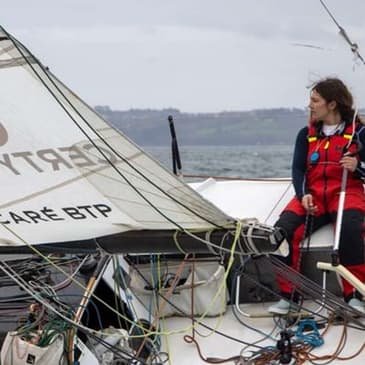
Ambre Hasson went from learning to sail in 2020 to completing the Mini Transat just five years later. In this episode, she shares her rapid rise into offshore racing, including losing her first boat during qualification and rebuilding her campaign from scratch.
She discusses resilience, managing fear, and key performance ideas like pacing, pushing to the “friction point,” and preserving the boat as a critical part of racing fast. Drawing on endurance sports, Ambre explains how handling discomfort and risk is central to success offshore.
Now moving into the Class40 circuit, she outlines her next goals and what it takes to keep progressing at the highest level.
[00:00:09] Hello everybody, welcome again to Sailfaster. The key question today is how fast can one go from beginner to Transat competitor? So today I'm talking to another of the new generation of tough, ambitious offshore sailors who are making their home and their professional career on the French Atlantic coast in the very heart of offshore racing today.
[00:00:31] Okay, Ambre Hasson's unconventional path into the sport began in 2020 while volunteering at a sailing school in the Florida Keys. This somewhat understated beginning led extraordinarily quickly to the Mini Transat and Class 40 offshore racing. Amber's originally from Paris but was raised in Virginia where she studied economics at UVA before working in technology in New York.
[00:00:58] But drawn to offshore racing, she relocated pretty quickly to France to pursue the Mini Transat, navigating both the challenges of campaign building and the complete loss of her first boat during qualification. Supported by her team and partners, she rebuilt her campaign and successfully completed the Mini Transat 2025, gaining recognition for her resilience and competitive progression. Amber is now focused on advancing her offshore career with the Class 40 circuit, finding her drive to succeed,
[00:01:28] with technical development, find racing performance and long-term campaign building. All of which we're going to hear about today, including all those key lessons from somebody getting into and improving very fast in this tough game of offshore racing. So, Amber, welcome to Sailfaster. Hi, Pete. Thanks for having me on board. So you went from never having been to sea to gunning for a Mini Transat in what, a handful of years? How did that happen?
[00:01:55] Yeah, it took about five years. I mean, like you said, I was in New York and we all went through the pandemic and I had this idea of buying a boat. And by happenstance, I ended up volunteering at a sailing school in Key Largo and learning how to sail in 2020. And 2020 was also the year of the Vendée Globe. So I discovered this concept for the first time going around the world solo on a huge boat.
[00:02:19] And something about it just really appealed to me, even though I remember speaking about it to my to my instructors, my sailing instructors. And they're like, Amber, you just learned how to tack yesterday. You know, there's like a few more steps before you get to the Long Day Globe. But I was like, OK, so what are those steps? You know, and you start researching and you find out there is a class 40. There's the Figaro's. There's the Mini 6.5 and hence the Mini Transat, which is a solo transatlantic race on a 21 foot boat.
[00:02:46] And it's sort of the first step to become an offshore racer. And so while I was in Florida, I sailed as much as I could. I showed up on docks. I started racing. I started doing offshore deliveries. Just get as many miles as possible, as quickly as possible. But I had this Mini Transat idea in my head and I I realized the only way to do it was to to move to France. Now, I hadn't lived in France since I was like seven years old.
[00:03:13] So moving back as an adult was just enough money to buy the boat. But nothing else was was quite an adventure. If you're in Florida and you're thinking about offshore racing, I don't think everybody would immediately gravitate towards the the Mini Transat, right? Like there's tons of U.S.-based options. What was the appeal of the Mini Transat versus all those other options? Yeah, no, that's fair enough. I mean, I started getting racing and offshore racing experience, but there was something about being solo.
[00:03:41] And at that time also, I was living alone on my boat in Florida and cruising around. There was something about being solo. The challenge of it really appealed to me. Having to really know how to do everything on the boat beyond just sailing the boat, also maintaining the boat and dealing with everything that might happen on board. And something about that challenge and the idea of really being alone on your boat and in the face of all the elements that is like the ocean. To me, it was like the greatest adventure and challenge possible.
[00:04:12] So you move over and you you very quickly picked up a second place in an English Channel race. Why do you think you were able to? Is that is that what happened? And why do you think you're able to do that so well? Well, so first, so I moved to France, right? And with my first boat, which was the oldest boat in the fleet, I had just scraped enough dollars to buy the boat. Well, then started the process of actually qualifying. Right. Because you can't just show up to the start of these big races.
[00:04:41] And I had five months to qualify. And usually it takes two to four years. And I knew it was very ambitious. But sometimes you also know you have to give it your all and just see what happens. And, you know, out of seven races that I did to qualify, I only finished four because the boat was actually in shambles. I mean, my mainsail would come out of my matlough and the mast. I mean, it was it was a disaster. And I was learning as well. But I managed to do enough races.
[00:05:07] And the last challenge was a thousand miles solo around the English Channel and the Bay of Escape. And I'm preparing my arrival to the port at the end of these thousand miles. And the conditions were not ideal. They had just been a big load that went through and there were the waves. You know, you can see them from further away, but the waves were big. And but I had someone waiting for me to tow me in because there's no engine on the boat. And basically, I couldn't see this boat.
[00:05:37] And, you know, I was talking on the VHF and I'm going into the channel. They told me to take the mainsail down about halfway through. I do that. I keep going. At one point, the waves start breaking and I know that this is not a good situation, but there's no turning back. I just don't have enough power to turn back at this point. And so I'm like, OK, the only way forward, you know, the only way to go is forward.
[00:05:58] And the moment I finally see the zodiac that was supposed to tow me in hiding behind the seawall is when a wave caught the stern of my boat and pushed me right outside the channel. And at this point, it's the keel is doing touch and go with the bottom and every wave is just pushing me further and further, closer and closer to the rocks until eventually I'm on the rocks. The worst part is there were so many. There was a crowd on the seawall like watching me, giving me giving me advice on what to do.
[00:06:27] I was like, it's too late. This is awful. I can imagine. And at one point, actually, the waves were slamming the boat so hard that the keel broke into the boat. And then I had to jump, jump overboard. And I sort of crawled, swam to a beach that was nearby. And and it was, you know, I was left with nothing. I had all my stuff in the boat. I had no car, no apartment. I had my laptop, my passport, like everything was in the boat my whole life. I was in shock for about two weeks.
[00:06:56] I don't think I really processed what had happened. But the hardest part was a void that was left behind. You know, when you're thinking mini transat, sleeping, talking, the only thing that's occupying your mind and others, there's nothing to do. So but the thing that saved me is actually I spent a lot of time with other sailors that were going to do the mini transat 2023 and spending a bit of time to help them do the race.
[00:07:19] And it sort of kept me in the community and and I fed off of their energy, you know, and it kept me also busy and it helped me rebuild the future while I was spending time with them. And so a few months later, I found another boat that was I mean, it's still an older boat, but in a lot better condition. And and I started I started the process all over again, qualifying, you know, doing all this stuff.
[00:07:43] And the nice thing. So in 2024 with the new boat, which is number six 18, I managed to qualify in one year for the mini transat for the 2025 mini transat. And really what was nice is the last race of the season, which was 500 miles solo in the English Channel. I actually managed to finish in second place, which, you know, was just like a validation of all the effort and all the work that I had been put into into this crazy idea.
[00:08:11] To go from that sort of depths of literally the depths of disaster to, you know, podium finish on a tough, tough solar race English Channel is is quite a remarkable story in itself. Yeah, well, I think I do think I needed that that win, because in the beginning, when I started training on the new boat, you know, there's training centers I had I was terrified on board. I had lost all my confidence as a sailor. I was scared of, you know, I was barely touching the boat, barely pushing the boat.
[00:08:39] And I had nightmares every week. I was scared of breaking another boat, my boat. So getting over that was like getting that confidence again was was really quite difficult. So how did you get your confidence back? Was it just merely getting used to it, pushing yourself a little bit more day by day? Was there was some advice or something that happened that gave you that boost so that you could push to the limit?
[00:09:00] It was it was a mix. I think the one thing that I could control was showing up to every training, you know, never, never saying, I don't feel like it today. I'm going to stay home. So I made sure that I showed up every day and I just kept, you know, just kept going on the water, whether I was scared or not scared, whatever was happening. But one day, I guess I was tired of being like a scared little girl. I was like, fuck this. Like, this is not this is not who I am. I'm not someone who's usually scared.
[00:09:29] I'm like and I got a little bit upset, like almost angry with myself. I was like today, like today we don't care. Like maybe I am going to break the boat, but it's racing. We always break the boats a little bit. And I sort of found this like positive anger inside of me. And I finally started like attacking, you know, like getting back into because the trainings is in a group. Right. And really like attacking and giving everything I have without being scared. And it was such a relief to see that that person still existed inside of there.
[00:09:59] And that was really a turning point in the trainings for me. And I saw that I could do it, you know, that I could hold the sails in big weather. I saw that it was possible and everything was fine. Before you got your boat, did you know that you had this sort of resilience and drive to push yourself to the limit? Did that ever, you know, occur to you before? You know, I do believe that people can build resilience and mental strength, but I definitely grew up this way. So I've always had it.
[00:10:27] I mean, even before I got into sailing, I used to do triathlons and marathons. So I've always sort of needed a challenge like that in my life. Before I bought my first boat, I did one mini race with someone. It was a double handed race, 250 miles in the English Channel. And so this was like the discovery of the mini for me. I had never sailed on one. And so we actually rounded the first buoy in like fifth or fourth place, something like that. It was all very exciting.
[00:10:57] But very quickly after we tore the mainsail and we broke the bow spread. And I was like, OK, these are the things that allow us to go. And the skipper asked me if I wanted to turn around and just go back to port because, you know, it just was just the beginning. And I was like, absolutely not. I mean, I came all this way to do this race. Like, I don't care for last. Like, we're going to finish it, you know. And and I remember. So we go then at this point. You know, it's nighttime.
[00:11:24] We we get to the coast of England and there was we were there was maybe 20, 25 knots upwind. And I remember I'm at the helm and the skipper was sleeping at this point and we're on a lee shore. And I remember thinking to myself, like from my AISA classes, like you're never supposed to be on the lee shore. Like, I'm like stressed out. I'm like, this is dangerous. You know, but this is racing. Right.
[00:11:47] And I think all the all the emotions and all this on like discovering like the intensity of this kind of racing, I started hallucinating. My I couldn't trust what I was seeing anymore. And at some point, the clouds start changing shapes. But there was almost a full moon so you could see them quite clearly. And one of the clouds turned into Jar Jar Binks and it's from Star Wars. And it started talking to me. And I was like, oh, wow. Like this, this is not real. Right. Trying to wake up my coast skipper. I can't I can't be in charge of this.
[00:12:17] That's why I'm like, I'm hallucinating. But he was really tired. So he I could not wake him up. He woke up like two hours later. And but it was, you know, you're hallucinating and you try to focus on your things that you do know. You've checked the charts. You know what's going on. You're not going to hit anything. And you just control the things that you can control and keep going. But it was I love the experience. And it's like we we crossed the finish line under Spinnaker.
[00:12:42] Like we had to go through this cargo parking, like zigzagging through these huge cargos that were parked near the finish line. And it was fantastic. I was like, this is exactly what I'm looking for. Great story. Okay, so I want to ask a fundamental question here, which is how do you sail faster than others around you? And just for context, one thing you talked about when we chatted a few days ago was this notion of the friction point that you're very conscious of. Could you talk a little bit about that?
[00:13:12] We all have strengths and we all have weaknesses. And one of mine is I'm not afraid of big conditions and really pushing the boat. And so you talk about this. The concept of the friction point is like pushing the boat as hard as you can within your own capability, like your own skill level. Because in the beginning, I couldn't push the boat as hard because I didn't know how to control that sort of power. And so learning as much as you can and gaining experience to find that friction point and push it and push it higher as you gain more experience.
[00:13:42] And also knowing sometimes you need, especially when you're alone, sometimes you can't be at 100%. You need to find those times where you're at 95% or 90% because it's an endurance sport, right? It's like marathons. You can't be running at your top speed from the beginning. You have to sort of gauge when you can push and when you need to pull back so you can push later. But I find finding that friction point of the boat where you're pushing really hard, but you're still in control of the boat.
[00:14:08] You know, it's not all out of control where you feel like you're going to like crash jive or like something really bad is going to happen and potentially break the boat. And finding that limit, I think, is really a key. And that's how I managed to get that second place in the year I qualified for the Transat. Because honestly, that race was very technical. You know, you have strong currents. You don't just have the currents in the English Channel. You also have it in the Rade Blanchard.
[00:14:37] And essentially, we got to a critical point against the current. And the strategy in that case was to go close to the rocks to get a smaller current and zigzag into the rocks. And if I'm being fully honest, I'm a little traumatized by rocks. So I did not do that. Not surprised. And that's also part of growth, right? It's hopefully next time I have more confidence and I'll do that.
[00:15:00] But so when we got, the idea was we were going to Wolf Rock off of England and then going along England under Spinnaker. And so when we got to Wolf Rock, I was one of the last ones because I had messed up big time at that point. But I knew that the wind was going to come in. We would have stronger winds. So I put, first I put the big Spinnaker until I couldn't hold it anymore. And then I put the medium Spinnaker up and then I held it.
[00:15:28] Most people took their Spinnakers down because they couldn't hold it anymore. But I held mine the whole way. I did, I mean, I did my top speed in that race, which was 18.1 knots. And I was definitely like, okay, okay, I think we're going fast. But I could just, I was just passing every single boat. So, and a key part of that too, it's not just like knowing how to handle your boat and having that confidence and finding that friction point. It's also preparation. The problem other boats were having is that they were not prepared well enough.
[00:15:57] So they were having technical problems, whether it was pilot problems or rudder problems or what have you. And actually we had a support vessel doing check-ins twice a day. And this guy is like a legend in sailing guide. I was doing the check-ins. And he said after the race, it's like, every time I checked in with you, everything was fine. Like you sounded calm. And you have to imagine there's like 30 knots of wind, huge sea state. I mean, it is not a calm situation. But my boat was well prepared.
[00:16:24] I was confident in my boat, which allowed me to push, like push really hard at that point and regain all those spots. So it all goes together. You know, that's how you can go fast. So there's so much fun packed there. Firstly, I want to talk about that link for you between triathlons and distance racing. Did that play into the sort of same mindset as you have on offshore racing? There's definitely parallels between the two. There's a concept of pace, like you said. At what percentage of your capacity do you start at?
[00:16:54] Usually 80%, 85% just to see how you're feeling. And then when you've done like the bulk of the work, then you can start pushing. When you're crossing an ocean, that 80% to 100% goes up and down all the time because you're dependent on weather. And then the other thing is a capacity to handle pain and discomfort. When your toenails start falling off at the end of the marathon, you can't stop. You have to keep going. And it's the same thing with offshore racing.
[00:17:21] I mean, there's times it's not just your body that's physically exhausted. It's just very uncomfortable, right? And so also, how do you handle that discomfort without hindering your performance? And it's just a capacity to take it, basically. Presumably, you get a new friction point every time you're trying to push the boat more and more. Presumably, that friction point sort of moves out on the performance envelope. You're exactly right.
[00:17:49] As you gain more experience and also more confidence, you're able to push that point further and further out. After I lost my first boat, a friend of mine invited me to do a figure race around Italy. So it's about, I think it's 1,600 miles or something. She made the mistake also of telling me that no one had ever dismasted a figure or three. I'm like, okay. So we can push as hard as we can. And, you know, there were more than once where we kept up the big sails.
[00:18:18] And it was uncomfortable. It's very, I mean, it's a bit nerve wracking. And really being at the limit of the boat and seeing other competitors furl their gennaker because they can't handle it anymore. Whether it's a lack of experience. They don't know how to manage the boat in those conditions. But definitely as you gain experience and you get comfort on your boat, you can keep pushing that further and further. And it's also, there's also confidence that comes from, I think, making mistakes.
[00:18:43] You know, on my minis, I've definitely like crash jive before or had the spinnaker in the water and had to recover from those situations. Because I was learning and I was at that limit. And, you know, like the consequences happened. But I was able to recover the boat and not break anything major. And so that also gives you confidence. You know that if something bad does happen, you're not like, you're not going to destroy everything.
[00:19:09] So for you then, as well as your sort of personal resilience and boat handling and navigation skill, boat preparation is absolutely key. I know that sounds obvious, but talk to us about that. Yeah, I mean, it's really important to preserve the machine that you're on. And especially the longer the race, the longer it has to last. And so what goes into that, it's twofold. You have just the preparation. You know, before I did the transat last year, there was a lot of preventative maintenance.
[00:19:35] If I saw something and I had a doubt about it, whether it would like hold up all the way across the ocean, I replaced it. Which also goes into performance because the least amount of time you're spending repairing things, it means that you can go fast. So you always have to think about that. So preparation is a huge thing. And also while you're racing, you always have that mechanical factor in your mind.
[00:19:59] It's basically how much risk am I willing to take right now when I have 3,000 miles left to racing. And we really saw that in the beginning of the mini transat. So the first leg was from France to the Canaries. And so it took us about two days to get out of the Bay of Biscay. It was a fairly calm start, but we headed straight into a low front, which also means there were a lot of things floating in the water. And it wasn't, I mean, I think the most wind we had was like maybe 35 knots.
[00:20:28] It wasn't that much wind. But the sea state was chaos, just terrible. Just all over the place. And a lot of people broke their boats. Bows spreads got broken. Two people dismasted. I don't know how many people broke their rudders. And so by the time they got to Cap Finisterre, like we got to the coast of Portugal, they were limping along. Whereas I decided to be pretty conservative in the beginning.
[00:20:57] I was like, we have so many miles left, you know. I don't want to break the boat right now and put the gennaker up if it's too risky. Which means that by the time we were getting closer to Portugal and the conditions had calmed down, my boat was intact and I was ready to attack again. And so that's when I started, you know, in the beginning I was not, I was pretty like behind, I guess. I was not like one of the first ones. But because everyone had, a lot of people had broken their boat, all of a sudden now I'm racing like I should be.
[00:21:28] And I'm regaining all those places because my boat is intact and I can actually, I can actually finish in like in good conditions properly sailing the boat. So there's also this aspect of preservation, which is maybe not as dominant if you're doing inshore racing, you know, because you're not pushing the boat for as long. I don't know. But there's a notion of knowing your boat and how much the boat can take on the long term. And when are you getting close to that point where you might break something? I love that notion of preserving the machine.
[00:21:58] That's really interesting. You can't forget that sailing is definitely a mechanical sport. And so the machine has to hold up the whole way just as you do. So I know that your new ambition is in the class 40 and you're going to do double handed. So new boats and having a crew member. Why the switch? And what are you thinking about that? Yeah, I mean, what got me hooked on the class 40 was that after my mini transit,
[00:22:27] I returned to France on a France class 40. We were four people. And I just love the power of the boat. At the same time, it's so much more stable than a mini. And I knew I wanted to do double handed this time around because what I found the few times that I did do double handed races is that I felt like I pushed more. And I learned more quickly when I was with someone else than just by myself. I mean, there's only so many things you can learn by doing mistakes. At some point, you have to learn from someone else as well.
[00:22:56] And so I love the idea of doing double handed class 40. And the idea is to do a transat next year that goes from France to Martinique. Fantastic. I'm going to ask you a strange question. I asked Will Harris the same question recently as well. How do you deal with fear out there? Yeah, I mean, I think that's a very good question. And I think, I mean, we spoke a little bit when I kept having those nightmares. And that was fear impeding my confidence.
[00:23:22] But I think another kind of fear is like when things are going wrong on board, whatever, you know, maybe you hit something like you have an accident happen on board. The thing is, you have to deal with what's happening fairly quickly. And I find that there's no real room for fear. There's only room for action. You know, you're allowed to feel scared later after you've dealt and you put the boat back in like a safe mode. But in the moment, and also maybe it's how some people are wired.
[00:23:50] And I think sailors are particularly wired this way. Most sailors that I've met is when something bad happens and you have to deal with it, your brain somehow takes over and goes into autopilot. Like you're ready for this moment and you just go straight into action. Whether that's slowing down the boat, whether that's making sure someone is safe, whatever is going on. And fear is the thing that you feel later after the action and then the adrenaline has worn off. Yeah, I've heard people talk about, okay, don't worry about what you worry about will happen.
[00:24:20] Just focus on what's happening now and how you're dealing with that. Control the things you can control and don't worry about the things that you can't control, which goes beyond just fear, but I think sailing in general. But there's no point, for example, in complaining that the shift that you were expecting did not happen the way you anticipated. And it's actually not really the wind that you were expecting. And sitting there waiting for the thing you have on your paper to match the thing that's going on outside.
[00:24:47] It's like, okay, well, what can I do? Okay, well, I'm going to change it to this sail and then I'm going to adjust my strategy and control my boat and my little universe in an environment that's very unpredictable. It's also interesting how when you're solo sailing, you've got nobody else to blame. It's definitely a humbling experience. Yeah, sailing is a humbling sport to me. So what's your ultimate goal? What's next for you? Yeah, so I mean, I already have a class 40.
[00:25:16] Someone contacted me from an academy to do a double-handed season this year and next year. And the ultimate goal is to do a big Transat race next year. So we've already started training. And I already have a few partners and sponsors on board this next adventure. And the idea this time is what I like about being an academy is, you know, there's a dedicated coach.
[00:25:40] And because they're also going to help me maintain the entire ecosystem that is like the sponsorships and all the other things that come with offshore racing, I'm hoping to spend a lot more time on the water. At this point, I just, you know, I've proved to myself that I can cross the ocean by myself and it was fantastic. But at this point, I want to become a better racer. And I think I have a lot to learn still in the weather. You know, I do like physical training every week, obviously, because the class 40s are like a dimension above.
[00:26:10] I mean, just moving a sail on the boat is not the same. But so far, you know, the trainings have been good. And I just want to race harder and faster, basically. So what's your next big race? Is it one of the class 40 series? So we have two races in the med. One is called the Med Channel CIC race, which is a thousand miles double-handed. And then the Massilia Cup, which is also double-handed in the med. And then after that, I'm going to bring the boat to Bretagne.
[00:26:40] And we're going to do either one or two races on the Atlantic coast. We're still determining that, depending on budget, basically. Fantastic. And I saw from your website, you've got an impressive list of sponsors there. So it seems to be working. Yeah, I mean, it's interesting in the beginning because I'm Franco-American. In the beginning, I didn't know really what strategy to use if I should go after French sponsors or American. I decided to present myself as Franco-American because that's what I am.
[00:27:09] And so I have a good mix on both sides. And I think what's really nice is a lot of the people that supported me in the mini are continuing now with the class 40 because the operating budget this year is very reasonable compared to most class 40 campaigns. That's a good selling point. You snuck in there. So, yeah, I think overall it's going to be a great program. And I'm just very excited. Brilliant. Brilliant. I've really enjoyed talking to you.
[00:27:38] And I'm sure our listeners have enjoyed hearing from you. We'll all follow your exploits. So keep in touch. And the very best of luck. And thank you so much for taking the time to be on Sailfaster. Well, thanks to you. I really enjoyed this dish chat and maybe next time. Hope so. Cheers.