
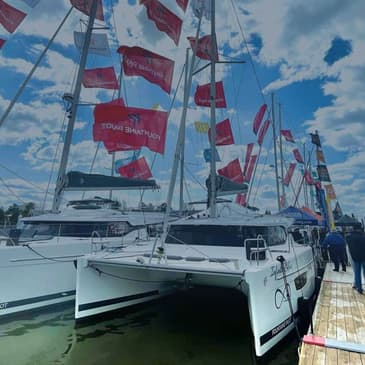
Here’s the very talented Mary Ewenson talking about the 2024 Annapolis Sailboat Show and sailing her Viper 640! We recorded it outside at the Annapolis Powerboat Show so you’ll notice the background noise, but hopefully it doesn’t diminish your enjoyment of the episode. Mary’s also the co-founder of the Spinsheet publications and the founder of the EWE Spirit Foundation, which honors the legacy of Geoff Ewenson by helping those facing immediate hardship bridge financial and social support gaps through mentorship, outreach and financial assistance, thus creating a kind world where everyone has the resources and opportunity to live with dignity, hope and joy.
The upcoming Annapolis Sailboat show is October 10-14, and you can purchase tickets on line at - www.annapolisboatshows.com
To contribute to the EWE Spirit Foundation, just go to www.ewespirit.org!
[00:00:09] Hello! In today's episode, I was lucky enough to catch the president of Annapolis Boat Shows, Mary Ewinson, on the first day of the Annapolis Powerboat Show. We are outside, so there's a fair amount of background noise, but I do hope it doesn't affect your enjoyment of the episode. The upcoming Annapolis Sailboat Show is October the 10th to the 14th, and you can purchase tickets online at annapolisboatshows.com. Here we go!
[00:00:44] Hello everybody and welcome to another episode of Sailfaster, and we are recording this on the day that Sir Ben Ainslie and Ineos Britannia got through to the America's Cup finals against Emirates Team New Zealand. So come on lads, of course this will be old news by the time you listen to this. I know that Brits aren't everybody's choice to support in most things, to be fair, but let's hope we continue to have amazing racing at UCM America's Cup, it's fantastic.
[00:01:12] So America's Cup is one of those things that probably everybody knows that the Brits have failed to ever win. It's a little bit like the Football World Cup, which we won only when I was about a year old. So it's been decades of hurt. So this is going to be a good one.
[00:01:26] Anyway, today's episode comes from the Annapolis Powerboat Show, and rest assured, dear listeners, we haven't gone over the dark side of boating. It's a great opportunity to chat with Mary Ewinson, who is, among many things, president of the Annapolis Boat Shows.
[00:01:42] And we're doing this a week before the Annapolis Sailboat Show, which is next week. So Mary is also the owner of the very well-known and fantastic Spin Sheep magazine and all those sister publications, which if you don't live in Annapolis, is probably the region's preeminent sailing and boating publications in both print and digital form.
[00:02:03] Mary is also the president of the Youth Spirit Foundation, whose mission is to honor the legacy of Jeff Ewinson by helping those facing immediate hardship, bridge financial and social support gaps in mentorship, outreach and financial assistance.
[00:02:17] And Mary, given all you have going on, I suspect you don't have much time to sit around here and chat to Sail the Fast for the opening day of the Boat Show.
[00:02:23] But thank you so much for joining.
[00:02:26] Oh, absolutely. Well, thank you for inviting me. I love talking about racism.
[00:02:30] So I've got to ask a question. How did you come to own? Because you own the Annapolis Boat Shows, right?
[00:02:38] I do. I have two business partners, the three of us own the shows together.
[00:02:44] And I think it was because of, well, I know, it was because of Spin Sheep and Prop Talk magazine at the time.
[00:02:51] Because, as you pointed out, those are the boating publications for the Chesapeake Bay.
[00:02:56] So I got to know the owners of Boat Shows.
[00:03:00] And when Ed Hartman, who owned them, was looking for an exit strategy, he reached out to his general manager, who put a team together of five of us.
[00:03:09] And we purchased the shows in 2012.
[00:03:13] Wow. Got it. I mean, this time of year for you with these shows back to back, that must be, well, I was going to say a nightmare.
[00:03:19] But obviously you'd love it. Otherwise, you wouldn't be doing it.
[00:03:22] Yeah, it's pandemonium.
[00:03:23] Pandemonium. That's a good word.
[00:03:25] But it's great because it's an opportunity for, with Spin Sheep, Prop Talk, and Fish Talk, and Port Book, where we can connect with all of our readers, which is super fun.
[00:03:35] People stop by the booth and say, I was on page 42 or I was in the water tissue.
[00:03:39] So we love, love, love doing that.
[00:03:42] And then obviously the boat shows are just the best, best sailing and power boating fishing parties of the year.
[00:03:50] And all of our friends come into town.
[00:03:52] We catch up.
[00:03:54] And it's a blast.
[00:03:55] Plus, you get to see everything.
[00:03:57] Your team has been kind enough to feature some of the SailFast extracts from the podcast and that, which has been great.
[00:04:04] And the crew finder is fantastic.
[00:04:07] Isn't it?
[00:04:07] Such a great resource for finding crew.
[00:04:10] I think most of my crew came from there.
[00:04:11] It's really, really high-quality people in that.
[00:04:13] It's something we love doing because for a lot of people who've just gotten into sailing or just moved to the area, they may not know somebody with a boat to go sailing with.
[00:04:24] Lots of people like you that have a bigger boat and need crew, I mean, it's ever-evolving.
[00:04:30] People move.
[00:04:31] They get promotions.
[00:04:32] They have babies.
[00:04:33] You have people say, well, if you're Chris, you're always looking for a new crew.
[00:04:36] So having that crew finder online and then the party every year to connect boats and sailors, it's just blast.
[00:04:43] So let's talk about the, if we can talk about the Annapolis Sailboat Show.
[00:04:47] Sure.
[00:04:48] And what to you are the most exciting boats or companies happening at this year's ABS?
[00:04:56] Okay.
[00:04:56] So full disclosure, I'm a racing sailor.
[00:04:59] Excellent.
[00:04:59] So.
[00:05:00] That's why we chose you.
[00:05:01] Yeah.
[00:05:02] So, I mean, they're phenomenal cruising boats, all these huge catter-mands, huge monohulls.
[00:05:09] But I look at every one of them and I'm like, could I race that?
[00:05:12] Could you race that?
[00:05:13] So, and you can.
[00:05:15] Some of the really big keel boats, there's some beautiful ones that are sort of racer cruisers
[00:05:19] or people that race their cruising boats for offshore races and that kind of stuff.
[00:05:23] So that's awesome.
[00:05:25] But on the racing front, something I really love is that Jesupic Region Accessible Boating brings their first 22 to the show.
[00:05:35] Not a new boat, not a new exciting boat.
[00:05:37] They're the boats that are fitted out so that they can take people with physical disabilities sailing and they race those boats and they race them competitively.
[00:05:45] And I just love that.
[00:05:47] Because it's just making sailing more accessible is really near and dear to my heart.
[00:05:54] And so seeing that there and they showcase it to everybody who comes to the show who might not need the disability services, but they might know someone who does.
[00:06:04] And getting people out on the water, I mean, it's freeing because if you're in a wheelchair all day, but you can get on a boat, it's completely different.
[00:06:13] I mean, most of us when we're sailing a boat, we're sitting down anyhow.
[00:06:17] So it's like, it's a great leveler.
[00:06:20] And they're always looking for volunteers.
[00:06:22] And so that's another great thing is, you know, if you are fortunate enough to be able to go out and sail and why not give a little bit of your time to help somebody else do it as well.
[00:06:30] And it's called the Chesapeake Accessible...
[00:06:33] Chesapeake Region Accessible Boating.
[00:06:35] Oh, it's crab.
[00:06:36] Yeah, it's crab regatta.
[00:06:37] I sailed on the crab regatta.
[00:06:38] Yeah, crab regatta.
[00:06:38] Of course, yeah.
[00:06:39] You're already supporting it.
[00:06:40] Yeah.
[00:06:40] Yeah, it's great.
[00:06:41] We have some fun new premiering boats.
[00:06:45] The Birdie Fish, which is a foiling teeny tiny boat that's a foiling boat.
[00:06:52] The VX2, which is, you may know the VX or the Viper.
[00:06:57] It's the same family, but it's a smaller boat.
[00:06:59] It's 16 feet long.
[00:07:01] It's crewed by two people and has a center board rather than a keel and a kick-up rudder.
[00:07:07] A lot...
[00:07:08] Easy to transport.
[00:07:09] Easy to transport.
[00:07:11] Not new this year, but Amalgus 15 will be here.
[00:07:14] Yeah, I saw that.
[00:07:15] And that's a growing fleet.
[00:07:16] It's a fleet that travels.
[00:07:18] They do a winter series.
[00:07:20] So we're going to have this whole area of smaller racing boats, which I just totally think that would be a Vyper sailor.
[00:07:26] I was going to say you're a Vyper sailor, aren't you?
[00:07:28] Yeah, I am.
[00:07:28] And I love that kind of sailing, especially.
[00:07:32] There'll be...
[00:07:33] The RS Zest will be here.
[00:07:36] The Arrow.
[00:07:36] The Toro.
[00:07:37] They'll be represented in that dinghy area.
[00:07:39] It's down at the end of Eagle Alley.
[00:07:41] So there'll be all these racing babies down there.
[00:07:44] Yeah, brilliant.
[00:07:45] Super fun.
[00:07:45] And there'll be an Ilka, formerly known as the Laser.
[00:07:48] Yeah, yeah.
[00:07:49] Also some new big boats.
[00:07:51] The 444, which certainly could be raised.
[00:07:54] Yeah.
[00:07:54] And I think we have 16 premiering sailboats at the show, which is really great.
[00:08:01] It's the first opportunity...
[00:08:02] Presumably from manufacturers all over, right?
[00:08:04] Not just in the U.S.?
[00:08:05] Oh, yeah, yeah.
[00:08:06] This is a very...
[00:08:06] It's an international show.
[00:08:07] So, but when we say premiering, we mean it's the first time they're seen at a boat show
[00:08:13] in the United States.
[00:08:15] Ah, fantastic.
[00:08:15] So, yeah.
[00:08:16] Yeah.
[00:08:16] So that's the first chance to be able to check it out here at the Inactive Sailboats Show.
[00:08:21] And presumably J-boats are here?
[00:08:23] Oh, yeah.
[00:08:24] Yeah.
[00:08:24] And there's an old J-boat section.
[00:08:26] And everybody can go and check in, talk about tweaks that they make to the ride.
[00:08:31] That's supposed to be one design, but we all tweak our boats.
[00:08:33] But in addition to the boats, we've got tons and tons of cool gear for racing sailors.
[00:08:38] The Fowl Weather Gear guys will be out in force.
[00:08:41] Haley Hansen, Team One Newport, Musto Mustang, Rooster, and North Sales Apparel will be here
[00:08:48] with Fowl Weather Gear.
[00:08:50] And then there are other manufacturers sprinkled in.
[00:08:54] I'm certain I've left someone out.
[00:08:56] That's the danger of speaking off the cap.
[00:08:58] You can always see somebody else.
[00:08:59] And I always love going to see what is the latest and greatest in Fowl Weather Gear.
[00:09:06] Because I am a part of being cold and wet.
[00:09:09] And so I just have closets full of Fowl Weather Gear.
[00:09:12] And I have bought jackets that work, jackets that don't work.
[00:09:15] And when I find something that works, I tend to try to find the next generation and next generation.
[00:09:20] But some of these manufacturers are now manufacturing women's gear.
[00:09:25] And that has come and gone in the sailing world.
[00:09:30] Everybody will be offering women's gear.
[00:09:32] And then fewer people will be.
[00:09:34] But it's picking up again.
[00:09:36] And I think that's good because we're seeing more and more women driving programs.
[00:09:40] Whether it's literally driving the boat or putting the program together.
[00:09:45] So it's a neat change in the sailing world.
[00:09:47] It's gradual.
[00:09:49] But more and more women are sailing.
[00:09:51] And I love that.
[00:09:51] Anything else you're excited about at the Sailboat Show, Mary?
[00:09:54] Yeah.
[00:09:55] Well, Mustang is offering a 40% discount to racing women who stop by the boat for the show to buy gear, which is pretty huge.
[00:10:07] And Team One Newport has some of the scrambler gear will be 50% off.
[00:10:12] There are other groups that are also offering discounts.
[00:10:15] So I'm a huge fan of boat show discounts.
[00:10:17] Just because I didn't name them doesn't mean that it isn't there.
[00:10:20] So always go ask when things are discounted.
[00:10:22] So get there early on the first few days.
[00:10:25] Well, for sure.
[00:10:25] Because, you know, things do sell out.
[00:10:29] Also exciting, Cole Brower, who was a first American woman.
[00:10:33] She's going to be here?
[00:10:33] She's going to be here.
[00:10:35] She's doing a presentation in town.
[00:10:37] And then she will do a meet and greet at the show on Saturday the 12th.
[00:10:44] Oh, okay.
[00:10:44] So that's really exciting.
[00:10:46] Super inspirational.
[00:10:47] Yeah.
[00:10:48] It's just a ton of fun to connect with people and to go.
[00:10:52] And as you know, right?
[00:10:53] You can talk to the sailmakers about how you're trimming your sails and what you're doing.
[00:10:57] You get quotes.
[00:10:58] All the sailmakers have boat show discounts.
[00:11:00] Fantastic.
[00:11:01] Looking forward to it.
[00:11:02] Good.
[00:11:02] Switching topics slightly.
[00:11:03] The sailboat scene in Annapolis seems to be pretty healthy.
[00:11:08] Is that your view of it too?
[00:11:10] Well, it's interesting.
[00:11:13] I would say we used to have a larger handicap tailboat racing scene.
[00:11:19] And by that, you know, it was, I mean, we had IMS, IOR, MHS, all the handicap systems.
[00:11:27] Yeah.
[00:11:27] Yeah.
[00:11:27] Before PHRF.
[00:11:29] And then PHRF.
[00:11:30] Yeah.
[00:11:30] And now they're playing around a lot with ORR, ORC, all that stuff.
[00:11:37] So handicap racing kind of, it waxes and wanes.
[00:11:40] Yeah.
[00:11:41] So there's a lot of discussion about that.
[00:11:44] So I started a lot of discussion about format.
[00:11:46] When I was growing up, we did, it was almost all government marks racing.
[00:11:52] You know, it was orienteering.
[00:11:53] I mean, we plotted the course from mark to mark to mark.
[00:11:56] And there was all sorts of that.
[00:11:58] It changed in the 90s.
[00:12:00] It really went to when we were towards.
[00:12:03] And now we're seeing a little bit of a shift back to pursuit starts, to more distance races,
[00:12:08] to different formats.
[00:12:09] We're seeing a lot more team racing and match racing.
[00:12:14] And that's exciting because it's very physically active racing, which is some people's jam.
[00:12:21] And it's not everybody's jam.
[00:12:22] So that's fun to me to see.
[00:12:25] Yeah.
[00:12:26] As someone who's not very good at sitting still, I gravitate toward smaller boat racing
[00:12:32] or lots of turns on the race course and that kind of thing.
[00:12:36] Whereas I grew up with a family that really likes those distance races.
[00:12:40] Yeah.
[00:12:40] They like to get on a jack and hang there for a while.
[00:12:43] I'm like, what are we doing next?
[00:12:44] You know?
[00:12:45] Yeah, yeah.
[00:12:45] So what I love is the diversity of racing that we're seeing now and the classes that are emerging.
[00:12:51] And I think that's a tonified.
[00:12:53] We have more single-handed racing and short-handed racing, groups like that.
[00:12:58] And then, as you said, a big women's regatta that was super successful.
[00:13:02] A lot more foiling.
[00:13:04] And then, you know, we've got windsurfing and kite foiling and all that stuff.
[00:13:09] Yeah, it's great to hear.
[00:13:09] I mean, you're right about the diversity of options that people have.
[00:13:13] Yeah.
[00:13:14] The one design seems pretty healthy.
[00:13:16] I mean, I'm, you know, part of the J-105 fleet here, which is one of the biggest and most competitive fleets in the country.
[00:13:24] Any thoughts about what we need to do as a sailing community to keep it that way?
[00:13:28] Well, I think access and access to the water.
[00:13:32] Yeah.
[00:13:32] And one of the challenges that we have here, especially in Annapolis, is where can you keep your boat?
[00:13:37] Yeah.
[00:13:38] And it becomes very expensive very quickly.
[00:13:41] But also, I mean, for example, I sail a Viper 640.
[00:13:45] It's a trailerable boat.
[00:13:46] You could keep it on a lift at your home, I guess.
[00:13:49] But you need to be near where the racing's going to be.
[00:13:51] Most of us keep our boats on a trailer and we hoist launch.
[00:13:55] Well, you've got to be somewhere where there's hoists.
[00:13:58] You've got to be at a club where the Viper 640 is one of the accepted classes.
[00:14:07] All the clubs in town have rules on which boats can be at their clubs.
[00:14:11] It's not because they don't like one boat or another boat.
[00:14:14] They are in the business of supporting the boats that their members have.
[00:14:19] So it's just hard to find space.
[00:14:23] And the type of sailing has changed.
[00:14:25] 20 years ago, many fewer boats were kept on trailers than they are now.
[00:14:31] So we've just got all these trailers piled up with Nuggets 15s, J22s, Harbor 20s, Vipers.
[00:14:38] So the way that we're sailing does this change, which means we need more land space.
[00:14:44] Spinsheet and its sister publications are, as we talked about, the heart of the local sailing and fishing and boating and port scene.
[00:14:53] How does it feel to have created that?
[00:14:55] It's awesome.
[00:14:56] That sort of empire.
[00:14:58] The empire.
[00:14:59] The empire on the Chesapeake.
[00:15:01] Dave Gendall and I started Spinsheet together in 1995.
[00:15:05] And we didn't know what we didn't know.
[00:15:08] So it feels great.
[00:15:10] Spinsheet will be 30 next year, which is super exciting.
[00:15:14] Prop talk.
[00:15:15] We started 10 years later.
[00:15:17] Pretty much there's one sailor for every nine power boaters.
[00:15:21] So, you know, there's, so we thought, well, there's power boaters, they need their own magazine as well.
[00:15:26] So we started that 10 years later.
[00:15:28] It's a passion.
[00:15:29] Dave and I started Spinsheet because we were passionate about sailing.
[00:15:33] Yeah.
[00:15:34] And so it's, it's, I mean, Dave was our first editor.
[00:15:38] He handed the reins over to Molly Winans.
[00:15:41] And just, she's grown it in so many ways.
[00:15:45] I love it when you tell me things like the crew finder connected people.
[00:15:48] I sort of feel like we're, we're the glue in the community.
[00:15:51] Yeah.
[00:15:52] We love promoting the regattas.
[00:15:54] We love getting more people to sail in them.
[00:15:56] So it feels great to have such a good team.
[00:15:59] We know that if somebody grabs a copy, it, it didn't just get shoved down their throat.
[00:16:04] They wanted to read it and they get to find it when they're out to lunch, you know, when they're at a library, when they're at the green store.
[00:16:12] So I think we, we have digital, we have emails, we do videos.
[00:16:17] They're all great, but print's really important too.
[00:16:20] Yeah.
[00:16:20] I get it.
[00:16:21] And there's not, there's not a lot of printed sailing magazines, really.
[00:16:28] I mean, there's Sailing World and Sailing and that sort of thing, but, but it's fairly limited.
[00:16:32] The Seahorse, there's Yachting World, I suppose.
[00:16:35] Yeah.
[00:16:36] Yeah.
[00:16:36] Yeah.
[00:16:37] And, and most of them don't print monthly.
[00:16:39] Yeah.
[00:16:39] That's right.
[00:16:40] They're quarterly or yeah.
[00:16:41] Yeah.
[00:16:41] No, it's quite interesting.
[00:16:42] Like Latitude 38 when I lived in San Francisco, that was great.
[00:16:46] Very similar thing.
[00:16:47] Okay.
[00:16:48] Let's talk about racing because I know you're a keen racer.
[00:16:51] So you are a long time Viper sailor, right?
[00:16:55] The Viper 640.
[00:16:56] What attracted you to that boat and class?
[00:17:00] I will tell you what my husband said.
[00:17:03] It was a boat that didn't go so fast that it scared me, but it was fast enough to excite him.
[00:17:10] And we, he was a pro sailor, so he sailed for work.
[00:17:14] I work in the marine industry.
[00:17:16] We both spent tons of time sailing on other people's boats with each other, you know, against each other or whatever.
[00:17:23] But we wanted to get a boat.
[00:17:24] We could sail together.
[00:17:25] Yeah.
[00:17:26] The Viper 640 just checked so many boxes for us because it is fast.
[00:17:30] You need to be planing along at 15 knots.
[00:17:33] It's also excellent for the bay because it's a good light air boat.
[00:17:37] And we get a lot of light air and we can sail in four knots and keep that boat moving.
[00:17:42] So it's, it's pretty versatile.
[00:17:45] But most important for the two of us is that it worked for us weight wise.
[00:17:50] There are a lot of, there are a couple other boats like the VX1 is a similar boat.
[00:17:54] But the optimum weight for Viper is all crew weight 550 pounds.
[00:18:00] We had to be in that weight range where we could sail with one more big guy.
[00:18:05] I have a great group of people that I sail with, but that's how we got into it.
[00:18:09] The reason I stay in it now is first, I love sailing the boat, but even more important than that, I love the fleet.
[00:18:17] And it's so easy to trailer.
[00:18:19] You can pull it behind anything.
[00:18:20] There are people who show up, you know, pulling it behind their super-roost station wagon.
[00:18:24] And I, we do a winter series in Sarasota, Florida.
[00:18:28] Yeah.
[00:18:28] December, January, February.
[00:18:30] I've sat them in New Orleans, taken it up to Canada a bunch of times.
[00:18:34] I'd love to talk about race or regatta prep.
[00:18:37] What's your regatta preparation like?
[00:18:40] I am not very good at getting off the dock on time.
[00:18:45] And one thing Jeff used to say to me all the time is, the last person off the dock never wins the regatta.
[00:18:52] And I'm just like, don't be last getting off the dock.
[00:18:55] Because what happens is you get out to the race course and you're all this,
[00:18:58] I think that race prep for me starts way long before race day.
[00:19:08] And it's because I own the boat and I have to get it ready and I have to make all the plans and do all that stuff.
[00:19:15] But I think for anybody, whatever position they are on the boat, the team is more successful if everybody does some race prep.
[00:19:24] Yeah.
[00:19:24] I mean, everybody should read the sailing instructions.
[00:19:28] Everybody should look at the weather.
[00:19:30] Here in Annapolis, you don't just look at the current predictions.
[00:19:34] You go and you look and see what's happening at the dam.
[00:19:37] And then as you sail out to the course, you look at what the ships are doing.
[00:19:40] I mean, there's so much of that that sets you up in advance.
[00:19:46] I always, and I totally got this from Jeff, if I'm sailing in a new area ahead of time,
[00:19:52] I start thinking about who I know from that area.
[00:19:55] And I reach out to them.
[00:19:57] What are you doing heavier?
[00:19:58] What are you doing lighter?
[00:19:59] Which way do you go?
[00:20:00] You know, we would go down to Miami and definitely, you know, find the person that he most wanted to talk to and be pulled aside and be like, you know, okay.
[00:20:11] And usually it was Augie Diaz, you know, just that.
[00:20:14] So what kind of racetrack is it going to be today?
[00:20:17] And so I think that's race prep starts way, way in advance.
[00:20:21] And when you know those people that are always successful, like they may or may not have the exact same routine in the morning.
[00:20:29] You always hear that, right?
[00:20:31] That, you know, like tennis players, they bounce the ball a certain number of times before they serve.
[00:20:37] I know sailors that eat the same thing every morning before they go sailing and they do the exact same thing.
[00:20:42] And they do great on the race course.
[00:20:44] I also know people that find a local restaurant and eat there.
[00:20:47] And they do great on the race course too.
[00:20:49] So I think routines are important.
[00:20:51] But if you're a routine person, it's really important for you.
[00:20:55] Yeah.
[00:20:55] If you're not a routine person, you just have to have really good checklists so you show up with all your stuff.
[00:21:00] So what about you?
[00:21:01] What checklist or routine?
[00:21:02] I need checklists.
[00:21:04] I don't have good routines.
[00:21:06] Yeah.
[00:21:06] Yeah.
[00:21:07] Because I come in thinking about a lot of different things.
[00:21:10] And so I need the checklist to make sure that I brought all this stuff.
[00:21:14] I'm the same.
[00:21:14] I use a little app on my phone.
[00:21:16] For me, it's a comfort because otherwise I know I'd miss something.
[00:21:20] So if you, going back to what you said at the beginning, because of what you've seen from Jeff and from others,
[00:21:26] are you now not lost to get out onto the race course?
[00:21:31] I'm usually not lost.
[00:21:33] Every once in a while, I'm lost.
[00:21:35] Yeah.
[00:21:35] I have a terrible habit of, and Jeff spoiled me right.
[00:21:40] So we would get to a regatta and he would, you know, we have to put the mask up, the peeling and everything.
[00:21:46] And he would say, you go work.
[00:21:49] And he would give me a 10 minutes.
[00:21:51] Like, I'm putting the boat in the water.
[00:21:52] You have 10 minutes to get your gear on and get on the boat.
[00:21:55] So he would, and so it's been quite an adjustment figuring out that like nobody else is putting my boat together.
[00:22:00] I mean, my crew, we work together on it.
[00:22:03] But I have gotten a little bit better about unplugging from work and starting the regatta process for a year.
[00:22:11] Yeah, yeah.
[00:22:12] I have a bad habit of working to the last minute, and it's hard to change gears.
[00:22:17] And most of us do it.
[00:22:18] It's so great to get out of work and go sail, you know, especially if you have a big job or a high-pressure job.
[00:22:24] But a lot of us, I think, are really bad at that transition.
[00:22:27] I think most people with a big job need more time.
[00:22:31] You have to change gears.
[00:22:33] Yeah, I totally agree.
[00:22:34] Personally, I have 11 DC, which is an hour away.
[00:22:37] And that hour is a great buffer.
[00:22:40] Well, and my office is five minutes from my boat.
[00:22:42] So sometimes I get there, and, you know, bad habit, right?
[00:22:45] Still taking the work call.
[00:22:46] Of course, yeah, yeah.
[00:22:47] And that's terrible because what you need to do is turn one thing off and turn the other off.
[00:22:52] And I think that's why so many people, you know, having a routine or a plan helps you get there.
[00:22:57] I'd love to hear any tips and ideas you have on how you sail that bike or faster than others.
[00:23:04] I've talked to a lot of great sailors, and they're pretty open about sharing what works for them
[00:23:11] because they know that, you know, anybody could write down those tips.
[00:23:15] I know people do.
[00:23:16] But replicating the race course is very, very different, obviously.
[00:23:19] But what's your thoughts on how do you get a viper to move through the water past another's?
[00:23:24] Yeah.
[00:23:24] So I love that you brought that up, that different fleets have different personalities.
[00:23:30] And one of the things the viper fleet does that I love, love, love is after every day of racing,
[00:23:36] we have a debrief, and we break all the boats together, and we all talk about how many turns we had on the rig,
[00:23:43] how much in-hull we were using, what degree of feel we had.
[00:23:48] We share how to make our boats go faster.
[00:23:52] Yeah.
[00:23:52] And it happens over and over and over again, and we all talk about how we make things work.
[00:23:58] And the first time that I raced my viper with my husband, like calling tactics for me and everything,
[00:24:05] at the end of the day, he walked up to someone we were racing against,
[00:24:08] and they were right behind us in the standings.
[00:24:10] And he said, you're letting your main out too much downwind.
[00:24:13] And he told them that.
[00:24:14] And I was totally joking, but I'm like, Jeff, now they're going to pull it in, and they're going to beat us.
[00:24:20] And he goes, it's no fun beating anyone on the race course if they're not sailing well.
[00:24:24] And I think that the viper fleet embraces that.
[00:24:28] So I love hanging out in the boat park with my other viper sailors and talking with them.
[00:24:33] I sail the viper a little bit differently than the tuning guide because I sail the way Jeff's sailing.
[00:24:40] So I tend to foot a lot of wind.
[00:24:43] I love sailing viper downwind.
[00:24:46] One of the things that I do is I carve the waves a lot sailing downwind.
[00:24:52] I love sailing with a spinnaker trimmer who talks to me a lot.
[00:24:56] I like a lot of feedback on the boat on how things are going.
[00:25:02] But the viper, you kind of have to let it rain.
[00:25:06] There's no pinch mode.
[00:25:07] If you are pinching in a viper, you're not making the force work.
[00:25:11] It has a decent heel, like you said.
[00:25:14] So let me unpack a lot of the things you talked about there.
[00:25:17] So footing, you can get yourself above target speed.
[00:25:20] And because the falls are working super efficiently, you've got lessly.
[00:25:24] Same principle.
[00:25:25] Yeah, you get on the elevator.
[00:25:26] But you don't get on that elevator until it's moving fast enough to start working.
[00:25:30] Yeah.
[00:25:31] Yeah.
[00:25:31] So you can make it point wind upwind, but you'll watch everybody foot through you and just carry on out.
[00:25:38] And then they'll attack and cross you.
[00:25:39] And we make a lot of adjustments.
[00:25:41] I mean, one of the things is that we have blocks to go in front of the mast.
[00:25:45] So that, you know, you change the curvature of the mast, the bend the mast.
[00:25:52] You can dial it up.
[00:25:54] And then we play a lot with, you know, the bang and with weather sheeting on the jig.
[00:26:02] And that, it really changes a lot depending how much chop there is, how big the waves are, and how flat you can hike the boat.
[00:26:12] So, you know, when I'm sailing light, a lot of times we sail up wind way more heeled over that sort of people.
[00:26:19] And that's one of the things we find in debriefs.
[00:26:22] There are people that just have a pointing mode and there are people that have a footing mode.
[00:26:27] I don't have a footing mode.
[00:26:28] Really?
[00:26:29] Yeah.
[00:26:29] You're always going for speed and then trying to curve up, presumably.
[00:26:34] Okay.
[00:26:35] Hey, the other thing you talked about I was intrigued about was the communication with the spin trimmer.
[00:26:39] That's, I mean, that's important normally, but why is that so important on the bike?
[00:26:44] Well, so on the bike converter, the spin trimmer is just using a ratchet block, you know, and it's so, they can feel little changes in the pressure.
[00:26:53] So, you know, they're feeling the changes in the pressure.
[00:26:57] I've got someone who's watching for changes in the breeze on the water.
[00:27:00] So, as soon as they can feel it, then it's like, okay, there's some pressure.
[00:27:05] I can bear off a little bit.
[00:27:07] And then, oh, it's getting light.
[00:27:09] I can come back up.
[00:27:10] So, we are constantly adjusting.
[00:27:13] There are some people, I mean, I've had other Viper skippers get on board with me and say, you're turning the boat too much.
[00:27:20] I'm like, yeah, but I'm turning it with weight.
[00:27:22] You know, you don't want to be turning it by using the barn door rudder.
[00:27:25] You know, like it's a break.
[00:27:27] But we adjust constantly.
[00:27:31] And different people sail different ways.
[00:27:33] But I really like to be adjusted just all the time because it's changing gears.
[00:27:38] And the Viper is so easy to move your weight on the boat.
[00:27:41] And so, we can steer downwind with weight.
[00:27:44] And also just adjusting because it's a very deep belly kite.
[00:27:51] That adjusting the angle of heel downwind.
[00:27:53] It's an ASL.
[00:27:54] So, you really often want to have more angle of heel.
[00:27:59] Here I'm using my hands like your listeners are being able to see them.
[00:28:02] They're all doing the same with their hands.
[00:28:04] Yeah, they're doing the same things too, right?
[00:28:08] But really, a lot of times, especially in light air, I want some more heel to project the sail away from the boat just a little bit so it works a little bit better.
[00:28:17] And so, that you can feel sort of how the boat just hooks up just a little bit better.
[00:28:24] But also, that person trimming will tell me, I'm losing.
[00:28:27] It's getting lighter.
[00:28:28] Like, I need you to bear off.
[00:28:29] So, oh, no, I got some more pressure.
[00:28:31] You can cheat up a little bit.
[00:28:32] And so, it's incrementally, right?
[00:28:35] If you make a lot of adjustments down the course, that can be three or four boat lengths by the time you get to the next mark.
[00:28:40] Do you have a favorite leg of the course?
[00:28:44] I mean, you're a very experienced sailor.
[00:28:46] So, I'm sure every leg of the course is greeted with the same amount of energy and dedication.
[00:28:51] But is there a leg of the course where you sometimes think, okay, we got this.
[00:28:56] This is where we know we can pass boats.
[00:28:58] Yeah, sounds like that.
[00:29:00] Yeah.
[00:29:00] Yeah, love it.
[00:29:01] Sometimes upwind.
[00:29:02] Like, there are days sometimes when, especially if the wave action is different from one tack to the other.
[00:29:12] Like, oh, can we just make this one end?
[00:29:14] And then get downwind, even if the wave action is different towards a starboard, that to me is more of a game.
[00:29:21] Upwind to me is still more of a challenge.
[00:29:24] I mean, I've scaled my whole life, but I haven't been the primary driver my whole life.
[00:29:28] I inherited that fairly recently and reluctantly.
[00:29:32] So, I feel like downwind makes a lot more sense to me.
[00:29:36] It works better for me.
[00:29:38] And is that because just going back, you have a team that knows what they're doing, teams communicating every path and light spot you can react to?
[00:29:47] I think that's part of it.
[00:29:48] Yeah.
[00:29:50] The other part is that Jeff's mantra was always feel the boat.
[00:29:55] I will look at a tuning guide and I will read a tuning guide, but I know I like the boat to feel.
[00:30:00] Right.
[00:30:00] And that's the same thing downwind.
[00:30:04] When it's working well, it feels so good.
[00:30:07] Yeah.
[00:30:07] And I just don't think I personally don't have as good a feel upwind as I do downwind.
[00:30:12] And I think it's hard, but one of the best ways to feel it is to practice driving until it feels bad and then bring it back from that.
[00:30:21] Yeah.
[00:30:21] Right?
[00:30:21] It's like when you're sick and then you get better.
[00:30:24] You're like, oh, this is what healthy feels like.
[00:30:26] Like, the way to find the good feeling is to make it sell badly and then bring it back.
[00:30:33] Like, have somebody over-trim the gym, over-trim the main.
[00:30:37] Interesting.
[00:30:37] And then you feel like, oh, man, I got it.
[00:30:40] Yeah.
[00:30:40] I just, I've got so much Lee Helm.
[00:30:43] I should not have that.
[00:30:44] Do you ever practice that or is that theoretical?
[00:30:46] Oh, you do?
[00:30:47] Yeah, yeah, yeah.
[00:30:47] Yeah, yeah.
[00:30:48] Yeah.
[00:30:48] And we will also talk about, like, pulling on more lowers to see, like, I mean, again, this is a little boat and it's a little platform.
[00:30:58] And you can watch, like, somebody can physically pull the lower on and you can see the shape of the mass change.
[00:31:03] Yeah, yeah.
[00:31:04] You can see the shape of the sound change.
[00:31:05] I bet.
[00:31:05] So we'll do stuff like yank on more at home.
[00:31:08] Be like, how does that feel?
[00:31:10] Did we speed up or slow down?
[00:31:12] And so if you get out early enough before the start, you play with it.
[00:31:17] A lot of people like to go out and go upwind with another boat.
[00:31:21] I think it's only useful if you sail your boat set up the same way and like to sail the same way.
[00:31:28] It's really great if you have someone you're used to sailing with and you know what that looks like.
[00:31:32] But a lot of times you've got to go out and do both, feel how it feels to you and do it with something else.
[00:31:38] Yeah, I've learned to spend that time before the actual start, to try and do practice starts.
[00:31:45] So for me, it's just on the day, just being able to feel, okay, well, that feels like the right place to be at two and a half minutes, just sort of to lure the line.
[00:31:53] And then we're going to do that port tack approach at this point here.
[00:31:56] I've got to look around and go, okay, this is the right place to be.
[00:31:58] This feels good.
[00:31:59] And that just makes it so much less stressful when it comes to the start because they need to have to watch out for other boats.
[00:32:07] But having that practice for me makes a huge difference.
[00:32:12] It's all well and good to know.
[00:32:14] We have a knot of current and we've got 10 knots of breeze and whatever.
[00:32:18] But, I mean, you're not doing that mental math and going, that means it takes me 18 seconds to get there.
[00:32:23] Yeah.
[00:32:23] And time it.
[00:32:24] But the other thing that I'm not always good at, but when I do it, it always helps, is have a routine for the start.
[00:32:32] And know that, okay, it doesn't matter if you're going for pin end or middle or boat end.
[00:32:38] You should have a routine.
[00:32:39] So, at whatever time it is, I sail with one person, he always at 3.30, he engages.
[00:32:47] So, at 3.30 to go, he gets in his cycle.
[00:32:49] Now, this isn't a viper, so it's, you know, you've got to scale it out for a longer line or whatever.
[00:32:53] But he just starts a cycle, running the line, turning, going back, turning.
[00:33:00] And then figures out, okay, well, I want to be over at the boat end, so I'm going to have to, at 40 seconds, head back that way.
[00:33:08] But he has just a loop, rather than reacting to all the other boats out there.
[00:33:14] This is my plan.
[00:33:16] Yeah.
[00:33:16] And if you have that, like, I always know, like, if it's really, really windy, I can be further from the line before the start.
[00:33:22] But then I watch, I can see on the instruments how many meters I am from the line.
[00:33:27] So, like, let's say today is going to be, I'm going to be, when I am running the line from the boat to the pin, I always want to be on the 30-meter line.
[00:33:37] So, I would just then get in the cycle and stay there until it's time.
[00:33:41] So, you're not up and down and up and down and all around.
[00:33:44] As soon as the, you know, one-minute gun goes, it's in chaos, right?
[00:33:49] The best-laid plans go to hell.
[00:33:52] But it is, for me, it's just getting in that rhythm.
[00:33:55] It gets you into the rhythm of the day and what it feels like.
[00:33:58] Okay.
[00:33:58] So, we know that your favorite leg of the course, Mary, is downwind.
[00:34:01] What about the alternative?
[00:34:05] What's your least favorite part of the course?
[00:34:09] Upwind and big breeze.
[00:34:11] Because there's so fast downwind and big breeze that the downwind leg takes, like, five minutes.
[00:34:17] And then you're slogging upwind.
[00:34:21] And it's just also, we, the way that we hike, it's like a dinghy.
[00:34:26] We have hiking straps inside and we straight-leg hike off the side of the boat.
[00:34:30] Your squats are killing you.
[00:34:31] I mean, sometimes you're like, can we just tack for a break on the legs?
[00:34:35] It's not even tactically.
[00:34:37] Like, I just think I can't hike on this side anymore.
[00:34:39] I need to go to the other side.
[00:34:41] Yeah.
[00:34:42] So, that's hard work.
[00:34:44] In light air, not so much.
[00:34:46] But it's a physically challenging boat for us.
[00:34:49] Yeah.
[00:34:49] Looks like it.
[00:34:51] Mary, I want to come on to the You Foundation.
[00:34:53] You're the president of that.
[00:34:54] It's a really, really large and well-known organization, obviously.
[00:34:58] Could you tell us how that all came about?
[00:35:00] Yeah.
[00:35:01] Well, it's a sad story.
[00:35:04] My husband died in 2020, which I don't recommend being a widow.
[00:35:10] It's pretty miserable.
[00:35:11] But he used to label all of his gear with an EWE.
[00:35:19] He had done it since he was in high school because he lost his gear all the time.
[00:35:23] And so, he was very good at concentrating on sailing, which meant he didn't concentrate
[00:35:30] on his stuff.
[00:35:30] So, he had EWE written on the back of everything, you know, on the outside of everything.
[00:35:36] Well, when he died, his friends, of course, you know, got on this huge chat together and
[00:35:42] they were talking, you know, remembering.
[00:35:44] Remember, he had EWE on everything.
[00:35:47] All the big boat programs are like, oh, I've got a life jacket with his EWE on it in my
[00:35:51] thing.
[00:35:52] I mean, he had an unlimited life jacket budget.
[00:35:54] I'm like, if you forget your life jacket, you buy a new one.
[00:35:56] Both of us always sell with our life jackets on, no matter what kind of boat we're on.
[00:36:01] So, they created EWE stickers, just like you see with the country sticker with the EWE
[00:36:08] on the oval.
[00:36:09] And they made them for me, for themselves and for me.
[00:36:13] And they put it on Facebook.
[00:36:14] And they said, anybody who wants one of these to remember Jeff by, send Venmo some money
[00:36:22] to us.
[00:36:24] We'll send you the sticker.
[00:36:26] You know, just send it up for the shipping.
[00:36:29] Or if you want to put a little extra in it, we'll give all the money to Mary to make a donation
[00:36:33] somewhere in Jeff's memory.
[00:36:35] So, one week later, they had gotten stickers out to tons of people and had collected $10,000
[00:36:43] of people making donations.
[00:36:46] And I looked at that and was like, okay, we already have a logo.
[00:36:51] We have $10,000.
[00:36:54] Let's make a foundation.
[00:36:55] And let's do some good for people.
[00:36:58] It's not a sailing foundation.
[00:37:00] It is a foundation to help people who are like, it's like when you get to the dock.
[00:37:06] And you go to step off the boat onto the dock.
[00:37:09] And your foot misses it by like two inches.
[00:37:12] And you're about to just logger in.
[00:37:14] You're either going to hit the dock or fall in the water.
[00:37:17] Somebody on the dock grabs your hand and they get you across.
[00:37:24] Plug in where there's a gap.
[00:37:26] You know, somebody who has a job and a car to get to work.
[00:37:30] And their car breaks down.
[00:37:31] And if they don't get that car fixed, they can't get to work.
[00:37:34] And they're going to become homeless.
[00:37:36] Well, we're not supporting them long term.
[00:37:38] We're paying to get a new transmission.
[00:37:40] Or we're helping kids that are starting school.
[00:37:44] And they don't have shoes that fit.
[00:37:46] We funded an organization that puts brand new name brand shoes on kids.
[00:37:50] First day shoe fund.
[00:37:52] So, we make grants.
[00:37:54] To organizations that help people with urgent and immediate needs.
[00:37:57] And in the last four years, we had made over $400,000 in grants.
[00:38:03] Wow.
[00:38:04] Which is, I mean, I think Jeff would be so chuffed.
[00:38:06] He'd be like, really?
[00:38:08] For me?
[00:38:09] But he was that guy who loved getting the call.
[00:38:13] Someone was aground and needed to be towed off.
[00:38:15] Or, you know, we literally left the wedding once.
[00:38:18] So, we went out in wedding clothes to rescue someone.
[00:38:21] It was getting dark.
[00:38:23] You know, whatever.
[00:38:24] He loved those things.
[00:38:25] So, and he was just kind.
[00:38:27] So, we've made a really big difference.
[00:38:29] And we make all our grants in areas where we go sailing.
[00:38:33] So, we go to Key West.
[00:38:35] We do a great sailing adventure.
[00:38:37] And we make a grant to an organization that helps locals with urgent and immediate needs.
[00:38:41] We do a lot in Annapolis, Newport.
[00:38:44] And it's great.
[00:38:46] We fundraise at regattas.
[00:38:47] People make donations.
[00:38:49] And then we make grants.
[00:38:50] So, it's...
[00:38:51] I love it.
[00:38:52] So, anybody listening to this thinks, oh, I'd really like to contribute to that.
[00:38:55] What would you suggest?
[00:38:56] Our website is YouSpirit.org.
[00:38:59] It's spelled E-W-E-S-P-I-R-I-T dot org.
[00:39:05] You can go there.
[00:39:06] You can make a donation.
[00:39:07] You get a cool YouSpirit sticker to go on your water bottle or your boat or your car.
[00:39:12] We've got hats and T-shirts.
[00:39:15] All kinds of swag.
[00:39:16] Jeff loves...
[00:39:16] He loves swag.
[00:39:18] He loves gear.
[00:39:20] But for me, it's super cool.
[00:39:22] You can be able to drive around town and see other people with YouSpirit stickers.
[00:39:26] There's a lot of restaurants and stores here.
[00:39:29] You'll see it.
[00:39:30] Yeah, yeah.
[00:39:30] You go sailing.
[00:39:31] You'll see it.
[00:39:32] And then there's a YouSpirit group, Facebook group.
[00:39:36] Yeah.
[00:39:36] People meet each other because they see the stickers and the hats.
[00:39:40] And they take photos and they post it.
[00:39:42] Like, Jeff loved connecting people.
[00:39:45] And he's still doing it.
[00:39:46] Yeah.
[00:39:47] Yeah.
[00:39:47] A wonderful legacy.
[00:39:48] Thank you for asking about it.
[00:39:52] But that's my true love.
[00:39:54] Sounds like it.
[00:39:55] Great.
[00:39:57] Well, Mary, I know you have to get back to your boat show duties here.
[00:40:01] We have Meredith who is hanging around waiting to whip you away somewhere.
[00:40:05] So thank you so much for spending time with us.
[00:40:07] Really interesting.
[00:40:08] Loved hearing about the YouSpirit Foundation.
[00:40:10] Thank you.
[00:40:10] And we'll see you on the water.
[00:40:13] And good luck with the next couple of shows.
[00:40:15] Well, I hope we'll see all your listeners at the Sailboat Show.
[00:40:17] And they can snap by the YouSpirit booth and the Spin Sheet booth and see all this cool stuff at the show.
[00:40:23] What's better than a sailboat show, right?
[00:40:25] Fantastic.
[00:40:26] I can't wait.
[00:40:26] I can't wait.
[00:40:27] I've got a ticket for the VIP day.
[00:40:29] So I'm expecting lots of VIP.
[00:40:31] Lots of VIP treatment.
[00:40:32] I very much doubt it.
[00:40:34] Thanks again.
[00:40:35] Thank you for having me.
[00:40:36] Lovely to meet you.
[00:40:37] Thank you.
[00:40:45] So that was a really interesting discussion, wasn't it, with Mary of the Boat Show, Spin Sheet, and the YouSpirit Foundation.
[00:40:52] If you'd like to make a contribution to the YouSpirit Foundation, it's really quick and it's really easy and it's a worthwhile cause, as you heard.
[00:40:58] Just go to ewespirit.org.
[00:41:01] And, of course, make sure you read Spin Sheet while you're at it, too.
[00:41:04] Thanks to all of you for listening.
[00:41:06] If you like what you hear, don't forget to tell your sailing friends.
[00:41:09] Make sure you subscribe to the Sail Faster series on Apple or Spotify or Google or wherever you get your favorite podcasts.
[00:41:17] And please continue to let me know if there's a guest or a topic you'd like us to cover in future episodes.
[00:41:22] Thanks again.
[00:41:23] See you on the water.