
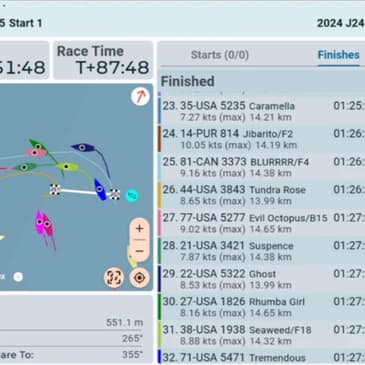
GPS-based starting systems are changing sailboat racing — whether sailors like it or not. In this episode, Pete Boland talks to Todd Wilson, co-founder of Vakaros, about how RaceSense and modern GPS technology are transforming starts, protests, race management, and training.
(Note this is NOT a sponsored episode!)
Todd explains why even elite sailors struggle to ping a line accurately, how RaceSense works, why starts are becoming tighter and more aggressive, how Olympic, J/70, and TP52 fleets are adapting.. and why he was “happy to lose a protest” using his own system’s data
It’s a fascinating look at the technology reshaping competitive sailing — from club racing to the Olympic level.
[00:00:07] Hello there, welcome to Sailfaster, the most popular podcast for racing sailors and thank you very much for tuning in as always. Let's talk about today's topic and its GPS-based starting systems. Love them or hate them, like VAR and SOCHA, it's probably technology that's here to stay. Many of you will already be users via either Velocitech or Vicaros or maybe another system.
[00:00:31] Vicaros in particular is being steadily accepted across both national and international fleets and competitions, as we're all seeing. And many of you no doubt heard our episode with Steve Hunt and Morgan Trubovich a while ago. I looked it up, it was episode 41, August 2025 if you want to go back. But we talked to them about how they get most out of the Vicaros system, which is obviously really worth a listen to that.
[00:00:56] But I think there's one thing we have to acknowledge, and that's that there's a bit of a debate that plays out on a regular basis between those for and against these kinds of systems. And the presee is probably that it's a balance between objective data compressing the skill gap between sailors, among other things, versus concerns over the loss of, I don't know, fundamental racing skills that you sorely need during the starting sequence.
[00:01:21] So, personally I get all that, but for me the chance to reduce that uncertainty over time and distance to that invisible starting line is most welcome. So, what I want to get into is the impact of GPS-based starting systems on racing today, how top-end fleets are using them, how starts are changing, and what can we as racing sailors learn from it, and how they actually work at a technical level. And today we have exactly the right person with us to talk through this, and that's Todd Wilson, co-founder of Vicaros.
[00:01:50] So, hello Todd, welcome to Sail Faster. Hello Pete, thanks for having me. Yeah, it's great to see you. And let's get something out of the way early on. This is not a sponsored episode, just in case listeners are wondering. It just felt like a good time, given the momentum behind Vicaros, to chat to you about how these things work, and what changes are being wrought on our race courses because of them. So, tell us about Vicaros and RaceSense, how that all works. Sure. Vicaros, the company we build battery-powered, self-contained instruments for the sport of sailing.
[00:02:18] Our devices are multi-role. They're your compass, your speedometer, their data logger. They can provide critical metrics like angle of heel or depth if it's paired with a transducer. But then they have this capability we call RaceSense, where they can network together across a race course and provide modern digital fleet management features like detecting boats being over the line or automating the scoring of finishes. How do you see Vicaros as changing racing for better or for worse?
[00:02:45] I think we're making the sport ultimately fairer and more fun. And our mission is to remove what we see as the biggest headaches in the sport and try to improve our time on the water. Ultimately, our time is very limited as people in our professions, our families. Every hour out there is precious. And so if we can make those hours at a higher quality level where we can learn more, get more races off and get back ashore and then enjoy it,
[00:03:11] I think that's going to be our path to success, both as a sport and also as a company. Yeah. We had a really intriguing conversation lead up to this a couple of days ago, where you talked about how you can practice using Vicaros with either a couple of boats, that sort of thing, which I thought was interesting. I want to get into that later on, but let's go back to the start. How did it all come about? What's the origin story of Vicaros?
[00:03:35] Well, I think the lesson is never get two engineers together on a boat because they'll start trying to solve all the problems. What we should have done is probably sail a lot more and practice harder. But instead, what we decided to do is that we needed a technology and a data collection tool to help us improve our sailing. So we were sailing an F-18 and there was this one particular moment. We were off the coast of Florida and this boat has jibing center boards. And it was our first time both sailing a boat that had this.
[00:04:00] And so it was throwing us off on what we felt like was the right angle we should be sailing or where are we going to even end up? And we just wish that we had a measurement device that could tell us, you know, like this is the optimal angle of the way to push the boat. So Jake's an electrical engineer. I come from a software engineering background. This is the recipe for disaster, of course. We started tinkering around building devices and then our friends found out about it and they wanted one and then their friends found out.
[00:04:27] And all of a sudden we're getting all these asks. And so we did something sort of like a Kickstarter and put a crowdfunding announcement out on the Internet. And I had a tremendous response. And now now we were really in trouble. So we definitely had to go go build it. What did it take, though, to go from that moment on the F-18 to actually having a working device? Did that did that take weeks, months, hours?
[00:04:50] Yeah, there was there's probably like an eight month period of just tinkering around and I guess becoming comfortable with the idea that I'm going to leave my great job and and go and actually try to do something like this. And we have the official date that the company started, but it was probably eight months after that, that we would say that we started in anger. But the thought that we were really going to go and do this, you know, we did a lot of prototyping and we actually had this one early product called Redstone that was actually far too grand of an idea.
[00:05:19] It was a bigger display, much more complicated board. And it's a good thing we never actually built it because then we would have we wouldn't be here. But we we realized that we needed something a little simpler or something a bit more portable and ultimately more cost down. And that ended up being the Atlas one. And that, yeah, that started our company and started the product line.
[00:05:39] And there was a great learning curve and many challenges and actually bringing a product to market and setting up manufacturing ourselves, losing a lot of sleep and dealing with suppliers. And but yeah. Did the concept of Wraith Sense, did that happen in the early days as well or did that sort of come later? It came slightly later. So we launched the Atlas one and we're focused on that.
[00:06:01] So when we started working on Atlas two, we learned a lot building that was one, but we really had it in our heads then we really want to build this device that had this capability that could do this across different fleets and the broader sport. And that's really where the seed was planted. We built Atlas two to be able to support Wraith Sense. And we had done that from day zero when we started working on that project. So for me, as a boat owner, as a skipper, it was just not having to ping the end of the line before the race, which I find quite stressful.
[00:06:30] It's just not being able to ping accurately. And then for me, that meant that in those last few meters before the line and seconds before the gun, somewhere in the back of my mind is thinking, I think we were too conservative on that ping. And it just takes your focus away. So under Vicarus, you don't need that, right? Yeah, it's so we have two modes of it.
[00:06:51] So if you're using Wraith Sense where you have that network where basically there's devices on the end of the line and they are constantly reporting their location to all the members of the fleet, you no longer need to ping. And then as the marks move, which they always do, those positions keep getting updated. The device does support manual pinging. So if you're not using Wraith Sense, you can ping the old fashioned way. Yeah, just for the practice. Yeah, just for the practice. Just the act of pinging itself is actually difficult to do.
[00:07:19] I've spent a lot of time on signal boats now, including at the top level of the sport, like the TP52 Super Series, where I watch some of the best sailors in the sport, including these bowmen who go stand up, hold on to the fourth day, stand about, put their hands in the air and drop them at the moment that they're calling the line for the pinks and the navigator is pushing the button on the tablet.
[00:07:43] But when you're actually on the signal boat and you're actually looking down the line and you're seeing the moment that they're making the call versus where the boat actually is, it's actually pretty amazing to see how far off they often are and also how different each boat has a perspective on where the line actually is. It's just a really difficult thing to do. So something like Wraith Sense helps just alleviate that entire problem. Even if you think that you're pinging as soon as the bow is level with the line, what you perceive or your bow person perceives the line to be.
[00:08:13] But then you've got to think about, did I program into the instrument exactly how far it is from the front of the bow anyway, right? So you have to have that compensation. So there's just so many things that can go wrong. If there's a shift, it can affect how close your pinging is, right? Because it'll put your bow either further up or further down. But the most important part is that you've marked a position on the water, but the marks are very, it's very unlikely they'll actually be there at the time that the race starts.
[00:08:42] And so the idea of pinging is it's a rough approximation at best. So now with the pings just being live data that can change automatically, the race officers are now able to move the line right up until the beginning of the sequence. And it creates better race courses. And we don't have to go spend all that time pinging the line. So just going back for a moment on the development of this, what was the sort of inflection point? What was the moment when you guys looked at each other and said, I think this is going to take off?
[00:09:11] Three events come to mind as different inflection points for different parts of the evolution of the product. And the first one was definitely the first time it was ever run live on the water on a real race course with people who weren't our friends, right? Who absolutely were going to let us know if they had criticisms. And that was the M32 fleet in Miami.
[00:09:35] And we rented an Airbnb in a pretty questionable part of Miami and had been up all the night running up and down the street, testing it, lights flashing, neighbors wondering what the heck we're doing. Like I said, this is a theme for the company of seeing how close we get to being arrested effectively for building our sailing devices. So we get out there on the signal boat for the M32s. The first day, they can all tell that we're probably exhausted.
[00:10:00] But we get into the first start and Phil Robison has the helm of one of the boats and just completely blows through the start and looks back at me. He just wanted to see what happened. And his lights went red and he got called OCS and he looked at it and he gave me a thumbs up. And we were like, all right, it's working. It wasn't just a laboratory test. So that was the first one. And probably then the next one was the VX North Americans about three years ago.
[00:10:29] We had, I think it was maybe 60, 50 boats, somewhere in there. And the fleet had been early adopters of this and really embraced it. And the regatta just went extremely well. Everyone was just so happy about it. It was the first regatta where I think people were coming to us and saying like, the whole sport needs to go do this. Like this was an enjoyable experience. It made our regatta better. That struck me of being an inflection point of we're getting this product to a point where people are asking for it.
[00:10:59] And almost insisting on it now at events. So that was a pretty big achievement for us. You had Chris Alexander on your podcast fairly recently. He was just an amazing sailor. He's like, you know, as far as I'm concerned, it's the best invention for sailing since carbon fiber, which I think that's a little excessive. But it was just how he felt about it in the moment of just the enthusiasm he had for it and what he thought it was doing for the regatta.
[00:11:26] So then we get asked by the J70 class to come do their worlds. And typically we don't want to just jump into a major event like a world championships, particularly not for a class like the J70. We want to ease into it, do some regional events and then, you know, maybe a nationals and then build up to a world so that the sailors get used to it. They, you know, they're comfortable with it and it's easy to get the adoption. You're not having to kind of push top down from something like a worlds.
[00:11:54] And so, you know, we get to Palma for the J70 worlds. And once again, I've basically been up all night, this time at a very nice hotel. And so I'm out by the pool with all the devices and lights are flashing. And now the security guys come and they bring the police, the actual cops from Palma. And so they come out and interrogate me and I start trying to explain what I'm doing, which does not help at all. And basically they say like, all right, you can either pack this up and go back to your room or we're going to arrest you.
[00:12:23] I'm like, well, I think we've come to a reasonable agreement. So the next day we get out there, first day of racing, we had a nice practice race. And our line is about a mile long, no midline boat, which was a big change for this fleet. PFLAG start went off perfectly and everything worked extremely well. I was so relieved. Get on shore. And after that day, everyone starts hugging me, basically.
[00:12:49] Like I'm walking down the key of the yacht club and people are just coming up and like just bear hugging me because they're just so happy that they didn't have to go through a million general recalls that day. And from then on, the J70 class has been full steam ahead on race sets and they use it for all of their major events and many clubs and many regional events.
[00:13:11] And so that was sort of the last, I would say, major inflection point of like that class, using it, using it at a major world championship, loving it, and now fully adopting it. And I think that's when we knew this is probably the direction that the rest of the sport will go. So I wonder if we could do a bit of a technology deep dive here. Can you explain to sailors listening, and many of them I know are engineers, so they'll have some baseline of knowledge here.
[00:13:40] But how does it actually work and why is the accuracy so good? Yeah, accuracy requires multiple components and then the full solution. But a good place to start is the precision of the GNSS receiver or the GPS receiver. And to cut to the chase, the reason why ours is so good in Wraith Sense networks is because we use something called DGNSS corrections from a commercial service,
[00:14:03] which any GPS receiver is going to be experiencing error from, you know, difference in the atmosphere or clock drift or something called multipath error, where literally the satellite signal is bouncing off of surfaces like the water or a structure or a boat. Corrections give you a reference point based on the measurements from a known position. That the receiver can compare against and then use to filter out erroneous data. That's a very generalized way of describing it.
[00:14:32] But that's really what the secret sauce is to our GPS performance. And so when I was two with DGNSS, you're highly probable to be within 25 centimeters of positioning error. And with a halo, you're going to be within two centimeters of positioning error. Yeah, that's amazing. That is absolutely amazing. It's the drone technology. It's what's been happening and things like lawnmowers and autonomous cars that are really driving the stuff forward.
[00:15:00] So it's the commercial service we use for our corrections is mostly based around autonomous vehicles. So we were talking the day, Todd, about the experience you've now built up observing when RaySense is used across presumably tons of regattas at this stage. How, in your observation, how have starts changed since Wraith Sense became more widely used? What are you seeing is going on? A number of things. I'm going to repeat a few things that Morgan and Steve said probably on your podcast.
[00:15:30] But you can divide this topic into two sections. Fleets that have the distance to line on their device and other fleets where they've not allowed that. And so the sailors, they know that they're over or not, but they don't know where the line is until the gun. And so for the former, like the J-70, they have the meters to the line. Everyone knows exactly where the line is and they also know exactly when the start is, which is, I think, an unspoken source of error that's always existed.
[00:15:57] But it hasn't really been apparent, the impact of it until recently, in my opinion. So we don't see as many boats getting third row starts anymore or even second row. Everyone can get to the line. The difference is who can do their acceleration at the line, who will have speed, who's working a little bit better, who's going to get their nose out and get in the clear air.
[00:16:19] And I think we look at the data of starts in the RaySense system, there's a pretty direct correlation of speed at the gun to who's at the weather mark first. And even if you're not perfectly on the line, if you're close enough and fast, you will get out. Because a lot of fleets using RaySense for the middle and back of the fleet, they tend to get to the line earlier. Everyone sort of pushes each other to the line a little bit earlier, and so they get downspeed.
[00:16:49] They need to, they've got more of a delta between the boats that are going faster, and so they get shot out the back a bit. So that's one of the differences we're seeing is just that there's always been this worry that a system like this would decrease the skill you needed to do your starts. And some skills, like getting a transient and perceiving where the line is yourself, again, I'm only talking about fleets where you have distance to the line and fleets where you don't, which we can talk about in a minute, that skill very much still exists.
[00:17:19] But the skill of time on distance at speed is probably at a higher premium now than it's ever been. And your ability to maneuver and keep flow and keep attached is critical now. There were gaps before that are less now because the racing is much tighter at the line. So that's certainly one difference we're seeing is just that everyone's on the line. It's who can squeeze out and who can get that jump in the first 10 seconds.
[00:17:47] So speed at the start is a place where we're seeing a lot of the top teams are focusing. But all of this is actively evolving right now. These sailors are all extremely good, and they're top sailors for reasons. They are figuring out the right strategies, the right way to execute all the time. And so, you know, it could be that a year from now, there'll be more ideas on how to start bettering these systems. But it's constantly evolving, and it's pretty fun to watch.
[00:18:16] What about the fleets that don't have the distance to line feature turned on? Yeah, so I was recently in Palma again with the 49er class for the Princess Sophia regatta. And so they are traditional Olympic class, and so they were using race sense, but they do not have the distance to line. The sailors have to start the same way they always have. It's just now when the timer hits zero, they're going to get the lights, you're over or you're not.
[00:18:42] And so the difference is, is before, if you were in a pack, right, and that pack is charging at the line, you really didn't have a choice, right? You had to basically go with the pack, right? The old adage was, you know, when you hear the ratchet of the, you know, next to you, you have to sheet on two because you can't afford not to, right? You'll get shot behind. But that is different now. And it was pretty fun watching these sailors, these Olympians, start to work this out.
[00:19:09] They can't just chase each other effectively over the line and be hidden and have some safety in numbers effectively as a group that either we're going to get general recalled or black flagged, but like it won't happen individually. Now that's not true. You will get called even if you're completely masked. And so the, there is a real risk now in, in like your strategy of like, you can't just let people chase you up over the line just because they're going.
[00:19:34] You, there, you will have to measure how much risk do you want to take on as a start. And it's going to be really interesting to see these fleets figure that out because it does change the strategy a bit. And I think adds a bunch of layers to it, but it's, those fleets all did 100% PFLAG starts, the whole regatta. So no one got letters. We were getting races off on schedule and the sailors were delighted. They, they loved it, but they, they're actively working on figuring it out. And it's, it's fun to watch.
[00:20:03] So if I'm a club racer and I have an Atlas and maybe the fleet I'm in uses a race sense for major races or championships, that sort of thing. Is there a way that I can sort of practice using that system outside of the race? I'm just curious. It's really easy to practice race sense. All you need, in addition to the devices you have on your boat already, is you need two devices and a tablet to control race sense.
[00:20:28] And so you put one device on the boat in, one device on the pen in, you stand up your race sense network and you put in the sequence and there you go. You're, you're literally off to the races. Over a hundred clubs and organizations currently run their own race sense system for, for practicing or just their own regattas. And so it's, it's really easy to do because you don't need specialized hardware. It's just atlases and edges. You know, our normal instruments serve this role of being the ends of the line.
[00:20:56] Creating and driving adoption of technology like this is, is generally really hard and it has not been a beautifully smooth road for you. You've been really successful in doing this, obviously. But are there, are there things that make you feel really good about the introduction of this technology and its impact? Yeah, I'll give two examples. Seeing races where people have been called over and they're still able to go and get a good result or even win races sometimes is compared to them having a black flag or a U flag is a great outcome.
[00:21:26] Because the fact that they were able to, you know, be called over and, and still not have that destroy the race for them is, makes me feel like we're doing something really good for the sport and, and we're, we're keeping it fun. The other thing that comes to mind, and I'll give a personal example of this is, is starting to see data getting used in protests so that we're not just relying on our, our human recollection of what happened. You know, we, we actually have empirical data to back up. It's usually wrong. Yeah, it was usually wrong.
[00:21:54] And so I, I, I kind of famously have used race sense data to lose a protest and I've never been so happy to lose a protest because I was wrong about what I thought had happened. And so it was in VX ones and we were overstood and we were coming in like a rocket ship at the gate. And there was another boat that was basically soaking effectively and just going so slow. And, you know, you're, you're trimming and hiking and you just have these like flashes of, of, of the picture of the race course at the time.
[00:22:21] Right. But coming into the, to the gate, you, you could not have convinced me that we weren't into the zone before they were. I just, in my heart of hearts, I just knew there was no way. Absolutely. Just like it was impossible to think otherwise. And so, you know, when we got to the room, I suggested, well, we have the data. Let's just, let's just replay it and look. And sure enough, I was completely wrong. They absolutely were into the zone before we were. My just perspective on it was wrong.
[00:22:49] And it was a great experience for me because it helped kind of calibrate, like, what does this picture look like on the water? But also it was, you know, they were right. And there was no animosity. There was no lawyering or politicking or the normal stuff that goes on. It was just, oh, it was over in about 60 seconds of here's the information. Oh, yeah. No, they were in the zone first. Yeah. Okay. I'll take my penalty and shake hands. And the three boat length circle is a complete mystery to. No one knows where it is.
[00:23:19] Yeah, exactly right. If we all had a red light or a green light that goes on or a three that flicks up, that would surely make it a lot more. Wraith Sense has that. When you come into the boat, the three boat length circle with RaySense, the lights turn on. It's a pink light. It's a, and it's just solid on the second you're in the zone. And then it goes off when you exit the zone. I didn't know that. It's great. It's the best thing ever because, well, one, we all learn that the zone is actually much smaller than we all thought it was.
[00:23:47] It's just the way we perceive distances on the water. I've been in one race. And so, you know, we were coming to the zone together with another boat. And the person in this boat, they're really good at the theatrics of the zone. Like, how do I express this? I guess making their opinion now. We all know what you mean. Yeah. And so, so they, they, they literally were standing up to make their presentation for lack of a better term. And I was like, your lights aren't on. And then he just sat back down.
[00:24:16] Removes an entire argument on the water of are you or aren't you? And again, I have to say at the end of this, that this is not a commercial. It wasn't meant to be a commercial. This is not a sponsored episode. I'm not even going to get a Vicarus RaySense t-shirt out of this, I don't think. But, but it's really interesting technology. Okay. As you're an engineer, I have to ask this question. What, what still frustrates you about racing that hasn't been solved yet? When we first started Vicarus, it was, it was not initially to build RaySense.
[00:24:45] It was to ultimately create a tool that made it easier to learn and, and analyze your sailing and get better. And I still feel like we've got a lot, a lot more to do there. And so it's just the, we're seeing these amazing tools, these analytical tools, people are recording video and audio on the water. And the, the ability to do analysis and improve the, you know, how much we absorb from a day's on, on the water is improving.
[00:25:13] But it's still, I feel there's still too much friction. And, and so what I would like to start working on next is improving that, making it easier to get insights from, from your sailing. Just the, the act of downloading the data and getting it into something that can, can utilize it is more streamlined. Um, and it's always amazing to go and watch Grand Prix teams, right? And how they, the resources that they have, that they've, they, they've literally got coaches in and out and people who are doing analytics, sometimes overnight for them.
[00:25:42] And they can present these amazing reports the next day. That's great. But, you know, I'd like to see something that was accessible for all of us. In golf, you, you've got systems that will analyze your swing and tell you exactly what you've done wrong. And many other sports are the same way. And there's a lot of, of untapped potential in sailing for, for improving, you know, how, how quickly we, we improve and, and learn about the sport and ourselves. So that's definitely an area where I feel like the data is not getting fully utilized yet. Yeah. That can't come soon enough.
[00:26:11] And usually these things sort of filter down, don't they? From some of the top boats. I can, you know, you've had access to sort of the GP52 teams and, you know, I've talked to some of the people involved in the GP52 and the data is incredible. The analysis is incredible. And you're right. For the average club racer, you have to spend your time faffing around over trying to download data and then convert it into some .csx form or something like that. And then you go, okay, there it is. You think, okay, lots of squiggles on this chart here.
[00:26:40] I'm not sure what I'm going to take away from this. It's hard. So, yeah, more power to you, mate. So come back on in two years with the answer. Yeah. That analysis that everybody can use. If I think it's going to take two, it's probably going to take six. But definitely. No, I think a lot of people are working on this and a lot of great things are happening, I think, in this space. But I'm very excited about it. I, you know, getting as long as I can say, you know, I'm better today than I was yesterday.
[00:27:09] That makes me happy as a sailor. And I know a lot of other people feel the same way. And so what can we do to help always make that the case? Yeah. Todd, this has been fascinating. Thank you so much for spending time with us on Rafe Sense of Akaros. Really, really interesting technology that's obviously changing the game. Thanks for having me, Pete. It's always fun to talk about this stuff.