
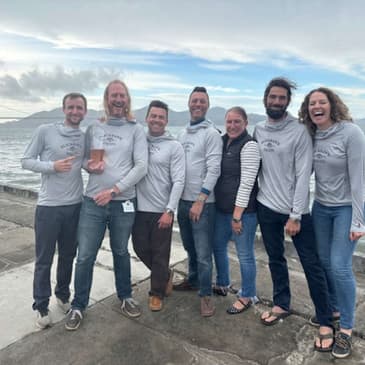
So much to learn from Ryan Simmons and Brent Draney of San Francisco-based J/105 Blackhawk! In this episode we interview Ryan and Brent fresh off their recent success at San Francisco’s Rolex Big Boat Series. We discuss crew dynamics and longevity, the crossovers between business and sailing as well as the team’s history of success including Blackhawk’s six victories in the Big Boat Series. Brent and Ryan dive into how consistent teamwork, preparation, innovation and some serious hiking have contributed to Blackhawk’s impressive track record in competitive sailing!
[00:00:09] Hello everybody and welcome to another episode of Sailfaster. I'm really thrilled that we have Brent Draney and Ryan Simmons from the J105 Blackhawk program out in San Francisco where I know it's 8.30 in the morning guys. I hope you've had coffee and you're ready to go.
[00:00:25] Absolutely. Thank you for having us. This is Brent Draney.
[00:00:28] Good morning, Ryan Simmons. I'm very happy to be here.
[00:00:31] And I did hear Ryan, you've just come back from workout. So the blood is flowing. You're ready to go. You're ready to talk J105s and sailing in general.
[00:00:38] Absolutely. It's actually how I start all of my mornings when we're out racing on Blackhawk. I usually wake up early and get in a run or a workout before we go sailing as well.
[00:00:48] You have a really, really successful program. I think Brent and I were just talking, you've won many honors, the Big Boat Series out there. Is this your fifth win just a few weeks ago?
[00:00:59] My sixth actually, our sixth for the Blackhawk program and my fourth as the skipper of Blackhawk. So we won twice in 2011.
[00:01:08] I was in 2011 and 2013 with my dad on the helm. And I was doing bow and pit for those two different regattas. And then I took over driving in 2014.
[00:01:18] And we've had a pretty good run lately. We won in 19, 21, 23 and 24.
[00:01:23] That's a pretty amazing run. Brent, I think you've been on the team for, again, about 10 plus years, right?
[00:01:30] Yeah, I think Ryan and I were talking, I think I joined in 2012, if that sounds right? And I was there for five of those six Rolex races.
[00:01:40] And speaking of which, Brent, I think you are wearing the Rolex, right, that you just won?
[00:01:45] You know, I normally don't wear it, but Ryan often does. And for this, I decided to pull it out and put it on today.
[00:01:53] And Brent is holding up the camera and it's blinding me with its sparkles and jewels. That's quite a prize, isn't it? Versus a mug or a piece of glass. That's pretty good.
[00:02:03] Yeah, well, it's certainly a great honor to be able to wear it. And it's a great honor that the G105 fleet is still honored to receive them as well. Rolexes are becoming rarer and rarer as the seasons kind of roll on. So it's good to have that opportunity.
[00:02:20] So let's go back to the beginning then. I'd love to know how each of you basically started out in sailing and racing. Ryan, do you want to go first?
[00:02:29] Yeah, absolutely. I grew up in Tiburon Belvedere, really close to the San Francisco Yacht Club, and grew up doing some dinghies on the lagoon there.
[00:02:39] My dad bought a keel boat back when I was eight and nine years old. And it was a Baltic 38, which is kind of like a swan, more of a cruising style boat.
[00:02:51] And we found ourselves racing it 95% of the time and not cruising. So he decided to step into something that was a little bit more race oriented.
[00:03:02] And we got a Bashford House in 41, which is a Sydney 41. And that was a racer cruiser named Cha-Ching that we raced very seriously.
[00:03:11] And I got to be a member of the crew. Started when I was 11 years old. And so that was my exposure to big boat sailing.
[00:03:18] I did a little bit of dinghy sailing through the junior program, a little bit of high school sailing.
[00:03:23] But I was always really drawn to the keel boats. I really liked the camaraderie, the teamwork aspect of it.
[00:03:29] Being 13, 14, 15 years old, and you're out there on the water, you really get treated like an adult and just a member of the crew.
[00:03:37] And I was always really attracted to that. And that was kind of my upbringing in sailing.
[00:03:43] Brilliant. Brent, what about you?
[00:03:44] Yeah, I started racing after I graduated from college and moved out from Utah to the Bay Area.
[00:03:51] I was a ski bum. And so that was my habit when I was up in the Rocky Mountains around the ski slopes.
[00:03:58] And so sailing replaced that shortly after I moved out here.
[00:04:02] Ryan and I actually raced against each other back when he had the Cha-Ching.
[00:04:08] I was crewing on a boat called Raven, which was a Carol Marine 1200.
[00:04:13] And so we got to race against each other when he was this young, delinquent little kid with a mohawk.
[00:04:20] It was really fun.
[00:04:22] One of the things that I loved is Ryan was able to go and do the Pacific Cup with his father.
[00:04:28] It's one of the great things as a teenager.
[00:04:31] And I followed suit with that and brought my son along on a Hawaii race as well when he was 14.
[00:04:37] And there's just nothing quite like being able to cross an ocean with your father to really kind of cement a relationship.
[00:04:45] I'm sure, yeah.
[00:04:46] It really sounds like you've had dreadful lives.
[00:04:48] I don't know how you cope.
[00:04:50] You're in a beautiful, beautiful part of the world.
[00:04:52] Hey, something I was intrigued about was that everyone refers to the Blackhawk program rather than the Blackhawk J-105 or something like that.
[00:05:01] But the Blackhawk program, why is that?
[00:05:04] This is some of the first I've heard of it that is being called the program.
[00:05:09] And I think part of it probably has to do with just the longevity and the number of different players that we've had.
[00:05:18] My dad was the skipper of the boat from 2006 through 2013.
[00:05:24] And then I took over as the skipper.
[00:05:27] We've had, he was a member of our crew back on the Cha-Ching days and the early Blackhawk days.
[00:05:33] Lindsey Brown used to sail with us.
[00:05:35] And now he has really kind of become our shore support and make sure that the boat's in great working order.
[00:05:43] And has really become the go-to guy for the local 105 fleet here in San Francisco.
[00:05:48] Every time someone has a problem with their boat or a question, it is straight to Lindsey, who is part of the Blackhawk program.
[00:05:56] Very entrenched in the local fleet.
[00:05:59] So I think it's just a lot of different aspects that are really connected to the fleet over the years has turned it more into a program, I guess.
[00:06:06] I would add to that, Ryan, that you have invested so much in the crew and maintaining stable crew as well.
[00:06:14] I think we looked at it and our average time on the boat with the program is, you know, at or over a decade for most of us.
[00:06:24] So, yeah, that's pretty rare in sailboat racing to have that kind of an enduring impact with the fleet.
[00:06:31] And we all love sailing with you too, right?
[00:06:34] You really never stop with the team building.
[00:06:37] And I think part of that comes from innately who you are and also what you do for work, which really comes across.
[00:06:44] Yeah, I was intrigued about that, Ryan.
[00:06:45] And, you know, you run a restaurant business.
[00:06:47] And Brent had talked about to me a couple of days ago about how he saw the efficiencies, even to do with how you guys put the boat away, just every opportunity to drive efficiencies.
[00:06:57] And he felt that was, you know, connected to running a multiple restaurant business in the San Francisco Bay.
[00:07:04] How do you how do you react to that?
[00:07:06] You know, it's funny that you make that connection.
[00:07:09] I totally agree that there are an incredible amount of parallels between the restaurant business and running a successful race program.
[00:07:17] And I grew up working in the business.
[00:07:19] I started as a busboy and a host.
[00:07:21] I worked in the kitchen as a dishwasher and a cook and a manager and general manager.
[00:07:26] And then I just recently, about a year ago, took over as CEO of the company.
[00:07:31] And my path on the sailboat is almost identical.
[00:07:34] I started as rail meat and then became the bow assist and the bowman and learned pit and done sail trim and got to step in as the backup helmsman.
[00:07:45] And then eventually ended up taking over the program.
[00:07:47] So the two agendas just run exactly the same.
[00:07:51] And some of the other similarities of it all is you need a team to succeed.
[00:07:57] You can't drive the boat, trim the sails and run the bow.
[00:08:01] Just as in the restaurant, I can't be the bartender, be the cook, be the dishwasher and the host.
[00:08:06] So you really need your people to go out and to be able to execute what they do.
[00:08:10] So there are a lot of similarities.
[00:08:12] I read a Medium blog that had been written about you where it quoted you saying consistency, leadership, long hours, controlling your costs, taking care of the team.
[00:08:22] Those are the sort of the hallmarks of a successful restaurant business.
[00:08:27] And I thought, yeah, it's not that far off for a race team as well, right?
[00:08:31] All those factors, consistency, leadership, long hours.
[00:08:35] You know, I don't...
[00:08:35] The data controlling costs and so on.
[00:08:37] I don't really agree with the controlling cost aspect of it from the sailing standpoint.
[00:08:42] I don't see that connection.
[00:08:43] But all of the other aspects, yes, the consistency is obviously key.
[00:08:48] Leadership is extremely important.
[00:08:49] You're going to have to put in the time if you want to get to the top and taking care of your team, your people, the boat.
[00:08:54] There are so many variables at play.
[00:08:57] And you really need everything going the right way.
[00:09:01] For me, the analogy of controlling the cost is, you know, with the restaurant business, you're out to make money.
[00:09:09] With the sailboats, you're out to win races and do well.
[00:09:12] Controlling your cost is really avoiding those mistakes and the deeply costly high point scores that you might have.
[00:09:20] You know, I think in recent years, we've gone away from how do we win this race?
[00:09:26] Because we can win any race on any given day.
[00:09:28] But our discussion is often how do we avoid getting outside of the top five?
[00:09:35] And that is the cost that we really try and control when we're out there on the water.
[00:09:40] That's really interesting.
[00:09:41] Much better analogy than mine.
[00:09:45] I'm going to come back to that in a minute.
[00:09:46] But I'm curious about for you, Ryan, is there anything that transfers from sailboat racing to running a business?
[00:09:53] Really, it just comes down to the people, trusting your people, letting them do their jobs.
[00:09:59] You know, both from the CEO role and the helmsman role, you are keeping an eye.
[00:10:05] You're paying attention to what people are doing, but you're not micromanaging.
[00:10:08] You're not telling them how to do their job.
[00:10:10] You understand that every job needs to happen in the right order at the right time for the whole thing to succeed.
[00:10:17] Build the team, trust your team, let your team do the job and understand what your role in the team is.
[00:10:22] Yeah, I think that's very true, isn't it?
[00:10:25] The corporate world probably as well as sailing.
[00:10:27] You find the right people, you put them in the right positions, and then you let them get on with doing what they do best.
[00:10:32] I'd like to know, what are you most proud of when it comes to your racing careers?
[00:10:37] I know you've got quite a sort of storied record, but is there anything you're most proud of when it comes to your racing career?
[00:10:43] Brent, do you want to start?
[00:10:44] Certainly being at the top of the Blackhawk program has got to be number one.
[00:10:49] It's being able to consistently go out year after year and be in the top two and three for the season.
[00:10:56] Always have a chance of winning big boat and just building that reputation of being a top boat that is still approachable, where we're out there to help the fleet build and maintain.
[00:11:09] And everyone is happy to see us out there when we succeed and do well, and we're happy to see the others also.
[00:11:16] I think in terms of individual racing successes, probably one of the Pacific Cup races managed to win our class and do fourth overall in Pack Up in Express 37.
[00:11:29] That was a pretty special moment as well.
[00:11:32] Brian, how about you?
[00:11:33] Yeah, for me, as far as the on-the-race course result success, the big boat series and the recent success we've had there would definitely be the top of the list.
[00:11:43] From just sailing in general, what I'm most proud of is the consistency with the crew, the lack of turnover, how many people have wanted to stay on the boat and be a part of it.
[00:11:56] I think it really says a lot of how much people are legitimately enjoying it.
[00:12:00] We've had a lot of success, but we've also had a lot of not successes along the way.
[00:12:05] And the energy has always stayed positive, looking forward, and we haven't had people abandon the program.
[00:12:14] And it's something that I'm extremely proud of.
[00:12:17] Nobody's jumped off halfway down their windward leg and said, I'm done with this.
[00:12:21] Not intentionally.
[00:12:23] Not intentionally.
[00:12:24] I'm curious about how much post-race analysis you do, whether that's sort of sitting down with a team and having an extended debrief, or whether you look at post-race data from your instruments or elsewhere.
[00:12:36] Just curious about that.
[00:12:38] Yeah, Brent, do you want to tackle this one?
[00:12:40] Yeah, so I went through a phase of making sure we had a tool called Race Queues turned on.
[00:12:50] I would probably, about 75% of the time, would remember to turn my phone on for recording.
[00:12:56] That was interesting, and it gave me a few insights.
[00:12:59] But it also gave me a lot of heartburn in reviewing every mistake, because it's pretty obvious when all of a sudden you miss a shift and things like that.
[00:13:08] I've gotten a little bit away from that as much as just doing more self-reflection.
[00:13:14] If we have a move that we're beat on, or we had a bad set or a bad douse, it's like, what went wrong and how do we fix that?
[00:13:23] Those are the things you can't really get out of the data so much.
[00:13:27] And in fact, one of the best moments we had racing, we were out and doing okay somewhere in the top five.
[00:13:34] And then we lost our electronics, and Ryan had to drive by wire.
[00:13:39] And we pulled off the best race ever, being blind with it without the data.
[00:13:43] So I think sometimes you can get yourself too wrapped up in the data and start imagining things that you're seeing with it, instead of just really being in the moment and then having some good reflections on what you just saw.
[00:13:56] I can share a similar anecdote, actually.
[00:13:58] The full series last weekend, our Triton Edge processor stopped working, and I had failed to charge our Velocituck properly.
[00:14:06] So we didn't have compass heading, nor did we have speed, but I had a very good tactician on board.
[00:14:13] We had our best results ever because he just got me to focus on, just focus on the telltales, just focus on the angle of the forced day against horizon and don't get distracted.
[00:14:23] Oddly enough, it was our best day racing.
[00:14:26] Brent, when we talked a couple of days ago, you talked about, I was asking about the success behind it, and you talked about getting the fundamentals right, which is things like having a front row start, going the right way, clear air, minimizing mistakes, working on both speed.
[00:14:39] That's what we all want to do, and we all try to do.
[00:14:42] What do you think has made you guys more successful than the vast majority in delivering on those fundamentals?
[00:14:48] Ooh, I want Ryan to follow up on this one because I have a very myopic view being the main trimmer and the tactician on it.
[00:14:57] I think one of the things we do is every morning we go through the same drill, and it keeps us in the same mindset and in a nice repeatable process.
[00:15:07] We head out to the starting line.
[00:15:09] We'll put up our spinnaker.
[00:15:11] We'll do three or four roll jibes until we have our timing perfect.
[00:15:15] We'll ask the bow what douse they want to practice that morning, and then pull off the craziest possible douses they feel like, or if they just want to go back to basics, you know, a nice weather drop.
[00:15:28] Turn around, go upwind.
[00:15:29] Make sure we have our upwind speed on both legs.
[00:15:32] If not, we'll do our morning boat setup process all over again from folding the prop to checking our leads until we figure out why our speed's not there, get our speed back.
[00:15:42] And then we go and we start analyzing the starting line, and we'll always ping both sides.
[00:15:47] We'll ping them multiple times to make sure boats aren't dragging or swinging too much.
[00:15:53] Figure out which side of the favored end is there.
[00:15:57] Come up with our plan on if we're going to try and win the end or if we're just going to win the third.
[00:16:01] And then know which way we intend to go upwind.
[00:16:07] You know, maybe 70% of the time we get our choice.
[00:16:10] 30% of the time the choice is made for us, and we're digging out for our best alternative.
[00:16:15] And we just repeat that process every single day.
[00:16:18] And even between races, we'll repeat it again.
[00:16:21] And immediately first back to the line, pinging the ends, analyzing which way we want to go, what's the bias of the line, and just constantly moving forward with it.
[00:16:31] Don't dwell on the past race or things like that.
[00:16:35] We'll save that for the dock.
[00:16:37] And don't get into what the sports scores are or anything like that, and just keep the focus on the racing.
[00:16:44] That was pretty long, but I do want to hand that over to Ryan and get Ryan's insights, because that was just what's going through my brain.
[00:16:52] He probably has a totally different mindset with it.
[00:16:55] Thanks, Brent.
[00:16:56] I totally agree.
[00:16:57] We try and keep that same system and just eliminate as many variables as possible that could come in and derail us.
[00:17:05] As long as we're following the same system as different situations come up, we are prepared for them, because you don't have to mentally think about X, Y, Z, because you've already gone through that.
[00:17:18] One of the things Brent did glaze over, everybody knows it, is the boat speed, especially the upwind boat speed.
[00:17:23] It's absolutely everything.
[00:17:24] We're pretty quick upwind.
[00:17:26] We know that.
[00:17:26] We use it to our advantage.
[00:17:28] And if you can get to that weather mark in the top five, it's much easier to stay in the top five than to try and break into the top five once you're coming back downwind.
[00:17:40] It can get a lot harder to get over that hurdle as we get through.
[00:17:45] So we've put a lot of time over the years into getting the boat set up correctly upwind.
[00:17:51] And then, thank you crew, they hike so hard and it absolutely makes a difference.
[00:17:58] When we have close crosses coming up, we'll call for max push and you can literally see the boat go almost a quarter knot faster when they give it their all.
[00:18:07] It's not a sustainable mode, but every extra bit of effort makes an enormous difference upwind.
[00:18:13] Yeah, I saw something where you referred to seeing photographs afterwards of you going upwind and confirming, yep, we do the hardest hiking versus the fleet.
[00:18:23] So for you, that's a factor.
[00:18:24] It's the factor as far as I'm concerned.
[00:18:28] My wife, Kristen, sails with us and I think she's the premier hiker in the San Francisco Bay.
[00:18:33] She's right in the middle of the rail.
[00:18:35] She is super flexible and she is going to make sure that the rest of the crew is hiking just as hard as she is.
[00:18:43] And for you, is that getting the boat flat or is that?
[00:18:46] Yeah, exactly right.
[00:18:47] So it helps keep us a little bit flatter, which and where it really kind of shows itself is as we start to lose speed, I tend to like to point a little bit just to try and minimize distance.
[00:18:58] I think that's overall the best way to go upwind as opposed to going lower and faster in most conditions.
[00:19:04] And as we lose speed and I go to point the bow down to try and build speed, that extra hiking helps keep the boat flat.
[00:19:11] And so we don't slide sideways at all.
[00:19:14] So I can bear off, build speed, stay flatter and then get back up into the point mode of just a little quicker and a little bit more efficient.
[00:19:20] And those foot here, foot there turns into two boat lengths, which is the difference between the cross and having a hole at the weather mark and taking seven sterns.
[00:19:30] We sail in more breeze in San Francisco, which I think probably helps with the pointing mode.
[00:19:36] In lighter air, it's a little harder to get the boat going, especially if you lose your speed pinching up in the light stuff.
[00:19:43] It can take a really long time to get it back.
[00:19:45] So I assume that probably has something to do with the difference of what I like versus what you guys are seeing in Annapolis.
[00:19:51] So the Blackhawk team, the Blackhawk program, you guys have been together for decades, right?
[00:19:56] It's been a while.
[00:19:57] But are there still things that you are learning?
[00:20:00] Are there new things that you learn every year?
[00:20:03] Or is it simply just about honing your skills even tighter and tighter?
[00:20:08] You know, I think we are always innovating as well.
[00:20:11] I think at least in San Francisco Bay, we were the first J-105 to really bring in wing-on-wing sailing.
[00:20:18] And we practiced it for probably almost an entire season between races or before racing, before we pulled it out in a regatta.
[00:20:27] And when we did, it came out smashing.
[00:20:29] And that kind of a thing allowed us to now play with different moves that you don't necessarily have.
[00:20:38] You know, if you're on port and you need to, you can flip the main over to starboard for rights.
[00:20:42] If you have uphill traffic coming at you and you're weaving your way through, you don't have to do jibes or other weird things.
[00:20:49] You can just flip in and out of wing to scoot around traffic to get away from them.
[00:20:54] If someone's up on your weather hip running downwind under Spinnaker and they're, you know, kind of on your air or covering your air,
[00:21:01] you can just flip into a wing for 20 seconds and flip back to find a new lane.
[00:21:07] So I think figuring out new modes of sailing the boat, new ways, just opens up new opportunities as well.
[00:21:14] And then the other thing too is a lot of what we do is really pedestrian, but it's still setting us up for efficiencies that little bits add up over a long period of time.
[00:21:25] Like our Spinnaker sheets, we'll preload around the base of the cabin top winches.
[00:21:31] And then we'll have halyards because we're in heavy wind.
[00:21:35] We really want to control halyard tension.
[00:21:36] We have them loaded on as well.
[00:21:39] And we'll always go upwind with our halyard set so we can easily adjust, add tension, back them off if we need to.
[00:21:47] But then as soon as we peel them off at the top mark, you just grab the sheet and you've got to wrap.
[00:21:52] So you're not fumbling around trying to get ready for your next transition.
[00:21:56] We've done something where we have our Cunningham double-ended.
[00:22:00] So I can grab Cunningham in the back of the boat, but the front crew can let it off when we hit the top mark and are heading to the offset just to gain that little extra bit.
[00:22:12] How do we make that boat more efficient to sail?
[00:22:15] It's hard enough to race as it is.
[00:22:17] If you're making it more complicated, you're not doing yourselves any favors.
[00:22:20] So trying to get that set up to be efficient.
[00:22:23] Playing with the new maneuvers, new ways to sail the boat, figuring out how to get new modes.
[00:22:29] Ryan talked about hiking being everything, and it truly is.
[00:22:33] Not only can it help you go higher at times, it really opens the groove in which the driver can steer too.
[00:22:39] So it makes that that much easier as well.
[00:22:42] Everything we have is about to make it easy and fun.
[00:22:44] And when we're sailing clean, easy, and fun, we're often winning.
[00:22:50] So we're happy with that.
[00:22:51] It sounds like a lot of what you do is really helping you in heavy air as well, which you get in San Francisco, right?
[00:22:57] I guess when you're sailing wing-on-wing, you've got great VMG.
[00:23:01] As you get near the gates, that's that tactical advantage of being able to switch from or be able to stay on starboard.
[00:23:07] Really interesting.
[00:23:08] Yeah, that's exactly right.
[00:23:10] Ryan, what about you in terms of other things that you have learned recently or this season that you think,
[00:23:16] oh, didn't know that?
[00:23:16] You know, I've learned so much about the rules over the last 10 years of being on the helm.
[00:23:24] And I think that's made a huge difference as well with our overall performances.
[00:23:30] Having the helmsman aware of the rules and how they change, especially with maneuvers and at marks.
[00:23:36] The decisions that you have to make just happen instantaneously.
[00:23:39] It takes way too long for Brent to process, communicate, say it to me, and then have me make a reaction to it.
[00:23:45] That we're going to find ourselves in, honestly, very dangerous situations.
[00:23:49] And so being aware of that has made a really big difference.
[00:23:53] It's an ongoing process.
[00:23:54] We don't get it right every time.
[00:23:56] But, you know, really just being aware, making safety the single most important thing.
[00:24:01] We will definitely sacrifice a race, a position, whatever it may be for the safety of our crew and our fleet and all the boats.
[00:24:10] And then, you know, Brent touched on the evolution of just kind of learning the wing-on-wing was a big part of it all.
[00:24:16] I really struggled without a main trimmer actively trimming the main in my first few years.
[00:24:22] And we've been working really hard of trying to get Brent on the rail as much as possible.
[00:24:26] And having me drive the boat and be able to trim my own main when the conditions and the situations present itself.
[00:24:33] We've picked up some different sets.
[00:24:35] We have a set where we do the pole in the middle of the set instead of having the pole out and everything loaded like that, which is really nice.
[00:24:42] We've learned how to set directly into a wing-on-wing, which can be very beneficial.
[00:24:49] And then, as with most everything in life, communication of how we communicate both short-term just between me and Brent.
[00:24:57] And then communicating with the entire crew and making sure everybody's aware of just the overall game plan.
[00:25:03] Okay, we're going to go left.
[00:25:05] Our goal is to not make it to the lay line.
[00:25:07] We're going to be doing a quick jive coming out of the weather mark.
[00:25:10] Everyone be ready for it.
[00:25:11] It's going to be a port douse, a starboard douse.
[00:25:13] It's just making sure everyone is kind of aware of what is coming and allows them to kind of go through the mental rep before the situation itself gets there.
[00:25:22] You know, if we're coming in tight cross, we're not sure if we have it.
[00:25:25] We're either going to make it or it's going to be a last-second tack.
[00:25:28] And everyone's like, okay, I'm going to hike extra hard and I might have to bail out in scramble mode.
[00:25:32] You talked about the rules of the marks.
[00:25:35] I'm pulling out my little mini boats, the little mark things, because it's very, very complex.
[00:25:42] So that's really interesting about a key factor for you is just being very, very learned when it comes to the rules, especially around marks.
[00:25:51] Yeah.
[00:25:51] If it's going to be a hairy or a tight situation, we'll generally start talking 15 boat lengths out of how do you see this shaking out?
[00:26:01] Just so I have a general idea.
[00:26:04] Brent knows the rules inside out and I'm working my way up the list of getting them down.
[00:26:08] By the way, are you a tiller or a wheel?
[00:26:11] Wheel.
[00:26:12] You're a wheel, yeah, which is more suited to probably stronger winds.
[00:26:16] People keep telling me, well, one person on my boat keeps telling me, you've got to convert it to a tiller.
[00:26:20] I was like, well, I didn't grow up sailing dinghy, so it's not going to get any better feel out of a tiller.
[00:26:25] But I'm curious, you ever thought about converting it?
[00:26:27] Is that even a conversation in San Francisco?
[00:26:28] You know, I have thought about a lot of the boats here are tillers.
[00:26:32] A lot of the top boats are tillers here as well.
[00:26:34] I had the opportunity to do the Lipton Cup down in San Diego, which is a rotational regatta in J105s, which is half wheels, half tillers.
[00:26:41] And from a racing standpoint, I really do prefer the tiller, upwind especially.
[00:26:46] Downwind, it's great.
[00:26:47] In the pre-starts or any heavier reaching, the tiller can be extremely heavy.
[00:26:52] I think the wheel's a bit of an advantage in that scenario.
[00:26:55] But overall, the tiller probably or definitely is the right way to go for the racing boat.
[00:27:01] We use Blackhawk a lot cruising as well.
[00:27:04] We'll take the boat out 15, 20 times a year cruising.
[00:27:07] We have a little five-year-old.
[00:27:08] He loves being there.
[00:27:10] So just the platform kind of works better for what we use the boat for.
[00:27:14] But from a strictly racing standpoint, there's a lot of value to having the tiller.
[00:27:17] Yeah, it's four or five hundred pounds of weight as well.
[00:27:20] There's something you can get out the back, people tell me.
[00:27:23] Yeah, yeah.
[00:27:23] Hey, Brent, when we talked the other day, you talked about being in the back half the fleet,
[00:27:28] then sort of going over the fold as you talked about to the top.
[00:27:31] Do you remember if there were any sort of key step changes in performance that you learned?
[00:27:37] Like maybe, hey, we realize windward cheating is going to get to the windward mark faster.
[00:27:41] Just anything there?
[00:27:42] Yeah, and this is more for me over my sailing career, not necessarily in my tenure with Blackhawk.
[00:27:50] I think Blackhawk had gotten through their growing pains before I came on board.
[00:27:57] Certainly being able to just tack the boat is important.
[00:28:04] Cross-sheeting in the Bay Area is super important.
[00:28:08] Other places, it might be cabin top sheeting in really light air.
[00:28:12] So that was one.
[00:28:13] The other one is figuring out the fine details on angles for me was really important.
[00:28:19] What is your opposite angle for your tacks and your jibes to be able to call those lay lines
[00:28:24] correctly and know, am I going to be able to cross those boats or am I going to be tacking
[00:28:30] and then immediately tacking back?
[00:28:32] Do I have a clean cross under spinnakers or not?
[00:28:36] Am I getting overstood?
[00:28:39] And then probably the last bit of that evolution is when you can look at the water,
[00:28:47] not only can you see the puffs, but you can see the puffs and the directions they're coming
[00:28:51] and you understand why.
[00:28:52] You can look at the weather and you can see how wind is wrapping around islands and things
[00:28:58] like that.
[00:28:59] And so you know where to go on the course.
[00:29:02] And once you get to that level of understanding, you have a significant advantage over the team
[00:29:09] that's been out there for just two or three or even five years.
[00:29:13] It'll take a decade to really get through and be able to do all of those activities and get
[00:29:19] enough time and see enough different circumstances to understand what it means and which way you're
[00:29:24] going to need to go, especially in San Francisco Bay, which is heavily governed by local knowledge
[00:29:29] and the currents.
[00:29:31] Yeah, I think San Francisco Bay must be one of the most complex places to sail, given it's
[00:29:36] a bowl with the wind coming through the bridge and then the current.
[00:29:41] There's never a slack period, is there, in San Francisco Bay?
[00:29:44] There's always those tongues of current that you can see.
[00:29:47] And you guys know where those are going to be, presumably at what point of the tide cycle.
[00:29:55] Yeah, exactly right.
[00:29:57] And you don't have to, you know, once you understand the principles of the bay, you don't have to
[00:30:02] study the entire map to understand it.
[00:30:05] You know, the South Bay will always go first if it's ebbing or flooding.
[00:30:09] The North Bay follows.
[00:30:11] You know, the difference between going to the city front from relief or going to the cone
[00:30:16] is how many hours after max flood it is.
[00:30:20] We'll determine whether or not you'll find that relief on the city front.
[00:30:24] And if not, you just have to hang it out to the cone of Alcatraz.
[00:30:28] The wind is remarkably steady and predictable.
[00:30:31] So in a lot of ways, I think San Francisco is easier to sail and certainly easier for me to sail
[00:30:37] than, say, the Chesapeake or Cleveland, where you're relying on shifts and the weather fronts
[00:30:45] come through, we'll go and swing wind by 100 degrees.
[00:30:49] For me, that's my next set of learning, is to be able to understand lake sailing
[00:30:54] and weather-dominated conditions.
[00:30:57] Brent, do they still have the bay model?
[00:30:59] They do.
[00:31:01] In Sausalito.
[00:31:02] Yeah.
[00:31:02] And, you know, Cammy Richards gives a great talk about the bay model and how it works
[00:31:08] and, you know, why you get relief on the shore sooner.
[00:31:13] And he also says, you know, slack water means the same amount of water is going in and is
[00:31:18] coming out, right?
[00:31:19] To your point that it is never stopped.
[00:31:23] There's always water moving somewhere.
[00:31:24] I remember the bay model would show you the eddies, doesn't it?
[00:31:27] It would show you the eddies going up the city front or through Raccoon Strait or wherever.
[00:31:32] I can't remember.
[00:31:33] Yeah, exactly.
[00:31:34] And he went and put Telltales in the water too.
[00:31:37] So you'd see what it was doing on the bottom versus on the top.
[00:31:41] And so...
[00:31:42] Isn't that accurate?
[00:31:43] Yeah.
[00:31:43] And so when we say that, hey, it starts on the edges, right?
[00:31:49] The tide change always starts on the edges.
[00:31:51] The whole bottom is the edge.
[00:31:53] So it's not just on the sides, right?
[00:31:56] It turns first at the bottom and the entire bowl of the bay.
[00:32:01] Wow.
[00:32:03] Right?
[00:32:03] So it's...
[00:32:04] Yeah.
[00:32:04] Ryan, same question for you then in terms of the progress that you've made and the knowledge
[00:32:08] you've built.
[00:32:09] I mean, you moved into that role of being helm.
[00:32:13] What are things that you learned very quickly?
[00:32:16] You know, I think more than anything with helming, it goes back to knowing your role.
[00:32:20] And as the helm was in my job is to make sure the boat is going as fast as possible at all
[00:32:26] times.
[00:32:26] So I don't look around the race course all that much.
[00:32:30] At this stage, we have a lot of experience in the bay and in the one design racing.
[00:32:34] So conceptually, in my mind, I have a picture of what's happening kind of around me.
[00:32:39] I'll take the occasional peek.
[00:32:40] Every time I look over my shoulder just to see what's happening, I come back to the speedo
[00:32:45] and we have lost speed.
[00:32:47] We're going...
[00:32:47] It's not going well.
[00:32:48] So I really spend 90, 95% of my energy just focusing on making sure the boat has maximum
[00:32:55] VMG at all times and just trust in Brent and the crew to be feeding me information so
[00:33:02] that I have an idea of how the rest of it's going.
[00:33:05] So we'll talk about, you know, tactics and stuff, but I'm not looking at those things
[00:33:10] at all.
[00:33:11] What does regatta prep look like for you?
[00:33:14] I always ask this question and I get a huge variety of answers.
[00:33:17] So it seems like a pretty straightforward question to ask, but in fact, you can unearth some interesting
[00:33:22] stuff.
[00:33:23] So what does regatta preparation look like for you and the team?
[00:33:26] And do you think there's anything you do differently from the other J105 teams in the area?
[00:33:31] So I think number one, the machine has to be in perfect working order.
[00:33:36] If halyards are breaking, if winches are locking up, if the bottoms failed, anything along those
[00:33:41] lines, there's no way to go out and win.
[00:33:43] So you got to have the boat in working order.
[00:33:46] We spend a lot of time and energy.
[00:33:47] Again, I mentioned Lindsey Brown earlier.
[00:33:50] He makes sure that every time we leave the dock, we have got every single tool that
[00:33:54] we need to go out and succeed.
[00:33:56] You got to have the right sails as well.
[00:33:58] You got to have the right...
[00:34:00] We have a maximum crew weight.
[00:34:01] So you got to be close to weight in the wind that we sail at.
[00:34:05] So those are all kind of just the intangibles.
[00:34:08] I don't think we have an advantage over the top boats.
[00:34:11] I think some of the middle and the bottom boats might not put the same amount of attention
[00:34:15] into the platform that we do.
[00:34:17] And then there's not that much we do differently.
[00:34:22] But with the steady crew that we've had over the...
[00:34:26] I mean, the newest member of our crew has been sailing with us for five years.
[00:34:29] And four of us have been together for 10 plus years.
[00:34:33] So everyone kind of knows the drill.
[00:34:35] We don't make that many changes.
[00:34:37] And then we'll be watching the weather and the tide forecast and that sort of stuff.
[00:34:40] I wouldn't say there's any secret sauce other than making sure the boat is fully prepared
[00:34:47] when we leave the dock.
[00:34:48] Do you split responsibilities between the team and somebody make sure the radios are charged?
[00:34:55] Somebody else make sure they've got the latest weather forecast?
[00:34:57] Most of that falls on me.
[00:34:59] I do sandwiches, the beers, the waters, the radios.
[00:35:03] I do a lot of prep work.
[00:35:05] I'd like to talk about starting, if you don't mind.
[00:35:07] I mean, these are heavy, low boats that they're worth.
[00:35:12] So the start is obviously absolutely crucial as it is for most races.
[00:35:15] But how do you handle starts in terms of who's responsible decision-making?
[00:35:19] Is it tactician making the calls or is the helm making the calls?
[00:35:23] Because you mentioned that you spend a lot of time in pre-start thinking.
[00:35:27] And then you talked about handing it over to Ryan.
[00:35:30] Yeah.
[00:35:31] So we'll go through pre-start, ping the lines.
[00:35:35] We're looking at the shifts.
[00:35:36] We're looking at how the wind is oscillating and decide which way we want to go.
[00:35:40] We'll typically pick a third of the line, right?
[00:35:43] So we'll say we want pin third or boat third.
[00:35:46] If magically the fleet opens up either of the ends and it's easy to win an end, we'll go
[00:35:52] and take that.
[00:35:52] But we don't necessarily say, yeah, we're after winning the boat or winning the pin.
[00:35:58] About a minute, minute and a half, two minutes, somewhere in there, we'll be on port.
[00:36:04] And we'll say, we'll pick kind of together, okay, what pack are we going to lead back?
[00:36:09] What hole are we going to go for?
[00:36:11] Everything after that is pretty much Ryan.
[00:36:14] I'll feed Ryan info on, I think we've got time to kill.
[00:36:17] Or looking at it, we're going well.
[00:36:21] And we should just heat up and go.
[00:36:23] But at that point, it's really Ryan.
[00:36:25] And I do have to say the instrument package that we have with BNG is really instrumental
[00:36:30] for us getting a good start.
[00:36:32] It keeps us in the box.
[00:36:33] We know where the lay lines are.
[00:36:35] We test the lay lines to make sure that they're accurate.
[00:36:39] And having it draw a line that you're racing against up to the starting line really makes
[00:36:44] it easy to help self-pace.
[00:36:46] If we didn't have something like that, if we were using a Velocitek there, I would make
[00:36:51] sure that when we do that last tack, we're always the same number of meters away from
[00:36:56] the line.
[00:36:56] 60 meters or something, just under six-foot lengths, with a minute to go is kind of manageable.
[00:37:02] And we were using that at the North Americans in Cleveland to pretty good success in getting
[00:37:08] off the line cleanly.
[00:37:09] I'll hand it over to Ryan, who can talk about kind of what he's doing in that last 45 seconds
[00:37:15] as we approach the line as well.
[00:37:17] Yeah, absolutely.
[00:37:17] It's more often than not, like Brent said, we're just trying to go for a third of the
[00:37:22] line.
[00:37:22] It's no surprise.
[00:37:23] You want a nice hole below you that you can put your bow down and accelerate.
[00:37:27] So if we're in a scenario where we can create that, that's outstanding.
[00:37:31] On the occasion that you need the boat or you need the pin, that's definitely a lot more pressure,
[00:37:37] making sure you don't fall below a lay line or get closed out of the boat.
[00:37:40] If we are going to be up at the boat, I think one thing that we're pretty good at is patience.
[00:37:43] If we know that we're above the barge line and it's pretty crowded there, we won't go
[00:37:48] and put our nose anywhere there.
[00:37:50] We'll just kind of go head to wind and wait and let it clear out.
[00:37:54] If you're going for the boat, you probably want to go right anyway.
[00:37:58] So if you're late at the boat by five seconds, 10 seconds, and just tack immediately, you're
[00:38:03] still going to find yourself in clear air.
[00:38:06] Again, there's no real secrets to it at all.
[00:38:08] The goal is to you got to beat the boat above you and the boat below you.
[00:38:10] So making sure that you got your bow out in front of them is a big part of it.
[00:38:15] And then just pulling the trigger.
[00:38:17] If you can pull the trigger three seconds, five seconds before the boat's around you and
[00:38:21] start accelerating, there's almost no way for them to stop it.
[00:38:26] So really just timing that acceleration is key.
[00:38:29] Hey Brent, you were talking about the B&G.
[00:38:31] I know they have that starting setup where you can start to see the lay lines.
[00:38:36] It's really hard to see, isn't it?
[00:38:38] Yeah, we've got a bigger one that we mount in the companion way and it's on a swing out
[00:38:47] arm.
[00:38:47] Oh yeah.
[00:38:48] And so, yeah, it's got to be closer to 11 or 13 inches.
[00:38:53] So I think for us, that's pretty good.
[00:38:56] The one thing I wish B&G would do, it's colored screen.
[00:39:00] I wish it would give more color indicators of green, you're good to go.
[00:39:04] Red, you're over early.
[00:39:05] Yellow, you're right on time or be careful with it.
[00:39:09] But in general, we found it fairly easy to adapt to.
[00:39:12] And I like it better than numbers from a visual.
[00:39:15] I can glance at a visual and know I'm ahead of the line or behind the line.
[00:39:20] If I have to do math in my head and I'm calculating numbers and trying to figure out how many seconds
[00:39:25] to kill, that's a little bit harder.
[00:39:27] Right?
[00:39:28] I think the VACROS also gives time to kill where they calculate it.
[00:39:32] And that is certainly helpful.
[00:39:34] But you have to be careful because it bounces around quite a bit, depending on if you're
[00:39:38] accelerating or how the boat's pointing.
[00:39:40] And if you just glance at it for a second, you hit one of the high points.
[00:39:44] You could get a really wrong impression of where you're at.
[00:39:47] The Velocitech's got quite an interesting visual, hasn't it?
[00:39:50] It'll show you whether you're early or whether you're late.
[00:39:53] That's quite a good little tool.
[00:39:56] But again, you're looking at tiny little bars, which is five meters in front of you.
[00:40:02] So it's not that easy.
[00:40:04] Okay, last question for you.
[00:40:06] And this is a bit of a strange one.
[00:40:07] But you've stuck with the J105 for a long time.
[00:40:11] You're hugely successful in it.
[00:40:13] It's a great boat and a highly competitive fleet.
[00:40:16] But have you ever been tempted to switch to other platforms?
[00:40:20] You know, one of the things that I've started to appreciate more and more is sailing on other
[00:40:26] people's boats is absolutely fantastic.
[00:40:28] Not having to run the program.
[00:40:31] And it really opens up the door of getting to be on a lot of different boats.
[00:40:36] I get to do other roles.
[00:40:37] One of the things I notice when I'm crewing on other people's boats is I get to look
[00:40:42] around and appreciate how beautiful the San Francisco Bay is and looking up the streets
[00:40:46] and the bridge and all that stuff.
[00:40:49] So I very much am enjoying getting my other fleet and other boat action sailing with other
[00:40:55] people.
[00:40:56] But what's the enduring appeal of the J105 for you?
[00:41:00] And there's plenty of the glasses.
[00:41:02] You know, I think it's a great platform for the San Francisco Bay.
[00:41:05] It's a slightly underpowered boat and we get so much breeze.
[00:41:09] So it's a really good stable platform.
[00:41:11] It's still a growing fleet.
[00:41:13] We've had multiple of the top local sailors either join the fleet or come back to the J105
[00:41:21] fleet to someone who used to own a boat.
[00:41:22] So it's something that people want to be a part of.
[00:41:25] I love the co-ed aspect of it.
[00:41:27] Most every boat has one or two females on board, which I think is a fantastic thing.
[00:41:31] I love the aspect that it does to our crew and to the fleet and from just the general
[00:41:35] crew communication morale.
[00:41:37] I think it is different and better doing that.
[00:41:41] And the boats are really perfectly suited for the bay, especially in the slot, which
[00:41:47] is where we do most of our sailing.
[00:41:49] It's a good boat for a rating system.
[00:41:51] Again, we take the boat cruising a bunch.
[00:41:52] What we do is we sail at jib only.
[00:41:54] We don't do any cross-sheeting.
[00:41:56] So there's no boom.
[00:41:57] There's no traveler coming across.
[00:41:58] It's just a really nice, safe way to go out there.
[00:42:03] Brent, I'm curious.
[00:42:04] So you saw Ryan transition from the front of the boat to the back of the boat into the
[00:42:10] driver's seat, as it were.
[00:42:11] What was that like for you?
[00:42:12] You know, for us as a crew, we were uncertain how that was going to go.
[00:42:16] And Ryan came back with a really mellow attitude to it.
[00:42:22] There wasn't a whole lot of stress involved.
[00:42:24] And he did really well.
[00:42:26] In fact, we won that first season.
[00:42:28] And I think it surprised us and it surprised the rest of the fleet at just how well we were
[00:42:34] going to be able to make that transition.
[00:42:36] Where did that helming skill come from?
[00:42:38] It's from other boats or?
[00:42:42] Growing up, having sailed in dinghies and the Sunfish and the Laser and the Lido 14,
[00:42:46] we used Del Toro's for high school sailing and FJs.
[00:42:51] I had quite a bit of tiller time coming in in advance to driving.
[00:42:56] I had driven Blackhawk around a little bit, not in the A series racing, but learning from
[00:43:05] a young age in those small boats is just, it's super important and really shows.
[00:43:12] I think every top sailor, I listen to quite a few of your Sail Faster podcasts.
[00:43:16] And every one of these guys that you're interviewing started in dinghies from a young age.
[00:43:20] And it's clearly, there's a reason that's where we all start.
[00:43:25] Okay.
[00:43:26] This has been fantastic time spent with you.
[00:43:28] It's really a privilege to hear from the Blackhawk team.
[00:43:31] So thank you, Brent Rainey.
[00:43:33] Thank you, Ryan Simmons for spending some time with Sail Faster.
[00:43:37] And congratulations on another Big Boat Series, another successful season.
[00:43:41] Thank you very much for having us.
[00:43:43] It's been a pleasure talking with you.
[00:43:44] Yeah, much appreciated.
[00:43:46] Very honored to be included.
[00:43:48] Thank you.
[00:43:49] And as I always say, see you on the water.
[00:43:51] But perhaps I'm next out in San Francisco.
[00:43:54] I can try and hitch a ride and make the tea and sandwiches for you.
[00:43:57] We'd love that.