
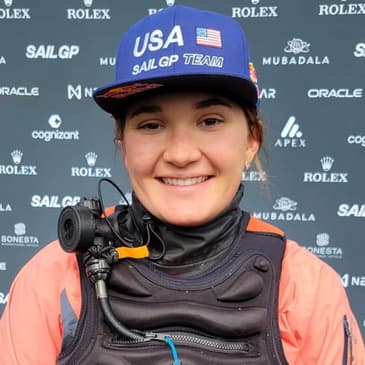
Today we’re talking to Cam Farrah, a world champion foiler who experienced what’s it like to be thrown into the Strategist role on the US SailGP team. Cam has some remarkable stories of what it’s like to be at the sharp end of a 70 mph catamaran in full view of the cameras!
Surviving a SailGP series is only one of Cam’s skills, she’s one of the US’s best young sailors and has fully embraced the foiling revolution. She’s been a world champion on Foiling A class Catamarans for the last two years, and a leading sailor on the 69F, the one design foiling monohull that looks like a mini America’s Cup design and similarly sails at astonishing speeds. She’s a recent graduate of Tulane university in New Orleans, and already has a sailing CV that runs to multiple pages. It was truly a privilege to chat to Cam, as you’ll hear, she tells some great stories from the new world of foiling, and has of course, some great insights into sailing faster.
[00:00:00] Hi, everybody, and welcome to SailFaster, the podcast for those who obsess about sailing
[00:00:14] faster than anybody else. We are up to episode 11, I believe you can catch them all wherever
[00:00:22] you get your favorite podcast from, or just go to www.sailfaster.net. We've got many more
[00:00:30] to come, it's spring and I hope that everyone is starting to get out on the water again and
[00:00:36] dusting off the boat or in the northeast brushing off the ice from the boat. Of course those
[00:00:41] of you who are in Florida or the Mediterranean or the Caribbean or the Southern Hemisphere,
[00:00:45] you have been sailing all through the winter of course. And actually I'm forgetting
[00:00:50] those who did a bit of winter frostbites throughout the winter. I'm feeling like quite
[00:00:56] a loser because I haven't been out on the water on the boat for quite a while now, but
[00:01:01] you know what, after 20 years of living in California and Florida, I'm not quite comfortable
[00:01:05] yet with northern winter sailing. Meanwhile our J105 is out of the water right now,
[00:01:10] we've got hauled this morning so I heard. I'm going to head over and see what we
[00:01:15] need to do to get her bottom in perfect shape for the upcoming season. Hopefully all the
[00:01:21] old girl needs is just a bit of spit and polish here and there, but we'll see. I tell
[00:01:27] you what today's episode is going to be a cracker. I bet some of you are watching
[00:01:31] the Sail GP series on YouTube. That's those 15 meter foiling cats moving it up to
[00:01:39] like 100 kilometers per hour over a relatively small race course. It's quite a spectacle,
[00:01:44] lots of drama, lots of close crossing and so on. And you know, they've got a good video team
[00:01:48] because they do a good job of overlaying graphics to show ladder lines and lay lines and so
[00:01:53] on, which makes it quite useful. And they do relay the drama quite well through multiple
[00:01:58] cameras and so on. It might only bear a passing resemblance to what we know right
[00:02:04] now is Windward-Lewitt club racing, but that said, it's a very dynamic and exciting
[00:02:08] branch of the sport. And I bet it foreshadows what club racing is going to look like
[00:02:13] in, you know, 10 years or so. So why am I talking about the Sail GP? Well, today it's
[00:02:18] because we're talking to Cam Fara who experienced last year what it's like to be
[00:02:23] thrown into the strategist role on the US Sail GP team. She called it a
[00:02:29] baptism of fire and it certainly looked like that. She's got some remarkable stories
[00:02:33] of what it's like to be at the sharp end of a 72 mile per hour catamaran in full view
[00:02:38] of the cameras. Surviving a Sail GP series is only one of Cam's many skills. She's
[00:02:45] one of the US's best young sailors and she's fully embraced the foiling revolution. She's
[00:02:50] been a world champion on foiling A-class catarans for the last two years. And she's a leading sailor
[00:02:57] on the 69F, which is the one designed foiling monohull that looks a little bit like an
[00:03:03] America's Cup design and similarly sails at astonishing speeds. When I say America's Cup,
[00:03:08] I mean contemporary America's Cup designs. Cam's a recent graduate of Tulane University in New Orleans
[00:03:14] and surely has a sailing resume that runs to multiple pages. It was truly a privilege to
[00:03:20] chat to Cam as you'll hear. She tells some great stories from the new world of foiling
[00:03:25] and has, of course, some great insights into sailing faster. So I do hope you'll enjoy it.
[00:03:30] Hey, one quick thing before I press play listening to the episode. I realized I was suffering from
[00:03:37] some sort of head cold so my voice sounds a little bit crackly. It could have been due to a
[00:03:42] hangover from a big night out with my wife. Can't quite remember. Anyway, enjoy it.
[00:03:48] So Cam, welcome to SailFaster. I'm really thrilled to have you on our series.
[00:04:02] Thanks. I'm stoked to be here. Really appreciate it. You're calling from Florida, right?
[00:04:06] Yeah, I'm home. I'm in Daston, Florida, which is pretty close to Pensacola.
[00:04:10] Yep, I know it well. We used to live in Seaside, beautiful part of the world. Fort Walton
[00:04:15] Yacht Club. Yes, absolutely. Favorite yacht club on earth.
[00:04:18] Those amazing sandy beaches. Anyway, welcome to SailFaster. I'm so thrilled to have you.
[00:04:24] We were talking about it. You just came back from a scoring an amazing result in the midwinter,
[00:04:30] didn't you? Yeah, yeah. I just got back from Key Largo, Florida, which was fabulous.
[00:04:35] Perfect and nice and warm in the middle of the winter. But I won the
[00:04:40] A-Cat, Cadmuran midwinter championship. Just like that. Yeah.
[00:04:46] And that's overall not the leading woman. You won the overall.
[00:04:49] Yeah, totally overall. Yeah, first woman to ever do so in the class. I was pretty excited about
[00:04:54] it. So did everything went right? Yeah, no, for the most part, everything went right. The boat
[00:05:01] all held together just fine and had good starts most of the regatta and just tried
[00:05:07] to stay really consistent, which was good. You have an amazing sailing resume for if I can say
[00:05:12] for somebody so young, it's just ridiculous. So how did it get started? How do you get started on this?
[00:05:18] Yeah, so I was pretty fortunate to grow up somewhere where sailing is so easy. Being in
[00:05:24] Northwest Florida, we can sail year round and my dad was a big sailor. He sailed like multi-holes,
[00:05:30] so mostly trimerans. And I had sailed with him always since I was little,
[00:05:35] but never really competitively until I was 16 or 17. So I always kind of felt like it was a bit late
[00:05:41] to the competitive sailing game compared to everyone else who sailed, opties growing up and
[00:05:47] everything. But yeah, I always did a lot of Cadmuran sailing, multi-hole stuff,
[00:05:52] a lot of wetter trimerans. That was kind of my version of the opties. So I sailed that
[00:05:57] since I was probably like eight or 10 with my dad. Love the boat. The best memory I have on
[00:06:03] the wetter was one day my dad sailed me out to the middle of the bay. So he was on the trimeran with
[00:06:08] me on the wetter and I was crewing for him. And my dad always thought it was very important that
[00:06:14] I learned how to drive the boat because women often don't get as much opportunity to helm the boat.
[00:06:19] So he was like, you know, you really need to learn how to drive. No, I don't want to do it.
[00:06:24] You know, I'm like 10 years old, eight years old, and he's got a six pack of beer and he
[00:06:29] wedges himself into the middle of the wetter trimeran underneath the boom. And he cracks open
[00:06:34] a beer and he looks at me and he says, well kid, I'm drunk, you got to get me to land. And I was
[00:06:38] like, oh my God, no, like, he's gonna die. I'm not going to be able to get him in all safe.
[00:06:43] And I was freaking out, but I eventually sailed him in fine. And that kind of started the whole
[00:06:49] beginning of driving boats and racing boats really. You race obviously in college, didn't you?
[00:06:54] Yep. You're a plane right in New Orleans. That's another big sailing area.
[00:06:58] Yeah, I was super fortunate to get recruited to Tulane. So we're the first group of varsity
[00:07:04] athletes at Tulane. So this wonderful donor gave a ton of money to the Tulane sailing program.
[00:07:10] And I mean, we were treated the same as the football team there. It was incredible
[00:07:14] to have that many resources. We won nationals my senior year and yeah, it was great.
[00:07:21] So where are you now in your sailing career? I can see from what I know about you from
[00:07:27] your resume and sort of what you're famous for is foiling. Is that where you're going with
[00:07:33] your career? Do you think foiling? And obviously, we need to talk about sail GP
[00:07:38] and sailing with Jimmy Spitzel. I can't wait to talk to you about that. But
[00:07:42] where are you in your sailing career right now?
[00:07:45] Yeah, I don't know. It's hard to say. I mean, I've done, I feel like so much over the past
[00:07:50] two years since graduating college that I'm trying to really decide what my main focus
[00:07:55] is going to be. And for me, like right now the ACAT is my absolute favorite boat that I'm sailing.
[00:08:01] And it's one of those boats that I feel like over time I can really get to the top of that podium.
[00:08:07] So putting a lot of emphasis on focusing on worlds every year for the ACAT and I've been
[00:08:12] steadily moving up that scoreboard I head down to, I guess over to Italy in the fall
[00:08:18] for the next world championship. But yeah, I'm focusing a lot on just racing a ton and
[00:08:24] focusing on the kind of sailing that makes me happy, not getting burnt out and
[00:08:28] yeah, foiling as much as I can, of course.
[00:08:30] Yeah. So you were sifting from the world?
[00:08:34] Yep. I think so. That was in Toulon, France. So I was the top woman,
[00:08:38] top under 25, top youth for that world and then the same for the previous year world in Houston.
[00:08:45] How did you do in the previous worlds for the ACAT?
[00:08:48] Yeah. So this past world was in Toulon, France and I was the top female finisher in the foiling
[00:08:54] fleet and then the top under 25 junior. I think it was like 16th. And then the year before was
[00:09:01] in Houston and I was top female and top junior again. But I mean, the goal is just to keep
[00:09:05] climbing up, you know, breaking to the top 10, top five and just see what I can really do
[00:09:11] in that fleet, which is cool.
[00:09:12] Um, is it natural ability or is it a ton of practice as well? I mean, I'm sure it's going
[00:09:20] to be a ton of practice. But just curious about what is your what does your week look like?
[00:09:23] So I try to really focus on because I sail so many different boats, right? So I'll
[00:09:29] sail like VX1s or I'll sail Vipers and then I'll sail ACATs next week or 69F sailing
[00:09:34] monoholes. So it's really important to like kind of segment my training to make sure
[00:09:39] that I'm focused on the right thing and I peek in the right boat at the right time. So
[00:09:44] if it's like a full on training week for ACATs, ideally with the training partner,
[00:09:49] you know, like wake up, do a bit of mobility, get down to the boat park, do about an hour
[00:09:54] of boat work, you know, prep maybe two hours, hopefully not more than two and then get out
[00:09:59] and sail. I mean, the ACATs, it's hard to spend more than like three hours of really
[00:10:05] focused training on the water. So ideally maybe do two hours, really big focus, come in,
[00:10:10] have lunch on the beach, you know, debrief with everyone else that I sailed with and then get
[00:10:14] back out and sail really hard for another two hours and then review film in the evenings. But
[00:10:21] I mean, I think one of the reasons I've done so well in the Fuelling Boats was when I first
[00:10:25] started sailing to ACATs, like I would get out of school at like what 1pm or something 2pm
[00:10:31] at a high school and I would just go sail my boat every single day for like three hours, you know,
[00:10:37] till the sun went down and just those hours of understanding how the foil reacts to the waves
[00:10:43] and how does your sail trim affect the foil and the loading of the boat. There's nothing that
[00:10:49] can replace time on the water, you know, and especially focused time on the water is even
[00:10:53] more important. So I'm curious about foiling. There's not as much sort of
[00:10:58] learned history as there is on many of the keelboat classes. So are you finding your pushing boundaries
[00:11:05] on foil, on foiling and how it works? Yeah, I mean, I feel like with foiling, every time you go out,
[00:11:14] you learn something new, right, or your body just you create muscle memory, right, like
[00:11:19] the foil starts to feel like this, this is how the boat's going to react. So I feel like there's
[00:11:25] a lot more daily innovation and maybe the gains that we're making in foiling knowledge are a bit
[00:11:31] bigger than traditional knowledge on normal keelboats and stuff because those have been
[00:11:36] sailed for so long and it's harder to make really big changes and understanding about the boat.
[00:11:42] But yeah, I feel like every time I go out, I'm learning a ton and so much of it is just
[00:11:48] trial and error. Like I'm the biggest believer. I care a lot about like safety on
[00:11:53] foiling boats and stuff, especially double handed foiling boats because you're obviously like
[00:11:57] in charge of taking care of your crew, right, and everyone's lives can be put at risk if something
[00:12:02] goes wrong. And I really feel like foiling skippers of multi-handed, like multi person boats,
[00:12:10] they should really sail a single handed foiling boat. So for me, like sailing the A-Cat by myself,
[00:12:16] I've wiped that boat out every way imaginable. You know what I mean? Like I've crashed that
[00:12:21] thing, you know, I've eaten, shed, drank water, you know, because I was learning the boat, right?
[00:12:28] And I was understanding how it reacts. And I think it's important to understand and learn
[00:12:33] these things alone without anyone else on the boat. You know, that way everyone's kept safe. And
[00:12:38] to me, that's important just to spend one-on-one time with the foiling boat and
[00:12:42] understanding how everything works because there is no guidebook, you know. And even if there
[00:12:47] was a guidebook, I mean, foiling is so changing all the time. It wouldn't really work for everyone.
[00:12:53] You sail a variety of boats you talked about. Do you have a favorite? Is your A-Cat your favorite?
[00:12:59] Yeah, the A-Cat's definitely my favorite boat. I mean, the Wettos up there just because it
[00:13:05] was such a great boat to learn on, you know, like it's just very accessible. There's some
[00:13:10] parasailing on it as well. But the A-Cat at this stage in my life and honestly onwards,
[00:13:17] we've got guys winning regattas that's 79, 80 years old on the non-foiling version of the A-Cats.
[00:13:22] But it's just the most amazing boat. The way it just goes through the water even in non-foiling
[00:13:29] mode is just amazing. I mean, they're so well built. They're so fast. I mean, they're a
[00:13:33] sail up, mast up everything. They weigh 160 pounds. They're all carbon fiber. They're
[00:13:39] so fast. Yeah, I love the A-Cat. Most favorite boat ever.
[00:13:42] The biggest differences between a foiling boat and a non-foiling boat like a Vipron so on,
[00:13:48] the obvious ones must be just the speed of having to make decisions.
[00:13:54] Everything coming in more quickly. What else is, what's very different about it that you've
[00:14:01] noticed? So the speed of a foiling boat versus a non-foiling boat is obviously the biggest
[00:14:07] difference and everything's also happening in a different plane. You know what I mean?
[00:14:13] This whole new component which is the boat's distance vertically out of the water that you're
[00:14:18] factoring in. But yeah, I mean to me when I'm sailing a foiling boat versus a non-foiling boat,
[00:14:27] if I get onto a Viper after an A-Cat regatta or I'm about to fly down to Miami to race VX1s,
[00:14:34] for me when I'm on a VX1 or a Viper everything is in slow motion. I go up three of all this time,
[00:14:40] right? Everything's happening so slow and the boat's so stable because it's not just going to
[00:14:46] drop out of the sky for no reason because you had an air bubble funny or something.
[00:14:52] Yeah, so just the decision making is happening really fast on the A-Cat and I'm thinking a
[00:14:57] lot of steps in advance. I'm thinking about a whole other list of things which is like the
[00:15:02] guy in front of me. If he suddenly drops off the foil or he wipes out, am I going to bail high or
[00:15:09] am I going to bail low? You know what I mean? Like how is his foil wash affecting what my boat's
[00:15:14] feeling and yeah there's just a ton happening and you just have to process it so fast and if
[00:15:21] you're not processing it fast it can become unsafe and you're definitely not going to win
[00:15:25] so you just have to be really sharp, really on top of it. Can you control, I know they're on
[00:15:31] sail GP and America's Cup they control, can you control the ride height from?
[00:15:36] Yeah, so one of the reasons I love the A-Cat is because the ride height is controlled by body
[00:15:41] weight and sail trim so when I'm sailing the A-Cat or NACRA 17 the Olympic boat is very
[00:15:47] similar. When we're sailing any kind of those foiling canvarrants there's no wand controlling
[00:15:52] the ride height. Like literally your body movement and your sail trim and your steering is controlling
[00:15:57] everything so you develop this amazing understanding of how the foil is working. You know you're
[00:16:03] anticipating stuff really really quickly and that to me sailing other foiling boats like I've done a
[00:16:09] bit of a little bit of moth and then some 69F stuff as well. Like if the wand didn't work on
[00:16:14] the moth I would understand how it reacted you know versus some other sailors who are always
[00:16:19] used to having the ride height controlled for them. They miss out on understanding just that
[00:16:24] relationship and how important it is. The foiling is the future of sailing that everything is going
[00:16:30] to be foiling it's that sort of generational step change or will it just be a one option like
[00:16:37] windsurfing keel boats and you know catch them around and so on? Yeah I think foiling hopefully
[00:16:44] and it should become more accessible for more people but I don't think it will ever become
[00:16:49] the most mainstream part of sailing you know. It might be the most like televised part of sailing
[00:16:56] or the coolest part to watch because it is interesting to watch but I love displacement
[00:17:01] sailing you know I love foiling sailing I think there's the right place for both of them and
[00:17:06] I think they both require really good sailors but I don't think it would ever replace
[00:17:11] displacement boats. I kind of think about sailing kind of like biking you know there's
[00:17:15] like road cyclists and then there's mountain bikers like there's different it's all riding a bike you
[00:17:20] know there's guys just like cruising on their bike through the park you know there's all different
[00:17:25] aspects of it. It's all biking it's all sailing but there's different stuff for different
[00:17:30] people which is good. So can we have to talk about sail GP so how did that happen for you?
[00:17:37] Yeah it was pretty crazy um it all started with uh there's this awesome pro sailor named
[00:17:44] Kinley Fowler who's incredible and if you ever have the chance to meet him or maybe you could do
[00:17:49] a show with him he's one of the best sailors in the world but I met him in Newport um I was sailing
[00:17:56] foiling NACRA 17s was training with the US Olympic squad and I had my ACAT up there
[00:18:00] and he had his moth so he would go out and sail his moth every day and I would sail my ACAT
[00:18:04] in the morning and my NACRA in the afternoon so I was sailing all day long during the summer
[00:18:10] and the day I was supposed to leave Newport um a text message pops up on my phone at like
[00:18:16] eight o'clock at night and he's like hey we need someone to come out and drive convexity which is
[00:18:20] an m32 for a practice day and I was like oh man like shoot I'm supposed to leave town like
[00:18:26] I don't know if I can do it and then I was like no I got to do it like I'd love to sail
[00:18:29] them 32 so he brought me out with the guys and like that was an incredible experience racing those
[00:18:35] boats it was so cool um and then flash forward a few months I'm sailing moths with American magic
[00:18:43] and I'm on the coach boat with Tom Burnham who's the coach of American magic and uh what's that
[00:18:50] pops up on my phone and it says hi this is Jimmy are you available to come to Christchurch
[00:18:57] and it was like three weeks notice or something it's like are you available to come to Christchurch
[00:19:01] to race with us Kinley Fowler recommended you and so I texted Kinley and I was like is this real
[00:19:07] or like is this like a scammer or something you know like it doesn't really seem real there's no
[00:19:12] profile picture on his whatsapp like this is kind of weird Kinley's like no it's legit like
[00:19:18] Erica had hurt her ankle the previous strategist on the boat so they needed someone to fill in
[00:19:23] I was like oh shit okay so next thing I know I'm in New Zealand which I'd never been to New Zealand
[00:19:29] I'd never been at all over there and I'd always wanted to go longest plane ride of my entire life
[00:19:35] couldn't believe it um I showed up and you know we're doing all the safety training and we're
[00:19:41] seeing the boats and I'm meeting all these insane people who I've looked up to and like
[00:19:45] I can't believe it's like watching a movie like introducing myself to Tom Slingsby you know
[00:19:50] and Spit Hills there and next thing I know I'm doing safety training and getting for safety training
[00:19:56] we keep the spare air canisters on us so it's basically like a tiny scuba tank and if you get
[00:20:01] trapped underneath the boat you're able to have a few breaths you know to get calm and then you
[00:20:07] have a few more breaths to swim out if something really bad happens so no one drowns and for safety
[00:20:12] training you jump in you put the canister on and this like really big strong special forces
[00:20:18] guy is like kind of holding you underwater you know to teach you not to panic when you've got the
[00:20:24] little spare air thing and I look up and I'm like oh my god that's Glenn Ashby who's like an
[00:20:31] ACAT legend like he's won Worlds I don't know like an insane amount of time I've looked up to him
[00:20:36] forever I look up I'm like Glenn oh my god I've always wanted to meet you the next thing I
[00:20:41] know I'm getting pushed under you know they're holding us down trying to breathe out of the
[00:20:45] spare air but it was crazy I mean just meeting those guys was just such such a dream and they were
[00:20:53] all so cool every single person there was incredibly nice incredibly gracious the US team was phenomenal
[00:20:59] so yeah and then getting on the boat was insane because we go into the first practice day got
[00:21:07] canceled because I think it was too windy or maybe there's no wind I can't remember so no
[00:21:12] practice day straight into race day and then they had you didn't have any practice no straight
[00:21:19] that's insane right and so race day they're like don't worry you'll get an hour of practice
[00:21:25] before the first race I'm like I'm shitting bricks I'm like an hour of practice like that's
[00:21:31] nothing oh my god and then they have these protected dolphins in the bay in New Zealand
[00:21:38] and they end up not letting us sail around at all yeah because of the marine mammals
[00:21:46] and I'm like what do you mean we're not going to get this hour of practice before racing
[00:21:50] and the next thing I know they're like okay y'all have 15 minutes to sail the boat
[00:21:55] and then you're racing I'm like oh my like I'm drenched in sweat you know that's insane
[00:22:02] you know and you're trying to like be cool but then like there's cameras on you and stuff and
[00:22:06] it was insane I remember the boat gets up on the foil and it was just moving so fast I'm used to fast
[00:22:13] boats right but like you know 50 knots is like a whole other different level of fast you know
[00:22:19] and Jimmy's like okay like all right go run across you know practice running across the boat
[00:22:25] you know wait you haven't even done that no I hadn't even done that not while the boat was
[00:22:29] moving like on land I ran back and forth like this and it's hard to run across on land I mean
[00:22:34] it's like a legit trampoline you know and I get up and I'm like everything in my body is telling me
[00:22:40] like don't run across like this is dangerous you know maybe crawl across but don't run are you insane
[00:22:46] you know and it was like an out of body experience just sprinting across that thing and the boat's
[00:22:51] like moving so fast and the ground is so unstable I mean after the first couple times it was like
[00:22:57] okay no big deal but the first time I was like I don't know if I'm coming out of this alive
[00:23:03] it was it was unreal so fast your heart rate must have been through the roof on the 30 seconds of
[00:23:11] the start right do you do you call the start tactics uh I mean how could you do that when you've
[00:23:19] never sailed on the boat yeah so it's tricky there's also a lot of starting software that I
[00:23:25] don't know I mean I think some people who really understand to the lgp know about it but
[00:23:29] um they basically tell you like where's the best point on the line to start but I mean achieving that
[00:23:34] realistically is kind of hard but on the wing there's this massive like flat screen tv and it's
[00:23:39] giving you all these information I saw that the other day I saw there was a screen there yeah
[00:23:45] yeah so it's kind of like showing you like how much time do you need to kill before the start
[00:23:50] and we're doing all these calculations and the biggest thing is just being aware of other
[00:23:55] boats you know so a lot of the times on the start um me and the wing trimmer would run across to the
[00:24:02] other side of the boat so we could have eyes to lure to tell Jimmy when other boats were setting up
[00:24:07] and trying to help with timing and that kind of stuff but yeah no it's the starting stuff is
[00:24:12] pretty pretty difficult in that fleet and you're so close to it you've got some very
[00:24:17] aggressive yeah highly experienced drivers there who know they're on tv as well and it's part of it but
[00:24:26] you know Ben Ainsley's and all the other drive I mean that's that's it's crazy incredibly intimidating
[00:24:32] I already enjoy it I don't I don't know if I'm not a sailing purist haven't done it for long
[00:24:36] enough I don't know what people think about it but I think it's it's uh it's a fascinating
[00:24:40] watch yeah it totally is and the reach starts are crazy too I mean I had done a lot of
[00:24:46] reach starting luckily leading up to it in the 69Fs which are the foiling monoholes the three
[00:24:52] person ones so I was really familiar with them but I was like thank god I had done all that reach
[00:24:56] starting practice because otherwise you're not really doing it that much and the normal sailing
[00:25:01] that I'm doing and for most foiling boats like you don't want to reach you know that's like
[00:25:06] the no-no square that's a little too fast you know I'd rather go upwind or downwind so um
[00:25:12] you know the wing trimmer is working really hard the flight controller is working really hard and
[00:25:17] yeah it's cool it's a really interesting dynamic doing the reach starts for sure
[00:25:21] it's cool for TV too I think it's probably one of the amazing it is it is ridiculous I'm curious
[00:25:28] about the is the is the wind shadow for these boats the same as on a the same size sort of
[00:25:34] conventional boats yeah you're still thinking about the wind shadow of other boats a lot um
[00:25:40] especially because it could cause you to drop off of the foil yeah and then you drop off the foil I mean
[00:25:44] that's just like that's game over you know you're dead at that point so yeah there's a lot of
[00:25:50] anticipating different wind shadows and you really want to keep your air clear to stand the foil
[00:25:55] especially in marginal stuff like super heavy wind you can kind of get away with it but marginal
[00:26:02] game over yeah absolutely yeah so no different well I suppose the difference is that right when
[00:26:06] she drop off the foil there's such a such a huge difference going around the the marks especially
[00:26:12] sort of that downwind mark um that looks like this there's g-forces you go around the corner right
[00:26:19] yeah the the tacks um I remember being on board the first tack we did and the Canadian strategist
[00:26:28] I talked to her a couple weeks ago I'd seen her in Pensacola or something
[00:26:32] and she was like hey like my biggest advice to you is just tuck your hips into the cockpit
[00:26:37] when you do your first tack and I'm like what do you mean like she's like you know just like
[00:26:42] nestle in there because you're standing the whole time you're not sitting or anything
[00:26:45] I was like oh okay so I remembered her saying that and I like tuck into the cockpit kind of
[00:26:50] squat a little bit so I'm kind of underneath it and the g-forces and the tack were so strong
[00:26:58] it was like my vision narrowed the first time and I felt like I was on one of those carnival rides
[00:27:04] where you're like stuck to the wall you know because they spin around it was like knocked the wind out of
[00:27:10] you strong the g-forces and the turns like you don't really see it on tv and when you're watching
[00:27:16] it on the broadcast but the first time you experience it and if you're not braced for it
[00:27:20] it's like it'll just fling you straight out of the boat if you're not careful that those are
[00:27:24] crazy the turns to like the roundups and stuff those didn't feel as bad but the tacks because
[00:27:29] we're going through such a wide angle so quickly and you don't want to lose speed and drop off the
[00:27:33] foil are pretty aggressive for sure so I was interested you said you stand yep yep so the
[00:27:39] flight controller sitting they're pretty like crouched they've got a little seat um I'm
[00:27:44] standing Jimmy's standing but a lot of the times as the strategist you try to kind of get as
[00:27:51] small as you can because you don't want to create more windage yeah same with the grinders you'll see
[00:27:55] them get on their knees sometimes because they're trying to be less windage which really slows the
[00:27:59] boat down um so yeah that's a consideration too as many as three right you do you must have done
[00:28:06] New Zealand and chicart do you do chicago as well and somewhere else right yeah I did chicago
[00:28:10] and san franc as well yeah were they completely different venues you have to learn all over
[00:28:15] again or would you be able to get up the learning curve yeah I mean the learning curve was great
[00:28:21] it was also cool because I did the first event where there was actually a panel for the strategist
[00:28:27] so my last event I was doing like jib lead trim you know and then I would steer the boat out of
[00:28:33] the maneuvers and then I could also swap the rudders and so it was neat like it was like
[00:28:39] I'm driving out of this tack and now I'm reaching down and I'm pressing all these buttons and
[00:28:44] like that was really cool because it felt like each time I got back on the boat we were adding more
[00:28:50] responsibilities on as well as like being a strategist right so looking around the race
[00:28:55] course and communicating that kind of stuff it was cool to finally do some controls as well
[00:28:59] yeah we talked to um a little bit ago about uh about communication right and about it's
[00:29:07] very different you have headphones on and presumably you you have no time to repeat
[00:29:13] something because by the time you repeat it that you'll through the maneuver is that was that
[00:29:17] something to get used to as well or or when you're foiling I suppose with a crew with a teammate on
[00:29:22] on another foiling boat the speed is not the same but the same imperative right to be able to
[00:29:29] communicate very quickly yeah absolutely I mean um for sales you pee we've got like the in-ear
[00:29:35] headsets right so they're like little earphones because the wind noise is so loud you couldn't
[00:29:40] talk to someone even right next to you um but there's a lot of you know emphasis put on not
[00:29:47] clogging the comms so if one person's talking on the airwave or whatever the radio wave
[00:29:54] someone else can't talk so my job is to speak as quickly as I can and say as few words and take
[00:30:00] up as little time in that airway if that's possible so that if someone else has something
[00:30:05] really important to say they can say it into the um into the radios so when you sail like the nacre 17
[00:30:13] or when I'll sail like the 69F it's that same thing we need to be like super succinct and we
[00:30:18] want to say as few words as possible so it gets communicated really fast so sometimes we'd almost
[00:30:23] have not code words but words that meant something to everyone on the crew so like
[00:30:29] still GP we'd have a playbook so if we said this word it meant you know we're gonna round this gay
[00:30:36] right or we're gonna drive immediately or tack immediately um for the nacre as and stuff we
[00:30:42] would talk about like uh when we'd hit like our bottom angle or something so that meant
[00:30:47] the driver's not going to steer any lower from there and um yeah there's a lot of importance
[00:30:53] placing on how do we talk quickly and clearly make sure everyone's on the exact same page
[00:30:59] you know there's no time to be wishy washy or have a conversation about something it has to
[00:31:04] happen like immediately um and that's the kind of thing that if I'm sailing a big keelboat isn't
[00:31:11] super applicable in light wind but as the breeze gets heavier it's harder to hear each other speaking
[00:31:18] right and you want to communicate super clearly to everyone on board so I think that's a great
[00:31:24] thing to carry over is how do I communicate clearly have everyone on the same page
[00:31:28] and another thing is as you get physically exerted it's harder to speak right like it's harder to say
[00:31:35] stuff because your heart rate so high and it's even harder to control your tone so you could come
[00:31:41] across as sounding like you're yelling at your teammate or something but you're not you're just
[00:31:45] exerted so a lot of that's like how do you get your heart rate down when you're communicating
[00:31:49] and how do you you know focus on tone at the same time it's being succinct and there's
[00:31:56] just it's a total art form being able to communicate well on the boat for sure so you have to consciously
[00:32:01] work on that oh yeah because I understand the problem yeah yeah absolutely so um can we go back
[00:32:08] to your role as strategist because I'm fascinated by this so um I'm into title you know the word
[00:32:13] strategies versus tactician because um when you when you're entering the starting box whatever
[00:32:21] they call it for sale GP are you talking about which side of the course is better or yeah does that all
[00:32:29] go to hell and it just becomes less of strategy like that and more about tactics as soon as you
[00:32:35] round that first term mark so a lot of the strategist pre-start because obviously it's a restart
[00:32:43] so I guess the question is more um when do you job right once you round that first mark
[00:32:50] so a lot of the time we would talk about um how far away the lay line was going to be after that
[00:32:55] initial job down to the mark if you could do one in in or if you'd have to do two job three jobs or
[00:33:02] um whatever so yeah I mean the strategist is looking a lot more big picture like where's
[00:33:06] the better pressure at right it's not as focused on immediate tactical decisions um so that was
[00:33:13] really cool you know big picture kind of stuff and then I mean still we're doing a lot of like
[00:33:20] making sure there are no collisions that kind of stuff because the blind spots on the
[00:33:23] boats are pretty significant when you're driving you can't see it yeah a lot of the times like upwind
[00:33:29] I would end up running maybe halfway across the boat to the pod or maybe all the way to the
[00:33:34] lured side to make sure we weren't in danger of getting hit or hitting someone
[00:33:39] yeah um who's coming at you at uh 50 knots right so like knowing how to call across like
[00:33:47] that's so important like calling crosses is like the number one job on that boat for sure
[00:33:54] on that on the tv they did a very good job of showing ladder lines and lay lines and that sort
[00:33:59] of thing which makes it uh it makes it very easy as a television viewer or a I'm looking at youtube
[00:34:07] really um to understand what's happening but sometimes I wish they'd take that away from you
[00:34:13] because then you get a much better idea of what's really you know the you have no idea where you are
[00:34:17] in the ladder line well I mean I mean not as accurately as you do on the um are you sort of
[00:34:23] aware of that that the the video audience has that sort of picture of what's going on yeah
[00:34:29] absolutely unfortunately they miss a lot of like what's going on on board the boats too it's
[00:34:33] hard to cover so many boats in the fleet I think there was a way I'm sure it's still
[00:34:37] like this but you could get the onboard camera of just one boat um while you're
[00:34:41] watching select you can select sometimes you can see out of the corner of your eye that the
[00:34:48] now the sort of German boat the french boat they're going to have a really tricky crossing
[00:34:51] right the camera hasn't really spotted that you're like what I mean it's very hard because
[00:34:56] there's so much action happening all over the place but yeah I think it's fun it's fantastic
[00:35:01] to watch I really enjoy it I look forward to it I think they do a good job of making it a
[00:35:05] sort of a bit of a grand prix given the people involved and so on so yeah what was it like
[00:35:14] coming literally back down to earth or back down to water do once you've done foiling especially
[00:35:20] sail GP when you return to keel boats or dinghies and you said it feels like everything's a slow
[00:35:26] motion but it but has the the speed of events in foiling especially cell gb as that helped you
[00:35:34] think ahead does it improve the way that you've thought ahead does it improve what you're doing
[00:35:38] with keel boats and dinghies yeah totally I mean especially um when you get on the a cat because
[00:35:45] up to that point the faster boats that I was sailing was they cat 69 f that kind of stuff um
[00:35:51] and there are definitely moments on the a especially when you're in breeze and it's wavy where the
[00:35:56] boat gets really loose you know like she wants to crash down or shoot straight out of the water
[00:36:02] and it's kind of scary during those moments and everything feels like it's fast like it's out of
[00:36:06] control and then after doing cell gb I got on the a cat and I was like god this is easy like it's not
[00:36:12] easy but it's safe and it's slow you know what I mean so that to me was just such a great learning
[00:36:20] because they cat suddenly was not near as intimidating as it was um and it felt really manageable in
[00:36:26] breeze which is an area I've kind of struggled in because I'm one of the smaller guys by guys
[00:36:31] girl but I'm one of the smaller people in the fleet and in big breeze that definitely makes
[00:36:36] a difference so has it helped you in big breeze oh yeah totally I feel just like um well I'm still
[00:36:44] under control the boat but I just feel like the boat's gonna do what I want for it to do
[00:36:48] all the time and breeze now nothing feels scary anymore which is great it's a good thing well
[00:36:53] I love that so Cam when it comes to uh preparing for a gata and it could be an a cat regatta it
[00:36:59] could be a vx vx1 regatta or or cell gp um what is there a routine that you go through that you
[00:37:08] has worked for you that you stick to yeah absolutely I mean it's important especially
[00:37:14] on the foiling boats they become very athletic and you know the vx1 is still an athletic boat
[00:37:19] and honestly keel boats are too especially if you're doing bow or something so I think the
[00:37:24] really important thing is being physically prepared you know proper nutrition proper hydration
[00:37:30] mobility stretching before you even get down to the boat park so that's kind of where everything
[00:37:35] starts for me and then just making sure your boat set up that you've done all the boat work
[00:37:42] nothing's gonna break you know you really want to trust your boat and trust every piece of
[00:37:46] equipment on the boat and like for me as a skipper sailing the a cat or the nackerel like
[00:37:52] I wanted to be responsible for every single little lashing on the boat because I knew that
[00:37:56] I could trust what I was doing when you get onto bigger boats like that 50 or a big monohull
[00:38:02] you have to trust your teammates right so there's that whole component of it is like believing
[00:38:06] in your team but also believing in the importance of putting in proper prep work and
[00:38:11] proper time setting the boat up and everything so yeah the foiling boats I mean it's constant
[00:38:17] boat work everything breaks everything has a shelf life you've got to make sure it's set up well
[00:38:23] that your foils are tuned properly the rigs tune properly so I care a lot about how the boat is
[00:38:29] set up because it can just ruin your regatta like if something silly breaks your tiller extension
[00:38:35] or your I don't even know a lashing on your main sheet block or something you're out of the
[00:38:41] regatta you only get so many throwouts and I mean I saw it at this past worlds where
[00:38:46] just something broke on a boat and all of a sudden the world championships over you know
[00:38:51] for that person so it's very important to trust everything and focus on keeping it simple and
[00:38:57] correct yeah I've heard from quite a few people about the fact that they there's meticulous
[00:39:03] preparations so that when you get on the boat or at the at the regatta for the day one you
[00:39:08] know you've done everything possible to prepare for it and that must be that then liberates you
[00:39:14] to sort of concentrate on and what's going to happen absolutely I was talking with Dawn Riley
[00:39:20] last week or the week before and she talked about visualization that was a technique that she uses
[00:39:25] I'm just curious about whether use visualization techniques I love the idea of it it's not something
[00:39:31] I do a ton of but I do really believe in you know that mental component of sailing right being
[00:39:36] in the right headspace I love box breathing I do quite a bit of that before each start you know just
[00:39:44] to keep the heart rate nice and low and focused and then sometimes when you're foiling and stuff gets
[00:39:51] scary you know it gets sketchy boat starts moving really fast it's windy flying too high
[00:39:57] you know just making sure to take a deep breath and get your heart rate down is just so
[00:40:01] important like I spend a ton of time thinking about staying calm dropping the heart rate
[00:40:07] if i'm sailing with someone else coming cross as calm you know because people feed off of your
[00:40:12] emotions and that's a really really important thing is a skipper to keep everyone on board calm
[00:40:18] so yeah I love that she was talking about visualization because I think that is a
[00:40:22] super good thing to implement something that I can definitely add into my routine too
[00:40:27] can you tell us about box breathing then yeah I think it was a navy seals breathing technique
[00:40:32] fact check me on that but it um centers around kind of bringing you your central nervous system like
[00:40:39] you know getting it normal or back to equilibrium whatever but it's four counts in and then you
[00:40:46] hold for four and then you exhale for four and then you hold empty for four and then you repeat
[00:40:52] that four times and that's why it's a box yep it creates that box shape and I love doing that
[00:40:59] pre-start um for me the minute the um gun goes you know the five minute gun I'm calm like I feel
[00:41:08] great you know but those minutes leading up to especially like at a world championship
[00:41:13] like seven minutes till the start or something like that's when you need to just get focused
[00:41:18] just kind of focus and I always think about my dad always said he's always like go out there
[00:41:22] and do your job you know like get the job done don't have any excuses you know that's
[00:41:29] kind of what I think about when I get out to race it's just doing my job your job very well
[00:41:37] let's talk about um a favorite leg of the course and you and I talked earlier about this and so
[00:41:41] downwind for you is I think you've chosen as your favorite uh favorite leg so tell us about
[00:41:47] that why it's your favorite what you did what you did differently perhaps yeah I've always loved
[00:41:52] downwinds um even on monohulls I've loved trimming spinnaker on downwinds and I love taking advantage
[00:42:00] of each and every little wave right like knowing those moments to focus you know when I'm sailing the
[00:42:05] vx or the viper or something if I surf this wave a little bit better then maybe I get like an
[00:42:10] inch better than my opponent and over the course this whole down leg that's all gonna
[00:42:15] add up and the next thing you know I've got inside overlap and it's game over for that guy
[00:42:19] so like on the foiling boat it's a little different but not really it's like how can I focus
[00:42:26] as much as possible on the quality of my foiling so making sure that I'm hitting max speed and
[00:42:32] I'm staying at max speed as long as possible without having to go through that whole rebuild
[00:42:37] speed cycle situation um that's how you win those downwind legs but at the same time
[00:42:42] you've got to be super tactically aware of what's going on like what's the breeze doing
[00:42:46] what's your opponent's doing how is the wave state changing you know it's your sail trim right all
[00:42:52] that kind of stuff so I think a ton about prioritization um and picking moments to look around
[00:42:59] right picking those moments to focus outside of the boat and then picking others to focus inside
[00:43:04] of the boat um when I sailed the nacre my crew and I we'd have like a communication where
[00:43:11] I'd be like okay your boat and that meant I needed to look around and he needs to keep the boat
[00:43:17] foiling super well you know he needed to just focus we can't both be looking around at the same time
[00:43:22] so that kind of thing happens as well on silgy p boats where you know jimmy will be like I got
[00:43:27] to take a look around or something or I'll be like jimmy look at this you know and then
[00:43:31] everyone else will be focused on the inboat stuff keeping the boat moving fast while the helm's
[00:43:35] looking around um I think the vx1 we do the same thing upwind same thing downwind just communicating
[00:43:43] those moments of what your priority is to the rest of the people on the team
[00:43:48] I love your emphasis on maintaining boat speed as much as acquiring boat speed that's that's
[00:43:53] critical for you right especially I suppose in foiling obviously if you come with the foils
[00:43:58] your your toks don't you yeah absolutely I mean on foils too you can foil but you can foil slow
[00:44:06] you know just because the boats out of the water doesn't mean that the boat's moving as fast as
[00:44:11] it possibly could be moving at that moment on the foiling canons we have differential so that
[00:44:16] means that the windward rudder is essentially sucking the windward hole down the lured ones
[00:44:21] lifting it up so they cat all of a sudden thinks I'm an 800 pound man you know that's
[00:44:25] what writing moment is created by the rudders so when the differential gets working the faster and
[00:44:31] faster you go the boat just locks in and gets ripping but you have to pick those moments when
[00:44:37] you look around and all of a sudden the boat stops ripping and now you've got to rebuild
[00:44:41] everything totally um so I think it's just really important to prioritize and then same on
[00:44:48] the kill boats and stuff too like when you're going downwind and you've got a nice wave surf
[00:44:55] happening right you're going for depth at that moment you know knowing that moment to come back
[00:44:59] up and get a little bit more flow on the sails it's all a field thing but it's also a communication
[00:45:05] thing of what you're intending to do and when you're looking around and all that kind of stuff
[00:45:10] so important your most comfortable sailing with one of the crew or single-handed or multi
[00:45:18] what where's your preference you know I I sail a lot single-handed but I really do love sailing
[00:45:25] with other people just pretty lonely on a single-handed boat it's really only okay if you have like
[00:45:30] training partners and people to talk to it's otherwise it's just like by yourself all the time
[00:45:37] um I loved I do some f18 sailing with the female crew and I love that but I've done a
[00:45:43] ton of three-person sailing um the viper was kind of my main boat growing up on the Gulf Coast it's the
[00:45:50] Gulf Yachting Association boat so we compete against other yacht clubs and a capitol kind
[00:45:54] of setting representing our yacht clubs so I honestly probably the majority of my sailing has
[00:45:59] been double probably triple handed sailing on the viper a ton and you prefer that to single-handed
[00:46:08] yeah yeah definitely as long as you and your crew get along if y'all don't get along then
[00:46:13] I would rather be by myself you know it's important to get along with the other person
[00:46:17] otherwise it's just miserable for everyone and so you were saying earlier you'd rather sail
[00:46:23] with somebody who you have a great relationship great bond with who may not be the best sailor
[00:46:30] is that is that am I characterizing that correctly yeah absolutely I think crew chemistry is one
[00:46:36] of those things that you can work on but if it's not initially there it's never going to be
[00:46:41] there um so I think I'd rather sail with someone who I click with I get along with we mutually
[00:46:47] respect each other and grow as sailors together versus sailing with someone who's already really
[00:46:53] good sailor but maybe they've got a horrible ego or something you know and you're constantly
[00:46:57] clashing on the boat like I don't care if you're two of the best sailors in the world if
[00:47:01] you don't get along you're not going to get the boat around the race course properly you know
[00:47:06] so um thinking of egos going back to sail gp I mean there must have been a bunch of egos in that
[00:47:12] in that room right uh or on the course I mean that must have been uh interesting what was so
[00:47:17] I've got to ask I've no idea whether Jimmy Spitler's a big ego or not I don't I don't know
[00:47:21] but but what was he like man he was just the nicest kindest guy I've ever met I've never
[00:47:28] seen someone just lead a team that effectively and he was just respectful all the time and even
[00:47:36] when we were in the shit he was still just awesome awesome teammate to have it was just such an honor
[00:47:43] to sail with him and honestly everyone on that US team was amazing like every single person was
[00:47:48] super welcoming you know it was like everyone was focused and professional right but no one
[00:47:54] was mean or there was none of that everyone was there to do their job and to get along while
[00:47:59] they were doing it so I mean honestly I didn't meet a single person in the entire league who wasn't
[00:48:04] incredibly welcoming and just fabulous sailor trying to help you learn so it was great super
[00:48:09] positive experience when you think of the people involved and the little I know about them they
[00:48:15] seem to be a good set of people um and and it feels sometimes that the sail gp tries to create
[00:48:22] drama I don't know if that's because of the they're trying to get an audience and it's good for social
[00:48:27] media you know some the one of the guys talked about hey the next generation he implied the
[00:48:32] next generation really needs to uh tell what they could do and and there's sometimes the
[00:48:39] you know I think Ainsley was in clashers a couple of times on the you know in high pressure
[00:48:44] moments on the mic with uh it was sort of a hot mic but uh that felt quite artificial actually
[00:48:51] didn't feel that didn't feel real what was what was your experience yeah I mean I understand they've
[00:48:57] want to increase viewership it's the same as like formula one and their drive to survive
[00:49:01] kind of stuff right I mean at the end of the day the sailing world is small and then that top
[00:49:07] chunk of high performance sailors is really really small like everyone's been on a team with
[00:49:12] everyone else at least one point in their sailing career and everyone's friends at the
[00:49:17] end of the day like you don't want to make enemies with anyone because you'll probably get on a boat
[00:49:22] with them in the next year and for the most part everyone kind of gets along which is good
[00:49:28] and but it is high stress right like those high stress situations can bring out the worst in
[00:49:32] people right so a lot of that is about managing that and being aware of you know what your words
[00:49:39] do to other people and that kind of stuff yeah you throw in those questionable umpire calls
[00:49:44] sometimes and uh that just leads to I know I can imagine it is and pressures enormous do you
[00:49:51] squeeze boat speed out of the absolute your boats that other people don't I mean obviously you are
[00:49:58] how do you know how you're doing that is it obvious to you what you're doing differently
[00:50:03] you know I think a ton about boat speed I think it's one of the more important parts of
[00:50:09] racing sailboats right because you can get away with a lot of bad stuff if you're sailing
[00:50:13] fast you know can get you out of sticky situations um I spend a lot of time training with my
[00:50:20] vicaris or a speed instrument so I spend a lot of time creating feel like seeing how fast I'm going
[00:50:27] if I can hit my pullers upwind you know if I'm sailing the viper the vx or something like
[00:50:33] in my head the front of my mind is just constantly like searching for speed I'm always
[00:50:37] searching for speed like I can't let it go um so for me like I'm always keeping flow when I'm
[00:50:44] sailing especially if I'm sailing in chop you know that kind of stuff is so important and
[00:50:50] I'm always thinking about flow in the sense that not just like flow where it'll create
[00:50:55] lift kind of in the vertical sense you know like while I'm foiling the faster I go the
[00:51:00] more I'm gonna foil right the better I'm gonna foil but I'm also thinking about it's going
[00:51:05] to get me like up the race course up the ladder rungs if I'm sailing a keelboat or something just
[00:51:09] maintaining flow getting those foils to work really well um but yeah I'm always trying to squeeze every
[00:51:17] tenth of a knot of speed out of the boat that's all I'm really thinking about for a good chunk
[00:51:22] of the race for sure yeah that's interesting you say that so you're always searching looking
[00:51:28] ahead searching for that extra extra bit speed out of the boat that's fascinating yeah yeah
[00:51:35] yeah I mean a lot of it's just like focus and your ability to focus on the right things at the
[00:51:40] right time but like ideally if I've got someone else looking around the boat and I'm sailing
[00:51:45] like the Viper or something I would love to just look at that speedo and just walk in you know
[00:51:50] really get the boat up and ripping and once I've got it in a nice stable spot at the right
[00:51:55] speed that's the moment that I can kind of look around and you know decide what to do next but
[00:52:01] boat speed is just it's so important um for sure speed first before anything yeah I mean starts
[00:52:08] first right because it's way easier to do tactics if you're in first you know looking behind you
[00:52:13] but yeah if you didn't have the best start or you did have the best start then you focus on
[00:52:17] the speed for sure but yeah love boat speed favorite part of sailing is just seeing how
[00:52:22] consistent I can get the boat moving fast well well can this has been a fascinating conversation I
[00:52:29] knew it would be but this is amazing you're already you have a ridiculous resume already of sailing
[00:52:33] and achievement so congratulations um you know I can only imagine what you're going to go on to do
[00:52:40] from here for sure so thank you so much for spending time with sailfast I really appreciate it
[00:52:46] and the very best of luck with the season coming up and the world championships and
[00:52:52] I can't wait to see what you do this year and beyond awesome thank you so much Pete I really
[00:52:57] really enjoyed it wonderful staff thank you very much