
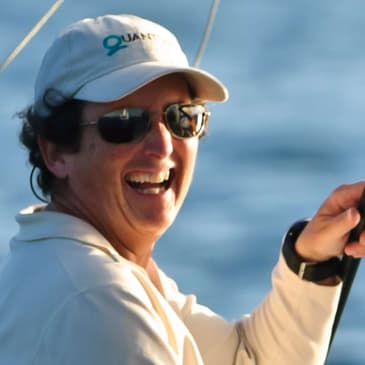
In this episode I’m joined by one of America’s top sailors, Olympian and award-winning author, Carol Newman Cronin.
Carol is very well known internationally as a member of the 2004 US Olympic team that won two races on Athens beautiful, Saronic gulf. She is a multi-time winner of the Snipe NAs, a winner of the Snipe Women’s Worlds with her long time team mate Kim Couranz, as well as a winner of the Snipe Nationals and the Rolex International Women's Keelboat Championship, and winner of several women's match racing championships with various skippers.
Carol is also an award-winning author, having written multiple books, blogs and article for the sailing media. You can find out much more about Carol, her stellar sailing experience and her writings at carolnewmancronin.com
[00:00:08] Hi everybody, welcome to Sailfaster, the podcast for those who obsess about sailing faster. We have completed about seven or eight episodes of Sailfaster so far. I think I've got two more in
[00:00:18] the edit room and more to come over the next few weeks. Thank you for listening and for subscribing to the series. I'm really thrilled that they've been of interest and used to so many sailors
[00:00:30] out there. Thanks to those who've sent me comments and ideas. You've got to keep them coming. You can email me at Pete at sailfaster.net or just DM me at Facebook or Instagram where you
[00:00:40] can search for, follow and like Sailfaster podcast. On today's episode I'm really thrilled to say that we have joined by one of America's top sailors, Olympian and award-winning author, Carol Newman Cronin. Carol's really well known internationally as a member of the 2004 US Olympic Sailing
[00:00:57] team that won two races on Athens' beautiful Ceronic Gulf in that year. She's a multi-time winner of the Snipe North Americans, a winner of the Snipe Women's Worlds with a longtime teammate Kim Caranthes. She's a winner of the Snipe Nationals and the Rolex International Women's
[00:01:13] Kielberg Championship and winner of several women's match racing championships with various skippers. And I think I already mentioned she is an award-winning author. She's written multiple books about sailing. I think another one's on the way already. And her award-winning
[00:01:28] article about her Olympic experience has got to be read. It's a really great read. You can find out much more about Carol, her stellar sailing experience and her writings at carolnewmancronin.com. That's a URL that I'll put in the episode description.
[00:01:46] Carol, welcome to Sailfaster. Thanks so much Pete for having me. It's great to be here. I'm not sure where to start really. There's so much to talk about given your background. Tell us a little bit about that Olympic experience. What was that like?
[00:01:58] I love the comment you made about the fact that rather than calling out your boat number when you checked it, you called in Bessay as your country. That really resonated with each other.
[00:02:09] That was just the culmination of a lot of hard work and experience that all built up to that moment. And if you want, I can talk a little bit about some of the kind of key moments looking
[00:02:21] back on growing up as a sailor and how it got me there if that's helpful. Oh, I love that. Perfect. Go ahead. Great. Well, I was first on a sailboat at 10 days old with my parents who were very anxious to take
[00:02:36] their brand new boats that had arrived the same day that I did out 32 footer and in Annapolis actually. And so just couldn't really escape it and actually had no wish to. I just loved
[00:02:52] the time we spent on the water as a family and then grew into sailing with other people as well as a teenager, as you do because you don't want to be around your parents anymore. And I think
[00:03:04] one of the most significant changes for me was college sailing. That was a whole eye opener of and we weren't, you know, it wasn't even nearly as professional as it is now. But just that eye opener of sailing small light weight boats, I grew up sailing much heavier
[00:03:22] boats to people and everybody wants to wants to win in the local sailing that I did as a kid, which is which was great. There were a lot of people out who were just going out for a sail
[00:03:35] and happened happened to be going racing at the same time. So the college sailing really, really opened my eyes to the possibilities of competition and the fact that I was actually
[00:03:45] pretty good at it. And so that was that was great. After I graduated, I was lucky enough to step back into the snipe class as a crew at a very high level sailing with Ed Adams, who is a turned into
[00:04:00] a huge mentor. I like to I like to say that was my my master's degree in one design sailing. I sailed with him for only a couple years in the snipe, but then also sailed with him
[00:04:10] in the interclub dinghy and he later coached us in the England. So just a great, a great relationship and there were there were a lot of other people along that path as well.
[00:04:22] But after sailing this night for several years as a crew, I decided I wanted to start steering and that gave me the confidence to then set up my Olympic campaign in 2001 on my own after sailing with a lot of different very accomplished women who then became my competitors
[00:04:38] at the Olympic trials of 2004. So it's kind of a strange coming up through the through the front of the boat, I guess is a little bit of a strange route to steering, but but thanks to a lot of
[00:04:50] support really worked for me. Yeah, Carol go back to when you went to college sailing and the difference that how long did it take you to sort of catch up? Was it sort of
[00:05:01] the first time you went out to train or did it take a while to catch up? I went to Connecticut college and there were people who had gone there specifically to sail
[00:05:11] and were already known to the coach. I showed up as saying, well maybe I'll try this out, not realizing that it would be just the best part of college of all. And so the first
[00:05:22] day I went to practice, I actually went out with a coach and managed to fall out of the coachboat when I went to grab a mark and kind of got off balance and was probably over eager
[00:05:35] freshman at that point, was definitely an over eager freshman at that point. I leaned out of the boat to help grab the mark, fell in the water, he had to fish me out. Now that was not a very
[00:05:45] auspicious beginning but eventually by sort of, I kept showing up and kept showing up, I sailed with some people who weren't that great and then eventually I got a job,
[00:05:59] a job. I got to crew for the guy who was then the captain of the team, my sophomore year and that was a real step forward into oh this is what sailing at a high level is all about and this
[00:06:12] is how much preparation you have to put in and this is how much practice you have to do and this is how if you really work together well the results are better than either of you
[00:06:22] could accomplish on your own. Carol you talked about shifting from crew to driving, was that an easy shift? Did it come naturally or what happened there? That's a great question. It did not happen naturally, it was an easy shift once I found
[00:06:42] the right boat. I actually started off in the Europe dinghy steering as a single-handed sailor back in the early 90s and I hated it. What I thought was oh well I really liked
[00:06:55] crewing rather than steering and what I finally realized when I did a little steering in the snipe was I just don't like sailing by myself and so and I love steering with the right crew
[00:07:05] and so that was a little bit of a step in the learning process. I went back to crewing, there was a period in the late 90s when world sailing had decided that the next
[00:07:20] women's medal that was going to be added to the Olympic family for 2004 was going to be in women's mat racing and so I was lucky enough to be part of a number of different really high
[00:07:31] level teams that were four person teams and so then when they shifted gears to fleet racing in a three person yingling it was sort of like musical chairs. I looked around and I was the fourth
[00:07:43] member of all these teams but there wasn't really a place for me in a three person boat and that's when I decided to buy my own boat start my own campaign and it was really
[00:07:57] a huge step into the unknown and more of a well I'm just going to try this and see how it goes rather than I can't say I really thought that we're going to win the trials at that point so
[00:08:11] so it was a big step, a leap of faith is the word I'm looking for. So you have obviously a ton of experience double-handed but also Olympics now you're triple-handed. Do you have any secrets for success that you'd share for double-handed and
[00:08:29] also triple-handle maybe the differences between them? Well I think there are differences between them in terms of how the team dynamics work but I'd say one commonality is get the best crew that you can possibly find and I don't mean just
[00:08:47] the most sailing experience. I think one of the things I learned in the course of my career specifically with the Olympics but also in the 14 years now that I've been in the snipe with
[00:09:00] Kim Courantz who's a huge part of my success is that there are people who make you better as a sailboat racer and there are people who don't and it's not a right or wrong thing it's not a
[00:09:14] you know there's nothing you can really you you can work toward better with everyone but there are people who bring out the best in you and Kim is at the top of my list for that
[00:09:26] and I think a lot of it there's there's a lot of I mean we could talk for the whole podcast about this. There's a lot of pieces to it but if you find that person hold on to them with both hands
[00:09:38] and just try to stick with it because the less you have to think about the we will talk about regatta prop but the less you have to think about well who am I going to be with and how is it going
[00:09:49] to be and what holes do I need to fill or do I expect them to fill the better the more comfortable you are with somebody you really enjoy sailing with the better you're going to do.
[00:09:58] And yeah that makes sense so with Kim was it and were you thrown together by Accent or did you was it sort of trial and error that you came to? No I first met her when we were both
[00:10:10] snipe crews I met her in the line for the shower but anyway we got to chatting and I realized wow she's really pretty cool and and has some good things to say about sailing and about snipe crewing
[00:10:22] and I actually asked her to be part of my J22 team for the 2001 I think it was a women's killboat championship which was in anapolis that year and she said oh sorry I'd love to
[00:10:38] but I'm sailing with somebody else and so that's kind of how so she was on my list of people I wanted to go sailing with. We so we did a little bit of yiggling sailing actually as part
[00:10:50] of my second campaign before I decided to retire in 2007 and then in 2010 when I bought a snipe I asked her if she'd sail with me and I've done I would say 99.9% of the regattas I've
[00:11:07] sailed had been with her ever since then. And this is your sort of active class right now in snipes right? Yes yes yeah I'm going to take I'm going to take away from this that that relationship
[00:11:19] you have with your crew especially on doublehander boats is absolutely critical to success presumably you can have a fabulous sailor with you but if you don't quite click and they don't improve your sailing
[00:11:33] that's obviously suboptimal I'm just taking away from what you were saying. Exactly and I think one of the differences we were talking about between double-handed and triple-handed and even four person crews and on up from there is the more people you have on the boat the less
[00:11:49] the more specialized those jobs can be and again not just in terms of who puts the pole up or who trims the gypsies or whatever but in terms of interacting with the skipper and filling in
[00:12:04] the blanks because we all have blanks. My my big hang-up is starting I'm not a very good starter and as Kim has sailed with me more and more she's learned to fill in the blanks of this is where I
[00:12:18] think the starting line is which is a huge help and if there were three people on the boat maybe the the middle person could do that and she could focus on trimming the jib but instead she's got to do
[00:12:29] that and trim the jib perfectly and count down the time so so there's uh there's less room for a specialization you have to be a little bit more of a multitasker. Okay I'm not sure I
[00:12:39] believe you about starting I mean you don't win a double race is it? Ask Kim she could be your next victim and she'll tell you what's happening there at the start then why I'm also super glad that I
[00:12:52] find starts in big fleets uh very intimidating so I'm really really enjoying it. Well two funny comments for you the first is every coach I've ever had except for my husband who's
[00:13:05] also an excellent coach has said oh I really wish you'd steered in college was like okay as a 40 year old that's really a helpful comment and the reason for that is the repetition that you get in college
[00:13:19] sailing of starts uh and mark roundings and blah blah blah but as a as as a crew you don't you don't really learn that um in terms of the time and distance and that's my big challenge is I
[00:13:35] do not judge well where the line is and so if I'm starting in a row of boats who are all on the line I do a pretty good job of lining my bow up but if I'm starting by myself I don't do a very
[00:13:48] good job so that's that's my weakness. So Carol I know you're writing an article for Sailor Magazine about how small boats are fantastic preparation for performing well in large boats tell us about that. Yeah that's I'm really looking forward to that I haven't actually started it yet
[00:14:10] but I have an idea for the for the opening which is explaining that while I grew up on uh cruising boats and if you look at my childhood and my experience you would say oh well she learned
[00:14:23] to sail on a 38 footer well what I remember is going out in the Dire Dau which is a nine and a half foot sailing dinghy first with my dad and then wonderfully when I had enough skill uh and learning
[00:14:36] to come alongside so make a landing as we called it on the on the big boat uh and it was so much easier to understand the effects of the wind and the waves and oh I'm I'm luffing into
[00:14:50] the wind now on a smaller boat and I think that's a that's an extreme example but um there's a reason why kids like going out on smaller boats is because they can they can feel and see and sense so much
[00:15:03] more easily without the oh there's a winch and you have to crank the jib sheet in and you can't you're distracted by the fact that that's hard as opposed to what are you really doing with
[00:15:13] the sail um so everything's simpler there are fewer lines and there's more direct effect of each action on small boats and I think that's why they make a really valuable learning platform for cruisers for racers for anybody um I knew a sailmaker years ago who would tell people
[00:15:32] who would tell all his clients oh you want to get better go buy a laser and and these are all again big boat um big boat boat owners who were trying to improve as a as a six or eight person
[00:15:46] phrf crew crew in the local wandsgenite series I need to say go buy a laser and learn to sail the laser better he said only one person ever took him up on it I suppose on small boats things
[00:15:58] happen a lot faster um in terms of the boat reacting a lot faster competitors are reacting to that a lot faster so you have less time to less time to think perhaps on uh versus the bigger boat
[00:16:11] yeah that's a good point I mean different different types of dinghies have different reaction times as well uh one of the things I didn't like about the europe compared to the snipe is that it was
[00:16:20] it was almost too quick for me I felt like I couldn't react fast enough because it's a very lightweight speedy dinghy whereas the snipe is a little bit heavier and slower to react
[00:16:32] almost like a 15 foot keel boat in some ways in light air and so it matches my my reaction time better so I don't think you can be quite that general about small boats react faster but I think the
[00:16:47] point I'm trying to make is that the connection between your actions and the waves and the wind are much more obvious on a small boat that's a great bit of advice isn't it to uh to get
[00:17:01] onto small boats to have that sort of feel and figure out how to translate that back up to um to a larger boat Carol let's talk about the operation you go into for a major regatta yeah
[00:17:14] it well it depends a little bit on the on the regatta itself um but if you're talking about a world championship or an olympic trials or something like that um obviously you you kind of
[00:17:26] put your financial blinders on and you do you do whatever you can to be ready to go and my goal um seldom achieved but we did we did definitely achieve it for the the 2004 olympic
[00:17:38] trials was to show up for the first day of sailing feeling like we could have done nothing else to prepare and it is an unbelievably powerful feeling when you can do that it's like I said it's very rare
[00:17:51] because normally you have jobs and and family and and many other obligations that are that are interfering you can't usually put a championship even a major championship as your absolute first priority um but when you do it's amazing what you can accomplish and the the things that are
[00:18:10] always on my list uh for a major championship are comfortable housing access to my own choice of food and and teeing those up so that you don't have to think about them um and you're not sleeping on
[00:18:23] couches and you're not being woken up at two in the morning um because that's as the regatta goes on that's really important so just so that's kind of where we start from if if
[00:18:33] Kim and I decide to go to a a snipe world say we've been to been to several together I call her the housings are because she does an incredible job of finding nice places to stay
[00:18:47] that make it as easy as possible one of my priorities is I always like to get to the boat park early each day she would prefer to not get there quite as early as I do
[00:18:58] so one of the things that we try to do is is find a place that's within walking distance so that uh so that I can go and she can go you know an hour later when it whenever it's really
[00:19:08] sensible to go as opposed to when I show up um I just like I love being in a boat park early in the morning when very few people are around and just kind of you know what your adrenaline is
[00:19:19] kind of hyped up and and uh you see what kind of day it is and it's just it's just a I just really enjoy that um as you you know as you go to events you realize what what you need and
[00:19:31] what's important to you somebody else it could be something else that's important to them but I think the the key is to uh to sort of try to make a list of priorities of if I'm to do well
[00:19:42] in this regard or what are my keys to success and one of them for me is always easy housing easy transportation and good food and that's the starting point
[00:19:52] is there uh do you have a sort of a calendar that you look at um weeks in advance like a project plan to say hey we're going to be there in 10 weeks so week one we need to be doing this for prep week two
[00:20:03] we need to get housing week three blah blah or is it just really a checklist you go down I'm just curious about about how that works for you well I think it's it's um it's a little bit different
[00:20:13] for each regatta when you talk about 10 weeks to me that's not nearly long enough in advance to start planning if we're going to go to a world championship we've made the decision often a year out and we don't actively start doing anything although again kim would start
[00:20:30] looking at housing options and looking at the weather so she's already thinking about what am I going to pack and I'm already thinking about do we have to put the boat in the container are
[00:20:40] we chartering all those things the earlier you start the better and when you start talking about um international events there's there's just a lot of details that have to be checked off the list
[00:20:53] so she and I again because we've done this so many times we've kind of developed a division of labor that works really well but yes I would say there's a there's an important checklist um yeah I didn't even talk before I talked about housing and I talked about
[00:21:08] food but I didn't even talk about the whole boat situation and that's a huge key to success is setting yourself up with good equipment um and there's a lot of challenges to that at any in any
[00:21:20] class and I I tend to prefer I know I'm going to perform better if I'm sailing my own equipment versus chartering but shipping snipes around the world has gotten really expensive so that's become
[00:21:31] a little bit prohibitive and then it's a question too of balancing your expectations with your your results it's like is it really worth shipping my boat halfway around the world to finish 25th at
[00:21:43] a world championship and that's a question you have to answer before you know before you know what your before you can balance the the expenses with the expectations so the charter boat versus your
[00:21:55] own boat given that these are one design boats I know there's some you know variation in in quality and and so on and so forth is that is that more of a mental thing than a real thing excellent question the there's definitely a large mental
[00:22:13] piece of it and I've tried to work around it but there's also the snipe is a bad example a bad or a good example because each boat is different people rig their boats differently and there's
[00:22:25] so many different ways to go fast in a snipe but that it becomes very personal in how you set your boat up and what your priorities are for oh well we're a lightweight team
[00:22:37] and so we need to we need to have more throw on the vang for example a brazilian team that's that's up to weight and and you know 30 years younger than we are they might not be playing
[00:22:49] the vang so much so I mean so we might get to brazil and find a charter boat that has half the throw that were from our boat and so that's a specific example and then you multiply that by
[00:23:01] the 16 controls that kim is in charge of and the one control that I get to handle which is the main sheet and and all of a sudden that's how it blossoms into this oh it's really nice to just
[00:23:14] reach down and know that you're you know know how much you have to ease or pull on a particular line without really thinking about it do you think I want to ask you was about getting the
[00:23:23] boat park earlier I thought that was really interesting for what it's worth I have the same thing that even on a wednesday night race or certainly on the uh eddie regatta we do locally
[00:23:33] I am at the boat I'm ashamed to say how early I'm at the boat way before my my any of my crews there um for me it's just you don't have to be ashamed to say that to me because I probably beat
[00:23:45] you I then I feel comfortable to reveal that but but it sounds for you that it's sort of you talked about breathing it in it's getting in tune with the the day and the conditions and
[00:23:58] what kind of day it's going to be on the water is that is that fair yes it's I don't think um what I've realized over the years is I don't think you can I can really justify it from a
[00:24:09] performance angle it's just pure joy and puts me in a good frame of mind but I don't think that I think you a lot of people can definitely get to the boat park too early and I've had these
[00:24:23] discussions with and leave the dock too early for that matter you know we had this funny joke in in the snipe class again because we know our competitors so well that that okay we're gonna
[00:24:33] leave the we're gonna leave the dock as soon as so-and-so leaves the dock which could be half an hour before somebody else leaves the dock but that's just we will we know that they're gonna leave a
[00:24:43] little earlier than we want to leave and most people are going to leave a little later than we want to leave so finding your own comfort zone with with every aspect of a race day starting
[00:24:53] from when do I want to show up at the boat park and when does my crew want to get there and if they're radically different you find a way around that because there's no reason why um
[00:25:03] you know you don't want somebody to be starting off the race day in a bad mood because they had to conform to the skipper's crazy idea of being there at sunrise which I've done yeah it's interesting
[00:25:14] I had Mike Beasley and uh and Jason Curry on um a couple weeks ago and they talked about um two facts are really interesting actually one was um I think Jason said that the generally
[00:25:27] the generally or quite often the people who win the regatta are the people who are first the dock in the morning and and Mike talked about the intimidation factor making sure that your boat
[00:25:41] is absolutely up to condition so that when people do come down the dock in the morning they look at your boat and they realize oh they've got themselves organized and sorted I thought that was a couple of interesting points that they made yeah I'll add two things
[00:25:54] to that one is um the uh Sally Barco who went to the 2008 Olympics in the engling she actually bought my old boat when I retired and one of the things she said to me later was that she was very surprised
[00:26:13] that everything all the rigging was basically stock for the boat that I hadn't re-rigged everything because I guess I had a reputation for tweaking everything because I was always working
[00:26:23] on the boat and so what she didn't realize is that I wasn't actually changing very much I was just maybe changing out a line here and there or or the length of a line or something like that but the
[00:26:35] stock the stock um layout deck layout was so good on those on the avid built boats that uh that I didn't I wasn't actually making a lot of tweaks that that she had to get used to
[00:26:47] that was very interesting that they assumed that you had yeah um was that because you did pay a lot of attention detail what as context what I've talked to many sailors now all of them with
[00:27:02] much more experience than I have and I suppose I'm looking for you know the magic bullet the two or three things that take you from the fleet to winning but it's more about um meticulous
[00:27:14] application of the fundamentals it you sound like you're just given what your um fellow sailor talked about the about the tweaking you you must have gone into enormous detail with the preparation of your
[00:27:26] boat yes I had a um a brief uh career as a rigger as a sailboat rigger and so I brought a lot of experience to the to the boat park that a lot of people just don't have as far as how to rig
[00:27:41] stuff and re-rig stuff and fix stuff if it breaks and jury rig it if you can't fix it and that kind of thing and so that was a that was a big part of my success and also I hate breaking things
[00:27:54] on the race course because there's just no there's there's usually no excuse for it it's usually something that you either forgot to do or you didn't do well enough uh and so
[00:28:06] so to me that's that's a huge goal is is preventative maintenance and and uh and staying ahead of of stuff like that so I'll tell you a funny story from uh October of 2023 uh at the
[00:28:19] snipe north americans where we finished second uh we were winning going into last day and the last day turned out to be 20 to 30 knots of breeze which is really pretty much
[00:28:29] too much for a snipe uh and the only race that they got off we were uh downwind with the pole up which you're not supposed to do in over 25 knots of breeze in the snipe uh and the breeze picked up
[00:28:44] to about 30 and I think they had a puff to like 38 um which is just terrifying to even think about but anyway I said to kim I think we should douse the pole because I felt
[00:28:56] not very much in control at that point and unfortunately the time that I chose to say let's douse when it it's a there's a um the pole lives on the boom and there's a there's a shot cord piece
[00:29:09] that comes back that retracts the the pole against the boom and it lives on the port side of the boom so that you can launch more easily on starboard uh for the first for the first
[00:29:21] rounding usually if you're going on to reach so anyway so we're on we're on starboard sorry for all this background that's good it's good we're on starboard uh she goes to douse and I can't trim
[00:29:31] the main in enough to line the pole up with the boom so that it which is the secret to success is to is to get the two parallel so there's no problem and so the pole comes into the
[00:29:43] mainsail the back of the mainsail instead of sliding back along the backside of the boom like it's supposed to and at that point we didn't quite realize this at the time but at that point the
[00:29:57] shock cord piece that's supposed to be attached to the end of the pole came out so the shock cords all the way at the back end of the boom and the pole is free floating you know this this
[00:30:09] now eight-foot piece of aluminum that's now dangling down in the water in way too much breeze and still attached to the boat with various lines so we ended up cutting it free and losing
[00:30:21] the pole and blah blah blah finish the race finish second for the regatta which we were we felt really good about so kind of in hindsight so mad at myself but also chuckling because you know what
[00:30:33] else can you do is I had spent the last six months worrying about that shock cord breaking and trying to find you know a replacement for it but I couldn't quite find the right size and then
[00:30:47] I didn't have time to replace it and so I spent all this time worrying about something and it ended up being something completely different I heard from other people that there they
[00:31:00] other people has been on this podcast have learned from top sailors to think about what could go wrong yeah and to really spend some time thinking about that because that ends your day early on
[00:31:12] the race course it's not there's the obvious things that people think about but to go through sort of a checklist and every time to make sure that everything is in place or that you have a somewhere bringing a spare of something is probably not something that everybody
[00:31:27] everybody goes through so the the best way to do that to to learn what the list is for each class because it's very different for each class is to go and talk to the people who have been in the
[00:31:39] class the longest because the best way that we all learn and the most memorable ways we all learn are when we make mistakes somebody else loses their rig on the on the on the course and it's
[00:31:53] you know it's gone the next day for you but for them that memory lasts forever and whatever lessons you can learn from that then you take to your next regatta and extra god and your next regatta so
[00:32:05] by the time you build up a few years in the class then you have oh yeah back in 1996 at the North Americans you know this happened and here's what you shouldn't do so that's that's the way to learn I think that's excellent advice
[00:32:21] one thing I want to talk about specifically boat speed and when you feel you're not up to target speed what are you doing what are you thinking about so anything particular is there a is there
[00:32:34] a loop that you go through um to try and identify what's going on so boat speed is a really I mean we could talk about that all day long and my feeling is there's not one simple do this and
[00:32:48] you'll be fast it's a whole bunch of different things and that's why you see people who I have this experience in the snipe all the time I think of agu ideas because we'll be sailing along lined up
[00:33:01] with him either racing or before the start will be lined up and lined up and lined up and holding even and holding even and holding even and then the wind goes down a knot
[00:33:13] or up a knot and he takes off and it's the tiny transitions that he's doing because he he sails the boat so much and has sailed the boat so much and is really good too but it's not
[00:33:26] something that I can look at him and say oh I should be doing that better it's more uh the just the little tiny changes that he's making probably without mostly without thinking about
[00:33:37] that that set him apart and I see this all the time with with people who are starting in a new class where they don't have the basics but then once they get the basics there's a whole another
[00:33:49] leap of comfort level and some people you know some people climb that faster than others but I don't think it's um I really think it's a culmination of a whole bunch of really small
[00:34:00] things and there's some things that you really have to kind of check off before you can even start thinking about the smaller ones like sail trim and and working with your trimmer if you're
[00:34:12] on a if you're on a killboat you're not able to do it yourself um there's some other simple rules that I've learned about you know the which you've probably already heard which are one in
[00:34:23] doubt ease it out um particularly with the main sole um I once lost a a snipe uh actually at a royal championship lost a snipe race because I this these people were kind of coming closer and
[00:34:37] closer we were winning the race they're coming closer and closer and I didn't know what to do and I kept trimming the main harder and harder and harder and they were going slower you know
[00:34:45] we're going slower and slower so that's a that's a good one um the other one uh we used to joke on the engling that um I as the skipper could be replaced with a piece of shock cord for the most part
[00:34:57] and so and to me what that what you translate that to is don't steer too much um don't especially downwind this is more of a I'm better at this upwind because there's more feel on the rudder
[00:35:10] but downwind it's very easy to just without even realizing it just keep moving the rudder which is actually slow uh and so I learned to lock the tiller extension on the deck I was watching the New York Yacht Club's um Melgers IC 37 I think they do a championship
[00:35:30] for a couple of years up a new port and they had a couple of cameras on there on the boats internally and I was watching downwind especially and observing how it was very noticeable how the
[00:35:41] tiller moved a couple of millimeters one direction a couple of millimeters the other direction but basically it was still that was great great learning just watching the you know the best sailors just
[00:35:53] doing doing exactly that yep so those those are a couple things that that um I've learned over the years also uh everybody's sense of what they're comfortable with as far as
[00:36:08] sailing attitude I guess is one way to put it but just the angle of heel and the little adjust you know how many little adjustments you can make in 30 seconds kind of thing whether you just want to
[00:36:19] just want to settle in and have no distractions or whether you want the jib sheet being eased and pulled and eased and pulled all the time uh that's something that everybody has to kind of learn
[00:36:28] for themselves or what their comfort level is and that goes back again to the longer you sail with somebody the the more you can take that sort of stuff for granted that that Kim will know oh you
[00:36:39] know Carol wants the jib sheet eased uh two millimeters because she's about to hit a wave and I I know without her having to say it to me and that's something that only comes with a lot
[00:36:49] of experience and and uh and the sort of a person of personalization of sailing fast keel boats seems to me heel angle is is critical were you very aware of that on on dingy's
[00:37:02] about the sense of whether you had the right heel angle it's critical in small boats that heel angle question particularly in the snipe because it's a hard chime and so whether the
[00:37:14] chime is in or out of the water is a huge difference in terms of of and I don't need to bore all your listeners with the details of the snipe but but that has taught me to be very
[00:37:27] concerned uh and realize that's a very critical adjustment whereas around bottom gingling a degree or two at any angle of heel was not a big deal um but in the snipe there's about a there's about
[00:37:40] a 10 degree window where that's absolutely crucial both upwind and downwind and so I've learned to be learned to be much better about it the other thing I've noticed is that when I've
[00:37:50] been away from sailing for a while and I jump back in the boat I tend to sail much more heeled because there's a little bit of a wider groove and then as we get more comfortable and I'm
[00:38:02] and I'm because because healing to windward is slow right because you're digging that weather chime in the water so so my my default is to heal a little bit more to lured so that you have
[00:38:14] a little bit more range you don't have to be quite as precise in your heel angle to avoid digging the chime in and that's been a that's been a good lesson and then as I get
[00:38:25] more comfortable and I've been in the boat been practicing or even halfway through a regatta I find I'm sailing flatter because I don't need as much quite as much of a margin um hey Carol
[00:38:35] I can't let you go without asking you about the 2004 Olympics in the beautiful city of Athens on the Saronic Gulf um are you prepared to talk about that I would um actually refer people to my website
[00:38:52] because there's an excellent award-winning article about it I thought you'd say that that starts off by saying it took me 10 years to write this and I'm only gonna say it once
[00:39:04] so there you go yeah I knew you're gonna say that yeah I definitely uh so so what's the website I'll I'll definitely put in the comments but just tell us what the website is it's
[00:39:14] Carol and also your um you're quite a review of books as well aren't you I bought a book from there earlier actually yes and and write them as well I'm working on my fifth uh my my sixth book
[00:39:27] right now it's it just came back from the editor so that's that's been exciting and uh have a seventh in the queue and all the details of all these can again be found on your website can't they
[00:39:38] yes yep really much detail not not this sailor's bit the title of that section is where books meet boats isn't it and and I think that's really interesting because there aren't really many good
[00:39:51] books about sailing yes and there's and there's some that include sailing that that frankly I wish they hadn't because uh it does not read ring true I have been known to uh to email authors
[00:40:02] and offer myself as a as a first reader for their sailing sections did I take you off on it no I shouldn't say that some have but Carol it's been a real pleasure to talk to you as I thought it would be
[00:40:14] um it's been great yeah thank you so much for taking the time really appreciate it you uh you're a fascinating uh guest so thank you for joining uh sailfast today thank you it's been it's been a lot of fun and uh good luck with the podcast