
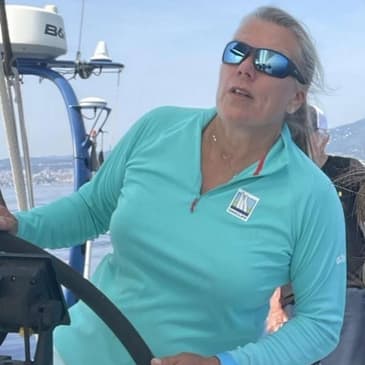
Today’s episode features sailing legend Dawn Riley at the renowned Oakcliff Sailing Center. Dawn’s been interviewed hundreds of times but I tried to home in on her thoughts on getting boats and teams to sail faster. Our episode touched on many things – managing campaigns and teams, race preparation, nutrition, and we spent a fair amount of time on her approach to helming. Oh we also talked about being tested to the limits – by the Southern Ocean and by kids learning to sail which was hilarious. I thoroughly enjoyed our chat – Dawn is inspiring, gracious and hilarious.
Dawn is one of the foremost sailors of the modern era. Famous around the world, she was the first woman ever to manage an entire America's Cup syndicate, the first American, man or woman, to sail in three America's Cups and two Whitbread Round the World races. Just to zoom in on that for a moment - Dawn was the first women to have an active role on an America’s Cup team in 1992 as pitperson, in 1995 she captained America3, the first women’s team in the America’s Cup, and was skipper of Skipper of Heineken, the only all-women’s entry in the 1993-94 Whitbread round-the-world race. If you haven’t seen it already, you must watch the film Maiden – it’s the epic story of the first all-women’s team in the 1989-90 Whitbread race, in which Dawn stars with Tracy Edwards, Mandi Swan, Claire Warren, and others.
Dawn is also a passionate advocate for the sport of sailing – under her leadership the Oakcliff Sailing Center in Long island has become one of the foremost providers of community access into the sport of sailing. And this is where we met for the recording, on a snowy winter’s day in Long Island, New York. You’ll find the audio quality changes a little as we were in an echoy room; I do hope that doesn’t spoil your enjoyment of what was a terrific discussion. Take a listen…
[00:00:00] Hello everybody and welcome to another episode of Sailfaster. I'm so glad you're here and
[00:00:16] I do hope that you are finding this series to be useful. Thank you for the comments
[00:00:23] and suggestions. I really appreciate those, read all of them. You know, I particularly
[00:00:28] like the suggestion that a couple of you had about focusing future episodes on particular
[00:00:35] parts of the race course. So having an episode dedicated to starting for example or an
[00:00:40] episode dedicated to downwind or finishing or that kind of thing, I thought it was a great
[00:00:46] idea. Maybe bring in a couple of experts with perhaps contrasting points of view. So
[00:00:53] love the idea, stand by while I figure out how to make that work and hey I don't know about
[00:00:57] you but I'm so looking forward to the new sailing season that has come up. I mean the weather
[00:01:03] is really warming up nicely here in Washington DC. I think we're about six weeks away from
[00:01:09] the opening regatta which is pretty exciting. Over the winter I think I've read every book
[00:01:16] I could find on tactics and I've watched every video on webinar but the trick is of course
[00:01:22] this is going to be what I can actually apply any of that's on the water this year. There's
[00:01:27] many of you know it's our second year racing our J1-05 that we call London Calling in
[00:01:33] the Annapolis J1-05 fleet which is pretty competitive. We're hoping to have a marked improvement
[00:01:40] on our first season. Well we actually did a care thought thanks in large part to having
[00:01:46] a town so crew of Cynthia and Steve and Maggie and Jen and Dan and Mora and then for this
[00:01:52] year we have a brand new Concent Maine sail, we have new winchers, we've even got a new
[00:01:58] backstake pump so she'll be out of the water next week so we can take a look at the bottom
[00:02:04] paint and the foils though I'm expecting beef Lee Marines fabulous work last year on London Calling
[00:02:11] to have held up well. There is much to do, we need to get cracking as we say in England. I've got
[00:02:20] a great episode for you today. I'm thrilled to say I got to meet sailing legend Dawn Riley
[00:02:25] at the renowned Oakcliffe Sailing Centre a few weeks ago. I know Dawn's been interviewed hundreds
[00:02:31] of times over the years but I really tried to hone in on her thoughts on getting boats and teams
[00:02:38] to sail faster so hopefully we got somewhere to that goal as you'll hear our episode touched on
[00:02:45] so many things managing campaigns and teams race prep nutrition and we spent a fair amount of time
[00:02:51] on her approach to helming which I thought was really useful. Oh and we also talked about what
[00:02:57] it's like to be tested to the limits by not only the Southern Ocean I found out but also by
[00:03:05] the kids that she's learning to teaching to sail which I thought was hilarious. I thoroughly enjoyed
[00:03:12] our chat Dawn is inspiring gracious and hilarious too actually as probably everyone who
[00:03:19] is listening to this podcast knows Dawn is one of the foremost sailors for the Monira. She's famous
[00:03:24] around the world she was the first woman ever to manage an entire America's cups syndicate
[00:03:29] as she's the first American man or woman to sail in three America's cups and two whip-bred
[00:03:34] around the world races and let's zoom in on that for a moment Dawn was the first woman to have an
[00:03:38] active role on any America's cup team which she did in 1992 was a pit person and then in 1995 she
[00:03:46] captured an America 3 which is the first women's team in the America's cup and also outside the
[00:03:52] America's cups she was Skipper of Hynacom which was the only all women's entry in the 93 94 whip-bred
[00:03:59] around the world race and of course if you haven't seen it already you must watch the film
[00:04:04] maiden it's the really an epic story of the first all women's team in the 1989 to 90 whip-bred race
[00:04:13] in which Dawn stars along with Tracey Edwards, Mandy Swan, Claire Warren and others it's great
[00:04:19] it's a great watch. Dawn is also you know famously a passionate advocate for the sports of sailing
[00:04:26] under her leadership the Oak Cliff Sailing Central Long Island has become one of the
[00:04:30] you know the foremost providers of community access in the sports of sailing and that's why
[00:04:37] I met actually for a recording on a snowy snowy winter stay in Long Island New York. Hey you'll
[00:04:43] find the audio quality changes a little as we were in a bit of an echoey room I do hope that
[00:04:49] doesn't enjoy that doesn't spoil your enjoyment of what was a really terrific discussion take a listen
[00:04:56] Hi everybody I am thrilled to be here with Dawn Riley at Oak Cliff Sailing Centre in
[00:05:13] in Lyleland where it's actually a beautiful day even though it's about 30 degrees and a snow
[00:05:17] around but Dawn gave me the tour of amazing facilities here for living, repairing, storing,
[00:05:26] everything, sail making, rigging amazing, amazing establishment you have here. So thank you
[00:05:33] very much for taking the time and I know you must be incredibly busy. Thank you yes we're busy
[00:05:37] everybody asks us what we do in the winter and I said with a hundred votes if we don't have a
[00:05:41] vacation we're repairing them fixing them preparing them for the next summer this summer it would be
[00:05:47] the commuter race plus the match votes that Matt Tracey has aggressive so you break votes then we
[00:05:53] had the high performance with the Ilka sailors going for the Olympic trials right now in Florida
[00:05:58] and when we're across the street you notice that one of our young young people forgot her measured
[00:06:03] in sale so that's going to fat hats. So it's never boring here and it's never slow. I did see
[00:06:11] that matracing about being repaired from it look like it had quite severity but we know that
[00:06:17] extremely severe team T-bone we had to cut the deck there's a video on our Facebook page
[00:06:22] of them using the chain pull to after they cut the deck and split the seam to pull the whole
[00:06:26] deck up and they're rebuilding it from the outer skin in. Yeah I mean fantastic learning and training
[00:06:33] right for people involved. I have to say I was slightly afraid at how excited all of the team was
[00:06:38] to cut a boat in half. That's what you do we were talking about matracing is must be unbelievable
[00:06:49] tactical training. I've never done matracing but I've seen plenty of it on YouTube it's just amazing
[00:06:56] from the tactical. Tactical strategic emotional training just for your competitive nature, crewwork
[00:07:05] everybody working together because in matracing I'm like most fleet racing you can't just
[00:07:10] sail off to the right hand side and catch a shift and end up in front is you and the person
[00:07:16] that you're racing against one-on-one offense defense stay between your guy and the group
[00:07:21] all the sports analogies and the races are usually 12 minutes long so you do multiple multiple
[00:07:28] races in each day. You have no time to wallow you have to get your head back together and do it again
[00:07:35] so it makes losing less painful of course unless you lose the last race. Yeah. Yeah that means
[00:07:42] the other guy has one the whole thing. The other thing must do apart from all of those is just
[00:07:47] really drum into the rules, mock roundings, mock roaches and there's slightly different rules when
[00:07:53] you have to read appendix seed like for instance there's no rule 17 so at a fleet race you come in
[00:07:58] front behind and then you're restricted in how high is coming from high to low. You can sail
[00:08:04] to the proper course but you can't go ahead and let them in matracing the minute you get a piece of
[00:08:09] them you can hook them as hard as fast as you can. Had them up to win but you have to give them the
[00:08:16] opportunity not to crutch which is something to keep trying to reclaim or be open about with.
[00:08:21] You can use the rules aggressively but you're not supposed to crutch the boats so what it does
[00:08:27] is it forces you to understand the rules at any one point in the race and it's quick and it's
[00:08:31] fast and it's aggressive. So when I have like a parents of a 420 sailor so I want to get my
[00:08:37] kid into college what do you have in 4 you know fj's or 420's so no no no no send them to the
[00:08:43] world matracing tour academy that will do them better for any kind of racing for their future
[00:08:50] especially for college because they'll know the rules will be a huge step above for anybody else.
[00:08:54] It must be that the quick thinking and just the ability to execute maneuvers without
[00:09:01] the slightest error again and again and again snap back and forward is it's fantastic watching.
[00:09:07] Well it's a goal without the slightest error but your mind goal against you is to screw you up
[00:09:13] so it puts a lot of pressure on the crewwork. I mean in the sailing around in an apples in a j105
[00:09:20] you don't rarely go head to win with your spedicor up in the middle of a race or and if you don't
[00:09:27] take it down you might have to tap with your spedicor up to keep it clear so it's pretty
[00:09:32] aggressive and it's a lot of pressure on the crewwork it's very physical kind of sailing.
[00:09:37] Yeah it's great I didn't realize how the big device was as well. Yes we were lucky we have
[00:09:43] the match forties which were designed essentially trainer boats and circuit boats when we had the IACC
[00:09:49] boats so that's between 92 and 2007 for the boats that I race by 4 america's cups in so they're
[00:09:57] 40 feet long they're designed for the keel to come up and slide into a container and the mass
[00:10:01] come in two parts because they were traveled around Europe but we've cornered the market on and
[00:10:06] we have all of the boats in existence except for six that are in Singapore right now.
[00:10:11] So so don't obviously there's an incredible amount to talk about and as I said earlier
[00:10:17] I mean I know you've been interviewed million times so I wanted to do something perhaps slightly
[00:10:21] fresh and slightly different so for me as I talked about would love to talk about
[00:10:27] this maybe not all that pressure but leadership managing a team what it takes to win
[00:10:33] love to get some thoughts for you on how are you being successful helming try and unpack
[00:10:37] that as a particular skill and capability and then we'd love to talk more about O'Clepper's
[00:10:43] as a venture as an organisation. Okay where do you want to start first? I'd love to start with
[00:10:47] leadership actually so so leadership of a team a project a campaign is obviously something you thrive
[00:10:55] on it's obviously something is it is it instinctive to you or did you learn it over time?
[00:11:01] It's a good question. First of all leadership is all encompassing it's not a part-time thing
[00:11:07] especially in a sailboat race or a campaign and for me being the the coordinator the director the
[00:11:16] executive director the leader is mental mental gymnastics wake up at three in the morning
[00:11:23] Dennis Connor put it much more succinctly he said you wake up in the america's cup every day trying to
[00:11:28] figure out how am I going to screw them and what are they doing to try to screw me so that's an
[00:11:32] ineligant way of saying it but yeah being in charge and finding a team that pulls together and
[00:11:40] executes perfectly a win-ridden mark grounding in you know the finals of the Louis Vuitton Cup that is
[00:11:46] just pure magic for me and if you train properly it's easy and that I think that's why I much much
[00:11:55] much prefer full team racing and no not teammates full teams racing as opposed to single-handed I
[00:12:03] get that question all the time do you want to race around the world by yourself say no especially
[00:12:08] because nowadays even when it's disallowed like in the bond day globe it seems like they use
[00:12:13] the routers on shore so people that are telling them where to go and you have the computers
[00:12:18] you have expeditions so you're just sitting on a boat that's being controlled by a video game
[00:12:23] controller and you're going around the world whereas post made in we had to really push on
[00:12:28] and we were still using sextons because there was not enough satellites around an
[00:12:33] article area so we couldn't even use this brand new thing called satna because there just weren't
[00:12:38] sets to now waffle so for you then being part of a high performing team is what drives you basically
[00:12:48] yeah I love that I love the fact that and you know I will say that being a leader in a high
[00:12:56] performing complicated team like the america's cup is exhausting then you translate that
[00:13:02] to oakcliffe and it's only people that have been in those america's cup teams that I talked
[00:13:08] to them and they get it instantly I say oakcliffe is like the america's cup that never ends
[00:13:14] just keeps going and ironically on the other side somebody asked me a few weeks ago like
[00:13:20] are you gonna do something else are you gonna retire and I said until I'm bored no
[00:13:26] and I need to be challenged all the time and that's what I get here did you expect when you grew
[00:13:34] up so I think did you expect to be managing in a position where you're managing and leading
[00:13:40] teams again and again and again I said out loud when I was 12 13 that I was going to
[00:13:49] skipper the america's cup and that I was going to race around the world of course when you're 12 or
[00:13:55] 13 one thank god nobody said girls can't do it so I didn't have that negative activity thrown at
[00:14:01] me at that point shortly thereafter yes but also I didn't really know what I meant but at
[00:14:07] least I had that goal yeah I also said I was going to win the I was gonna ski in the Olympics
[00:14:13] and because I didn't even know that sailing was in the Olympics except I knew skiing was in
[00:14:17] the Olympics and then I think earlier than that I came home after winning Field Day and told my
[00:14:22] mom I was going to go to the Olympics in the softball toss which of course is just ridiculous but
[00:14:28] to her you have plenty of options so it's easy to succeed when we have like 92 different things
[00:14:33] you know what I'm doing well yeah a lot of people wouldn't have done that so I read the I think
[00:14:40] you pointed out in a previous interview the Peter Peter Blake great news dealer sailor sailor had
[00:14:45] this point about you when you join in the team you want a basic fiber everybody and re-interview them
[00:14:51] but did you ever actually practice that no kind of so when Peter told me that it was after there
[00:15:01] had been a mutiny on hine again so the second round the world I was flown in by the sponsor hine
[00:15:07] again to come and take over the women's team that had had a mutiny so this was essentially that
[00:15:16] was essentially a failed hostile takeover and I came in and I was doing this is in the time with
[00:15:21] BC and you know all of that you know in the 90s where I was doing a hostile takeover of a startup
[00:15:27] so it was absolutely corporate and I should have listened to Peter and I used the word but
[00:15:34] and that was what I try not to use them because as soon as you hear yourself going blah blah blah but
[00:15:40] but I don't know this team but I don't know this boat but what about this but what about that I
[00:15:44] shouldn't just what am I big girl pennies and fired everybody and interviewed them which I kind
[00:15:51] of did I didn't fire them dramatically interviewed all of them there was one person on the boat
[00:15:57] that I absolutely had misgivings about and I should have fired my replacement for her was not confident
[00:16:06] in taking over and I listened to her instead of empowering her because 100,000% she could have done
[00:16:13] the job as well if not better she's got on to be a captain of industry. And this this the hostile
[00:16:20] takeover was taking place during the race right it was pretty much I was in Michigan on Sunday and the
[00:16:26] race started on the next Saturday so I had a very short window by the time I got to put it to
[00:16:31] last on Tuesday to meet these people to interview them figure out how the sales went up and down
[00:16:38] on Wednesday Thursday sale without any of the men that were trying to help us in other words do all
[00:16:43] the jobs while the women watched on Friday was the only time we sailed without anybody else on the
[00:16:48] boat and I was like this is bullshit and then we started on Saturday it was crazy I would never
[00:16:54] recommend anybody do that but I did. When you for America 3 were you able to choose your own team
[00:17:01] from scratch? No so my first America Cup American Cube was with the men so I was the only team I
[00:17:07] tried out full on try out you know beat my way into the team on the 1995 team I was part of the
[00:17:16] creation of it the manifesto put together the business plan this is the women's team yeah 1995
[00:17:23] the women's team yeah I did all of the legwork the business plan the strategy and then there was
[00:17:30] an attempted coup by one of the husbands of one of the sailors and it all stalled and then I went
[00:17:38] did heineken so by the time I came back it was all full on and being run by the coaches and
[00:17:46] but they're using my blueprint in my business plan and I obviously had a spot on the boat
[00:17:51] I didn't have to try out myself the interesting thing is I was being recruited by another team
[00:17:58] and they were offering me double the money and a guaranteed 18 position they would have been
[00:18:05] it would have been a mixed team because I was there it turns out they did have one other female
[00:18:09] on the sailing team at the end and I really considered hard but I understood at that point how
[00:18:18] important and impactful the women's team was going to be for general society yeah women in sport
[00:18:25] the Atlanta Olympics were the women's Olympics I had been to the women's sports foundation I wasn't
[00:18:32] in the board you know and at that point and so being that young and that naive and that much
[00:18:39] on a treadmill I was like maiden Merkeh women's team second place first place heineken didn't die
[00:18:47] back to do another campaign I was like whoa whoa whoa whoa whoa and somehow I slowed down enough
[00:18:53] to say I think in the real world the way this happens is you take the offer you have from the team
[00:18:59] you don't really want and you go and see up the team you want we'll match it they went sure so I
[00:19:05] doubled my salary which was a whole I think 30 thousand dollars a year yeah well I've got
[00:19:11] the back of the 90s you've been at the forefront of changes in how women in sailing
[00:19:19] oppa see time and time again from going back to maiden I know that was Tracy Edwards and you
[00:19:27] and others that in the america's car is that's just something that comes naturally to you
[00:19:34] to be a bit of a warrior and there's you know listening to you about there's a ton of
[00:19:39] drama around it but you're really comfortable with that drama I would say yeah I'm pretty I don't
[00:19:49] hard-assed I care a whole lot but put it this way in relationships with my boyfriends all acts
[00:19:59] of the moment they will inevitably say stop yelling at me and I will say I am not yelling so when
[00:20:08] I get angry just making my point or upset I get call and that's just the way I've always been
[00:20:18] there I don't like the drama I don't need the drama we have the saying around here that I repeat
[00:20:23] unfortunately too much that stress makes you stupid so that goes back to the preparation you don't
[00:20:28] want to put yourself into a situation where your heart rates up or the blood is rushing through your
[00:20:32] ears where you just simply can't think and you make a stupid decision because you're incapable
[00:20:37] of thinking so you have to call my everything down and I think that goes back to like throwing
[00:20:43] discus and racing ski racing and swimming and all the sports I was lucky enough to do so you
[00:20:49] learned that you learn to control your mind yeah yeah visualize had burst of energy yeah as a
[00:21:00] sprinter in swimming I was a sprinter in track and field except for we had really really good
[00:21:09] sprinter so that it shifted me over to the discus and the shop putt which again is really high
[00:21:14] intensity preparation it's mental because think about it with a discus you're throwing it the way
[00:21:19] you're not looking when you start off so you deck out that mental visualization as you go and then
[00:21:26] for the fun side I also was sailing competitively at that point and so I was 15 years old
[00:21:32] and I was one of the only people on the crew that didn't have a real job so the owner of the
[00:21:38] boats said how about you become the boat captain I said sure my parents were crazy they said sure
[00:21:44] and off I went well they were sailors weren't they were sailors we had just come back to sailing for a
[00:21:48] year when I was 12 turn 13 sail for a full year on our boat all the way from Michigan to Maine
[00:21:54] to Florida to the homies the Virgin's Caribbean Grenada and back but it was sailing almost every day
[00:22:00] and we all stood watch and we learned a lot yeah you talk I've seen some of your writing about
[00:22:09] you've got to feel it don't worry about instruments you've got to feel it but for those of you who
[00:22:14] are lucky to grow up with that it must be they must be very instinctive it is instinctive and
[00:22:21] I don't think it's necessarily because you've grown up with it I don't know if you read somewhere
[00:22:28] but I remember distinctly like cruising Georgian Bay and the Great Lakes in Canada and my dad's
[00:22:36] down below reading a book or navigator or whatever and he yells up get back on course and my sister
[00:22:44] and I are looking each other like how does he know and it's because you can feel the boat yeah you know
[00:22:50] so we thought he was like psychic and scary so my point is is that when you become an adult
[00:22:59] and you have that sense you develop that sense conversely if you're not overthinking it any age
[00:23:08] if you just let yourself feel the boat you will sense what's going on is the boat healing over
[00:23:15] our my toes really really hard soar because I've been standing on tipy toe because I'm healing too much
[00:23:21] is my you know it's my back of my legs sore because I'm sitting down and I'm trying to I'm too flat
[00:23:28] so I'm having to pull myself in so yeah um that all sense stuff I coached a team from that's
[00:23:36] really interesting so it is about not just sensing what's happening on the boat but also
[00:23:42] what you're feeling in your body yeah it might reflect things that you haven't really noticed exactly
[00:23:47] it's amazing so sometimes when I'm just I'm always too busy and always talking to short cuts so
[00:23:53] when I'm out here at a match 40 and like just shut your eyes and listen to your butt
[00:23:57] they're like what but I had a team that I coached from Stan they call him the blind
[00:24:04] and Helm has been now because he was with NASA NASA Ames at the San Francisco this great team of
[00:24:09] literally rocket scientists and they were they hired me to coach them and Stan they all have so
[00:24:16] much brain power and so much knowledge of the instruments and you say trim the sales so that the
[00:24:21] leach is about like that like what's the camera what's the attack what angle of attack they want
[00:24:26] to have numbers indigital I'm like just pull the sale in and Stan would be the same thing he
[00:24:31] get into the instruments and he's such focused on that I said just just just close your eyes
[00:24:36] and everybody would just have to tap into that but it is when you can add the instruments back in
[00:24:42] yeah they help especially when you get all discombobulated yeah they reboot you but then once
[00:24:47] you get into the groove which is more or less there then you're maybe not in the current
[00:24:54] America stuff but in most votes you are then using your senses to your senses are smarter than
[00:25:02] the instruments yeah you will you will feel something before it reflects your both speed you can
[00:25:07] be a lag is no six seconds on both speed yeah that's the thing I want to go back just for a second to
[00:25:14] you talked about you know skiing and all the other sports you did top sports people have
[00:25:20] this ability to make everything slow down but they're able to operate it fast as speed
[00:25:26] and others and it feels like slowing down did you do you do you find that you also talked about
[00:25:31] being calm and in you know maturacing or racing your whether it's around the boys or in the sub-nation
[00:25:40] making the right decision is obviously critical to not just performance but safety as well so
[00:25:46] I just wanted you do you get yourself on the zone when you feel I got this and what's going on
[00:25:51] I can make a decision I feel that often when there's a crisis or when it's just like a really good race
[00:25:57] and everything's working it can be you know you can be knocked out of you by something weird
[00:26:02] that happens but I think in when you're in the beginning part of developing that skill
[00:26:09] it is practice it is preparation it is thinking through as simple as reading the rule book
[00:26:18] and closing your eyes and imagining what that looks like simple port starboard close your eyes think
[00:26:22] about about port starboard so you visualize it and then go back you know when we're luring
[00:26:28] react and then and then you read the rule book just you know part two and then you add in the
[00:26:32] maturacing and then you read Dave Perry's book which goes through those types of things
[00:26:37] you can't just well at least for me I can't just read on paper I'd love to read it's fine
[00:26:42] I don't have any problems with it but I need to when I find that when you're going to do something
[00:26:48] physically action to be able to visualize that and there's different levels of visualization one
[00:26:55] is just like okay there's two boats on a table then you're starting to think about how
[00:27:00] it is on the boat in your position then you're starting to think about what things you're doing
[00:27:04] with your body whether it's the pit or you know pulling a halirot or steering or whatever it is
[00:27:09] how you're leaning in and out then when you get to the ultimate level of visualization it's as if
[00:27:17] you're watching from a helicopter and you can see the sights the colors feel the wind if you
[00:27:23] can add that into your visualization that becomes really easy yeah that's not a trait of top sports
[00:27:28] people isn't it the visualization where whether they're soccer players rugby players whatever it is
[00:27:33] so let's say spend hours and hours thinking through what's going to happen tomorrow right
[00:27:38] and it's a very powerful so it's first time I've heard of you talk about that in sailor
[00:27:44] it's a little more difficult sailing the first time I and and I haven't been trained and I haven't
[00:27:48] gone to sports like hi actress and all that kind of stuff it's just something I do but my coach
[00:27:53] in high school discous coach Hoover he was the one he came back from his conference he told me about
[00:28:00] visualization like yeah yeah yeah yeah and I already talked about the fact when you start the discous
[00:28:05] you're not looking where you're throwing and I have been throwing well over the school record
[00:28:10] but never in bounds so he talked me through visualization he walked out he put his styrofoam white
[00:28:17] styrofoam coffee cup at 120 feet which was past the school record dead center in the middle of in
[00:28:23] bounds said look at that visualize hitting it get to wind up hit it smash the crap out of it
[00:28:32] I'm like oh there's stuff works yeah yeah the other key skill is maybe
[00:28:39] is unique to sailing well that's not neat but but something really important in sailing I'm finding
[00:28:45] is that you've got to know what's going to happen 30 seconds ahead of where you want yes yes
[00:28:50] the bigger the both the more people you have doing it smaller the boat the more one brain has to do
[00:28:55] all that so like an america's cup of you have a strategist who's looking at the whole big picture
[00:29:00] their job is to know that there's another match over here there's a spectator boat that's throwing
[00:29:05] wake the clouds are building behind us so they're looking at the whole overall picture you have the
[00:29:11] tactician who is there doing the boat on boat coaching the helms person and the helms person is literally
[00:29:19] until your actual combat right next to a boat they're executing most of the time they're just
[00:29:25] there is a speed person so there's there's different parts of it and a lot of times the helms
[00:29:32] person gets all the credit when really it's the tactician that is the person who is the most
[00:29:38] experienced the most critical because they have to do exactly that they have to be 30 seconds at
[00:29:45] hand what's going to happen what are we doing what's the other guy doing what's the other guy
[00:29:49] gonna try to do against us and then communicate that to the helms person in the rest of the crew
[00:29:54] so they can execute we had a situation in one of the teams where the tactician said I know what to do
[00:30:00] every time they just can't execute and it was very clear because the tactician was telling the
[00:30:07] helms person about a half a second after it was too late to execute and that happens all the time
[00:30:14] in all kinds of sailing you've got this great quote what it takes to win is everything every single
[00:30:19] thing has to be done as perfectly as you can that's a pretty straightforward statement for life
[00:30:25] exactly but it's so what I'm learning from top sailors is preparation is everything obsessive
[00:30:32] preparation months before weeks before certainly days before and hours before even to the extent of
[00:30:40] I've talked to people who even come down to the boat part get the dock an hour early than
[00:30:45] anybody else just as part of that feeling that there's nothing that's missing I've done every
[00:30:51] single thing possible to get us here but just curious about your take on preparation yeah when I do
[00:30:58] some like boat show coaching sessions yacht up tours that kind of stuff I do a talk which is just
[00:31:03] about how how to race have to race and it's usually an hour long talk plus question and answer
[00:31:11] and about 45 minutes into the conversation I say okay now we're at the starting so 45 minutes of
[00:31:19] the talk is things to do from in the winter deciding your crew from deciding who's going to bring
[00:31:25] sandwiches what are your different options are they're going to bring their own or not do you need a
[00:31:30] cooler or not where's the boat going to be docked what is the schedule do you need backup group
[00:31:35] what sales do you have what boat work to do what is are you going to do rotation how much practice
[00:31:41] are you going to do is there going to be a rule for people that if they practice if they want
[00:31:45] to race they have to practice the answer should be yes so you go through all of that and then you
[00:31:50] get out to the race course and you do all your homework and you sail up winning down when it gets
[00:31:55] to the point there's two like critical funny things that nobody ever thinks about the first one
[00:32:00] is when you have a dock off time you have a dock off time you do not let the owner or the Helms
[00:32:07] person in charge of when you leave the dock because inevitably they will leave the dock 15 minutes
[00:32:13] early because they're anxious and nervous and you've left somebody in the toilet so usually I
[00:32:17] have like a fit person or a trimmer that literally counts down 10 minutes to dock off yeah that's good
[00:32:25] the other one is everybody gets out there and they practice and they go up when they run the
[00:32:31] windward mark bits in or imaginary windward mark they put the spinograph they do one more jive
[00:32:34] one more jive one more jive they take the spinnaker down they have those people pack it
[00:32:40] and then the back of the boat so they're eating sandwiches relaxing and the front of the boat is
[00:32:44] exhausted by the time you get to the second lap because they haven't had a chance to eat
[00:32:49] so you go up you put the spinnaker up you do one or two jives you take it down you help
[00:32:55] get the spinnaker panic and you make sure everybody has food and water before you start
[00:33:00] so this is fantastic advice I must I'm one of those skippers like come on we're going to go we're
[00:33:06] going to go come on it's an hour but I've learned from the top sailors to pay particular attention
[00:33:12] to nutrition Jason Curry talked about your brain is that this the organ that's taking the most
[00:33:21] power you've got to make sure that in the in the game of sailing that people's brains are
[00:33:28] absolutely switched on and for that you need great nutrition and so on and she's good
[00:33:33] when we do offshore races yes we have pringles and pretzels and stuff but we focus on protein and
[00:33:41] vegetables on the distance races we do do freeze-dry food although I'm allergic to the sulfites
[00:33:47] so I will go to bermuda eating walnuts oil eggs carrots some pretzels yeah pretty much nuts
[00:33:56] of carrots and and I don't do any sugar but that's me some people need it with that being said
[00:34:00] the timing is awesome like a kind bar just having a bite or two you can literally feel
[00:34:07] yourself come back yeah I totally get on longer distance races or any sort of offshore overnight but
[00:34:15] even on the sort of an afternoon race you know two or three races making sure people are fueled up is
[00:34:21] yeah and it's different for individuals main peanut butter and jelly are great there's a quick
[00:34:27] whole meal unless you're on a French boat then they get really pissed at you I've learned
[00:34:31] that's not French food but like for me personally I will make sure that I eat in a solid breakfast
[00:34:40] yeah and I will generally not eat on a day race until it's over so I have myself at that
[00:34:46] perfect level of I've got the base but I'm not going to get it with arctic and that's because I
[00:34:52] have a problem with sugar and they prediped it water is uber important water water water water you
[00:34:59] can't drink enough water and a lot of times women don't want to because they're afraid of having to
[00:35:05] use the head which is silly personally I always use the trancem which drives these safety and see
[00:35:12] people crazy but clip in use the trancem I can say you know ladies rooms open everybody looks
[00:35:19] forward you pee you get back to your job it's so much more efficient than going down below and
[00:35:23] struggling over sales and trying to remember if the through hole is open and go into that sticky
[00:35:27] head so on the 1992 team and I was the only female I used to bucket all the time
[00:35:33] and it was because TV cameras and coaches and tenders and other boats and one day a coach was
[00:35:42] on the boat and I handed the bucket up now all the guys on the boat knew what was going on and he
[00:35:48] didn't and the moment I saw him he lifted an office actually when I saw take the bucket edge of
[00:35:54] the bucket by his hand and tip it over so they would keep up with bill water went onto his hand
[00:35:59] and it was warm and he dropped the bucket in the water I was like I got to get another solution
[00:36:04] here so most boats especially bells with open trancems it's super easy and nobody even notices
[00:36:11] I've been using the trancem on an America's Cup boat and the women's team there's if we didn't have
[00:36:15] 18 buckets right yeah so on the women's team we use the trancem all the time and the coaches would
[00:36:21] come up and be having a conversation to winward and not even realize that there was somebody
[00:36:24] being the word so that's probably top tip always peed the word 10 Turner was on the boat
[00:36:29] oh yeah we peed to winward I was so disappointed here's this legend and on the America's Cup
[00:36:35] boat it didn't take a pee this is in 92 and it peed to winward never end up we were going down
[00:36:40] wind but still it ended up all over the boat in his feet I was like all mean wow even the best
[00:36:48] have flaws okay so preparation I love that point about you spent an hour
[00:36:56] coaching people on how to an erase and 45 minutes before you start talking about getting to
[00:37:03] the start the other thing I've noticed is about I'm calling like meticulous application these
[00:37:11] fundamentals so preparation obsessive attention to detail I know people who you know got a new
[00:37:18] J1 or 5 on not a new J1 or 5 and completely taken with the part because they need to understand
[00:37:23] everything that racing platform as they called it it could offer that might have been a
[00:37:30] little bit obsessive did it leap when they put it all back to the top of the hole the
[00:37:36] the holes of the actual holopark but that was that was one fact the other factors for me are we
[00:37:42] talking about team little bit but this notion of unbroken concentration as well that knowing it's
[00:37:48] a game of millimeter by millimeter an inch by inch like Beasy was talking about if you're able to
[00:37:54] be ahead by one millimeter on every wave and there's a thousand waves on a typical beat you're
[00:38:00] going to be able to break an oval act probably at the in a mark does that unbroken concentration
[00:38:06] attention detail that must that I can see that working in around the boobies,
[00:38:11] fibrating that sort of thing but in a long distance race how the heck do you keep up
[00:38:16] concentration here on the helm you just do one thing is is that you if it all possible change every
[00:38:23] hour and so you don't do it for more than an hour so you can maintain that intensity and the way
[00:38:29] you do that in the in the distance race is you have the next person sit next to you and shadow
[00:38:34] you for about five and a minute and you talk through verbally what's happening so I got this wave
[00:38:40] and this happening it would see that we when we hit a battle we lose at least a half and I'm trying
[00:38:44] to fix that I haven't found out the solution yet blah blah blah and then like okay ready they're
[00:38:49] like yep ready and they stand up they take over and they used to go all and you do not need to relax
[00:38:56] a little bit so you should do it change every hour a lot of times here at Oakwood on the bigger
[00:39:03] boats I get stuck steering from way too much and it becomes counterproductive because my job is
[00:39:09] to coach people that at some point I get so tired it's more exhausting for me to coach than it is
[00:39:15] to just do it so that's one thing that we're looking at this year in the beginning of the season as
[00:39:21] I am going to strictly coach tell them some people mansel tremors and just work on them with the
[00:39:27] instruments with the speed loop and get them so that I don't have to be on every boat for us
[00:39:33] to do with all because they're perfectly capable they just don't have the hours and it haven't been
[00:39:38] coached yeah it is a friend of mine for when I talked about it's stick time right making sure you
[00:39:43] have that stick time um for what it's worth I'm you know very new to it but uh it's mentally exhausting
[00:39:50] you end up with a quite severe headache and I go just sort of just because I've been focusing on
[00:39:56] the telltiles and you can do any probably of your network yeah I do it all wrong I'm sure I do it all
[00:40:01] wrong but I'd love to move on to talk about just unpacking your thoughts on um being a world class
[00:40:08] hums person and I know it's instinctive to you I know you've done it for a long time but
[00:40:14] what's what's your salute that you go through when you first grasp the wheel the tiller
[00:40:19] what what goes on the first thing is let me try to do better than the previous person
[00:40:24] and it's a competitive side yeah but it it is just being fully aware of what's going on the angle
[00:40:29] of the way the angle of the horizon yes the telltale side describe it unfortunately sometimes
[00:40:35] I describe it to people under 16 it's like driving a car where you're looking at the rear view mirror
[00:40:40] the road this pedometer your side mirror and you're just going through so it's the same loop
[00:40:44] you're sitting there you're obviously feeling the boat but you're looking at the the telltales
[00:40:51] sometimes the windex if it's really light and crazy that's your biggest most gross actually
[00:40:55] your most gross telltale is your jab but really the windex the telltales the speed the wind
[00:41:02] true wind angle and then the feel of the boat and then you're looking at the waves if you can
[00:41:07] get that loop where you you're getting it down smaller and smaller so it's speed wind uh telltales
[00:41:14] waves speed telltale waves so you're just looking at that and trying to keep the angle of the horizon
[00:41:19] similar uh as people forget that the heel of the boat is over critical because every time it changes
[00:41:30] there's a puff or you've gotten too high and the boat flattens out and anything you do to correct it
[00:41:38] and get it back to the sweet spot and heel is going to slow the boat down we've had to ease the
[00:41:45] main you've had to uh turn the rudder the helms person can only slow the boat down because everything
[00:41:52] they do is is at in resistance so the more you can get all the sales working in conjunction with
[00:41:58] the waves so that you're at the same angle of attack throughout the race the the texture you're
[00:42:04] going to be so i love hearing you talk about heel angle because that's again something i'm learning
[00:42:09] is actually critical to the success of top sailors getting that angle to the horizon right but it's
[00:42:16] um obviously not easy you get knocked off the right heel angle because of waves or conditions
[00:42:21] and also as you said when a when a puff comes you're it's going to change the angle how how do you deal
[00:42:27] so heel angle is critical because it's the most consistent thing right so a boat and each
[00:42:36] whole shape has a different optimal heel angle through lift often the whole shape the heel of
[00:42:42] the foils it's not the same that i see seabotes i think we sail around at 2227 which uh in an ior
[00:42:51] boat you would have been bearing the rail and like dying so each boat it has a different optimal
[00:42:58] heel angle j-24's last time i sailed with eons ago i'm pretty sure their optimal heel angle is
[00:43:04] done right so you sail with a little bit of leahum so it depends on what it is that you are sailing
[00:43:11] but the reason why it's so important is because all of the factors contribute to getting there
[00:43:17] and so then how do you maintain it yes if you can so first of all you pull the sails in and you put
[00:43:23] the crew on the rail just say it's a medium day ten knots pull the sails in put the crew on the rail
[00:43:28] like it's your true wind angle you should have an idea of what it should be and then you're looking
[00:43:34] at your heel angle or just estimating it again one of those plastic things so you have an idea
[00:43:40] don't have to have a heel sensor hooked into your curculeus b and g system it's not that important
[00:43:47] and then you start to sail along you get the feel and then you start to make some fine adjustments
[00:43:51] if it's a totally calm day it should be relatively simple and then your conversation and your
[00:43:56] thought process is this is a really flat water day we have a nice steady wind we're going to have
[00:44:02] a lot of different modes let's try to go into low mode so we we're sitting here we can just come
[00:44:08] out the start line and we need speed and we have nobody to lure so you want to go low mode which
[00:44:13] doesn't mean just ease the sails out and turn the boat means ease the sails out lead forward
[00:44:17] travel or down make sure the bangs not too tight and then you can ease get a little more twist in
[00:44:25] your main then you say okay let's practice we're squeezing we're we've got plenty of speed and we're
[00:44:31] trying to stay above somebody we've gotten a little extra speed let's squeeze up and go one-tenth
[00:44:36] less and move to windward and then you are trimming your sails in cruise hiking harder so you're
[00:44:45] putting more pressure on the boat which would be more heel but you're flattening the sails
[00:44:50] and hiking harder so you're maintaining that heel so you if you can and as again in the
[00:44:57] beginning it's if everybody should practice and take time to do these things because it's part of
[00:45:04] everybody on the boat it might even be if you have an older sail that if you're going into high
[00:45:09] mode your pit person swinging around and giving a crank on the hallye so it's it's it's multiple
[00:45:14] multiple different parts of it everybody has to be aware we're going high mode high mode you
[00:45:19] shouldn't have to say everybody high we are going in high mode we have a boat till lured it should
[00:45:25] just be high mode and everybody goes into that mode I like a point about the it's one constant
[00:45:32] isn't it because the whole shape doesn't change that you can change sails draft all those sorts
[00:45:38] of things and trim obviously but it's that's true that in all conditions that hold us and change so
[00:45:44] you're looking for a consistent heel for the day for the conditions yeah now you talked about a puff
[00:45:51] and a lift so puffs are not always lifts the way the puff is coming down the water at you if
[00:45:57] it looks like a line coming straight across your bow that's going to be enough if it looks
[00:46:02] like a puff that you as a helmsman can't even see in the lines coming parallel to the boat it's
[00:46:07] going to be a lift if it comes generally at 45 degrees it's going to be a puff and they lift but
[00:46:14] that's what we call a velocity lift it's only a lift because you get more wind so that needs to
[00:46:19] be fed to the helms person and the mainsil trimmer in particular because you need to know are we taking
[00:46:26] this this puff is going to be a lift we're going to take maximum or this puffs going to be a lift
[00:46:31] we're going to translate this to bow forward because we've got another boat that we're trying to
[00:46:34] splash down on so that becomes your tactical and if it's a a puff is going to be a knock sometimes
[00:46:42] especially in the lighter winds or that would really up and down you might say especially on a heavier
[00:46:48] boat this puffs going to be a knock we're going to go straight through it which means that the
[00:46:53] helms the gym trimmer has to be ready to ease the jib a little bit because it might actually start
[00:46:58] to bang but you can see that the next puff is only a boat length away and as opposed to dialing
[00:47:03] down 25 degrees to sail properly in the knock and then have to dial 25 degrees back up to what's
[00:47:11] coming then you want to just go through it and in you're from the Chesapeake Bay area right now
[00:47:18] so in that area that's super critical because they're just especially we stood up in Baltimore
[00:47:22] in the bay there's there's puffs to come down you know the river and through town hall
[00:47:27] ego alley and out from the sion and yeah that's a conversation that's one of the really good
[00:47:34] training grounds for that in particular what about other secrets of helming what do you know
[00:47:41] that other stuff already said don't don't turn too much um yeah you're not the you're not the
[00:47:47] person in charge you're the orchestrator it has to be a conversation uh when you're
[00:47:53] staring the boat I always tell people people you're nudging the boat you're nudging the boat up
[00:47:58] and nudging the boat down you're not just because you have the opportunity to turn and wipe
[00:48:04] somebody off the bow with you know a very quick turn that's not that's not your job unless
[00:48:08] first you're avoiding something i like that but nudging yeah i'm taking that with me to the
[00:48:13] yeah so like even on oc86 but i'm in the right mode well numbers the the jv66 we have
[00:48:19] is also really important to steer up when but even on the mass of oc86 which was sponsored by
[00:48:26] red pick and the kinskis from an apple sale that for the last permute on that boat when i'm in
[00:48:32] what i've got it all dialed in it is still just fingertips so don you tackle some of the most
[00:48:38] difficult things in sailing that you can imagine including running the america's cup team race
[00:48:42] to the america's cup racing sub-motion multiple times what drove you to do that i had little to no idea
[00:48:51] yeah i do know that when people tell me i cannot my gut instinct is screw you and watch me
[00:49:02] and people have asked me like when did i know evidently my grandfather told my mother when i was
[00:49:10] five that girl scares me she can see into the future i just grew up determined and i really don't
[00:49:17] know why because you as you get older you think back further and i just i just know i like to be
[00:49:24] competitive and i'd like to be successful and i'd like to have other people around me be successful
[00:49:30] and that back to doing every little thing as best as you possibly can is not because i'm a perfectionist
[00:49:38] it's because i understand that if you break it down into all the little tiny steps about you know
[00:49:43] clean up make your bed in the morning do the dishes before you go to sleep because in the morning
[00:49:49] then making your coffee you're not going to have to wash the dishes before you make the coffee
[00:49:52] that just saved three and a half minutes and it's just it's it's just that way to live so that
[00:50:00] life becomes easier and we say here if you don't worry about winning but you do everything you
[00:50:06] possibly can within your perfume as best as you possibly can then the winning is easy
[00:50:14] control me yeah oh it's easy it's like oh we won it's almost anti-climatic you're like
[00:50:26] there must be many moments when you have been tested to the limits probably on shore as well as
[00:50:33] certainly off shore i mean i know the story of hypothermia that you had in the sub-nation
[00:50:39] but it's really one that stands out as being a life-changing event for you when you
[00:50:44] when you were to test the limits and it changed things for you i don't think there's any one event
[00:50:50] when you mentioned on shore it's kind of funny because i mentioned earlier i am single
[00:50:56] and i never really wanted kids i never had time to have kids and yet hear it oak lift i'll have
[00:51:01] 45 to 50 on site at anyone's time they drive me freaking crazy and i've mentioned if i ever
[00:51:08] mentioned to my mother she just starts laughing she's like you didn't want to give me grandchildren
[00:51:12] look what happened so i think those are the times when i've tested the most when it's just like
[00:51:18] come on i know your brains aren't fully developed but please there's five of you
[00:51:23] somebody should have realized this was a stupid idea what i love about that don't is you have
[00:51:28] had hypothermia and being tossed over board in the sub-nation and yet your
[00:51:34] most stressful event is dealing with 40 kids other people's children's
[00:51:39] that is brilliant um i saw another quote of yours um you said that you
[00:51:45] i don't think this was true enough but you said you had a choice roughly between
[00:51:49] you know you could be sailing super yachts in santa pae or oak lift and you chose oak lift
[00:51:56] i still try to do the super yachts when i can um i'm going and speaking in health sinky and uh
[00:52:04] wouldn't vote conference this winter instead of going to state parts for the bucket which is
[00:52:09] killing me but um i think because super yachts are great and wonderful and pay well and it's you know
[00:52:18] it's something i've earned and i do well and because of all the things that we do it open if i
[00:52:23] use the owners and the gas to part of the crew so it's everybody on the boat contributing and
[00:52:29] winning the super yacht regatta is a big part of uh but here it's um it's i'm
[00:52:39] and being able to be tested and pushed every day and i've seen people grow and learn
[00:52:45] uh every day i think there's probably a little tiny bit that i do enjoy about sitting around
[00:52:53] and sharing knowledge with the younger people and it's on any given day so imagine like your
[00:53:02] like grandfather's sitting in your armchair you've got all these stories and nobody to tell them to
[00:53:06] i'm not that i have kids to tell the stories to you all the time and it's as simple as i was speaking
[00:53:12] on a cruise ship uh last week in san francisco and i it was a non-sailing group and so i was talking about
[00:53:18] and oak that re-educating the younger people it's simple things like postcards they have never seen
[00:53:26] postcards and i had one of my development people that was writing the postcards which he had helped
[00:53:32] create and he's putting them in envelope and he put a sticker and i said okay so he's sending
[00:53:36] the stickers that's why it's a Viamelo couple days later i see him putting an envelope in
[00:53:41] or a postcard in the envelope i'm like you know you can just put the address and put a statement on it
[00:53:45] and he looked at me incredulous and he looks and he goes do you mean make it?
[00:53:52] i was like yes people are going to read what you said on the postcard.
[00:53:56] so funny you never think about that you never think about it so i get i get to yeah it's bizarre
[00:54:02] and fun yeah i found as i got further towards the end of a corporate career the most pleasure you
[00:54:07] get is from seeing other people develop yes whether it's through coaching or through just what they're
[00:54:12] doing so fast but that's what i took the greatest pleasure from actually exactly and it's
[00:54:19] hilarious it entertains me to no end yeah o'cliffe it looks like absolutely an amazing facility here
[00:54:27] it's doing good where are you taking it? you're obviously an ambitious forward looking person
[00:54:33] obviously this is not the final thank you well so we oak was started 10 years ago
[00:54:41] i was i did the swatting analysis i was a consultant in 2009 and they guilted me into running it
[00:54:48] in 2010 when we started January 1st and i was going to stay for three years and run for office
[00:54:53] back in michigan or do another america's cup 14 years later this is a whole other
[00:54:59] area so let me drop this but 14 years later we're still here and as a constant struggle between
[00:55:08] we're doing too much but we can do more we're doing too much but we can do more so the current
[00:55:13] mission right now is to continue to do everything that we're doing as best as we possibly can
[00:55:19] and to continue to educate the public and the donors and the funders that this is a service that
[00:55:25] we are doing for our whole sport and not to be too grandiose for our country we are truly building
[00:55:34] american leaders that are representing our country and they're going to do amazing things if
[00:55:40] they haven't already you know mark and Charlie just won the ocean race after doing three laps
[00:55:44] those are graduates sono heller and plus a handful of people are running are working with american
[00:55:50] magic robin lash was working with american magic and we just got sent an article from New Zealand
[00:55:55] she's running alongside their best culture endurance runner in New Zealand so it's crazy how
[00:56:02] much our graduates are doing and we have to change the narrative between isn't that amazing with
[00:56:09] dawn and hunter doing in oyster bay run along to i need to support this so we are in an absolute
[00:56:17] fundraising campaign because i'm going to turn 60 so we need to start building up sustaining
[00:56:25] circle don't tell anybody else take your time like 102 but we need to have a sustaining circle fun
[00:56:31] we need to start bringing our graduates back in so that they the next generation of management
[00:56:36] is trained and ready to run this for a long time we we definitely need to do a capital campaign
[00:56:43] to purchase the building so there's some big ticket things there that are not super sexy but
[00:56:49] are extremely important we are doing everything we possibly can which is not our mission and our
[00:56:56] purview it's us sailing mission but they have not been doing a good job on the Olympics so we're
[00:57:01] trying to fill that void the board meeting yesterday they're like but that's not your job i said
[00:57:06] but we can and we must because we can we must the offshore programs doing quite well we're going
[00:57:12] to send a bunch of votes for me to the matricing we're part of the world matricing tour that is our
[00:57:17] bread and butter like if you just set hold the cord there's nothing left to do you have to pick one
[00:57:23] matricing is the most self-sustaining the most uh easy to continue running and it was what we
[00:57:28] started with really that was our primary and it's a good media event isn't it? it can be media it's not
[00:57:34] that hard or near future airport so it's a quick in and out there's social at the end there's
[00:57:40] pre-breast and debrief so it's clientensity learning so that is the one that anybody in an
[00:57:45] apolis already has that a paramount that anybody anywhere can run a matrician program and do a really
[00:57:50] good job of it where we have the complete uniqueness is the apprenticeship program yes there's
[00:57:56] iris yes there's some boat building schools that work like rocking the boat uh they have different
[00:58:01] missions but no place at all in the world can you come in and do the sailing side the fixing the
[00:58:09] boats side the project management the budgeting the promotion the fundraising so the whole campaign
[00:58:15] so we're training CEOs of nonprofits and corporations so that's where we you know it's a worthy
[00:58:22] cause that is word people giving their tax of multiple dollars to so then in our spare time what do
[00:58:30] we do next the thing that we keep getting asked over and over and over is can you make an
[00:58:36] oakland west and oakland west and oakland west yeah we don't have a huge desire to
[00:58:43] do that and run we are coaching people in the south and in the west there's not a revenue
[00:58:52] stream that comes back to oakland but there's opportunities that we would be extremely frustrated if
[00:59:03] they were withered away there's too often well-meaning people that don't have the experience that
[00:59:10] jump at an opportunity and talk to somebody else who doesn't have enough critical thinking in the
[00:59:15] business and experience and great nonprofits start flourished and died so we're working with a
[00:59:23] couple of other places to do that but I don't you know if we could just have a hundred percent full
[00:59:31] enrollment then I think we're doing really good and we have the funding to support that and
[00:59:38] that increases then we're doing really well and there's no need to expand our graduates can go
[00:59:45] into those expansions yeah I love that thought you said at the beginning there about um creative
[00:59:51] american leaders um I think that's so interesting rather than just creating a new generation of
[00:59:58] sales it's more than that yeah and that was part of it is that trying to do a speech or talk to a
[01:00:03] donor and say everything we did yeah and we had I think it was a poor member oh marketing we're
[01:00:11] gonna do this huge project and actually I had a friend of mine whose son was in the program
[01:00:18] who was the person who was a sponsor of my 19 uh or 2000 america's cup team who is a brilliant
[01:00:25] marketer Denise vano stuyers and she came up pro bono and did what my father who was a young
[01:00:31] group of him used to do with the branding exercise and a focus group and that is where we ended up
[01:00:37] with this we do this but we do this but we do this remember the word but no we do and and and and
[01:00:44] and then we started talking about what it is that we're really doing and what we're really doing
[01:00:51] every part of the program is that as best as you possibly can at every possible moment which
[01:00:56] is leadership so we're building american leaders through sale so we're using sailing as the
[01:01:02] the carrot and the sexiness and the tool and the fun to do the real work which is building leaders for
[01:01:07] america yeah it's so interesting because uh you know my limited experience of um you know managing
[01:01:14] about managing your sailing team there are so much crossover from corporate life and you see the
[01:01:20] skills of individual responsibility mutual trust communication leadership vision um understanding
[01:01:29] the dynamics that are happening and anticipating those that's all high performing team stuff in
[01:01:34] the corporate world it's fantastic training for the world and as you say a lot more fun
[01:01:41] yeah a lot more fun so we do do corporate team building here
[01:01:43] yeah that's awesome i don't like calling motivational informational
[01:01:49] information inspirational speaking um i am looking personally to sit on four-profit boards
[01:01:56] and whenever i have income whether it's team building speaking whatever that all goes back into open
[01:02:02] so that's a revenue stream because i believe again when you talk about leadership and ethics and
[01:02:06] doing things that are truly american not flag waving american but sincerely truly american if
[01:02:12] you're working for a nonprofit and you're having to decide between working to ten o'clock at night
[01:02:18] to finish something from the nonprofit or applying to Las Vegas and doing the speech
[01:02:23] it's easy to make that decision when all benefit is going to the nonprofit yeah so i shouldn't be
[01:02:29] benefiting even though they're talking about me and open up his built-in my experience in my reputation
[01:02:35] it's it's open is more important than any one person yeah i mean i'm i mean you're a force of
[01:02:42] nature behind it but it feels like a sustaining yes that's from the very beginning that was the
[01:02:49] biggest challenge because we had a main benefactor who it before this wasn't a nonprofit it was just
[01:02:55] somebody helping sailors and so from the very beginning every board meeting every year end and
[01:03:01] every audit because we're a public nonprofits were audited every year think this year we're back to
[01:03:08] completely common free audits which is awesome and the thing the question always is what do we do
[01:03:17] disaster recovery what do we do if we lose a main chunk of funding what do we do so we're
[01:03:22] always looking to be sustainable therefore the sustaining circle so we're looking for people that are
[01:03:27] willing to contribute and pledge a hundred thousand dollars for five years and then that will build
[01:03:33] the the coffers for a rainy day then we can start doing an investment fund and then
[01:03:41] we will continue to save every single dollar that we possibly can just to give you an idea
[01:03:46] our budget with a hundred votes not as many people but doing a crack load is a fraction of what
[01:03:54] the national governing bodies budget is not surprised somewhere about 92 95 percent of every dollar
[01:04:03] goes towards programming and you launch a capital fund campaign we're just hopefully I have a major
[01:04:12] gifts officer shortly and then we will work on that and again Billie Jean King turned 80 and
[01:04:22] I was part of the fundraising for that for the women's force foundations on like I'm 60
[01:04:27] fundraising about me I don't care about my birthday but I care about it yeah this has been amazing
[01:04:34] I sort of guessed it would be amazing and it absolutely is amazing and I know we've
[01:04:40] we've probably covered thousands of percent of what we could cover but thank you so much for
[01:04:47] your time it's the fantastic establishment here so if anybody hasn't been to work live
[01:04:51] hasn't heard about oakcloth or hasn't read about oakcloth if you really should
[01:04:55] and I'll put all that information in the bio and stuff so we've had cruising groups come up here too
[01:05:00] and we'll do like oyster shocking and they can go into oyster bay so yeah and so you haven't
[01:05:06] seen the waterfront here but there's a moron field we have a high performance speech
[01:05:12] there's waterfront quaint rustic very basic waterfront
[01:05:19] establishments and then oyster bay town is historic teni Roosevelt's right here so the oyster bay
[01:05:25] area so for people if they're just because they're like why not racing I don't care about that but
[01:05:29] they're just traveling up through long-end sound call us for NVGF 690 do you do custom coaching as well
[01:05:36] yes we can do custom coaching yeah it's more economical for people to come and join in a quarter
[01:05:42] of a sampling program which is 15 and above and by above doesn't matter how old you are
[01:05:47] so it's more economical for you to come here and practice speak because we have everything set up
[01:05:51] and you get numbers but yes we can do custom coaching and I can send my graduates down to do that as well
[01:05:56] no interesting really I didn't know that really interesting thank you very much for your time
[01:06:00] it's wonderful to meet you thank you
[01:06:10] well I told you it was going to be a good episode I think I'm right thanks so much to Dawn
[01:06:15] and the Oak Cliff Sailing Centre posting me thanks to you for listening as always and now see you on the water