
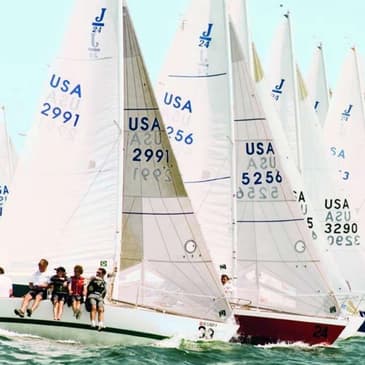
In this episode we dive into the inspiring journey of Maura Winston, London Calling’s tactician. Maura grew up sailing in the picturesque waters of Rhode Island and began racing at an early age, moving later into Bermuda Cup match racing and J/24 and J/105 keelboat racing. With her infectious enthusiasm for the sport, Maura shares how teamwork is at the heart of sailing success, as well as the importance of networking and finding the right team, proving that building connections is a vital skill for burgeoning keelboat racers! We also chat about London Calling’s performance journey over the last two years, with Maura emphasizing how intentional practice and coaching elevates performance, with driving skills being an obvious game-changer for boat speed.
Maura also offers refreshing advice: focus on the basics instead of getting bogged down by excessive data. And how practice starts are the perfect way to boost confidence and get a solid read on that day’s racecourse. Maura’s insights are practical and motivational, making I what I hope is a great listen!
[00:00:10] Hi everybody, and here we are again with another Sailfaster episode. Thank you as always for listening. Sailfaster is, according to Google and Buzzsprout, now a top 20% podcast, which is great. And yes, I'm just as surprised as you to hear that.
[00:00:26] As always, thank you for your emails. Love getting them. Some great suggestions for guests and topics. Your suggestions for guests have included Cole Brower, Terry Hutchinson, Andrew Molaris and Ian McDiarmid, Deb Fisher of the Royal Ocean Racing Club, Stephanie Roble and Maggie Shea, Yannick Bestaven, who is currently racing the Bondi, Dylan Fletcher, Hannah Mills from SailGP, and
[00:00:56] Shirley Robertson. Some of them are already on the schedule, which is great. And I'll do my best to convince the others to take part at some point. But if any of you know Dylan, Yannick or Andrew and Ian sort of personally, let me know. If you've got a connection to them, let me know and I'll reach out to them and see if we can say them to go on the on the pod.
[00:01:15] So today we are going to go local. We're talking to Maura Winston, a tactician and team racer who sails out of Annapolis. Maura grew up sailing in Rhode Island, racing all over the world.
[00:01:26] Optimus and then moved on to high school and college sailing in New England. Post-college, she competed on the team racing circuit events around the country before, I think, taking a pause to work on her legal career.
[00:01:40] She's been a New York Yacht Club and Annapolis Yacht Club member. She lives in the Washington, D.C. area.
[00:01:45] And as I said, sails out of Annapolis, Maryland, where she's actively involved in both the J-105 fleets and J-22 fleets. Now, I know Maura well because she's our tactician on London Calling.
[00:01:59] And she played a huge role in improving our racing performances on London Calling and always good to have a lawyer on your boat, I think.
[00:02:09] And every time she's on the boat, good things happen. Sometimes when she's on the boat, bad things happen, but it's rather to do with Maura.
[00:02:16] So, Maura, thank you for joining us on what is a snowy day, actually, in Washington, D.C.
[00:02:23] Yeah, thanks for having me, Pete.
[00:02:25] Yeah, it's great to see you.
[00:02:26] So what I wanted to talk to Maura about was just her experience on racing on many teams in Annapolis and actually also in Newport as well.
[00:02:36] I'm doing, I think, team racing there, so I want to hear about that.
[00:02:39] And then also you've had a lot of time on London Calling and the various regattas we've done in Annapolis.
[00:02:46] And at the end of our second year, we had a really good finish, right?
[00:02:50] We had top 10 finishes on the last two big regattas.
[00:02:54] I mean, we were 7th and 8th or 6th and 8th, something like that.
[00:02:57] So there's a bit of a story to be told here of how do we go from, you know, the bottom third of the fleet to, you know, almost the top third of the fleet in some occasions.
[00:03:07] And over the last few regattas and long may that progress continue, we could be right back at the back again.
[00:03:14] But I don't know.
[00:03:16] But anyway, I wanted to talk about that.
[00:03:17] So let's kick off with Maura.
[00:03:19] So when and where did you get into racing sailboats?
[00:03:23] So I grew up in Rhode Island and my dad grew up sailing and he got us all.
[00:03:29] So I have three brothers and he got all of us into sailing from the time we were in diapers.
[00:03:33] We sailed in the summer at Bristol Yacht Club, started racing pretty early at Opti's and just kept going on through high school sailing, college sailing and beyond.
[00:03:44] So I didn't know you had three brothers.
[00:03:46] Where are you in the water?
[00:03:47] Yeah, I have two older brothers and a younger brother.
[00:03:50] And my two older brothers are still sailing regularly, very regularly.
[00:03:54] My younger brothers mourned a rock climbing.
[00:03:56] So I imagine if the two older brothers were going, then your family just had to all go as a group, right?
[00:04:02] You're just like, right, we're going sailing.
[00:04:04] Did you have a choice?
[00:04:05] Yeah, actually, that was part of it.
[00:04:07] So when I first started sailing, I started in what we had little Mercuries.
[00:04:13] They're little keelboats and they would pack a bunch of young kids into them.
[00:04:16] And everybody was scared, but I wasn't scared to drive the boat.
[00:04:19] So I started driving and, you know, sailing class in the summers.
[00:04:23] And then when I got into Opti's, they could flip really easily.
[00:04:27] And I became scared and I wanted to actually not continue sailing.
[00:04:32] And my parents were like, no, this is what our family does.
[00:04:35] This is what you're going to do.
[00:04:36] So I stuck with it.
[00:04:38] And then I started racing and I, you know, learned how to write the boat officially after capsizing.
[00:04:44] And it, you know, moved on from there.
[00:04:46] Yeah, that's really, that's really funny.
[00:04:48] So I know you've done plenty of roles in the boat.
[00:04:52] Do you have a preferred role?
[00:04:53] Yes.
[00:04:54] So I actually like the tactician role a lot.
[00:04:57] It's a comfort zone for me, probably.
[00:04:59] When I grew up sailing on a J24 racing, in addition to dinghy sailing, my family had a J24.
[00:05:05] And my brother, Ted, drove the boat and my dad trimmed the jib and I called tactics.
[00:05:13] And my brother, Tom, did bow.
[00:05:15] And then we'd have, my younger brother, Peter, just was never into sailing.
[00:05:18] So we'd always have another person on board.
[00:05:21] And we sailed for many years and that way.
[00:05:24] And we became very, very, very good competing with the top boats in Fleet 50 in Newport.
[00:05:29] And I just loved calling tactics.
[00:05:32] And I was a skipper all growing up in sailing and through college sailing as well.
[00:05:37] So continuing to call tactics is something that I've just really enjoyed over the years.
[00:05:42] So you were back up in Rhode Island this summer, weren't you, for the team racing?
[00:05:46] What was that about?
[00:05:47] Yeah.
[00:05:47] So I sailed in the Hinman Masters team race.
[00:05:50] When I was in college sailing, I sailed.
[00:05:53] We team raced quite a bit.
[00:05:54] And then when I got out of college, that was sort of the major sailing that was accessible to me.
[00:06:00] I joined New York Yacht Club pretty much right out of college and started team racing on their team race team.
[00:06:06] And I got to travel all over the country doing different regattas.
[00:06:10] And it was basically like the whole of college sailing just moved over to these yacht clubs, team racing against one another.
[00:06:16] So it was really amazing and really a wonderful experience.
[00:06:20] And I took a break for a while after having kids, having really young kids.
[00:06:26] And, you know, have recently got into it again since getting more involved with Annapolis Yacht Club.
[00:06:31] They're trying to build up their team race program and asked me to join.
[00:06:34] And so it was a really fun experience to try to really to come in and be part of a growing team.
[00:06:41] Everybody's interested in learning and getting better.
[00:06:44] And it allowed me to have more of a leadership role on the team, which was really fun.
[00:06:47] Hey, did you ever do match racing, by the way?
[00:06:51] I did a little bit of match racing.
[00:06:53] Actually, many years ago, I sailed in the Bermuda Gold Cup, which is a very serious match race with some friends from college sailing and sailing growing up.
[00:07:04] But at the time, you know, and that was sort of a pivot for me at the time, just out of college.
[00:07:10] Many friends were getting into sailing very seriously and looking into it as a career.
[00:07:15] And I was in law school.
[00:07:18] I was trying to become an attorney and I had to sort of make a choice.
[00:07:23] And I chose to become a lawyer.
[00:07:25] And so my sailing took very much a backseat for many years while I was in a large law firm.
[00:07:31] So, Maura, tell us about how you sort of slot into your designated role on the new team, whether it was the women's J105 regatta or the J24 team racing up in Newport.
[00:07:45] What's that like for you?
[00:07:46] I think when I'm joining a new team, it's really important to be on board on the same page with the skipper or whoever is really running the program and have each person understand their role.
[00:08:00] If you don't have that, then you oftentimes have many people trying to call tactics over one another.
[00:08:06] And it really doesn't work.
[00:08:08] And they're often not focusing on their own role.
[00:08:11] So that's always really important to me is making sure I'm on the same page with the skipper if I'm calling tactics or whatever my role might be.
[00:08:18] And making sure that my voice is heard by the skipper if I'm calling tactics instead of someone else, really.
[00:08:27] And then I find that, like for the women's regatta, there were talented people on the boat.
[00:08:33] And initially, we had sort of a few voices calling tactics.
[00:08:37] But we started to do better when one person was making the calls.
[00:08:42] And I think the team saw that.
[00:08:44] And so everybody was able to sort of focus in more on their position and let me make the tactical calls, which was great.
[00:08:52] How did you do that?
[00:08:52] Did you say to the skipper, hey, should we just have one voice here?
[00:08:56] Or did you just raise your voice louder?
[00:09:00] No.
[00:09:01] So it's not my style to raise my voice louder because, you know, I grew up.
[00:09:07] My dad on the boat always said sailing is supposed to be fun and there's no yelling.
[00:09:11] And he had a zero tolerance policy.
[00:09:12] So it's really whoever is in charge of the boat.
[00:09:16] Usually it's the boat owner.
[00:09:18] Talking with them either one-on-one or in real time on the boat, making sure we're on the same page and they're listening to me.
[00:09:25] You've been really successful at, you know, joining and being asked to join other boats, whether it's our boat or Mayhem or the J-105 on the women's regatta or, you know, the J-2014 that you joined in Newport.
[00:09:38] What advice would you give to somebody looking to, say, move out of being on dinghies and trying to break into a keelboat team in some of these very competitive fleets?
[00:09:51] I think that the way it's usually done for most people and probably me too is by sort of having somebody vouch for you.
[00:10:00] So let's say you're picking up and moving to San Francisco from college.
[00:10:05] You know, you've just graduated from college and you're moving to San Francisco.
[00:10:08] I did that after law school.
[00:10:10] And what I did was, you know, I reached out to some friends that I had from college sailing in that community, got together with them, asked them, you know, sort of networked, right?
[00:10:20] Almost as if you're trying to find a job, asked about good boats and who should I meet and, you know, was sort of involved in the social scene of sailing and got to know people.
[00:10:29] And because I had people who were very good at the sport, they were sort of vouching for me and helped me get on boats.
[00:10:37] And then once you're on a boat and you prove yourself, pretty quickly other people start to realize, hey, you know, this person knows what they're doing and they're an asset.
[00:10:46] Are there ways to recognize what's a good team versus what's not a good team in terms of which team to join?
[00:10:53] Can you spot that from afar?
[00:10:56] Yes, I think I can at this point.
[00:10:58] It's taken a long time.
[00:11:00] So I think it's important to understand what you want to get out of sailing.
[00:11:05] For me, I don't want to be on a boat with a skipper or a tactician that's yelling.
[00:11:10] I just don't think it's fun and I don't think people perform at their best.
[00:11:13] And I think you see that the top boats, they're usually not yelling.
[00:11:18] So, you know, if you find yourself on a boat where there's yelling or you don't really want to be there, you have to either extract yourself pretty quickly.
[00:11:29] So don't sail with them again.
[00:11:30] Or you might want to get something out of it.
[00:11:33] So let's say you're new to sailing and you want to learn and you don't have that many opportunities to get on a boat.
[00:11:39] You might put up with it for a while and then network within the fleet and try to get on another boat that is sort of a better vibe for you.
[00:11:48] But, you know, the things that I look for when, for instance, when I was new to Annapolis and new to the J-105 fleet, you can tell when a skipper kind of has such a big ego that they're not going to listen to you.
[00:12:01] So often, even before you get on their boat, if people are really set in their ways, then it will be hard to come in as a tactician or a person that wants to make tactical calls or even maybe change things up a little bit on the boat.
[00:12:17] If you have a lot of experience, it will be difficult to actually add value in that environment.
[00:12:22] So what I often look for is a skipper that is open to learning and what you can figure that out when you have an initial conversation before you sail on their boat.
[00:12:32] But also like a job, right, in corporate America where there's high turnover, that's a red flag.
[00:12:38] So if there's a boat that can't keep crew, there's usually a reason.
[00:12:43] And so you want to avoid that.
[00:12:44] That's great advice.
[00:12:45] So I want to talk about this year, Racing on London Calling for you, where 99% of the time you're a tactician there.
[00:12:53] And we seem to improve enormously in the back half of the season.
[00:12:58] We won one smaller regatta, the MD Cures, for the first time.
[00:13:03] And then in the last two sort of fall series and Chesapeake series, I think we came like six and eight, something like that, which I found surprising.
[00:13:14] I should say the least.
[00:13:16] We were pretty consistent.
[00:13:18] You and I haven't really talked about this, but to your mind, what do you think the improvements are down to?
[00:13:26] So I've spent a little time thinking about this, actually.
[00:13:30] And I think there are two major things.
[00:13:32] I think the first is starting from when you wanted to put the program together, I don't know, two years ago.
[00:13:40] So you set a goal of wanting to be mid-fleet and you systematically worked towards that goal.
[00:13:47] So you actually, Pete, put in place opportunities for the crew and the fleet as a whole to have on-the-water coaching several times.
[00:13:57] And before we went to those coaching events, as a crew, we said, what do we need to work on?
[00:14:04] And there was one particular coaching session where we must have spent two hours going around a tight course just doing downwind mark roundings with, you know, Spinnaker.
[00:14:15] Yeah, I remember.
[00:14:16] And that was the first thing that made the team be able to move from sort of crisis management where nothing's going right and we're solving problems to everyone does their job well.
[00:14:30] We have trust in one another.
[00:14:32] And all of a sudden, we can start looking at tactics instead of inside the boat.
[00:14:38] We're looking outside the boat because everybody has their roles down.
[00:14:42] That was huge.
[00:14:43] I've seen a lot of people have a goal in mind, but I've never seen anybody work towards it in the way that you set this up where you had sort of intervals of learning and very concrete things that we wanted to work on and improve within those sessions that we had with coaches.
[00:15:03] So that was huge. And then the second thing by far this year for us moving from sort of bottom of the fleet to mid fleet and above is the driving.
[00:15:15] It's 100 percent the driving.
[00:15:16] Boat speed is so important, especially in our fleet.
[00:15:20] And when you don't have the feel of the boat, your boat speed is just not going to be able to compete with the top of the fleet.
[00:15:28] And so we had some people come on board that, you know, Guillaume specifically, that he's a really good driving coach and he's a really good driver.
[00:15:36] And he was able to kind of help you get in the groove in a way that I think you haven't been able to in the past.
[00:15:42] I mean, he made an enormous difference.
[00:15:44] Nobody really sort of told me before how to how to drive.
[00:15:49] I mean, I mean, anybody can get on a boat and steer in the right direction.
[00:15:51] You get sort of roughly there.
[00:15:53] But getting into the nuances of it, getting into the feel of it, which I didn't I didn't have feel basically, because I don't think I had enough sort of time on it.
[00:16:02] But it started to come in those last few regattas.
[00:16:05] And yeah, it made it made it made a massive difference.
[00:16:07] But going back to the first piece about being intentional about improvement, I think that's that's true.
[00:16:14] We I think we were as a team pretty intentional.
[00:16:17] I think we did some good planning and talking about it as well.
[00:16:19] I also think it's another factor is just the fact that, hey, after one and a half seasons of sailing together with the same team, we started to gel a bit.
[00:16:28] And you you're right.
[00:16:30] We went from crisis management to boat handling disasters to sort of knock on wood, rarely making major errors.
[00:16:38] Everybody makes error after error.
[00:16:39] And we did we did that.
[00:16:40] But just reducing our error rate, I think, was a huge, huge difference for us.
[00:16:46] The thing for me, I think, was just we had great starts.
[00:16:51] Nobody really told me the difference between a good start and a bad start in terms of how that race is going to be the ease of that race.
[00:17:01] Because when you're in the top 10 out of 25 boats, your options are a little bit more open.
[00:17:07] There's less disturbed air.
[00:17:09] The lanes are open.
[00:17:10] And the marks are less crowded.
[00:17:12] I'm not saying it was easier.
[00:17:13] But when you're back in the pack and you're wallowing along in disturbed air, that's very difficult to do well in.
[00:17:20] One thing I think is that you always make really good tactical calls, sometimes fantastic tactical calls.
[00:17:26] But only in the latter half of the season did we have the boat handling and the boat speed to be able to take advantage of where you wanted us to go on the course.
[00:17:35] Yeah, I think that's right.
[00:17:37] And I'll go back again to the starts.
[00:17:41] Because when we first started, even if we got a great start, we could never hold a lane.
[00:17:47] And the driving has improved so much that now we can hold a lane off the line.
[00:17:53] And so within the first three minutes, you're starting, starting well, holding the lane.
[00:17:59] And then we're able to make a really good tactical call about when to tack, you know, on the first upwind leg.
[00:18:05] But before, we weren't holding a lane.
[00:18:08] And so then it becomes, okay, we might have to tack early.
[00:18:13] We're not following the tactics that we want.
[00:18:15] And so I just can't reinforce this enough.
[00:18:18] Like, the driving has improved so much that it allows us to execute on the tactics.
[00:18:23] And that has been the defining piece, honestly.
[00:18:26] I think we've become braver in the starts as well.
[00:18:29] I remember my first few starts on a, you know, Wednesday night, you got 30 skilled, experienced J-winner 5 teams bearing down on you.
[00:18:40] So I would shit myself, you know, and you'd be like, Lee Bowman, get right up to the mentality.
[00:18:46] No, I don't want to do that.
[00:18:48] But I think having you helped me have the courage to follow what you wanted me to do.
[00:18:54] Yeah.
[00:18:55] And one thing that was a differentiator there that really changed is you said to me, you know, talk out loud and tell me what you're thinking.
[00:19:03] And I think when you understood that I had a plan or that I was talking to you saying, okay, we're going to, you know, tack right under this boat.
[00:19:12] And then you're going to have a hole beneath you.
[00:19:15] And I'm going to, you know, show you how to do sort of an S turn to not let anybody steal your hole.
[00:19:20] So when you saw the sort of plan, I think that there was more comfort there in executing it rather than me just saying, okay, tack.
[00:19:29] But you didn't know why you were tacking.
[00:19:31] You didn't really know what the starting strategy was.
[00:19:34] Yeah, I think that was really helpful because I just don't, I didn't grow up sailing.
[00:19:39] So I think I said to you, pretend I'm a seven-year-old.
[00:19:43] Explain it to a seven-year-old.
[00:19:46] Yeah.
[00:19:47] Yeah, that worked quite well.
[00:19:49] It was great fun.
[00:19:51] So Maura, what have you learned over the last couple of years?
[00:19:54] Is there anything that you've learned that's sort of new and different for you?
[00:19:57] I think one thing that really surprised me in the J-105 fleet is that there are, and you can hear it on your podcast, actually.
[00:20:05] There are so many different schools of thought for jib trim and how flat versus how much heel you want.
[00:20:12] There's all this talk about VMG and all these different calculations about target boat speed.
[00:20:18] All of that to me, you know, I sailed dinghies predominantly.
[00:20:23] And then on a J-24 where we only had a compass, we could only tell our heading.
[00:20:27] And so my style of sailing is to look at the wind and pay attention to the current and figure out, you know, sometimes in different places, like in Newport, when the big puffy clouds are coming in, that means the sea breeze is coming in.
[00:20:41] So, you know, you look at the clouds and you go back to basics, you know, where's there more breeze?
[00:20:49] You stay on the shifts, you stay in phase and you tack on the shifts.
[00:20:52] And for a while in our previous two seasons, we got very caught up in the noise.
[00:20:58] And I thought that was really important.
[00:21:00] And I thought I was actually learning a lot about how to sail a J-105.
[00:21:04] But the best regatta that we've had, I think it was our best score, but maybe not.
[00:21:09] One of our top regattas was when all of the instruments were down and we just had to sail old school.
[00:21:17] And we sailed so well.
[00:21:20] And what that really reinforced to me was ignore all the noise and go back to basics.
[00:21:26] You know, pay attention to the wind, stay in phase, tack on the shifts and make sure you have a good start.
[00:21:33] Yeah, I agree with that.
[00:21:34] That was a real insight, wasn't it?
[00:21:36] I think not being an experienced sailor, I use the instruments as a bit of a crutch.
[00:21:42] There's so much data, so much information coming from them.
[00:21:45] But you and Guillaume were very much like, stop looking at that.
[00:21:49] Just look at the telltales, feel the boat loading up.
[00:21:52] And you're right.
[00:21:53] Maybe then we were more in tune with each other as well, because we were all looking at the same and feeling the same thing at the same time.
[00:22:00] And maybe that was helping us rather than each person looking at a particular different set of numbers.
[00:22:06] And the data can be, you know, obviously pretty overwhelming at times.
[00:22:10] I do remember coming on that race when we had no instruments and no starting.
[00:22:15] But we came around that windward mark on the last leg and we were silent, absolutely silent for about five minutes after that.
[00:22:23] Because we suddenly realized we were second approaching the finish.
[00:22:27] And nobody wanted to say anything.
[00:22:30] It was that sort of shock.
[00:22:31] And I was just terrified of doing anything wrong to get us away.
[00:22:35] I would say, too, one thing that I never spent a lot of time on was doing a practice start before the race.
[00:22:43] And that's something that we do that has helped a ton that probably honestly never even occurred to me.
[00:22:48] So you get out to the race course a little bit early and everybody thinks, let's do a set.
[00:22:53] Let's make sure this vinegar is rigged correctly.
[00:22:55] Let's look around, make sure we know what the current's doing.
[00:22:58] But I would spend time, you know, when I was skippering, looking at the course.
[00:23:04] But what we do on London Calling is we do a couple of practice starts before there are other boats out there even.
[00:23:11] So there aren't boats to start against.
[00:23:15] But we get a feel for where the line is, you know, how much time it takes us to get up to speed and get going and where we want to be doing that based on the conditions, you know, the current and the wind.
[00:23:25] And that has made a huge difference in our starts.
[00:23:28] And I honestly don't see other boats in the fleet doing it.
[00:23:31] Yeah, I don't know if they do or not.
[00:23:32] I think you're absolutely right.
[00:23:33] That gave me a huge level of comfort because I need to sort of feel it.
[00:23:37] So we'll do it a few times, a practice start a few times.
[00:23:39] You start the clock as we do, like, okay, let's pretend it's three minutes.
[00:23:43] Here's the approach we're going to take just to sort of figure out, ah, we need to be a little bit further from the line.
[00:23:48] Otherwise, we're going to be earlier.
[00:23:49] Let's try it again.
[00:23:50] Okay, that feels comfortable.
[00:23:51] For me, I need to sort of feel that and sort of look around and see what that feels like.
[00:23:55] And of course, once you've got, you know, 20 other competitors there, it all goes to shit.
[00:24:01] But I found that really, really helpful.
[00:24:04] If you remember, I think that's something that Jason Curry from Content Sales helped us do a few times.
[00:24:09] His coaching about how to think about those practice starts was really, really, really helpful.
[00:24:16] Yeah, yeah.
[00:24:17] It's made a huge difference for us.
[00:24:19] So, Maura, thank you.
[00:24:20] Thank you for spending a little bit of time with us on Sail Faster.
[00:24:23] I really feel privileged that you're on our boat.
[00:24:26] You've made a big difference.
[00:24:28] I'm really looking forward to next year.
[00:24:30] I'm really, actually really inspired by listening to people who've come on Sail Faster and talk about how to get the most out of practicing as a team, which is absolutely crucial.
[00:24:39] I'm really looking forward to next year.
[00:24:41] And I've really appreciated the work you've done on London Calling this year.
[00:24:45] Thanks.
[00:24:46] Yeah, it's been a really great journey.
[00:24:48] And it's been fun to see the team improve.
[00:24:50] So I'm excited to see what's to come.
[00:24:53] Yeah, me too.
[00:24:54] Lots of podium finishes, perhaps.
[00:24:59] Yeah, perhaps.