
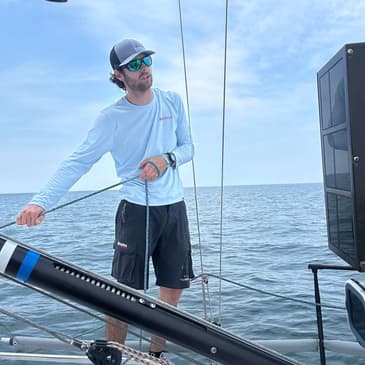
Today we dive into the world of crewing with Quantum Sails’ John Rampe. We discuss what it takes to excel as a new crew member and the art of crewing including how to evolve your skills from the bow to the back of the boat. From the critical role of communication and preparation to the unique qualities that make a good skipper stand out in the eyes of the crew, John’s insights are both inspiring and practical. We also found time to unpack what separates top-tier boats from the rest, from the point of view of its crew. You'll also pick up on the power of teamwork, the joy of learning, and the sheer, infectious thrill of sailing fast boats...!
[00:00:10] Hello and welcome to Sailfaster. Today we are talking about crewing and what makes someone a really good team member for a competitive team. And to do that, we're talking firstly to John Rampe, who is a sailmaker at QuantumSails in Annapolis. He grew up racing Opti's, Lasers and 420s competitively, and also has experience on the keel boats. I think his family had a Tartan 10. He's experienced racing a J109 and a J111 as a crew member.
[00:00:40] And though I think, John, I can still say you're still quite young. John has gained quite a lot of experience actually. He worked for three lofts, Doyle, Ullman and Quantum, which is super interesting, as well as racing competitively in the Annapolis area. So today I wanted to find out from John what it takes to be a good crew member, how to contribute to the team and to the race, of course, and how to become a sought after crew member among the most competitive boats. So John, thank you for taking the time and welcome to Sailfaster.
[00:01:10] Thank you for having me.
[00:01:11] So let's start with the origin story. How did you get into sailing, John? I think you're from Cleveland originally, which is on the lake, right?
[00:01:19] Correct. Yeah. No, my family grew up sailing for as many years as I can remember. And pretty much as soon as I was born, they were dragging me onto the boats.
[00:01:28] It's, you know, it didn't matter the age. They just kind of wanted me there to learn. And from there, I just kind of developed a passion for it. I really enjoyed being on the water.
[00:01:37] And from there, it just kind of turned into something that I thought I'd really like to do with my life.
[00:01:42] Now, I think I saw that your family had a Tartan 10. Did you race it or was it cruising?
[00:01:48] No, it was a racing Tartan 10. The One Design class up in Cleveland is actually very competitive for the Tartan 10s. It's usually 15 to 20 boats for the regattas.
[00:01:58] So it's a great place to learn and it was a great atmosphere to learn.
[00:02:02] Okay. Now I had to ask, so what was the, how old were you when you did your first race and what was your responsibility?
[00:02:11] Well, I was probably five or six years old when I started truly being on the boat for races. At that time, it was more or less me just pulling down the spinnaker and helping with that.
[00:02:23] But as time grew on, I started to just do some bow work. And from there, it kind of branched me out into wanting to sail on a couple of different other boats and faster boats.
[00:02:34] And from there, it just kind of took off.
[00:02:36] John, how did you turn that interest in sailing and experience sailing into a career?
[00:02:43] Well, when I was younger, I was looking for a job and there was a Doyle sailmaker that was kind of part of our club.
[00:02:50] And I just asked him, Hey, you know, could I start working with you, helping you with things?
[00:02:55] And from there, worked with him for about a year, year and a half, and then kind of wanted to do more like in loft sailmaking.
[00:03:03] And I found my way into an almond sail loft. And there I just really, you know, discovered a passion for it.
[00:03:09] And from there, you know, I was down here working and found my way into a quantum loft and never really looked back.
[00:03:16] And I got lucky enough to sail with my boss, Jason Curry. And from there, he ended up offering me a job.
[00:03:22] And, you know, I'm not going to not take an opportunity like that.
[00:03:26] Yeah. Yeah. Fantastic. Jason's been on the podcast before.
[00:03:29] So what's your role at Quantum right now? What is it? What is it involved?
[00:03:33] I'm the service manager here.
[00:03:34] So pretty much my day to day is kind of making sure the guys on the floor have work to do, talking to customers when they come in with questions, calling customers about estimates, depending upon if they have questions there and just kind of making sure the service area runs smoothly and things like that.
[00:03:52] OK, tell us about the sailing you're doing.
[00:03:54] What's your season been like?
[00:03:56] What have you been racing on?
[00:03:57] Because it's now we're in the fall, so it's starting to come to an end or it is at an end.
[00:04:01] But what have you been doing?
[00:04:04] Started out by racing a couple of the 105s on Wednesday nights.
[00:04:08] And from there, I've been able to hop on a bunch of different other boats.
[00:04:12] I was racing on a 122 for a little while.
[00:04:14] And then from there, I went on to Amelgus 32 for a little bit for the Wednesday nights.
[00:04:20] During the regatta weekends, it's mostly was the 105s.
[00:04:24] But then I did a couple of races down to Solomon's and to Oxford with a FAR 400.
[00:04:32] I've sailed with you once.
[00:04:34] Yeah.
[00:04:35] I think that's mostly been about it.
[00:04:38] It's mostly just quantum clients.
[00:04:40] So the Amelgus 32 on Wednesday night race, that must have been quite an interesting boat, very different boat from the J105s, of course.
[00:04:48] Definitely.
[00:04:48] Yeah, no, I mean, they're a lot of fun downwind.
[00:04:52] Pretty much the same upwind, but really those boats are made for when you turn that windward mark and you start heading downwind.
[00:04:58] You know, you're full plane mode the entire time, trying to get the boat as fast as it can be.
[00:05:03] And it can be very exhilarating for sure.
[00:05:05] It's definitely the more wind there is, the deeper you can take the boat.
[00:05:09] And the whole thing is you want to keep that boat on a plane when you're able to, because that's how you get the most speed out of it.
[00:05:16] So, John, what's your advice on crewing boats, especially to those wishing to sort of make progress from the front of the boat to the back of the boat over time?
[00:05:25] I think, you know, a couple of key things are definitely just learn as much as you can.
[00:05:29] But most kids start out as a bowman or so, you know, helping out with the bowman and becoming the bowman.
[00:05:34] And from there, you know, you really just got to start listening to the people in the back of the boat, trying to make decisions for yourself and seeing how they work out.
[00:05:43] And then from there, you know, possibly offering some advice and just kind of trying to figure out, you know, what the key things that make a boat go fast are.
[00:05:54] As a bowman, you know, learning to read the wind and learning to read the wind off the water was definitely a step in the right direction to help people understand that I am, you know,
[00:06:04] putting forth the effort into trying to figure out myself how, you know, you can really make a boat go faster.
[00:06:10] And reading the wind, reading the water, is that something you grew up learning or did you take any courses or anything like that?
[00:06:17] Or did you have anybody mentoring you on that?
[00:06:18] The most courses I took were pretty much just reading, you know, and then just kind of trial and error.
[00:06:24] You know, you got to start kind of doing your best to call wind.
[00:06:28] And from there, you kind of truly learn, you know, how the water is going to display the wind.
[00:06:33] And, you know, it helps out with just trying to figure it out that way.
[00:06:38] And then it's your role to sort of pass that information, your observations back to the back of the boat.
[00:06:46] Correct. Yeah.
[00:06:47] And the, you know, biggest thing I always hear is there can never be enough information.
[00:06:52] You know, it's biggest thing for a Bauman is to just try and let them know everything that you see on the course and let them make the decisions they want to make based off the info.
[00:07:03] Have you been in a situation where you keep telling them information and they're ignoring it?
[00:07:08] Definitely.
[00:07:09] Yeah, no, that definitely happens all the time where I will make a thought or a suggestion or so that I'm seeing because of something playing out and they do the exact opposite.
[00:07:20] And all you can do is just kind of keep on giving them information until hopefully they, you know, take a bit of the advice.
[00:07:27] Are there other roles on the boat that you really covet?
[00:07:30] Like, you know, you want to, you really want to be a mainsail trimmer or do you care?
[00:07:35] I like the adrenaline rush on the front of the boat.
[00:07:37] You know, when the water hits you and stuff like that, it's definitely just gives you a bit of excitement for sure.
[00:07:43] But as I've gotten older, you know, I definitely want to find my way into the back of the boat to truly kind of help with sail trim and stuff like that.
[00:07:50] Because I feel, you know, as much as I've learned now, I can still learn more and just apply that into making a boat go faster overall.
[00:07:59] BOW is on a Mel Gizora J-105.
[00:08:01] It's quite a high risk role to play, right?
[00:08:04] That's where things can and do go wrong.
[00:08:07] So there's quite a lot of responsibility in that role that you seem you're totally comfortable with that.
[00:08:12] Yeah, no, definitely.
[00:08:13] I mean, you have to make sure that everything you're doing is up to par because if one thing goes wrong, then it creates a ton of problems elsewhere in the boat and especially in the race course.
[00:08:24] You know, one thing, you know, growing up, it was such a big thing that my father taught me to, you know, make sure the spinnaker's tapes are run and everything.
[00:08:33] So that way, when the spinnaker goes up, that there is no chance of anything being twisted.
[00:08:39] I bet you find yourself swearing at a skipper when he or she doesn't give you time to get the chute down as you're coming into a gate, right?
[00:08:50] I know I'm guilty of that.
[00:08:52] Definitely.
[00:08:53] No, there have been some times where I've had to bite my tongue in certain situations where I felt things could have gone a bit differently.
[00:08:59] But, you know, things happen the way they do.
[00:09:01] And, you know, it's another thing as a bowman.
[00:09:03] You just got to react to it and you got to react as fast as you can to the circumstances.
[00:09:08] What else should sort of a budding racing sailor do in terms of trying to get from the front of the boat to the back?
[00:09:16] I think a couple of key things are, you know, showing up, showing up that you've already looked at the wind.
[00:09:23] You kind of have a thought of how the wind's going to play out, you know, voicing your opinion on that, hearing what other people have to say to that.
[00:09:29] Having discussions about it is a huge thing for boats.
[00:09:33] You know, I definitely see boats that do really well are constantly discussing things, constantly going over what went right, what went wrong, how they want to play things out this race.
[00:09:44] Showing up to the boat with the correct set of gear, you know, making sure that if it's going to rain, you have gear for that.
[00:09:50] And if it's not going to rain, you know, you're not bringing everything in a bag just in case.
[00:09:55] You know, sometimes people will just bring as much as they can.
[00:09:59] And at the end of the day, that is another way that owners gets quite frustrated as if you're deciding to bring a luggage case onto a boat.
[00:10:07] I do love that because it's a lot of weight.
[00:10:10] Yeah.
[00:10:10] Yeah.
[00:10:11] People put big backpacks down below.
[00:10:13] And it's like adding a person and a half by the time your crew has done that.
[00:10:18] Definitely.
[00:10:18] I did learn this trick from George Simpkins and Mark Ruin from the Chicago Mack race where instead of having ice and water, they freeze bottles of water.
[00:10:30] And so that keeps the fridge cold.
[00:10:33] And so you're not having to bring water and ice.
[00:10:35] So I thought I would do that next year.
[00:10:37] But anyway.
[00:10:38] That's a good idea.
[00:10:39] So, John, you said something really interesting there about the in-between races that teams will evaluate what happened and what went wrong and that sort of thing.
[00:10:48] Is that universal?
[00:10:49] Presumably you must find yourself on boats where you finish race one, you get out the sandwiches and people relax.
[00:10:54] The boats that I've seen do well and the boats that I've done well on are definitely finish race one, you know, eat some food if you need to, get hydration for sure.
[00:11:03] But then it's, you know, discussing what went right at the top mark, what went wrong, what we felt we could have done better on the course, you know, how we saw the course and how it played out at the end of that.
[00:11:14] For sure.
[00:11:15] I mean, those are huge things that teams that do good talk about constantly.
[00:11:19] What other observations do you have about the sort of winning boats or the boats in the top half?
[00:11:24] You know, usually those boats are very calm and collective when it comes to making decisions or decisions going wrong or when, you know, stuff goes wrong in the boat.
[00:11:33] It's a very calm, collective way of dealing with things.
[00:11:36] And when they're discussing it, it's not a yelling sort of situation because I know that that can deter people a lot from, you know, wanting to put forth their full effort.
[00:11:47] And, you know, a big thing is just making sure that everyone's happy on the boat, making sure that everyone's enjoying it.
[00:11:54] Because at the end of the day, that's, you know, what sailing is about is just enjoying.
[00:11:58] Have you ever been on a boat where you were yelled at so much that you thought, I'm not coming back here again?
[00:12:04] I have a couple of times, yes.
[00:12:06] There's definitely been some instances where there's been a ton of yelling going on and it's made me really just not want to sail with that program at the end of the day.
[00:12:14] So, John, how do you prepare for race day?
[00:12:17] So, a typical day for me when it comes to race day is, you know, checking the weather, checking the wind, making sure that I know what the conditions are going to be.
[00:12:25] And from there, you know, getting to the boat earlier on time.
[00:12:28] And if I happen to be doing bow that day, it's making sure that, you know, the spinnaker sheets are ran the way I like them, the tacks set up correctly, the spinnakers themselves are packed the way I want them to be so that there's no issue when I go to hook one up.
[00:12:40] If I get a chance to be in the back of the boat, you know, it's from there, it's kind of figuring out what I'm doing and trying to talk to the skipper about how he wants the sail trimmed for sure.
[00:12:52] Because I know with certain skippers, they want certain sails trimmed a certain way for them to steer.
[00:12:58] And you need to kind of have that back and forth talk with them to truly figure out, you know, what the best course of action is for trimming in the sail that day.
[00:13:06] That's really interesting.
[00:13:07] So I talked to a J-105 crew out of San Francisco, Randy and Russ, who talked a lot about neutral helm being critical for them.
[00:13:17] So very little weather helm going upwind.
[00:13:19] And that's how they got speed.
[00:13:20] Would that be sort of conversation you might have with a skipper?
[00:13:25] Definitely. Yeah.
[00:13:26] What's your favorite boat to crew on and why?
[00:13:31] I would say my favorite of all time has probably just been the 111 due to the increasing competitiveness of the class.
[00:13:39] And just because the boat is a very well built boat and it's a relatively fast boat.
[00:13:45] But, I mean, I always have love for, you know, any boat that can go faster than that.
[00:13:50] So from there, you know, I've had a really, really good time sailing on the far 400 around here with one of the other salesmen here, Andrew Waters.
[00:13:58] And even with Jason Curry on the Melgus 32, it's a great atmosphere to be with.
[00:14:03] A whole bunch of knowledge to be learned for sure.
[00:14:05] And just a fast boat in general.
[00:14:07] Yeah, we've had Jason coach our boat London calling a couple of times and he's very thorough.
[00:14:16] He's very understandable.
[00:14:17] He's very insightful.
[00:14:18] He's very pragmatic as well.
[00:14:20] So, yeah.
[00:14:22] The J111 is...
[00:14:24] Those boats get going.
[00:14:25] It is a lot of fun.
[00:14:26] And they, yeah, can't boast enough about the boat, honestly.
[00:14:31] Hmm.
[00:14:32] I talked to George Simpkins, who owns a J111 in Chicago, about Chicago Mack race.
[00:14:39] And he was saying it's the perfect boat because it's a downwind race and those things are rockets.
[00:14:45] So, they fly.
[00:14:46] So, I'll put you in touch with him in case he needs crew for the next Chicago Mack.
[00:14:51] Yeah, for sure.
[00:14:52] For you, what are the characteristics of a good skipper, a good owner, say?
[00:14:58] You know, I always love sailing with the skippers who are very inviting to the boat,
[00:15:02] who are always kind of want you to come out and sail with them no matter what you're doing.
[00:15:06] You know, another good thing is when they start to talk about certain things that they kind of want to see that day.
[00:15:13] And even if they don't come to Influition, they, you know, still give kind of credit to the team where it's due.
[00:15:19] And they really just, you know, want to make the team feel like they want to be there.
[00:15:22] And I definitely have seen that as a huge help when it comes to sailing with certain programs overall.
[00:15:30] You know, better programs that I've raced with, you know, it's definitely huge for having a crew meeting.
[00:15:37] Usually, I've heard it's called.
[00:15:39] When we're going out to the race course, you know, people are talking about their positions,
[00:15:43] talking about their weaknesses in a sense, what they feel like they can do faster,
[00:15:46] what they feel like they need a little help on.
[00:15:48] And from there, it kind of creates just, it gels the team together in a sense to, you know, be one type of unit.
[00:15:55] And that's a huge way that I've seen boats do well.
[00:15:58] Also, another huge thing when it comes to, you know, a good owner is creating a goal for the season.
[00:16:04] I know a lot of times boats are always wanting to do well each regatta.
[00:16:08] And, you know, that's always the case when it comes to racing.
[00:16:10] But when, you know, your skipper is set on one regatta or one race that they really, really want to do well on,
[00:16:18] it kind of builds a little bit of relief into the team for a bit of practicing at the other regattas.
[00:16:24] And then they know that when they step on the boat for that regatta or race, it's, you know, this is what the owner wants.
[00:16:30] This is what we want.
[00:16:31] We try, you know, we want to do our best to win this race.
[00:16:34] Yeah, that's really interesting.
[00:16:35] So in some ways it's treating the smaller races, small regattas as practice for that.
[00:16:42] In a sense, yeah.
[00:16:43] I mean, there's always that thought of like, we really want to do well this weekend.
[00:16:46] You know, I haven't raced with a boat who's not like we want to, you know, we don't want to do our best because everyone always does.
[00:16:52] But having a goal set for the year of this Mackinac race for sense is what we want to do really well in.
[00:16:58] That gives the team drive to, you know, not beat themselves up if one regatta doesn't go well,
[00:17:05] because it's all in the sense of trying to get the boat to top tier performance for that one race.
[00:17:12] Another thing that is always very nice when skippers do is when they bring food.
[00:17:17] I've sailed on a couple of boats that do it and a couple of boats that don't.
[00:17:20] And it's always definitely more enjoyable to get on a boat and the owner's like, yeah, I got a bunch of sandwiches for everyone for lunch.
[00:17:27] It kind of just makes you feel like, you know, this boat's friendly.
[00:17:31] This boat wants people on their boat.
[00:17:33] This boat's, you know, up for everything.
[00:17:35] I didn't know that skippers didn't do that.
[00:17:38] My team convinced me from the start.
[00:17:40] My job is to bring sandwiches, beer, point the nose in the direction they want the bale to go in.
[00:17:46] And that is always the mindset of a good skipper for sure is providing beer and food for the team.
[00:17:52] Yeah.
[00:17:52] The only thing about beer, I always think this is fucking heavy, right?
[00:17:57] I'm trying to take all this weight off the boat.
[00:17:59] You've got ice and beer on there.
[00:18:00] But anyway, that's good.
[00:18:02] John, what to your eye is the difference between the top boats and the middle boats from your point of view as a crew person?
[00:18:10] A couple of things that I've seen throughout the years of sailing are usually good teams come prepared for the day.
[00:18:17] You know, everyone's on time.
[00:18:19] Everyone's, you know, as soon as they get to the boat, trying to help out in a certain way.
[00:18:23] And from there, it kind of translates to the race course of when things go wrong or things go right.
[00:18:28] You know, the team is doing their best to find a resolution if something went wrong.
[00:18:33] And like I said earlier, you know, not getting upset at one certain thing happening and just kind of letting the race take its course and, you know, determining what went right and wrong and making it better for the next race.
[00:18:46] I've seen on a couple of boats when they, you know, mistakes are had, you know, people get quite upset and frustrated and that can just kind of, it deters the entire team.
[00:18:57] And it also, you know, deters that one person a lot from, you know, doing their job 100% well.
[00:19:02] And then that affects the rest of the team from there.
[00:19:05] So those are definitely some big things I've seen overall.
[00:19:08] So, John, as essentially a professional sailor, what's it like being, say, on the rail with, you know, basically amateur sailors who may not be sort of as serious as you about performing?
[00:19:24] You know, I think a bit of chatting is always good.
[00:19:27] You know, when teams are talking on the rail, even if it's not directly about sailing at the time, it kind of just boosts morale.
[00:19:32] You know, people make jokes here and there and that definitely, you know, just brightens the mood in any sense.
[00:19:38] But I've definitely been in instances where I felt that we need to focus up for a certain mark rounding coming up or, you know, if we're really in a close race with a certain other boat, you know, and it's back and forth between this boat,
[00:19:53] sometimes it's really good to try and focus up and see how you can push the boat a little bit more that time and try to get ahead of the boat for sure.
[00:20:02] I sometimes hear there's this sort of four-deck union where it's the front of the boat versus the back of the boat.
[00:20:08] Is that sort of mythology on the sort of racing we're doing or is it?
[00:20:14] No, I mean, there's always a bit of, you know, kind of a front of the boat team versus the back of the boat team.
[00:20:20] You know, usually you're going to have younger guys up in the front of the boat.
[00:20:23] So, you know, it's a couple more jokes every now and then.
[00:20:26] It's a couple, you know, it's a bit more fun in a sense of, you know, you feel like you can, you know, you're like the same age as the person.
[00:20:33] So it kind of helps out in that sense.
[00:20:36] But overall, I think the better teams, you know, show that both front and back of the boat are really gelling together.
[00:20:44] And, you know, decisions get made off kind of all parties on the boat.
[00:20:48] And, you know, it's certain when you have a tactician, he's going to be calling a lot of the, you know, moves.
[00:20:53] But, you know, like I said before, feeding the tactician as much information as you can is just going to help out in the long run.
[00:21:00] John, what's your most exciting experience racing so far?
[00:21:04] So far, I feel like my most exciting experience has been, I think it was a couple years ago.
[00:21:09] I was sailing on a FAR 53 called Far Cry out of Cleveland.
[00:21:13] And we were doing a race called the Indigo.
[00:21:16] And it's a relatively overnight race.
[00:21:19] And on the way back, we were in first by a good margin.
[00:21:23] And coming into the finish, we ended up hitting a sandbar, which stopped the boat in its tracks.
[00:21:29] And the, you know, all the crew on the boat kind of just went forward.
[00:21:32] People were falling everywhere.
[00:21:34] I was racing with my dad at the time who was in the back of the boat, who ended up smacking his nose off the wheel post and breaking it.
[00:21:42] And I remember going into the back and him rolling back and forth on the deck, just bleeding everywhere.
[00:21:47] And I wouldn't exactly say that was fun, but looking back, it's definitely a little funny now.
[00:21:52] Wow.
[00:21:53] So what happened?
[00:21:55] Well, we ended up just going down in a wave and the keel caught a sandbar.
[00:22:00] And so the boat just stopped moving in its tracks.
[00:22:03] It literally did not go probably two more feet after that.
[00:22:07] Did you, you had to pull out of the race, did you?
[00:22:10] Well, no.
[00:22:11] Thankfully, we were basically like right at the finish line.
[00:22:14] So we hit the sandbar, the boat stopped, and then the wave kind of came back, picked the boat up out of the sandbar, and we just kind of floated on into the finish line.
[00:22:23] Oh, God.
[00:22:24] Yeah.
[00:22:24] Blood everywhere from broken nose through.
[00:22:27] It was a great story overall.
[00:22:29] Wow.
[00:22:30] Did anybody video it?
[00:22:32] Sadly, no, not at the time.
[00:22:34] How's your...
[00:22:35] Oh, he's fine now.
[00:22:36] He's fine now, but definitely a couple of black and blue eyes for a couple of months there.
[00:22:41] Oh, sorry about that.
[00:22:44] Well, this has been a great half hour.
[00:22:46] Thank you so much for talking to SailFaster, John.
[00:22:49] I really appreciate this.
[00:22:50] Good fun.
[00:22:51] Thank you for having me.
[00:22:52] John, outro.
[00:22:53] Well, thanks for listening, everyone.
[00:22:55] If you'd like to hear more SailFaster episodes, make sure you subscribe to the SailFaster series wherever you get your podcasts.
[00:23:02] Definitely, of course, tell you you're sailing...
[00:23:05] Let me start this again.
[00:23:06] So thanks for listening, everyone.
[00:23:08] If you'd like to hear more SailFaster episodes, make sure you subscribe to the series wherever you get your podcasts.
[00:23:14] So just search for SailFaster on Apple and Google and Spotify and so on.
[00:23:19] Definitely tell your sailing friends.
[00:23:21] And as always, let me know if you have suggestions for guests or indeed what you'd like us to talk about.
[00:23:27] You can email me directly at Pete at SailFaster.net.
[00:23:31] Pete at SailFaster.net.
[00:23:33] Lastly, don't forget to sign up to Spinsheet's sailing newsletter at Spinsheet.com.
[00:23:39] It's really, very good.
[00:23:40] And you also will see extracts from SailFaster in Spinsheet.
[00:23:45] I think that's it.
[00:23:46] See you on the water and good luck in your next race.
[00:23:49] I'll try it one more time.
[00:23:50] Well, thank you for listening, everybody.
[00:23:51] If you'd like to hear more SailFaster episodes, subscribe to the SailFaster series wherever you get your podcasts on Apple or Spotify or Pocket Cast or Google.
[00:24:01] Definitely tell your sailing friends about the series.
[00:24:04] And as always, let me know if you have any suggestions for guests that you'd like us to interview or indeed what you'd like us to talk about.
[00:24:12] You can email me directly at Pete at SailFaster.net.
[00:24:16] That's Pete at SailFaster.net.
[00:24:18] Lastly, don't forget also to sign up to Spinsheet's sailing newsletter at Spinsheet.com.
[00:24:24] It's really good.
[00:24:25] And that's it.
[00:24:26] See you on the water.
[00:24:27] Good luck in your next race.