
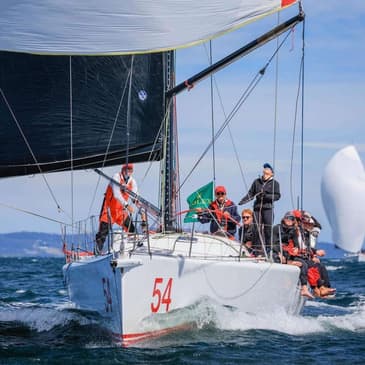
Richard Hudson joins us from Australia to share his experience of December's challenging Hobart race. A highly-experienced ocean racer, Richard shares what led up to their retirement from the race, how the Pretty Woman team executed a flawless night-time high-speed jibe in 30 knot winds, coping with dramatically- changing wind conditions, and making the critical decisions. He also reflected on the emotional impact of retiring from the race and the lessons learned.
[00:00:09] Hello everybody and welcome again to Sailfaster. Thanks as always for subscribing, thanks for listening. Today we're back in sunny Sydney, Australia with a former guest on the podcast, Richard Hudson. As you might recall, Richard's a highly experienced offshore racer with more than 150 races of 200 miles or more under his belt, including multiple Sydney Hobarts and other long distance Southern Pacific races. His prior wins include the Hobart races, Corinthian and Wild Roads divisions, but he's also really well known for fostering
[00:00:39] the next generation of offshore sailors by a blend of youth and experience on his Farr 45 Pretty Woman. And you can hear a lot more about that if you go back to the episode of a few months ago. Richard kindly agreed to return to the pod today to talk about the most recent Sydney Hobart back in December, which was a very difficult race for all competitors, of course, and one in which Pretty Woman retired with damage. 30 other boats retired, and of course, sadly, there were two deaths.
[00:01:09] During this race in what was obviously very rough weather conditions. So we grabbed Richard in his home in Sydney, Australia to just talk us through for a few minutes about the decision to retire and what lay behind that. So I do hope you'll enjoy the episode.
[00:01:36] So Richard, I was really relieved to see that you and your team got back to port safely, of course. You've done many Sydney Hobarts over time. What did this one rank for you in terms of weather conditions and any other difficulty factors?
[00:01:51] It was ranked highly. The weather conditions were pretty heinous. One of the factors, Pete, too, was from a northerly. So we were getting, you know, as the race progressed, very strong northerly. So it was a downwind, which makes it, it might seem a bit counterintuitive, but does make it a bit more challenging, in my view, because you've got fewer options. But look, I think the conditions were tough, but I wasn't overly concerned. There was nothing we couldn't handle. Well, that proved not to be totally right, but I can explain that as we get further into the race.
[00:02:20] But we were very happy with where we were in the positioning of the fleet, and we got out of the harbour in good shape. We were on line two, which meant we sailed to the northernmost inner mark and the middle outer mark. When we went round the northernmost inner mark, we were probably 500 metres, sorry, half a mile ahead of the next boat off line two. We just nailed the exit. We got a really good start, front row, clear air. We were in fact able to tack onto port and cross the fleet to get, we wanted to be on the eastern side of the harbour, which was interesting,
[00:02:49] but it really paid off. And so we went out of the heads in good shape, went round the middle mark offshore, hopped the S3 and sailed south in a building northerly. Being first out of the heads, that was quite an achievement. It was very exciting. At one point I looked under the boom down the harbour and I thought, where is everyone? Did I turn round the wrong marker? Well, as an aside bar to that, as we were going from the northern innermost mark to the middle outer mark,
[00:03:17] there was a spectator boat at T-52, which wasn't in the race, but they were yelling at us. They thought we were going to the wrong mark because they thought we were on line one. So when we got out of the heads, we just popped the S3 and off we went into the building northerly. We were sailing well with good average speeds. I think a couple of the faster downwind boats in our group passed us, which was going to happen anyway. I wasn't overly stressed about that. But we were going very well down south with the S3 up and then the breeze increased.
[00:03:45] So we changed down to an S5, which is a fractional 1.5 ounce spinnaker, about 55 square metres smaller than a normal big one. We were fine with that. Then we put one reef in the main and again, we were okay with that. And we were making some good grounds on similar rating boats of our cohort, taking 30 miles out of them in the first 12 hours, which is not bad. Yeah. And we were up or with some bigger boats.
[00:04:13] So anyway, we were sailing along with one reef in the S5 up in its early 30s and the boat's doing it comfortably. The guys are sailing very well. No problems. And then it increased into the mid-30s, high 30s. So that's time to take the S5 down. So we put up the J5 and took the S5 down. And I've taken, we've got a shorter spinnaker pole we use on non-spinnaker races, like Wednesday afternoon races. And I've taken that with us with the view that we might be poling at Hetzel. So we use that shorter pole because our spinnaker pole is very long.
[00:04:43] And we were then one reef in the main J5 up, going quite comfortably in mid-30s. Then the breeze dropped down to 24. This is the old trap. That breeze dropped down to 24. So let's put the S5 back up. So we did. We were going again, averaging probably 15 knots. Wow, you're flying. Well, we were seeing top speeds in the early 20s. Down waves and the like. Yeah, the sea behind you, presumably, right?
[00:05:10] Well, that wasn't a really good surfing seaway. It was a bit mixed, but it was all right. We were handling it, coping well. And the guys were sailing back very well. We were where we wanted to be. I put a waypoint as to where we wanted to be for the transition from the northerly because there was a front coming through from the southwest. So we've now got the S5 back up again. And then we started to get 38 knot gusts, which was challenging. You can imagine.
[00:05:38] Anyway, we came to the decision to take the sail down. Right decision. We've done it before. So our standard operating procedure in those conditions, we spike the brace rather than let the brace run. And so to do that, we've got to ease the pole forward and drop the topping lift down because Bauman can't reach the end of the pole. And then he just spikes it. And we do a letterbox drop and all's good. That's the theory. Anyway, as we're in the process, we've let the pole forward. It's coming down. He was getting ready to spike. We've got a gust and rounded up.
[00:06:07] Boat lay over. Again, done that before. No one was overly concerned with this deal with it. But as the boat came back upright, I don't know whether you know, but the boat sort of comes back upright and then it'll often roll into windward a little bit. Not major, but as it rolled into windward, the spinnaker came inside the forestate and wrapped around the forestaff. Anyway, when it wrapped, it wrapped including the topping lift because the pole was right forward. So we've narrowed up the spinnaker and the topping lift wrapped around the forestate. And look, it was just bad luck, really.
[00:06:37] I wouldn't put it down to bad sailing or any of that sort of thing. It just shit happens sometimes and that happens. So we're on port jive. And again, we were heading in the rock. VMG was still not bad. We're sailing with a main with one reef in it, still doing 12 knots in the right direction. So I thought, OK, we'll just keep going, try and figure out a solution. Are you on main only at this point? Main only with one reef. Yeah. That was the only option. So we're on port jive.
[00:07:04] There's a point where when the shift came through, we wanted to be on starboard. So as I said earlier, I put a waypoint on the plotter as to where I wanted to be for the change. And we were aiming for that, still doing 12 knots with main only and a reef. Anyway, it just wasn't the reef. The reef was not going to come out. Now, Pete, the only way to get a raft out is jive. I mean, it's like that. Now, normally, if you're inside calm waters or it's lighter winds, if you had a raft like that, you'd immediately jive. And we didn't do that because of the wind strength. So we talked about it and talked about it and planned.
[00:07:33] I said, guys, the only way we're going to solve this is jive this boat. And it was 38 dusting 40 knots. A lot of reason. Normally, you would not jive. That's when carnage happened. But we were left with no alternative. So we spent a lot of time planning it. And three people on the main, one grinding on the wind with main winch, one tailing at the leeward and someone bouncing at the mast. You know, it comes out. I said to Juliet, who was driving. She's a very good driver. I said, bide our time. Pick the moment and just do it. And anyway, she got on her way.
[00:08:02] If the bow went down, the mainsail started to flap as it does as the apparent wind went forward. And I said, just effing do it. I'd say, Pete, we did the best job I've ever done in my life. We came out the other side. No broken battens. No broken mainsail. No banging. No crashing. And guess what? The spinnaker unraveled off the forestay. So while we're jiving the boat, our people had the spinnaker on the deck and then pretty well straight away down below. Yeah. Undamaged. Well, two minor tears in it, which I couldn't believe.
[00:08:30] So now we're on starboard jibe, still with only main and one reef up, heading again into shifted come through. So we're on the right position. We were aiming at Tasman light, through wind angle about 60 degrees. And knowing the breeze was, well, thought the breeze was going to back, which it ultimately did. And the head foil was seriously damaged. So then we spent a lot of time trying to figure out ways of getting a headsail up. We just couldn't do it. We tried the storm gym. And we had a bat the bowman on the bow, standing on the pulpit, literally.
[00:09:00] This is in the strong breeze. And we got it about halfway up. And then it wasn't going to go any further. And bringing it down, we damaged it, bringing it down. And I wasn't worried about that. I was prepared to sacrifice. Did it miss a heat or something with the pressure? It caught on the shards of the head foil and tore. So we ended up with a significantly damaged storm jib. And I thought, well, look, there's a couple of factors at play here. I'm not prepared to sacrifice, you know, our really good sails if we can't get it to work.
[00:09:27] But the other one was a safety factor, too, because we're now heading towards Tasmania, about Tween the Bass Strait. And upwind, the safe havens like St Helens or Flinders Island or places like that are all upwind by a couple of hundred miles. Whereas if you're heading, all we had to do was tack and head back up the coast. We've got Eden, Bateman's Bay, all sorts of places you can go to if you needed to. So it was a safety decision as well. And look, we weren't going to win the race without proper headsets,
[00:09:56] or I should say, you know, do well in the race or win our division. So our chances of achieving a good result had gone. And it wasn't a case of, well, we just need to get there so we can say we've been there because we've been there. It looked like the wind went through about 120 degrees. Before we jived, it was probably around 0, 5, maybe. We saw some late 355 sort of angles. It would have been, testing my memory a bit here, but it would have been in the 200s, maybe.
[00:10:23] We're very well positioned with the transition, too, because we only had, you know, how you get that calm bit before it changed. We had it for 10 minutes. So we'd gone from the strong northerly into the southwestern, went down to about 10 knots for 10 minutes and then went back into it, whereas boats further inshore had that for a lot longer. You knew that was coming. That's why I said earlier on I had a waypoint plotted as where I wanted to be, and it proved to be pretty close to the right spot. At that point, I thought we were looking in pretty good shape. You know, if we'd been able to keep going,
[00:10:52] there was a couple of boats in front of us that were faster downwind boats that we would have needed to catch and overtake. I'd worked out that we had 400 miles to go and we needed to be 1.3% faster than the boats we had to catch, all of which was doable, over 400 miles. So we were in good shape. So anyway, we made the decision, and it was the right decision, even though I agonised over it and agonised over it. And we then tacked the boat or started the motor so we could tack the boat and headed straight back up to Pitwater, which took 30 hours.
[00:11:22] How long did it take you to make that decision? Was it pretty quick or did you agonise over it? I think it was in the order of nearly seven hours from when we had the wrap to when we actually retired. By the time we retired, it was early morning. Yeah. So all this was going on in the dark. Which makes it really, really tough in those conditions. I mean, you're underplaying it a little bit to be trying to figure out how to take a wrap off and then jibing high speed in the dark with a bollobing sea.
[00:11:50] That must have been pretty thumping. I'd rate it as one of the highest rich manoeuvres you can do out there. What was your technique? Was it about trying to get as much speed as possible? Yes. If you're going downwind and you get the boat on a wave, every now and then you'll feel the mainsail lighten up, you know, as your parent goes forward. You must jive at that point. But the trick is too, and this is up to the helmsman, and Juliet did a brilliant job, is you can't, when you come through the jive, you've got to be game enough to hold the boat pretty well 180 true wind angle
[00:12:20] for a nanosecond while it all happens. And then when you come out on the new jive, you can't let the boat round up. Yeah. She did all of it. It was brilliant. The alternative was then just to cut the, because you couldn't, we couldn't go anywhere with a spinnaker on the fourth day. I guess when the front had come through, we would at any rate, we'll start the motor and tack the boat and then head north and deal with it later. But anyway, we did what we did and it was the right call. I imagine it must have been a fairly quiet boat on that 30-hour trip north. That's a long way back north.
[00:12:50] You went to Pittwater, which is north of Sydney. North of Sydney. It's 30 miles north of Sydney. Yeah. And did you say it was a 30-hour trip back? Yeah. It was 200 odd miles. I think about to be 230 miles when we went back. But look, we were fortunate and we had the Southerly to blow us a lot of the way because you've got to conserve diesel. I wouldn't have had enough diesel to motor all the way back. We would have had to go into Eden or somewhere and get diesel and that then adds another X number of hours onto the journey. And we were travelling quite nicely just with the main. We took the reef out.
[00:13:20] How was the crew? Presumably deeply disappointed. Broken. Well, I personally was very, very broken, just devastated. Like we put so much effort into it. The guys had sailed so well. Apart from that, they'd sailed a flawless race. And it's not the crew's fault that it happened either. There's no blame can be apportioned. And was it a first Hobart for anybody on your team? No. In their own experience? No, they'd all done at least one Hobart. Yeah, yeah, yeah. Even though they're young. Most of them had done it on Pretty Woman.
[00:13:50] So we've done a few Hobarts together. When you look back to your preparation of the race, which I know is meticulous. I know you've done it many times. You've done so many, 150 plus offshore races. Anything you would do differently now you knew what had happened? One thing I would review, this is the way, so we've gone through a three-week reef main, which all worked. But just the way I've got the, it's only a minor thing because it wouldn't have been a race breaker, just the way I've got the reefing line set up through the jammers in the boom.
[00:14:19] I probably put another, they were slipping a bit in the jammers, which was okay because we could put them on the cabin top winches. So it wasn't a problem. But that sort of thing means you've got to manage your winch usage carefully. And I could solve that by just solving that. But that's about the only thing I'd rethink. As far as the actual incident's concerned, there's a couple of factors that we've revisited. I think the process of trying to spike the spinnaker by lowering the pole to the bowman, which is fraught.
[00:14:46] So we will investigate the option of taking the bowman out to the end of the pole in a harness, which is, again, many boats do that. In the olden days, it used to be done all the time before asymmetrical boats came into play. That's nervous. It's all right. It's not. Anyway, we're going to investigate that. And we know the safety protocols that we can use. So that would have been a better solution. But the other one that's important is, and we always normally do this, put a jib up before you do the drop.
[00:15:16] So we didn't have the jib on the foredeck for the reason being that going downwind at the speeds we were going and the bow going into wave. You can damage or lose the sail or just, it's not a good idea. And in the moment, there was a sense of urgency to get the sail down, which was right. So whether we would have been better off spending the time getting the jib up, which would have been a process and just waiting, I don't know the answer to that. We'll never know the answer to that. And sometimes in races, in shorter races, we've actually, in those conditions,
[00:15:45] left the jib up if we know we don't have to jive. But when it's heinous like that, would we have been better off doing it? I think the answer is no. The jib did not, shouldn't have been up. Look, I don't know, Pete. It's easy in hindsight. One thing I do know is that we won't be dropping the pole forward using that process anymore. I think everything else we've got pretty right. We reefed the main at the right point. And reefing downwind, so just saying that for us to reef downwind, we had to actually put a jib up drop spinnaker and put the boat onto a beam reach.
[00:16:14] So you can unload the sail away from the shrouds to get, which we did. So we went through that, got the reefing quite quickly, put spinnaker back up the way we went. Yeah. So Richard, again, I'm so glad that that worked out well for you because it was obviously a difficult race. It could have been different. So that was tough luck. But look forward to hearing more of your offshore adventures. And thank you for taking the time. I know you're good guys. So really appreciate you talking to SailFast.