
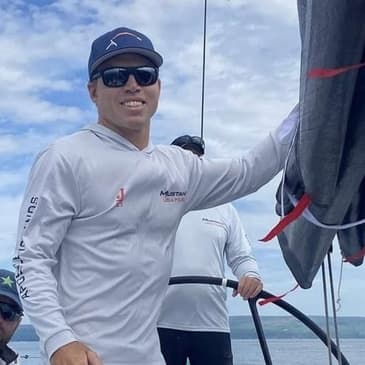
Here’s part two of my chat with J70 expert Patrick Wilson, in which, we dive into the craft of raceboat preparation. Known for his sharp eye and hands-on approach, Patrick shares how a childhood fascination with boat repair led to launching Next Level Boatworks, one of the top one-design prep shops in the U.S.
We talk about keel work, sanding secrets, the quirks of J/70 production, and why boat prep is really about eliminating variables. Patrick also reflects on perfectionism, the psychological edge of a well-prepped boat, and why he’s passionate about sharing knowledge—even with DIYers.
Whether you’re prepping for your first regatta or your 500th, or just curious what makes a boat fast, this episode has tons of advice and behind-the-scenes insight from one of the most trusted names in the game.
[00:00:08] Hey everybody, here's part two of my chat with J70 expert Patrick Wilson, in which we dive into the craft of raceboat preparation. Known for his sharp eye and hands-on approach, Patrick shares how a childhood fascination with boat repair led to him launching Next Level Boatworks, one of the top One Design prep shops in the US.
[00:00:29] We talk about keel work, sanding secrets and the quirks of J70 production and why boat prep is really about eliminating variables. Pat also reflects on perfectionism, the psychological edge of a well-prepared boat and why he's passionate about sharing knowledge even with DIYers. So whether you're prepping for your first regatta or your 500th or just curious about what makes a boat fast,
[00:00:56] this episode's got a lot of advice and behind the scenes insights from one of the most trusted names in the game. I do hope you enjoy the episode. Here we go. Welcome back everybody. So I'm here again with J70 whisperer Patrick Wilson from Charleston and we're going to talk in this episode about raceboat preparation, which is his business. So, Pat, welcome back. And can you tell us about your raceboat preparation business? How did it start?
[00:01:26] Yeah. So from an early age, for better or for worse, I've been pretty good with my hands and I was always attracted to working on boats. I was thinking about this question earlier. I think I remember when I was like seven, a sunfish hit my wooden optimist and put a hole in it. And I went to the guy's shop and he fixed it and I couldn't tell there was a hole there. And maybe that left an impression on me. I don't know. But fast forward to like 15, I was working as a dishwasher at a restaurant downtown and really did not like the job so much.
[00:01:53] And my dad said, hey, there's this guy, Dick McGillivray, who fixes old sailboats. Maybe you should go talk to him. So I went and talked to him and he hired me. I didn't know anything. I was a sailor, but he was a really good sailor, Charlestonian. And I was like his nipper for all of college and high school. I mean, I did the dirtiest jobs and this, that and the other, but I loved it. And then after college, I was starting to do some more sailing.
[00:02:20] I was sailing with Will Wells from north at the time, a lot of J24 stuff. And kind of the man in J24 keel world, one of them was this guy, Chris Morgan. And I didn't know anything about that, but that seemed like something I wanted to learn. How do you, how do you shape a keel? How do you laser a boat? How do you do all these things? And Chris was going to work and sail with us. And I got ahold of him and I said, Hey Chris, you know, I've got like kind of enough sailing to keep myself going for the winter.
[00:02:46] If you'll give me a place to stay, I'll come work with you for free if you'll teach me how to do this stuff. And so he said, okay. And I moved down there to Bradenton and spent the whole winter, two winters in a row with him actually him and Monica, who they had just started dating at the time they're married now. Monica would just run her up to Kohlbrauer for the Rolex Yachtman woman of the year last year. Oh yeah. Phenomenal year, phenomenal sailor. One of the best people I know.
[00:03:10] Um, so I lived with them for two winters and we were broken, dirty and dusty, but we learned how to do all kinds of stuff. But, and then I guess after that, I went to, I was up on the Cape. Well, I met in Newport, I met a guy named Carl Anderson, who Carl had Carl's boat shop, who actually did all the J24s for Kenny Reed and everybody else. And, uh, he was also very famous for doing this stuff.
[00:03:37] And, uh, I became friends with him and went up there and spent a summer working on the Cape. And after the first summer, he had a bunch of Cape guys working for him and said, Hey Carl, I like this, but can I bring some of my buddies from Charleston? I think they'd be better at doing this with me and these guys. And, uh, I brought a guy named brother Mallard. He was one of my best friends growing up. His name is brother. It's crazy. The only person that doesn't call him brother is his sister. And then I also brought my good friend and partner in our next level boat works business, Emory Williams. And, uh, we moved to the Cape and we would stay there for about seven months a year.
[00:04:07] And we ran the one design shop for three years or so. And then we came to Charleston and Emory and I said, you know, we should probably just do this on our own. The weather's a lot warmer down here. Like, and the first boat we did was for Joel and the catapult. And we agreed to do it. He bought an old boat and, uh, we didn't really have a place to do it. We didn't really have the tools. We ended up using his debt of concrete pad behind his dad's warehouse. And we flipped the boat over and we're doing the center seam and keel.
[00:04:37] And then, you know, it started raining at one point. And we had to go buy like a tent at Harbor freight. And there were bugs. We had to buy a gas compressor. It was, I don't, and, but that boat, and we've won the world with that boat a year later. Fantastic. Yeah. And it was like, and so fast forward, I was thinking about this last night because I was in the shop, we had kind of a lot of stuff to do for the Annapolis nude. And we've been there way more than normal, stay a little later than normal. And I was thinking like, you had told me back then I would have, you know, this warehouse and all these nice tools and everything. Like I shouldn't be complaining now.
[00:05:06] Cause think about back then we were having to go to Harbor freight and buy a tent to keep the bugs off the boat. Yeah. So it was good. So that one, that was like 2015. So in 2016, we kind of incorporated ourselves. And for the longest time it was JPW boat works just cause that was a kind of a thing for tax purposes for me. And then it's funny, it's fun to talk about this because within the last two months, we just kind of did a rebranding and rename the company next level boat works. Oh yeah. For a couple of reasons. Uh, one, I don't need my name on the door.
[00:05:36] The guys do. Emery is my partner. He does every bit as much work as me. He's probably the best guy doing the stuff in the country. Um, and two, I started thinking, well, I'm getting older 10 years from now. I'd rather people know the next level name then. Hey, that's that guy that used to be good at sailing. And so, you know, things are going well. I think, uh, one thing we're trying to do and we just, you know, you kind of inspired me coming on here, made me realize I should start Instagram. So I started Instagram yesterday for the shop, uh, next little boat works on Instagram. Check it out. Um, I think there's a spot here.
[00:06:05] You know, I think I'm a good candidate for this because I've worked at most of the one design, big ones, nine guys in the country. I've worked for everybody at one point or another, um, and learned a ton. And I think for a very long time, uh, the boat shop world is, was a little bit of a dark art. You send me your boat, you write me a check. You don't really know what happens to your boat, but it comes back faster. Um, I think there's a time and a place here to kind of shine a light on all this. Cause I mean, what we're doing, it's a lot of hard, dirty work, but.
[00:06:33] It's not, there's nothing illegal where, you know, if, if there's a rule, we're going to go to 0.1 millimeters that rule, but we're just trying to, you know, make everything as perfect as we can within the guidelines we're given. Um, and I think there's a good spot here to show people what we do and the products we put out and have them learn more about the process. It kind of started just recently. I've started, if I work on your boat, I'll do a Google drive and just everyday put photos. You can watch your boat lights in the shop and see what's going on every day. And the response I got to that was pretty incredible. Like people were like, man, I did not realize there's that much work or what?
[00:07:03] Wow. That's really cool. You guys are doing, I think we do it so much and see so much of it that we don't really realize that most people have no idea. Hmm. So it's been, it's been fun. How many boats do you sort of have in the shop at one time? It depends on the time of year. Good question. Uh, we're lucky that we're so spring and fall or when we were really busy, cause Charleston is perfectly on the way to Florida and out of Florida.
[00:07:29] So, you know, going into Charleston race week, I think we had 30 ish boats in our possession last week. Wow. Yeah. No, we weren't working on all of them, but we were going to a fair amount of them. Um, but that's like the high season, right? Everybody comes to Charleston and they know you. So you're like, you know, leave your boat shop for whatever you need. We're here for you. Yeah. Um, you know, any given time, summer gets a little slower, but we've always got something going. Like right now we're booked out through roughly July at the moment. How often are you starting from scratch?
[00:07:56] Somebody buys a new boat and old boat, a different boat, um, versus sort of fine tuning, uh, and existing. What, what's the sort of ratio roughly? I would say 30, 70, maybe. I was thinking about that yesterday cause I looked at our board and what we've got going on. Um, yeah, I would say, I mean, we enjoy doing the big jobs more because it's a lot more, it's a lot easier and straightforward to take a boat and do the whole bottom as opposed to trying to fix little things here and there. Yeah.
[00:08:23] Also there's, there's some times when you run into some stuff other people have done before you that is not the best. And you spend a lot of time. That was my week this weekend doing some stuff that people had done. That wasn't quite right. Um, but yeah, 70, 30, I mean, a lot of, you know, we do a lot of small gel coat repairs and a lot of rigging and stuff like that. But I mean, our big ticket items that are kind of our bread and butter are one design keels, rudders, bottoms and laser aligning. It's kind of, I think that's the big important things to do.
[00:08:51] Um, you know, we don't really ever work on boats from Charleston. I would say maybe we've in the 10 years we've been doing it, maybe three or four times we've worked on a boat from Charleston. So we've been lucky in the sense that we've done well enough that, uh, people are willing to kind of send their boats from wherever to us. Um, Beathley Marine, Mike Beathley's outfit. That's a, there's a similar thing, right? Yeah. Yeah. Yeah. So he, he, he does it. And, um, he does it, I think his, his really strong suit, I think is carbon composites and bigger boats and stuff.
[00:09:20] He does the one design, but I think, uh, I think on the East coast really in like the J 70, Malgo's 24 world, it's myself or, uh, Chris small is in a marble head is also a phenomenal, the stuff I think the two of us are probably the best at it. Yeah. I've heard of Chris. Yeah. He's a great guy. I never really met him. You know, you always see his boats and he sees our boats. And about a year ago we were both the same regatta and I was like, Hey, can I buy you a beer? And, uh, we sat down and we nerded out about sandpaper and gel coats and people walk by and like, look at us funny.
[00:09:49] And we had the best, cause you never get to talk about all this stuff with somebody. So he's actually become a good friend and we talk quite a bit and you know, I've ever had a problem with the product. I'm using I'll call him or vice versa. So it's, it's cool to both be really good at something and feel like we're both at such a high level with it, but we're there's plenty of work to go around. So why wouldn't we help each other? So I actually want to talk about sanding because it's one of those, um, sort of mystical areas, right?
[00:10:13] You get asked about wet sanding, burnishing, polishing, is there a preferred method that you use or? Um, so yeah, I would say for what we do. Um, so if I'm going to spray something with gel coat, right? I'm going to start with 400 grit sandpaper. Uh, we pretty much die. If you're familiar with dye camera, we've seen the dye at all. So there's a machinist dye. You can buy a McMaster car called dye chem and you cut it with like, say 10% dye, 90% acetone.
[00:10:42] You rub it all over where you're going to sand. It does two things. If you're trying to repair something and you're like longboarding it, anything that's low is going to stay purple. And that's how you identify. You're not just kind of feeling it. That's how you identify where your loads are. And then once you finish sanding, if I dye it and sand it with 400 and dye it again, now all my 400 marks scratches will be in there with the dye. So then you stand it with 600, dye it again, stand it with 800.
[00:11:10] Then we usually go around a thousand. We usually stop with the dye and go to pencils and, uh, then we'll use some orbital sanders with big foam pads at the end to go from a thousand to 1500 normally. Wow. I didn't even know there was a 1500. Yes. You, you, you must, it must all almost be perfectly smooth. Yeah. It's pretty good. Look at the Instagram, put a picture up. Our first post ever was yesterday and it was a boat that we just finished about, I don't know, a month or two ago. And it looks, it looks glad it looks good.
[00:11:39] So are there, um, are there common issues that you, you see skippers or owners overlooking when they're getting their boat ready? Thinking about what, what are the things you typically think? God's sake, man, you've got to fix that. I think, uh, so I'll take, I'll kind of direct that question two ways. I think one side of it is that the boat work is expensive. There's no way around it. It's a lot of hours. It's a lot of stuff. So a lot of people see a big number and they get nervous about doing it to the boat.
[00:12:10] My defense side of that would be that as opposed to sales and opposed to a lot of other things, mostly it's a one-time fixed cost. Like, yes, there'll be some maintenance here and there, but when you do a keel, it's going to be expensive, but you're going to have that. The keel shape is not going to change. No, granted, I might get some nicks and dings and need to be touched up, but you know, so I template it right to get there. Right. Yeah, exactly. You know, we've got some basic dimensions from the class on what the keels can and can't be, you know, stay inside that.
[00:12:38] I think, I think, yeah, for people to not think about it so much as this number, as far as it's a one-time cost of the boat. Um, so if we talk J 70 specific, um, I think if I look at a boat, I automatically start looking at, uh, keel, rudder, bottom, is there a speedo? Uh, most specifically with the bottom is the center seam. Uh, the biggest thing with the J 70s for bottom stuff is you are allowed to fare within a hundred
[00:13:07] millimeters of the center seam. When they build the boats and put them together, the center seam ends up just not being very fair. They don't do a lot of finish work on it, which is a production boat building. If you want the boat to cost double, they could do all this. But, um, so that's a big area for a game, I think is getting that straight. I mean, sometimes we'll have to move them over eighth inch or more to get it straight in the boat. So if I buy a J 70, um, from, from new, from, you know, Rod and Jeff, that sort of thing. Yeah.
[00:13:35] Um, is it's, there's still some work to be done to get it right. Definitely. It depends on the history of the boat and stuff like that. Who's had it and who's worked on it. I mean, but even brand new. Yeah, definitely. Yeah. Brand new. And so the other thing with gel coat, and this goes across all boats, right? Gel coat shrinks for its entire life. Like it continues to shrink. So I tell somebody if they buy a brand new boat, like don't even think about touching the boat until at least a year in, cause you definitely want it to shrink.
[00:14:03] It happens a lot in the beginning that continues to shrink. That's what gives you the wavy ripples. And you start to see the print through the checker balsa core from underneath. Um, so that, but you know, and it's one of those things too, where you can take it as far or as short as you want. Like I talk to people all the time and I think it's about your budget and your goals. I don't think you need to go into it thinking, oh, I need to spend 30 grand on a whole new bottom runner, keel, everything. I think, you know, I talk to a lot of people and say, Hey, you know, I can do all this,
[00:14:31] but it's not going to help you get off the starting line if you don't know how to start or it's not going to help. I hate to say that cause I would love to sell more jobs, but to some people that like, why don't we do the keel? And then why don't you go sail the boat for a year and see how you feel? And then, you know, we can always do more work later. So I think for people like breaking it up is good. Or just even, I think one of the problems too, is there's no way for people to really talk about it. Like I'm pretty sure if you were to go and Google like J70 bottoms, like you wouldn't find me, you wouldn't find Chris, you wouldn't find Arthur in Florida.
[00:15:01] So that's kind of back to the dark art thing, which is what I'm hoping some of this will help is you can call me anytime. I mean, I might work on your boat. I might not, but for better or worse, I know a lot about J70s. I'm happy to talk about them. But those aren't the only boats. I know, I know you know for J70s, but you do others. Do they tend to be the sort of similar thing, Melgias? Similar. I mean, the Melgias, I would say as a whole, the Melgias 24 build quality is higher. The Melgias family builds really good boats, but it reflects in the cost.
[00:15:29] A brand new Melgias 24, don't quote me on this, I think it's around 120 grand. At this point, a brand new J70 is around 60 or 60-ish. You know, both just different, a little bit different animals, but same kind of boats. I mean, the Melgias 24 is a great boat and it's a great class. I sail that class a lot and I'm lucky enough to be pretty good friends with some of the Melgises and I'm going to go sail my Melgias 15 this weekend. So you have a regatta, don't you? Yeah. And you're sailing with your girlfriend.
[00:15:57] Yeah, me and my girlfriend Lauren are going to sail the Melgias 15. Have you, is there a lot of shouting or is it? No, not too much. I have to kind of keep it in check. She's the calm cool one. I can get a little heated sometimes, but I'm working on it. It's good. Have you ever made a change to a boat in terms of Pratt that delivered like a night and day performance jump that you saw?
[00:16:20] I can't say that we've, I think the rules in most of these one design classes are so tight that there's no change you could do that would make you go from like, you know, you're not, we're talking about tenths of a night or maybe like, we're not talking about from last to first. I mean, not any one thing. I think having all the boxes checked from a boat that, you know, isn't tuned properly, doesn't have the right sails, all of it together makes something.
[00:16:45] I think a lot of it comes back to about, well, just sailing is such a game of variables and how many variables can we eliminate before we go on the race course. And that's where the preparation comes in. And that's where if I've done the bottom of the boat and the keel and the rudder and all this stuff, at least I'm even with the top guys that have done it, you know, I think it's for it's level of variable elimination a lot of the time. It's also a bit of a psychological thing as well, isn't it? I think that you just don't have to worry about that. So you're not, there's not that nagging thought in your brain.
[00:17:15] Well, the reason why I'm slightly slower than this guy to windward is because my, you know, the keel's not templated right. If you've got all that, then you can just, just, just delete that out of your mind and focus on other things. A lot of the boats we laser. I mean, the Melgus for sure. And the J 70, they do pretty good job at the factory. I mean, you know, every once in a while we'll have to move some rudder hardware over or shim the keel a little different to get it straight in the boat. But most of these one design class, the boats are pretty good from the factory.
[00:17:44] There's always the J 70 has got some stuff with the center seam, some other stuff that can definitely be better. But could you go out and win with a stock chartered J 70? I mean, a couple years ago, we saw Brian Keene go to the world to get second with a chartered boat. But, you know, to that effect, you see the top guys go to major events. It's pretty rare they don't ship their boat there. Yeah. Because again, back to what variables can we eliminate going in a foreign country of the foreign boat that just my anxiety is peaking talking to you about it right now.
[00:18:12] Yeah, we did talk about anxiety last time. That's right. Yeah, it comes in the boat side too. I mean, I, my goal is to make everything perfect, even though it can't be, you know, and the boat works ahead. Yeah. This must be great for you. If you are a perfectionist. Yeah. If you are a perfectionist, then this is the perfect job, right? Because you are trying to make something perfect and it's in your power. I like it. It's a double edged sword, like attention to detail and all that stuff.
[00:18:36] And I think, I think that's why at next level, I think we have an advantage because myself and Emory are both very good sailors. I think having people that work on the boat that sail in the class is, you don't see it that much. It's a big advantage because not only am I doing the work, I know the boats, but I also know what it means to have the boat be right. And I'm going to be at the regatta seeing you with your boat. But, you know, I think the whole thing just works better.
[00:19:01] I think you learn what it means, like how much more important it is to have the details be perfect when you're also sailing and all that stuff. Yeah, I know. That makes total sense. You know, you know, the boat, you know, the class, you know, what makes it get past. And that must be in your mind as you're doing, as you're prepping a boat. Do you, because you're a perfectionist, do you ever, do you ever often have to sort of tear yourself away from a boat? Like that's it. I can't. Yes. I've got to stop here. A thousand percent. I have this.
[00:19:30] I go to therapy sometimes, you know, talk about, you know, therapy, meditation, everything. And one thing I tell her is there is no such thing as the perfect banana. Because it's like a metaphor for like, I could go in the grocery store and sometimes I'm not paying attention. I could stare at bananas, bunches of bananas for 20 minutes, trying to find it the perfect bunch to bring up. Even though I'm going to eat them in three days later, they're going to be gone. For that 10 minutes, those are the most important things in my world, making sure they're perfect. So I think you got it. Yeah. We're pretty good at doing things at a high level.
[00:19:58] We've gotten a lot better at, but sometimes, sometimes Emory will be like, all right, we got to stop. You got to back away from this. Yeah. I wondered the hug. Yeah. Okay. But a whole new, I know what you mean about bananas. Yeah. I know what you mean. Yeah. You spent a long time looking at it. Yeah. Sometimes I'm talking about there's no such thing as the perfect banana. So Patrick, one thing I know about you is that you're really open to giving advice and suggestions. People don't have to bring their boats to your boatyard, which I'm sure you want them
[00:20:27] to do, but you're also very happy to talk to people and try and give them advice, even if they've got a distance in a different boatyard, right? Yeah, I think so. I think, you know, I think one thing that everybody should know is I know a lot about the boats. We've done a great job of our company. You know, we've got a lot of work. So we're in a good place where I'm happy to talk to people about their boats. You know, I had a guy, James Golden, a young kid from Annapolis, good sailor, hard worker. He called me and said, Hey, you know, I don't know if I can afford to come to, to have the
[00:20:55] work done, but I'd like to try it myself. And I said, no problem, dude. I mean, it's pretty rare. You see somebody that wants to get dirty and do this stuff. So I was sending him Amazon links, the products we use and tell them what we do. And, you know, I'm a believer in, you know, there's certain things that we're good at, but most of the things we're good at, we've done for so long. So why not help some people out? Same thing with sailing. I think, like I said earlier, I think we as pros need to be approachable and need to be helpful to people. We're very lucky to do what we do. And the sailing community is very strong.
[00:21:24] And the more we can do to raise the people around you, the better the community is going to be. So I've heard that from a lot of pro sailors that they, they have this sort of sense of gratitude and a little bit of awe that they're actually making a living out of this. So yeah, no, we're very lucky to do what we do and give them back and, you know, helping like, you know, a lot of the guys, a lot of guys don't work on their boats and, you know, I'll talk to them multiple times a week. And we'll be talking about why they wiped out a jive set last week at their local regatta, which has nothing to do with their boat, but I'm happy to talk to them, you know.
[00:21:54] I might be calling you. We don't have a day, haven't you? But I might be calling you. It sounds really interesting. So Patrick, thank you so much for taking the time. I love your advice and tips on, on starting and prep and that sort of thing. And then this episode has been really about the fascinating subject of bottom preparation. So I really appreciate your time. Good luck in, in both the business and sailing. And I really look forward to seeing you in Charleston or Annapolis if you're up for the nudes and, and, or perhaps seeing you on the water. Yeah. Great chatting with you. Look forward to doing it again soon.
[00:22:29] Well, now I really want to buy a J70 and hand it over to next level for some prep work, which may actually happen as my J105 London calling is up for sale. So more about that in a future episode. Thanks for listening and good luck in whatever regatta you're sailing in this weekend.