
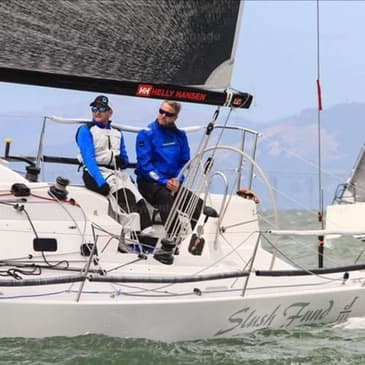
In this episode we’ll hear from top sailors Mike Beasley of Beasley Marine and Jason Currie of Quantum Sails about regatta preparation, managing the slot, the dockside ‘intimidation’ factor and the perils of poor nutrition while racing! Both Mike and Jason grew up in New Zealanders but transplanted to the USA a few years ago.
Mike’s a round-the-world racer with a long list of sailing accolades. A boat-builder by trade, he’s assisted with building and/or project managed yachts such as Mai Cha 3, Americas Cup yachts (Aloha, Le Defi and Alinghi), Volvo 50’s (Kvaerner, Merit Cup and SEB) and many more high performance racing vessels over the years. He’s the owner of Beasley Marine, and known in J/105 circles as the ‘bottom guru’ for his team’s skills in performance finishes for top racing boats.
Jason moved to the USA from New Zealand in 1997 to pursue a career in sailmaking with the newly founded Quantum Sail Design Group. He was appointed Quantum’s regional manager in 2008. Some of the many projects Jason has been involved with include extensive sail inventory modifications to America’s Cup syndicates America3, Il Moro & KZ7 and maxis Sayonara and the RP85 My Song. Jason has competed successfully on all levels of Grand Prix one design & IRC circuits over the years and is actively involved with the Farr 40 class development for Quantum Sails. Jason has an incredibly long list of accolades and experiences including winning the 2013 Farr 40 North Americans, along with a strong performance at the 2014 Worlds in San Francisco. In 2017 Jason narrowly missed out on a World Championship win in the J/111 class by 1 point. Other notable achievements include most recently wins at Charleston Race Week, J/35 North Americans, San Francisco Big Boat Series ORR Division, C&C30 East Coast Championships, NYYC Race Week, and many others!
[00:00:10] [SPEAKER_00]: So hello and welcome to Sailfaster, the podcast that gives you expert insights on racing and winning.
[00:00:17] [SPEAKER_00]: And today we are joined by a couple of real experts, Jason Currie of Quantum Sails and Mike Beasley of Beasley Marine.
[00:00:25] [SPEAKER_00]: Thanks boys for joining.
[00:00:27] [SPEAKER_01]: Yeah thanks Pete, good to be here.
[00:00:29] [SPEAKER_01]: Likewise thank you Pete.
[00:00:30] [SPEAKER_00]: I know you guys are incredibly busy so I feel very privileged to have you on the show.
[00:00:36] [SPEAKER_00]: So I'm going to start with you're both a long way from New Zealand.
[00:00:40] [SPEAKER_00]: How did you both come to be here, to be in an Appalachian?
[00:00:44] [SPEAKER_00]: Jason do you want to kick it off?
[00:00:46] [SPEAKER_01]: Yeah sure thanks Pete.
[00:00:47] [SPEAKER_01]: So I started sailmaking in 1992 and when I finished my apprenticeship around 95-96
[00:00:54] [SPEAKER_01]: I got the opportunity to come over to work for Quantum.
[00:00:58] [SPEAKER_01]: Quantum was basically just starting up, it was originally a sub-stead sailmaking loft here in Annapolis.
[00:01:06] [SPEAKER_01]: But I got a letter from one of the guys that I knew that worked here.
[00:01:11] [SPEAKER_01]: And he basically said to me, hey would you be interested in coming over?
[00:01:15] [SPEAKER_01]: Quantum would be more than happy to sponsor you out and get a green card.
[00:01:20] [SPEAKER_01]: This is back in the day where there was no email, internet really or anything like that.
[00:01:24] [SPEAKER_01]: So the letter in the mail I responded to right away and jumped at the opportunity.
[00:01:29] [SPEAKER_01]: And you know the process took about two years to get the green card.
[00:01:33] [SPEAKER_01]: And I think I was on the plane around 1997 and landed here in Annapolis.
[00:01:40] [SPEAKER_01]: Quantum put me on a three-year contract based on the amount of level of effort and costs that were associated with getting the green card.
[00:01:49] [SPEAKER_01]: So yeah, three-year contract and 26 years later I'm still here Pete.
[00:01:54] [SPEAKER_00]: So they got you locked in for that green card early on right?
[00:01:57] [SPEAKER_01]: Yeah, no I didn't leave New Zealand until I knew that I had the green card.
[00:02:01] [SPEAKER_00]: Okay, and how do you start sailing? I still have a note that you started at three years old with your dad right?
[00:02:07] [SPEAKER_01]: Yeah, yeah my dad got me into sailing, put me on a little 17 foot trailer sailor at three years old.
[00:02:14] [SPEAKER_01]: And you know at that age I really didn't know what was going on and I think I fell asleep down below most of the time.
[00:02:21] [SPEAKER_01]: But yeah, he got me into it and I did a heap of sailing with him throughout the years and from probably the age of 11 or 10 years old got into the optimist and worked my way up through the dinghy thing.
[00:02:33] [SPEAKER_01]: I did a lot of sailing in New Zealand before I moved over here.
[00:02:36] [SPEAKER_01]: I was 22 years old when I got to Annapolis so you know I'd already done about 12 or 13 years of sailing solidly in New Zealand through the dinghies.
[00:02:45] [SPEAKER_01]: But once I got to Annapolis that's kind of where the bigger boat stuff took off for me and you know I think I would say I've learnt a large percentage of my sailing skills have come from sailing in the Annapolis area.
[00:03:00] [SPEAKER_01]: You know there's a lot of science to sailing and rig setups and I'd learnt most of that stuff once I got here.
[00:03:08] [SPEAKER_01]: But you know sailing side of things, I started with the mum 30s, far 40s, J111, I did a lot of sailing with Mike actually on various boats with and against.
[00:03:18] [SPEAKER_01]: But yeah I mean throughout the 26 years I say that I've been here it's been quite a successful time.
[00:03:23] [SPEAKER_00]: Yeah it sounds like it so exactly what you said about sort of the science of it, the technical aspect of it.
[00:03:29] [SPEAKER_00]: I'd love to get into that in a few minutes.
[00:03:32] [SPEAKER_00]: But Mike how about you? How did you start? And how did you get here?
[00:03:35] [SPEAKER_02]: Oh well yeah it's not unlike Jason's story but as a teenager a Kiwi sort of upbringing is to do your overseas experience.
[00:03:48] [SPEAKER_02]: And I did a race on an IMS 40 footer from New Zealand to Japan.
[00:03:56] [SPEAKER_02]: We stopped in Fiji and Guam, this was in 1991 I think.
[00:04:02] [SPEAKER_02]: And anyway at that point I was at, ended up from going from Japan, got on an American boat, went through Alaska and then down to San Fran and ended up in Fort Ural from 93 to 95.
[00:04:21] [SPEAKER_02]: And I basically loved America, I loved the sailing.
[00:04:27] [SPEAKER_02]: I was doing some, a lot of sailing on a Hobie 33 down there.
[00:04:31] [SPEAKER_02]: I met Mike Topper at North Sails.
[00:04:34] [SPEAKER_02]: There he was fortunate enough to give me a bunch of gigs and then went back to New Zealand at that point and was building Grant Dalton's Volvo 60s.
[00:04:49] [SPEAKER_02]: And we finished those and then in 90, just as we're halfway through those one of the guys comes up to me says do you want to go to Norway and finish, help build Kavana?
[00:05:03] [SPEAKER_02]: I'm like yeah hell yeah.
[00:05:05] [SPEAKER_02]: And so as a Kiwi kid it's I think it's more so in New Zealand than anywhere that we just part of our upbringing is just to do the great escape and just see part of the world you know.
[00:05:16] [SPEAKER_02]: And anyway, halfway through the build program, Canute fired the two boat builders and said do you want to come around the world and be our technical shore manager.
[00:05:27] [SPEAKER_02]: And I was like hell yeah.
[00:05:29] [SPEAKER_02]: And here's a free phone and a bag of gear and away we went.
[00:05:33] [SPEAKER_02]: As we went around the world, we obviously came to Annapolis.
[00:05:39] [SPEAKER_02]: Well it was originally Baltimore and then Annapolis and we're met a whole bunch of expat Kiwis, you know English, Australians, South Africans, and I just fell in love with the place and and just for me from, I could see the economies of scale in the US both when I was living in
[00:06:03] [SPEAKER_02]: Fort Oral and in in or when I visited Annapolis compared to New Zealand where it's a little different now but there might have been 1040 footers and those people were concerned like I just thought of those as the most rich people in the entire world you know and
[00:06:23] [SPEAKER_02]: and if you had a 40 foot powerboat then that was another level again, you know, and then you come over here and you've got those same 40 footers being lifted on the back of 120 foot powerboats as their tender.
[00:06:37] [SPEAKER_02]: So the and that's kind of why I ended up here was just from me being a boat builder slash you know at the time it wasn't certainly wasn't professional sailor but the was given so many opportunities over here that I couldn't refuse the opportunity to live here and just build
[00:06:58] [SPEAKER_02]: Beasley Marine from you know established Beasley Marine in 2006 and never look back.
[00:07:03] [SPEAKER_00]: Yeah, you've both had pretty dreadful experiences by the sound of it. I was so envious of you guys who've had this lifelong association with sailing always always a corporate drone who got into it late and I was always pretty envious but the New Zealand thing is quite interesting.
[00:07:20] [SPEAKER_00]: I just recall I sat next to we were sponsoring companies when we were sponsoring the Americas Cup in San Francisco probably about 10 years ago now and I sat next to lunch with the parents of the New Zealand team and you know they're up against Larry Ellison at that time and I remember her saying to me if we don't win at this time we have no chance of winning again because the resources in New Zealand are just not are just not there compared with a Larry Ellison programs.
[00:07:50] [SPEAKER_00]: You talked about scale and I think that's true though of course New Zealand does fabulously in sailing whether it's a sale VP or an Americas Cup it's very much a player.
[00:08:02] [SPEAKER_02]: Yeah, that brings me back to a point I remember growing up we there was you know and Jason touched on a little bit with the sort of the technical aspect of it we we grew up with Dacron sales that were thread beer and but you just go out and race and
[00:08:20] [SPEAKER_02]: everyone had it was pretty you might get one new sale every three years or something and so the difference of racing was it was quite quite different growing up it's it's changed a lot now but getting getting back to the hard school we that's that's what we did growing up you know and
[00:08:40] [SPEAKER_02]: and I think it puts you in good stead rather than just being I don't want to say spoon fed but you know just being your whole sailing career being being dictated to you a little bit.
[00:08:53] [SPEAKER_00]: Yeah, yeah, I get that.
[00:08:55] [SPEAKER_00]: Okay, let's let's talk to you about race preparation you're both vastly experienced racing sailors so when you I'm intrigued about when you think about race preparation and Jason let's kick off with you.
[00:09:10] [SPEAKER_00]: Same thinking process every time you come to a regatta or does it depend largely on type of boat where you're sailing all that sort of thing.
[00:09:18] [SPEAKER_00]: And then I'm going to add a part B which is anything you think you do differently from others in sale preparation.
[00:09:24] [SPEAKER_01]: Yeah, I think you know the preparation, you know we don't just rock up to a regatta and start preparing to sail or race.
[00:09:31] [SPEAKER_01]: It's all basically you know you start the preparation months before you know you should be talking about the spring and summer sailing right now for example you know with Charleston race week.
[00:09:43] [SPEAKER_01]: That's a good example you know that's in April so it's about three or four months away so you know any event that you do you put a calendar together and then you start outlining what your plans are and your goals are for me you know I try to stick to the basics you know making sure the boat the equipment is to level to the level that will last.
[00:10:01] [SPEAKER_01]: And enable us to reach the goals that were set for the event. Everyone has different goals every owner has a different goal you know some owners want to win some don't care so much about winning would rather have a few bears in the bar at night.
[00:10:14] [SPEAKER_01]: You know go have a good time everyone is different and it's important to outline or find out what those goals are prior to the event.
[00:10:23] [SPEAKER_01]: You know also making sure we've done our homework before we even get to the venue you know San Francisco was a very current driven area with a lot of wind whereas inapolis is is predominantly a light area so the venue plays a big part in your preparation as well.
[00:10:41] [SPEAKER_00]: And then when it comes to the you know the day off is there a is a routine that you go through.
[00:10:47] [SPEAKER_01]: Yeah the day off now you're really fine tuning everything and drilling down into the final forecasting for the day. You know you know what your currency going to be but you get the latest forecast and then you have a team meeting either before after breakfast or during and discuss what the goals are for the day discuss the forecast and go for it.
[00:11:10] [SPEAKER_01]: It's all about getting the team into the mindset as well.
[00:11:13] [SPEAKER_00]: Mike how about you. Is it the same or you know just giving your.
[00:11:18] [SPEAKER_00]: Do you focus on more whole preparation.
[00:11:23] [SPEAKER_02]: Yeah no I think it's a all points that Jason made but sort of we turned back the clock just just the same way.
[00:11:30] [SPEAKER_02]: You know for me I was always sort of impressed by the likes when I got on Yamaha for the first time and then at the Kenwood Cup and then started doing the far 40 events over here and I was always I always felt that the boat that was trying to think of the right word here but intimidated.
[00:11:57] [SPEAKER_02]: When you look at like plenty barking mad and you know we were on we're on some very good boats and but those guys just had an edge element of perfection and you know Terry Hudson was obviously involved in those programs and the I think the intimidation is something that I try and bring to the table with just if it's the bottom is good.
[00:12:26] [SPEAKER_02]: You know the top sides are good. The ropes are good. The rigging is good. You know I used to walk down the dock and you can be against a guy with frayed lines.
[00:12:36] [SPEAKER_02]: He's got a plastic wind channel that's half broken. You know you already know that you're going to have a good chance of beating that guy. Not always the case but so you know I think there was a guy that I saw with the New Zealand.
[00:12:50] [SPEAKER_02]: His name was Simon Gundry who was one of Peter Blake's projays but he we were doing a coastal classic which is a 126 mile sprint up the coast of New Zealand out of Auckland into the Bay of Islands and he was like you got your five peas and I was like of course it's you know prior preparation prevents poor performance and I was doing the bow for Murray Ross another good sailor and you know we put a
[00:13:19] [SPEAKER_02]: spinnaker up and he'd go what's the next sailor? Like what do you mean we just put this one up. He's like well you know what is the next sailor and it taught me a lot about both beforehand before you even leave the dock the preparation that the bowman should be doing you know and the level that you get to with sailing at the
[00:13:43] [SPEAKER_02]: upper echelon is that there's a lot of mistakes that if you don't do those five peas then halfway through the day you break a jib sheet. We got a jib sheet? No I didn't bring one you know and so there's always that element you know that I think that boat prep is you know so much involved.
[00:14:03] [SPEAKER_02]: The good guys don't break stuff. The good guys have the right sails you know they've got their bottoms done you know and they've gone through the checklist 30 times a VHF they're going to spare VHF and I've got my own checklist that I do as well it's an I always put it in front of the race folder and it's just lunches
[00:14:22] [SPEAKER_02]: lunches water VHF charge velocity charged just 20 bullet points that safety gear is another one you know and so the big thing is that when you when you hit the race line you've got the weather as Jason said the tide for any venue and and I think one thing that you can't get complacent about is every day every minute every hour is different on the racetrack so you know just leaving the dock in the morning
[00:14:50] [SPEAKER_02]: going oh the breeze is going to go right you know and D Smith's very good at that with like he will have five different models and he say and so by lunchtime he might say look the the GFS model is is actually the best model at the moment it's saying that it's not going to go right it's going to hang you know at 230 or whatever you know and so there's always
[00:15:12] [SPEAKER_02]: continual updates that I think is very important to during the course of any event and going in as prepared as possible so and Jason's at the nail on the head with you know if you're thinking about a vent it's if you're showing up and thinking that well we should look at
[00:15:31] [SPEAKER_01]: the other side of the road and get a tide book or something it's already too late you know I mean yeah I think just to add to that two feet you know every single person on the boat on the team is responsible for their department you know so like Mike mentioned you know the
[00:15:45] [SPEAKER_01]: tactician might be in charge of making sure the VHS up to charge the Velocity Scott batteries while the tremors are you know the tremors are responsible to making sure the sales are on the boat that is attention correctly every morning every person should set about their department once they hit the boat and then and put it all into place
[00:16:06] [SPEAKER_02]: what I heard you say earlier Mike was that thought about thinking about what could go wrong. Oh without a doubt and I think the biggest thing is what I've been taught by good guys is you need to be proactive nine times out of your 10 if you're reactive then you already lost the situation or you're behind the eight
[00:16:25] [SPEAKER_02]: boom and you know if you're proactive particularly I guess you know it does I'm getting more into offshore racing a little bit but certainly for around here it does apply you know there's a thunderstorm rolling through and your phone has that many powerful apps on it now to give you updates and it's just about someone's job to maybe keep on top of that but you know being being proactive in any part
[00:16:54] [SPEAKER_00]: of the sport is going to I think it's going to put you certainly in that top 25% very quickly. Yeah I got it so there's a bit of a follow up because we're sort of getting into a question I wanted to ask really and that Jason that you know when you step onto a winning
[00:17:09] [SPEAKER_00]: boat or a boat that's very likely to win what are those differences versus a boat that's midfleet can you tell straight away can you tell how the crew operate how they talk I just just curious about if there's a difference there that you immediately see.
[00:17:26] [SPEAKER_01]: Well it's hard to step onto a winning boat because there hasn't one yet but.
[00:17:31] [SPEAKER_01]: Potential. Yeah yeah I mean like Mike said you know you can it's all about the preparation but when you walk down the boat you can see the way some boats are prepared and some aren't you know most of the time the teams that win are the teams that are already at the dock before anyone else getting the boat ready but you know having the right people you know and it's not just the team sailing the boat
[00:17:54] [SPEAKER_01]: but it's also the boat captains that are preparing the boats that just as important as anyone else as our you know some teams have shifts and cooks that preparing the nutrition for the team that's so important as well I mean I've been on I've been involved with teams where we have not eaten a proper breakfast
[00:18:12] [SPEAKER_01]: and it really does affect you throughout the day so there's lots of gears towards winning and it starts with the shore crew all the way through to the team sailing the boat.
[00:18:25] [SPEAKER_00]: Yeah it's interesting we had Laurie Stout who's a you know very accomplished local sailor on earlier and I asked her that the question about preparation if I recall the first thing she said was nutrition making sure the people you know before you know getting sales trimmed and the boat tuned it was about making
[00:18:41] [SPEAKER_00]: sure that there was water and food and nutrition for the crew which I thought was really interesting she mentioned that a couple of times and perhaps the sort of club racing buoy races we don't think about that but I definitely made a note to myself to improve the standard of the snacks.
[00:18:59] [SPEAKER_01]: It's critical it controls your brain and obviously we're using our brain to get the boat around the race course so it's very very important.
[00:19:07] [SPEAKER_02]: I'm not going to name the boat or the person but Jason I both sailed with them we did a port here on Mac where we had a hand decelerator which created two drops of water with two guys trying to hand pump like they were on the great lakes.
[00:19:22] [SPEAKER_00]: Hey Mike, what we've got you.
[00:19:25] [SPEAKER_00]: I think about you as being somebody you prepared the bottom my J105 and you gave us a grand prix bottom and despite my incompetent helming when we are one on one we tend to slide past other boats which is been working for us so is that something you particularly focus on or is it just for you just part of the mix.
[00:19:48] [SPEAKER_02]: No, no, I well there's just you know from a scientific standpoint there's 784 times more friction and water than what there is an air so you know and I've spoken to this.
[00:20:02] [SPEAKER_02]: He's actually a doctor that I spoke to about it and he said there's there's a huge amount of energy required for that let's just say a straight line is 30 feet on your boat.
[00:20:14] [SPEAKER_02]: Now that molecule waters got a travel 32 feet.
[00:20:19] [SPEAKER_02]: Then there's a huge amount of energy absorbed in those sales or however the Russian method is to make that you know eliminate that that drag so you know I think a race bottom is so critical and and even wax on the top sides and guys.
[00:20:40] [SPEAKER_02]: I was speaking to another 105 and the other day and he had like 10 different vinyl bootstripes and I said, look, those are in the water just as much as the keel.
[00:20:53] [SPEAKER_02]: You know it's like sure never thought about that you know because he just saw the boat out of the water.
[00:20:57] [SPEAKER_02]: And you know there's there's a lot of things that sort of crossover words here for the salemaking industry there's in plate effect where the rudders got to be tied up against the hull.
[00:21:07] [SPEAKER_02]: You know, again looking at, you know, oil packages on a narrow plane.
[00:21:13] [SPEAKER_02]: You know your trailing ages got to be tight down to zero.
[00:21:17] [SPEAKER_02]: I don't know how close you'll ever get to an America's Cup sort of boat but they'll raise a sharp they can't have the turbulence coming off the back.
[00:21:25] [SPEAKER_02]: So, and through holes is those there's the zinx you know and again halfway through the season.
[00:21:33] [SPEAKER_02]: You know, have your diver replace the zinc you know on a 105 you guys are you guys are looking for just fractions of an inch and we had we had just sort of a side note but we had Chris Dixon come and talk to us when we're doing the Royal New Zealand squadron new scheme.
[00:21:52] [SPEAKER_02]: And he just won his third world title.
[00:21:56] [SPEAKER_02]: And someone said, how did you win the third world title he said well we're in the same boats and all we've done is we focus on and this is for you Pete or as a helmsman.
[00:22:08] [SPEAKER_02]: I want to go over each wave if I can be one millimeter better than the guy next to me.
[00:22:15] [SPEAKER_02]: And I do a thousand waves and a beat, then I'm a meter ahead of that guy at the top mark which could break an overlap.
[00:22:21] [SPEAKER_02]: So, you know it's all those little things combined and again, you know, Jason sales, you know there's the end plate effect on the, on the against the deck.
[00:22:31] [SPEAKER_02]: There's the entry, there's the exit, there's the baton pockets, there's all those things combined, you know, all make that just that ounce of difference and then suddenly, you know, you're at the front of the pack and you go,
[00:22:44] [SPEAKER_02]: it doesn't, it doesn't just necessarily happen. It's gets back to that five P's of everyone doing their part and it's combined effort with a crew as well.
[00:22:53] [SPEAKER_02]: You know, everyone like just feeling the, the heel of the boat is at a 10 degree, you know what, what angle do you like in the, in the heel angle Bible does it say nine degrees and nine knots of wind or does it say less than that, you know,
[00:23:06] [SPEAKER_02]: and so that's something that, you know, as a helmsman and a tactician shouldn't be doing that. That should be maybe the pit guy looking at the heel angle on the velocity or the instrument.
[00:23:16] [SPEAKER_02]: So, you know, again, it's, it's, it's one of those things where it's a global picture you've got to be looking at rather than just one particular area.
[00:23:24] [SPEAKER_00]: Yeah. Hey, someone will ask you is somebody said to me recently that the, hey, you know, you have that wind shadow on sales, of course.
[00:23:37] [SPEAKER_00]: But also the hull itself creates a lot of disturbance in the water that maybe, you know, we're focused on staying out of somebody's summer's wind shadow or trying to avoid being gassed.
[00:23:49] [SPEAKER_00]: But equally important is about understanding that, you know, J105 or any, any, any keel boat is pushing a lot of water out the way.
[00:23:58] [SPEAKER_00]: And that's creating turbulence in the water. You don't necessarily see or feel. I just wonder if either of you think about that much.
[00:24:06] [SPEAKER_01]: A good example there, Peter's, you know, back in the day when both Mike and I were sailing far 40s mostly against each other, you know, we were getting 30 to 40 boats at events.
[00:24:17] [SPEAKER_01]: And when you're around the top mark in those boats, you know, they don't take off. They're not really planning boats.
[00:24:23] [SPEAKER_01]: They just got big old symmetric mast head spinnakers, but more often than not, there's just a train of boats.
[00:24:29] [SPEAKER_01]: And the last thing you wanted to be doing was sailing in the wake of the boat right in front of you.
[00:24:35] [SPEAKER_01]: So in those boats did give off quite a substantial amount of wake off each quarter stern.
[00:24:42] [SPEAKER_01]: So yeah, you got to get out of that wake and just sell either slightly to weather of it or slightly to Lord of it.
[00:24:49] [SPEAKER_01]: But don't sell in it. It's quite slow.
[00:24:52] [SPEAKER_00]: Yeah, yeah, yeah. Jason, how do you squeeze extra speed out of a boat?
[00:24:59] [SPEAKER_00]: I'm sure there's you're going to tell me what is 1000 ways Pete, but is there anything that you say you know you're on a boat for the first time?
[00:25:07] [SPEAKER_00]: And you're your is it like a mental checklist that you go through in terms of, OK, how do we get this boat sail faster?
[00:25:13] [SPEAKER_01]: Well, if it's the first time that I'm jumping on that boat, the first thing that I'm going to check is rigging and me and I'm going to do some homework there.
[00:25:22] [SPEAKER_01]: And that I'm going to print out the the tuning guides that particular boat and make sure that, you know, when we leave the dock that the rig is at the setting that we want it for the given wind speed.
[00:25:34] [SPEAKER_01]: That's that's critical.
[00:25:38] [SPEAKER_02]: And for a sec, J sweet.
[00:25:41] [SPEAKER_02]: Yep. A good example, Pete, we did the Southern Bay Race Week last year and we left the dock. It was I think the weekend they did the anathlis to Newport races when that front was rolling through.
[00:25:53] [SPEAKER_02]: We went out and we we looked at the region and we put 20 turns on the headstate for a mistake. And we went up when the day before we put on 10 turns and frightened the caps and we just thought with the rig further forward take away with a helm and we thought it'd be a better setup.
[00:26:12] [SPEAKER_02]: And we were getting to six that's called six three the previous day. And this particular day, we couldn't get to we're just touching getting to six too easy, but we couldn't get to six three.
[00:26:23] [SPEAKER_02]: So get gathering data, I think that rig tune and is absolutely key because and feedback from the helmsman and the main sail trimmer is is day to day is critical because being able to repeat things and is absolutely critical.
[00:26:42] [SPEAKER_02]: Absolutely. You know, we won that waste or how do we win it? You know, and so having that information and I know that I sailed with Roy Dixon in New Zealand. He was Chris Dixon's father.
[00:26:56] [SPEAKER_02]: He's the first guy I've ever seen with a notebook. And it was that sort of information for anyone. And you look at, you know, Terry Hutchison or always guys have always got wet notes just just collecting data, you know, and it was it's repeatability.
[00:27:14] [SPEAKER_01]: You know, Pete, the two, the couple of Wednesday nights that I've done with you on your J105. I think the first question that I've asked you every time we've left the dock is where's the rig chain right now?
[00:27:25] [SPEAKER_01]: You know, and you know, like Mike said, you've got to be able to repeat it. And by doing that, you got to measure your turnbuckles with calipers and have it written down into a into a boat tuning guide as well.
[00:27:39] [SPEAKER_01]: And so that when you get back to the dock, you can put it back to a base setting knowing that it's ready to go for the next day or the next week's Wednesday night race.
[00:27:46] [SPEAKER_01]: But in terms of squeezing extra speed out of the boat, you know, one of the biggest things I'm a fan of is just overall crew weight kinetics.
[00:27:55] [SPEAKER_01]: You know, if you're sailing with eight people, eight to 10 people, really honestly, it doesn't matter how many people even if it's just two.
[00:28:01] [SPEAKER_01]: If the entire group is working their weight together, particularly on a downwind leg where you're sailing VMG angles and working the weight with waves, that is that you're going to gain a good amount of speed and a good amount of distance on other boats by really, really working that crew weight with waves.
[00:28:19] [SPEAKER_01]: You know, every time you move the rudder, it's going to slow the boat, particularly on a J105 or a F-40 because those rudders are huge.
[00:28:25] [SPEAKER_01]: So every time they move, it's going to slow the boat.
[00:28:28] [SPEAKER_01]: But downwind, you know, the group of guys on the rail should be on their feet hunched down and listening to the trimmer.
[00:28:36] [SPEAKER_01]: And so if the trimmer has pressure in the kite and he's telling the driver to bear away a little bit to soak with it, well then the crew weight should be pushing their weight over the windward rail to really drive the boat down.
[00:28:47] [SPEAKER_01]: And so there'll be very little rudder movement once that's in play.
[00:28:52] [SPEAKER_01]: And the vice versa is if it goes light and the trimmer wants the driver to put the bow up, then the crew weight are leaning in almost to lured and that's going to turn the boat up naturally.
[00:29:04] [SPEAKER_02]: And just one other thing on that note, just because we sail on an Aplis, windage is something in light air.
[00:29:11] [SPEAKER_02]: And as much as it's cruel for the crew, but I hate to say it, but you know, if it's five knots of wind, then half the crew should be downstairs sitting on top of the keel.
[00:29:25] [SPEAKER_02]: And because the normal place where they're going to sit is in the slot.
[00:29:29] [SPEAKER_02]: And that's just the worst thing when, you know, you've got Jason's doing all this R&D like clue patches and things like that of how the airflow goes over that.
[00:29:40] [SPEAKER_02]: And then someone sitting there, then it's defeating the whole purpose of the flow of the sail.
[00:29:46] [SPEAKER_02]: And because the wind or windage is something you can see, it has to be a big mental thing plugged into the crew that they're like everything they do, both
[00:29:55] [SPEAKER_02]: kinetically and windage is all helping boat speed.
[00:29:59] [SPEAKER_02]: You know, and it's a happier crew at the dock of they're sitting on the podium rather than DFL.
[00:30:06] [SPEAKER_00]: This is not a popular call though, is it? Right, Jason?
[00:30:09] [SPEAKER_01]: No. You know, most of the time as a team sport, you know, and the guys are more than happy to do it.
[00:30:17] [SPEAKER_01]: I mean, I'll never forget the first time I learned that weight down below was such a fast move and light air of special choppy conditions.
[00:30:26] [SPEAKER_01]: And I was actually doing a regatta with my father in New Zealand on a Ross 780, which was a national.
[00:30:32] [SPEAKER_01]: And when we put two or three guys down below and we won the race easily, we would faster than everyone else around us.
[00:30:39] [SPEAKER_01]: Everyone else had people on deck and yeah, it's a power play.
[00:30:44] [SPEAKER_00]: Right, we're going to try that. My crew will probably send me down.
[00:30:47] [SPEAKER_00]: That's what I'm thinking. Hey, Jason.
[00:30:50] [SPEAKER_01]: But if it's raining, Pete, they're more than happy to go down there.
[00:30:53] [SPEAKER_00]: I guess that's true.
[00:30:54] [SPEAKER_00]: Jason, you talked about joining London Calling on a Wednesday a couple of times and I think we improved our position in the between the times that you went with us.
[00:31:05] [SPEAKER_00]: But I learned something really interesting that's probably pretty obvious to most people out there, but to think about trimming the sails as a pair.
[00:31:15] [SPEAKER_00]: That was quite an inflection point for me on learning how to how to sail a J105 relatively fast was to make those two flow together and not treat them as separate sails.
[00:31:26] [SPEAKER_00]: So that was big learning for me.
[00:31:28] [SPEAKER_01]: Yeah, you can you controlling the slot between the two sails essentially Pete.
[00:31:33] [SPEAKER_01]: And so, you know, if the jib's too tight, then it's going to shut down the slot between the leech of the jib and the and the love of the mainsail and vice versa.
[00:31:41] [SPEAKER_01]: You know, if the mains too tight and the jib's too far out, then the entry is too open and you're going to lack points.
[00:31:48] [SPEAKER_01]: So yeah, the two sails are designed to work together.
[00:31:50] [SPEAKER_00]: Yeah, we learned from you to have somebody get the trimmer to go back and occasionally just make sure that the leeches of both sails are in somewhat parallel.
[00:32:02] [SPEAKER_00]: Okay, great. Hey, I'm interested in you guys have sailed a ton of different boats.
[00:32:06] [SPEAKER_00]: Is sort of do either of you have a particular boat, particular race platform that you absolutely love?
[00:32:13] [SPEAKER_00]: You feel really comfortable with this.
[00:32:15] [SPEAKER_02]: There's there's all different shapes and sizes and, you know, I've sailed on Steve Bossett's Mexi catamaran and that that thing's 125 feet long and done some same bar buckets on big boats like that.
[00:32:29] [SPEAKER_02]: And the loads are scary and frightening, but they're beautiful.
[00:32:35] [SPEAKER_02]: You know, doing 12 knots upwind is powered by the wind.
[00:32:39] [SPEAKER_02]: The loads are through the roof, but they're spectacular.
[00:32:42] [SPEAKER_02]: You know, at the other end of the scale, there's I haven't done any skiff sailing, but when I owned my GP 26, I think that thing was it was so dynamic that I was I was love the fact that I could make a wholesale change and feel the difference.
[00:32:59] [SPEAKER_02]: And, you know, I'm sure people sailing 505s or those sort of things, you know, definitely have, you know, that similar ability.
[00:33:07] [SPEAKER_02]: But there's, I think for me, the SR 26 was sorry, the GP 26 was was a huge fun boat because it was so dynamic and then but I've also just on a sort of just doing a circle back to that tuning thing a little bit too was something that Gavin Brady taught me was when we're doing a lot of 52 sailing.
[00:33:29] [SPEAKER_02]: Don't stick around with quarter turns and that do wholesale changes.
[00:33:33] [SPEAKER_02]: So again, like if you feel you might be able to handle more rate, Pete, just just have a go one day, you know, there's no harm in in experimenting a little bit, you know, I mean, and because the worst thing is you can just put it back to where it was, you know, but the there's there's
[00:33:49] [SPEAKER_02]: plenty of cool boats out there that you can do, you know, all that sort of stuff on.
[00:33:53] [SPEAKER_00]: Jason, what about you? Is there a sort of a go to boat for you that if you if you could you would.
[00:33:59] [SPEAKER_01]: You know, I mean when I first got to the US, the mum 30 was the boat that was just going off, you know, it was a fairly new design.
[00:34:07] [SPEAKER_01]: I think it was new around 9495. So the fleet here in Annapolis was pretty strong.
[00:34:12] [SPEAKER_01]: I think there is about eight boats down at Jabans and and I'd seen the prototype in New Zealand before I left.
[00:34:19] [SPEAKER_01]: And I thought that was just the coolest looking boat and to have ended up sailing on a bunch and winning a couple of North American championships with that mum 30.
[00:34:27] [SPEAKER_01]: It was just kind of a dream come true.
[00:34:30] [SPEAKER_01]: I mean it was Bruce Farr hit the ball out of the park with that design.
[00:34:35] [SPEAKER_01]: It's such a cool boat.
[00:34:36] [SPEAKER_01]: You know, today, yes outdated and there's new boats.
[00:34:41] [SPEAKER_01]: You know, the car keep 40 the 52s the Cape 31 this amazing boats and very, very responsive to correct tune, correct sailing, correct, you know, kinetics with what we were talking about earlier.
[00:34:58] [SPEAKER_00]: Yeah, the Cape 31 gets a lot of attention doesn't I think it's quite fast growing especially.
[00:35:03] [SPEAKER_01]: I think especially in Europe actually well your your neck of the woods in England and England.
[00:35:07] [SPEAKER_01]: Yeah, they got they got 30 boats over there now sitting in one spot.
[00:35:11] [SPEAKER_00]: So yeah that is do Jason do you have a favorite on this buoy now.
[00:35:16] [SPEAKER_00]: And this is the leg that I know I can make up time on it's my favorite leg just wonder if there is an also obviously why.
[00:35:24] [SPEAKER_01]: Yeah, you know I mean I think everyone's going to say downwind, you know, because downwind sailing is easier and faster but.
[00:35:32] [SPEAKER_01]: You know not really a favorite but I will say I've probably got more favorite angles to sail you know reaching you know if you're doing an offshore or distance point to point race we're always going to love the wind angles on the beam putting
[00:35:44] [SPEAKER_01]: reaching cells up code zeros and and and stacils in between you know running two or three sales up on the bow.
[00:35:52] [SPEAKER_01]: I mean that's such a fast area for most boats but yeah I mean downwind would always be my favorite Pete but I would always lean towards angles more than that more than legs.
[00:36:02] [SPEAKER_00]: And if you're going downwind do you have a sort of stock strategy that you stick to notwithstanding obviously tactics between different competing boats but is there a do you always tend to always go high going around the top mark to create clear air,
[00:36:19] [SPEAKER_00]: drive and go just curious.
[00:36:21] [SPEAKER_01]: You gotta know what the true wind direction is Pete based on the axes of the course so so as you as you're approaching the top mark if the breezes in a right phase you really should be able to get to the top mark.
[00:36:32] [SPEAKER_01]: You should be gyped setting you know same for if the breezes in the left phase you would never jive away because you're going to be on the wrong wrong wrong jive making it making your way downwind.
[00:36:43] [SPEAKER_01]: So do your homework as you're approaching the top mark and the offset leg in terms of one direction and that's that should be your first strategy for the top end of the course and that's the final leg final downwind with a you know finished downwind
[00:36:57] [SPEAKER_01]: and then the bottom half is more geared towards positioning and boats that you need to be especially if it's coming down to the final race.
[00:37:05] [SPEAKER_00]: So I just echo you so I know they say, you know, take a note of which is the lift attack as you and I read that thing to myself.
[00:37:15] [SPEAKER_00]: I'm coming towards that windward mark.
[00:37:17] [SPEAKER_00]: I don't have time or room in my brain to think about that at the helm because you're you're trying to figure out how am I going to approach this this mark where's the three boat circle.
[00:37:27] [SPEAKER_00]: What a competitor is doing is my team ready to get the spinnaker out all those things I just can't get my brain around also let me contemplate right now which is the best, which is the, you know, the head attack down going downwind so I'm sure if you
[00:37:43] [SPEAKER_00]: you pros it's it's just part of the deal but for a, you know, an average club race and like me it's just another thing to do.
[00:37:51] [SPEAKER_02]: But I think I think Pete for you, you should be focusing on on driving that should be, you know, you've got seven other people on the boat that should that should be a responsibility that should be the pit guy or someone that for the majority of the leg upwind.
[00:38:06] [SPEAKER_02]: He's just looking because all the sales are up so the pit guy should probably be a numbers guy you know what I mean.
[00:38:12] [SPEAKER_02]: And or it can't be someone can't be the bowman.
[00:38:17] [SPEAKER_02]: You know the main sheet trimmer should probably be quite influential on that on your type of boat because he's going to be looking, he's going to be looking at the job.
[00:38:26] [SPEAKER_02]: He's going to be looking at the instruments and the main and that's kind of something that you're just doing a full rotation the whole time.
[00:38:33] [SPEAKER_02]: So, you know, your focus of your taking away some of your focus of driving then you're down a tenth of a knock you don't mean and so that's that's where your crew responsibility as Jason said earlier comes into play.
[00:38:50] [SPEAKER_02]: And, you know that that that starts when you leave the dot or let's get out of the race course and just see what's trending with the breeze and just have a pencil in the pit somewhere where you can write on the true wind direction.
[00:39:04] [SPEAKER_02]: And what the trending is particularly if you have oscillate and this is all written down 1000 times for me but you know, if the breeze is oscillating, you know if you're in a right hand phase at the five minute gun is it going to go back left or is it going to go.
[00:39:19] [SPEAKER_01]: Is it going to hold you know and that's the sort of thing that you collect data long before you get where we've done so many regattas with owners and drivers who are completely focused on getting the boat around the course in terms of driving.
[00:39:33] [SPEAKER_01]: And that's all they do.
[00:39:35] [SPEAKER_01]: And so, yeah, they look around a little bit to kind of get an eye on the fleet and what's going on but 95% of the time they're just looking at telltales and instruments in terms of boat speed and targets.
[00:39:48] [SPEAKER_01]: And then by the time you finish and cross the line a lot of the owners off sale with asking well, where are we and what happened.
[00:39:57] [SPEAKER_00]: So Mike, do you have a favorite leg of the course?
[00:40:01] [SPEAKER_02]: Yeah, I do.
[00:40:03] [SPEAKER_02]: I'm an absolute fan of just the name off downwind and the reason I say that is that it separates the men from the boys and it's so influential on how you sell the boat bang off crew weight, your trimmers, the drivers and you can make big gains up when but I think you can
[00:40:30] [SPEAKER_02]: you know if you're on the step and you are rail riding then you know your gains are equally if not bigger and so that that's for me and you know when when your foresail reaching on these bigger boats now the 45s and the 52s.
[00:40:49] [SPEAKER_02]: It's pretty cool that you're going as fast when if not faster on any sort of sea state so yeah that's sort of the the moldy head racing is something that's come ahead about in the last sort of five years and the more slots you have working for you the faster the boat goes so that's
[00:41:08] [SPEAKER_02]: me personally and if you even even more so on that you've got a reef in and your triple heading takes a lot of load off the helm that's generally where you can broach so not so much well and on your boat.
[00:41:22] [SPEAKER_02]: If you're doing a distance race where you got tight angles, you should never be shy on putting a reef in if it comes to that one strength because it takes a lot of load off the helm and rather than just having a flogging main, you can then pull the main in the boats balanced
[00:41:38] [SPEAKER_02]: and it's phenomenal how much you know speed you're going and the other thing that even Jason I were at the the J80 Worlds.
[00:41:48] [SPEAKER_02]: We were sort of fluffing around we hadn't sailed the boat much and breeze and we were sort of going dead down when we looked at the guys in the front and we had our jib rolled up and the guys in the front were if you do 12 knots and a J80 it's a magic number it's probably not far off probably what you are in your boat but
[00:42:04] [SPEAKER_02]: we put the bow up roll the jib back out and away we went or Jason suddenly we're we're in the money and we're in the top five of the fleet so that's my particular angle I just love being where it's absolutely
[00:42:21] [SPEAKER_01]: and that's what New Zealand was like Pete you know growing up we were never kept on shore whether you're sailing an optimist a P class or a 50 footer there was very rarely a postponement or cancellation I mean we're sailing off the beach in P classes with you know three meter seas off shore
[00:42:44] [SPEAKER_01]: but that's how we learn and that kind of relates to what Mike's saying is you know down heavy air downwind sailing is a lot of fun particularly when you have a good group beside you who are getting the boat round the course with you
[00:42:59] [SPEAKER_01]: keeping the rig up right.
[00:43:01] [SPEAKER_02]: I agree with that and I think we we a cancellation I hadn't heard of that until you know just in the last 15 years when we grow up we'd be driving around the Auckland waterfront it'd be it'd be sheep in the paddock everywhere it was howling
[00:43:18] [SPEAKER_02]: and you just get on the boat you put your wet weather gear on you plugged the number three in and decide on the way out whether you put a reef in and you put the the and not there was no symmetrical spinnaker's back then it was either the the eight sorry the S2 or the the S3 and away you went
[00:43:36] [SPEAKER_02]: and it was for us sailing in that breeze was just normal you didn't think anything of it and you know I think it's it's an and you're the same God look at the solar look at you know this and I think it breeds a better better crew person because if you can sail a boat in that breeze in 20 knots it's simplicity you know
[00:44:00] [SPEAKER_02]: and so you know fortunately I was very fortunate to sail with the likes of Earl Williams and Joey Allen who have done some round the world sailing to New Zealand and those guys were just at home in that stuff you know so that they taught me a lot but and I think it's important to go out
[00:44:21] [SPEAKER_02]: in here the races cancelled go out in 20 knots and 25 knots because you'll be amazed at how much you learn just you know and you don't have to line up with anyone just feel the boat that that bring the leader that you know max out all you know max back stay see what the rig sitting up and and it'll teach you a lot on the helm as well
[00:44:41] [SPEAKER_02]: just and you know it's about being proactive rather than reactive because everything turns to shit so quickly in the breeze but if you're organized and and you know say we get a windy you know Hallie Hansen regatta in April or Charleston can be pretty windy at times too and if you're comfortable sailing in that stuff I guarantee again you'll be passing boats left right
[00:45:00] [SPEAKER_01]: and see that hey last question guys I'll let you go is there a piece of advice that the sort of best piece of advice that you've either received the one big one is you got to sit clear and realistic goals okay so you know based on how long you've sailed the boat what regatta you're
[00:45:24] [SPEAKER_01]: not going to go if you've just bought a boat you're going to go say do the J105 North Americans well you got to you got to set a realistic goal and keep it in perspective you know top 10 top 15 whatever whatever it is and then the other one I heard one other good one was actually from
[00:45:42] [SPEAKER_01]: Stu Bannatine another top Kiwi sailor and it was when we're sailing a 52 together and he sent out a debrief and there was one line that's always stuck out to me and he basically wrote a team that has fun together will perform well together and that team that we had back in that day is about 10 years ago
[00:46:05] [SPEAKER_01]: there's a really really good team and we did have a lot of fun together both onshore and offshore but yeah if you have a good group that gels together yet more than likely gonna perform and one together as well Mike how about you
[00:46:19] [SPEAKER_02]: well I think the best advice I can give Jason has just come and sail with me more often so I can teach him a bit more you know I think it's probably been down for all of life but yeah there's still plenty of time Jase you know at the end of the day
[00:46:49] [SPEAKER_02]: yeah we got we got eight out of 50 we we were lying second at one point in the regatta and had a little DSQ incident that we won't discuss but anyway I'll put my hand up for it but it was a little frustrating but no it was a great event we certainly we jumped in the boat pretty green and to line up with the rest of the world was a lot of fun
[00:47:12] [SPEAKER_01]: and we but it was a good good example of realistic goal Pete because I think you know out of the how many sell with us five you know I think four of us had never sailed a no there's only four there's only four of us total four so three of us had never
[00:47:30] [SPEAKER_02]: sailed a J80 yeah ever so I think we set a good goal and we nailed it yeah yeah no it was you know what was your goal then go on tell me was it top 10 I said if we get top 10 I'll be stoked you know so after day after day one or day two we were sitting in second yeah yeah so the yeah we but
[00:47:55] [SPEAKER_02]: no I think I think the biggest thing I and you know so with Rod and I've sailed with Rod on good and bad days and he is the happiest and the crew is happiest when there's a good mood on the boat and I think that starts off from just the
[00:48:16] [SPEAKER_02]: band are in the morning on the dock you know and and the debrief sorry the briefing of the day can be talking about last night's activities you know and so I think it doesn't have to be all business there's certainly you know and I grew up on a there was three of us involved in this
[00:48:34] [SPEAKER_02]: and it was the same guy sailing on it for probably 10 years and fun that we had and the speed came naturally and to back stew's coming up you know it's your relaxed group if your tension and everyone the tensions high and the moods bad generally your position is about the same so you know a good fun team is generally I think
[00:48:59] [SPEAKER_00]: so Jason Curry of Quantum Sales and Mike Beasley of Beasley Marine thank you so much for taking the time that was fantastic expert insight and stories wonderful stuff really appreciate you taking the time to join sail faster this morning.
[00:49:16] [SPEAKER_02]: Thanks for having us.
[00:49:18] [SPEAKER_02]: Absolutely I concur.
[00:49:27] [SPEAKER_00]: To hear more of our conversations about racing sailboats make sure you subscribe to the sail faster series wherever you get your podcasts or go to sail faster.net to sign up and learn more thanks for listening and see you on the water.