
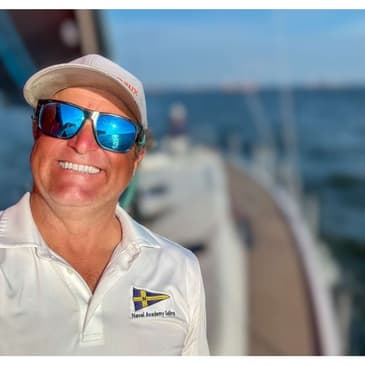
Echoing high-performance team development in the business world, sailing instructor Kristen Berry focuses on the more cerebral aspects of sailing and team dynamics. We had a fascinating discussion about this different approach to coaching sailing teams. Lots to take away from the conversation, including why when the helmsperson is yelling it usually means they are out of mental bandwidth (!) and why top teams are highly communicative but whisper quiet. Kristen is a 20-year US Sailing-certified instructor and founder of Annapolis-based Gale Force Sailing. He also works with the U.S. Naval Academy’s Basic Sail Training program and is advisory board member of New York’s Hudson River Community Sailing organization and executive director of Baltimore’s Downtown Sailing Center. I love the quote from Galeforce Sailing’s website: Sailing is a sport filled with challenges, chaos, and curiosity, and you should always strive for elegance. Hope you enjoy listening to this episode!
[00:00:00] Hi everybody and welcome to another episode of Sailfaster, the podcast for those who obsess about sailing faster than anybody else. And today we have a great guest who I'm pretty sure does does exactly that. We are very lucky to have Annapolis' Kristen Berry on Sailfaster today.
[00:00:27] And I'll give a little bit background on Kristen. He is a, I think something like 20 year US sailing certified instructor and coach.
[00:00:37] I've just learned actually in the pre-mumble we did before we record that he was also a beltway bandit, which for those of you not been watching DC will probably sound a bit strange, but he's very much mixed up with the Washington
[00:00:48] political crowd, which is a whole other podcast that we'll have to do. He is the founder of Galeforce Sailing in Annapolis, which is really well known, specializes in, I think, personalized sailing training and supports and so on.
[00:01:03] I know you also work with the US Naval Academy, their basic sail training program. You're on the advisory board of New York's Hudson River Community Sailing Organization. Your past director of J-World, which is the performance aid school in Annapolis.
[00:01:17] And you're, or you have been, executive director of the downtown sailing center in Baltimore, which my crew loves. We donate stuff, people spend time there. So that's really wonderful.
[00:01:29] So I was really interested by this because as well as sailing and coaching and teaching, you obviously enjoy leadership roles too, right? You like the responsibility.
[00:01:38] Well, I'm delighted to be here and excited to talk about sailing and my approach to sailing, which I think will be a little different than what some of your previous guests have talked about.
[00:01:49] And I am excited to share beyond just the nuts and bolts of tacking and jibing and setting spinnakers and all of that team building and what have you.
[00:02:00] My philosophy about why we sail and how we find joy in sailing and in sailing competition and how that can fuel making people go faster. I love the quote that you have in the front of your website, which is written down here.
[00:02:17] Sailing is a sport filled with challenges, chaos and curiosity. And you should always strive for elegance. Elegance. That's right. Joe Jones really just knows every excuse me of having a bit of elegance. So that's really interesting. How did you come up with that?
[00:02:32] Well, that goes right to the heart of my teaching style, which is I believe that sailing smarter, not harder. Will will reveal results. And that's where the progress really is at. And if you have friction points or pain points, that's where you need to put your energy.
[00:02:51] Somebody I do a lot of sailing with recently sort of filled my head with the idea of moving the big rocks first. And so one of the first questions that I ask teams when I when I get on board with them is where are the pain points?
[00:03:05] And I'd like to go around the cockpit with that kind of a question, because oftentimes the helms person is really shocked to find out where the pain points are downstream from them.
[00:03:16] And if I know we're doing well in the initial briefing, if people are sharing things that they haven't had the opportunity to share before, they're using me as the vessel to help bring delight. Something that is important for them to talk about.
[00:03:33] Yeah, it's interesting you say it's surprisingly difficult for people to speak up this night. It's a little bit like a like a work team where I think people sometimes a little bit reticent to talk about the problems they're having on my boat.
[00:03:48] They'll tell you that the biggest pain point is the driver is the idiot behind the helm for sure. Yeah, which isn't which isn't fair because the helms person really only has one one role to play on board the boat and it's a full team effort.
[00:04:02] That's that's where you know again stylistically I think I come into things and approach them a little differently, because I start by setting some ground rules.
[00:04:11] The first of which is is that every team member is equal so rather than creating some sort of a hierarchy of importance we usually list off the roles it as far as numbers are concerned from bow to stern instead of the other way around.
[00:04:30] So our number one position is always forward not aft and second I try to try to get people talking about the idea that everybody is entitled to the material that they need to be successful.
[00:04:43] And if you don't present what that is, then you own the responsibility of not getting it.
[00:04:51] My job as a coach is to listen to a team and try to figure out what's missing where are the gaps. Is it knowledge, or is it practice, or is it confidence, or are people in the wrong seat on the bus, and then help advise how to provide that material that every team needs to be successful
[00:05:14] because most teams that are sailing, regardless of where they show up on the score sheet have what they need to be successful. They just oftentimes aren't implementing it in the right way or and you know deploying it properly.
[00:05:28] And so I get to come in as a outside advisor and shake things up a little bit and challenge people and and make recommendations that don't have value statements associated with them about how things might might go better if we tried it.
[00:05:42] This is a very modern way of looking at it. You sound pretty much like KPMG or McKinsey sort of consulted with that approach of looking at it holistically and trying to do some sort of assessment. Really interesting.
[00:05:56] Yeah, well I think high functioning teams in the modern era do that across sport. You know there was a time where the Helmsperson was God, whatever they said went and they directed all the traffic. But if you think about any sailboat racing team the Helmsperson's job is overwhelming.
[00:06:16] How could they possibly be looking into the future and and helping people prepare for what comes next. And I think that's why if we look back in time, Helmspeople had a reputation for yelling.
[00:06:28] They had reached their capacity mentally to be able to anticipate what was coming next and as soon as they hit those capacities the volume goes up.
[00:06:39] Usually when you hear somebody yelling it's when they're sharing with you that they're out of bandwidth. And that's why really high functioning teams are highly communicative but whisper quiet.
[00:06:52] I think that's often mistaken as they don't talk but that's not true. You know on a J105 which here in Annapolis there is no better one design racing going on.
[00:07:05] 25 plus boats on a Wednesday night. A weekend regatta is getting 20 boats out which is really impressive and these are 35 foot 5-6 person teams. These are big campaigns in the grand scheme of things, a lot of moving parts and it is alive and well.
[00:07:27] But each member of a J105 team has a physical responsibility at every moment on the race course and also has a cerebral and communications responsibility on the race course.
[00:07:38] And the teams that are going well are the ones that know what they're going to do next. They're not necessarily the ones that know how to do what needs to happen right now best.
[00:07:49] They're the ones that have anticipated, are prepared and then when the decision point comes the decisions are basically binary. It's A or B and they do them because they're not that complicated broken into their many iterative parts and they just execute.
[00:08:06] And there's not a lot of magic. It's a lot of not making mistakes that makes those boats consistently succeed ahead of the rest of us.
[00:08:16] Yeah, it's interesting that you say that. I just had Randy Hecht and Russell Bestry who are back to back J105 champions on the podcast and episode is coming out soon.
[00:08:26] And they said something similar but different about everyone knows their job. Everybody knows their jobs. I think Randy said I'm not coming in to rescue you because you know your job on the boat which was super interesting.
[00:08:40] And then he said we just don't make mistakes. Right. So we win that. Yeah, so you know not to give it all away here but this isn't even given away. Yeah, this isn't proprietary by any means. But you know good teams ask what if questions.
[00:08:59] So at any given moment they're running all the potential scenarios. What if the wind shifts? What if the velocity increases or decreases? What if that boat tacks or jives and they are communicating out loud what they'll do when that happens.
[00:09:15] And therefore everybody on board the boat knows that if option A gets executed where they're going and what they're doing. And any team that's going out on a Wednesday night knows how to do all the things that are in option A or option B.
[00:09:30] It's only when we're required to be artistic in the moment, do we start to fail.
[00:09:37] I mean that necessitates though having a crew that has got some tenure. They've been together for a while. Everybody knows their place. It's quite hard today. You know it's quite hard to get a regular crew on a consistent basis.
[00:09:54] I'm going to challenge you on that idea because I'm not 100% sure that's true. It is important that you have teams that are clearly directed what their role and responsibility is. And some teams get at that by the first person to the boat is position one and the second person to the boat is position two.
[00:10:17] But they have a crew card that clearly tells them what they do before they leave the dock on the way to the race course in the pre-start, on the windward leg, on the downwind leg, on a reaching leg after the race is finished.
[00:10:31] People know exactly what they're supposed to do and they don't have to have 10 years of experience to be there. You can cut the corner on tenure if you're organized and communicative.
[00:10:43] So you literally have a card. So if somebody's new, they're jumping on board and it's going to be, hey, you're trimming jibs tonight. Here are your priorities. Yeah, that's interesting.
[00:10:52] And, and, you know, great teams have great calibration. So if you're the jib trimmer on a J 105 and there's a scale on the deck and a mark on the jib sheet and in zero to six, we're normally trimmed to the eight mark and eight to 12 knots.
[00:11:08] We're normally at the 10 mark and then when it's blowing hard, we're in this zone of non-marking but a black space or something. Then people get to get into the ballpark very quickly and then they're allowed to use their trimming skills to fine tune.
[00:11:26] We can't trim to landmarks, but we can get within 90% of performance by landing on repeatable spots. Super. I want to dive further into this, but I want to go back to how did you get into sailing? Did you grow up sailing?
[00:11:42] I always have people on board who on the show who I grew up sailing with my father when I was three years old. I'm always envious of that because that didn't happen to me at all. What about you?
[00:11:52] Well, you know, if you fail at everything in life, there's always sailing. But no, the reality is or the story that I like to tell is, is that my dog or yours?
[00:12:03] No, no, it's my dog. I guess this guy is here and they're probably tearing his arms off. Oh, it's okay. You know, I came to sailing as a young person through piracy. I was infatuated with sailing. I'm from Indiana of all places and not a lot of.
[00:12:25] Yeah, right. Where all the great sailors are from. I had a basketball in my hand, not a tiller extension. But, you know, I went to the library and read everything there was on sailing.
[00:12:36] And one day I'm standing at. Why? Yeah, because people in Indiana want to be anywhere other than Indiana. So I think sailing out of there seems like a pretty good idea. Who knows?
[00:12:47] I don't know what switched me on. Nobody in my family, heck, half my family couldn't swim, let alone were they into sailing. And anyway, I was super into it and I read every book in the library.
[00:13:00] The librarian got microfilm or microfiche and I read every popular mechanics magazine. And one day I'm standing at the card catalog, which dates me a little bit. And some guy comes up and says, hey, are you that kid who's into sailing?
[00:13:14] And I said, yeah, that I'm the kid who's into sailing. He said, you know, just outside of town, there's a lake and it's covered in sailboats. You ought to go out there and check them out. So the next day I did not ride my bike to the library.
[00:13:26] I rode my bike to that lake and sure enough, it was covered in sailboats, which in hindsight probably means there were 10 or 12 sailboats there. But one of them was a boat that I had read about called a snark,
[00:13:39] which is essentially a styrofoam surfboard with a broom handle mast and a cutting board rudder. And this one was particularly cool because the owner had smoked enough cool cigarettes. And if you tore off the tabs and mailed them in, they sent you a sail,
[00:13:58] a green and white stripe sail that said cool on it. K.O.O.L. And it was it was it was something. But all the parts were sitting there in the weeds. I put the thing together, pushed it off the beach and I went sailing.
[00:14:12] And I did that. I did that, I don't know, 10 or 12 times before coming back to the beach and finding an incredibly angry man waiting for me on the on the beach. And he asked, how many you know, why did you steal my sailboat?
[00:14:26] And I said, I didn't steal it. I keep bringing it back. He said, how many times have you done this? And so at that point, I knew I should start lying. And instead of calling the cops, he called my mom.
[00:14:38] And my punishment was I had to clean his big boat, which was a Catalina 22. And he took me. Yeah. He took me under his wing and taught me a little bit about sailing and then started taking me to Chicago and introduced me to Chicago sailing.
[00:14:54] And from there, the rest is history. And I was I was passionate about the sport from that point forward. That is a great story. Yeah. Modern modern piracy. Yeah. You know, with an origin story like that, it's impressive. I got my Navy clearance. You know, yeah, yeah.
[00:15:13] Criminal record. Right. Exactly. So that's brilliant. So so you're the Gale Force is your organization, right? How are you been running Gale Force? Yeah. So Gale Force has been around for, I don't know, 15 years now or so. I hopped in and out of professional sailing.
[00:15:37] I really cut my teeth in professional sailing as a coach at J World in Annapolis under the tutelage of John Tehanski, who's my sailing mentor. And he taught me everything I know, but maybe not everything he knows.
[00:15:50] And I became passionate about teaching sailing, specifically working at J World. And that began opening doors for me. I started coaching as often as I could as a moonlighting gig. At the time, I was still working full time in political advocacy in Washington, D.C.
[00:16:13] And after the 2006 election cycle, I thought I'd like to take a break and recharge my battery. I'll come back to work in a 2008 presidential or some federal cycle. So after the 06 cycle, I decided to take that year off in 07 and just teach sailing.
[00:16:32] And I've never gone back to work. And since then, I've had the pleasure of being heavily involved with the Naval Academy, being the executive director at the Downtown Sailing Center, returning to J World to function as its co-director with my friend Jeff Jordan.
[00:16:51] And then after I left J World in 2017, I went full time independent as essentially a personal trainer for people sailing goals through my company, GIL. Definitely had to learn to be a coach, for sure, to be a good coach. But I come from a family of educators.
[00:17:18] But I've worked really hard at trying to master the craft of teaching and coaching. Well, I'm very focused on the human element of coaching, maybe more so than the technical aspects. There are lots of sailors who are significantly more technically competent than I am.
[00:17:51] They see things that I don't see. They're more aggressive than I am. But there aren't very many coaches out there who understand how to help people unlock their own potential with the tools that they already have available to them.
[00:18:06] And I think that that's something that I'm proud of being good at, is empowering people to reach their full potential. And also I'm able to help people that are struggling to understand a concept or crack the code on something
[00:18:23] do that by changing the language of it to meet them wherever they are. And so, you know, you and I might talk about sail shape. We're talking about exactly the same thing. I have four or five different ways to describe that same outcome.
[00:18:40] And I'll keep trying until I find the one that works for you. And so if I can't figure it out, I will also go find it because there's I don't like to lose.
[00:18:52] And for me, not being able to explain something to somebody in a way that they can then explain it to somebody else, that's losing for me. In my case, I have experienced sailors on board who, you know, great technical, great coaches.
[00:19:08] But they ask they they feel things that I don't yet feel. I'm too new to it. And so I'm trying to think, OK, what am I feeling here? OK, feel about healing. But how much is that?
[00:19:21] And how come you're feeling that five seconds ahead of me feeling that? What's that all about? I think that's the one of the hardest things is that sort of anticipation. Yeah, without a doubt.
[00:19:33] I mean, I've had the good fortune of sailing with some some of the best in the world. And it's amazing to watch them work. They are in a flow state. They are unconscious. You've heard players describe that way.
[00:19:49] And it's true. The conscious brain processes things two or three seconds after they're realized. The unconscious brain processes things tenths of a second after they're realized. We describe that as muscle memory, but your muscles don't really have memory.
[00:20:05] Your brain does. And many people who are great sailors are not great coaches. Not because they don't want to be, not because they don't try to be, but because they are processing information at a level that their brain isn't able to articulate exactly.
[00:20:24] And you'll see this in the boat park all the time. There are sailors that appear to be sort of standoffish. And in fact, I think professional sailors get this reputation as being, you know, edgy maybe. But they're almost, they're just in a different place mentally.
[00:20:43] And especially as you get closer and closer to race time, they're so focused on the thing that matters most that they have a hard time being able to communicate beyond that because it's occupying so much of their brain power.
[00:21:01] And I applaud that because it allows them to be super successful. I don't share that. I'm still in coaching mode most of the time, and that's always been a limiting factor for my own performance for sure.
[00:21:15] Because what's the limiting factor there? I'm following what you're saying, but what's the limiting factor for you though? I don't stop talking about what we, you know, about the coaching aspect. I never take the coaching hat all the way off and just get fully competitive.
[00:21:31] Yeah, it's interesting. Sorry I'm interrupting you. No, please. Yeah. I think you and I talked about this that, you know, there's some terrific sailors in Metelus.
[00:21:42] But what they have heard from some of my sort of J105 colleagues is that, you know, you can have a great coach on board from a sail maker. And they're, you know, a string of success as they've had.
[00:21:57] And when they're in a race, they're in race mode. They're not in coach mode. They're in race mode. Right. And so their primary objective is to help you win, which is great. But if you, for me... Is it sustainable? That's the question.
[00:22:12] I could bring somebody on board and I could win a Wednesday night race, hopefully. But I don't think I'd be able to repeat that because once they're off the boat, then the magic's gone. Yeah. I just had this conversation with a client of mine who is...
[00:22:30] The team is not performing as well as they would like. The reality is they're performing much better than they should be given their experience level. And the helms person in particular was like, I would just like to bring on the best helms person we can.
[00:22:46] And I want to observe them. And I said, you know, there's a time and a place for that. That's called practice. But on a Wednesday night, this is the test piece or a weekend regatta.
[00:23:01] That's not the place to observe because the person who's going to be doing the driving in that particular case is never going to be able to call time out and describe what they were feeling, how they came to that conclusion,
[00:23:16] why they ignored the telltales and headed up or headed down in that moment. They're just going to do it. And that moment is so ephemeral that there's no way to really capture it because they're playing at a level that is unconscious, essentially. It's operating at a baud rate.
[00:23:41] It's dial up email or dial up Internet versus cat five email or what? I'm dating myself again with those types of terms. But you know what I'm saying, instead of instead of getting the information at 100 units a second, they're processing the processing that information at 1500 units a second.
[00:24:03] And it's just it's impossible to share that if it's not in a practice environment. And so great sailors don't always make great coaches for that reason. Yeah, I was telling you that we had an apples person, great sailor,
[00:24:20] we are on the on the boat with us at the Maryland Cures Cancer Regatta. And for the first race, he was constantly talking to me about driving. It was because he I he was very good at talking about what's what's happening and how you could be reacting.
[00:24:41] He was patient enough to stay with it. The other thing I thought was interesting, you know, the sort of feel about this people, yes, feel about just be the boat feel about great. I don't have to do that. Right.
[00:24:52] I was talking to him, you know, as we were going downwind and we were pushing deeper than others and making great, great angles downwind more than I than I would do normally. And I was sort of asking, how did you know to push down that point?
[00:25:07] And he just said, I just felt the boat tilt. I felt it in my feet just slightly, you know, tilting as the wind caught the top of the. And I said, oh, shit, I didn't feel that.
[00:25:18] But just those clues were, oh, next time I'm going to I'm going to stand up and see if I can feel that. So I so I agree that that, you know, not all great sailors are coaches. Well, there's a few things there.
[00:25:31] First, I'm tickled that Guillaume was on board with you and he was a former J World coach and a good friend of mine. And and so it is it's great to see that you can take the boy out of J World,
[00:25:42] but you can't take the J World out of the boy. Yeah. And and that is a J World coaching style and technique where we work very. And this is across all the class of J World instructors.
[00:25:55] In my experience, we work very hard at not just saying do it better, but then providing you with the material that you that you individually need to be able to make that happen,
[00:26:05] giving you the visual cues, the physical cues, the audible cues that will help you process that information faster. The other thing that you said there is, is that, you know, as a as a helmsperson in particular,
[00:26:18] you can easily be duped by either the lag in the instruments or faulty telltales or what have you. And you really have to rely upon all your sensory inputs to maximize your potential performance.
[00:26:32] And Guillaume's ability after years and years of sailing on a J 105 to feel that the angle of heel was slightly off performance is something that people need to work to develop.
[00:26:44] And so, you know, if you're sitting on the rail and you don't feel like you have a physical role to play, you do have a very significant cerebral role to play, which is to process the information, ask if this is good.
[00:26:56] And if it is, you imprint it in your mind. I believe that top level sailors don't necessarily know more than the rest of us. They're not knowledge advanced. But what they are amazing at is pattern recognition and speed of response.
[00:27:13] You would never want to play the game of memory with an Olympic level sailor because they know where the cards are right. Stratego is not a game you want to play with a top level sailor because they know where you put the bombs.
[00:27:28] And and it's just that that's a big part of of unlocking the code for sailing is recognizing that there are patterns all over the place.
[00:27:39] And if you can, if you can recognize those patterns, assimilate them into your plan and make the right choice the next time you see the same pattern, you get much faster, much faster. That's brilliant.
[00:27:53] That for me that pushes on something I think is a huge, huge learned advantage that people have, which is being able to assess what's going to happen 30 seconds ahead. Yeah, I can barely assess what's going to happen five seconds ahead.
[00:28:09] But that is the skill at the start of the gate where people can can visualize what's going to happen in 30 seconds ahead, which is an advantage for top sailors. I mean, it is. But I also think that the secret to that is in delegation.
[00:28:25] So as a helmsperson, you're not responsible for what's happening 30 seconds in advance. You're responsible for what's happening now and maybe five or 10 seconds from now. But somebody else on the boat is the person who's responsible for that 30 seconds.
[00:28:41] And it would be overwhelming to ask you to try to hold that in your mind. The best people on board your boat are going to paint a picture for you that makes you prepared for what could happen next.
[00:28:52] And either that is this is what it'll be or these are your two options. But it's asking too much of a helmsperson, especially on a boat like a J-105, for the helmsperson to be thinking that far down the road.
[00:29:07] Somebody must be responsible for that. But it isn't you. And so if you think about the way that we delegate crew responsibility, let's let's say we're sailing in a five person J-105 team.
[00:29:21] Right. The forward crew member, that person probably has the best perspective on what's going to happen environmentally next. So they should be calling the next puff, the next lull, the next wave, the next flat spot.
[00:29:33] They are painting a picture and it is imperative that they are descriptive, not directive. They're really talking about what's going to happen next, just without any bias or influence on it. Just saying environmentally what's happening.
[00:29:50] And it's important that they keep that dialogue going so that the people that are making decisions can edit out when they don't need that information, but also can tune in when they do.
[00:30:00] Then we slide back the next position and we've got a masked crew members or a spinnaker trimmer, somebody in that seat. This person is really good, especially on the upwind leg and helping us call our relative performance to the boats to windward.
[00:30:15] So they're sitting right in the middle of the boat. So they have a great perspective on whether we're sailing the same angle, the same speed.
[00:30:22] And then they can make a value statement about that of whether or not it's net gain to us or net gain to our near neighbor.
[00:30:29] And they're really helping feed that information back into the boat so that any change that's been made can be determined whether or not it was the right change or we should change again to try to be better.
[00:30:41] Now we slide back, we've got maybe a head sail trimmer who's dialed in and has good visual on the instrumentation on the boat. So we've got a really good idea of whether or not we're sailing on a lift attack, a head attack, an even number.
[00:30:57] And are we sailing to our target boat speed for the given with the given condition? And they've really got that information. Finally, we slide back now. We've got a main sail trimmer. They're sitting legs in. They've got the only perspective to Lured.
[00:31:11] So they're playing a safety officer role. They're calling relative performance on Lured boats, but also making sure that we're setting up well for any port or starboard tack crossing boats. And they're the look down there.
[00:31:27] This person also generally is our central computer in making the global decisions about where we're going to execute the strategy that we had determined prior to the start.
[00:31:36] And so they're taking all that information that's coming from the front of the boat about the environment and relative performance, processing it through what was our goal and our objective prior to the gun and making sure that we stay on track or making a good choice to abandon that and move on to a different strategy.
[00:31:52] And finally, we've got our helms person has the narrowest view on the boat of all this person is oftentimes looking at the mast for instrumentation, looking at the telltales for for mode.
[00:32:06] And then looking at the angle of the boat to the horizon and taking information about the near environment so that they can be anticipating what's coming next.
[00:32:15] That's a very classic delegation of role and responsibility that is about how do we process information and allow everyone to stay in their lane, but to be highly communicative about what's going on.
[00:32:27] Can we talk about when you see step change improvements in the teams that you coach? Are there any commonalities on the kind of things that have happened to generate that step change? Yeah, teams that yes, step change comes from growth, not acquisition.
[00:32:48] You got to unpack that for me. Yeah, so the teams that make the biggest leaps in ability and outcome are the ones that work to get there. Don't go shopping for crew members to make it happen. They have a culture. They get people to buy into that culture.
[00:33:07] They work together and they make racket rapid advancement in their ability and performance. I very rarely does somebody parachute in and make lasting change in the outcome of a boat's performance.
[00:33:22] But if you say like it's the most bizarre sport in the world in the fact that we practice one day and usually not a full day for every 10 days of games. We go out, we'll sail three races in a day, three days in a weekend.
[00:33:44] And that's 10 races or nine races. Right. We have probably not practiced one full day for those nine races. That is so upside down. And teams that make a just a minor investment in practice and working together and in practice, you have to sail with purpose.
[00:34:05] It has to be a good practice. And most sailors don't know how to how to put together a good meaningful practice. But if you do that, you make huge gains over all of your near term competition.
[00:34:20] The other the other big thing I think that teams that make giant strides in their performance figure out is that it's not about the other boats.
[00:34:33] They focus most of their energy inside the friendly confines of the lifelines and they learn how to make their boat, their team perform better.
[00:34:46] And then they find that they can ignore most of the other boats because even in a one design race, we're really sailing a time trial.
[00:34:57] The Tour de France is coming up and early in the Tour de France, there will be two time trials, an individual and a team time trial. They're all riding the same course there and they all start in the same spot in the same finish in the same spot.
[00:35:11] They're not thinking about anybody else on the course other than them. And the teams that do that on a sailboat racing course tend to step away from most other teams. They just don't engage. They sail clean, alone and fast.
[00:35:26] Guillaume had said to me on a number of occasions, don't look at the boat. Don't look at it. Don't just ignore them. Don't let other boats around. Just forget it. Just ignore them. Don't even look at them.
[00:35:35] Which was great because as soon as you look at them, you come off slightly, you know, your change course slightly imperceptibly. Yeah. And I take that to another level. Generally when I'm sailing with teams, we don't refer to the boat name or the people on board.
[00:35:50] We either use a bow number or we just say there's a boat on starboard. And do you see them? Because there's also this thing like, you know, let's say let's say you've snuck off the start line and you're in second place.
[00:36:04] And the best sailor in the fleet is on starboard coming at you. And if you say, oh, there's oh, I don't let's say Mirage. There's Mirage. Your attitude is different than if you say there's somebody else.
[00:36:19] Right. And and so I try to to not allow the personality to come into the conversation. It's just another sailboat. And, you know, I've had several people say to me that were you tacking on me on that beat?
[00:36:36] And, you know, my response is usually are you a white sailboat? Because if you were, yes. You're like, why were you doing that? Well, I'm like, because I'm trying to beat you and all the other white sailboats.
[00:36:50] Now you have a unique distinction, Pete. You have a blue sailboat. So yeah, so people see us. Yours is personal. Generally, they can look behind us and see us though. We're not much of a bunch of we're going to change that.
[00:37:05] We're going to we're going to fix that. Do you know what? It's interesting you say that because in this regatta, we I did start at one point very aggressively at the start. You know, I headed up, you know, and just in order to to protect space to Lured.
[00:37:22] And also because the you know, we were slightly early. I think we did that twice. And the boat to our windward did say to some of our crew afterwards, were you coming after us? And that's no idea.
[00:37:35] You know what was there? I could just exactly as a there's a white boat that needs to go up now. You just come down again.
[00:37:41] I wasn't focusing on it at all, but yeah, you were using your Lured rights as a shield to defend your ability to protect your lane. So no, it wasn't personal. You were trying to have the best start you could. It sounds like you did. Congratulations.
[00:37:54] Now we had two terrible starts. We had two lutely awful starts. One really good start, but two awful starts. Anyway, that's the game. So, Christian, OK, so there's two key step changes you see. One is just about growth.
[00:38:08] You don't need to parachute something and grow as your team. That's the step change that you see. Secondly, don't worry about the boats. Focus on your boat sailing fast, doing what it needs to do, maximizing performance. Is that true? And if so, is there a third element?
[00:38:26] Yeah, I think there is. I think that the third element is about honesty. And I know that seems like a funny thing to talk about.
[00:38:35] But if you go to the bar and you listen after a regatta and you listen to people talk about the race, they're not intentionally telling lies. They are self diluting.
[00:38:48] What I mean by that is, is that rather than really addressing the true elephant in the room, what was wrong, they think about a thousand different things that happened on the race course or they blame things like, oh, that boat had better sails or they have better sailors or what have you.
[00:39:06] But most of us are self defeating on the race course because we just refuse to sail to the fundamentals. And so you have to be really, really honest.
[00:39:18] And to fix that problem, it's as easy as having an open and honest debrief at the end of every day where people feel empowered to share their honest thoughts about what went well, what could be improved and what they're going to bring intentionally the next day they come sailing.
[00:39:42] And that first part is what went well. Those are the things you want to keep. What do we want to prove? Those are the things that we must change. And they just get stated. They don't have to be discussed.
[00:39:52] And then what are you going to bring the next day? That's your intention.
[00:39:56] And that is how you promise to be accountable the next day, because if you said you're going to bring a better attitude tomorrow and tomorrow you don't, I get to put my hand on your shoulder and say last night's debrief.
[00:40:07] You said you're going to bring a better attitude. That's all I have to say. And then and then it happens or I'm going to stay focused on jib trim and I'm never going to let the telltale bounce that that's that's an intention. And that that's meaningful.
[00:40:19] And if people do that, it's a very simple step. But if you do that, it's a lot better than looking at somebody and saying sail better. How does that mean? You know, this is a process that allows you to eat this giant elephant one bite at a time.
[00:40:37] I can see why you're a much sought after coach, Kristen. So it's really good. And it's a language of high performing teams as you as you mentioned earlier as well. It's very having spent 30 years in the corporate environment, mostly in American corporate environments.
[00:40:54] I you know, that's very much a language that people people try to aspire to and performance aspire to. That's really, really interesting. There may be more team building for sailing teams available in the Harvard Business Review than there is in the back of Sailing World magazine.
[00:41:13] Yeah, I talked to Randy and Russ again.
[00:41:17] It was the most recent podcast and they were saying that how much their business, I think their investment bank is and so on that they they had learned so much from sailing to help their business, which I thought was interesting rather the other way around.
[00:41:31] I've been fortunate to do quite a bit of corporate team building event using sailing as the platform for that. And I have one client that I'm still in very regular contact.
[00:41:41] We have, you know, twice monthly calls what that we have framed our think like a sailor call where we take business problems that they're experiencing in their businesses and we apply sailing thought process.
[00:41:57] And and I think they use it as a refreshing exercise to just kind of get out of their their world, step into the sailing world and see if that can't shake up the solution.
[00:42:10] Yeah, it's it's very obvious because I think that all the time that in, you know, as marketing guy and you're always trying to understand what competitors are going to do next.
[00:42:21] At the same time, you're trying to understand the market conditions and that's like tides currents and unexpected things that come at you and wind shifts as as consumer tastes change and that sort of thing.
[00:42:33] Your competitors, you try to understand what they're doing the same time on the whole thing is shifting. So what you thought, you know, the equivalent of five minutes is probably a couple of months. It's completely changed because this sort of the environments change utterly.
[00:42:47] So it's a lot of commonalities and then you need to in order to succeed as you know, with a team, I always had that philosophy of making sure you put the right people into the right roles.
[00:42:59] But you basically gave them the opportunity, the tools, environment, the permission to do what they did best and let them do what they can do best and try to integrate as a team. It's very, very, it's very, very similar.
[00:43:14] There's no absolutely telling people what to do being a dictator, not letting people sort of express themselves in their work is the is the worst thing you can do. And it leads always to failure again and again.
[00:43:26] Yeah, I you know, there's two other cool things that kind of relate to that. The first is, is that I'm sure you've worked with a client somewhere along the way who didn't have a windward mark. You didn't know where you were going.
[00:43:37] Right. And they were they just said sail up wind. Just get us up wind. But it's really helpful to know which tack you should be on if you know where the windward mark is.
[00:43:47] So having a even a near term goal is useful and teams benefit from having that informing, you know, what is what is coming next. And then the second comes thing that's sort of related to that.
[00:44:01] This past winter I sailed with Portuguese sailors, one of the top sailors in the J 70 class. We did a lot of work together. He went on to win the North American champion championship this year in Mexico. And he's just brilliant.
[00:44:14] And one of the things that he says when we're on the boat together that I've now stolen is he just says priority. And when he says that, it makes everybody look around and say, what's my priority right now? What should I be doing right this moment?
[00:44:30] And, you know, sometimes it isn't the thing you were working on. You're like, well, you don't know this could wait. I should be hiking, not not fiddling with the the spaghetti bowl mess that's in the cockpit. I should be hiking right now.
[00:44:43] And all he has to say is priority and it just brings the whole boat into focus. It's such a fantastic tool. So a question I always ask people on the podcast is about do they have a favorite? Do you have a favorite leg of the course?
[00:44:58] Is there you know, you get to the top mark and you think, right, this is this is me. I'm in my limit now going down when this is when I can pass by. It's just curious if this other course that you have that I live in.
[00:45:10] I live in complete terror. I've been passed so many times that, you know, I, you know, as somebody who I'm a bigger sailor, you know, I'm 220 pounds and and and so I've always been a trimmer, Spinnaker trimmer in particular.
[00:45:28] So I love the downwind leg from the physical aspect of it. I love the giant gains that can be made because, you know, upwind if you sail in three knots more wind than another boat, you might be gaining a degree of point and a tenth of a knot.
[00:45:44] But downwind, if you sail in three knots more wind, you've got 10 degrees of angle change and two and a half a knot or a knot of boat speed change. So the opportunities downwind have always been something that that I love.
[00:45:56] And and I love the risk reward of it because leverage seems really painful downwind too. And I also have become a huge fan of asymmetrical Spinnaker boats downwind recently because we've learned to really expand the modes.
[00:46:13] You could I say a lot of J 70s, but you can apply this logic to J 105s to, you know, you can have a high fast mode. You can have a V.M.G. mode. You can have a low slow mode.
[00:46:24] You can have a wing mode these days. All of these all of these things make downwind sailing a lot more fun because that's what we used to do with symmetrical Spinnakers.
[00:46:34] And we don't have the complication of the pole anymore, but we're learning how to mode the same way. And that's unlocking a lot of doors and kind of making a renaissance of downwind sailing right now for me.
[00:46:46] And and because of that, I'm having a ton of fun on the downward legs. Yeah, I heard from the J 70 sailors that we're going to wing with the big explosion of performance in their in their class. And that's actually now affecting the or infecting the J 105 plus.
[00:47:03] But I'm going to say that you when you're trimming the kite downwind, I mean, again, you're in charge. You like that responsibility, don't you? Because that's at that moment, you're really driving the boat.
[00:47:14] Absolutely. Yeah, that's been my philosophy all along is that the Spinnaker trimmer has the feedback indicator in their hand, the sheet tension. And and I do like having responsibility. I'm sure that I'm sure my therapist could unpack that. But you know, that it's not a bad thing.
[00:47:33] Not at all. And I'm willing to take that responsibility. So and so, yeah, I absolutely love. I love the fact that I'm the one who feels what what's going to happen next first through the through the sheet change.
[00:47:47] And if I can communicate that well, you know, if I say come up versus up for if I can be directive and accurate, then we're going to do better. And I love that challenge.
[00:48:02] And and I also love, you know, figuring out how to crack the code with a Helms person where my up five might be there up 10. And how quickly can I learn their language means how quickly can we make the boat go better?
[00:48:17] So yeah, I'm a huge fan of the downwind lake for sure. The other side of it is, is that I spent a fair bit of time in the decision making role as the tactician strategist mainsail trimmer role on a lot of boats.
[00:48:31] It allows me to sort of be in the center of the action and help process. And I get pretty excited about starting ever since we added that I was a pretty good time on distance person. So I had decent starts before we started using the magic boxes.
[00:48:49] And I really bristled at the magic box initially. You know, once Velocitex came onto the scene, I was like, oh, those things should be outlawed. And and then the Vicaros came onto the scene.
[00:49:02] And and it was really through the Vicaros that I learned to use the box better and use it for good, not evil. And now I'm now I'm a big believer in the value that they offer.
[00:49:14] I think that the future of sailing is probably through something like race sense, where all of the boats have all of the information that they need. I think the best sailing takes place when there are no when everything is revealed and nobody has any secrets.
[00:49:33] I wish everybody had had a box to help them know exactly where it was and we could have fair starts because of it. Yeah, the box are amazing. We have a Velocitex. And we've learned to our cost that the Velocitex is fantastically accurate.
[00:49:46] But if you ping the boat at the wrong place, then you have a close start. You're OCS as we were the other two. We were OCS that same week too. And we weren't using the box.
[00:49:58] So, you know, the real value of the boxes actually isn't on the start line. It's in after sailing because they're data loggers as well.
[00:50:06] So, if you take that information and you find a sister ship that's willing to share data with you using any of the analysis tools that are out there, you can again, you can make rapid gains in your sailing ability by looking at how good you're tacking, how good you're jibing and where you were fast and slow.
[00:50:23] So, well, Kristen, thank you so much for talking to us to the past hour. I could continue this for another couple of hours. Thank you for taking time to have this. What I thought was fascinating conversation.
[00:50:35] Pete, thank you for having me and look forward to seeing you on the water. Yeah. See you on the water tomorrow night. Excellent.