
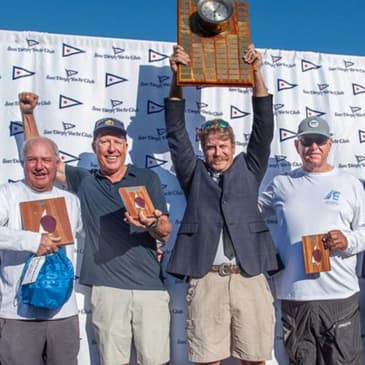
In this powerful in-person conversation, professional sailor Luke Lawrence returns to Sailfaster to share his extraordinary journey — from burnout to balance, and from racing hard to racing smart. Speaking from Pete’s dining room in Washington, D.C., Luke opens up about the mindset, mechanics, and mental resilience required at the top levels of the sport.
We talk about:
How Luke learned to become a “fact-based robot” and shut out distractions
His recent pro sailing season across Stars, Etchells, J/70s, and superyachts
Tactical and technical tips for starts, laylines, mark roundings, and game planning
His candid battle with addiction — and how sobriety transformed his sailing
The lessons he brings to coaching and how to reset a team after mistakes
This is a deep, wide-ranging conversation about performance, preparation, personal growth, and the joy of mastering the fundamentals.
Connect with Luke:
Instagram: @lukelawrence13
Coaching & pro inquiries: 772-260-2437
[00:00:09] Hello and welcome to Sailfaster. So, you know what happened? Luke Lawrence stopped by a few weeks ago on his way to the Etchells North Americans, which he and his team ended up winning. We ended up recording what was, I think, a really interesting open discussion, ranging from mental preparation, including when to switch between being what he called a fact-based robot on the race course and perhaps being a more empathetic coach,
[00:00:38] to a candid discussion about his 10-year battle with alcohol and drugs. The sound quality is not as great as I'd like it to be, I'm sorry to say. We didn't use my studio, unfortunately. We were sitting around our dining room table. But I do hope you'll bear with it because Luke's, as you know, a really interesting guy. So here we go.
[00:01:11] So here we are. We're in Washington, DC. I'm done with Luke Lawrence. I'm really thrilled to have you. Thanks so much for the call. It's a pleasant surprise and great to see you. Great to see you actually in person. Yeah. Is this your first one when you've done live in the living room?
[00:01:23] It is. I've done it live in yacht clubs and that sort of thing. It's the first in the Boland studio here. So we'll see how it goes. But when we took last, you had this, it sounded idyllic, right? That you basically had an RV, your family, and a map, and a sense of let's just go all over the USA. You had a list of people you'd call up and say, let's do some coaching. Did that work out? It did, actually. It was kind of a blend at the end of that season and then rolling into the...
[00:01:53] Incredibly packed Miami racing season. Did 14 events since we did the last episode. Wow. In four months. Between the Agiles, the Star, the J70, and a little bit of super yachting. There wasn't a free weekend to do any coaching down there in Miami, but it's kind of reverted back to its original where I guess my destiny is supposed to be, I guess you could say. While I have the body and physical ability, I should probably be racing.
[00:02:23] But from a fundamental point, I think I've leaned back towards the pro sailing side. I figured out how to love it again. You took this break, didn't you? I think you'd ended the break when we last spoke. Are you getting the sort of satisfaction and joy back again? Yeah, 100%. Learning how to enjoy the process and how to, I guess, take away the distractions that took up so much of the day-to-day.
[00:02:48] And as you get a little older and maybe go through more ups and downs in life, you kind of learn to appreciate the little things a little bit more. When you have a family as well, right? As you do, you have quite a young family. Stepson's 13. My daughter's three and a half. My son is one, so I've got talks back, talks too much and doesn't talk.
[00:03:09] So the whole spectrum. But my whole fundamentals on how I view life is a lot. You know, being able to express myself in an art form, what I call an art form like sailing, it's a silent art. You know, there's communication and there's talking, but at the end of the day, there's this essence of tranquility when you're out there, even if you're just by yourself.
[00:03:37] Or on a boat with other people, it's like that moment when you put in the time and the effort and everything just starts to gel and the boat gets quiet, but you're still hitting targets and you still go on the right way and you're still in front. And even when you're not racing, there's something about sailing that, you know, you can't really replace it. But yeah, back to the RV thing, I've actually become a bit of a mechanic through RV living.
[00:04:04] I just did my breaks last week in a RV park in South Carolina because those went out coming down the hill and that was entertaining. But I've learned I'm a lot more mechanically savvy than I ever thought I was. I assumed you would be anyway. I mean, didn't you say it was a lot of mechanical... As far as, you know, it's interesting. You look at boats and you're like, okay, here's lines and ropes and blocks and cleats. Yeah, there's that mechanical, a couple of Phillips heads and, you know, some 10 screws or whatever.
[00:04:29] But, you know, when you're getting into taking apart something that's greasy and dirty and like stuff that people look at every day. I don't think a lot of the next generation is as savvy in what needs to be what goes on around them in their daily life. Yeah. You know, how it works and just the physics of it. And it was interesting because, I mean, I'm a YouTube professional. I take pride in most stuff. I can YouTube videos and I can kind of reverse engineer most things from them.
[00:04:57] Not that I consider myself a professional at it, but I've developed a way to pretty much take any problem I come across and through YouTube figure out how to do it. And, you know, I have all the tools. That's the biggest part. It's really got to have metric and standard everything if you want to. And then you've got to recognize, go identify whether it's a metric or standard bolt. Pretty decent idea. Oh, yeah.
[00:05:21] One of the side effects of like doing thousands of ducks and close crosses is like you end up being able to look at it and be like, yeah, it's a 12. That's funny. And it's cool when you get into the groove and it's a lot like sailing in the regard and at a high level in the regard that if you can, you know, kind of take your brain into that focus spot and eliminate the distractions around you.
[00:05:46] I think you can get a lot done in a short amount of time where, you know, otherwise you could look at something and procrastinate. That was actually one of my big milestones in this year was seeing problems that I'd never come up against in a mechanical sense. Like with the RP is a good metaphor. And how I don't want to do that. It's going to be pain. I don't know what's going to happen. What's going to be next? Am I capable of doing it?
[00:06:11] And then finally, you know, I developed this like mindset of like, oh, I'm just going to take it apart and find out. And if I don't find out, I'm in the exact same situation I was before I started taking it apart. Which is broken. So you might as well try. I mean, that mindset of you might as well try must have carried you through sailing, right? I imagine that. Yeah. Because every, every, when you start every race or even when you start every leg, you don't really know what's going to happen to wins and currents and competitors. Exactly.
[00:06:40] And you got it. You got to keep, you got to keep your, to the sailing side of it. It's, you're never at it again. That's the coolest part all the way to like, at the Hedgehog's North America. Well, unless you're, unless you're me, sometimes I'm very much. Still, I mean, you can develop the mindset to, to evolve into, you know, this. I know what you mean. Yeah. You might not have the same time on the water yet as like a Kenny Reed, but you're young, you have your body and you have the potential to grow stuff. You're not talking about me, are you? You're talking about the average. Absolutely.
[00:07:10] No. It could be, you know, you put, you look at, I mean, Peter Duncan's a prime example. J70 guy, world champion. And, you know, he put the time in and he got guys around him like Willem Van Wey and Victor Diaz, Billion and, and Judd Smith and put the time in with them.
[00:07:31] And yet Peter's obviously been doing it a long time, but like to be as consistently successful in that, like at the end of the day, he still had to put, he still had to have that open mindset. Of, of growth and development. I know that if that ever, if one person on the boat ever checks out of that mindset, the whole thing snowballs into a disaster. So it's very much, it's very much a learning mindset, isn't it?
[00:07:58] One of the episodes done recently is with people who started racing later in life. And I was asking the person who, Beth Crabtree, who did a series on this for Spin Sheet magazine in Annapolis, what sort of common denominators were for people who started learning later in terms of the success of them. And for her, it was, it was about being open, curious, long love of learning and the sort of competitive instinct. That's what she saw in those things.
[00:08:23] And I think you have to, perhaps in any sport, right, you have to, you have to be curious and open because that's the, that's the only way to learn sort of inch by inch and piece by piece, isn't it? You had a good, you had a good year. I saw you with a Etchells Midwinter's East Champions. Correct. Yeah. And, and you were also back with Paul Kayard in the, in the stars, right? You did Star North America. So you came third in the stars with. Yeah. We just did it.
[00:08:53] That was a couple of weeks ago. Yeah. Yeah. No, the Etchells was, was a really cool one. You know, it's, we got second in the series. I've been second in the series twice before that, having lost the series kind of in the last day and the ones prior. Yeah. I read the reports on it. Yeah. For this one, this was the first entire season where we were on the podium for every event. Outside of one there at the end of the Cool Reef Cup where we had some other outside influences that kind of,
[00:09:22] took us out before we even started. I got bed bugs at an Airbnb. The day of four. No. No. No. Was it like America? No. Oh yeah. No, it was bad. Going out there, I couldn't even wear my ceiling. Covered in cowl. Oh my God. That would, yeah. The wife and kids were trying to move out of this Airbnb. That bug. Well, we had one of the good winners too. We had four of that. Yeah. That was kind of the, that was the goal. Yeah. You know, winning good winners and having a chance going into the winning series.
[00:09:49] And then it's interesting because the actual series, the winner series, now that I've done it, I've done 10 of them now, probably more. But it's one of the most challenging overall things in my mind to win because it's essentially like a four month long world championship. Oh yeah. Where you have to be on in December. You have to be on in January. You have to be on in February and the beginning of March. This is for the midwinter? For the whole series. Yeah.
[00:10:17] So there's the midwinter, which is the last of, it's the final of the four event series, which was called the Jaguar winner series forever. And you can drop one of the four events. So you have, you have your series and you get third and the first event. You got discots. And so our series was a three, five, four, which doesn't sound like much, but at the end of the points. Yeah. You know, you drop the five, you got a, you got a three, four, that's seven points.
[00:10:45] And that's the same as somebody getting a, you know, whatever, whatever it ends up being. But the mental side of it, being able to go check out of like, you got to check in and check out of this mindset into that specific boat in that class, like the actuals where it's, I don't know, you know, world's different from a star. Say, you know, there's similar fundamentals, but it, it, you know, retunings nowhere similar. The principles are, you know, you do the, you do the opposite on a lot of things, you
[00:11:14] know, like star and break back when it's windy, actuals, you break forward. So it's like, there's not too many crossovers, but at the end of the day, you're still on a, you know, relatively heavier keel boat. And it's not like, you don't want it feels really good. So when you swap between the, uh, between the classes, do you, you have to have a day or so to sort of get used to it again? I can switch it in on the dock. I could walk from one to the other. Yeah. I want to go straight into the other and I don't know how it didn't develop like a,
[00:11:44] like the switch kind of had to, I think, especially with the, the family, families of life, you know, being able to go from like super intense, like fact base, everything, you know, like in sailing, it's facts, right? There's no room for emotion. If there's any emotion at all, it's just extra points that you put on your scorecard. It's how do you turn yourself into that fact space robot, dark spot there, win there, go there, go fast. And then just repeat that cycle over and over and over again. Versus I come home.
[00:12:14] And as you might know with your wife, am I problem solving or am I here to listen to feelings? And it's something that my wife and I developed a good, you know, and I've learned how to visually recognize it. I think a little bit. That's kind of saved me a bit of a good fear. You need to give me some tips on that. You hear that thing? And yeah, so that switch development has been something because I was younger. I couldn't turn it off. I find myself up all night till, you know, I couldn't sleep just in, in the boat, just
[00:12:42] thinking about the sailing side of it. And like over the course of doing that for two weeks straight, you know, you start blurring lines of what's, what's reality, what's real life. Like, you know, what is this? So the fact, the fact-based robot, which I love that as a description. Did you, did you have to learn to be a fact-based robot? I think it was kind of a natural evolution because it was really straightforward. When you, I talked in the last episode about being able to go out and just black out for
[00:13:10] like four hours at a time and not think, not actually be putting anything into short-term memory. You have your long-term memory, but you actually kind of like switch into, you have to be able to completely dissolve yourself from anything outside of what is going on in that boat at that particular moment. And, you know, the racing mindset is like, how are you going to get that consistent?
[00:13:34] And I think when I allowed my emotions to take over, I would do stupid stuff and wouldn't win. But there was a direct correlation to me. Like I said, fact-based robot, which is if you can develop that loop of the fact-based robot, you win. And I think it was just kind of a natural evolution to, to be like, I want to win. This is the way to do it. And like I said, I mean, switch is the key.
[00:14:03] I had a guy, very successful guy out of Michigan. It was one of my long time star sponsors said to somebody else after meeting me, but first time he switched on all the time. He said, yeah, but I needed to figure out how to turn that on. So when do you, this is fascinating. So when does that switch go on from you? When you're, is it on your way to regatta? Is it the morning of? Is it as you leave the marina to go to the, do you consciously do it?
[00:14:32] You consciously think, okay, let me switch modes here. I switch in and switch out all the time. And I know how to switch it on right before. Yeah. You know, kind of about four minutes is kind of the drop dead time of when I'm in the zone because I get this routine. You know, I got in the actual and like in the star when I'm driving is I start the boat. You know, I kind of, I talked to the guys, you know, I talked to Brad Boston's my middle guy and Andrew McCray.
[00:14:59] And we kind of had like a little discussion about what we think, but like we, at the end of the day, I got the, I have the tiller and they defer and let me do my own thing in the, in the starts, you know, and, and kind of, it gets quiet. Like there's nothing outside of the Andrew call on the time. And, you know, Brad will, if, if I'm, if I ever get to the late point where I'm a little late on the final approach, you know, Brad will chime in, you know, but that, that we're
[00:15:26] doing better at minimizing kind of conversations and developing the flow in the, in the final approach and, and, you know, using the VACAROS has been pretty cool. Have you been around with that at all? We have a, we have a Velocity on our boat, but we're, we're doing a trial in our class at the VACAROS. They're awesome. Yeah. They're great. You know, it's, I was super old school about it. I was like, oh, you know, cause I was like blind sites and I was like, it's like, it's going to change the game.
[00:15:54] And at the end of the day, it made the game better because I've lost, I don't know, many events because of Black Flag or an OCS, or you go a minute and a half upwind and you finally get called, you know, like we, we, the VACAROS or the Midwinners was a good example of this kind of like allowing you to save the game a little bit, you know, like came through a rocket ship on the start and boom, flash is red.
[00:16:22] And like, I just got this, like, I do my own main sheet as well on the actual. So that's like, as it flashes, like it's already out of the cleat and we're already dumping down and like the transom's barely past the line before I've got the bow back spawn until it's clear. And like, we were OCS and so is John Dane and Hardesty that, and we're right next to him. We both spun around and they won the race and we were third in the race. Got right back into it. Yeah. You know, so it's cool. I think.
[00:16:52] The emotional side. Oh, am I going to, you know, lose my edge because of this new tech? No, it's, it's, we used to have compass pots and we had tactics and there's just like always been this, you know, evolution in the sport. It is a certain point. Technology arms race. There's still guys out there that started with masts. Yeah. Racing. It's like, who would you complain about a little technology? It makes the day. You save black flags.
[00:17:21] You save general recalls. You save time. You save sales. Yeah. You know? No, I've become a big proponent of it. Yeah. I can't, I can't wait to go on myself just because of that. The, also from, for me, the vagarism, do I, did we ping the line correctly? Did the line move? That's a lot of way. So the trick was. And the time you waste sort of doing that. Yeah. Exactly. And it's a, it's a danger, you know, like a lot of the painting stuff, like there's, I've seen more wrecks and more, more people hit committees while painting.
[00:17:51] Yeah. Than any other point. Yeah. It is a moment of stress because everybody's coming around to do that. But I want to go back to that sort of quiet boat as you start to approach the last, presumably last few minutes. It's, it's getting into the, into the zone. So it's more, you don't, do you have any sort of self-talk or anything like that that gets you in there? Or if you've just done it so many times now, you just automatically, your team knows. Yeah. This is when we get serious. I think I've done it enough times. I think self-talk.
[00:18:21] No. The only time that I guess that would be self-talk is if there is something, this, off the water that has nothing to do with it, that it like keeps, you know, poking into the, the side of the frame. Yeah. Life. Life. And, and being able to. Like mentally just be like, that doesn't matter. And leave it. You know? Yeah. It's easy to say, oh, you just leave it all at the dock and this and that.
[00:18:49] It's like, but then when life and your pleasure, you know, or whatever it may be intertwined too much, nothing usually ever happens. At least in my, in my experience, you have to be able to compartmentalize just for optimum, optimum efficiency. I think with anything in life, companies we run and whatnot, there's always a department that specializes in whatever it may be that the goal is. So you're, you are one of the more popular members of the, the racing fraternity.
[00:19:18] And I'm, I'm not surprised by that. You're really good as part of that, of, of giving thanks and praise and appreciation publicly for the team around you. Right. I think you, I get the impression from me that you definitely feel the gratitude for the support network you have. I mean, your mom was obviously a huge influence on you and that hasn't, that hasn't changed. Right. That's part of, part of your makeup is that gratitude towards others. Yeah, definitely.
[00:19:45] You know, appreciate what, you know, we, like, I think, I think I said before, we're not, we're not out here solving world hunger. Yeah. So yeah. All in perspective and, you know, being appreciative of, of the opportunities that you have and then making the best of them, whether you got a good boat or not, you know, you, you got to, it's about keeping that mindset. And I think that, I mean, other people may recognize it, but to me, it's just about being
[00:20:12] a good human and recognizing that, you know, I might bring a decent amount to the table, but at the end of the day, when you're on a big boat program or, or, or anything, you're, you're just a, you know, small, a small gear in the, in the spoke, you know? And I remember when you, um, one of the things that was very interesting about it were the many things that you talked about was your preparation three months ahead of time.
[00:20:37] And the number one thing for you was thinking through what your, um, speech would be on the podium, uh, when you won the event. And, um, because you were petrified of leaving somebody out of that speech. So I thought it was really, that was really interesting and revealing and surprising. Well, it does, it does take a, you know, it takes an army. There's, there's, it, everybody sees the end all result that most people, whether it's
[00:21:07] people don't show it or there's no, as far as like the, the work and the effort that goes into it, you know, like there's, I've got guys in Massachusetts that, you know, that make the sales at Doyle, you know, with Tomas and Judd and like, they're a fundamental part of it. You know, you don't, every single little piece of it, you know, you're not, that's the wax sponsor is paying you to say, you kind of, you know, everybody waxes their book, you know, you can do it. You take that out of it.
[00:21:34] But no, at the end of the day, everybody who was part of the team deserves recognition a hundred percent. So one thing I want to talk about is the fact that there's a lot of pressure and there always is at the top end of a sport, even, you know, say even a sport like sailing, certainly a sport like sailing. And you weren't immune to that, were you? There's some of the pressure and some of the impacts of that. No, I wasn't at all.
[00:21:57] I had my battles, you know, and I kind of came from a decent, you know, lineage of alcoholism in the family. And I wasn't immune to that either, you know, and it is. I was a young pro and, and it wasn't necessarily the pressure. I don't think in hindsight from other people as much as what I put on myself or allowed other people's opinions to, I didn't, I didn't, in the long run, I didn't need their opinions
[00:22:27] to justify my existence, which I think was a big revelation. But no, I, I battled alcohol and, and drugs for 10 years, you know, starting, you know, it wasn't, it was a slow onset into the alcohol thing. You know, it was obviously sailing. It's just, it's as old as, as time. The two are connected. Yeah. Synonymous. Yeah. Yeah. The sponsors. Exactly. You know, and, and, and nothing against them.
[00:22:53] You know, they, they've, they've done great things for the sport, you know, Cardi and what they continue to do. It was my personal choice to step away from alcohol. I didn't like where it was. I wasn't going to keep, I wasn't going to live, you know, much longer if I had kept going on the path I was on. It was as bad as that, was it? Yeah. Wow. Stop, drinking wasn't the problem. Stop it. Drink. It was the issue, you know, and then that turns into a bag of cocaine, you know, it's just
[00:23:21] the snowball would just go and then, you know, then next thing you know, it's today and you're 11 and it's time for a little drinky poo and, you know, the rest of your day is gone, you know, and it, I couldn't, I didn't, I didn't want to see that get passed down. I didn't want my kids to see that version of me, even though it was a big part of me,
[00:23:47] you know, not, not that it was my identity then, but I definitely hated myself with that crowd and that fundamental, like, okay, where's the party? What are we doing? You know, like they've got that. And, you know, you're in your twenties and when that's all you know, and all you're doing is regattas and you never go out of the little bubble to see what the rest of the world does. It's really easy to be like, no, this is it. Everybody just drinks all the time. And this is normal. It kind of helps sailing.
[00:24:16] I mean, to go out in bright sunlight with a splitting that they can hang over. You did well to succeed even. I don't know how I did it. I can't matter. I won a lot of stuff just properly dusty. Wow. You know, by the time I hit 30, it was, it was like this line in the sand, so to speak,
[00:24:41] where I'm out there at day three of a big star regatta and, you know, been drinking and every day and, you know, or every night, you know, and sending it hard. And then it's like day three of staring at the sky, hanging upside down in a star broke with just like the worst indigestion. And be like, you feel your skin just like nothing good. It doesn't feel good. And like, it wasn't like it was when I was 26. Oh, you're fine. I'll just get back to the dock and, you know, take the edge off and start the whole cycle over again. Yeah.
[00:25:10] You know, by the time I hit almost 30, you know, the Czech liver light came on and, you know, this time I either had to decide, am I going to be there for my kids or am I going to be six feet under, you know, kind of made that choice. And I've always done a cold turkey, like everything I've ever, you know, quit alcohol, cold turkey, quit, you know, got away from cocaine, cold turkey, cigarettes, cold turkey, you know, just
[00:25:39] stopped them, you know, and like, that's just how I, you know, internet, you know, social media, that was a severe, easy to sit there six hours a day. Oh yeah. You know, and it's, it's such a waste. Like the amount of people that spend thousands, thousands of hours a year, just swiping in a reality that doesn't exist. Granted, they might be watching this podcast in that reality, but we're here to tell you, go outside. So that, was that your moment then? You, was that? Yeah.
[00:26:08] It was the story that you, you remember that moment? This isn't working. It was true for Scott Mason. And, you know, just, it was a combination of making poor decisions, like off the water and on the water, you know? And then, it just kind of, just kind of came to this realization. I needed to, I needed to get my life together. And that when you're in the moment, it's so easy to feel like you're alone with it. You're the only person going through that.
[00:26:35] You're the only one that has that subconscious drag back to, I mean, with some drugs, they call Chasing the Dragon, you know, where you're always trying to get back to that first initial feeling of satisfaction, you know? And then you do it enough, and then your brain chemistry changes, and then all of a sudden you can't function without it. And, you know, your life crumbles around you, and you might be enough of a daze where you don't even see it. Did you find others, though? Were there others around you that you realized had that same?
[00:27:04] Because you talked about being alone, feeling like you're alone. Yeah, I think there is. I mean, I think they could be out here, they're listening to this podcast. That's why you're not alone. If you're out there and you think you are, if I can do it, anybody can do it. It was a long time I could drink anybody under the table and put more up my nose than anybody could ever imagine. Never, ever thought I'd cease over. I told myself, I'm never going to stop drinking. This is hard.
[00:27:31] Like then I gave myself that negative affirmation, I guess, and developed an identity that wasn't actually me because it was easy. That must have been hard. I mean, like this is hard, but it must have been hard if you did go cold turkey, come back in the dark and everyone expects you to be little or anther's going to have some drinks or some fun. It was initially, but I actually had a lot of support, which is it was taking the first step myself. And not that there was any gratification for it, but it was more reaffirmation of my theories that I had before I stopped drinking.
[00:28:01] And I had to get, at the time I had to get away from pro sailing because it was such a mantra of, not saying it was status quo, but like it was historically, yeah, pirates and bootlegging and booze, they've always gone together, you know? For sure. Yeah. To take that leap, not a leap, it was necessary, you know, to survival, but to go into the unknown
[00:28:27] seemingly alone and to find friends on the other side was probably the coolest moment out of all of it. And then now to have people who may be going through their own things, you know, if they can look at me and be like, oh, Becca, I can do it, then they can figure it out. Was it very difficult? The first couple of weeks was challenging because I had, so when I finally got away from sailing and actually went, I did the family business and commercial fence in Florida,
[00:28:57] which is fencing is kind of like the Marines of construction. You're the first one's in and the last one's out and you're the one's out in the ditch, digging the holes when it's a hundred degrees in August in Florida. So that was not necessarily the greatest environment for me to go and try and find sobriety is the standard American construction workers and pretty much making enough money to pay, pay bills and feed their addictions. You know, red bull, nicotine and alcohol. That's the cycle. You look at everything around you that's ever been built.
[00:29:26] And I'm sure even in the UK, you know, they go and have a couple of pints at lunch and then they're back up on the scaffold. Absolutely. Just because it's socially acceptable doesn't mean it has to be that way. Yeah. There's definitely a trend, isn't there, where a younger generation are, you know, drinking a lot less. They have different addictions. The alcohol consumption amongst the younger generation has fallen pretty steeply where they're sort of breaking away from what we all did, right?
[00:29:54] But in correlation, I've seen a direct rise in fill with other issues. Yeah, for sure. Flawed humans, aren't we? Phones, vaping. Like, there's always been this, like, kind of balance level. You know, in the 80s, it was like everybody just did cocaine. Apparently, it was like the thing. Then, you know, it kind of faded into that and then it turned into drinking through the 90s. You know, I don't think addiction has gone anywhere. I think it's just kind of funneled in a different direction. Yeah, like human beings, right? Exactly. No, it was pretty interesting.
[00:30:24] I was watching the Theo Vaughn with Mark Zuckerberg podcast the other day and Zuckerberg doesn't even do coffee, right? And Theo Vaughn, very similar background to me, you know, battling their own drug and alcohol addictions and then kind of to get on the other side and start to see the success of life after that and taking that mindset has opened so many doors to me. Has it changed your sailing? I mean, I know you've been with Paul for quite a long time. Yeah.
[00:30:54] And so he, presumably, he went through that with you. He saw you. He saw me going through that and Paul was, you know, very supportive of who I was at the time, no matter what. Paul's a really good guy. Yeah. Really good conversations about that. And after the North Americans, I actually long enough went back to the dock after we finished. Then I asked him, I said, do you see a difference between full drinking party, Luke, and this one? He said night and day. Oh, interesting. It's a whole other world.
[00:31:22] And I got to do the Rose Hardy at the St. Bart's Bucket two weeks prior to that. Nice. Same as well. We actually had, it was just a pretty cool team. We had Brad Reed and Mike Topa and Kay Hard. And, you know, we had the Loughborough brothers, both of them on the bow. Got a dream team. We had a head squad of Super Yachties, which was really cool, but it was just a fun dynamic
[00:31:51] to be there and to be working with some of the people like that, you know, that have done what some would say everything in the sport and to see the human side. And like, we're all still people, you know, you might put somebody up on that pedestal, but at the end of the day, they can still stub their toe. Yeah. It's interesting you say that I've interviewed lots of top sailors. I've been very lucky to do that.
[00:32:16] And what I'm always surprised about is that they have the same anxieties and the same fears as all of us, except they either figured out how they can turn that into a strength or they figured out how to suppress it. And of course they have, you know, better brains than me and better abilities than me. But the fundamentals of being human is really, it's really quite interesting. Well, I think, I was thinking about it on the way over here.
[00:32:43] I think fear of rejection is a base human instinct because as we evolved over 100, 150,000 years, rejection was instant death. If you weren't part of the pack, you weren't part of the herd. And I think that in modern society, success triggers the same chemical in the brain as acceptance and not necessarily acceptance. But you don't have the negative one of rejection.
[00:33:09] In fact, it's so repressed that all you feel is the upper side. And then not that people are scared of rejection. It's a natural, it's a survival instinct. I never thought about that because we all have that, I think I say we all, lots of humans I've met have that desire for it to belong. If you were rejected, not only did you die, but your genes weren't passed on, that kind of weaned itself out.
[00:33:34] One thing I'm interested in is, so you talked about being in, sound like the St. Bart's bucket. You have had plenty of big boat experience, but for you, the smaller keelboats, the J-24s, the Stars, the Etchells, is something you stick with? Is it a smaller team? You have more control? I think it's more a product of abundance. There's a lot more small boat regattas. There's only one bucket a year.
[00:34:00] There's only four made, like actual super yacht regattas a year. The odds of anybody getting invited to all four unless they're running their own program. But it's also, you repeat a lot more of the fundamentals on a regular basis in a smaller keelboat. And I think you end up with a lot more of the satisfaction of feeding that learning bug in the small boats. Like you go out in a super yacht, if you do two sets and two jibes, that was a long practice day.
[00:34:30] Like your ability to get repetitions and to be able to look at things on a small scale and be like, okay, this needs to change. This needs to go by. This needs to be super yacht, say a meter different. You know, where your marks on the sheets are. Where's your cut point? What's your angle? What's your rate of turn? You know, like that kind of stuff. You don't, it's not like you get to go out there and you set the kite once. And you get on with a new team on a far 40 or something and you got the right guy. It's like, it's really cool to go on one run with an okay team.
[00:34:59] You know, guys that may have sailed together or may not have sailed together. It's really cool to go out there and bust out 15 jibes and have a perfect one at the end. And then to be able to replicate and duplicate perfect boat handling. You know, but the fact that I think it's, I enjoy it because you get a lot more of the satisfaction. There's a lot more opportunities for it to send itself. There's obviously a lot more maneuvers, content maneuvers versus, I get that. But what about sort of the TP52 class?
[00:35:29] You know, that's becoming super popular. Yeah, it's becoming super popular. I'm excited to see the great length stuff going on. Kind of like with the US 52 circuit. Yeah. We have, I mean, there's, I've done the European, the TP, the super series over in Europe. You did? I didn't know that. Yeah. Yeah. A few, a few events over there with the Spooky program with Steve Benjamin. We did a few events and it was cool, you know, to see, like to watch a program like Quantum
[00:35:58] or Platoon or any of those guys, you know, with just their container setups. Like the whole, the whole observing how a proper program is supposed to be run in a well-oiled machine operates always has intrigued me. And, you know, and then for my brain type, it seems maybe I learned it in construction, managing 40 guys on a job site and all the emotions and all the, you know, everybody's got problems on Monday morning. I'll tell you what.
[00:36:25] And you hear about them, you know, it's being able to get a team back gelled and having with any bad situation emotionally or, you know, you put the kite in the water. Like the more opportunities I get to just put bad stuff behind me and focus on what is the next positive decision that can be made to get us closer to our goal.
[00:36:52] And sometimes it's do nothing and, you know, and being able to recognize when that that's the situation. And it's funny, that ties me back to one of my biggest life lessons that I didn't listen to early enough was from a guy named Ian Leinberger, who was Mark Mendelblatt's coach for a long time, went to the star, went to the games and the star. And he told me back 10, almost 15 years ago, he said, there's a Portuguese term you need to learn.
[00:37:18] It's called omirda, which means to omit, which means keep your fucking mouth shut. If I had learned that a lot, you know, I probably could have made it a lot farther on big boat programs because, you know, when you, when you come in as the young fin guy and you used to be in the self-reliant, you know, like you, in the fin, you have to develop this mentality that you're the only one that's capable of doing this out here. There could be 150 boats, but if you don't have that self-drive and determination and hate
[00:37:48] to torture your body and to put that you pretty much, like, at least for me, you know, you, you have to develop such a strong sense of self-reliance in a boat, like a fin. And then the more you do that, the harder it is to transition into a team, to a group setting. Yeah. Yeah. And I think that ties back to, I give credit where credit is due and recognizing that
[00:38:12] everybody on the boat was in an integral part, no matter how small or how tiny of a line they touched, if they touched any line at all. They were there and they didn't mess it up. Yeah. It's part of the sort of big cogs in the machine, isn't it? Versus, you know, being the engine yourself, right? It takes 120 pound person stepping on the, on the old lazy sheet and attack to mess up a job, mess up a tack and not cross the fleet. Yeah. The smallest person on a big boat can mess up all of it. Yeah.
[00:38:41] So recognizing that and, you know, yeah. When you do the cut, one person steps on that old sheet, it doesn't get smacked on the new side. You know, it throws off all of it. Yeah. You don't get the jib to 93, 94% out of the tack. You're not crossing. You know, and that throws a lot of tacticians into a tailspin. Mm-hmm. And I think developing the fundamentals with the team is like the priority of any tactician when they get onto a boat. It's like, what can I do with this weapon and the tools that I have? Yeah.
[00:39:12] In hand and the team that's there and being able to show up to that team and bring out the best of everybody's ability. It's like one of my, I get a lot of personal pleasure from it. It's like that, oh yeah moment. Like when it all just goes, you know, because you look back when the boat was slow before and then you look at 15 minutes into the future when you finally get it figured out and you're Matt. How do we, we started from that and then we ended up here. It's, I get a lot of them. Thinking about coaching, you're doing coaching now.
[00:39:40] What are you learning about yourself as you coach others? Is it necessary? Is it necessary? Is it necessary to say what you're thinking? Is it, is it going to achieve? Is it going to, you know, is it going to better the group? Go on. What's the example of that then? Oh, I mean, it's easy when somebody messes something up and go up and I can see it's cheap shot coaching to go up and be like, well, you're messed up that driver. You know, it's how do you, how do you dig somebody out of their own mental?
[00:40:09] So that's, that's, that's the fun side of coaching for me. And like, I get, I get a lot of enjoyment out of crew and for somebody like K-R because we don't have a coach. It's like, we are the coach when you're in a program and, you know, even saying with some of the best guys in the world, going back to, they're still human. Like, even if it's a small fleet, it doesn't matter. Like anybody, I don't care who you are, how strong you are, can fall back into a revolving door of self-pity and not, not saying that specific.
[00:40:38] I'm just saying, using that as a segue to how quickly can you stop your own bleed in a situation? And if you can do it really quickly and you can get back into the positive and go forward, that's how you win world championships. So it's, it's a very interesting point you make because you're right. People do step on the lazy sheet or they just fluff attack or something goes wrong where it's usually, there's usually, you know, people make mistakes all the time. That's the whole sport and it can be crushing. What's your advice for somebody in that situation?
[00:41:07] How to sort of get their heads back in the game? Would you, is there advice you can, you have first? Um, I, I mentioned it in our prior episode, but it's, it's the reset button. Oh yeah. I remember you talked about the reset button. Yeah. And I say it all the time, you know, it, it, it's beef attack, beef or whatever. Before the damage is even over to say reset. And if you've done that enough with the team, that's just the key word to go back and do your job to the best of your ability.
[00:41:36] No matter what the fire drill is. That is the fastest way to recovery is, is realizing that the last race didn't matter. Any, any of the issues that you might've come across in that day or that week leading up does not matter. It is what is the next wave? What, and, and being able to reset back to the basics of Salem, which is what's key, go fast. And, and if you can get your team on that similar principle of, of forgetting the past immediately, it's already there.
[00:42:06] And I said to the KR at the, you know, we had a shot going into the last day where we had a bad first race at the North Americans and the first and second, they just sailed a really good regatta, but we came on strong at the end. We closed the gap down to three points and no, we're kind of running out of time for the last race to happen. And we were leading that race for a little bit. And at one point the guys we needed to beat for the overall series were way back in the race.
[00:42:33] And we started getting into this little match race with one other guy. And I said, Paul, we don't need to win this race. We need to stay up here, period. We can't get a fifth, you know, cause then that's going to, you know, if we get second, that's fine. You know, and cause the gap is still there, but, and then that was kind of like our reset moment where we stopped battling out to a corner, giving the rest of the fleet the opportunity to get by us and to keep the head in the game. So let's go back to the big picture. The big picture. Yeah.
[00:43:00] And being able to stick with big picture, trusting your guy that's in charge of the little picture stuff. Like it's really easy to nitpick. And the biggest trick is taking a deep breath. Like it's so easy in sailing. Cause it's, it's not a, from a physical point of view, it's, it's, it's not very conducive to like deep breaths and, you know, like proper posture and keeping your shoulders back and your neck straight.
[00:43:24] It's like, and that your brain's lack of oxygen will start to go into survival mode. And it won't necessarily make the best facts based decision. Give me information. Robot. A robot. Yeah. Yeah. You know, the robot, it just needs lube. Lube, lube, you know. Yeah. I tried, I tried to do that box breathing on the way out to the, to the race course, you know, cause you have a bit of a transit time. Uh, but then I instantly forget to do it at any other time.
[00:43:53] Not sure it would make a lot of difference, but it does. It is. It's a discipline. This is a calming discipline that allows you to, uh, just reset, step back and see, see what's really going on around you. Well, it's being able to recenter yourself from center all the way up to your extremities, release the tension that you might be building up in your body that's wasting energy long term. And that's something you learn. You kind of start to develop it in the laser, you know, if you have the right coaches and
[00:44:22] then, you know, when you get into the fit and especially when you get into the stock is learning how to properly implement your energy. Nobody can go a hundred percent for two and a half hours of a star. It's absolutely draining. Eighty seven percent. It's not enough sometimes, you know, and it's kind of, it always ends up being in that like 92 to 94% of like maximum exertion. Like a huge spark for me has been the physical side.
[00:44:52] And I was always a natural athlete. I didn't have to, I didn't go to the gym. I sailed enough where my body stayed physically strong enough, but I was a natural athlete. And I kind of rode on that for a long time. There was an interesting book called, uh, talent is overrated. And one of the quotes I got out of that was, uh, was hard work will surpass talent that doesn't work hard. For sure. And I was at that point of riding the talent bus, you know, and then obviously the culmination
[00:45:21] of like my long-term drinking and running out of the physical side of, of not being 24, you know, being able to pick 300 pounds up or walk with it on your shoulder. Those days were gone. I think at the end of the day, I've developed a mental structure ability to be able to call myself and the people around me, which in the worst of situations is always seeming to be beneficial long-term, just in light.
[00:45:48] You know, you could be on the side of the road with a flat tire and all the semis are flying by. You still got to be able to do the exact same thing as a bad lure mark rounding and reset and, and do that. And the more I practice it in everyday life, the better I get at it in sailing. So that's Luke in his natural state. He's open, human, and funny.
[00:46:19] Part two, in which he gives some great advice on race course moves, is coming up in a couple of weeks. I'm out of the country for a few weeks in beautiful Greece and more to come when I get back. Best of luck in whatever and wherever you're racing this weekend.