
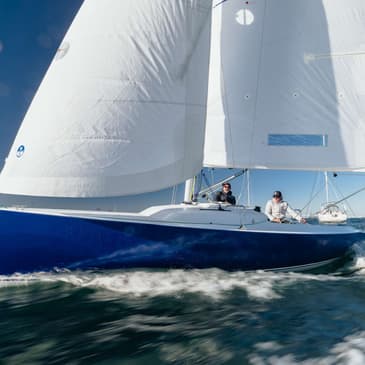
In Part 2 of my chat with Jeff Johnstone, President of J/Boats, we dive into the art of getting the most out of your J/Boat on the racecourse. Jeff shares invaluable insights on optimising boat setup, crew coordination, and tuning techniques that can make all the difference in competition. From rig tuning and weight distribution to the importance of repetition and dialing-in manoeuvres, this episode is packed with practical takeaways for every racing sailor. Plus, we explore the philosophy behind J/Boats’ design and why performance and ease of handling are at the heart of every model. Whether you’re new to racing or looking for that extra edge, this is an episode you won’t want to miss.
[00:00:10] Hello and welcome back to Part 2 of my conversation with Jeff Johnstone, the President of JBoats. In Part 1, as you'll remember, Jeff talked about the design process for JBoats, the common characteristics across the range, and how in some cases over the years the economic environment influenced their design. Today, Jeff talks about getting the most performance from JBoats and what he sees as the fundamentals to setting up correctly for racing. I do hope you'll enjoy the episode, and to hear more episodes in the Sailfaster series, make sure you're going to be able to get the most performance from JBoats.
[00:00:40] I'm sure you subscribe at Spotify or Apple Podcasts, wherever you get your favorite podcasts. And while you're there, I'd love it if you gave Sailfaster a positive review. Okay, here's Jeff. Hope you enjoy it. Hey, let's move on to your advice for getting the most performance out of a JBoat. What would be your basic advice to a JBoat owner?
[00:01:10] I guess I think of it sequentially that there's some low-hanging fruit that is important to address right up front with boat prep, but also, more importantly, with just the crew, just getting acclimated to the boat and learning from it. And then I think as you achieve a certain level in the fleet, you're naturally going to just want to find little advantages here and there that may make a very slight difference if everything else is perfect, if every tack is spot on, if every spinnaker sets right on.
[00:01:40] You sail on a lot of different JBoats, helping teams come up to speed on the race course. What are your top tips for better boat speed, crew handling, and tactics on the race course? I know that's a huge question, but you've got a ton of experience there that I know listeners would love to learn from you, what you do. Yeah, probably the best way to answer that is maybe what I go through when I first step on a boat.
[00:02:08] I haven't been on it, just meeting the owner, the crew, and it's the day before a big regatta. And so I've been asked to, invited to join them and share whatever I can to help them get up to speed. And normally when I'm sailing on a team, I don't usually volunteer to sail on a top team. I'd much rather help someone who's just getting to know the boat. My normal approach is hopping right on the boat, checking the condition of the bottom. I mean, it's not even worth going out on the race course unless the bottom is smooth.
[00:02:35] And I think for virtually all racing, I've been satisfied at world championships with 400 wet sanded bottom. But at the very least, it ought to be, it shouldn't be rolled on bottom paint and it ought to be clean. So, I mean, that's the key thing. The next thing, the most obvious is to have some of the crew go through the boat and anything that we can take off that's excess weight would be great, particularly in the ends of the boat. And a lot of our boats are cruiser racers and those cockpit lockers just fill with all sorts of stuff.
[00:03:05] In fact, stuff gets put in them and nothing ever comes out till the end of the season. So usually you can put a boat on a big diet that way. Excess water in the tanks, water in the bilges. So those are pretty obvious ones. The rig tune, I think, is really important. If there's time, what we'll do is, well, first thing is to make sure it's centered. And then when we go out on the water, we just quickly check whether the rake feels right. Is it a nice little touch of helm and eight to 10 knots of wind?
[00:03:33] Make sure the head stay length's the right, you know, if that needs to be adjusted. And then I usually like to leave, if the owner doesn't already have a tuning grid, which most sailmakers provide for all the one designs, but not necessarily for the non-one designs. I usually like to come up with a base setting that they can go back with and hopefully they have a tension meter. If not, I encourage them to get one.
[00:03:56] And usually what I've found for the most part is you want an average setting, base setting in 10 to 12 knots, let's say, a light air setting, then a heavy air setting. If you have those three for your rig, I'm just talking really about upper and lower shroud tension. Bigger boats, there's an intermediate, but you don't really adjust that much typically. If you have those three settings, then as you sail more, you'll probably find an intermediate setting between each.
[00:04:24] So virtually all the boats I race, the 80 or 24, or it's sort of three major settings, but then a couple of intermediates. So then it's making sure trolls are marked. If it's a boat under 40 feet, a double-ended boom vang is just huge on a boat. So often don't have time to install that right beforehand. But so those are just, that's kind of the low hanging fruit.
[00:04:48] And then the key thing is getting right on the water and going through a bunch of drills. And so usually before I say anything, I'll usually have the team go through a bunch of tacks. Forget about the spinnaker now. Let's just go upwind, do a bunch of tacks. Where's everyone stepping across? Can we have fewer people go to Lward for the tack? Can the main sheet trimmer actually go ahead and just release the Lward primary and trim in on the new main sheet and traveler on the new side?
[00:05:16] Or do we have to send someone to Lward in addition to the main sheet? So it's really going through. And probably the best memorable case was the 08 J80 Worlds in Kiel, Germany. And sailing a charter boat, two days to prep. Crew had never sailed together. And we'd never seen the sails. And we launched the boat. And we just said, let's just do like five sessions this afternoon. And they're each going to be like 30 minutes each, right off the dock.
[00:05:44] And so we went out and just tack, tack, tack, tack, tack. And by the time we had finished the tacking, everyone knew exactly who was swinging their legs in, either forward or aft, who was going in what order, where they were stepping, going across the boat, how they go to the rail, lean in a little bit. Then everyone would hike out together in one sort of power hike to fan, basically learning how to roll tack. So in a very short amount of time, being able to just work everyone through a tacking maneuver. And then move on to the next maneuver.
[00:06:13] It's so key to be able to, for the crew, needs repetition, especially on our boats. We typically have new crew every time we go sailing. I'm probably the worst example of having a full crew that's there every single week. So we're used to doing a lot more spinnaker sets, jobs, takedowns than anyone else on the race course before a race. When we talked earlier, you talked about doing maneuvers that become second nature. Crazy Ivins, Mexicans going wing on wing in a nanosecond, remember you said.
[00:06:42] Tell us what the crazy Ivan is, because I didn't know if that was a commonly used maneuver that people know. What we like to do, especially before a world championship or big event is with the crew, is just have maneuvers that have a single or quick name where everyone knows automatically what we're doing. It could be as simple as back down. I mean, actually to do a back down, especially in a bigger boat, if you don't want to turn an engine on, takes a coordinated crew effort.
[00:07:10] Four people probably pushing the boom out, the main sheet trimmer overhauling it and to be able to do a back down to clear weeds. So we use that a lot in smaller keel boats to back down. The Mexican is really the jive, windward drop, spinnaker drop. That's commonly referred to as a Mexican. But the crazy Ivan, we would use on the J-24 quite a bit. I've used it also where you've dropped down to the bottom.
[00:07:38] This unstarting line, crowded starting line, you're trying to work your hole and have a gap to lure. And for whatever reason, you're down at the low end of the gap and there's a big gap above you, but you don't have enough room to tack, tack. It's crazy because it's just crazy to do, but we've done this where we've accelerated into the boat below us. We've thrown it into attack, leaving the jib backed on the old side. You have to be careful because you could just spin right around and create all sorts of havoc.
[00:08:05] But we've got it perfected in the J-24 where we could basically go head to wind where the Genoa kind of backs and then would yank the main sheet in really, really tight. To give the leech to help to balance out the sail plan, we go basically on port tack, release the Genoa, 3-2-1, and then carve the jib back or the helm back and then be ending up on the high side of the hull.
[00:08:34] So that was just kind of one that we loved doing. And I've done it in the J-80 and I've done it in a few others. And I think that has helped. I would say my biggest speed tip for all J-boats, it doesn't matter what size, most of our boats have moderate draft. We don't stick super deep draft keels on the boat. And some of it's practical, just being able to truck larger boats over the road, but it's also offshore friendly. Super deep keels are not offshore friendly. You get a lot more pitching.
[00:09:03] But speed, lift on the keel is hugely influenced by speed. The difference, if you're going four knots, the lift on the keel is half of what the lift is if you're going six knots. Oh, wow. Yeah. And so our biggest successes on the race course in the J-24 and J-80 have typically come on heavy air days. And we grew up in light air, Long Island Sound.
[00:09:27] And what we've learned is sailing the boat a little flatter, leeches open, jib sheet out a little bit and sailing it really fast off the starting line. My favorite start is a port end start or anywhere in the middle where you can go sort of bow down. When I say bow down, I mean bow down, not heeled over, but bow down going about a half knot faster than everyone else trying to squeeze off their neighbor. And you footed a little bit to enable that.
[00:09:55] You're footing, but you're not sailing heavy on the telltale. You're just basically, you're sailing fully powered, fully speed, but you've got your main and jib flat and maybe the leeches open a little bit, twisted. And it's not the physically pointing up that gives you pointing. It's the lift on the keel generated by boat speed. And if more people remembered that, I don't know how many times we would come off the starting line in fast mode.
[00:10:23] And this was Kenny Reed's secret with the J-24 during the mid-80s when he was winning the Worlds. The Genoa on the J-24, you typically trim into just a couple inches off the spreader. But in top end of the Genoa conditions, when everyone's power hiking, everything's flattened out. You'll see on his boats at that time, you'd see the Genoa 10, 12 inches off at times. And also in the boat, physically pointing lower, going a lot faster. But a minute later, somehow they're in front of you.
[00:10:53] Like they've, they're out pointing you. They just don't look like it at the time. And so that's- Because of that speed difference makes up for it in terms of lift and it's less leeway. It's hard to get my head around that, to be honest. If the boat's pointing off a little bit, okay, I can see you're going to go a little bit faster. Getting your head around the leeway. Yeah, if it's absolutely flat water and 12 knots, I mean, people can pretty much hold a pretty high angle.
[00:11:18] But what I found sailing on big fleets, if you can start in the middle of the line, and this is another just general tip I like to tell people is, you know, it's not like the experts know necessarily which way to go on a closed course when we're lured. If you're near the land, okay, maybe. If you've got predict wind, you know, you've got all the strategy. That's one thing. But a lot of times we're coming off starting lines, not really knowing whether the top right or top left of the course is going to pay.
[00:11:46] And so the surefire way of everything else being equal, of being up in the top quarter of the fleet is find somewhere in the middle, make sure you've got hold of lured so you can go full speed while boats that are in crowds are trying to pinch each other off and go slow. A quarter of the fleet will tack off at the committee boat. The other quarter of the lured are pinned. And you have no reason to tack or rush into attack until the fleet sort of tacks in
[00:12:13] and, you know, two thirds of the way up the course probably or halfway up the course. And then that last part of the course, you can be aggressive and see who's gained one side or the other. But we've used that so many times now in big events that, you know, if we just, if we can get in the top 15 out of 60 boats at the first weather mark, then you can pick them off one at a time. But people are surprised when I hop on a boat and say, well, Jeff, which way should we go? I say, well, I'm not sure. What do you see?
[00:12:41] And, well, when in doubt, let's start towards the favorite end, but let's just see what develops. Well, let's not take us out of the race right off the start. Sort of playing the percentage a bit, sort of risk management, I guess, at that point. The other thing is not overstanding on the downwind leg. It's just as punitive as overstanding on the upwind leg. But we've passed so many boats downwind. Windward lureds are great for that is coming around the weather mark and recognizing that
[00:13:10] a jibe set is going to put you within a few degrees of the bottom mark. And typically that's good for passing several boats. Yeah, I always have to get my head around that. Okay. If we were lifted coming up to the windward mark, then what do you do? You do a jibe set to get back down there on the other side because it becomes a header in the direction that you want to go.
[00:13:32] So the position I like if I'm hopping on like a 109 or let's say a 111 or something, I love to jump right in initially on the jibe sheet and then turn that over to the normal jibe trimmer. But I think the other huge boat speed tip upwind is jib's got to go out when the main goes out. If it's puffy conditions, windy, you get a gust. The jibe sheet needs to be cracked an inch or two just when the main sheet is.
[00:14:02] And you don't want any excess heel. And that's actually a really good lane holder off the start. When you're trying to hold your lane or pinch someone off is you get a big gust. You're better off burping the jib out rather than loosening leach tension on the main. You can keep the heel under control, open up the slot, and that works in every boat. But I find the jib trimmer is really, I always thought of the main trimmer as the throttle.
[00:14:30] From the jib, you can, if the driver's too low, you bump the jib out. If the driver's too high, you grind in it a little bit, but let them know they're too high. But constantly in and out, never cleated. When we talked, you talked about Wally Cross. I looked at Wally Cross and I went down a rabbit hole the other night of puff response. And exactly that, right? When you get a gust, if you allow the boat to heel, then you've lost that energy.
[00:14:54] If you ease the sails because the apparent wind angle has grown, then you can capture a lot of that energy. They talked about the main. They didn't talk about the jib. I hadn't really thought about cracking the jib. On a big keel boat, J-109, J-105, and J-111, that probably means you'd be cross-sheeting the jib sheet so you don't have anybody down on the leeward side, I suppose. You can, I think, actually on all those boats, work it out to be able to directly windward sheet.
[00:15:23] You probably have to add an anti-chafe and a few other things. But on the boats that have inhaulers, you can get away with the same thing. If the inhauler control is on the windward side and the opposite side is the actual inhauler, you could have the jib fully inhauled off the line. You get this big gust, just blow off inhauler. Oh, yeah. Let the jib go from 8 degrees out to 9 or 10. Just like you would if you're overstood. Before you ease the jib sheet out, you just ease inhauling her off.
[00:15:51] And that actually is really effective. And I think people are just starting to pick that up. In our J-105 fleet, inhauling the jib is the thing to do upwind. And it seems to work well, but I have this sort of sense that there's basically a jib lead bandsaw that's going through the front end of my mast. So I've got a friend and loyal listener in Chicago who sails a J-111. And I'd said that you were going to be on the show.
[00:16:21] And he said, can you ask him for any tips on sailing a J-111 fast? And this is from a very experienced J-111 and Mackinac racer. So over to you. What do you think? Keep your crew weight forward. This is good for all J-boats, but basically, you know, lighter wind, you can probably sheet. Same with a 105. We do it with 99. Actually run the primary sheet up to a cabin top. And I've always trimmed my own main sheet.
[00:16:49] So even on the 88 that I had for several seasons, the 99, 105, I haven't done a lot of skippering on the 111, but virtually every boat that we have, the driver can drive and also at least adjust the fine tune or a few controls to depower. So one of the best things you can do coming off the line, if it's steady breeze, pretty much I always have a main sheet trimmer, no matter what size boat, go full hike on the rail. Because if it's just, if it's steady and it's just a fine tune, I'll do it.
[00:17:18] So that gets them forward, gets them to windward. But our cockpits are comfortable. Most of our boats have sit in nice cruising cockpits. And so you can kind of look around and realize, hey, we've got five people sitting around the cockpit. Guys, move forward. Yeah. And don't sit on the coach roof because that blocks vision. You need to sit down on the side deck. So keeping sight lines open for the skipper is important. Yeah. I was talking to Ray Wolf, who's a big IC37 and J-105 sailor last night.
[00:17:46] He's determined that when you have people hiking, let's say you have everybody hiking the rail and as it eases, often the convention is, hey, two people go down to the leeward side. But for him, it's no, no, you keep them all in the line on the windward rail. They just lean in more. And for him, it was sort of hydrodynamics. He thought it made a big difference versus three up, two down, four up, one down. I totally agree. And that's also another little drill to work on with the team is just the in and out
[00:18:15] and maybe someone calling heel. The other thing, you know, learned this in the 109 several years ago. And I think most of our boats, J-24s, the flatter you sail the boat up when the more lift you're generating. And it feels a little weird in eight to 10 to have everyone hiking, but try it. Eight to 10, try having everyone up on the rail and sailing the boat flatter than you normally would. And the helm is going to be a little bit more neutral.
[00:18:40] It might even be a little uncomfortable, but just experiment with it because be surprised. And you're not trying to pinch the boat. You still want it to go fast. But you'd be surprised the little extra lift that you get. So how does that work from a sort of a hydrodynamic effect if that's what it is? You're sailing the boat flatter. You've got sort of uniform weight on the windward side. That just makes the foils work more efficiently because they're more vertical. Is that simply it?
[00:19:09] I don't know if that's quite it, but we have big rudders on our boats. And so the other thing is you want to minimize the helm as much as you can, but still have a little bit of a feel. But by sailing flatter, you can almost have the helm go neutral, which means there's no resistance off the back of the rudder. So you're minimizing resistance, but you're also putting the foils deeper, which someone smarter than I can talk about whether that's more lift or not certainly seems to work.
[00:19:35] So it sort of makes up when you have the foils more vertical, that makes up for perhaps less lift coming off the rudder. Is that the idea? Yeah. You might have the same lift in the field you're generating, but the more upright the sail plan, I would argue that you're getting more power in the sail plan. Oh yeah. Yeah. That's true as well. I hadn't thought about that. Yeah. As a J-boat owner, I really appreciate the quality of the design, the way it sails, the
[00:20:01] friendliness and the scale of the class associations and racing that goes on with it. Also, there's a ton of information that's been really good. So what a fantastic job your family has done for sailing, introducing new people to the sports and having a level of quality and performance design that's really fantastic. So for us, what gives us so much pleasure is people enjoying their boats.
[00:20:27] And we're often asked, how do you measure the success of a boat or is it how long it lasts? And of course, we want the boats to last a long time. That's why they're built well. And the J-24 is coming up on age 50, but in a couple of years. For us, it's whether someone owns a 1979 J-30 or the latest J-7, if they're really enjoying themselves and the boat is giving them, making life better, then that's all we need.
[00:20:57] We don't need to win the America's Cup or anything like that. Just bringing new people into the sport on good boats. And I'd say the other part of that is we're so happy that so many of our boats are used in training and bringing new sailors on board because it helps raise the standard, we hope, for everyone to enjoy our great sport. You can tell it's a passion and we love what we do and we love just seeing our boats out there being enjoyed by so many. Thank you.
[00:21:25] And thanks again for spending time on SailFaster. I really enjoyed the conversation. Me as well. Thank you. Thank you.