
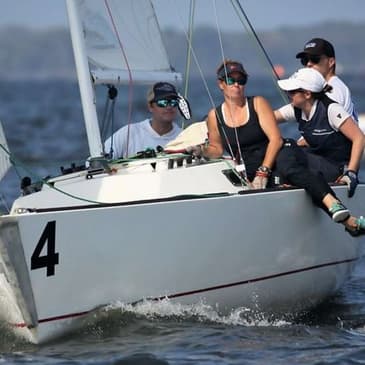
This week I sat down with Guillaume Seynhaeve—seasoned racer and accomplished helmsman—for an engaging conversation on the art of driving a keelboat. From mastering boat speed to simplifying race strategy, Guillaume eloquently shares invaluable insights gained from decades of sailing experience, including everything from semi-circumnavigations to competitive world championships.
It's an episode I was really looking forward to, and it didn't disappoint! We dive into starting line tactics, the importance of rig tuning, the concept of “feel” when helming, and why simplicity is often the key to success on the water. Guillaume’s passion and clarity make this episode a must-listen for sailors of all levels.
Whether you’re looking to sharpen your skills or gain a fresh perspective on racing strategy, this conversation is packed with actionable advice and thoughtful philosophy. Join us for a fascinating masterclass on driving fast and smart!
Note that my new studio needs to be optimised for sound...apologies if it's a bit boomy in places.
[Don’t forget to subscribe and leave a review—fair winds!]
[00:00:10] Hello there. Today's episode is one that I have been really looking forward to. It's basically a masterclass on driving a keelboat with someone truly accomplished in that art, which is Guillaume Seynhaeve.
[00:00:23] Guillaume has an extensive background in competitive sailing, which began with his early years of, in fact, cruising around the world.
[00:00:31] And that included a two year semi-circumnavigation from the south of France to New Zealand.
[00:00:37] And really from offshore blue water sailing and racing, including multiple Newport to Bermuda races to cultural regattas, his experience spans a wide range of sailing disciplines.
[00:00:50] During his college years, Guillaume, or G as we call him, competed for Boston College, which was one of the leaders in collegiate sailing, of course,
[00:00:57] the most popular sports, while also spending his summers coaching at J World Annapolis, where he mentored the next generation of sailors.
[00:01:04] He's taken on some of the sport's toughest racing formats, competing as crew and skipper and tactician at big events such as the J22 Worlds, the J80 Worlds, where his team was a top 10 finisher,
[00:01:19] J24 Championships, J105 Nationals, and lots of Block Island and Key West race week. So he knows what he's doing.
[00:01:26] I've been fortunate enough to sail with G on London Calling during some of last year's J105 regattas.
[00:01:33] And really, I wish he could join us for every single one. His intensity, his passion, his skill, and just that relentless focus on boat speed drove us to our best results of the year in a fiercely competitive big fleet.
[00:01:51] For me personally, G's advice and coaching were transformative. For the first time in my sailing career, I actually felt like I understood how to steer a keel boat.
[00:02:01] Probably not very well, but it was a big improvement. It did take me a while to persuade him to join the pod, but I'm glad he did because he's got such great, straightforward,
[00:02:12] straightforward, and clear advice and technical knowledge as you're going to hear. So here you go. I hope you enjoy the episode.
[00:02:29] And so, Guillaume, welcome to SailFast. Thanks so much for joining us on what is quite a cold Friday evening here in DC. How are you?
[00:02:37] I'm good. I'm good. Thanks for having me.
[00:02:40] Yeah, great. You're in Annapolis, right? You live in Annapolis?
[00:02:43] Annapolis, Maryland.
[00:02:44] Yeah. Yeah, good. So let's start with how you first got into sailing, your background in sailing.
[00:02:50] Was that through family, I think, right? And how did you get into racing specifically?
[00:02:56] Yeah, so sailing is, I mean, look, I've been sailing since I could swim. I was a cruiser long before I was a racer.
[00:03:03] So sailing has been sort of the way or the mode of travel for our family when I was a kid. My grandfather sort of kicked it all. I kicked it off.
[00:03:11] He had a couple of cruise boats and then my father did the same thing. And we did everything from cruising the Caribbean to actually almost a full circumnavigation, right?
[00:03:20] So that was actually what predated the racing career. So water, sailing, all that's been very comfortable.
[00:03:29] Sailing evolved after we returned from that said circumnavigation, you know, and returned back to Annapolis.
[00:03:35] That's when we started to race. And for me, where I really started to connect the dots, even though I'd done junior things, you know, club sports as a child.
[00:03:44] You know, AYC here, Severn Sailing Association and so forth, really kicked off in college where I was a sailor and member of the Boston College sailing team.
[00:03:52] That's that's really where the racing aspect, you know, took hold.
[00:03:56] So you were racing dinghies on the Charles?
[00:04:01] No, not on the Charles outside. We did race a ton on the Charles.
[00:04:05] The Boston College location is actually outside in open water.
[00:04:08] But, you know, that's where it started. And I had made the mistake.
[00:04:11] Honestly, I thought, well, you know, I've been sailing for so long.
[00:04:15] Racing should be something that should be relatively easy.
[00:04:18] And that was not the case.
[00:04:21] We all thought that.
[00:04:23] Yeah. College was definitely a trial by fire.
[00:04:25] I learned quite a bit there.
[00:04:26] Yeah. Yeah.
[00:04:28] But so when you joined the sailing team there, did you so you joined to sail, not necessarily to race or is that just?
[00:04:33] No, I joined. I mean, I joined the sound team to race.
[00:04:36] I mean, one of the one of the appeals and did so for four years.
[00:04:41] I was not the best sailor on the team.
[00:04:44] I was surrounded by some of the best sailors and all Americans, both on the team and, you know, within that Nisa region, which was which was fantastic because.
[00:04:56] You're measuring yourself up against, you know, some of the absolute best sailors of that generation.
[00:05:03] Did you know Maura Winston then?
[00:05:05] I did. Maura Winston.
[00:05:07] I know you sailed and, you know, won many regattas with Maura over the in those years.
[00:05:12] Just put that sort of put two and two together there.
[00:05:15] Yeah.
[00:05:15] Yeah. So Maura and I know each other back from college.
[00:05:18] You know, she was one of the female skippers, you know, quite good at it as well.
[00:05:23] So, no, we we were on the same team and by default raced against each other during practice and so forth quite frequently as well.
[00:05:30] So, yeah.
[00:05:32] For listeners, just so you know, I'm really fortunate to have both Maura and Guillaume on my boat.
[00:05:37] Maura quite a lot of time and Guillaume whenever we can persuade him to break away from his family and work commitments.
[00:05:44] So I feel very, very fortunate to have you guys on board and it's worked.
[00:05:48] It has worked.
[00:05:49] It has worked. It's fun.
[00:05:50] It's fun to get back into it.
[00:05:51] So, can you describe what you love about racing in particular?
[00:05:57] Well, I'm inherently a competitive individual. Right.
[00:06:00] So so and the fact that it's something I've known since since my youngest childhood years. Right.
[00:06:06] Just being on the water.
[00:06:08] I think the thing I like most about sailing and what I like most about racing is I, you know, for the most part, life is pretty chaotic.
[00:06:14] And it's one of the few places where I can escape to where when you're racing, if you're giving it the appropriate amount of attention, you don't have the option to think about anything else.
[00:06:26] So, yes, racing can be intense.
[00:06:28] You can have bad days on the water as much as you can have good ones.
[00:06:32] But for me, it's an opportunity to escape from what awaits you on land.
[00:06:37] And that could be, you know, family, work, whatever.
[00:06:39] And I'm not saying all that stuff is bad, but it's an opportunity to take a mental break from that.
[00:06:44] And, you know, racing, if you're going to do well, requires your complete undivided attention.
[00:06:50] And so in some respects, it's a little bit therapeutic for me in that regard.
[00:06:54] So you use the word chaotic to describe the life outside, which I know modern life is for most of us.
[00:07:01] The race course as well can be extremely chaotic.
[00:07:04] Or do you, are you just so comfortable with that?
[00:07:07] You've done it so many times.
[00:07:08] For you, it's not chaotic.
[00:07:09] It's very much pattern filled, if you like.
[00:07:12] No, I think, well, it is chaotic.
[00:07:14] But the chaos is predictable to some extent.
[00:07:16] I mean, you know, there's some of those mark roundings or starts or basically slow motion car crashes.
[00:07:22] And you probably, you know, you've raced long enough and you're like, yeah, no.
[00:07:26] I saw that one coming in hindsight.
[00:07:28] But, you know, for me, what I like about sailing, I think it has a lot of, and I don't want to get overly philosophical, but there's some things about racing that I think are applicable in life.
[00:07:40] And, you know, when you talk about chaos, you know, on a boat, there's only so many things in a race that you can control.
[00:07:47] You can control your team.
[00:07:48] You can control the direction of your boat.
[00:07:50] You can control the, you know, the trim, the decisions that you make.
[00:07:54] But you're doing it in an environment that's constantly changing, right?
[00:07:58] You don't control the waves, the wind, whether or not the direction of the wind is going to change, the competitors, people who aren't competing, like motor boaters coming through the course, whatever.
[00:08:07] And so you have to navigate and anticipate all of that.
[00:08:10] And I think there's some life lessons there, right?
[00:08:13] So, you know, we always tell ourselves, you know, control what you can control, right?
[00:08:17] And there's an air of truth to that.
[00:08:19] And you're constantly reminded, at least in my case, of that when you're racing.
[00:08:23] You know, the successful racers are the ones that are able to separate out what is in their control and the ability to manage or completely ignore the things that are not and simply deal with them.
[00:08:34] Whether it's at a starting line, a rounding, you know, crossing tack from another boat, things of that nature.
[00:08:39] I like that.
[00:08:40] So there is chaos in the water, but I think there's an air of simplicity to it that can also parlay back, you know, on land.
[00:08:47] Yeah, I love this conversation, actually.
[00:08:50] And we can get as philosophical as we want to here.
[00:08:53] There are people in life who do a very good job of seeing patterns in chaos.
[00:08:58] My wife, who is a serial entrepreneur, is brilliant at picking out patterns in what looks to me like chaos.
[00:09:05] And I'm just wondering if that sort of inherent characteristic is what marks people out on the race course.
[00:09:12] I wonder if they're able to see patterns in the current change, the wind changing from time to time, the boat loading up differently, competitors, waves, everything that's happening that changes every couple of minutes.
[00:09:25] The ability to, I think, two things for me is find patterns and then also know what's going to happen ahead of time.
[00:09:33] Because you sort of, you can sort of process everything that's happening around you and see with some clarity in 10 seconds, 15 seconds, 30 seconds time, what's going to happen.
[00:09:45] I find it extremely difficult, but I know that the great races managed to do that.
[00:09:49] And I just, does that resonate with you or?
[00:09:51] Yes and no.
[00:09:53] So I've, I've, as I've gotten older, I've actually gotten to a point where I think simplicity is, is actually helpful.
[00:10:01] Right?
[00:10:01] Sailing is an extremely complex sport.
[00:10:04] I equate it to, to, to, to golf.
[00:10:06] I'm a horrible golfer.
[00:10:08] Right?
[00:10:08] And I find it extremely irritating because on the surface, I look at someone, it's like you swing it, you hit the ball.
[00:10:14] How hard can it be?
[00:10:15] Right?
[00:10:16] And then you try yourself and you realize it's actually deceptively really hard, let alone hard to do well.
[00:10:22] And I think sailing is probably, probably has that same air, you know, to an outsider.
[00:10:27] They look, it's like how hard could sailing be?
[00:10:28] But there are a lot of factors into sailing.
[00:10:30] And that, that is true, but it can also be, if you're not careful, all the variables can ultimately end up being coming in their hole and distraction.
[00:10:39] So there's, there's a balancing act there.
[00:10:41] Um, you know, at the end of the day, when I look at the race course, yes, there are patterns.
[00:10:48] There are things that are predictable.
[00:10:50] There's a lot of things that aren't.
[00:10:52] I think the best racers are the ones going back to what I was alluding to that stick to controlling what they can control.
[00:10:58] Right?
[00:10:59] Um, and if something goes wrong, I don't think they focus on being able to find the next pattern so much as they focus on making their own luck.
[00:11:07] And by that, what I mean is, look, I, I'm gonna, I know that for example, if I'm not going to cross this fleet of boats that are coming my way, um, let's tack and lead them back to next shift.
[00:11:21] And you'll hear people about getting back into phase or staying in phase.
[00:11:25] A lot of that has to do with, look, I may be on the outside of, of, of an inside lift.
[00:11:31] And, you know, but you know, if, if I manage this race course properly, and if I have enough runway, if I connect to the next shift and reach it before this group, then I can start clawing and eating those gains back.
[00:11:45] And it's also a case of racing is, is not won by the person who sailed a perfect race.
[00:11:51] The only, the only definition of a perfect race is, is that you made one less mistake than the person who finished in second.
[00:11:58] It's just that simple. So racing, you have to tolerate mistakes.
[00:12:01] And then if you do make them, you simply have to get back to the basics and, and make your own luck.
[00:12:08] So there are patterns.
[00:12:09] There are of course, in the process of making luck, there are things that you can focus on that are very specific catching the puff, making sure you don't miss those couple degree lifts when they hit.
[00:12:17] I'm knowing when to foot versus when to pinch, um, being able to switch out modes, you know, if the wind goes from 15 to 10 knots, you know, there are all those things that you have to continuously manage, of course.
[00:12:29] And if you race long enough, you, you do them as they're almost second nature, right?
[00:12:34] And that's what I think good racers, that's where they have an advantage is they're on the water.
[00:12:37] So often that, you know, they take for granted things that for someone that isn't racing as frequently almost has to treat as a checklist.
[00:12:46] And if it's a checklist, the amount of time you spend going through your checklist, it might always been too late, right?
[00:12:51] Your reaction time is going to cost you that distance and that distance can be measured in feet, a boat length and so forth.
[00:12:57] But a boat length could be the difference between an inside rounding and rounding outside of 10 boats.
[00:13:02] Yeah.
[00:13:03] And it's a game of inches.
[00:13:05] Yeah.
[00:13:05] You talked about, I was interested in, in you talking about sailors controlling what they can control.
[00:13:11] One of the issues surely is that, that the things that you can control while you're racing change constantly because of the actions of other people.
[00:13:20] So it's not as if there, there are four or five things I can always control these.
[00:13:23] It'll, it'll change, right?
[00:13:25] I can, I can somewhat control the direction I want to go in towards on a certain, on a certain tack, but I can lose control of that when somebody tacks on top of me or something like that.
[00:13:36] So just thinking about the things you can control are going to change all the time.
[00:13:41] So the adaptability is, is got to be highly, is a skill as well.
[00:13:47] It's got to be highly.
[00:13:48] Well, one of the things, so it's like a game of chess, right?
[00:13:52] The way I typically look at that situation is if I'm a, if I'm coming into some type of an approach with another boat, let's say it's upwind on opposing tags.
[00:14:00] There's two things I take into account.
[00:14:02] And usually in this priority, one, if it were me on that other boat, what would I do?
[00:14:08] Now that doesn't mean they do what I would do, but am I going to cross and, and continue because I presume I'm on the right tack and I don't need to deal with this, you know, this opposing boat.
[00:14:20] Am I going to leave out them?
[00:14:22] You know, are we fighting for first and second, in which case they're going to go into a cover boat versus not right?
[00:14:28] What, what, what circumstance are we in?
[00:14:29] So I try and put myself in their shoes to try and anticipate what they would likely do.
[00:14:35] The other factor, which is not scientific in any way, shape or form is who are they?
[00:14:40] Now, if you sail in the fleet long enough, there are certain personalities that you can, you have to account for where logic may go right out the window.
[00:14:49] And you're going to go, I know, I know what they're going to do.
[00:14:52] And it's, they're going to do it just to irritate me or the, or it's just in their nature, right?
[00:14:57] This boat will always tack on you because they can't help themselves, even if it's an illogical thing to do.
[00:15:03] And this is the same thing on the starting line.
[00:15:05] You talk about controlling what you can control.
[00:15:08] There are certain boats on the starting line that you're going to go, I don't want to be the windward of this individual.
[00:15:14] Because they will love me and pin me longer than they should.
[00:15:18] And they're going to focus on my boat and not on their, on, on what is the best start for both of us.
[00:15:24] Right.
[00:15:24] And so I have to avoid them because I know that they're not, you know, going to be dependable.
[00:15:31] Right.
[00:15:32] Good sailors, you know, you look at America's cup.
[00:15:34] So if you look at a fleet start at some point, they all hit the line at the same time at full speed, because if I lost one boat at the expense of the other nine I'm racing against, I just, I lost the race as much as I took the race.
[00:15:47] And the, and the reverse is true.
[00:15:49] There are other, there are the same boat that I wouldn't want to start to windward to might be the boat that I choose to start to lure it off because I can muscle them into maybe being someone else's problem.
[00:16:01] So there are things that you can control.
[00:16:03] And one of those factors is also knowing who you're racing against.
[00:16:06] And that is, that is a personality thing.
[00:16:08] And you're, that could be a rivalry as much as it is, you know, the last race and the two of your tied.
[00:16:14] That's going to also dictate some things that you can predict as to who is likely to start next to you.
[00:16:20] And what are they likely to try and do to you?
[00:16:21] So one of the things I, I, one of the many things I enjoy about sailing with you is your intensity, which I really like because you're absolutely committed or 120% or 150% engage with it.
[00:16:37] And you never let up, which I think is the only way to really, you know, do this properly.
[00:16:42] If you're going to do a sport properly and you're gonna have some success in it, that's what you have to do.
[00:16:46] How do you, how do you personally manage the stress in those, in those sort of high pressure situations?
[00:16:54] Well, one, I would argue, I mean, if we're being frank, you know, for our listeners, depending on who they are, I'm an acquired taste, right?
[00:17:00] That intensity you're referring to works for you and I and Maura to a large extent, it may not for others.
[00:17:07] So at some point, you know, that, that speaks to making sure when you're building a team that you account for personalities as much as capability, right?
[00:17:16] That you can't ignore one at the expense of the other.
[00:17:21] How do I manage the intensity?
[00:17:24] If I'm being frank, getting older has helped.
[00:17:26] Honestly, you know, I was very blessed in my younger years sailing for a team, you know, I sailed with, with and for my father, you know, and it's been some of the best memories I have to date with him, you know, as father-son relationship and so forth.
[00:17:41] But as a father and son, we would definitely get into it.
[00:17:43] And I didn't know, I thought I did, you know, young, cocky, I know everything.
[00:17:48] Um, you know, I didn't realize how lucky I was to be on a team that was as tolerant with my intensity at the time.
[00:17:57] Intensity is fine if it's one well-placed and justified.
[00:18:00] So, you know, the results have to pan out.
[00:18:03] That wasn't always the case back then, but they, they, they afforded me, you know, the patience to learn in some cases at their expense.
[00:18:11] So how do I manage the stress?
[00:18:13] At some point you have to remind yourself that it's just a race.
[00:18:16] I'm not a professional.
[00:18:18] And myself and those that I race with at the end of the day, we're choosing to, you know, be out there at, you know, at the expense of doing something else with family and so on and so forth.
[00:18:27] And I, I know if you're racing and you're racing competitively, it's a significant time commitment.
[00:18:32] And you're usually, if you're anything like me, you're usually negotiating that time somewhere with someone in the background, wife, kids, and so forth.
[00:18:39] And that's fine.
[00:18:40] So, you know, at some point the intensity can't be, you know, can't overcome or, you know, why is it you're there?
[00:18:48] If it's not fun anymore, you have to stop.
[00:18:50] So I enjoy winning.
[00:18:51] I do also enjoy learning from my mistakes, right?
[00:18:55] My favorite race is not the one where I'm leading from the beginning.
[00:18:58] My favorite race is the one where we absolutely screwed the start or going back around, effectively starting from dead last and actually put our heads down and claw our way back up.
[00:19:10] I find an enormous amount of joy in that kind of race.
[00:19:14] And that intensity at that point is justified, right?
[00:19:17] So the stress is part of it, to be honest.
[00:19:20] But having raced and done enough things, there are certain situations that stress you a lot less because you can anticipate what's going to happen.
[00:19:29] And so as a result, you can plan accordingly.
[00:19:31] Whether it's a takedown and 20 to 30 knot wins, you know, you're going to time that differently than you would in five knots.
[00:19:38] And you're going to, you know, you're going to plan that more heading into it than you would otherwise.
[00:19:42] Because you know that if you treat it like you would in five knots to win, it's not going to end well, right?
[00:19:49] So, you know, the stress is definitely there.
[00:19:55] You know, if you're not stressed in those circumstances, I would argue there's something wrong with you or probably it's getting too boring.
[00:20:00] Honestly, you need to find a different sport or move into a different fleet that challenges you.
[00:20:05] Yeah, as I say, I like the intensity because in a competitive fleet, you can only, you know, climb step by step up the rankings through being 100% engaged and having that intensity.
[00:20:19] So I learned a ton from you in that.
[00:20:22] And I want to come on to driving because you're acknowledged to be a really good Helms person.
[00:20:28] And, you know, I've seen that.
[00:20:29] But I do want to talk about boat speed then particularly.
[00:20:32] For you, are there any sort of key principles that you have in your mind when it comes to boat speed and how to accumulate it and retain it?
[00:20:42] Well, okay.
[00:20:44] Yeah, a couple, I guess.
[00:20:46] Number one, I would argue one of the, at least as far as I'm concerned, one of the most important things that are going to determine your boat speed that day is how well you've tuned your rig.
[00:20:56] Rig tuning, I think, is absolutely critical because it's not an easy thing to adjust after the fact.
[00:21:02] I mean, you can make adjustments even on the 105, but it's, it's, you want to try and get it right or the majority of it right heading into, into the day's racing.
[00:21:11] So knowing what, what are the, what rig tuning looks like for you is important.
[00:21:16] I'm of the opinion that, of course, you know, you get your numbers and so forth and, and, and whatever for your sales in terms of what your rig tune should be and so forth.
[00:21:29] But I think everyone has to recognize that everyone, every boat sails differently.
[00:21:35] I'm not suggesting, you know, in a one design fleet, the boats themselves are foundationally different, but the way you helm, the way you trim your sails, how much, how your attention you put on things and so forth, all those factors together do have an impact.
[00:21:47] So your rig tune, you know, at some point you need to find what is your rig tune.
[00:21:51] And you and I have had this conversation, right?
[00:21:53] I know the first day I jumped on your boat, I looked at your tune and I said, you know, what are you set for?
[00:21:59] We're like, well, I'm set for what the guide says I should have.
[00:22:02] And my response was, okay, well, that's fine, but let's, you know, let's try something different.
[00:22:08] Right.
[00:22:08] And I think we ended up finding out that it worked for that day quite well.
[00:22:12] So you have to have a willingness to, to, to make adjustments and you need to document them.
[00:22:17] You know, ultimately start creating, you know, a little bit of a reference guide that may be an adjustment from what, you know, the standard or the official tuning guide might suggest.
[00:22:27] And figure out what works for you.
[00:22:29] And you can only do that on a race course when you're, you're tuning against other boats, you know, in the moment.
[00:22:34] After you've done your, your tuning, which I think is, you know, to my earlier point, fairly important.
[00:22:41] When it comes to helming and boat speed, you know, I'm, and maybe it's because I've sailed as long as I have.
[00:22:46] I sail significantly by feel.
[00:22:48] I know there are a lot of boats that rely heavily on the speedometer.
[00:22:51] Uh, and Hey, at, at this angle, at these wind speeds, this is our target boat speed.
[00:22:57] And I, I am of the mindset.
[00:22:59] I may be in a minority group where that can be actually quite damaging to you as a helmsman.
[00:23:05] Everything should be a reference guide at some point though, that can't be at the expense of your ability to just allow the boat to respond to the environment around it.
[00:23:13] Indicators and so forth are going to be react, you know, after the fact, when you get a puff, you're going to sense it long before it's going to be meaningfully shown on the, you know, the, the, the, the wind gauge, for example.
[00:23:26] So I, I sell a lot by feel.
[00:23:28] I, a good helmsman, unfortunately, probably has the most boring job there is because you don't get to look around.
[00:23:33] You don't get to enjoy the race.
[00:23:35] You've got one job to do upwind and one job, you know, it's look at the telltales, check out the, you know, check out the waves.
[00:23:41] And that's all you get to do.
[00:23:42] And if you're winning, you don't get to look around.
[00:23:44] If you're losing, well, you're that you're going to see it by default because they're, you know, all the boats are in front of you.
[00:23:49] So I, I sell largely, um, by feel and also in terms of what you're trying to achieve.
[00:23:57] Right.
[00:23:57] So that has to do with, I rarely would suggest, you know, for a 105, for example, to go in a pinching mode.
[00:24:03] So you, you, you got to know what a boat likes to do.
[00:24:05] 105s don't like to pinch.
[00:24:07] But there are exceptions to that, right?
[00:24:09] If you're trying to get rid of someone so that you can pinch them off and, and, and get back into, you know, tack out, you know, tack and sail the race that you want to.
[00:24:17] But other than that, it's all about, you know, um, maximizing your boat speed.
[00:24:22] And your best reference point, in my opinion, aren't your, your instruments, but the boats around you.
[00:24:27] And that's where your crew on the, on, on deck are quite important.
[00:24:31] You know, you have one person specifically calling out the breeze and looking around the course.
[00:24:35] You know, uh, it's very easy for me to get distracted.
[00:24:37] And every now and then I'll ask the team, where's the mark.
[00:24:40] And you want to have someone who's like, it's right there.
[00:24:42] Right.
[00:24:42] Because you don't want me to spend 10 seconds looking for it.
[00:24:45] You want another individual that's constantly saying, are you higher, faster relative to the other boat on the same tack, maybe with a worm word.
[00:24:53] They're not telling you whether it's good or bad.
[00:24:55] They're simply feeding that information back to you.
[00:24:57] And it's for you to then determine, I wanted to be higher and, and slightly slower, or, or, or I need to adjust.
[00:25:03] And I need to make sure I'm, um, faster because I need to get bow out for some reason and hit the next shift and try and catch them on that, on that, on that shift at that point, timing it for the marker or the lay line, whatever.
[00:25:16] So communication from the rest of the crew is absolutely key.
[00:25:19] It's also a way to make sure you're keeping them involved.
[00:25:22] Otherwise it can be quite boring.
[00:25:24] It was like, oh, I'm just going to sit here until someone says tack.
[00:25:26] And that's where it helps you and the rest of the team stay completely in sync and contributing to the overall success of the boat as a whole.
[00:25:35] And as a helmsman, you just want to take in those inputs.
[00:25:38] The most difficult thing though, as a helmsman, because I'm suggesting you shouldn't be looking around, is the person who is calling tactics, presumably the main cell trimmer, if it's alive, is at least allow, is at least helping to paint a visual picture of what the circumstances are.
[00:25:52] Right?
[00:25:53] You've got a boat on your head.
[00:25:54] It doesn't matter who they are.
[00:25:55] And this is what's going to happen.
[00:25:56] And this is, you know, we're going to try and get to the lay line.
[00:25:59] That's the goal.
[00:26:00] And at least set some expectations for you and either tell you you're doing good, you're not, you know, and so forth.
[00:26:09] And I know when you and I have sailed together, I've said, look, whatever you're doing, keep doing it.
[00:26:13] You're crushing it and provide that feedback and encouragement or, hey, we really need to make an adjustment.
[00:26:19] Is it you as a helmsman or do I and the team need to make an adjustment for you?
[00:26:22] Whether it's sail trim and things of that nature or make an adjustment to help get you back into a group, whatever.
[00:26:28] So I want to go back to, gee, you were talking about feel and the difference between or the advantage of feeling a boat versus seeing things happen later on by just monitoring instruments and that sort of thing.
[00:26:41] That for me was a revelation because I never really had anybody help me drive the boat that you did.
[00:26:48] And I found it very, very difficult.
[00:26:50] Initially switching away from being obsessed by the speedometer and also the telltales to start to feel the boat load up, to start to look at the angle between the forestay and the horizon.
[00:27:03] As you know, I was always doing things too late.
[00:27:05] You saw things five seconds or you felt what was going to happen five seconds before I did.
[00:27:09] And it took a while for me to sort of catch up to that.
[00:27:13] But once I did, it's completely different sailing for me.
[00:27:16] Just remarkably different to stop looking at the instruments and start just focusing on feel.
[00:27:24] I'm still way off the pace, but that was a big breakthrough for me.
[00:27:28] Well, I remember the first regatta we did and the instruments for one reason or another weren't working.
[00:27:35] I was like, great, this is going to remove even the temptation to be distracted, right?
[00:27:41] And I thought, we're fucked.
[00:27:42] And you thought, this is going to be a horrible day.
[00:27:46] And I thought, this is great.
[00:27:47] And then I remember with the second regatta, because you attempted to get the instruments fixed.
[00:27:52] And you were so mad because, again, they weren't working.
[00:27:55] And I was like, that's fantastic.
[00:27:57] We've already proven you don't need them, right?
[00:28:00] Let's go with what works, right?
[00:28:02] Don't, you know, again, instruments do serve a purpose, right?
[00:28:05] I'm not advocating against them.
[00:28:07] But the earlier part of the discussion, you know, on the topic of simplifying certain things, they can create obsessions that are actually can create bad habits, right?
[00:28:16] You don't want a dependency.
[00:28:18] Sailing is about feel, ultimately.
[00:28:20] You can't see the wind.
[00:28:22] So the only thing you can do is sense it and sense the boat's reaction to it.
[00:28:26] And then it's up to you to determine, to your point, when I get hit by a puff, can I anticipate the puff and I don't want to ride it up, I want to take the speed?
[00:28:36] Or is that going to afford me the ability to sort of coast the boat and sort of climb?
[00:28:42] You know, a good boat, both upwind and downwind, never sails in a straight line.
[00:28:46] If you pay attention, you're sailing almost in zigzags, right?
[00:28:50] Where you're basically trying to take chunks out of those upward and downward legs.
[00:28:54] And what it is, is you need to sense it so that you know when you can afford to take those chunks.
[00:28:59] And it is 100% contingent on do you have the boat speed to afford you a little bit of a pinch or to drive the boat down, downwind, where the apparent wind is allowing you to move in that direction only for that duration of that gust, right?
[00:29:14] And the only way you can do that is in an upwind, when it's dialed in, it's such a great feeling.
[00:29:20] You can feel the boat glide.
[00:29:22] And the only way it glides is, again, this is counterintuitive for some, you need a flat boat, right?
[00:29:31] Because there's two things you need working for you.
[00:29:33] One, everyone gives far too little attention to why you don't want the boat to heel.
[00:29:38] It has everything to do with the keel.
[00:29:40] The keel is really, it's still subject to the same principles as a mainsail or a jib.
[00:29:45] It's all Bernoulli's principle, right?
[00:29:47] So when we argue about get the boat flat so that you can get the keel working for you, if you get enough speed over the keel, you're going to get that natural lift.
[00:29:57] It's not going to show itself in the form of a telltale, right?
[00:30:01] Where the telltale is telling you you can now climb more.
[00:30:03] The boat will climb on its own while you're still maintaining that telltale and maintaining that speed.
[00:30:09] So speed ultimately will give you climb, right?
[00:30:13] And the only way you can do that is if the boat is flat.
[00:30:16] So if you're going to get a puff, you want to anticipate the puff so that, yes, it heals and it gives you that helm and you can let the boat ride itself, right?
[00:30:26] Not going to fight it.
[00:30:27] Again, the rudder also acts as a brake.
[00:30:30] So you almost don't want to fight it if you can avoid it.
[00:30:33] You want to keep it flat enough.
[00:30:35] So the anticipation is to make sure that you're not correcting the boat because it overhealed and now you're rounding up because you can sense it glide.
[00:30:43] You're actually, you know, you're anticipating it so that you can keep the boat flat before you get that hit so that you can let it ride and maximize the keel favorably as opposed to trying to do a corrective action, which will require a rudder, which is going to effectively act as a brake.
[00:30:57] Like that's the difference between the boat that can, that will most likely crush you upwind and one in which you do it to that.
[00:31:05] Yeah.
[00:31:05] I love the word glide because that's exactly the language I felt as well.
[00:31:09] And the gliding moment that comes, I suppose, because when it gets to sort of the end of that arc, you have less weather helm for a moment or no weather helm.
[00:31:20] And so the wheel goes light and that's why it feels like it just glides upwind.
[00:31:25] And the key to finishing that, and this is where the relationship between helmsman and mainsail, especially, you know, in a dinghy, you have both, right?
[00:31:35] You have the main and the tiller and so forth.
[00:31:38] And so you actually have both controls.
[00:31:40] In a boat the size of a 105 or a J24 or so on and so forth.
[00:31:44] Well, no, J24, you got it.
[00:31:45] But, you know, anything larger than a 105, a J30 is what I meant to say.
[00:31:50] Typically, that is now a two-person roll.
[00:31:53] And so when you hit that gliding moment, the biggest mistake you can make is then to, as you're slowing down, to helm your way back in, you know, onto the appropriate point of sail.
[00:32:03] What you'd rather do...
[00:32:05] You mean to come down then?
[00:32:06] To come down is what you'd rather do is have the mainsail trimmer ease the main to allow the boat to do it on its own without having to have any rudder action, right?
[00:32:14] And so you do need someone on the mainsail or you're communicating to that for them.
[00:32:19] Hey, give me a little ease so that you're driving the boat now with the sails and to the extent possible, completely minimizing the amount of helm action that you require.
[00:32:28] So now the helm is sort of an indicator of where you are in your sort of upwind mode.
[00:32:33] But you are constantly coming in and out of those modes in puffing conditions.
[00:32:38] Now in flat conditions, it's a little bit different.
[00:32:41] It's flat and you're just going, right?
[00:32:43] And you might have that glide action for longer.
[00:32:45] Typically, it's never 10 knots perfect.
[00:32:47] You're going to get 10 to 12 or it's going to be 8 to 10 or maybe 15 to 18.
[00:32:51] I mean, there's constantly fluctuations.
[00:32:54] And that's where you're making those slight adjustments.
[00:32:56] And the mainsail trimmer is quite important in those situations.
[00:33:00] And then, of course, now, you know, if any larger change in wind pressure, then you may be adjusting more than just, you know, mainsail sheet.
[00:33:09] But the alignment between the Helmsman and the mainsail trimmer to basically find and maintain that very narrow window where you can find that glide action but doesn't cost you on the exit.
[00:33:21] That can be the difference between, you know, doing really, really well and just okay relative to your competitors, so to speak.
[00:33:28] So as well as upwind, let's talk about downwind because I've sailed with you downwinds where our VNG was, seemed to be a lot higher than others.
[00:33:38] I remember you telling me, as soon as you feel the boat loading up, you can feel it in your feet, stand up and you can feel it in your feet.
[00:33:45] That's the time to keep turning downwind.
[00:33:48] Yeah.
[00:33:48] Which we did.
[00:33:49] Yeah, I use my feet to steer downwind.
[00:33:51] So downwind, the boat should be flying.
[00:33:53] Period.
[00:33:54] If not slightly heel to windward.
[00:33:56] Again, depending on the boat you're sailing, of course.
[00:33:58] But in the case of a 105, which is what you and I were sailing together, there are a couple mistakes that people make downwind.
[00:34:05] One, typically the Spinnaker trimmer is usually more willing to trim than they are to ease when it should be the opposite.
[00:34:13] You should be easing a ton.
[00:34:15] And sometimes you'll get what I call a fake curl where you think you're at the edge and actually you can ease the kite right through that curl into what is actually where the sail should be, where you'll actually get a more meaningful curl.
[00:34:26] So Spinnaker trim is quite important.
[00:34:29] And constantly trying to make sure that you've got as much of an ease as possible and never at risk of overtrimming.
[00:34:35] Because, of course, if you overtrim, eventually it's going to get vacuumed and sucked in behind the main.
[00:34:40] And so the only thing you can do then as a helmsman is to take the boat up and everything you may have gained, you just gave it up.
[00:34:46] Right?
[00:34:46] Not to mention positioning relative to fleet and things of that nature and tactics.
[00:34:52] The other mistake that is constantly made is the Spinnaker trimmer is not communicating sufficiently to the skipper.
[00:35:02] And what I mean by that is when there's a puff, they'll tell you, oh, suddenly I've got pressure.
[00:35:07] You'll get that.
[00:35:08] But they tend to be very silent when there's no difference.
[00:35:11] Nothing has changed.
[00:35:13] And as a helmsman, you need constant communication.
[00:35:17] Even if it gets to tell you, Pete, keep doing what you're doing.
[00:35:19] And five seconds later, still nothing has changed.
[00:35:21] Oh, wait.
[00:35:22] No, it has or it hasn't.
[00:35:24] Because, you know, the environment is changing more frequently than typically is communicated to the skipper.
[00:35:30] I agree with that particularly because to your earlier point about you're never going in a straight line.
[00:35:36] You're always trying to go either higher or lower in order to optimize the path you want to take given the conditions.
[00:35:43] There's sort of long silence sometimes.
[00:35:46] Silence is damaging.
[00:35:48] And again, it's a way to make sure that your entire crew is participating in the entire performance of the boat as a whole.
[00:35:55] So the Spinnaker trimmer should be the most vocal individual.
[00:35:58] But next to the Spinnaker trimmer, you know, when I'm standing next to them, I'm providing them information.
[00:36:03] Okay, there's a puff that's going to hit you in five seconds.
[00:36:06] I'm providing them that information.
[00:36:08] And then it's for them to determine, did that puff give us an increase in speed?
[00:36:13] Did it help us get our speed back?
[00:36:15] Or do I now have excess and I'm starting to feel, and this is the feed comment.
[00:36:19] If I start to feel the boat kind of kick, right, where all of a sudden it's kind of healing to lure it, right?
[00:36:24] You're getting that pressure and the boat wants to heal.
[00:36:26] You know, you've already missed to some extent, unless you can get the helmsman to react quickly.
[00:36:31] You've already missed your opportunity to take a chunk of VMG downwind, right?
[00:36:36] So I'm providing them that communication about here comes the pressure.
[00:36:40] And now they need to quickly decide, okay, if I get pressure, am I already at speed?
[00:36:44] In which case, most likely I'm going to say, okay, let's come down.
[00:36:48] Or am I going to say, you know what, there's a wave or a set of waves in front of us.
[00:36:52] We are at speed, but I need this excess speed to break through these waves.
[00:36:56] So you have to anticipate that as well.
[00:36:58] And then the other members of the team are contributing to, okay, so-and-so jived or so-and-so is coming up on your wind.
[00:37:04] So everyone needs to be a participant.
[00:37:06] I'm not saying everyone's a tactician.
[00:37:08] That can get quite, you know, I mean, at some point you do need a chain of command so that there's a clear decision maker and everyone's clear on who that person is.
[00:37:16] But everyone should be contributing to the different, you know, information that that individual so that they are aggregating all that in the moment and making those quick decisions.
[00:37:26] And that ultimately then comes back to you, Pete, as a helmsman.
[00:37:29] Pete, we're going to come down.
[00:37:29] Or Pete, we're approaching this mark.
[00:37:31] We don't need to come down or up.
[00:37:33] We're going to be actually, we're going to actually come down, come up a little bit now early so that we actually have the opportunity to over, you know, aggressively come down to help with the, you know, dropping of the kite.
[00:37:44] So that's a tactical decision, which of course the spinnaker trimmer has to be aware of because they're going to say, I've got tons of speed.
[00:37:50] What are we doing?
[00:37:50] It's part of the plan, right?
[00:37:52] So everyone needs to be involved.
[00:37:54] But when it comes to, to how do you get the maximum speed out of the boat?
[00:37:59] I'm not looking at a speedometer when I'm going downwind.
[00:38:02] I don't care.
[00:38:03] What I care about is positioning and how is my speed relative to the boats around me.
[00:38:07] If I'm going faster and lower, speedometer be damned.
[00:38:11] I know what I'm doing great.
[00:38:13] If I'm not, I need to decide if that's because it's by design or if I need to make an adjustment.
[00:38:18] Then you need to then figure out what's the adjustment.
[00:38:20] Is it you as a helmsman?
[00:38:22] Is it the spinnaker trimmer?
[00:38:23] Is it that the main is over trimmed?
[00:38:24] You may not have yet determined what is causing the issue.
[00:38:28] But my, you know, my gauge isn't an instrument.
[00:38:32] It's the other boats around me and the race course.
[00:38:34] So one thing I find challenging in those moments is how fast to turn.
[00:38:41] Because, you know, you'll say to me, okay, we can come down five, whatever it is.
[00:38:45] And sometimes I do that quite slowly because I'm trying to balance the drag of the rudder.
[00:38:52] But if you're slower, then you may have missed the puff or you've missed the first four or five seconds of the puff.
[00:38:59] But I'm always sort of balancing my head.
[00:39:01] Yeah, but if I turn fast, I'm going to apply some braking action here.
[00:39:06] I know we should be using weight as well.
[00:39:08] We should be moving weight from one side of the other to be able to help the boat heal.
[00:39:12] In a jibe, he'll help you.
[00:39:15] Yes, to some extent.
[00:39:16] In a tack, I want people hiking the very, very last second.
[00:39:21] You know, a pet peeve of mine is there's nothing more irritating when I say, all right, guys, we're getting ready to tack.
[00:39:28] And all of a sudden, everyone starts getting up, right?
[00:39:31] And what happens?
[00:39:31] The wind hasn't moved, but all of a sudden, the boat starts to heal more.
[00:39:34] And now I've lost my water action over the keel, right?
[00:39:38] And I'm going, well, we just, we already messed up the tack and the helmsman hasn't done anything yet.
[00:39:42] Because everyone just got up.
[00:39:43] Not to mention, you just told everyone around us we're about to tack.
[00:39:46] And maybe I didn't want them to know that.
[00:39:47] So there's that mind game to account for as well.
[00:39:51] But I, you know, upwind, you know, you want people moving at the very last minute.
[00:39:55] Downwind, it's the same thing, but it's for the opposing purpose.
[00:39:58] You actually want them to help rotate the boat and stay to windward and weight to windward helps round the boat down, right?
[00:40:04] So that can reduce your rudder action.
[00:40:07] Upwind, your tacks, the only thing that's going to change how quickly you're turning the boat is going to have to do with the pressure that you're in at the time.
[00:40:15] In big pressure, you can afford to rotate a little bit faster.
[00:40:18] I mean, you don't want to stay head to wind longer than you have to.
[00:40:20] In light air, you do need to balance how quickly what your rate of turn is.
[00:40:23] But at the end of the day, the difference between the two is relatively minimal.
[00:40:29] The exit's going to be a little bit different.
[00:40:31] Typically, when you come out of a tack in heavy air, what you want to try and avoid is the boat getting knocked down, right?
[00:40:36] Because then, again, you've lost that rudder act or keel action.
[00:40:41] And now you're almost recovering out of a bad tack because you overhealed the boat, right?
[00:40:45] At the same time, you know, in light air, you want to make sure you come out enough that you're quote-unquote footed, which could be, you know, we're talking about a degree or two.
[00:40:53] So let's talk about tacking there because I think this is a fascinating topic to talk about because it's basically a fairly simple maneuver moving from one tack to another, moving through 80 to 90 degrees.
[00:41:05] But it's critical, obviously.
[00:41:06] Can you talk me through how you think about tacking a keelboat from, you know, a driving point of view?
[00:41:14] How do you judge the right angle to come out of a turn in different winds?
[00:41:18] How do you judge the speed of attack?
[00:41:21] You mentioned a little bit there, but how do you think about that as you approach that maneuver?
[00:41:26] Well, you might be surprised.
[00:41:28] One of the things that I focus on heavily is the jib.
[00:41:32] You know, one of the things that I find very annoying, specifically, you talk about what do I look for if I'm at the helm.
[00:41:38] I use the jib quite a lot to provide me a reference point in determining, you know, my entry and my exit.
[00:41:46] And so, you know, and again, there are certain in light air, you might backwind the jib for a little bit.
[00:41:51] That's fine.
[00:41:51] That still tells me when I'm past head to wind, right?
[00:41:54] So that helps me.
[00:41:55] It tells me when I'm supposed to be slowing my exit.
[00:41:57] And in heavy air, you know, for me, it's, you know, the jib release is when I know, you know, when I'm entering that head to wind point of sail.
[00:42:07] And so one of my points of frustration is in heavy air, you typically have a jib trimmer who will come off the rail too soon and release the jib too soon.
[00:42:16] And as a result, because their timing doesn't match my timing, I've lost my reference point, right?
[00:42:22] Or they'll try and rest or in light air, it's the opposite.
[00:42:26] They'll let it go too early, but then they'll try and force it around faster than my rate of turn.
[00:42:32] So, you know, it's too easy to put the entire blame of a bad tack on the helmsman.
[00:42:37] And I would argue it's still a dance between you and the rest of your crew all the way through to when do they exit the rail and how fast do they get to the other side?
[00:42:47] And the windier it is, you know, the longer you want them on the rail and the sooner you want them on the other side as soon as you finish the tack.
[00:42:53] And light air, you're roll tacking it, right?
[00:42:55] So you actually don't want them to come up onto the high side until you've established the boat and determine how much weight do you actually need depending on the wind once you've completed the tack.
[00:43:04] So the rate, you know, within a margin of error, and what I mean by that is it's going to be slightly faster and heavier breeze than it is in light.
[00:43:13] But you've heard me say, ultimately, the rate of tack should be consistent every time.
[00:43:19] Yeah, it is.
[00:43:20] Because if it's not, you know, your jib trimmer is going to have a hard time anticipating, you know, okay, how fast is he going to turn this time?
[00:43:27] And the rate of turn most likely needs to be consistent for the day, for the circumstances that you're in.
[00:43:32] So that's why you really want to go out early and do a couple of tacks just to figure out, okay, today, you know, I need to speed it up a little bit.
[00:43:39] That's how you just figure out what is how, you know, what is that rate of turn for that day for those circumstances, right?
[00:43:46] And then you have to make sure that you are consistent so that it doesn't change when you're around other boats.
[00:43:53] So, for example, you and I have had circumstances where, you know, I need you to tactically lebow someone or whatnot.
[00:43:58] And, you know, I'll say tack.
[00:44:00] And I might say tack as in with some intensity because I want to time it right.
[00:44:04] But the intensity doesn't mean you should change the rate of turn, right?
[00:44:07] We're timing it assuming you're going to tack as if they weren't there, right?
[00:44:12] And that's always a little bit difficult, right?
[00:44:13] Well, you're yelling in my ear.
[00:44:16] So, okay, I want to do this super fast.
[00:44:19] So I rip it around and basically the boat stops in the water.
[00:44:22] You're going, you're going, well, okay.
[00:44:24] Well, that just, everything just went to shit now.
[00:44:27] Yeah.
[00:44:27] That was a learning for me that it doesn't matter what circumstances on that day,
[00:44:32] that the speed of those tacks should be consistent, whether you're lebowing somebody,
[00:44:36] whether there's nobody around you in that space.
[00:44:39] If they're not as a tactician, how do I know when to ask for you to initiate the tack?
[00:44:45] For sure.
[00:44:46] The other thing that was really interesting for me in the tacking that I've tended to take,
[00:44:50] I've always done coastal racing.
[00:44:52] So I've always taken a line and said, okay, I can see that house there is at 85 degrees at roughly,
[00:45:01] that's where I need to come out on, which is fine.
[00:45:03] I liked your, you told me something about as soon as you feel the boat loading up,
[00:45:08] because the mainsail is starting to load up.
[00:45:11] That's when you should start coming out.
[00:45:12] That's when you should be coming out of your tack.
[00:45:14] And I found that incredibly useful.
[00:45:16] It's probably basic and obvious, but that was a much more sort of useful guide
[00:45:22] than something on land I found to do.
[00:45:25] Yeah.
[00:45:25] Yeah.
[00:45:26] Land for attack is not really a good reference point.
[00:45:29] Again, I would use your jib.
[00:45:31] And again, I would certainly sense the boat.
[00:45:33] So the mistake I've seen people make is they focus a lot on the exit.
[00:45:39] So they'll almost be, they'll almost slow, they'll start off great.
[00:45:42] And then they'll slow their rate of turn to try and, you know, come out perfectly with the jib telltales happy.
[00:45:50] And I'll, and I, you know, and I've seen that happen, you know, you, with you and I say like sometimes,
[00:45:54] and I'm like, you got to finish your tack as in like, just get us there.
[00:45:58] And then you have the alternative where people overshoot it, boat loads up.
[00:46:01] And now your helm's all out of whack.
[00:46:03] So as, as the boat, as you start to see the, as the jib comes over, you know, it's going to load up.
[00:46:10] So as you anticipate it loading up, that's when you almost want to start allowing.
[00:46:14] And I do mean allowing, not steering the wheel into straight, so to speak,
[00:46:18] but allowing the wheel or the rudder to, to, to right itself, if you will.
[00:46:22] So if you come out of attack, well, the rudder almost straightens itself out.
[00:46:26] You just don't want to fight it.
[00:46:27] And you'll find that it'll usually time itself quite well with, with where the boat started to, to start sensing, you know,
[00:46:35] or, you know, getting the pressure and starting to heal a little bit without coming past that point.
[00:46:41] No, but then the problem is for everyone who overtax, then when you try and fix them, they under tack.
[00:46:45] And that's just as damaging, right?
[00:46:47] Again, it's a game of inches.
[00:46:48] It's an unforgiving sport, right?
[00:46:50] It's, and you will have, for what it's worth, I have plenty of bad tacks all the time.
[00:46:56] You know, it's going to happen.
[00:46:58] And, and some tacks you can, you can afford them to be bad.
[00:47:01] They won't, they won't mess up your race in the grand scheme of things.
[00:47:03] The tack by itself, tacking too often is way more damaging than having a few bad tacks, but doing everything else correctly.
[00:47:10] So again, you have to, this goes back to keeping things relatively simple.
[00:47:14] You don't want to get overly obsessed with any one thing because that one thing by itself is probably not going to win or lose you the race.
[00:47:22] So Guillaume, talk to me about the start, which I know is obviously the most crucial, can be the most crucial part of the race, obviously.
[00:47:28] How do you typically set up for a start?
[00:47:32] And I think you're probably going to tell me it depends massively, but I had an interesting conversation with you a couple of days ago when we were prepping for this, where you talked about how your approach to starting has really evolved quite a lot over the, over the years.
[00:47:47] So could you, could you talk to us about starting?
[00:47:50] Yeah, it has evolved.
[00:47:50] And I guess in the sense, um, I would have agreed with what you said, which is, you know, the start is critical, right?
[00:47:56] My younger self would say, absolutely.
[00:47:58] You have to win the start to win the race.
[00:48:00] And, and I'm of the opinion, look, winning the start, and we have to agree on what the definition of winning the start is.
[00:48:06] And that may be the point number one is, is helpful, but I've seen people win the start and lose the race.
[00:48:11] And I've seen people have very bad starts and, and are just bad starters in general.
[00:48:17] And they're some of the best sailors I've ever sailed.
[00:48:20] So I've come to accept that the start is, is, is, is not the sole determining factor of how your race is going to ultimately pan out.
[00:48:30] And that's actually significantly relieved.
[00:48:33] You were talking about how do you manage stress and so forth.
[00:48:35] I used to have in my younger years, my heart would beat, especially in the big regattas.
[00:48:41] I I've had the privilege of doing a couple of world championships.
[00:48:44] I didn't, they didn't all pan well.
[00:48:45] Uh, but I have had the privilege of, of doing well on some selling for some very good sailors.
[00:48:49] Um, and, and you're, you're managing a boat with 60, 70 boats on the line.
[00:48:55] It's windy and it just looks like chaos.
[00:48:57] I mean, it's organized chaos, but I can only imagine what it looks like to someone who doesn't know what's going on.
[00:49:03] And back then I used to be very, very nervous.
[00:49:05] And, and, and, and, and, and, and hindsight, they had a very bad effect on how, no matter how I started, how I then allowed myself to then mentally move into that next stage of the race, which is get going right.
[00:49:16] And go up, win and sell your plan.
[00:49:18] So I, I'm now of the opinion that there are races where, you know, the pin ends favored and you need to go left.
[00:49:24] And, you know, you can't just start where there's nobody and think that that's going to work out.
[00:49:29] I get that.
[00:49:30] But if the pin is the favored end, let's say marginally, and these days they're pretty good at creating relatively fair lines.
[00:49:38] You don't have to win the pin and, and, and you have to consider your risk and what the risk reward is.
[00:49:44] If everyone goes for the pin, and usually there's a handful that will fight for it, there's only going to be one winner.
[00:49:51] So if you're one of five boats, four of you are going to come out losers for it.
[00:49:56] And then, and then what's it going to cost you?
[00:49:57] You might not have any lane.
[00:49:59] You might not be able to attack out.
[00:50:00] And now that all of a sudden you, you basically put all your eggs in one basket.
[00:50:04] And so my, my philosophy has changed in that, you know, the definition of a good start for me is not necessarily winning the, the, the perfect, you know, be the one boat that's, you know, one, right.
[00:50:16] The start relative to all the other boats in that moment at that time.
[00:50:20] I've also won a pin or won the boat, but I was also slow because I fought for it so aggressively that within 10 boat lengths of the start, someone else actually technically won it.
[00:50:30] Right.
[00:50:30] So there's also that there's where you start and how well did you start?
[00:50:33] So boat speeds, a big factor in my mind, the definition of a good start is one that allows you options as soon as you get off the line.
[00:50:41] And that means, you know, one, are you at speed and two, do you have the option for an exit strategy?
[00:50:47] Or do you have the option to continue to sell your own race?
[00:50:50] Though that's ultimately when you're going upwind as a tactician, the ability to sell your own race is really what you want out of a start.
[00:50:57] Because there's a one and a half, one and a quarter mile of, of, of, of field that, you know, that you're trying to dominate.
[00:51:05] And the positioning coming off the start is important, but having the options I would argue supersedes that.
[00:51:11] So if everyone wants to win the boat or if everyone wants to win the pin, I'm going to put myself close to that group.
[00:51:17] But I'm okay with being the second best start on that line.
[00:51:20] And in exchange, have less at risk if, if I fail.
[00:51:24] Right.
[00:51:25] So being at speed is number one.
[00:51:28] Speed will cure a lot of things.
[00:51:30] You know, you'll roll a boat or you'll all of a sudden be lured in the head and reach the next shift.
[00:51:36] So speed is ultimately king.
[00:51:38] And then I would argue closest to where the start matters.
[00:51:42] The only, the only caveat to what I'm saying is if you're going to be a top three boat, at some point, you're going to have to be the one willing to go, you know, all in and win that pin or win that boat.
[00:51:54] Right.
[00:51:55] But again, if you're trying to be a top quarter or top five, depending on the number of boats or top 10 that are in your fleet, what I'm suggesting will get you there.
[00:52:05] Most likely you'll be more successful being a top five, top 10 boat or top 25 in the fleet.
[00:52:09] If you adopt that strategy, once you get that comfort zone and you know how to manage a start and be at speed and so forth, then I would argue, go ahead and take some risks and test yourself.
[00:52:20] But you're testing as much yourself as a helmsman as you are on the street.
[00:52:25] So trimmer and jib trimmer are crucial.
[00:52:28] So you need to make sure that the three of you are in sync before you're going to go and bet the farm.
[00:52:33] You talked to me about the notion of simplicity, trying to drive complexity out of anything you can on a boat and on a race.
[00:52:42] Do you want to talk about that?
[00:52:43] I think it's a state of mind.
[00:52:45] I'll give you an example.
[00:52:46] When I was younger, we were always happy when the sailmaker would come on board.
[00:52:49] Right.
[00:52:50] And because, you know, you figured you're going to get some tips and tricks that are all of a sudden going to change your entire season.
[00:52:55] Yeah, of course.
[00:52:57] I have, in hindsight, I look back and I realize that they were massively disruptive.
[00:53:01] And detrimental more often than not.
[00:53:04] Because they'll come in and say, well, you know, the new thing to do these days is to do inward cheating.
[00:53:10] Right.
[00:53:10] Or, you know, or you need to move your blocks this way and adjust your rig that way.
[00:53:16] And they end up changing some things that are so fundamental or so impactful to how you've sailed the boat so far that almost it takes you a step back.
[00:53:25] And you're now making adjustments to what they've done to you.
[00:53:29] And they may be at the expense of just growing from where you were already.
[00:53:34] So I, when I talk about simplicity, I know I've come on your boat.
[00:53:39] I'm not picking on your boat.
[00:53:40] And one of the things that, you know, you guys were doing is you were doing all this windward cheating.
[00:53:44] And I happened to be the dip trimmer for your boat that day.
[00:53:46] And I think you had mentioned, man, I'd never heard someone cuss so often during attack.
[00:53:50] Because it was driving me nuts, you know, having to manage two winches and adjust two winches because we're, you know, when my argument was, why don't we just move the tracks where they need to be and just, you know, sell the boat the way in which it was intended.
[00:54:04] Whatever incremental gain you're gaining from this process, I would argue is at the expense of other things that we should be doing.
[00:54:13] So it's really, really sailing.
[00:54:15] There's so many things you can adjust.
[00:54:18] You can get lost in it.
[00:54:19] And some matter, some don't.
[00:54:21] Some are psychological.
[00:54:23] Some actually may make a difference in the long haul.
[00:54:26] But you have to decide where you are in your sailing career or racing to determine what are the things that are going to really have a meaningful impact for you and your team.
[00:54:37] Work on those first.
[00:54:38] So for me, it's, you know, first start, don't worry about winning the start.
[00:54:42] Just focus on getting off the starting line with speed, right?
[00:54:45] Just start there.
[00:54:46] For mark roundings, you know, just make sure you're not, you know, you're smart enough to round the mark and not get caught out and be, you know, four boats.
[00:54:55] Outside the mark, right?
[00:54:57] And that has to do with just positioning.
[00:54:59] You know, upwind and downwind, just focus on the basics, right?
[00:55:02] When you get a puff, make sure your boat, you know, is gliding upwind.
[00:55:06] Take those chunks upwind.
[00:55:08] Same thing, downwind takes those chunks downwind.
[00:55:10] You'll be surprised how those things will pay larger dividends than some of the things that a professional will come on your boat and have you all of a sudden start obsessing about.
[00:55:20] Now, as you get perfect those, yes, you can afford yourself those luxuries and start really tuning around the margins.
[00:55:27] And that's the difference between being a top five boat and perhaps being the dominant boat in the fleet.
[00:55:33] But you can't put the cart before the horse, so to speak, in terms of how you prioritize those things.
[00:55:38] So when I advocate simplicity, I know that in my heyday, we got obsessed about a lot of things that in their aggregate really shouldn't have mattered as much as we gave them credit for.
[00:55:49] And they ultimately were distractions.
[00:55:52] Instruments is another example.
[00:55:53] If you want to learn what it is to sail by field, get rid of your instruments for a little bit.
[00:55:58] And you will most likely acquire some of what I was alluding to earlier.
[00:56:02] And then, yeah, bring the instruments back into play.
[00:56:04] But now you're most likely going to judge them and use them differently because you've afforded yourself the luxury not to be dependent on them, as an example.
[00:56:12] Well, Guillaume, or G as we call you, this has been a really fascinating 45 or so minutes here.
[00:56:19] I've learned a ton.
[00:56:20] I learned a ton when you're on the boat.
[00:56:21] And I've learned a ton from this.
[00:56:23] So thank you for taking the time.
[00:56:24] And it just reminds me, I can't wait to go back to racing with you once the weather gets a little bit warmer.
[00:56:31] So I'm really looking forward to that.
[00:56:32] But thank you for taking the time with us today.
[00:56:34] Pete, look, it's my pleasure.
[00:56:36] Thanks for having me on board.
[00:56:37] As I told you offline, I feel a little bit out of sorts knowing the individuals you've had on this show.
[00:56:43] But no, I echo the same sentiment.
[00:56:46] I'm looking forward to you and I going out there and seeing what else we can learn together in the new season.
[00:56:52] It'll be fun.
[00:56:53] Fabulous.
[00:56:54] Thank you.
[00:56:54] Have a nice weekend.
[00:56:55] You too.