
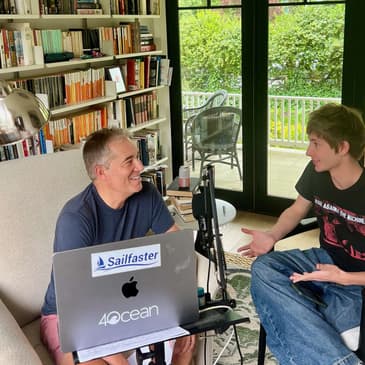
This episode is a little different… and, I admit, a little self-indulgent.
To mark Father’s Day, I’ve handed over the mic to a special guest: my son Jamie. He turns the tables and interviews me — about sailing, podcasting, and whatever else he felt like asking on the day. We talk about what I've learned from 50 episodes, as well as looking back to teaching windsurfing on Greek beaches while at university, and how that eventually led to a sunny afternoon on San Francisco Bay with the person soon to become his mom, and other stuff.
So if you’re here for the usual expert advice and elite racing tips… maybe skip this one. But if you’re curious about the person behind Sailfaster, or just in the mood for a bit of Father’s Day fun, join us. And happy Father's Day....
[00:00:09] I should probably edit that answer out because I sound really stupid. Can you teach me some a Gen Z, some Sailor slang? We scrapped that. We did end it on a very personal note, didn't we? Hello everybody and welcome to a special Father's Day edition of Sailfaster. Normally I'm the one who's asking the questions but today the tables are turned. A few of you have suggested it's time that I stepped into the hot seat myself. Thank you in particular Steve Jagger and Christian McDonald.
[00:00:37] And well as it's Father's Day this felt like the right moment to give it a go. And joining me is someone very special, my 18 year old son. Just a few months away from heading off to university, right? He's going to throw out some questions, how I got started in sailing, what inspired Sailfaster and what I've learned from guests and episode along the way. He's also warned me that he has a few tough personal questions lined up. A little bit worried about that but let's get into it. So here's my son Jamie.
[00:01:06] Hello, I'm Jamie and I guess I'll just go right into it because the first question I have to ask as someone who is not a listener is when and how did you start sailing? Firstly, I can't believe that you're not a listener. I know you're massive into music. This is so not your speed, isn't it? So how did I start getting sailing? Actually, I started windsurfing which in the 1980s was massive. It was a sport that everybody was doing, especially in Europe. Every beach would be covered in windsurfing.
[00:01:36] And so we had a house by the sea in a beautiful little town called Lime Regis in Britain's, what they call the West Country in Dorset. And it was actually my sister who, somebody else who doesn't listen to my club class, I know. But actually, my sister took some lessons because she was hanging out with the cool kids. And I was a couple of years younger and complete geek. This is when I was about 16. I'm so different from you at that age. You were actually cool and tall. And I was not cool at all.
[00:02:05] Anyway, so my sister had a crush on some of the other instructors, which I think was why she was doing it. But the instructor I had was an American. His name was Diddy. And he had this huge conventional American car, which was so out of place. And he was like a sort of a Hawaiian surf god out of place in this town. But anyway, I remember finally getting up on the board after a few sessions and starting to move forward under my own steam. And he yelled after me, you're sailing. You're sailing.
[00:02:34] And I thought, that is amazing. So that's where I started. It was only when I moved to San Francisco in my 30s that I actually started proper sailing, as it were. So I don't know if you know that. I bought this big 40-foot boat. And I actually lived on it, which was crazy because I was working. You know, I was a marketing guy. So I was working for Visa. And he had to go to work in a suit.
[00:02:59] And so every morning, I'd sort of pop up out of this boat in a suit and with a bag to go to work. I really didn't start racing or anything until with my good friend, Eric Pavelka, we bought this J80. And we terrorized the local fleet, I think, because we didn't know what we were doing. But it was really, really good fun. That's how I started. It seems like you look back fondly on some of these early moments. It seems like you were really inspired by the first moment when you were told, like, I'm sailing and all of that.
[00:03:26] So what are some other early moments that you look back on, some great sailing memories? And I mean, it could be early, but it also could be recent moments that really sparked your passion. So my favorite moments sailing are spread probably across a number of years. I suppose my favorite actually is 20, 25 years ago was with your mom. And we were living in San Francisco. Your mom lived in Sorcellito, which was the other side of the bay.
[00:03:54] And I just started going out with her a few times. And she was, I think, not entirely enthusiastic about going out with me. But anyway, I remember sailing across to Sorcellito on a beautiful afternoon in San Francisco to meet her. And it was a rare San Francisco day when it wasn't blowing a hooli. It was really quiet and calm. The sun was out. It was warm. And I sailed my boat across, picked mom up from a quay at Sorcellito.
[00:04:21] And then we then sailed over to Angel Island, which is this nice little island in the middle of San Francisco Bay in the Marin side. We moored at the little dock there. I brought a picnic. And the thing that I remember most about it is as we were heading over to Angel Island, I remember looking back at her. Your mom was leaning against a rail and she looked like Grace Kelly, the sort of blonde hair and the sunshine.
[00:04:46] And I remember thinking, I don't know how I could be so lucky to go out with this person. But anyway, that was a favorite moment that really worked. Another memory I have actually is I've been windsurfing for probably a year, two years, that sort of thing, in cold gray English waters. And I went on holiday, on vacation with my parents and my sister to Greece. I was about 18 years old. So I was your age, basically. And on the beach, there were these, windsurfers still in the bubble wrap, brand new.
[00:05:15] And I helped the guys sort of put them together. And he let me go sailing. And I stayed for the rest of summer, because the summer before I went to university. And I stayed for that summer and taught windsurfing in this little village in Greece. Back then, for me, it was paradise. But for me, it was such a turning point because I was this sort of very geeky, pale, skinny English guy. And then after a few weeks over there, I was, you know, suntan and probably knew more about what I was doing.
[00:05:45] It sort of gave me the confidence about who I was as a person. I didn't expect to be doing that sort of thing. And I had this Greek girlfriend who was beautiful and nowhere near your mum. But in those days, it was quite a life-changing experience for me. And then I suppose the other thing around that time is that me and my friends from university, we used to drive a van down to Greece full of our windsurfing gear. And we had great fun on the way down.
[00:06:10] And we'd stay in Greece and we'd teach windsurfing and then drive all the way back to cold, rainy Britain to go back to university. So that was wonderful times. So some of my favorite moments. There's a hundred more, but you look bored already. You are so self-deprecating. You're such a loser back then. But these are pretty cool stories. You need to give yourself some more credit. So moving on, I do have to ask you, why did you start SailFaster?
[00:06:39] Oh yeah, that's a good one. I bought a J-105, which is a fairly sophisticated boat that's used for racing in one design. But I started SailFaster because I just realized the people in this fleet really knew what they were doing. They're really skilled. They've got tons of experience. And I had none of that, right? So I just started talking to a few people and I recorded it in order to perhaps share some of that information.
[00:07:08] And before I did it, though, I did talk to a guy called Ray Wolf, who's a top sailor, super guy. And I said to him, he and Dawn were driving up to New York, I think. And I called him in the car and I said, I've got this mad idea. And he said, I think it's a fantastic idea. You should definitely do it. Get on with it sort of thing. And he was my first guest. So I did it because I wanted to really learn from people and share that learning.
[00:07:30] And what I found is that so many people are really willing to share what they've learned, how they think they sail faster. And also there's thousands and thousands of people like me who really want to listen to that. So that's my biggest learning from doing this. And from these numerous helpful episodes, what are some concrete lessons, some things that you have directly put into practice after doing this?
[00:07:58] Well, let me start with what I've learned, shall I? And I can tell you what I've put into practice. So what I learned, you know what, I always hope, Jamie, that there would be somewhere somebody's going to tell me, hey, Pete, if you lift up this switch on your J105, it'll make you go faster. You know, is there a button there? So my first thing was, there's no button. It's all about getting the fundamentals right.
[00:08:21] Rig tuning, sail trim, having a decent start, knowing how to tack without bleeding off speed, exiting, attack at the right angle and pace. You know, those sort of fundamentals. And then I've also learned from top sailors about preparation and the mental preparation as well as the operational preparation has been so important. And they consider every single aspect from food and drink. They think about specific crew roles, think about communication.
[00:08:50] And each person I've talked to has a slightly different approach or process to that. And each of them is fascinating. So that's my second learning. The third one really is about communication and working with the crew. So, you know, it goes without saying that working as a high performance team in probably any environment, sport, whether, you know, you play in a band, that sort of thing, or tennis, you know, you play tennis.
[00:09:14] But working as a high performance team, each person has a distinct role that they know very well. They practice it endlessly. So there's seamless interaction. And then they have this sort of concise control communication. And that, for me, it feels like the way to win is just all about communication and the crew. And also what I've learned is some, you know, it's putting together some thoughts about what I think characterizes the top sailors.
[00:09:41] And some of the things that I've found from Sail Faster is, one, is this ability to separate the strategic from the tactical. You keep the big picture in your head while dealing with, you know, crossing competitor or shifts in wind or weather. And how they redraw that strategic map in their heads is really, really interesting.
[00:10:00] And then, of course, when you talk to people who've sailed in a modern America's Cup or the Sail GP, the time that they have to make those switches between strategic and tactical decisions is so short. But that's what they're really, really good at. The second thing is that they take every single opportunity, however small, to inch ahead, wherever that is on the course.
[00:10:22] I've talked to quite a few about going from the windward mark to the offset mark, which is short sort of sail of maybe a couple of minutes. And it's often an opportunity where people sort of relax. But the top sailors use that time and leverage that moment to inch ahead of anybody else, especially when they know other people are relaxing. And I think that also points out mental readiness, right?
[00:10:46] Like the top sailors do a lot of things like meditation, visualization, and they know what they need to do personally to overcome doubts. And often imposter syndrome, which you know what that is, right? It's when you sort of don't believe you can really do this. And they're mentally very, very strong and ready. The other thing I think they do really well is sort of connecting with others on their team. You know, people on long-distance ocean races have talked about, Kenny Reid talked about, you know, the love that he has for his teammates.
[00:11:16] Because over a long-distance ocean passage across the South Atlantic, they rely on you for their life and you rely on them. So that connection they have with others is really good, or whether it's just with their double-handing Olympic team. Perfectionists, and that's probably obvious, but these people are generally perfectionists. They don't stop until they've got to the nth degree in getting everything ready. The other thing I think is really interesting is that they're optimists.
[00:11:45] There's a streak of optimism that runs through them. And for me, that came to light when I talked to Stephanie Robel, who is an Olympian. And I was talking to her about, you know, I get worried that when I'm coming to the starting line, do that final tack, and I probably want to leave out somebody if I'm coming on a port. And I said to her, I'm always thinking about what happens if I get that wrong, what happens if I smash into them? And she said to me, but what happens if you get it right? And for her, that was just an obvious question.
[00:12:12] But for me, it was quite, oh, right, that's a really good way of thinking about it. Why not think about what's actually going to happen right? So optimism is important. And related to that is this notion of drive. They never, never, never give up. And then I think the last thing, they're all really nice people. And what I've loved is in a fucked up world, right, with everything that's going on, and all the screaming that takes place,
[00:12:36] it's so good to talk to people who are so nice and so skilled and so considerate. And they have a strong desire to sort of give back because they're in the sport that they love. And they're very happy to give back to that. So that was probably more. Oh, I know that your question was, is there anything that you've learned that you've actually put into practice, right? What I've actually done to listen to all these brilliant people. Has it changed anything? Yeah. So if you look at my results, probably not a lot really. But I do think about it all when I'm racing.
[00:13:07] You know, hearing somebody say something and then you put that into practice is very difficult, right? You can watch Roger Federer and he can tell you how to serve. Or if you listen to Radiohead or Radiohead tells you how to play a different chord, it's actually quite hard to do it. That's not a good analogy, is it? No, I can see you shaking your head. I actually want to expand on what you were talking about.
[00:13:34] You were describing how at a higher level, the level that you and your fellow races are at, it is seemingly just as much a mental game as it is like, you know, practically putting hands to, putting all hands on deck to use that phrase. And I guess I was wondering, what do you think is simply like a way to, or like a lesson that you could distill that is applicable and sailing, but you have found since learning it, it is applicable and helpful to the rest of your life.
[00:14:03] So for me personally, something that I found very powerful through performing music is the insistence that every bandmate, every instructor will have that no matter what, stopping is worse than messing up and continuing to play. You watch Nirvana play their cover of whatever, David Bowie, the man who sold the world. He messes up the guitar solo in the recording. It's on Spotify and it keeps going.
[00:14:31] So, you know, there's some lessons that you learn from higher levels in your hobby. You know, great basketball players always talk about flow state. There's a lot to be surmised from like the mental part of your hobby. So what's a lesson that you've learned? Yeah, it's very similar to David Bowie. I never thought I'd compare myself to David Bowie. But it is that notion of keeping going, I think, that all is not lost.
[00:14:55] And you may be way down the fleet and then something happens, something changes. You take advantage of it and you can still get a better result out of it. I think the other thing that is of the same sort of ilk is that notion of just biting off chunks of it. So if you have a bad start, for example, then that doesn't knock you out of the race. But it can remain in your brain for a long time.
[00:15:21] So for me, it's a question of just breaking the race up into different chunks that you can tackle. And only think about this chunk. Forget the start. You're in the middle of this race now. Put it behind you and keep going. For me, I've talked to people about when you have a huge task and it seems insurmountable or it seems really problematic, just take bites of it. I think it's called eating the elephant, right? Something like that where they talk about how do you eat an elephant? Well, just take a chunk at a time.
[00:15:51] And after a while, you eat the elephant. The mental state is really important. But it's inches and tenths of inches and that sort of thing in every sport. But in order to be able to get in that flow state, there has just to be total muscle memory, right? You can't think about what you're doing in order to do well at it. Maybe I didn't put that well. I think that makes sense. I'll have to edit a lot of this out. Yeah.
[00:16:19] This is another mandatory question, I think. But what is it about Sail Faster that makes it so good? Like, why is this flowing up? Why you? And why your format? Why does it work? That's great. I didn't even pay you to say that. I think it works in a number of levels. One is that there are lots of great sailors out there with great stories to tell. You don't have to be an Olympian or an America's Cup person or a Sail GP or a Vendee Globe person
[00:16:46] to have experienced, you know, racing at a pretty high level and everything that goes with that and have a story to tell. It's always great if you have that experience because the stories are sort of perhaps well known. But sailing is such a complicated, amazing, frustrating sport that there are so many different stories to tell. So I think that it's a sport that's full of stories. And all of us who are racing sailors are really interested in how others do it.
[00:17:14] So I think there's that natural curiosity as well. I think, to be honest, there aren't many series like Sail Fast. There's a ton of podcasts about people sailing around the world and that sort of thing, cruising sailors. And there's not many, certainly in the US, that are focused on racing sailors. I think also I don't have much of an ego, which means I don't feel any need to compete with anybody or anything like that. I just want to draw their stories out.
[00:17:42] And I think, again, in today's world, human stories about a sport that you play or want to play is, you know, that's fantastic content for anybody. So I've been thrilled to be able to tell some of these stories. And you know that I look at the numbers of downloads and that sort of thing and what Apple tells me. And I'm absolutely amazed. But it's working well. It's thanks to great guests and great listeners and friends. Who is like a dream guest that you want to have on in an ideal world, alive or dead?
[00:18:12] Well, I'll start by saying I've been excited to talk to every single one of my guests. But I do have a sort of a wish list, I suppose. And again, you don't have to be an Olympic champion to have a great story about racing sailboats and, you know, have great insights and advice. There's some club racers who've been on here who say really profound things or some of the things that I've really taken away and tried to put into practice. But that said, you know, I'm Brit.
[00:18:37] So Sir Ben Ainslie would be great just because he's been through so much. He's a controversial figure. He's got a good story to tell. So if anybody knows how to get hold of Sir Ben and tell him to get on the show, that would be great. Dylan Fletcher is not a British sail GP sailor. I think he's an amazing sailor. Jimmy Spithill, of course, and some world-class people like that. And also, I'm really fascinated by some of the top French long-distance sailors like Charlie Dallin, Sebastian Simon and Sam Davis, who is, I think, Anglo-French.
[00:19:06] You know, also, I've been really fortunate to speak to people who've been sailing a class of boat called TP52s, which is really quite an exciting class, such as Sarah Stone and Tom Burnham, Steve Hunt. I'd love to do deeper dives into classes like that, whether it's J70s or IT37. So anybody around those sorts of boats would be really interesting. And I also actually have an episode on remote control yacht racing coming up as well.
[00:19:30] Beyond guests, what is next for Sail Faster as a brand, enterprise, empire? Like, are you going to do any events? Are you branching out into merchandise, new forms of media, new formats? Like, what's up? What's up? I don't know, really. I don't want to change much because it works. But I think I'd like to do more collaboration with other sailing media. Steve Hunt, for example, and maybe focus on different parts of the course.
[00:19:59] An episode dedicated to attacking, jibing, or that sort of thing. I've got a list of great guests coming up. And for me, it's just about reaching more and more people in the sailing world. It is incredible how people actually listen to it and find out about it. So that's what I'm going to do and listen to what people want. And I'm sort of here to serve what the sailing community, the racing community want, I think, or wherever that goes. I have a more fun question now. Do you have any sailing horror stories? Like, everything goes wrong.
[00:20:29] I do. I do, obviously, yeah. My first, one of my early windsurfing races, I wear contact lenses. At that point, I wore glasses and had contact lenses. I started to get quite good at windsurfing, and I led a race, the first leg of a race. But I couldn't see the buoy. I couldn't see the marker where we were going to turn because I didn't have my glasses on. So I was used to following these brightly colored sails. I just follow where they're going. So these people are in this speedboat that's sort of sitting in the water.
[00:20:58] As I passed, I yelled, can you point towards where the buoy is that I'm supposed to go around? So that was a bit of a disaster. But anyway, I came around it in first place and then slammed into this rock that was below the water and smashed up my board. And so I was left under water while everybody piled and passed. I think the other most embarrassing thing that happened, actually, my first time I went out in Annapolis, right,
[00:21:26] I managed to get a crew of people who could come with me. And I imagine some of them listened to this. I'm really sorry about this. But we went out and we went straight. We ran aground, went straight to the sandbank, ran aground, broke the steering cable. And therefore, two of the people on the boat had to sort of get into the bowels of the boat and steer the rudder manually from below. It was so embarrassing. Anyway, most of them stayed on the crew, unbelievably. But I think that's the worst thing I've done.
[00:21:56] I don't know a lot about sailing, but I do read history books. I think old sailing history is very fascinating. And recently I was reading a book and it was talking about supernatural experiences that sailors have. Very common superstitions, things like that, odd habits or supposed interactions with whatever sea entity or spirits out there. Do you have any superstitions or anecdotes about weird experiences on the water?
[00:22:25] It's true, isn't it? That it's always been very much associated with superstitions and spirits, spirit of the world, that thing. And I think it's because if you're in a small wooden woodcrafted sort of boat and it's the 13th century or 14th century, you're completely and utterly at the mercy of the weather gods and the sea and the monsters and that sort of thing. You can see how people would do that.
[00:22:51] The only weird thing that happened to me, I think, it's not that weird, but again, going back to this resort where we taught windsurfing in Greece, so there wasn't much wind. We didn't have anything to do. I think we were probably paddling our sailboards and windsurfers around a bit. And we're in about maybe 30, 40 foot of water. And there was this buoy that we tied up against and then we were sort of diving off and that sort of thing.
[00:23:17] And I followed the anchoring line of the buoy down into the about 40 foot down. At the bottom was a cannon. It was a World War II German cannon. But, I mean, field gun, you know. It was sitting on the bottom of the sea intact. And I went down and I sat on one of the seats there and it was really eerie because it was so unexpected. And so, hey, when you get back up again, you understand that, hey, the Germans invaded Greece. This is part of the place they landed.
[00:23:48] This must have dropped overboard or, you know, a ship was sunk and that sort of thing. So that was probably the weirdest thing that's ever really happened. It was really eerie. Yeah. So that is good. There are these big expeditions that crop up. You know, we're sailing around the world in this many days. We're taking this tiny boat around the world. Would you ever be inclined to join one of those? No. No. It terrifies me. I'm in absolute awe of those people who do it.
[00:24:17] The people who race around the Southern Ocean. I mean, you read The Wager. You love that book, The Wager, right? Think of that storm. Think of volunteering to do that. Pip Hare was a fantastic guest that we had. And Ken Reed had stories as well. And many people do about crossing oceans, racing across oceans. And I can only imagine what it's like to do a Transpac race to Hawaii from the West Coast. And they talk about, you know, you start to smell land over the sunrise or the sunset.
[00:24:47] There you start seeing the island. That must be fantastic. That sense of achievement of it's such a primeval thing to do, to travel like that. But I personally, I just don't have the guts. I've only admiration for people who do that, but I would never do. Would you? I don't think I could ever be a part of any cruise like that. But I also have no experience really on the ocean.
[00:25:12] But there is a belief that my generation, Gen Z, is kind of pendulum swinging back away from technology. Nature is more valued now. Phones are kind of being pushed away. I mean, it hasn't fully come into effect, but people believe that is the trend at the moment. And that creates a space for people in my generation to become interested in sailing, which is very much being connected to nature.
[00:25:36] And I mean, I would be interested, but it is such a daunting thing to get into when you, I know nothing. I don't know how to get into it. Seems expensive. You know, where does one even begin? So I'm going to turn that question back to you. You're right about it. It is communing with nature, as they say. You're being driven forward by the power of nature and the wind and the currents. And that is quite amazing.
[00:26:06] This is a question for you and me, right? That I never dragged you sailing. You maybe came a couple of times, but you just didn't really have a lot of interest in it because you had other interests, which I totally get. Yeah, I never want you to do anything that you didn't want to do. But part of me does think, God, I wish I had forced you because it is such a great skill to learn. It's such a great way of connecting with people as well as connecting with nature as well.
[00:26:30] I guess on a broader level, would you agree that it is not easy to just get into sailing? Because I don't think people are really just hopping on a boat and going sailing. But maybe in places like Annapolis, that's normal. But they are. They are. Kids are. Maybe it's just where we live.
[00:26:49] I guess the prospect of even starting seems very daunting because at the end of the day, because I don't know the details of the basics, to me it's being strapped in the open water on a boat. That's pretty terrifying. It's really easy to start. There's loads of sailing schools. And it's not daunting. It's quite simple. Like a lot of sports, right? The basics are really simple. Doing it well is really hard.
[00:27:15] I can pick up a guitar and I can ping a few bars of it. But to do that well, I don't know if I can do that, but you know what I'm saying, right? But starting sailing is really, really easy. Well, now we've learned something about our relationship with sailing. The philosophy of me and your mum is that you find your own way just like we did. I didn't come from a sailing family. My dad was a mad, keen cricketer.
[00:27:44] And was probably heavily disappointed that I'd never played cricket. I had no interest. But I, and I think that's just how you make your own life. I mean, you're big into music and, and that's your, that's your passion, right? So I think it's good that people find their own way. That said, I'd still love to go sailing with you. Yeah, I would love to. I don't feel as if you failed me because you didn't force me into it because I wasn't super enthusiastic about it. I'm just curious.
[00:28:12] And it's also because I've just gotten older and I've experienced more things. But yeah, I'm curious. We did end it on a very personal note, didn't we? Hey, we're going to go to Greece. Maybe we can do some sailing, sailing there. So, um, hey, thanks for doing this with me. I feel deeply grateful for having you as an amazing son. I can't wait to see what you do.
[00:28:36] Hopefully it'll be a little bit of sailing, but, uh, um, you're off to Vassa college in New York for undergrad. So looking forward to that Harvard PhD in a few years as well. Probably. This is why I'm selling my boat in order to pay for your grad school. That hasn't even, it's like six years away, but yeah, that's right. Take each. That's right. Anyway, good to see you. Thanks for doing it, mate. Love you. Take care.