
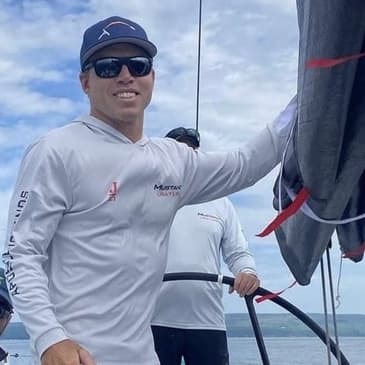
Today’s guest is one of the most quietly influential sailors on the J/70 circuit—Patrick Wilson. Whether it’s Midwinters, North Americans, or the Bacardi series, if you’ve been following top-tier J/70 racing over the last few years, chances are you’ve seen Patrick’s name near the top of the results sheet—often as part of some of the most respected and well-run programs in the fleet.
Patrick has a reputation not just for his trimming skills and consistency under pressure, but for the calm, collaborative way he helps elevate everyone around him. He’s sailed with teams like Catapult, Black Mamba, and Stampede, working with legends like Victor Diaz de Leon, Jud Smith, and Bruno Pasquinelli. Today, in Part 1 of our chat, we’ll dig into how he prepares, what he looks for on the racecourse, and why great communication might just be the most underrated skill in the sport.
In Part 2 which I’ll publish in a bit, we dive into his raceboat preparation business.
[00:00:07] Hello everybody and welcome to Sailfaster. Glad you tuned in. We have published around 45 episodes so far with more on the way. And amazingly, we are in the top 5% of all Apple podcasts based on monthly downloads. So thanks entirely to you as listeners and thanks to our fantastic guests as well, of course. Clearly there's interest in and demand for these kinds of conversations in our racing community. So I'm really very humbled to be able to deliver some of them.
[00:00:36] I don't know about you, but I've learned so much over the last year about what makes top sailors tick, what makes them succeed, what makes them push against the odds, what makes them sail faster. And in fact, some of you suggested I need to consolidate all the insights into episodes dedicated to starting and prepping and so on. And I'll probably do that sometime in the future, perhaps at the end of this season. Speaking of suggestions, as you know, I always welcome feedback and ideas about future episodes and guests and so on.
[00:01:05] And in fact, today's episodes comes from suggestion by the ever gracious Sarah shall color Russo. So thank you for that, Sarah. Please keep them coming. I'm easy to find. I'm Pete at sail faster.com Pete at sail faster.com. Anyway, today's guest is one of the most quietly influential sailors, I think on the J70 circuit. And that's Patrick Wilson.
[00:01:28] Whether it's Midwinters, the North Americans or the Bacarda series, if you've been following top tier J70 racing over the last few years, chances are you've seen Patrick's name near the top of the result sheet, often as part of some of the most respected and well-run programs in the fleet. So Patrick has a reputation, not just for his trimming skills and consistency under pressure, but for the calm, collaborative way he helps elevate everyone around him.
[00:01:53] He's sailed with teams like Catapult, Black Mamba and Stampede. He's worked with legends like Victor Diaz de Leon, Judd Smith, Bruno Pasquinelli. And today in part one of our chat, we're going to dig into all that experience, how he prepares, what he looks for in the race course, why great communication might just be the most underrated skill in the sport. So great stuff to come from Patrick. I think you'll really enjoy it. In part two, which I'll publish in a little bit, we're going to dive into his premium race boat preparation business based in Charleston.
[00:02:23] So lots to talk about there. I really love my chat with Patrick. He's a great guy. I do hope you'll feel the same. And here we go with part one. Patrick, it's great to see you. Thanks for joining. Yeah, thanks for having me. How's the weather in Charleston, first of all? The weather. Spring is here. The pollen's finally starting to clear out. I have a little bit of allergies left, as you may be able to tell.
[00:02:50] We just had Charleston Race Week last week, a great event, kind of like the major big event here for the season. For sure. Now we're into summers, 80 degrees every day and beautiful sea breeze. How was the race week for you? So Charleston Race Week is always one of my favorite events, right? One of the only events of home. Get to stay in my bed. But it's a lot. You know, you try to go out of your way to help everyone. We've got the boat shop here, Next Level Boat Works and everything and the sailing. So I love it, but I always breathe a little bit of a sigh of relief when it's over.
[00:03:19] This year we had a great fleet, a lot of boats. As far as Charleston goes, we had one day of a westerly and two days of a dying northerly, which if you sail there very often are probably the trickiest, shiftiest conditions you can have in Charleston. On top of the tide. Yeah, the tide's always there. So a lot of shifty wind on top. So it was fun. It was dynamic racing. You know, you're never out of it. No lead was safe. So it was fun. Were you sailing J70s?
[00:03:46] Yeah, so I was sailing J70s with Stampede with Bruno Pasquinelli, the owner who, you know, it's funny, it's come like full circle. When the J70 first came out, I sailed with Bruno for a long time and was the youngest guy on the boat. And now I'm back nine years later and I'm the oldest guy besides Bruno. We have a great team with myself, River Paquin and Greiner Hobbs. And you're the veteran of the team. I guess so. I love the J70. I think it's a really interesting boat, right? It's extremely competitive class, large class.
[00:04:16] And everything I've read about it is that it's a relatively easy boat to sail. I mean, obviously, there's a huge difference between sailing a boat well and winning races. It's a huge problem there. And also, I noticed that you have a number of different classes, right? Where you have one pro, multiple pros, Corinthian. How does that all work? You know, I think the class has done a really good job. I mean, from the get-go, the class kind of exploded. We have all these boats. It's very competitive. But I think there's room in sailing for a little bit of everything.
[00:04:45] And I think the class has done a very good job of having, you know, a mixed plus division. With a half female, half male, a one pro division, a Corinthian division, an open division. They all get to compete together, but then there's still subclasses within those. So, you know, you might be fighting to win the open division. But when you watch the guys competing to win the Corinthian division, it's the same level of competition, same intensity. Just, you know. Do you sail in separate fleets between Corinthian and open? No, no. It's normally all one division. They will pull aside a handful of regattas a year.
[00:05:14] Like, they'll have Corinthian Worlds and, you know, a one pro. So there are some standalones, but for the most part, it's all together. And you're in the open, presumably. Yes. Yeah. Let's go back to, you know, your origin story, as I always say. How did you get into sailing and racing? So I grew up in Charleston, more specifically on James Island. And both my granddad and my dad sailed, I would say more locally, not, you know, not traveling a lot or doing anything like that.
[00:05:41] But when I was a kid, when I was about six, my granddad built me an Opti in his garage by his house. And they lived about a quarter mile from James Island Yacht Club. And at about, no, I think he built it when I was five. And at six, I was allowed to take sailing lessons with it. And I just got really into it. And I had a really good group of friends. And from about the age, let's say, eight to 10 or 12, it was like you could sit home with the babysitter all day during the summer. Or you could ride your bike to the Yacht Club and sail with your friends with no adult supervision.
[00:06:12] Sounds like a great way to spend your summer. Yeah, and so it wasn't as much racing back then. It was more like we would just get in our boats and sail to, like, barrier islands and play manhunt or just a lot of fun. So I think sailing definitely started off as a lot of fun. Sounds like an idyllic child. How did you get connected with J70s? Well, I think for me, it was a little bit of right place, right time, right? Like I sailed all as a junior in high school and in college. And then after college, one day, someone asked me if they could pay me to sail. And I was like, wow, that's a thing.
[00:06:42] And I went and did it and went well. And I sailed, you know, started selling some keelboats, J-24s, this, that, and the other. And I think 2013 is when the J-70 came out. And I kind of thought, wow, I think this boat's going to take off. And I think this could be like I'm the right age to really start to learn. My favorite thing in sailing has always been one design, big fleets. And so as the J-70 grew, I kind of played right to my wheelhouse on what I love to do. Did you find a role on it that you liked?
[00:07:11] Or do you even jump through your own? I started off with Bruno and the Stampede. I would call tactics some of it. I don't know. I was always kind of driven to trimming and speed and kites and waves and surfing. And that kind of stuff was really, I think, what I love the best. Yeah. The early days were a lot of fun. A big draw in the beginning is this new boat came out. There were so many of them. And no one knew exactly how to sail it, which that was my favorite part of trying to learn and figure out what you could fare before the next guy. Yeah.
[00:07:37] I was looking at the J-70 before this call just to sort of get every refresh on it. There's a ton of webinars and YouTube and information on, including yours, on the J-70, how to sail, how to sail it fast, how to rig it, how to trim it, that sort of stuff. Really, really interesting. So it seems to have, like many of the J-boats, a very large class of owners who always are happy to share tips and insights and that sort of thing. Yeah. I think that's an important thing.
[00:08:07] And I think especially as pros, I mean, I can't speak for all the pros, but I can speak for myself as in, I think it's part of a responsibility to help and answer questions and be around and help people when they need it. Because at the end of the day, the better people are at sailing, the stronger our fleet's going to be. I'm thinking that the J-70 is my next boat, by the way. I mean, you guys have an amazing class in Annapolis, though, with the 105. Oh, yeah. It's really healthy. It's really healthy. Same thing. You know, a bunch of people who are really very competitive, but prepared to share things. So it's good.
[00:08:36] I lived in Annapolis for a short period of time. After college, when I first started getting into pro sailing, I came up there and interviewed to be the main trimmer on a TP-52 called a NimaCore, a guy named Inyo Stefini. And I worked at the Doyle off for Chuck O'Malley. Oh, yeah. And I'll never forget. I showed up in Annapolis. And I'd never really sailed anything bigger than like a laser or maybe a J-24, but I didn't really tell anybody. And I got there at like sunrise. I saw this boat, these grinders and all this stuff.
[00:09:05] And I was like, this is the coolest boat I've ever seen. I can't believe I had to sail on it. And I took two hours before anyone got down there and figured out what to do to work the grinders and the buttons. And I just faked the whole thing. And they hired me as the main trimmer and boat captain. And I moved to Annapolis. That's a great story. One of those things where you think, well, how hard can it be? Yeah. Yeah. Halfway through the first day, they were like, well, you tend to carry the traveler pretty high and a lot of twists in the main. Is that your style? And I was like, oh, yeah, that's definitely my style. It's what's worked for me down in Charleston.
[00:09:35] Yeah. So you say you jumped on early before anybody was there and started figuring out how to work. Yeah. Worked it through my mind enough to get off the dock and go sailing. That's brilliant. If only I could do that. Yeah. So, Pat, can you talk to us about your pre-race or pre-regatta preparation? I know when we talked to you a couple of weeks ago now, you're a big advocate for mental preparation. Can you just sort of describe what that's like for you? Yeah.
[00:10:05] I think so. For me personally, I definitely deal with some anxiety. I guess you'd say a generalized anxiety. Most people have some type, but I tend to have a good bit. And the sport we've chosen, we are trying to predict an unseeable force of nature. And the uncertainty in that can definitely raise anxiety levels quite easily. So I think before regatta or just in general, I try to do some meditation in the morning, some breathing, try to keep the fever down, so to speak, when things hit the fan.
[00:10:35] But I think the biggest thing that I do well is when I go sailing, it's one of the only times in my life that I can purely be in the moment and be sailing and not worried about everything else and zone everything that's out and just focus on my job. And I think that really helps just, you know, I leave my phone at the dock, you leave everything else behind. And if we're going downwind in waves and I'm trimming the kite, all I'm worried about is how we're catching the next wave and not really much else, I think. It sounds simple, but it's hard to do sometimes to yourself that focused into that, you know,
[00:11:05] small of a world for the moment. No, that's really fascinating because I agree it's 100% absorbing. Yeah. You have no space, even at the level I sail at, you have no space to worry about anything else going on in life. I think that's really interesting. Yeah. I've always been a big believer in that and the team side of the sport. And, you know, we have a great coach right now at the Stampede, Morgan Trubovic. And, you know, I think every coach has something they're good at. Like, you know, if you have Ed Adams, he's amazing with weather.
[00:11:34] And if you have so-and-so, they're amazing with this. I think one thing that Truby brings to the table is his ability to look at and talk to you about team focus and communication and that stuff. That's one thing as a new team, we're really working on the Stampede and it can be hard to get everybody on the same page. And I think the more we go into this, you know, we're lucky we're pros, so everyone's pretty good. A lot of it comes down to the team and how you as a team sail with each other and react to each other. And, you know, it's easy to spool each other up, but it's hard.
[00:12:02] You know, when you're on a good team, you can feel it and you know you have an edge on people just because of how you operate as a group. And what are the signs of that? Is it that things are done seamlessly? You know what people are thinking and doing? You know, I think, yes. You know, one thing that I, this is going to sound kind of weird, but one thing I'll kind of judge sometimes, I think when you go to dinner as a team, if you're sitting around dinner having a conversation that you're all into that has nothing to do about sailing, sometimes it hits me as I think this is probably a pretty good team because, you know, we don't
[00:12:31] need to talk about sailing. We have like some common interest and we're getting along here. And so I know that's not sailing related, but I think it just shows, you know, we're here for more than sailing. We get along, you know, we respect each other. No, no. I think it's vital that if when you work with anybody, any sort of form of work or activity to have that human connection with people just makes things a lot easier in terms of communication and trust.
[00:12:56] And for sure, I think trust is such a hard thing, but it's the big thing in the sport, especially, you know, I've been lucky that I've sailed with some very, very good tacticians. And, you know, I trusted those guys so much. I'd, you know, I'd run into a burning building after them, you know, not that we would win every race, but I had so much faith in those guys that, you know, you have the ability to win any race. Yeah. I talked to Kenny Reed recently and he was talking about, you know, doing long distance offshore racing where your life is literally in other people's hands and their lives are in your hands.
[00:13:26] So you do create major bonds between you in those sorts of circumstances. We're talking about communication. Truby, you know, he's, I told you he's big on that. He jokes a lot about how, you know, in the military, they have evolved their communication so much they speak in numbers. Like, you know, they, and we are so primitive in our sailing communication. We use 30 words to describe what they'll say in like a code five or something, you know, whatever they say. Yeah. That's really interesting. I want to go back to anxiety. Yeah.
[00:13:54] I've been fortunate to talk to many of the top sailors and they all quietly express sometimes quite deep anxiety. And that, that always amazes me. Yeah. Just given people's demeanor is very calm. They're very confident. They're top of the game. Presumably sometimes anxiety drives you right to, to perform better, to make sure you've, you know, covered all the bases, checked all the checklists and that sort of thing.
[00:14:23] Is it, is it a positive as well as? It's definitely a double-edged sword. I mean, I think I have a very good eye for detail and notice things and tend to be very perfectionistic, which I think might be driven by my anxiety a little bit. So there's definitely some positives with it. It's learning how to, and I'm still not the best at it by any means, but keep it in check when it, when there's things out of your control, how do you not let that affect your performance? I would say. Is there a particular race that your mental preparation, you know, made a big difference at that?
[00:14:51] Well, I would say maybe not as much as a lesson I learned. So when we won the worlds in 2016, we did all this sailing all summer. We were in San Francisco for, we're sailing with Joel Rodding, the catapult, myself, Chris Stocky and John Kostecki. That's one of the guys that really, I learned so much about sailing from him. The guy's amazing and probably one of the best ever. Um, but we were the most ready I think I've ever been for a regatta and going into the last day.
[00:15:20] Uh, I think we had like a 15 or 20 point, a pretty big league on the last day. I mean, I've never won a world before. That was the only one I've actually ever won. So I was quite anxious as you can imagine. And JK has won, I don't know, 15 or 20 worlds at this point, you know? And so I come down to the dock all ramped up. All right, what are we going to do today? How are we going to respond? He just looked at me at real calm and said, we're going to go out there and we're going to treat it like it's any other day of sailing. I was like, what do you mean? We don't need a special. It's like, no, we're going to go out there and we're just going to go sailing and do everything we've done every day for the last three months.
[00:15:50] I thought that was pretty telling about cool and calm his demeanor, where his mind was, you know? Yeah, because otherwise you, you know, that, that, uh, raising the kite or coming around the offset mark for that last leg, it's sort of weighted by all that anticipation, right? Oh yeah. Like I might've been trying to keep it cool on the outside in front of him, but I was a nervous wreck on the inside. Do you, um, do you practice visualization techniques? Do you start thinking through a little bit?
[00:16:17] I would say, uh, I would say before, after an event, maybe I do believe in the fact that if you can't say it out loud or see yourself doing it, how are you ever going to do it in reality? Um, even if it's good or bad, you know, um, I do, I'm pretty simple. Like I like the little headspace app and like I go to the gym pretty early in the mornings and usually I go to the gym and like 10 minutes where I go in the gym, I do my little five minute guided morning meditation just to, and it seems, you know, just to take five
[00:16:44] minutes and kind of just chill out and, you know, relax your brain seems to help a little bit. I, I saw that quote about, it must've been from you now, uh, about if you can't say it, you can't, you can't do it. Yeah. What's that mean to you? I just think if it's something about believing in yourself a little bit, you know, if you can't in your mind, see yourself doing something and believe that you can do that, whether you actually do it or not, but if you don't believe you have the ability or the chance to do it,
[00:17:13] I don't, I think it's harder to actually do in real life. And, uh, yeah. And then saying it out loud is, is it's one thing to think about in your head, right? That, Hey, we're going to make a really good exit around the, around the, you know, gate mark or that sort of thing. But say it out loud, we're going to make a really good exit. A good rounding of a gate mark is, is, is different. That's really, really interesting. Yeah. And like you said, I don't think it has to be cocky or anything like that. It's more just believe in yourself that you can't do it. But yeah, for sure. For sure.
[00:17:40] So you've written a ton of articles in sailing media about boat and team preparation and sail trim and writing things down the deck and that sort of thing. Yeah. What for you are fundamentals to, uh, your preparation for, for a race? Well, I think, um, a lot of times I ended up being the speed guy on J seven specifically in the rig. I mean, obviously you're working as a team, but I've done a lot of that. So for me, I think getting on a boat, if I was like, if you bought a J seven,
[00:18:08] and we were going sailing, um, tomorrow, uh, primary things I would like to think about would be making sure the rig's in the center of the boat, which is, you know, measuring it with a weight each side. I like, I like to use the jib hired because the jib hired connects right about where the hounds do in the mast. So I think because you can control that quite easily, where if you go to the kite higher, the main higher, you can't really control the tip, but, uh, measure it, make sure the mass in the center, get to your rig tune, um, on your tuning guide, uh, checking the pre-bin with a little pre-bin gauge.
[00:18:37] I think it's always a really good idea to make sure cause that's, you know, at the end of the day, we, we do a lot of stuff with judge Smith and he always says like, at the end of the day, we designed these sales for a certain pre-bin. So make sure that you're at your numbers, your pre-bin's right. And then like you mentioned, marking the deck with, uh, for me, really good jib sheet marks. Uh, the J 70 has some, you do a lot of in hauling on the J 70, which isn't in all classes, but you do it and it's quite critical to going upwind.
[00:19:03] So, you know, I've got degrees of nine, 10, 11 written on the deck on each side to kind of know how far in or out I am on the jib. Um, and then really good sheet marks. I think for most people though, like we have nine, 10, 11, if you were talking like big picture, right where the, uh, the non-skid meets the glossy on the cabin top. If your jib's living about in that area, you're pretty good. 90%. That's a rule of thumb. Is it for the J 70? I'm very good at over-complicating things, but you can also simplify them as well.
[00:19:31] What do you think you do differently or maybe even think differently about preparing the boat or preparing yourself for the race that perhaps is, you know, it's fundamental to your, your success? Um, I think that's a tough one. I don't think there's any like magic bullet in my mind with a lot of the sailing. I don't think I've ever been particularly more talented than anyone or better. I think I've always taken the approach of I'm going to outwork everybody.
[00:20:00] I'm kind of a proponent of the Malcolm Gladwell, 10,000 hours, where if I'm going to beat you, it's probably going to be because I put in a lot of time, a lot of effort and made slow, you know, gradual gains. That's a really interesting and a very humble answer from a world champion. But that, that notion of, um, not feeling you're better than others because of pure talent, which is quite surprising, really. Top sports people talk about imposter syndrome. You know, there could be a little bit of that in there somewhere. So many top athletes do. Yeah.
[00:20:29] You know, athletes with strings of medals and that sort of thing, they're exactly the same as you about you have to work harder. In my, in my working life, when I first came to States, I worked, I came to work, uh, I came to graduate school. I went, went to work for Prudential Gamble, which is, you know, this is corporate America bullshit, right? Yeah. But the Americans there just sounded so much smarter than me. They'd all been to Yale and Harvard and Princeton. God. So I decided that I was going to just work harder and I worked weekends and studied. Cause I felt the same.
[00:20:59] These people are much more talented than me. I think coming through junior sailing, I was a, I was a good junior sailor, but I was never like unbelievable on a national level or anything. And I mean, that's probably kind of how I got started in the boat work side of things. It was an avenue into sailing, like that not many people wanted cause the work was hard and stuff, but you could produce these amazing boats that might give you an edge over people if you really knew what you were doing. In part two of this, I really want to get into a boat preparation, which I know you're an expert at.
[00:21:28] One thing I wanted to ask you is it was a really interesting, uh, quote in one of the articles in probably sailing world. Here's a quote. It's essential. The driver is placing the boat, the proper angle out to the hoist for a quick exit out of the offset. Got it. That all sounds good to me. Um, having telltales on the shrouds will give you a great sense of where the bow should be. And I thought it was really interesting because this is my issue. I lose track of the race course geometry. Um, when you've come around the mark and I'm, I'm sort of looking for where's the finish
[00:21:56] to try and figure out what's that angle I need to take out of, you know, we have an upset mark. Yeah. Um, how do you use those telltales to assess the right angle? Um, I think, you know, that, that article from a while ago, I was thinking about this and I would refine some of the stuff in there. Still using the telltales. I think a couple of things. First off, I think the offset leg is one of the most overlooked areas of the race course. We fight tooth and nail for six to inches to a foot upwind to cross another boat where
[00:22:26] you get the weather market. Everybody kind of just kind of takes a break for 20 seconds on the offset leg where I think if you continue to hike hard and really focus on trimming your sails, you can pick up a half of boat length, the boat length on the offset, like pretty quickly. And for the percentage of how short it is, it's a big difference versus upwind when we're, you know, so I think that, and then I think that also leads into a better set because everybody's a little more switched on going to the set. Obviously the faster you get the kite, the faster everything else. Um, but I think a lot of it comes back to the teamwork thing.
[00:22:54] I think once you sail the boat enough and you have your telltales on your shrouds, you get a good sense of what angle they should be. But, um, you know, the sets are always changing depending on, I mean, if you're in a big fleet, it's a lot of communication. Like I know Griner is very good about, you know, our default set is going straight with a little down out of the set to hoist the kite. And as soon as I yell made and the kite goes up, we heat up to angle, but there's also a couple other plays where he, you know, he'll say there's going to be a hot set, which means
[00:23:21] we're going to set high or set likely to defend. I mean, there's a big pack of boats behind us. And so anytime during the set, if he says my boat defend, we know exactly put the bow up. So I think, I don't know if that quite answers your question, but I think it gives people a little bit of an idea. You're absolutely right. When you come around the windward mark, there's a break, but it's sort of like a sense of relief. Okay. We made it. Exactly. And then you, you know, bear off and you know, the wind sort of goes quieter as well. You're starting to go, go down.
[00:23:49] The focus is then on getting the pole out, doing the pre-feed and your, everybody's eyes are on getting that, getting that shoot up. Right. Exactly. You know, I don't know if we are focusing on our, is a main and jib trimmed for that close reach leg down. That's really interesting. I'm going to take that away from, from this. But the other thing is just about using those telltales, is it just basically just gives
[00:24:14] you a reminder of where the, what the wind angles are between the windward leg and the offset. I tend to be a little more of a feel guy. So I think it, I think it's more helpful for a driver than anything. Just kind of where the angle is, you know? Yeah. Yeah. And then when, when you're, when you're defending and you're heating it up, that's presumably to stop people driving over the top of you. Exactly. Yeah. You know, if you round in a big pack, cause you know, the great thing about the J70
[00:24:42] is we'll have a lot of, you know, 60 to 90 boat regattas. So, you know, if you round in 25th, there could be a huge pack on your stern and that's when you're, you know, your risk assessment really comes into like, how much are we willing to defend? Do we need to go high early? What is the, you know, what's the priority on the run? Is the priority on the run that we have to be on the right side of the run? Cause if it is, we're probably going to really be willing to defend and do whatever we can to not get rolled and stay in the high lane or is it okay to jibe?
[00:25:09] So, you know, I think this, it's kind of like the gate and the offset shape your next leg in a big fleet dramatically, just like the bottom gate. If you get a bad rounding, trying to go to one side at the bottom, it's very hard for you to get your tactician to where he wants to be. And same thing with the offset at the top. So, you know, knowing if, you know, if you're happy to jibe early, you might not worry about defending and if people try to get too high and roll, you'll jibe out.
[00:25:36] This, there's, um, if you have, as you say, 50 or 60 boats coming behind you, especially if you're in sort of middle or top third, that sort of thing, there's a ton of disturbed air behind you, right? And so that, that always, for me, uh, even if we have to sort of go left or the right side of the course is if you're coming up, I'm always worried about, you know, doing a jibe set or even jibing early and just getting into that messy air. A hundred percent.
[00:26:04] I think some rules that I'm there in a big fleet are like, I know what I think about is, so say you're in the top 20 of a hundred boat fleet, let's just say, I think you have to go at least a third of the run, maybe a little more before you even think about jibing because it's just, unless you were going to jibe and be within 10 degrees of land the mark. I mean, if there's a massive shift and you're within 10 degrees, it's probably fine. Then you've got to do it. There's a big penalty. So there better be a big gain on the other side. Interesting. Um, can we talk about starting?
[00:26:34] Starting has changed a lot in the last five years, like dramatically. What's going on? Um, so let's say five or six years ago, you, you know, if you had a really good line site, you could start in the middle of the line, boat links in front of people. Like, I mean, sometimes it was like you were scared, but then we saw the Velocitech come out and then pinging became a thing. And then, so the midline sag started to disappear. Um, and then recently now the race sense is here and it's not going anywhere. It's a great program, a great product.
[00:27:05] And, you know, part of me doesn't like that we've lost some of those skills, but I think it's the future and it's here and it's pretty binary. If the box says red, you're over. If the box says green, you're not over. So it's kind of, you got to live and die by that. Um, so the big positives I think about it are, I mean, no more general recalls, no black flags. I mean, we would go to J70 worlds and, you know, out of 10 races, more than likely eight would be started under U flag. It was stressful.
[00:27:33] And now with the, with the Vicaros, I just did the worlds in Palma in the fall. And, uh, you know, it was crazy that yes, you're over, but you can round. And I think the British guys actually won a race after being over early, which would never happen back then. So that's the positive. Because they, because they knew straight away. Yeah. And there's no black flags anymore. So you're allowed to turn around and clear yourself immediately. On the other side, I think, and we're still learning, but I think this whole box thing
[00:28:00] has really made starting a little more video game, like then feel, um, by that, I mean, it seems to be all about the ratio. Like I know in a J70, uh, now you got to dial it in for waves and win, but generally you want to be around 60 to 70 meters at a minute. And if you're much inside, that's going to be very hard to not be over and keep your speed. And if you're outside of that, you know, you know, so it's all the game now is ratio.
[00:28:29] You know, where do I want it? When I attack at one minute, I would say two things. It's ratio and density. So I think the bigger the fleet, the more likely you are to be more concerned about density. As far as like, I just need to find an area that's not super crowded on the line. We're like this weekend sailing the middle of this 15 with seven boats. You're probably more likely to push the ends of the line because, you know, in a hundred boat fleet, if you get a good start in the middle and go faster in the top 20 already. So for us, it's finding low density on the line.
[00:28:58] And then the ratio as your last minute to minute and a half approach, meters to seconds, it seems to be the key. And I think whoever gets that best usually has the best starts. And for you on a J70, is it, you talked about being a minute and 60 meters. Is it roughly one to one, a meter a second? I think that's a good place to start. But I also think somewhere within the last 30 seconds, you need to have roughly 10 meters more than seconds.
[00:29:28] You need to accelerate. I think one thing, this is again, something that Truby and Larson, some guys that have coached me before, have talked about a bunch, is that we overlook the speed versus the number. So a lot of times we get very, very occupied on having that thing say one meter at the gun. Where, and I'm as guilty as anybody about this, where I think as people get better, I think it would be better to be like 10% over target speed at three meters. You know what I mean?
[00:29:57] And so that's where the ratio comes in. So yeah, I think you can get there at 60 and 60, but that's kind of like our cutoff. If we're inside that, then you get real nervous. Yeah, it's interesting. On the Velocitate we have, I think after two minutes, it starts to give you that visual graphic in terms of you're early, you're late, that sort of thing. So I've started to try and think about that. But yeah, I hear what you're saying, that you'd rather be slightly late, but at top speed or even over boat speed.
[00:30:26] I think one thing, you know, I was lucky enough to say with Victor Diaz de Leon a good bit in my career. And one thing he does a good job of every morning is doing like religiously doing two or three practice starts with ourselves before the race starts. Even if we have to ping our own imaginary line, we just go from like a minute. So he's really just dialed into looking at the box because that just changes so much based on waves. And then, you know, you also be careful if you get a big lefty, all of a sudden you're going to get the line really slow. Or if you get a big righty, you're going to get the line really fast on the meter.
[00:30:54] So it's an easy thing to think about the ratio, but there's so many variables in it that, you know, it's hard to compute fast, I guess. I talked to Steve Hunt recently and, you know, he sells TP52s and all sorts of things. And he talked about the importance of the practice starts. And I totally get that. It really, at my level, it really, you know, it really helps me. And he talked about doing the first couple on feel alone. Don't look at the instruments. Just look at, get a feel alone and then start to bring the instruments in.
[00:31:24] Because like you, he wanted to, want to retain the feel of it and then add instruments onto that, which I thought was a really interesting approach. Yeah. And one other thing kind of a side note that we're starting to learn about the Vicaros starting to just remind me of is it seems like you have to be willing to bail out of your group of boats late in the start if you have to. Like sometimes if you're in a group of boats and you're like, this group's probably going to be over, there's a good chance they're going to be over and you just got to get out of there. There's no more cover. There's no more, you know.
[00:31:55] So, so. The Vicaros thing is, it's quite, I'm not sure the right word to use, maybe democratize the fleet that idiots like me can now have. Everyone makes the line is. Unaccurate, you know, the same data that somebody like you could have. Obviously, I'm going to sail it a lot more incompetently than you. So, but I think that's, that's a factor in, in maybe a little bit of resistance here and there to, to widespread use of the Vicaros.
[00:32:25] Yeah. Another nice thing it does that I'm sure most people know is it gives you that line square two number as far as what wind shut the line square two, which I think is important. I mean, if I'm going to think about a start, it's kind of like three different things. Like how big is the fleet? How important is the side of the race course? Like obviously if I, if you had, like we're in Charleston, if the currents do a certain thing, I might have to start the boat whether I want to or not, because we've got to get out of the current that way. But if that's not a factor, then you, the middle of the line becomes more open quickly.
[00:32:53] And then, then you start to look at the bias as well and see, you know, because on a big line, it doesn't take many degrees for it to be a lot of boat lengths. So it's kind of like your, it's all, it's only a giant game of risk management, right? That's all we're doing at the end of the day is like how risky do I want to be on the start versus, oh, I'm really fast. I don't need to be that risky or, you know. So that's all it is. The, the line set angle, if the Vakaros displays that all the time, that's super useful in
[00:33:21] terms of immediately knowing the bias, right? If you know the wind direction, you know where Gems biased, yeah. We would always, you know, as soon as we, our old practice was as soon as we would ping, we'd aim straight down the line and look at the compass, you know, which is pretty accurate because a lot, it's just like one less step. No more pinging, no more look. So, you know, it's gotten easier, but now everybody has the information. So it's also gotten harder. Yeah. I can't wait to not ping because I'm never sure what our pings are accurate. Exactly. And then when you are approaching the line and you've got, you know, six meters and it's
[00:33:48] four seconds to go, you do think two foot could make a, make a big difference. But yeah. Yeah. Like we try to shoot for, I mean, that's a great point. Cause I think, you know, we try to shoot for like two to three meters at full speed. Like I think one meter or even two, I mean, that's always too risky, you know, like you'd rather be three or four meters at full pace than two meters at half speed or even, or one meter in general, like one meter that you're playing with fire. Yeah. What we've learned is that it rounds up and down.
[00:34:18] So you could be 0.6 meters and then it hits 0.5 and it goes to zero immediately. Do you have a preferred approach to the line? Or does it a hundred percent depend or starting strategy or does it a hundred percent depend on the conditions? Exactly. As you talked about there's current, we need to stay away from that in the line. That's yeah. I think that, so I would say normally that's more of a tactician kind of thing and what their style is, but I can kind of throw some scenarios out there to you that I've seen that have been successful.
[00:34:46] I think one thing in between races and even up to like three minutes, most teams are selling it. It's a good idea to stay in the, granted no current or anything aside, but stay in the middle of the line and stay upwind of everybody. I think getting too far to lure to the line below the pack, like at five minutes or six minutes for the gun is just, there's nothing good can come from that. So if you're above the line, above the pack in the middle, the five minute goes off. You have the best view of the breeze, the clearest wind to do a wind shot and kind of
[00:35:14] really look around and assess the race course one last time and kind of, you know, it's good to have that like five or four minute check in with the team as far as what are we thinking here? What are, you know, so I think it's even though like what I try to do with tacticians, you never want to give biased information as I try to ask questions to help them or help just understand what they're thinking. You know, like every time four minutes, it's like, or what do you think, or do you want to be here on the start? And then from there, it's kind of, you know, a lot of times it's, it depends on the guys.
[00:35:41] Like with, with JK, we always had a place in the line. We were shooting to be on port at two and a half minutes going back. He would say, all right, I want to be, you know, pin third at two 30. And every guy's got their own way. But the one thing I will say is all the best guys have a very good process for doing it. Which they do all the time. I'm not, you know, repeatable process is the one common denominator, regardless of what their style is. Yeah.
[00:36:10] I like the, the two and a half minutes below the pin, you know, a couple of boat lengths below the pin coming in on port that, um, I wouldn't say that really works, but it's just having a repeatable process that I know where I am and do that a few times to, uh, to practice it. Um, we had a J one of five clinic the other day, um, in, uh, in Annapolis and, uh, it was a good chance to try things that, uh, you're uncomfortable with. Yeah.
[00:36:37] And so, so for me, I, I have much more comfort coming in on that, you know, doing a port tack base lag and then, you know, tacking onto the final approach. And I, I didn't really know what to do when you have to come from the other end. And we had, um, a guy on a boat, Jamie Gilman, who sails on J one of five Patriot. He was brilliant. And, uh, and he's really helping me out. Do you know him? That's Ray Wolf. I know Ray Wolf pretty well. Yeah. Yeah, exactly. On his, uh, yeah. It's on Ray, uh, Ray's crew. Yeah.
[00:37:04] And they were great at sharing knowledge about how they do things on Patriot, which is, you know, which is a probably the top boat in the fleet sort of thing, but he was really helpful in terms of getting me to think differently about, about that boat end approach coming in being a lot deeper than I thought I would be. So new for me was that notion of using vertical space, uh, turning hard up and down, uh, rather than burn sort of horizontal time along the line. Um, you know, both to defend space.
[00:37:33] Like I started to get that. Okay. If I turn up really hard here, the boat's still going to have some motion. We'll create some room to, uh, to do it at us, hopefully, but also just to avoid eating up that distance along the line. Another thing we really try to focus on there is what's our minimum creep speed. We call it like, what's our minimum speed where we can keep flow and go forward. So like I know in a J 70, if it's flat water, you can probably get away with somewhere around two knots, but that's like when you're starting to flirt with the bottom of, cause once you lose flow on the floor, right, you're going to go sideways. Yeah.
[00:38:03] I think along with the ratio to accelerate, it's also really knowing it's really wavy. That creep speed is going to be lower or whatever. And then it gives you as a driver kind of a feel of like, all right, I've got kind of some parameters of, I can't get below this number or, you know, probably going to go sideways. Um, then your point about starting the boat, the boats, I'm a pin guy myself. I like the pin's a little easier to start, but I think the boat comes down. We'll both come down to lay lines. Um, I think really knowing your pin lay line to make sure you're not below it or your
[00:38:32] boat lay line to make sure you're not above it. So if we're ever trying to start near the boat, a lot of comms will hear where the closeout is, or if that guy's on closeout. So knowing when you lead back, if the guy to lure it of you could possibly close you out or not. Um, and I think, you know, whoever has the best command of the lay line at the boat usually wins the boat. So in part two of our discussion, I'd love to get into race boat preparation, which is, I know it's a, what you do for a living and you know, you're one of the top.
[00:39:02] So I really want to talk about that in, in part two. Definitely. So that's part one of my chat with Pat Wilson, which I'm sure you'll agree was a really interesting conversation. Thank you for listening in part two. We're going to dive more into the intricacies of race boat preparation. See you next time and best of luck in whatever race or regatta you're doing this weekend.