
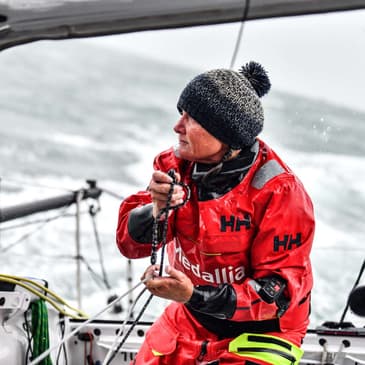
I was thrilled to chat recently with Britain’s top ocean racer Pip Hare. Pip is a core member of that extraordinary group of athletes - the round the world solo racing sailors who fly across some of the planet’s most inhospitable oceans in huge, high-tech foiling yachts. With the 2024 edition of the Vendee Globe blasting off in November, I was lucky enough to catch Pip for a fascinating conversation about her journey to the top in ocean racing, and how she copes with the incredible demands of a Vendee Globe race! I know you’ll enjoy our chat, but to learn more go to piphare.com or IG @piphareoceanracing
[00:00:09] [SPEAKER_00]: Hi everybody and welcome to another episode of Sailfaster. We're in the middle of a really sultry
[00:00:15] [SPEAKER_00]: midsummer here on the U.S. East Coast, but I just came back from Europe where I was following
[00:00:20] [SPEAKER_00]: England at the Euro Soccer Championships and I came back with deep sorrow actually because we
[00:00:25] [SPEAKER_00]: lost in the final against Spain and I also brought back Covid which was a bit of a disaster.
[00:00:30] [SPEAKER_00]: It meant I missed the recent race to Baltimore which was a big race in the Appalachia area
[00:00:35] [SPEAKER_00]: of course I heard that it took place in champagne sailing conditions as my friend Jen Sturmer would
[00:00:40] [SPEAKER_00]: say. But back to today and I've been looking forward to this episode for weeks. We've been
[00:00:46] [SPEAKER_00]: mainly concentrating on what it takes to compete a win in short distance racing, we've been
[00:00:52] [SPEAKER_00]: talking obsessively about starts and mark roundings and upwind tactics and so on which
[00:00:56] [SPEAKER_00]: is which has all been good but today we're going to talk about the other extreme of sail
[00:01:02] [SPEAKER_00]: racing. We're talking about the Vendée Globe and non-stop, unassisted, single-handed,
[00:01:07] [SPEAKER_00]: round the world racing and I can't think of a better person in the world to talk to about
[00:01:12] [SPEAKER_00]: this than today's guest, my fellow Brit, Pip Hare. So Pip welcome to Sailfaster thank you
[00:01:18] [SPEAKER_00]: so much for joining us it is an unbelievably busy time for you. Thank you very much for
[00:01:23] [SPEAKER_00]: the invite it's great to be chatting with you. Are you in the headquarters of the operation
[00:01:27] [SPEAKER_01]: No I'm not actually visiting my parents in a little sleepy town in Suffolk on the East coast
[00:01:33] [SPEAKER_01]: of the UK and I'm actually about half a mile away from the river where I very very very
[00:01:40] [SPEAKER_01]: first went sailing. I grew up in a landlocked town but we were kind of like about a two
[00:01:46] [SPEAKER_01]: hour drive from from the coast. I was lucky enough to be introduced to sailing before
[00:01:52] [SPEAKER_00]: I was one year old. Just for some from background to you know some American listeners who may not
[00:01:57] [SPEAKER_00]: be exposed to you before Pip is a core member of what is I think is an extraordinary group
[00:02:02] [SPEAKER_00]: of athletes the round the world's racing sailors who race alone on foiling boats especially along
[00:02:09] [SPEAKER_00]: the Southern Ocean and in recent years I know you'll correct me if I'm wrong here but
[00:02:14] [SPEAKER_00]: you've competed in a couple of the Transat Jacques Vabre, the Routes de Rhone which I
[00:02:20] [SPEAKER_00]: cannot say right, the 2020 Vendée Globe, Vendée Arctique and most recently the New York Vendée
[00:02:27] [SPEAKER_00]: for me as well as these being extraordinarily challenging races in some of the planet's
[00:02:32] [SPEAKER_00]: most inhospitable waters with that ever-present you know risk of breakage equipment breakage
[00:02:38] [SPEAKER_00]: and so on. It also requires enormous organization committed onshore teams and serious funding
[00:02:44] [SPEAKER_00]: and some great PR and Pip you seem to have managed to find a way not only to excel on the water
[00:02:51] [SPEAKER_00]: but also with sponsors like Medallia and with building obviously a very talented and loyal team
[00:02:57] [SPEAKER_00]: around you while at the same time sharing that experience in real time on and off the water
[00:03:01] [SPEAKER_00]: through social media so I'm in total awe of what you've been able to achieve both on and
[00:03:06] [SPEAKER_00]: off the water. Thank you. Could we start with you perhaps telling us about the Medallia
[00:03:12] [SPEAKER_00]: Programme, the Vendée Globe and why in particular the race has so much attraction for you?
[00:03:17] [SPEAKER_01]: Yeah it's true it's kind of always been my goal since I very first read about it. I was 17
[00:03:24] [SPEAKER_01]: years old going just to a kind of local comprehensive school in a landlocked town
[00:03:30] [SPEAKER_01]: and I started to really enjoy my sailing in my teens because I just found a real sense
[00:03:38] [SPEAKER_01]: freedom and adventure that I wasn't having anywhere else and I looked in a sailing magazine
[00:03:43] [SPEAKER_01]: and I was already kind of deep into lots of books about the Whitbread, about the round the
[00:03:50] [SPEAKER_01]: world adventures you know these incredible boats massive teams and that was already
[00:03:56] [SPEAKER_01]: kind of piquing my interest and then I came across the Vendée Globe Race which was the
[00:04:02] [SPEAKER_01]: concept as the Whitbread you know a full-on round the world race in big powerful ocean racing yachts
[00:04:09] [SPEAKER_01]: but it was non-stop, it wasn't in legs and it was solo and for me I just looked at it and
[00:04:16] [SPEAKER_01]: thought okay that's the hardest thing you could do in the whole world of sailing
[00:04:20] [SPEAKER_01]: that's what I want to do and I had no idea no idea at all how to make it happen. I had no
[00:04:27] [SPEAKER_01]: knowledge of the world of sailing, I didn't even know whether I could get a job in sailing. We
[00:04:34] [SPEAKER_01]: lived so far away from kind of the sailing culture within the UK but I just decided I
[00:04:40] [SPEAKER_01]: was going to make it happen. It did take me 30 years but I eventually got to the start line.
[00:04:46] [SPEAKER_00]: What were those first few steps? You have been a professional sailor for a while right?
[00:04:50] [SPEAKER_01]: Yeah that's true so I left school at 18 and I just took myself found out where kind of all the
[00:04:58] [SPEAKER_01]: work for sailors was which was down on the south coast of the UK and I just moved myself down
[00:05:03] [SPEAKER_01]: there. I've got a job as an apprentice with a sailing school, I got my skipper's ticket when
[00:05:09] [SPEAKER_01]: I was 19, just turned 19 and I started working and the idea was kind of I would just
[00:05:16] [SPEAKER_01]: experience, I would try and meet people, I would try and kind of find my way into the racing world
[00:05:22] [SPEAKER_01]: and what actually happened was I got knocked back over and over again trying to get into
[00:05:28] [SPEAKER_01]: the racing world because I was a 19 year old girl who hadn't grown up in a sailing community
[00:05:36] [SPEAKER_01]: who didn't speak you know with the right jargon or the right accent and I was a girl
[00:05:45] [SPEAKER_01]: and in the 1990s participation in inshore and offshore racing by women was less than 2%
[00:05:54] [SPEAKER_01]: so even me working in the sailing industry was hard work. You know I would regularly turn up
[00:06:01] [SPEAKER_01]: when I got my skipper's ticket I would regularly turn up to kind of big sailing events, big
[00:06:06] [SPEAKER_01]: corporate sailing events where I would be in charge of a boat and I would be standing in
[00:06:10] [SPEAKER_01]: a room of 80 skippers and I would be the only woman in there and a young one at that.
[00:06:16] [SPEAKER_01]: You know the world of sailing didn't really kind of, the world of racing didn't really
[00:06:21] [SPEAKER_01]: open up to me like I imagined so kind of I'm not one to stick around being ignored so I just
[00:06:29] [SPEAKER_01]: thought okay I'm just going to go and get as much experience as I can and in my very early
[00:06:34] [SPEAKER_01]: 20s I kind of just went and decided I would try everything out there kind of in the world
[00:06:41] [SPEAKER_01]: of sailing for a job so I went to the Caribbean, I worked on super yachts you know I quite quickly
[00:06:46] [SPEAKER_01]: decided I didn't want to be stupid I didn't want to clean boats. I did a delivery to
[00:06:51] [SPEAKER_01]: New Zealand ended up living in New Zealand and running adventure charters down there
[00:06:56] [SPEAKER_01]: I just kind of did as much as I could and by the time I was kind of 22-23 I had gained
[00:07:03] [SPEAKER_01]: a lot I think I'd sailed over 100 000 miles already by the time I was 22 or 23 and all the
[00:07:09] [SPEAKER_01]: time just soaking everything up you know every skipper I sailed with I learned from them,
[00:07:16] [SPEAKER_01]: I learned how to fix engines, I learned how to astro navigate, I learned how to manage big boats
[00:07:22] [SPEAKER_01]: you know I watched them I just drank as much as I could and of all the while I guess expecting
[00:07:29] [SPEAKER_01]: that if I kept representing myself to the racing world and now I've been away and done
[00:07:34] [SPEAKER_01]: that I've got all this experience now and I've done that that somebody would just go oh yeah
[00:07:39] [SPEAKER_01]: welcome aboard. It just didn't happen and it didn't happen and I think you know the older
[00:07:45] [SPEAKER_01]: I got I started to kind of get a bit despondent probably because I think I had imagined
[00:07:52] [SPEAKER_01]: that I would be able to feed into some sort of program that delivered me towards the world of
[00:07:59] [SPEAKER_01]: offshore racing and it just wasn't there and then I realized in my mid-30s that I was going
[00:08:04] [SPEAKER_01]: to have to make it happen so I had a big think about what it was I wanted to do and
[00:08:08] [SPEAKER_01]: I was still very very sure that the Vendee Globe was my goal because it still seemed to
[00:08:15] [SPEAKER_01]: me the hardest the hardest race in the world of sailing ever by the time I'd reached the
[00:08:20] [SPEAKER_01]: mid-30s I'd never sailed a day solo but I was pretty sure that I could so I thought okay what
[00:08:26] [SPEAKER_01]: have I got? How can I make this happen from here from a standing start and at the time
[00:08:32] [SPEAKER_01]: I was actually living on a lightweight 395 which was like a 39 foot racer cruiser kind
[00:08:39] [SPEAKER_01]: of like the first 40 of the 90s and that was my home and I realized that the Ostar
[00:08:46] [SPEAKER_01]: which is the solo race from Plymouth to Newport, Rhode Island, the Ostar was happening in 2009.
[00:08:53] [SPEAKER_01]: I had a boat that would qualify to race in the Ostar and I just thought okay stop thinking
[00:08:57] [SPEAKER_01]: about all of these expensive classes and these things you can't afford to do just go and do
[00:09:02] [SPEAKER_01]: a race. A, find out if you're any good B, find out if you actually like it so that's what
[00:09:08] [SPEAKER_01]: I did. I did the Ostar, I absolutely loved it and that kind of set me off then
[00:09:16] [SPEAKER_01]: on a path to the Vendee and I mapped out a performance pathway to get me from the racer
[00:09:23] [SPEAKER_01]: to Imoca sailor. Every step I took I had to generate the funding, I had to find the boats,
[00:09:30] [SPEAKER_01]: I had to manage my own race campaign, I had to train myself, kind of you know establish
[00:09:34] [SPEAKER_01]: my goals and all of that and every time I finished one of those steps I asked myself
[00:09:40] [SPEAKER_01]: three questions. Do I want to do more? Am I capable of more? Have I got the energy to
[00:09:46] [SPEAKER_01]: do more? And every time it was yes, yes and yes and eventually 10 years or 12,
[00:09:53] [SPEAKER_01]: 10 years after, 10 years after I did the Ostar I found myself chartering a knackered
[00:10:00] [SPEAKER_01]: Imoca which is the class of boat you use to race in the Vendee, absolutely knackered it was
[00:10:07] [SPEAKER_01]: but it was available and I took out a 25,000 pound loan, I opened a crowd fund
[00:10:13] [SPEAKER_01]: and I single-handedly started a Vendee Globe campaign with two years to make it work
[00:10:23] [SPEAKER_01]: and I've never worked so hard in my life ever. In my first year we turned up so kind of
[00:10:29] [SPEAKER_01]: put it in a bit of perspective for your listeners that don't know the event. The Imoca class and
[00:10:36] [SPEAKER_01]: the Vendee Globe, the kind of four-year cycle is if you think of it like Formula One motorsport
[00:10:43] [SPEAKER_01]: so you know there's a massive investment in a highly technical incredibly advanced piece of kit
[00:10:50] [SPEAKER_01]: and you've got a range you've got the state-of-the-art boats that just launched
[00:10:55] [SPEAKER_01]: down to boats that are 20 years old racing but the teams that race at the top of this bracket
[00:11:03] [SPEAKER_01]: they would be about 40 team members to cover a massive range of competencies within the team.
[00:11:12] [SPEAKER_01]: Their budget is about 20 million euros for a four-year cycle and then you have a sliding
[00:11:17] [SPEAKER_01]: scale all the way down and in my first year trying to qualify for the Vendee I did three
[00:11:23] [SPEAKER_01]: international races supported entirely by volunteers some people I've never met before
[00:11:29] [SPEAKER_01]: just saw that I was what I was doing on social media and came and helped me. I had a crowd fund
[00:11:35] [SPEAKER_01]: and I did the whole year which qualified me for the Vendee Globe on 150,000 pounds
[00:11:41] [SPEAKER_01]: raised month by month and supported by volunteers and we finished every race and we were never
[00:11:47] [SPEAKER_00]: lost. You had some extraordinary results didn't you because you were in this old knackered
[00:11:53] [SPEAKER_00]: was it called Bijou or something something Bijou is that right? Super Bigou yeah but you raced it
[00:11:59] [SPEAKER_00]: to you know way above what the expectations were and the ranking right in the first Vendee
[00:12:04] [SPEAKER_01]: am I right about that? Yes yeah so in the first Vendee so there were 33 entries in the
[00:12:11] [SPEAKER_01]: first Vendee and normally the attrition rate in the Vendee Globe is 45 percent. In 2020 it
[00:12:20] [SPEAKER_01]: was it was 37 I think you know we had a great improvement not only in the resilience of the
[00:12:28] [SPEAKER_01]: boats but I think maybe a change in style of the way people were racing as well but I started
[00:12:36] [SPEAKER_01]: that race with the second oldest boat in the fleet so out of 33 entries I was ranked 32nd
[00:12:43] [SPEAKER_01]: and I finished the race in 19th position within 24 hours of four foiling boats and the closest
[00:12:54] [SPEAKER_01]: foiling boat to me was less than four hours ahead of me but my best ranking in the race
[00:13:01] [SPEAKER_01]: was 15th and sadly I broke my rudder as I was 15th and I lost four places as a consequence
[00:13:08] [SPEAKER_00]: but yeah we sailed that boat hard. The other thing about this class it's very French dominated
[00:13:15] [SPEAKER_00]: right you didn't choose the geographically easiest sort of boats environment to be in
[00:13:21] [SPEAKER_00]: right because it all happens in France right the French are obsessed aren't they with solo
[00:13:25] [SPEAKER_00]: long-distance racing you were one of the few non-French people in the race did that
[00:13:29] [SPEAKER_00]: present any difficulties or was there a tight community there that was sort of welcomed you
[00:13:34] [SPEAKER_01]: just curious? No it does present a huge amount of difficulties and you know if anybody ever
[00:13:41] [SPEAKER_01]: gets the opportunity any sailing fans are ever in Europe and they get the opportunity to visit
[00:13:47] [SPEAKER_01]: the Brittany coast in particular Lorient it is I mean you walk into La Bass which is the main
[00:13:55] [SPEAKER_01]: kind of centre for offshore and ocean racing in Lorient and your jaw will drop there is a
[00:14:02] [SPEAKER_01]: arena full of all team trimarans class 40s there are just there are kind of 50 or 60
[00:14:10] [SPEAKER_01]: Figaro's on the hard there are minis on the hard everywhere there are there are people with
[00:14:17] [SPEAKER_01]: sheds there's this huge base of knowledge and enthusiasm everyone works together to collaborate
[00:14:24] [SPEAKER_01]: to improve performance but also all the skill that is there if you need someone to come and
[00:14:30] [SPEAKER_01]: your boat or advise you or coach you it's there and so of course this collaboration this collection
[00:14:36] [SPEAKER_01]: of knowledge is only going to keep expanding and make the French better and better and
[00:14:42] [SPEAKER_01]: better at what they do and there was a part of me that did think okay now I've got an
[00:14:48] [SPEAKER_01]: IMOCA campaign I need to move to France and my wholesaling career actually had been
[00:14:54] [SPEAKER_01]: constantly told by those that know you're never going to make it as a British sailor
[00:15:00] [SPEAKER_01]: you have to move to France no one will take you seriously in Britain all of these arguments
[00:15:06] [SPEAKER_01]: that that's kind of being a British based campaign wasn't pure enough wasn't good enough
[00:15:12] [SPEAKER_01]: I wouldn't find the talent and so there was a massive carrot dangling over in France when
[00:15:18] [SPEAKER_01]: I really reflected about my struggle to get into racing in the first place and how I had felt
[00:15:26] [SPEAKER_01]: isolated and I'd felt unwelcome and I'd struggled to find a way in I really thought okay well if
[00:15:34] [SPEAKER_01]: the minute I hit the big time I disappear off to France well I'm just closing the door behind
[00:15:39] [SPEAKER_01]: me for everyone that's coming up you know you have to be the change don't you if you want
[00:15:44] [SPEAKER_01]: people to start viewing your sport a bit more seeing it as a bit more accessible if you want
[00:15:49] [SPEAKER_01]: to spark the imagination of people to become involved in the industry in every way not just
[00:15:54] [SPEAKER_01]: sailors you've got to be there you've got to show them you've got to demonstrate and so I
[00:16:00] [SPEAKER_01]: did take the hard path by staying in the UK but I'm really really proud to have a British
[00:16:07] [SPEAKER_01]: team that is high performing and we've been on a heck of a journey in the last three years
[00:16:13] [SPEAKER_01]: building the team and coming up to this next Vendee cycle and I'm really proud of that.
[00:16:18] [SPEAKER_00]: You were part of that sort of rising British sailing scene with the Olympics and Ben Ainslie
[00:16:23] [SPEAKER_00]: a lot of it a lot more attention than probably in previous years and I'm sure that's due to
[00:16:28] [SPEAKER_00]: people learning about about what you're doing for that hey I want to ask you going back to
[00:16:33] [SPEAKER_00]: your Naked Old Boat, the switch from non-foiling to foiling I remember reading
[00:16:38] [SPEAKER_00]: the blog that I think you wrote a couple of blogs about that a couple of years ago now
[00:16:42] [SPEAKER_00]: was that a huge learning curve for you was that just another of these barriers that you're just so
[00:16:47] [SPEAKER_01]: used to just vaulting over? Well it's I mean it was hugely daunting to start off with
[00:16:53] [SPEAKER_01]: and when I look at the boat I sail now which is just an utter weapon and it's not even a new
[00:17:02] [SPEAKER_01]: boat it's now three generations old but we have adapted it to big foils and I look at some of
[00:17:08] [SPEAKER_01]: the footage of it sailing and we are flying two meters above the surface of the water doing top
[00:17:16] [SPEAKER_01]: speeds of 38 knots and there's one person on board and I just think look back to my 17 year old
[00:17:24] [SPEAKER_01]: self would she have ever imagined that? No absolutely no but not even in 2009 what
[00:17:32] [SPEAKER_01]: not even when I did my Oscar if you'd have tapped me on the shoulder and said oh 2024
[00:17:37] [SPEAKER_01]: you're going to be sailing a flying boat around the world I just wouldn't have believed you
[00:17:44] [SPEAKER_01]: know that the leap that we've seen design I think is so exciting but as the sailor
[00:17:52] [SPEAKER_01]: it has been daunting for me because I guess you know just worry I worry about how much more
[00:18:01] [SPEAKER_01]: have to learn and have I got time and the boat is very violent the motion is really violent when
[00:18:10] [SPEAKER_01]: it suddenly stops which is when it falls off the foils we don't have tea foils on the rudders
[00:18:14] [SPEAKER_01]: so we cannot control ride heights not very easily we just have to use ballast and sail trim
[00:18:19] [SPEAKER_01]: but it means that you can trip up quite easily and just fall out of the sky and that is like
[00:18:28] [SPEAKER_01]: in a car crash no seatbelt in a car crash you know you could be doing anything around the boat
[00:18:34] [SPEAKER_01]: and it will just suddenly stop and decelerate by 20 knots you know that is that's a mindset
[00:18:41] [SPEAKER_01]: but also you know you need to physically look after yourself as well but the way we structured
[00:18:47] [SPEAKER_01]: kind of our our campaign with the new boat so we finished the Vendee in 2021
[00:18:54] [SPEAKER_01]: Medalia resigned as a title sponsor which basically gave us the base level funding to
[00:19:00] [SPEAKER_01]: start another program we bought a small foil boat and in year one I learned how to use the
[00:19:06] [SPEAKER_01]: small foils which was actually sensible because I got my head around the different physics around
[00:19:12] [SPEAKER_01]: it and the different kind of concepts of sailing fast for example wind angles you're
[00:19:18] [SPEAKER_01]: always much like in kind of like a high performance dinghy you know you you don't
[00:19:23] [SPEAKER_01]: really ever sail upwind you're always slightly off the breeze because you your vmg is so much
[00:19:29] [SPEAKER_01]: better if you're going faster at a lower angle so it's things like that and I learned that with
[00:19:34] [SPEAKER_01]: small foils where it was a bit more manageable a bit less scary in our second year we just did
[00:19:41] [SPEAKER_01]: a massive investment project in the boat and we put big foils in it to make it in line with
[00:19:48] [SPEAKER_01]: the 2020-24 performance it's always going to be an older hull but we reckon we've we've got the
[00:19:55] [SPEAKER_01]: potential to be kind of within 90 94 95 percent of the performance of a new boat and then I had
[00:20:04] [SPEAKER_01]: to learn to sail with the big foils so I kind of broke it up into manageable chunks and now
[00:20:10] [SPEAKER_01]: it feels I mean now we I'm doing kind of 28 29 knots going that's boring so the difference
[00:20:17] [SPEAKER_00]: having big foils and the small foils do they enable you to ride higher at the water do they
[00:20:23] [SPEAKER_00]: enable you to ride at lower wind speeds what's the performance difference yes so the foils kind
[00:20:30] [SPEAKER_01]: of the the way the foils work what people are asking from the foils has changed slightly over
[00:20:35] [SPEAKER_01]: the three generations that we've seen them and now kind of the the when you look at the boats
[00:20:42] [SPEAKER_01]: when you look at them in the dot foils are retracted into the boat and you can see the
[00:20:48] [SPEAKER_01]: shape of the foils and the shape that you see there dictates kind of how quickly you will lift
[00:20:57] [SPEAKER_01]: out of the water so the aggression of of the up curve in the foil kind of dictates whether
[00:21:03] [SPEAKER_01]: you're going to be good running or whether you're going to be better reaching and then
[00:21:09] [SPEAKER_01]: the part of the foil that's inside the boat as that comes out that pushes the rather than
[00:21:14] [SPEAKER_01]: pushing the foils away from the boat it pushes the foils down and so that is your ride height
[00:21:20] [SPEAKER_01]: and effectively we can control that so I will set my set my foils at kind of 95 percent or
[00:21:27] [SPEAKER_01]: 65 percent you know if it's really rough sea and I'm reaching I might only use 60 percent
[00:21:33] [SPEAKER_01]: oil but if it's downwind vmg everything's lush I might use 100 percent so that's
[00:21:40] [SPEAKER_00]: and that's right high because that 100 gets you out of the water yeah higher yeah 100 would lift
[00:21:46] [SPEAKER_01]: you kind of two and a half meters clear of the water yeah you know your results
[00:21:50] [SPEAKER_00]: if I look at them as just you know from an outsider's point of view you're getting
[00:21:55] [SPEAKER_00]: closer and closer to the front of the fleet is that because of just an accumulation of
[00:22:00] [SPEAKER_00]: experience that you've gained over time and you're making better routing decisions or is
[00:22:05] [SPEAKER_00]: it just the accumulation you getting used to everything that goes into this boat it's
[00:22:11] [SPEAKER_01]: definitely an accumulation and it's not just me it's the team um you know we are constantly
[00:22:18] [SPEAKER_01]: working on so a massive a massive function of doing well in these races is actually the boats
[00:22:25] [SPEAKER_01]: staying in one piece and the boat not breaking or when the boat does break your ability to fix it
[00:22:31] [SPEAKER_01]: or your level of redundancy and and that's a hugely important thing that my team are working
[00:22:37] [SPEAKER_01]: on in the background all the time and of course for the Vendee it's it's absolutely mission
[00:22:42] [SPEAKER_01]: critical but we are constantly kind of after every training session and every race I will
[00:22:49] [SPEAKER_01]: down and debrief with my team and we go through the entire boat inch by inch and we talk about
[00:22:56] [SPEAKER_01]: what worked what didn't we're working with rope manufacturers to you know make sure that
[00:23:01] [SPEAKER_01]: we've got the right covers that we've got the right diameter lines and we're constantly
[00:23:06] [SPEAKER_01]: looking at the angles that lines are coming through blocks to reduce friction I'm working
[00:23:12] [SPEAKER_01]: with sailmakers so I'm allowed to take eight sails on the Vendee and and I specify
[00:23:18] [SPEAKER_01]: you know what range each sail goes on so those choices are quite critical as well
[00:23:25] [SPEAKER_01]: and they're very much adapted to me and my sailing style and my strengths and also my
[00:23:32] [SPEAKER_01]: kind of my keenness to change sails or not but we also analyze everything so we're collecting
[00:23:40] [SPEAKER_01]: data all the time we're looking at our relative polar percentages we're looking at
[00:23:46] [SPEAKER_01]: the autopilot settings where you know do we need to be are the sea state was a bit crossed
[00:23:51] [SPEAKER_01]: here you know so do we go better if we slightly bow up should we have ballast in there so
[00:23:57] [SPEAKER_01]: there's this constant never-ending feedback circle all the time and then for me personally
[00:24:05] [SPEAKER_01]: you know I think it's about being meticulous never being lazy never taking the easy option
[00:24:14] [SPEAKER_01]: if you think about something you do it you don't say oh it'll be fine and I think in terms
[00:24:21] [SPEAKER_01]: of the routing we pretty much all use the same routing package we all use a piece of software
[00:24:26] [SPEAKER_01]: called Adrena not many other not many people use anything else some people use expedition I
[00:24:33] [SPEAKER_01]: used both so we're all kind of on the same platform but the difference in the routing
[00:24:39] [SPEAKER_01]: is about your appetite for risk your ability to understand the theoretical performance of the
[00:24:46] [SPEAKER_01]: boat and match it and I think I found in some races that my appetite for risk is maybe slightly
[00:24:53] [SPEAKER_01]: greater than some of my competitors and that will kind of push me to just go a little
[00:24:59] [SPEAKER_01]: further into a depression or to go out and then the route to my I kind of I went from 19th to
[00:25:08] [SPEAKER_01]: ninth by opting to go through a fourth front the rest of the fleet was kind of oh you know
[00:25:14] [SPEAKER_01]: we just need to get south they get out of here and I saw an opportunity to cross a fourth
[00:25:19] [SPEAKER_01]: front and I took it and that allowed me to jump 10 places so it's that kind of attitude
[00:25:23] [SPEAKER_01]: for risk but again on the Vendée that will change you know you can maybe take more risks
[00:25:28] [SPEAKER_01]: on a transatlantic for us is 10 days so take more risks on a 10-day race but you know at the
[00:25:35] [SPEAKER_01]: start of a three month around the world race your appetite for risk is going to be slightly
[00:25:40] [SPEAKER_00]: different. Lower you mean because you want to preserve your equipment? Yeah yeah I mean the
[00:25:47] [SPEAKER_01]: stakes are really high I kind of split my vision is how I describe it so I've always
[00:25:52] [SPEAKER_01]: got one eye on the finish and I can't see the finish you know I can't see the finish
[00:25:57] [SPEAKER_01]: until two days before the finish so I've got this eye beyond the horizon which is just a
[00:26:04] [SPEAKER_01]: okay well to finish first you first must finish you know it is as old as the hills and there's
[00:26:11] [SPEAKER_01]: no unique wisdom there but that has to underlie everything and then and then I'm looking at a
[00:26:19] [SPEAKER_01]: normally a five-day goal and then a 24-hour goal they will be driven by weather by
[00:26:25] [SPEAKER_01]: my circumstances on the boat by how good I'm feeling by how close my competitors are and
[00:26:32] [SPEAKER_01]: you're kind of balancing those three objectives all the time. What's your goal for this
[00:26:40] [SPEAKER_01]: November's? So my boat despite having having put some big foils on it the fleet there
[00:26:48] [SPEAKER_01]: now 40 trees in the Vendée Globe and 13 of them are new builds which is incredible and then
[00:26:57] [SPEAKER_01]: there are the 2020 generation boats which are one generation old and then there are the 2016
[00:27:04] [SPEAKER_01]: generation boats like mine all of which have now been upgraded to big foils but theoretically
[00:27:10] [SPEAKER_01]: I am still 17th on paper because of the age of my boat but my objective is to finish in the top 10
[00:27:19] [SPEAKER_01]: is to outperform my boat and to finish in the top 10 yeah. So Medaglia is your main competitor
[00:27:26] [SPEAKER_00]: sorry sponsor by the way look the boat looks beautiful with that the blue and the Medaglia
[00:27:32] [SPEAKER_00]: brand and as I said to you before we started this I was actually a corporate customer of
[00:27:37] [SPEAKER_00]: Medaglia it's a great company are you done for sponsorship or do you constantly look for
[00:27:42] [SPEAKER_00]: additional ones or how does what's your sponsorship search look like? So we are entirely
[00:27:49] [SPEAKER_01]: funded by sponsorship as you know most high performance sport now is you know it relies on
[00:27:57] [SPEAKER_01]: corporate sponsorship to perform and it is you know it's absolutely true that the kind of
[00:28:03] [SPEAKER_01]: volume of investment is directly proportional to your performance because at the level we're
[00:28:11] [SPEAKER_01]: racing at you know you spend your money on skills on expertise but then also kind of on
[00:28:18] [SPEAKER_01]: the boat itself is you know so it's a huge asset and it's really expensive to keep that
[00:28:25] [SPEAKER_01]: going at the level we need it to perform and we set our team up on a kind of fairly standard
[00:28:34] [SPEAKER_01]: funding structure. The dream for any team would be a total sponsor because then you've got your
[00:28:42] [SPEAKER_01]: whole budget it's a done deal you absolutely don't need to worry you know what you're
[00:28:46] [SPEAKER_01]: getting you can plan you can go for it not many people have that so we have set up a
[00:28:53] [SPEAKER_01]: structure where we have Medaglia who are our title sponsor so they rolled over from 2020 came
[00:28:59] [SPEAKER_01]: into 2021 and they basically provide the base level of funding which enables us to create a
[00:29:05] [SPEAKER_01]: team and exist and say that we're going to race and then we bring other sponsors in on top
[00:29:13] [SPEAKER_01]: of that and any kind of more money we bring into the team is going to help performance so
[00:29:19] [SPEAKER_01]: to put the big foils in the boat I needed to bring more money into the team and now
[00:29:24] [SPEAKER_01]: in the final preparations you know we're really looking to kind of buy some new sales bring
[00:29:31] [SPEAKER_01]: some coaches in kind of get that final fine tuning from a really expert workforce
[00:29:38] [SPEAKER_01]: and so we are still raising sponsorship money to make sure we're as good as we could be
[00:29:43] [SPEAKER_01]: on the line and that's in kind of we have like a bronze silver gold corporate structure
[00:29:51] [SPEAKER_01]: where we can offer branding kind of corporate hospitality we work in-house with people to help
[00:29:58] [SPEAKER_01]: kind of them demonstrate their corporate values through the medium of sailing and then we also
[00:30:06] [SPEAKER_01]: have a because kind of my my team has always been crowdfunding we've always had a real
[00:30:11] [SPEAKER_01]: community feel to it so we also have a funding structure where anybody can get involved so you
[00:30:18] [SPEAKER_01]: can donate to the campaign and have your name on the inside of the boat and we also have
[00:30:23] [SPEAKER_01]: oh I didn't know that yeah yeah yeah I've got a whole wall on the inside of the boat
[00:30:28] [SPEAKER_01]: some of the things people put up there are brilliant people's names they've kind of they've
[00:30:33] [SPEAKER_01]: honoured they've honoured people they've done kind of names in memoriam and then there's
[00:30:38] [SPEAKER_01]: some little comments up there as well it always makes me smile to look at it
[00:30:42] [SPEAKER_00]: how does somebody find where that is like because I'll put a link on onto this program for sure
[00:30:48] [SPEAKER_01]: yeah yeah so my website is piphair.com and on there there is a link you just follow the tab
[00:30:56] [SPEAKER_01]: and it tells you kind of how you can support the campaign you can sign up to the newsletter
[00:31:00] [SPEAKER_01]: you can get a name on the hull you can just kind of you know we sell hats and merchandise
[00:31:07] [SPEAKER_01]: and stuff like that and every single penny we raise goes into the performance of the boat
[00:31:13] [SPEAKER_01]: kind of you know towards running the team and all that. Piphair Ocean Racing is it or is it
[00:31:19] [SPEAKER_01]: Instagram? Yeah so we're on Instagram and Facebook and it's at piphair ocean racing and
[00:31:26] [SPEAKER_01]: then yeah you can find us on LinkedIn as well piphair ocean racing. I did hear you talk the
[00:31:30] [SPEAKER_00]: other day and you said something extraordinary you said the great thing about the southern
[00:31:33] [SPEAKER_00]: ocean is well just reading the the wager that book about just desolation and loss in the
[00:31:40] [SPEAKER_00]: southern ocean but you talked about the fact there are no geographic features there to avoid
[00:31:45] [SPEAKER_00]: so if you you know you can you get on the right run you can keep going and going and going
[00:31:50] [SPEAKER_00]: and are there any days when you relax in the southern ocean or is it just as you talked
[00:31:57] [SPEAKER_00]: about waves the size of tower blocks and that sort of thing? The southern ocean was a
[00:32:02] [SPEAKER_01]: surprise for me because that first bond day I had been up and down the Atlantic more times than
[00:32:09] [SPEAKER_01]: I cared to count. I knew that stretch of water so well but going to the south I had no idea
[00:32:16] [SPEAKER_01]: what to expect and I'd tried to gauge it and I'd read all the books and I'd even tried
[00:32:22] [SPEAKER_01]: talking to sailors who had spent time in the southern ocean but all anybody ever wants to
[00:32:28] [SPEAKER_01]: tell you is their tales of daring do you know so I kind of went down there just eyes wide
[00:32:34] [SPEAKER_01]: you know just absolutely ready to be terrified somebody said to me and this is what I remember
[00:32:40] [SPEAKER_01]: they said your first day in the southern ocean you're going to think this is amazing
[00:32:46] [SPEAKER_01]: this is incredible your second day and for the rest of the six weeks you're going to
[00:32:52] [SPEAKER_01]: you weren't there and that's why I moved it but actually surprised me because it wasn't wall to wall
[00:33:01] [SPEAKER_01]: you know being nailed by storm the storms when they came through the depressions when
[00:33:07] [SPEAKER_01]: they came through they were big but the wavelength is long you know the waves are big
[00:33:11] [SPEAKER_01]: it is big everything down there is big but it's in its place and actually what surprised me was
[00:33:18] [SPEAKER_01]: I used my massive A2 spinnaker down there I had a couple of days where I got she's called big
[00:33:25] [SPEAKER_01]: birther and I had a couple of days where I got birther out and that sail is just under 400
[00:33:33] [SPEAKER_01]: square meters and I used that sail to great advantage I actually gained a couple of places
[00:33:39] [SPEAKER_01]: because it was light airs downwind bmg so between the systems it can be very tight
[00:33:46] [SPEAKER_01]: so the thing that surprised me the most about the southern ocean was how much I enjoyed
[00:33:54] [SPEAKER_01]: the opportunities to keep coming back you know a depression would come over the top of you
[00:34:00] [SPEAKER_01]: the strategy is quite clear ahead of the front where the flat water is and the breeze is a
[00:34:06] [SPEAKER_01]: bit more stable it's a building stable breeze you put your foot to the floor I mean like a
[00:34:13] [SPEAKER_01]: you push that boat so everything shakes you are sailing as hard as you possibly can to get as many
[00:34:22] [SPEAKER_01]: miles as you can ahead of that front and then the front crosses you and then you have to
[00:34:28] [SPEAKER_01]: reduce sail because it's squally the sea state is messy that's when the boat and the people
[00:34:33] [SPEAKER_01]: get broken and then the depression goes over the top of you and then you wait and another
[00:34:41] [SPEAKER_01]: comes and the thing is if you backed off too early if you weren't quite close enough to the
[00:34:46] [SPEAKER_01]: center if you hadn't used the right sail if you put a reef in too early or too late
[00:34:52] [SPEAKER_01]: you've got time to analyze your performance and then when the next one comes you can try again
[00:34:58] [SPEAKER_01]: and you can do better that's what I loved about the southern ocean it just kept giving me
[00:35:04] [SPEAKER_01]: chances to grow and learn as a sailor and I couldn't get enough of it I can't imagine
[00:35:10] [SPEAKER_00]: fatigue you must be under how do you cope with that and this is you know this is going to be
[00:35:16] [SPEAKER_01]: a new experience for me because the foiling boats are much much harder than non-foilers
[00:35:22] [SPEAKER_01]: and you know it's a combination of the movement I think probably the anxiety and fear levels
[00:35:32] [SPEAKER_01]: because you know it is frightening to be trying to sleep on a boat that's doing 30 knots
[00:35:38] [SPEAKER_01]: hurtling through the dark I mean I can't imagine really anything in your brain that says yeah
[00:35:44] [SPEAKER_01]: there's a sensible good sleep so but also there's the the noise is incredible so much so that many
[00:35:52] [SPEAKER_01]: of my competitors wear noise-cancelling headphones constantly so yes you are and then on top of
[00:35:58] [SPEAKER_01]: that you know you're in a you're on a boat that is physically exhausting to sail you are
[00:36:05] [SPEAKER_01]: race so you know you can't just switch off for huge amounts of time if you care about your result
[00:36:11] [SPEAKER_01]: then you know sometimes it can be very hard to to switch off your competitive spirit enough
[00:36:17] [SPEAKER_01]: to sleep but you you just kind of have to become incredibly self-aware and incredibly honest
[00:36:26] [SPEAKER_01]: and in any given moment you need to kind of scan the boat and scan yourself and just ask
[00:36:33] [SPEAKER_01]: question you know what is the most important thing that I could do now and if the most
[00:36:37] [SPEAKER_01]: important thing I could do is sleep then that is what I have to do because if I don't sleep I'm
[00:36:41] [SPEAKER_01]: going to make bad decisions I could injure myself damage the boat I'm not going to sail
[00:36:47] [SPEAKER_01]: fast and so there's this constant question in your head do I need to sleep do I need to
[00:36:53] [SPEAKER_01]: sleep when you sleep little and often you just grab as much sleep as you possibly can but
[00:36:58] [SPEAKER_01]: 10-20 minute bursts when we get out into the open ocean we can start to take kind of two hour
[00:37:04] [SPEAKER_01]: sleeps so we get that deep sleep in but in the last Vendée Globe race I think I only slept
[00:37:12] [SPEAKER_01]: for longer than 40 minutes about 10 times over three months. I just can't imagine that the
[00:37:19] [SPEAKER_00]: mental resilience and the way of coping with that is that something that comes naturally to
[00:37:24] [SPEAKER_00]: you. But did you have any additional sort of training in anything like that?
[00:37:29] [SPEAKER_01]: No I've built my own tools and techniques myself but and I think that's largely because
[00:37:35] [SPEAKER_01]: you know I as I said before I had to kind of make my own performance pathway
[00:37:39] [SPEAKER_01]: and you know I was always struggling for funding and every penny I ever got always
[00:37:44] [SPEAKER_01]: went to my boats they never went to me. I think had I had you know full funding from the
[00:37:50] [SPEAKER_01]: beginning then probably like my fellow competitors I would have you know spoken to sports psychologists
[00:37:56] [SPEAKER_01]: I would have learned about coping mechanisms but actually I've just developed all of that on my own
[00:38:03] [SPEAKER_01]: out of necessity. One of the biggest tools that I use is a reminder constant reminder to myself
[00:38:11] [SPEAKER_01]: that I chose this I chose to put myself in this situation you know and I didn't just choose
[00:38:16] [SPEAKER_01]: it I worked really flipping hard to put myself in this hell so so suck it up princess it's time
[00:38:24] [SPEAKER_01]: to step up this is what you asked for. In the middle of the southern ocean when it's
[00:38:32] [SPEAKER_00]: freezing cold it's snowing and you've got to change the bloody jib again that's your pep talk
[00:38:37] [SPEAKER_01]: suck it up princess. I have actually um I've written a book which covers a lot of the tools
[00:38:43] [SPEAKER_01]: and techniques that I've developed along the way and it's kind of based it's based around my 2020
[00:38:49] [SPEAKER_01]: Vendee Globe race kind of using the story of that race but in each chapter I talk about a
[00:38:55] [SPEAKER_01]: kind of different methodology and a different tactic I use when things get hard yeah and
[00:39:03] [SPEAKER_01]: and in researching that book I kind of discovered that you know much of pretty much everything
[00:39:08] [SPEAKER_01]: I do has been written about somewhere else by sports psychologists you know it's not none of it
[00:39:13] [SPEAKER_01]: is is groundbreaking it's just kind of in my own words and worked out from my own experience but
[00:39:21] [SPEAKER_00]: but yeah you have to constantly manage yourself. I can't imagine anything more testing on the
[00:39:26] [SPEAKER_00]: planet than being in that southern ocean on your own with equipment about to break or broken
[00:39:31] [SPEAKER_00]: like replacing a rudder one question I have for you Pip which may seem really sort of a bit
[00:39:36] [SPEAKER_00]: of a silly question but are you ever able to relax and enjoy the race or is it only when
[00:39:42] [SPEAKER_00]: it's over that you you've enjoyed it do you know what I mean? Yeah I do I have gained a bit of a
[00:39:49] [SPEAKER_01]: reputation certainly among the French as being kind of captain smiley because during the Vendee
[00:39:57] [SPEAKER_01]: I was constantly sending back these videos where I was just smiling and every time during
[00:40:03] [SPEAKER_01]: the Vendee Globe they have a daily live show where they interview skippers on board
[00:40:07] [SPEAKER_01]: and yeah every it was just a running joke that every time that Andy the host of that show would
[00:40:14] [SPEAKER_01]: call me up and he'd say Pip how you doing I go I'm great and it was because I was. I enjoyed
[00:40:20] [SPEAKER_01]: that race it was the best three months of my life I mean yes it was terrifying at times
[00:40:26] [SPEAKER_01]: it was soul destroying I was physically drained cold I was wet I was knackered you know just
[00:40:37] [SPEAKER_01]: sometimes you feel like you are being knocked down every time you stand up you get knocked
[00:40:43] [SPEAKER_01]: down and you get knocked down and you get knocked down and there's a little part of
[00:40:46] [SPEAKER_01]: you that just says just don't bother standing up there's no point but you know I was doing
[00:40:52] [SPEAKER_01]: exactly what I wanted to do and I was surprising myself every day I could be the solution to all
[00:41:00] [SPEAKER_01]: these problems and how when I was left to my own devices I was strong I was unbelievably strong
[00:41:07] [SPEAKER_01]: and I could sail that boat fast and I loved sailing the boat fast and there is this
[00:41:13] [SPEAKER_01]: unbelievable on the edge feeling this tightness in your chest where I mean sometimes I would just
[00:41:19] [SPEAKER_01]: stand there and even on the new boat now when we really get going and we're flying
[00:41:25] [SPEAKER_01]: and I would just sit in my chair and I'm constantly kind of playing with the keel
[00:41:31] [SPEAKER_01]: controls and the autopilot and I'm doing what I can you become mesmerized by the numbers
[00:41:37] [SPEAKER_01]: you're just kind of gripped and inside you is this amazing ball of adrenaline that feels
[00:41:45] [SPEAKER_01]: incredible but alongside it is this ball of anxiety that is hacking away at you it's amazing
[00:41:51] [SPEAKER_01]: and I feel that every day every day I am on that boat I feel lucky and I know
[00:41:59] [SPEAKER_01]: I know I have hit the jackpot because I am doing what a 17 year old school girl
[00:42:08] [SPEAKER_01]: dreamed of and had no right to believe could happen and I am doing at the highest level
[00:42:15] [SPEAKER_01]: representing my country on an international stage I love it how could I not it is amazing
[00:42:22] [SPEAKER_00]: I'm so glad I answered I asked a silly question because I mean I'm feeling quite emotional I'm
[00:42:29] [SPEAKER_00]: just listening to you if you look about that that's that's brilliant so Pip I think that's
[00:42:34] [SPEAKER_00]: a great note on on Papswear to wrap this up and you're incredibly inspiring for sailors
[00:42:41] [SPEAKER_00]: and non-sailors alike I really look forward to continuing to following you as you get closer
[00:42:45] [SPEAKER_00]: to November and through that race obviously the best of the British luck as we say and
[00:42:51] [SPEAKER_00]: can't wait to follow how you do that so thank you so much for joining Sail Faster
[00:42:56] [SPEAKER_00]: you're a marvelous guest and when you're a top 10 finisher or does matter what what you
[00:43:00] [SPEAKER_00]: finish I would love to have you back to talk about how that was after having
[00:43:04] [SPEAKER_00]: enchanted us today well let's do that