
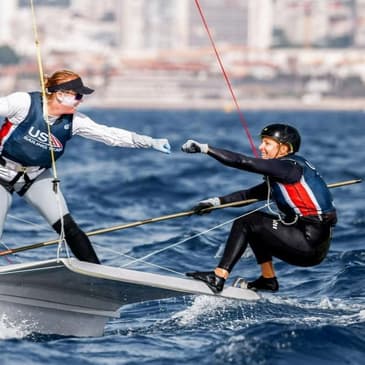
In Part 2 of my conversation with champion sailor Stephanie Roble, we dive into race strategy, and teamwork on the racecourse. She shares how she simplifies complex conditions, breaks the course into key sections, what decisions she makes approaching the windward mark and how she sets up for the start. We also talk mental focus, risk assessment, and her top advice for sailors. An episode packed with great insights!
“You give power to what you focus on. If you’re thinking about what’s going wrong, you’re not thinking about how to win.”
[00:00:07] Hello! So here's part two of my chat with top sailor Stephanie Roble. We carried on a discussion from part one by talking through race strategy, sticking to priorities and making decisions under pressure. I also managed to persuade her to talk through her starting process and also what goes through her head when she's approaching a marked rounding.
[00:00:31] So altogether I think you'll find it's a ton of great advice and insight from someone who's been consistently at the top of her racing game. I thought it was a great discussion, I hope you do too. Thanks as always for listening to Yacht Racing's most popular podcast. Here we go!
[00:00:55] I've heard you talk about the need for simplicity, but how do you strive for simplicity in such a complex, multifaceted environment as a racecourse? Yeah, I think in this sport it's all about how can we keep it as simple as possible. We, you know, in our approach to racing, we would always diagnose what kind of day it was and we broke that into two categories. Is there somewhere to race to or is it an open race course?
[00:01:22] And so if there's somewhere to race to that can be a geographic feature like in Palma or racing in Lake Garda or, you know, that can be current relief like you might experience in San Francisco Bay or that can just be like more pressure on one side of the race course. And that kind of, you know, narrows, helps you narrow your priorities or it can be an open race course. You know, you can be in a sea breeze and you just have like, you know, an oscillating breeze and it's pretty steady.
[00:01:50] And so, you know, your priorities change. And so we really, Dave Allman taught that to us. And that really helped us kind of eliminate variables and just simplify the game plan and simplify the priorities on the race course. The dividing the race course up into thirds. I found that really interesting. Do you actually do that? I'm sure I do. Like, I don't, I wouldn't say I, you know, I'm like, okay, this is the first third here and second third. But, you know, the first third of the race course, I would say you're focused on that lane management.
[00:02:20] You're focused on, on getting leverage on the fleet. And then that second part, you're, you're focused on like kind of cashing in that leverage and crossing the, you know, crossing people when you can. And then, you know, you get into your top third and you're, it's all about winner mark approach. And so that's, you know, that's how I would think about it. And in the 49ers, the edges are really powerful, you know, minimizing tax and getting leverage and being able to put the bow down and just rip is super powerful.
[00:02:48] And that happens on the edges, not when you're stuck in the middle dealing with traffic. So we would think a lot about like, how do we, how do we get out to the edges? And then it's, yeah, you get to that like first third and you're starting to think about your first move. You know, what, what's, what's our lane situation? How many people can tack on us when we start, you know, going back towards the mark? So that, that typically happens around like 60, 70% of your way to lay line.
[00:03:14] You start thinking about that move of like, how am I, how am I getting out of the corner here? Am I in control of the pack or is the pack in control of me? And so then, you know, you get into your second, third, and that's really about like, how do I get a good lane going up, up the course? And then that, that, the last third is about how do I approach the winward mark? So let's talk about how you approach the winward mark.
[00:03:37] And I know this is quite hard to do on sort of on a podcast, but can you take us through what goes through your head as you're approaching the winward mark? Yeah, I would review the priorities for the day. Again, are we, is it something to race to? Is it open? Are we playing the shifts? Is it a really puffy, shifty offshore day where pressure is absolute priority? Or is it like a survival day going downwind in 25 knots? So kind of think through like, what is the big picture with the priorities?
[00:04:05] And then I would think through where are we in the race? And then I would think through where quickly, where are we in the regatta? And knowing those three things really helps formulate your plan at any mark rounding, I'd say, whether it's winward or lured mark. Yeah, so knowing your priorities. So obviously very simple. Are we straight setting or jive setting? If you're winning the race, obviously a jive set can be a pretty risky maneuver going under the fleet.
[00:04:31] If you're in the middle or towards the back, jive set is more open. But like, are we jive setting for more pressure? Are we jive setting to get a clear lane? Are we jive setting to sail on our own because there's less traffic that way? Or is it actually going to be a gain? Are we just like doing it to, you know, Hail Mary kind of thing? And so I think there's a lot of variables about like, yeah, where you are in the race, what the priorities are, and also where you are in the regatta.
[00:04:58] Because let's say you had a tough first beat and you're rounding towards the back of the pack. It's like, well, do we have a throwout? Have we raced our throwout yet in this regatta? And you think about it that early, right? Yeah, you have to think about how much risk you're willing to take on. Because there's a chance when you take on more risk by jive setting and going the opposite way of the fleet that you actually get yourself deeper into trouble. Or if like, you just have to pick up, pick off one boat at a time.
[00:05:26] But also if you jive set, it could be a big gainer, you know, and you gain 10 boats. And so it's, I think, yeah, it's a constant calculation of that. I heard you say that if you're in the lead and you jive set, that's the risky strategy. But presumably if you want to go back to the left-hand side looking now downwind because of current relief or something. So is the risk there that in these types of boat that people are more likely to do a bear away set rather than a jive set?
[00:05:55] Yeah, and I'd say like, you know, the risk in the jive set is that you just have a bit more traffic to manage. You're sailing underneath the fleet, obviously, as a leader. You have to sail under all the people who have stacked up on Starbortack lay line. So, you know, you risk sailing in less breeze for a while. But like you said, if there's current relief over there or geographical gain or more pressure, you know, on those shifty offshore days. If I look up wind and I'm like, there is a big puff rolling down course side right now, we are 100% jive setting.
[00:06:25] I don't care where we are in fleet. So that's just assessing those priorities. If it's a pretty open race course and pressure is pretty similar, like we're focused on locking into boat speed. So straight set, lock into boat speed, set up well on the pack in front of you so that you can jive and jive with them and make a gain there. How do you divide responsibilities between you and Maggie as you approach the mark?
[00:06:53] And what's the conversation like? I would generally, you know, I was in charge of our tactics and strategy and Maggie was in charge of our boat speed. But Maggie's an amazing sailor and an amazing tactician. So we could spend a whole day with her calling tactics and race at the top of the fleet. So I always really trusted her feedback and opinion. But that was always our default division of labor. And so I would say a plan and just, you know, say like, you know, good with that.
[00:07:21] And, you know, she would, if there was something else that she saw to, you know, say anything against what I wanted to do, then she would chime in. But for the most part, it was just, you know, me saying the game plan and confirming what kind of set we're going to have from there. On the skiffs that you sell, I mean, things happen very, very fast. Yeah. The windward mark is coming at you very, very fast. There's not a lot of time to make decisions. So you must have, I'm sure by now you have excellent communication between you.
[00:07:51] Are there single words that you use, sort of code words that you use to describe what you're going to do? Yeah, definitely. And that's like, you know, early on in the campaign, we focused a lot on like the communication part of it. And so, you know, it was always like straight set, jive set, or Batman was the third one. What was Batman?
[00:08:12] It was like full jive, like Maggie's still on the main, and then like come up on port, get the boat settled, and then go for the hoist. It was like if you had to defend on any one jive setting behind you, or, you know, if you had traffic coming, or if it was really windy, we would like complete the jive and then get sorted and then do the hoist. So you get under control, find a lane, and then do that. Yeah. Why was it called Batman? I don't know. It just came to me one day in training.
[00:08:41] I was like, kind of do like a quick turn. Feels like a Batman turn. I don't know. After being on skiffs, when you switch by the keelboats, and again, approach the wood of mark, things must feel that they're happening so much more slowly right in that situation. Have you done that? Yeah, you know, you think about a skiff race is like 25 to 30 minutes long. You divide that by four. Well, you're going slightly faster downwind, obviously.
[00:09:04] So you were racing upwind for eight to 10 minutes, which is really not a lot of time when you're going 10, 11 knots upwind. So everything's happening very quickly. And so I would spend a lot of time after events studying the GPS trackers that we'd have at Regattas to really narrow in on the plays that you can make. Because you find yourself in similar situations.
[00:09:31] And so it's like, how do we make, yeah, like a process or checklist for when we're the lure boat leading out to the left, when we're the windward boat going to the left. And so you kind of just make your little processes and see patterns. And the plays come a lot easier as you experience them all a bit more. But this winter, I've been racing on an Edgels team as a tactician. And yeah, everything happens a lot slower, but it's a totally different perspective.
[00:09:59] One, not holding the tiller and two slower boats, different tacking angles, different closing angles. So I'm definitely like recalibrating to all of that. But it's been a good challenge. So you talk about plays there. So you have multiple plays for different situations. Once you've rounded that mark, you obviously thought through beforehand there's how many? Four, five, six, seven different plays that you might have? Yeah.
[00:10:27] I know it must really depend on the environment, conditions, you know, competitors, where you are, what the day's like. But yeah, but it all goes back to the priorities. You know, if your priority is, you know, to get to that geographical feature, like that's all you're thinking about. That's your play. If it's an open race course and we're just focusing on boat speed, then yeah, you're focused more on like your positioning. Positioning on the boats around you.
[00:10:53] And like, how do I use my boat speed to like get down on the pack so that when that pack jives that we can, you know, jump them in the jibe. And so I think all those plays just come back down to priorities and upwind plays. Yeah, probably. The big ones are like when you're exiting the corners, I would say. And like, like I talked about earlier, it's like if you're leading to the left and you're in a lured boat, well, can we tack and cross the pack on our hip? Like you have to be able to assess that.
[00:11:21] Can we, you know, if we can, this is the play. If we can't, this is the play. And so really like, you know, the best Olympic sailors know exactly like when you tack, you know, where you're going to cross someone, how you're going to intersect them. And that makes such a big difference on the race course. You talked about reviewing the GPS data, the tracking data after a race. Presumably you have, do you have access to other boats as well rather than just yours?
[00:11:50] What do you, what do you learn from that? I would often, if there was like a moment or like a moment or mistake that stood out to me from the regatta, I would go back and kind of replay it and say, okay, what can I do differently here? Because like I said, you know, you often end up seeing very similar situations throughout racing. And so I would review it, think about it. Okay, this is how I would do it differently. Or I would see someone else doing a similar move in a different race and okay, they handled it this way.
[00:12:19] Do you have an example of that? Something I like put a lot of effort into studying was the left corner exit. So, you know, how do you mode off the line to get strong on the boats around you and then creating awareness of the boats around you, knowing the intersection if you were to tack.
[00:12:39] And then like if you're in the middle of the pack that's going to the left, kind of like ranking yourself to where are you realistically in this pack? Are you leading it? Are you first, are you like third or fourth in this pack? And then that like determines so much of your exit. So I would really look at that a lot and like think about like how we were moding the boat in that scenario. Like, okay, if we were to put the bow down and go a little bit faster here, how would that change the situation?
[00:13:08] If we were to go into a higher mode here, how would that change the situation? If we were to exit sooner, how would the situation have changed? So that was like a really fun puzzle that I dove into for a while. And the Dutch girls were really good at that left corner exit. So I would, you know, follow their tracker. I watched them. Yeah. Yeah. That's really interesting. I love that. So let's get back to talking about starting for a moment.
[00:13:33] I'd love to sort of hear you share how you and Maggie approach the sort of starting sequence and the process of starting. Yeah, we would always, you know, finish our pre-start homework and take a minute on the coach boat to discuss the priorities and the game plan. So that was always a three-way conversation between myself, Maggie and the coach. And I kind of led it based on, you know, what I was thinking from our warmup.
[00:14:01] And then, you know, we'd leave the rib and go check the starting line, check the bias, all that, and just try to gather as much information as we could. And then, you know, depending on the day, we would position ourselves on the starting line. So a light air day, if you wanted to go left, you were setting up at the pin at 10 minutes to go, like before the sequence would even happen. Or you'd start at the boat at that time if you wanted to go right.
[00:14:25] And so that, because you get those best lanes on the race course and in the skiff, you can hold your lane, you can hold your boat in that position forever. So you'd literally set up 10 minutes. So you sort of reserve your spot on the line of 10 minutes to go. Yeah. Wow. Yeah.
[00:14:44] But if it was, you know, if it was like an offshore puffy shifty day, we would like hang out above the starting line until three minutes before the start of the race, looking up when and scanning what was coming down. What's, what's going to be the first pressure that we're starting in because that was pressure was always priority on those days. And so then we would kind of like go from there and split off to the end that we wanted to go to.
[00:15:08] And then once we were on final approach, Maggie was really in charge of managing the distance to the line. And that's a, that's really a full-time job because in the, in the 49er, we don't have any electronics. It's all about Maggie finding a line site or well, yeah, a transit or line site on shore and managing that as, as we're doing all this pre-start boat handling that we talked about.
[00:15:30] And so she was really working on, on getting that dialed in and then obviously working with me to, to make sure the boat was in a good position with the boats around us. And then, you know, we would always like, let's say at like a minute or a minute 30, we would confirm the game plan again. And Maggie would, you know, say, I was still happy here, you know, happy to go, happy to go left still. Or she would also manage like the shifts as well.
[00:15:59] So really shifty day I'm feeling, feeling left shift in the gym right now. And that would cue us into like, we need to get a little bit further forward on the boats around us, maybe a little closer to the line. And so we were always talking about those things. And then, you know, there comes a moment, like if you start getting in trouble at all, how do we bail out? And she was always the one keeping me honest about that because I would definitely want to keep fighting. And, and she, you know, she would keep the big picture in mind of like, this isn't going to go well.
[00:16:26] We need to, we need to bail out and just preserve, you know, get as much as we can out of the start. So, yeah, it was, I really loved starting in the FX. It was such a fun challenge. And, you know, like I said, you're constantly pushing your boat handling to just get that little bit more of an edge on the competitors around you. And, you know, if you can have consistent starting, you're going to have consistent, consistent. So in these scenarios, are you always sort of starting in the front row?
[00:16:55] Is that, is that the case where in perhaps keelboats there's sometimes two or even three? If we're not starting in the first row, we're having a really bad day. I mean, everyone's, the race committee is good at creating enough space for everyone. You know, it looks like from the videos, right? It's tight, but you're always fighting.
[00:17:14] And so that's where like having really good boat handling comes into place of just being able to like be just a little bit bow ahead of the boat to lured of you and being like pretty snugged up on the boat to windward of you and, you know, making sure you're defending your, your spot well. So having all that boat handling is really, really critical.
[00:17:31] And then when I, if I think about the skip, I mean, the speeds are upwind are somewhat faster than normal keelboats, but are you still in that situation of trying to hold your lane to the, to the boat to lured of you? And is there any, what are the sort of techniques? Is it, are they the same techniques on a 49 FX to hold your lane as there are in another keelboat?
[00:17:55] Yeah, we would. So Maggie was always in charge of, of the moding and, you know, always her default was always VMG mode. And then I would say to her like, oh, we need, you know, it's tight lane. We need to go a little bit higher here. Like, um, let's put, let's, you know, we rolled the boat to lure it of us. Like let's put the bow down, let her rip out to the corner type thing. And so that was always on her to lead that based on what I was telling her I wanted for the race course. And, you know, in the 49er, like you don't have a lot of controls.
[00:18:24] She has the main sheet. I have the jib and she has the bang and Cunningham right there. And that's it. So you can only really make so many adjustments. So yeah, if I call for, for a higher mode, she would, you know, change banging and Cunningham. And, you know, we'd maybe put a little bit of lured heel in the boat and just like slowly make that happen. It was like, you know, Cunningham on maybe a little bit of windward heel or the jib, get the main sheet on, you know, that nice east range.
[00:18:54] And then it became, you know, the balance of the boat became a lot more like on me once we got to that, like outer end of the main sheet range or on the higher end of, you know, if we were going for a higher mode. Like that was me communicating a lot to her about like the load in the boat in order to like maintain that constant drive up to the boat to windward of us. She was really the one leading it and making the adjustments on the sails.
[00:19:20] Yeah, that's great. Love it. I can sort of visualizing that in my head as you as you're doing that. It's great. So Steph, one thing I'd love to know is what would be your sort of top piece of advice to pass on to other sailors, perhaps up and coming sailors based on the experience that you've had? I would say number one, wear your sunscreen.
[00:19:42] Well, maybe that's just like an always thing, but I'd say, you know, Olympic specific or, you know, even any sort of campaign, just enjoy the journey. It's so easy to get focused on the results. And of course, they're important to all of us. But there's so much more to it, especially in an Olympic campaign. You know, I've been reflecting a lot on everything, all parts of the journey.
[00:20:09] And, you know, I built an international family and, you know, traveled the world and I got to sail in beautiful places. And, you know, I got to wake up every day with this challenge of how do I become a little bit better today? I always really love that challenge. And so there's there's so much beauty in that journey. This last Olympics really highlighted that for me. You know, we finished racing and I got to go up to Paris and be part of the some of the sporting events up there.
[00:20:39] And I remember I walked into a track and field stadium at 10 o'clock on a Monday morning, expecting the stadium to be empty. And it was full of 60,000 competitors or 60,000 spectators waving flags from all over the world and cheering on athletes from all over the world. And I was like and people were passing around the wave. And I looked around and I was like, this is what the Olympics are all about. Oh, my gosh. Uniting the world through sport.
[00:21:06] And it really like made me appreciate so much more about the journey and the beauty of the Olympics. And there are so many moments like that. We didn't have a normal Olympics in Tokyo and in Paris or actually in Marseille, our sailing venue. We sailed out every day with our friends and family on the seawall cheering for us. And that was just so special. And, you know, that those are the moments that you remember more than like what place I got in Palma in 2017.
[00:21:36] I have no idea, you know, but it's so it's it sounds so cliche, but it is really true to like really enjoy the journey. And, you know, with that, the results will come. And then I'd say, you know, my other piece of advice or like mantra that I like to live by is you give power to what you focus on.
[00:21:54] If you when you're doing an Olympic campaign, it's easy to constantly focus on like what other people are doing or what you what you need to improve on or get distracted by whatever else is going on. And like you end up giving those things power. But when you focus on, you know, what you're doing and your journey and your strengths and building on your weaknesses, like that's that's where the power comes in. So those are like two powerful things that I that I learned throughout the journey.
[00:22:24] Thank you. That's really interesting. Really useful and a great way to end. Very uplifting, inspiring way to end. So, Stephanie, thank you so much for joining us on SailFaster. Really appreciate it. Good luck with your new career. I know you'll be doing plenty of sailing, but good luck with that. And I look forward to hearing more about that. And hopefully I'll see you on the water at some point. That would be awesome. Thank you for your time today and letting me join you guys. It was really fun. Yes, pleasure. Thank you for your time. Thank you. Thank you.