
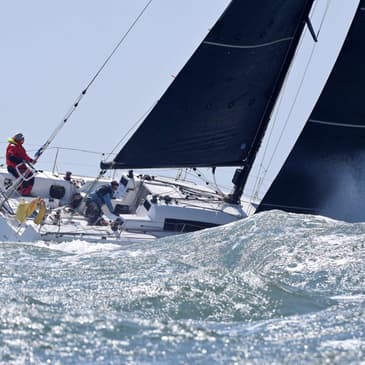
In this episode Pete interviews fellow Brit and offshore sailor Dr Deborah Fish, Commodore of the Royal Ocean Racing Club, on the challenges of long-distance yacht racing. Deb shares some great strategies for staying positive and managing risk, and the art and science of balancing boat speed with smart navigation in double-handed racing. Deb also discusses teamwork, communication, and resource management in multi-day races. You'll also hear about the unique challenges of the Three Peaks Yacht Race and her reflections on past experiences, including the Fastnet and Dream Cup. And Deb reveals her bucket list race - the 750-mile Race to Alaska! A really interesting episode with one of the top offshore racers!
[00:00:06] Hello, well we're back with another episode of Sailfaster, which is, thanks to you listeners, the most popular podcast for racing sailors. I'm into a bit of a rhythm of doing an episode every two weeks. Hope that works for everybody. I'd love to do more because there's so many great stories out there, but life gets in the way as it does for everybody.
[00:00:26] Anyway, today I'm delighted to say that we have a truly special guest, and that is Dr. Deborah Fish, who is the Commodore of the UK's Royal Ocean Racing Club, or RORC, one of the most prestigious and influential organisations in offshore yacht racing.
[00:00:44] In January 2024, so just over a year ago, Deb made history as the first woman ever elected as RORC Commodore. You won't be surprised to know, therefore, that Deb has racked up a spectacularly impressive offshore racing resume, including 11 Rolex Fastnet races, the Sydney Hobart, Rolex Middle Sea Race, the 7 Star Round Britain and Ireland, Myth of Malone, Three Peaks Yacht Race, and so, so many others.
[00:01:12] And interestingly, all from somebody who didn't even start sailing until her 30s. Deb is an accomplished double-handed racer, sailing with Rob Craigie on Bellino, which is Rob's SunFast 3600. And together they've led both 2023 and 2024 RORC Seasons Points Championship.
[00:01:33] So in this episode, we're going to dive into Deb's strategies for how to stay positive in long-distance racing, how she thinks about risk management in racing, and how she prepares for the world's toughest offshore racers. So get ready for an insightful conversation with one of offshore racing's most experienced and inspiring competitors. And next week is the turn of racing legend Ken Reed, who'll be in the SailFast hot seat.
[00:02:01] But first, here we go with Deb. Deb, great to have you on SailFaster. Hey, thanks for inviting me. It's a pleasure to join you. Yes, pleasure to have you. And I know it's evening there in UK, so we'll try not to take up the whole of your evening. But thank you for joining. And let's start with the beginning of the story. Where did you grow up?
[00:02:28] So I grew up in a small seaside town called Western Supermare in the southwest of England. But I didn't really get the opportunity to go sailing until I was about 30. I do know Western Supermare. I used to live on the other side of the Bristol Channel in Wales. We used to call it Western Supermud because I think you had incredible tide range, wasn't it, on the 7th Estuary there that left you with half a mile of mud, right, at low tide? Is that right?
[00:02:55] Yeah, it is quite a big tidal range, but it's very, very flat. So the tide goes a long way out. It was there last weekend and we were very excited because we actually saw the sea. It was actually in. I love that. It was actually within miles of you. So Deb, I know you didn't start sailing until you were 30. How did that happen? How did you first get into sailing and then how did you get into racing? So I had a job working in the meteorology department at Reading University.
[00:03:23] And I was always into outdoor pursuits. I used to go climbing and things. And they had a weather and sailing field course. So I thought to myself, hey, I've got to get onto this. So the first year I got onto it and did four days as a member of staff. And then the next year I did eight. And then the people who owned the boat said, we're going cruising to France in the summer. Do you want to come? And I jumped at the chance and haven't looked back since then. I then signed up to do the fast net on what we call a pay-to-play boat.
[00:03:52] So a boat where you pay for a place on the boat. And so on. And did a fast net campaign and yeah, haven't looked back since. You dive straight in because doing the fast net is obviously no small means. It's not one of the first things you would do to gain experience in racing. Did you quickly jump onto it or was that a little bit after you started sailing?
[00:04:19] So I went to France one summer for like a week or so. And then I decided I'd do some courses over the winter because we ended up coming back with just two of us. And the skipper was explaining what the lights and shapes of ships would look like in the dark. And I was like, wait a minute, this is a bit scary. So I thought I'd get myself on a course and I did my day skipper over the winter.
[00:04:45] And then when I went to the boat show and saw people advertising it and thought, why not? And they'd offer training and so on. And because I was very confident in navigation with my kind of meteorology and scientist background, I jumped straight into the navigator. Wow. So one of your early experiences then was double-handing across the channel. That's pretty impressive.
[00:05:10] Actually, for my first few years, for probably my first 10 years of sailing, I sailed fully crewed. So yes, we did double-hand back from France cruising on a semesterly consort. And then I raced fully crewed for 10 plus years before I got into racing double-handed. But yes, I guess one of my first experiences was coming across the channel double-handed. Yeah, that's impressive. Hey, let's talk about your current role at Royal Ocean Racing Club.
[00:05:40] So can you tell us a little bit about that role and perhaps what you hope to achieve over your time in that role? Cool. Cool. So I'm the Commodore of the Royal Ocean Racing Club, which is an immense honour. It's a prestigious club. It's got about 4,000 members, third place overseas, the biggest offshore yacht race in the world in the Rolex Fastnet. Two clubhouses. We run a racing system called IRC and so on.
[00:06:10] And we have staff who deliver all those roles. But my job as Commodore, I suppose, is a figurehead for the team of elected volunteers who connect with the racers and set the direction. And it has some wonderful moments and some hard work. I think my first duty as Commodore was to host the Commodore's cocktail party in Antigua for our Caribbean 600 race. But then you're also at the focal point if people want to have a good moment. So a little bit of everything.
[00:06:42] You'll take the rough with the smooth there, right? Yeah. Well, like offshore racing, you have some highs and you have some lows. And what I want to achieve, if there's one thing I want to achieve, I suppose it's sharing the passion that I and many of my friends have for offshore racing. To me, it's a sport I love. And it's a sport for life. You can start, you know, we've had people do the Fastnet aged 14 or so. I don't know what age the youngest is, but we've had people doing it aged 80.
[00:07:12] So it really is a sport you can do for life. And I'm particularly keen, as we are in the club, to encourage young sailors, but also more women. Because I think we're about 20% women. So it would be nice to encourage more to get into the sport that we love. Hey, congrats on being the 2023 Rourke season points champions on Bellino with Rob. So I'd love to explore how you think about prepare for races.
[00:07:38] And, you know, perhaps we get into what you do, you think you might do differently to achieve that sort of success. So could we start with perhaps you talking about how you prepare mentally, physically or operationally for a big regatta, typically? So a couple of sort of baseline things, I guess, before we get into that. One is we know our boat pretty well. And that gives us a bit of reliability. So we do all the deliveries ourselves. We do most of the maintenance ourselves.
[00:08:08] Rob, I should say, does most of the maintenance. And he's very good at fixing things. So we know our boat and we know how to look after it quite well, which is good. In terms of preparing for a big race, that differs whether it's a race in an area I'm familiar with or a new area. So if it's a race, if it's in our backyard, which for me is the English Channel, I will try and get a big picture navigationally. Think about the key decisions that we need to make as the race unfolds and understand the factors that determine those decisions.
[00:08:36] So, for example, one of the big race decision points in the Roddick's Fastnet race is Portland Bill. And there's often a decision, if you get there with the tide against you, to go inshore, out of the tide or offshore south of the big tidal race. And there's a lot of factors that influence that decision. So you think about what state of tide you're at, the wind direction and so on. So you think about what is the key decision and what are the factors and under which circumstances will I do one thing versus another.
[00:09:03] And then having thought it through when it comes to the race, you can look at it and go, it's like this. I do that. It's really important to find a way to prepare. It's time to prepare. And then when you've gone beyond that, you can start getting into things like, you know, plan the first few manoeuvres so that they're easier because you've got the sheets, pellicle sheets in the right place or the jib in the right track at the front. And even to things like when we can rest in the race with minimal impact, it's a long, long race. So there's so much to do there.
[00:09:32] So I'm interested in the fact that the first decision you make is sort of scenario planning for the Portland Bill rounding or passing Portland Bill. And then other things are sort of fall subsequently to that. Am I reading that right? Or is it just that's the major decision? I guess that some races navigation is a big part of it and you win or lose on navigation. So I guess my first thing is to think about, you know, what will the weather be like?
[00:10:01] What sort of race will it be? And have I got any big decisions to make? And if so, what preparation I can do before the race so that I'm as well prepared as I can be to make that decision during the race? Does that make sense? Yeah, no, that makes total sense. When do you typically start preparing for something like the Rolex Fastnet? Is it weeks before, months before? I mean, I know you're obviously very busy just trying to figure out how you sort of begin that process.
[00:10:28] There's a few things in the months before, like making sure the boat meets the special regs, which change. In our case for next year, we're sailing with some crew, four of us. So organising that is something I haven't done for a long time. So there are things you do plan well in advance, but navigationally, I'll probably start looking maybe a week in advance. And I'll just have a quick look.
[00:10:54] And as it gets closer, I'll look much closer and really start running routines and what ifs and really start thinking about it. Because too early, you're just looking at curiosity early. And then what are your priorities when it comes to preparation? I've talked to some people, the first thing they say is getting food, getting drink right. That's the first thing they go to. Others say, oh, getting into the right mental state. Sometimes a week before, visualisation techniques and so on.
[00:11:22] I think it's probably mainly associated with perhaps windward-leward racing rather than the offshore. But I'm just curious, do you have similar priorities that you think through before you even get to navigation and weather and that sort of thing? Yeah, absolutely. One of the principles we have in particular with shorthanded racing is we have to look after ourselves because we've only got two of us to make the boat go for maybe four or five days at a time. So we've really got to look after the two people on the boat.
[00:11:51] So that means that things like making sure you've got food that you enjoy and that gives you the nutrition you need is actually really important. So we'll have a checklist of all the things we need to do. And that might be putting the sails on, adding some extra equipment that's required for a Category 2 race, getting the food. And that's the must-do. You know, we've just got to do those, so get on with it.
[00:12:17] And then there's the more advanced stuff, which is really – I suppose it's getting your head in the right place. I mean, another of the sort of the basic foundation things is try and go into the race rested and well-prepared. So if we've got a race starting on a Friday night, I'll try and take a bit of time off work on the Friday so you can prepare and feel ready and just feel in the right mode.
[00:12:42] There's nothing worse than dashing from a meeting at work and rushing to the boat and getting there late and rushing to the start line. It just sets you off on the wrong foot, and that tends to go wrong from there. You're still not giving yourself a great deal of time there, are you, if you're rushing down the motorway to try and get a handle or something? Yeah, so I won't. If I need to take the day off to prepare, I will.
[00:13:09] So I'm very much a put the time aside and make sure you're prepared properly, because that for me is part of getting in the right mental state. You've done 11 fast nets, right? Are you really comfortable with what you have to think about, prepare for a fast net? Or is every race different? I mean, I can imagine the sea state and the weather and the day is very different every time.
[00:13:35] But generally, are you pretty familiar and comfortable with the routines you need to go to to prepare yourself for the fast net, for example? Broadly speaking, because I've done it before, so you still need to do the preparation, and everyone is different. But I suppose I know what I need to do.
[00:13:51] The one thing that's different, of course, is the new finish in Cherbourg, because the first section, as far as perhaps Bishop Rock on the way back, or the Isles of City on the way back, I know very well because I've done it 11 times. The last section from the Isles of City to Cherbourg, I've only done in the fast net race once. So that is new, and that is complicated with the tides you get in the Channel Islands. They are massive.
[00:14:19] I think we had five or six knots at Cap de la Haag for boats just behind us last year, and that's massive. And the routing can vary from taking you, this might not make sense for some of your audience, but you've got Cherbourg to Peninsula. West of that, you have the Channel Islands, with Alderney being quite close to the route. There's also a traffic separation scheme, and optimum routings that I've run using historical weather data will diverge an awful lot.
[00:14:48] Sometimes they'll take you south of Alderney, maybe even south of Guernsey, perhaps 20, 30 miles south of the wrong line, to pick up a strong north-going tide. Other times they'll take you north of the traffic separation scheme, and probably 20 or 30 miles in the opposite direction, in perhaps a 100-mile lake. So there are some big navigation decisions to make, and some little ones.
[00:15:11] I think we were probably a mile further north of the island of Alderney in the last Fastnet, but that gave us significant tidal advantage, and actually gained us quite a lot on some of our city ships. So little things and big things. I know you do scenario planning for Portland Bell.
[00:15:31] Do you also do scenario planning beforehand for what happens when you arrive around the Channel Islands, and the current is either adverse or with you? Presumably you've thought that through with Rob a long time beforehand. Yes and no. So I guess we – so yes, I have looked back over time and run some historical scenarios, taking weather from perhaps 10 years and then running it, starting at different times and seeing where they go to get a feel for it.
[00:15:59] And that gives you a baseline feel of under what conditions you might do what. And that it also gives you almost like the experience of knowing that perhaps my default, 80% of the time I'll go this way, but just once in a while when the weather's doing this or that, or the tide's doing this, I'll go this way or that way. So that gives you that foundation to build on.
[00:16:22] And then when it comes to the actual race itself, I'll put more time and effort into the bits near the start because I can see what's going to happen there. So, you know, because I know what time this start is and I know that all the weather forecast is the night before, I can plan exactly where I'm going to go down Solent within reason. Whereas if I go perhaps two tidal gates down the course, perhaps 24 hours down the course, I could be there easily, a complete tide out of phase. So I really don't know what's going to happen.
[00:16:50] So my planning gets as vague as you get through the race, but you always want that baseline of knowing, broadly speaking, you know, under these conditions, like in the tides against you, you might look to go inside in the bay outside the tide. At the headlands, you've got a choice of inshore or offshore. You've always got that baseline knowledge. Hey, Deb, when we talked a couple of days ago, we talked through some of the, perhaps the sort of more unconventional training techniques and drills that you do that have really helped your performance.
[00:17:20] Would you like to perhaps talk about those? So some of the training techniques that people might not have thought about, one I found very useful when I had a symmetric rigged boat with a spinnaker was diving the symmetric spinnaker without a spinnaker pole and doing that perhaps 10 times. That's really helpful for helping you fly it through the dive, which means that when you come to use it with a pole and it's only flying free for seconds, it's really easy. So that's a really useful drill.
[00:17:50] Another interesting one from the helm is, particularly if you're a sailor like me who relies on instruments and perhaps hasn't got the dinghy sailing feel, is to sail with your eyes shut. Particularly at wind, where you can try and do it on feel and use the heel. Now, sometimes you drift off, but that's an interesting drill to make you realise how much you use the instruments or the telltales or just the heel. So that's an interesting one.
[00:18:20] Similarly, sailing without instruments is an interesting one for someone like me who relies on them. Another thing we tend to do in our programme is have a mixture of races that are perhaps important to us, that are in a series that we're targeting, but also some races where we're going to go and have fun and they're not so important to us. Because then you can try things that you perhaps wouldn't normally try or are a different configuration that you perhaps, where you wouldn't try in training, but you will try in racing because you're driven and everybody else is doing it.
[00:18:50] So that's good for pushing you as well. Those all sound really interesting. The one that appeal to me, especially because I don't have that dinghy sailing feel, is that idea of sailing with your eyes closed. Is it more about trying to feel the heel in your feet or is it about the wind on your face? Or what are you seeking in that situation? I think it tells you what inputs you're using as a helm.
[00:19:15] So it tells you how much you rely on heel, particularly if you're sailing with someone else, because they can observe what makes you go off course. So they might observe that you get a lull and you sail with a constant heel angle, even though the wind angles change. So it's really about, I suppose, understanding what inputs you use and then perhaps sharpening your focus on the other inputs you could use. So I would say if you're doing that, you can go on a heel. That's probably the biggest one for me.
[00:19:45] You can also go on what you feel on the helm. And if you focus on that, that might help you work out whether you need to change your rig position a little bit, your rake, to perhaps increase that weather helm, if that helps you. Then there is wind on your face as well. But heel is a big one. And the feel in the tiller is also a big one. I love that. That's great. I'm going to try that and try and steer away from the rocks.
[00:20:11] So thinking about offshore racing, Deb, what's been the most challenging race of your career? And what did you learn from that experience? Oh, that's tricky. But I think it would have to be the 2023 Rolex Fastnet. So the challenges in that race, we had a very big fleet. We had three periods of either gales or strong winds.
[00:20:37] And because of the strong tides you get in the channel, they really kicked up a pretty bad sea state with wind over tide. As we were approaching Sherwall, probably on the fourth or fifth day, we had the final blow. And the visibility was terrible. We had driving rain and 30 knots of wind on a broad reach. So we were surfing at speeds up to 24 knots.
[00:21:01] And ships were just coming out of the traffic separation scheme at a really fine angle. And they'd just suddenly appear out of the mist. And you'd be like, which way do I go? So that was challenging in all sorts of ways, particularly when that occurs near the end of the race when you're already tired. What did I learn from that? I learned, I suppose, two things really. One is that bad weather will be over in a matter of hours. So things will get better in a few hours.
[00:21:28] Whereas if you don't finish like we did in 2021 because we had a collision, you'll be visible for weeks. So my calculus would be just push through it as long as you're safe and you'd be happy with that decision. But the other one is you need to know when to push and when to ease off. So in that race, we carried the Spinnaker quite a long time, but not that long. And that got us a little bit ahead of someone who was just behind us. And that meant when we went through the Aldi race, we had got through a slack tide.
[00:21:58] And they had about six knots against them and huge standing waves, which were a real denture of the rig. So sometimes pushing is a safe thing to do. So in that case, you were sort of racing literally to get ahead of the changing tide, presumably. Oh, actually, we hadn't realized that. We were just racing for racing. But as it happened, it got us out of a sticky situation. And had we thought about that...
[00:22:24] You could have said, yes, that was exactly our plan. I could have said that. So what strategies do you use to stay positive and motivated when things perhaps aren't going as well as planned? And how do you navigate through the lows of offshore racing? So I think the main thing with the lows of offshore setting is to just really try and look after yourself and each other.
[00:22:50] And certainly with the two of us, we try and look after the other one if the other one's having a bad time for some reason. So good food, hot drinks, a dry bunk, they're all key. And you need to appreciate the little things. In the 2023 Fastnet, I felt terrible at the end of the first afternoon. Rob sent me below and I just lay on my oil skin, soaking wet on top of a jib on the floor. But I was out of wind and it was wonderful.
[00:23:19] And the other way we sometimes cheer ourselves up is with the thought that there's probably another boat out there, perhaps one that's a bit smaller or less freeboard, that's having a much rougher time than you are. So that can always cheer you up. You've just got to find the little things and look on the bright side. I love that. Schadenfreude, that's brilliant. The other thing I always remember is that when you give up, when we gave up the 2021 Fastnet,
[00:23:47] because we'd had a collision and we had a big hole in the deck, we felt awful for weeks and months. Whereas if you struggle through bad weather, it's usually gone within a few hours and then you feel great again. That's really interesting. I get that, that you think about, okay, if we give up now, I'm going to feel a lot worse that I'm going to feel in three or four hours when this front has moved through and we're bearing down on the finish. And the central achievement when you get through the rough weather is always fantastic.
[00:24:16] So let's talk about risk management. For you, how does risk management in offshore racing differ from, say, inshore or club racing? Well, I didn't do a lot of inshore racing, but offshore, what I try and do, and this is very informally, is think about the benefit I might gain by taking a risk and the loss if it goes wrong and the likelihood of ease.
[00:24:42] So in an inshore race, you might think about perhaps a spinnaker drop. And if you're going down tide, you might drop early. If you're going against the tide, you might drop late. So there's a little bit of risk there. But a good example was in the Dream Cup last year. The Dream Cup is a French 600-mile race. And last year, it started with 60 boats on the start line. And there was a one-mile reach to a buoy, which we were going to harden up and make quite a sharp turn.
[00:25:11] And it was really gusty. One moment, the wind would be less than 10 knots. The next, it would be over 20 knots. And there was an hour time penalty for being OCS. One of our competitors, Red Ruby, they looked really good there. First across the line, within seconds, they had their code zero unfilled and they led the pack. Got their OCS. So they took an hour time penalty. And we went just the right side of the line. But I'd made the call that we'd be cautious. We wouldn't put our zero up. We'd just fly our gym.
[00:25:41] And that did leave us in the pack going around the mark. But what we didn't have is the added complication with a sort of four boats stacked out all going around the mark, sharpening water. We didn't have the added complication of a big head sail having to be furled away, which would have been a nightmare. And we reckoned that we'd have gained about a minute by flying the code zero. But had we got it run at the mark, our race could have been over. So we played it safe. And I think we were glad of it.
[00:26:07] And one of our very well-sailed rivals, they got caught out dropping their zero in a gust approaching the mark. And I think their zero went in the water. And they burnt themselves out, retrieving it. And later on, they had another drama. And in the end, they retired from the race. So we definitely don't always get it right by any means. But it's always a risk balance that takes into account your abilities and those of you.
[00:26:36] Yeah, I can sympathize with sort of the adrenaline of the start. It must be so tempting just to sort of launch and go for it. Because this is the start. I could totally get that. So that's really interesting. Yeah, that turning mark, it was a nightmare. Is being obsessive about both speed just as important in offshore long-distance racing as it is in inshore club racing, that sort of thing?
[00:27:02] Or do you find that there are additional considerations that sort of come into play? Or is boat speed just king all the time? I think boat speed is always king. Because otherwise, we'd never do very well. Because we don't tend to have the best boat speed. The nice thing about offshore is you can often make a navigational gain, or sometimes you can make a navigational gain. And that can make up for not having the best boat speed. But obviously, boat speed is magic.
[00:27:32] And if you have boat speed, then what's the old saying? Great boat speed makes you look like a tactical genius. So for us, particularly shorthand, it's a balance. And for us, it's a balance between making the right calls, and that's navigation, and which sail configuration. Using our resources wisely. Working out when we're going to have two of us making the boat go as fast as possible.
[00:27:56] And when we're going to have one person resting so that we're fresh for the next push, or the next navigational decision. But navigation really comes into its own offshore, depending on the race, of course. Is either Rob or you more sort of obsessed with boat speed, and the other ones are more obsessed with getting navigation right? I think we're quite similar, really. We're both capable of navigating.
[00:28:21] And when we navigate best, we'll both contribute, and then we'll make a decision based on the combined views. So we both will try and make the boat go fast, and we'll both have an interest in navigation. The trick, I think, is to make sure that you both have the same view of making the boat go fast. And that's something we'd have to work on over the years, because there's often a debate, isn't there?
[00:28:46] Like, there's always a big debate between whether you're overpowered, whether you twist the main off, or whether you blade it out and just let it down the track. And it's the same with the jib. If one of us is trimming the main one way, like with twist, and the other one's instead letting the jib out, but not twisting it, that's when you've really got to communicate. You must have, over the years, you must have developed some sort of trimming playbook between you and Rob that works, right? I don't know. I think we're always learning, to be honest, because the conditions are never the same.
[00:29:17] So, yeah, we're still learning, definitely. And every time we go out with a coach or with our folks who are running from North Sales, we always learn something new. Well, Deb, this has been a really interesting and pleasant 40 minutes with you. Fantastic. I really do appreciate you joining. I know you're extremely busy in your new role as Commodore of the Royal Ocean Racing Club. Good luck with that this year. And thank you so much for joining. It was a privilege to chat with you.
[00:29:47] Thank you.