
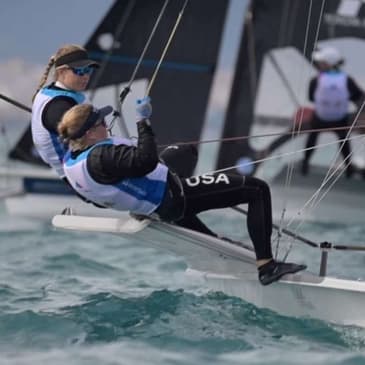
In Part 1 of my chat with two-time Olympian, Stephanie Roble, we discuss her techniques for mental preparation, visualization, and pre-race routines. We’ll also dive into starting strategy, boat handling drills, and decision-making under pressure, plus the intensity of an Olympic sailing program. Steph’s an elite skiff and keelboat racer, with World, National, and North American Championship titles across multiple sailing classes. The 2014 Rolex Yachtswoman of the Year, she partnered with lifelong friend Maggie Shea to pursue her Olympic dream, ultimately competing in two Olympics in the 49erFX Skiff. A great discussion with Part 2 coming next!
[00:00:06] Hello and welcome to another episode of Sailfaster. Thank you as always for listening. So in this episode of Sailfaster, I sat down with Stephanie Roble, who is a two-time Olympian, World Champion and Rolex Yachtswoman of the Year, and we dived into the mental, tactical and strategic elements that shaped her career. A native of Wisconsin, Steph began sailing at five and quickly got hooked. Her racing career really took off at Old Dominion University, where she captained the sailing team, earned MVP of the year.
[00:00:36] She did honors twice and was a two-time All-American. Post-college, she transitioned into elite keelboat racing and secured world, national and North American championship titles across multiple sailing classes. Indeed, her skill and versatility led to her being named the 2014 Rolex Yachtstool of the Year. In 2016, she partnered with lifelong friend Maggie Shade to pursue her Olympic dream, ultimately competing in two Olympics in the 49er FX Skiff.
[00:01:05] And along the way, she achieved two Pan American Games titles, world championship medals, multiple World Cup podiums, and a world ranking of third. Stephanie is now using her experience as an elite athlete to help others unlock their potential, which is an exciting new career direction for her, as you'll hear. I'm breaking our discussion into two episodes. In part one, Steph shares her techniques for mental preparation, visualization, and pre-race routines.
[00:01:32] We'll also dive into starting strategy, boat handling drills, and decision-making under pressure. Plus, you'll also hear about the intensity of an Olympic sailing program. So, much to enjoy here in part one. And as always, let me know what you think. Hey, Steph. Welcome to SailFast. I'm really thrilled to have you on the pod today.
[00:01:59] Hey, you're somebody who, quite a few of the listeners have asked me for. I ask people, hey, what guests would you like? And you very often come into that list. So, I'm thrilled to have you on the show. Yeah, thanks for having me. And I'm honored to be requested to be on this show and share the story of my sailing career with you all. I'm really excited for this conversation because I first came across you on the Sailsing website, which I think is the Inland Lake Yacht Racing Association.
[00:02:27] I think it's Rob Hudson put it together. And it's brilliant stuff. And it has you and your teammate, Maggie, just going through a lot of discussion about trim upwind and managing upwind, managing starts, that sort of thing. It's a great video. I actually, as I told you, I printed out screenshots of a lot of it, like when you broke the upwind leg into thirds. I found that super helpful. And I literally had them in my backpack pocket when I was racing.
[00:02:54] So, just the way you broke things down into really clear, actionable principles was really useful. Yeah. But let's go back to the start. How did you get to be a top sailor? So, I grew up in Wisconsin on a small lake. And actually, the day I came home from the hospital, my dad sailed around the lake with It's a Girl written on the sail. And I like to joke with them that little did they know what they were manifesting for me in life.
[00:03:22] But yeah, it was just around five years old. They signed me up for lessons. It was what everyone did in the summertime in Wisconsin. And so, you know, fully living the lake life, I was in lessons. And at first, I actually really didn't like sailing. It was very intimidating to me as a young sailor. And soon I realized, like, this is a fun way to spend time on the water with my friends. And, you know, we were chasing, like, greased up watermelons and playing sponge tag and swimming and capsizing the boat.
[00:03:52] So, Lake Beulah Yacht Club definitely did an amazing job of just introducing me to, you know, the love of the water. And that was really special for me. And then I started racing, like, on our, you know, our local yacht club races and won my first race and just kind of fell in love with the feeling of winning. And I just remember from a young age, like, having this desire to work hard and chase goals.
[00:04:20] And so that kind of just, you know, launched me to where I am today. I had a successful junior sailing career and went to Old Dominion University to sail in college and was a two-time All-American and then teamed up with Maggie after college to do some match racing for the 2012 Games. And we went our separate ways for a little bit. And she continued to pursue Olympic sailing while I went into a little bit of professional sailing.
[00:04:48] And then in 2016, we joined our worlds together again and started the Olympic campaign. You've had, you know, amazing success throughout your career. I think you've done at least two Olympics. So where are you now in your career? Because I know there's a bit of a transition moment for you. Yes, it is. So I've done two Olympics, two Pan Am Games, and now I am retiring from sport. It's hard to admit.
[00:05:11] I'm, like, even getting teary-eyed thinking about it because, you know, I really loved what I did with Olympic sailing. And it's really hard to say goodbye to something that I love so much. But at the same time, my tank is empty right now in the sense that, like, I don't have the energy to do what it takes to, you know, pursue another, like, successful Olympic campaign.
[00:05:37] So right now I'm in the middle of a transition, which has been full of ups and downs. But I just started a course to become a certified professional coach. And I'll focus on performance coaching. What I'd really like to do is work with athletes and business people to help with any roadblocks that they're having in pursuit of greatness. So can we step back to Olympics, though, for a second?
[00:06:01] Because you talked to me about just the sheer intensity of training for Olympics once every four years and how different that was versus other sort of championships that you've done. Can you sort of talk about that for a sec? Yeah, I mean, everyone is so good and everyone is working so hard. And it's really hard to find your edge in Olympic sailing. You know, everyone's putting in the same amount of hours as you.
[00:06:28] Everyone knows about how to achieve better settings. Everyone knows all these things. And it's really about how do you find, like, your secret sauce to perform on game day. And it's, you know, it's four years that you're training for this one event. And so you're putting all your eggs into one basket and really just, you know, you completely shift your lifestyle to around one question.
[00:06:53] And that's, will this make me one step closer to my goal? And it's an all-encompassing lifestyle. You know, it comes down to your sleep, your nutrition, your gym work, your mindset, your sports psychology work, your hydration levels, like all of that stuff. Plus what you know on the water, your settings, your execution on the starting line, your boat handling, your team dynamic, you know, all of this stuff.
[00:07:20] And then it's all about how you plan your year and how you peak throughout the year. And so there's so much more to it than just going out on the water and sailing. I can only imagine what it's like to sort of come down from that moment when it's behind you. How easily do you adjust to normalism? It's certainly not been easy, you know, after catching myself here to not get teary-eyed.
[00:07:45] But yeah, like I said, you put everything you have into this dream of standing on the Olympic podium. And, you know, I walked away from two Olympic Games not achieving that dream. So while I'm very proud of the campaign that Maggie and I put together and all of the work that we did, I'm incredibly proud of that. I'm also heartbroken because we didn't achieve the goal.
[00:08:11] So it's been a journey of just reflecting on, you know, the positives and everything that I learned and how I became a better sailor, a better athlete, a better teammate, a better human throughout the whole process. I know you talk about being disappointed, but representing your country at the highest levels of your sport in the Olympics is an incredible achievement on its own that 99.99% of people just dream about. You actually did it.
[00:08:41] So that's an actual achievement. It was a huge honor to represent Team USA on the world stage. And, you know, the feeling of representing not only yourself and your teammate and Team USA and our whole country, but we're representing our yacht clubs, our family, our friends and everyone back home.
[00:09:04] And so it's a huge honor to be able to do that, to show up on the starting line and have just the American flag and USA on your sail. You know, you're no longer USA 50 or whatever, you know, you're, you are USA and that is something that's really special. Oh, that's interesting. That's right. Cause it just says USA doesn't have your sail number or boat number. Yeah.
[00:09:27] So in, in your new careers, performance, high performance coach, and I heard you say for businesses as well as sort of sport teams, there's so much you should be able to take away from the intensity of the performance sailing that you've done.
[00:09:40] And I would venture that the fact that you have, that you didn't get to where you wanted to get that, you know, the absolute peak of, of what you want to achieve there must help as well, because that must give you a lot of empathy and understanding of, you know, people who struggle to reach their sort of performance goals in business and all sporting life. Yeah. Just wonder if that's, if that's true. Yeah, certainly.
[00:10:06] You know, I, I think the, the special thing is that as an elite performer, I have been in your shoes, you know, whether you're an Olympic or, you know, training for the Olympics or a young athlete looking to become an Olympian or a high performing business person. I've been in your shoes and like you said, I can empathize with what they're going through and all the highs and lows of the journey.
[00:10:30] And then also, you know, relate to what it takes to really show up and bring your best. And, you know, I'm looking forward to translating that into, into business with, you know, high performing executives. But I also look forward to, to translating that to athletes of all ages. Yeah. I, I, like many people I've, I've thought that, um, sailing has the complexity and intensity of business life very often where everything's changed. Yeah.
[00:10:59] Whatever plan you have goes out the window as soon as the gun goes very often. External factors, environmental factors, competitors get in your way. So there's, there's a ton of crossover, I think, between being able to manage all those things that go on on the race course, especially at the level that you've had it. There's tons of parallels with, uh, the, I was going to say the real world, but I suppose it's the real world. Yeah, totally.
[00:11:25] There's sailing is a great platform for, for business and for life. Like you said, you know, you make a game plan and all of a sudden it's changing and you have to adapt. And, you know, we experienced that on the race course all the time. And so that's just one simple example. But, um, I think sailing provides a really great platform for, for teaching all of those principles.
[00:11:47] So what I'd love to talk about is the preparation that goes on for you, uh, before, before agattas and the preparation you needed for the Olympics is, uh, is incredible, obviously. So let's start with sort of the mental space. How do you get into the right mental space for a big race or a big gatta? That's a big loaded question.
[00:12:08] It came down to developing a process and really putting a lot of time and effort into understanding what works for me and what doesn't work for me to, to get into the ideal performance mindset. And everyone's different. You know, some people need like a lot of anxiety and a lot of arousal to really like bring out their best. Some people don't need that and need to like focus on being a little bit more casual in their approach.
[00:12:35] And so for me, I was like, you know, very early on, I, I got lucky enough to get linked up with a great sports psychologist who taught me a lot about that. And then, you know, we, we did a lot of work on just like, how do we find this optimal state for, for me? And, you know, a lot of preparation is just, well, for me was like seeing it before I did it. And that really helped me a lot on the race course and then having processes in place for handling different things.
[00:13:05] Coming up on a big event, like a world championship or even the Olympic trials. And, you know, I would think I would have visualization sessions with myself and just, you know, think through like, okay, what, what points of the race course might I get nervous or be a little tight? And, you know, I'd reflect on those things. One point is when you come off the pin end and you go to make that tack to cross everyone.
[00:13:28] It's like, we have to have a good tack now, but how do you like, how do you make that tack happen without like putting that pressure on yourself in the moment, you know? And so I would visualize moments like that, or I would visualize before a windy day of sailing, really good bone handling downwind. Sailing the 49er FX in 20 to 25 knots in big waves is full on.
[00:13:53] And precise boat handling requires dry, you know, extreme, extremely precise driving around the waves and communication and awareness of what's happening around you. And so that was always like a nervous point for me. So, you know, I would definitely spend some time visualizing if the forecast is calling for a windy day. So I really believed in the power of seeing it before you do it.
[00:14:19] And then, like I said, I would develop a lot of processes for myself so that I didn't have to think about things. Processes allows you to just not have to, yeah, like I said, not have to think and you can just go. And that's how you get into your flow state, right? You just, you're not thinking, you're just doing. And so I had my process for the morning, the morning kind of checklist. And then I would have my process for pre-racing. It was all the things that I needed to do on the boat before racing.
[00:14:49] And, you know, I would make a playlist even for before every regatta. Like that was something really special to me to have like the right music going. It would change too. If it was a lighter day, I'd have a different vibe going than if it was a breezier day. And then once we got off the race course, we'd have that pre-race checklist. And so just really honing in on all of those processes so that I could just really focus on the now. And I had a process for resetting during racing.
[00:15:15] Like if something happened where I got frustrated or, you know, I made a bad move or whatever. It was like I had that process in place, so I didn't even have to think about it. It was just like stop, breathe. And then I'd say mantra to myself. The process and the list, were they actually written down? Or were they memory items that you'd memorized beforehand? I would write them down because I'm like, I'm a checklist person. So I would kind of like, you know, go through them. I knew them all at the end of the day.
[00:15:44] You know, I could recite them to you. But it just, it helped me, especially like if I was feeling really nervous, I could, you know, I could stay on task. And just like do that task really well. Okay, then next I'm going to do that task really well. And so having those processes in place doesn't allow time for your mind to wander. Yeah, I love that. It keeps you focused. And it also is some level of comfort for your mind that you can do something. There's something to do here. And then I'd love to go back to the visualization techniques.
[00:16:14] I do find that fascinating. The notion of sort of seeing before you do it. I totally get that. Was it about visualizing, if this is possible, your mental state? Or was it visualizing going through the operation of starting or tacking and the process involved in that? Or was it a bit of both? It was both. Yeah, definitely. There's, yeah, there's like the actual like physical, like visualizing how you're going to physically handle something. But then there was also like, yeah, the mindset component to it as well.
[00:16:44] Like before the Olympics, for example, the mindset goal was attack the starts. And so I would like, I would say that to myself and then like visualize what does that actually mean to me? How am I going to attack the start? What does that look like of how I'm positioning the boat and how I'm handling competitors around me, how I'm standing in the boat, how I'm, you know, if I'm, yeah, what I'm saying to myself in those moments. So there was definitely a component of both.
[00:17:12] And then going also, it sounds like you're also going through, okay, if that doesn't happen, if plan A doesn't happen, that, hey, we, you know, we can't port tack the fleet from the pin end. What's plan B? And presumably you were thinking through those sorts of operations as well. Yeah. And I think, you know, as, as I got, as I got older and more mature in my racing, I was able to like remove the emotion from the decision making, you know, and in that example, it's like, okay, plan A doesn't work.
[00:17:42] Like, how do we react to it? So if you react to it with like, like, you know, cuss word, cuss word, like this isn't working, you get all worked up and, you know, you have this emotional reaction to it. You're distracting yourself from your performance and what the next thing you have to do. Like sailing is such a fast paced sport with so many things changing all the time. And you can't give yourself that opportunity to be distracted. So really worked on like accepting, you know, when things would happen. So that plan didn't work.
[00:18:09] Like we didn't make that, that tack and cross, like accept, breathe and reset. You know, that's, that's what I was constantly telling myself. And so it's just like, how do you attack the next thing? And how do you attack the next thing? It wasn't, I didn't allow myself that space to, to get upset. Of course, I'd always slip up and have time. So I would, but it was all about like, how do we move on quickly so that we can keep the race going? Yeah, it's, that's really great advice, isn't it?
[00:18:34] That rather than panicking or becoming angry or letting your emotions take over from you, focus them on what am I going to do here? What's the alternative plan? How do I get through this? And how do I get out of this? Which is, is clearly the hallmark of great, great athletes, right? When things go wrong, what are the alternatives? Interesting. You're talking about attacking the start. Maura, who is our tactician, the goal for this season coming up is to get me to do much, be much more aggressive in the starts.
[00:19:00] So that's often about, you know, coming in on a port tack, debowing somebody to, and that is very intimidating for, you know, it will be sort of year three for me. Um, so I've been starting to think about how can I start just using visualization techniques to sort of let myself come up close to somebody closer than I normally would. And then, you know, tack on them and hit the line sort of thing. So, yeah. Yeah.
[00:19:26] I think so often when we're doing something new, it's easy to, you know, think about what, what's the worst that could happen. It's like, how do we shift our, our focus and mindset onto like, what's the best that could happen? Or, you know, like we're, we're so, as humans, we're so trained to, to think about like, oh, what's the worst case scenario here? And it's like, well, what's the best case scenario? And that, yeah, that's great. I'm going to take that onto the race. What's the best thing that could happen here? I love that.
[00:19:55] So do you practice any particular drills, you know, before the start? Are there drills that you do? Um, I mean, on our boat, what we've figured out that really helps us is just doing practice starts, setting the timer for two minutes, three minutes, and just going through that routine. So you start to, for me, especially start to feel where I need to be at the right time. I'm sure you do a lot more sophisticated drills than that. What do you guys do? Well, it's not really much more sophisticated than that, to be honest.
[00:20:22] You know, well, first of all, in the 49er, we would, we had very little time to get ready for racing. Our, we, we had to wait for a D flag to go up in order to launch. And so we usually had about 30 minutes of time from when that D flag went up until the start of the race. So we had to be very efficient with our pre-race homework.
[00:20:41] And, um, we would change, you know, the priorities based on what kind of day it was, but we would always make sure to get in pre-start boat handling and pre-start maneuvers and time and distance and do a practice start like you were saying. And, you know, when I think about the race course, like you can never be too good at starting and you like every time you do a start, you gain confidence. And that is absolutely critical for the first two minutes of the race.
[00:21:10] And that's critical for getting you up the ladder runs and getting to the first one or mark in a good spot. So yeah, you can never put enough energy into starting. And we really, we, we shifted that. I would say a year or two before the games into putting a lot more emphasis on the starting boat handling, like in the 49er. That's a really critical part of the start is, um, you know, double tacking or versing going forward, crabbing up to the boat to weather view. And there's a whole dance to the, to the game.
[00:21:40] And so we put a lot of energy into every day of racing of making sure that we had that boat handling dialed in. Um, cause it's, you know, the conditions are constantly changing. Some days you're going to be in 12 knots and swell, and some days you're going to be in, you know, six knots in flat water. And so you have to really like kind of to what you've already learned and remember those things again on race day.
[00:22:03] So I imagine your, your boat handling skills between the two of you and decision-making and pre-start maneuvers. You've done thousands of times. You must be, it's sort of somewhat surprising to me that you would go out there and sort of practice that. Is it more just about sort of figuring out what sort of day it is, what the, what the environment is like and just getting used to that.
[00:22:26] Right. Because you're not, I'm going to guess you're not really focused on tacking properly because you know how to do that. You've done it thousands of times. Yes. But also, like I said, each, each scenario is so different and, you know, constantly trying to push like how much you can push each situation. So, you know, it's, as we got better and better, so did our boat handling.
[00:22:49] And it's like, well, how can we get a little bit better at this and how, you know, you know, in practice for the couple of weeks before regatta, we'd be like, okay, we really want to nail this part of the double tack or whatever. And so, yeah, you're constantly refining everything. And so, yeah, we're, we would go out and do, we called it the flow drill. And so we would, on one whistle, we would double tack, two whistles, we would reverse or change flow. And in other two whistles, you'd go forwards and three whistles, you'd double tack into an acceleration.
[00:23:16] And we'd do tons of that just to get, get in sync with the conditions. I think it's really important. I've seen the videos of the 49er FX, isn't it? That how you approach the line and get very, very close to the line. This is not some keel boat starting 50 yards back. You guys are on the line or a yard short the line. And then it must be that race to accelerate.
[00:23:42] I mean, that's, and then I, once you've done that, I suppose then you're into clear lanes and keeping a lane and, and trying to spot a shift and being able to tack out of that. But that last few seconds is, is very, very intense in those boats. Yeah. Super critical. And it's all about like how you place yourself to those other boats. Everyone gets really close. Everyone's really close to the line, like you said.
[00:24:04] And so it's all about like that, that pre-start boat handling of, you know, how do we, if it's super light air, how do we stay just a little bit bow forward on the, on the boat to lure it of us? And you pull the trigger at the same time as that, because you're always just trying to be that little bit ahead, but obviously not too close to the line. And, and, you know, how do you use your double tack to set up better on the boats? When we're to do it, create that gap to lure it.
[00:24:27] And so, yeah, the, the, the final 20, 30 seconds of a, of a skiff start are super critical. I would even say the final minute are super critical to, to the success of your race. So I was intrigued by, uh, the videos of the practice races you do with competitive practice starts you've done with competitors. And that, that was interesting to me.
[00:24:50] Do you, um, do you learn a lot from your competitors in terms of, can you guess what their tactics are going to be at the start or what their strengths and weaknesses are at the start? Is it, I just wondered, it must be great practice, obviously, but you also get some intelligence from being around them. Yeah, for sure.
[00:25:10] I mean, we were definitely, I would say more focused on ourselves and just executing our maneuvers and our time and distance rather than, you know, oh, this person's strengths and weaknesses are this. But you, you, you certainly become aware of everyone's strengths and weaknesses because you, you race the same teams over and over. And especially in the year leading up to the games, you're, you're racing the same team.
[00:25:31] So, you know, you know, you know, who's loose on the starting line, you know, who's pretty dialed in and yeah, you know, but I, like I said, you end up, I think it's more powerful to just focus on you and building your skills so that you can start next to anyone on the starting line. You don't even care who's around you. You're, you're there going after your game plan. Okay. That's part one of my great discussion with Steph.
[00:26:00] In part two, you'll hear her share race course strategy, decision-making, and how to simplify complex situations. Steph also shares her approach to starting techniques, lane management, and tactical communication. So look out for that coming episode on Apple podcasts, Spotify, or wherever you get your favorite podcasts. In the meantime, thanks again for listening and so fast.