
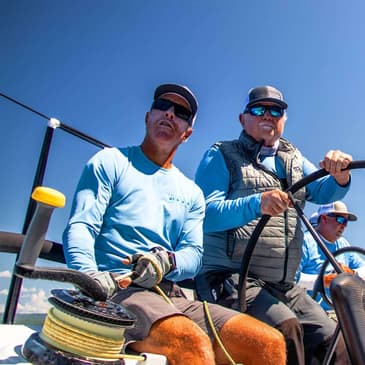
This week, Scott Nixon came back to Sailfaster to chat about his winning run on TP52 "Fox" at the 2024 ORC World Championships. Scott shares what it took to prepare for this event over four years, from nailing down teamwork and boat handling to bouncing back after losing wind instruments mid-race. We got into the nitty-gritty of sailing at the top level—how technology and instincts work together, why the TP52 class rules are always evolving, why you should focus on weaknesses, and why constant learning (and relearning!) is the secret to staying competitive. Scott’s got some fantastic tips to up your game: the value of recording your progress, using local races as training grounds, and focusing on the fundamentals like heel angles and smooth boat handling.
I really enjoyed the behind-the-scenes stories and practical advice; hope it inspires you to sail faster and smarter!
[00:00:09] Well, welcome to another episode of Sailfaster, the podcast for those who obsess about sailing faster than anybody else. And this week, I'm really thrilled because we have a returning guest and friend of the podcast, that's Scott Nixon. And Scott Nixon is QuantumSail's Global Offshore Wonderside Director here in Annapolis. And as you will know from our earlier episode that Scott was on, he sailed with Quantum customers to win championships at the World Gold Cup,
[00:00:39] European, North American, and national levels. He campaigns, coaches, and racers in almost every class of racing boat you can think of. You've got multiple world championships, including Melchized 32 and the J11 classes, which for me are probably one of them, you know, two of the most attractive sort of boats and classes out there. And, you know, the reason that we were talking today, the reason I asked Scott to come back is that he's added to his glittering hall of prizes the ORC TP52 World Championships.
[00:01:09] In the O-Fleet a few weeks ago in October, I think. So, Scott, congratulations on that win and welcome back to Sailfaster.
[00:01:16] Yeah, Pete, thanks so much. Great job with the podcast. We're getting a lot of comments from people listening to your podcast. And I think everybody really appreciates it locally and around the world. So, great job.
[00:01:26] Great. It's really nice of you say that. It seems to be gaining traction, which I love. It's great.
[00:01:39] When we were texting each other, I think you were up in New York, New York Yacht Club, for the prize giving, right?
[00:01:45] Yeah, just last week. Yeah, we went up there with the owner. It was a great cap for the season for him.
[00:01:51] You know, we won the ORC Worlds and the Yacht Club gave them, I think, Boat of the Year Award.
[00:01:56] So, we went up to their clubhouse downtown New York last week for a big prize giving and it was a lot of fun.
[00:02:00] It was a great wrap-up for the season and now, you know, I think as everybody wraps up the season, they look into 2025 and what happens next, you know?
[00:02:07] Yeah, you must be thrilled with that. I mean, I know you've got quite a few world championships, but that's a big one, isn't it?
[00:02:12] It's a new class, right, as I understood it.
[00:02:14] Yeah, it's a really big deal. I mean, this owner I've been sailing with since 2017.
[00:02:20] His name is Victor Wilde. He lives in San Diego, a businessman out there.
[00:02:23] He has a wonderful wife, Andrea, who helps run the program and just really great people.
[00:02:27] I think he's had three or four 52s now.
[00:02:31] I sailed with him on one previous to this one, the original Fox.
[00:02:35] And then this boat that won the Worlds, he built specifically for, back then it was the IRC-ORC Combined Worlds.
[00:02:43] It happened in 2020, but obviously COVID happened and that regatta was canceled and kind of put him in a pickle, right?
[00:02:49] He's got a boat in Spain getting built for this regatta in 2019 and the regatta gets canceled.
[00:02:54] So he improvised and put a great team together.
[00:02:58] And we went around and just did a bunch of events, did the Great Lakes circuit a bunch of times out in the Great Lakes, Lake Michigan.
[00:03:06] With that circuit out there, as that circuit started, you know, we were kind of one of the first boats out there doing that.
[00:03:10] And then we did all the Florida events and a couple events over in Nassau and different events like that to train for this.
[00:03:17] And then obviously this was the icing on the cake because it was kind of the goal for this boat to do it.
[00:03:22] So we just had to put it off another four years.
[00:03:24] And basically we trained for four years for this regatta.
[00:03:26] So it was a great culmination to win it.
[00:03:28] Yeah, I remember when we last talked, which was in the spring, this was one of the races or regattas that you were most looking forward to.
[00:03:34] I remember you talked about that.
[00:03:36] So you won five out of seven races off Newport, right?
[00:03:40] Was it as straightforward as that sounds?
[00:03:43] Yeah, I mean, obviously I've never done this ORC Worlds event before, but it's been going on.
[00:03:47] It's only been in the States once before.
[00:03:49] I think it was 25 years ago.
[00:03:51] So a lot of us in the States have never done this regatta.
[00:03:54] It's always been happening in Europe.
[00:03:55] And obviously ORC has been embraced in North America and it's going really well.
[00:03:59] I mean, Annapolis Yacht Club embraced it early on.
[00:04:01] And now all our local events are ORC and you're kind of privy to the J-105 stuff.
[00:04:05] So you don't have to deal with all this rating stuff.
[00:04:07] But I think the rule is well received, unlike PERF and some of these rules in the past where you have a kind of a committee, you know, getting together and picking out the rating.
[00:04:16] And obviously it changes if you do bad or do well or whatever.
[00:04:19] But this thing is very subjective.
[00:04:20] They look into all the sail sizing, the boat weight, the crew weight.
[00:04:24] There's tons of aspects that go into it.
[00:04:26] And the ratings are pretty fair.
[00:04:27] And, you know, this regatta has been going on for a while.
[00:04:29] And it's a long event.
[00:04:31] It starts, it's a whole week event.
[00:04:33] It starts out with a really long 33-hour race, 200 miles.
[00:04:38] So that's the very first day, first race.
[00:04:40] And then as soon as you finish, you kind of rest up.
[00:04:43] And the following day you do a couple days of winter leward racing.
[00:04:46] And then you ended up with a short coastal race of 60 miles.
[00:04:51] And then the last day is one more distance or winter leward race.
[00:04:55] And that elapsed a week.
[00:04:57] But, you know, it's a whole program to get together and save your time and energy and make sure you're prepared for that event.
[00:05:04] Because any little weakness, you get exposed in that.
[00:05:07] Because a lot of stuff can happen in the distance races.
[00:05:10] We were really fortunate for this Newport Worlds.
[00:05:12] The weather was crazy nice.
[00:05:13] It was basically 10 to 17 knots every day.
[00:05:17] Just beautiful in Newport.
[00:05:18] So super light winds or heavy winds.
[00:05:20] So no crazy breakages.
[00:05:21] But it was a great event.
[00:05:23] I read that you did have an issue, right?
[00:05:24] You lost wind instruments when a halyard slipped or something?
[00:05:27] Yeah, we had the very first race was kind of a run out of Newport Harbor.
[00:05:31] And we're going down to the NOAA buoy off of the tip of New York, just south of Montauk.
[00:05:36] Going downwind with a reaching spinnaker up.
[00:05:39] And we went to transfer the halyard off of the bitch winch in the middle of the boat.
[00:05:45] And when we did that, it was just hanging on the clutch.
[00:05:47] And it was pretty wavy and surfing.
[00:05:49] And the boat surfed down a wave.
[00:05:50] And the halyard loaded and slipped about five feet really fast.
[00:05:55] And when that happens, the tip of the mast kind of went forward.
[00:05:58] And it flipped the wand off the mast.
[00:06:00] And the wand is just a big, tall carbon stick that holds the wind data on there for all our B&G instruments.
[00:06:05] So this happened within three hours of the race, four hours of the race.
[00:06:09] So basically, we had to go into the evening and the night and the next morning with no wind gear.
[00:06:14] Which, you know, when you sail these boats, we work on target sheets.
[00:06:17] And there's targets for everything possible.
[00:06:19] And without wind gear, we had to go old school.
[00:06:21] So it was really cool.
[00:06:22] We just strapped on some flashlights, put them on the telltales and sailed the boat the best we could.
[00:06:26] And it worked out pretty well.
[00:06:28] At times, we were leading the race.
[00:06:29] Other times, we were pretty deep in it.
[00:06:30] But we ended up pulling a second out of that race.
[00:06:32] So that was a really good saver.
[00:06:34] And I think it goes credit to the team for not panicking when that happened.
[00:06:38] It was just a small mistake with that slipping.
[00:06:40] And we dealt with it.
[00:06:41] You still have GPS, did you, for course over ground, speed over ground?
[00:06:45] Yeah, basic speed data, no problem.
[00:06:48] Just, you know, the sails that we've developed and the apparent wind sailing that you do downwind on these boats.
[00:06:52] Really important to have.
[00:06:54] It's so nice to have a apparent wind angle up at night when you're driving these boats to a code zero or a reaching spinnaker.
[00:06:59] General stasels up all that.
[00:07:01] You know, it's really apparent wind sailing.
[00:07:02] So to not have that data, it just makes it harder.
[00:07:04] It's doable.
[00:07:04] But, you know, we had some great, great guys on board that were able to deal with it.
[00:07:07] Yeah, it's the old-fashioned way, isn't it?
[00:07:09] Doing the old-fashioned way.
[00:07:09] That's cool, for sure.
[00:07:11] Yeah.
[00:07:11] We lost our wind instruments and we lost our Velocitech in one regatta here in Annapolis.
[00:07:19] And it was our best result ever.
[00:07:21] Is it?
[00:07:22] It's a great thing to think about, you know, because when it happens, I think you, obviously, I feel like you have to focus harder, right?
[00:07:27] You have to focus on, you know, your boat speeds.
[00:07:30] And you have to basically be, you know, cognizant of what the wind speed is blowing.
[00:07:35] Is it blowing eight?
[00:07:36] Is it blowing 10?
[00:07:37] It's hard to tell, you know, but on 52, eight-knot target and a 10-knot target are pretty different.
[00:07:41] So you kind of got to do your best to figure out what it is and just sail your boat speed targets that are posted for that wind speed and, you know, do your best at the apparent wind angle.
[00:07:49] But, yeah, it's Seize the Pants sailing.
[00:07:51] And we all learn that sailing small boats and dinghies.
[00:07:53] And I think that's why you see the really good guys that have done well in the sport.
[00:07:57] It's so much easier for them when they come up from smaller boats, you know, sailing lasers and the foiling moths and all the little boats.
[00:08:03] Now, these kids are so good because they're so used to apparent wind sailing.
[00:08:05] And then they get on a boat with instruments.
[00:08:07] Once they figure that out, they just have that other background that they just keep learning faster and faster.
[00:08:13] Well, amazing.
[00:08:13] The TP-52 is a beautiful looking boat, isn't it?
[00:08:16] And I was doing, as I said, a little bit of research before you jumped on the call.
[00:08:21] They're built to box rule.
[00:08:22] I knew that.
[00:08:23] But what I didn't know is that the rules also evolve over time.
[00:08:27] So the box rule is essentially that the boats can fit within a described box, essentially.
[00:08:34] But at the time, the TP-52 rules change, don't they?
[00:08:38] Over each sort of build, there's bigger keels, reduction, displacement, weight savings.
[00:08:44] Do those changes turn into tangible advantage on the race course?
[00:08:48] In other words, do the new boats built to the latest rule tend to excel?
[00:08:53] Do you see that?
[00:08:54] Yeah, for sure.
[00:08:55] I mean, I think I'm not a great 52 historian, but basically the boats originally were built to do the TransPak.
[00:09:00] You know, that's why it's called a TP-52.
[00:09:02] It's a TransPak-52.
[00:09:03] It was built to sail from California to Hawaii.
[00:09:05] You know, most of that race is downwind.
[00:09:07] So the boats are super high performance.
[00:09:09] They go really well off the breeze, reaching and running.
[00:09:12] They're very flat, low drag boats, so super fast downwind.
[00:09:16] So that boat just was popular when that came out to do that race.
[00:09:19] And people started getting involved with it in Europe and the U.S.
[00:09:22] And that's when they started the Super Series.
[00:09:24] So the Super Series basically adopted their own rules.
[00:09:27] And that's where they basically created this box rule.
[00:09:29] It's kind of like Star Class has a box rule where you can have, you know, so big of a rudder, so small of a rudder.
[00:09:35] The keel sizing, the keel weight, the weight of the hull, the deck, all there's a whole bunch of different rules.
[00:09:41] Mass height, sail sizing, mains jibs cut, all that goes into a box.
[00:09:45] So in the Super Series, you have to be in that tight box.
[00:09:48] So there's a very low tolerance there.
[00:09:50] Boats get measured and they're all very even.
[00:09:52] But for sure, like anything, like F1 and everything else, people learn as you move on and get more time in these boats.
[00:09:59] And things have evolved and changed.
[00:10:00] And, you know, technology's changed.
[00:10:02] The rigs are better, stiffer, lighter, taller.
[00:10:05] Prods are gotten longer.
[00:10:06] But, yeah, I mean, the 52 Super Series every, I don't know if it's five years, they update their rules to go, okay, we want to make the boats go faster.
[00:10:13] So they make a deeper keel, a heavier keel, a larger mainsail, larger prod.
[00:10:18] So they always look at doing that.
[00:10:19] But for sure, the newer boats that come out seem to be pretty quick.
[00:10:23] But it's interesting to see, like in the Super Series this year when you followed it, I think there were three or four new boats.
[00:10:28] And, you know, they normally come out of the box not so fast.
[00:10:31] And they eventually will get there and be the fastest boats.
[00:10:34] But it takes so much time to develop every little thing in these boats.
[00:10:38] You know, the sails, the sail trim, the sail shapes, the depths, how you sail the boat, how you trim the boat.
[00:10:44] The masts are totally adjustable with a hydraulic headstay.
[00:10:47] You can move the butts fore and aft.
[00:10:48] So a lot of adjustments there to get these things developed.
[00:10:51] And it just takes time.
[00:10:52] You know, when we won the five out of the seven races at the Worlds, it seems like an easy thing to do.
[00:10:57] But I just think that we worked harder than anybody else over those four and a half years.
[00:11:02] And we knew our boat really well.
[00:11:04] We knew our sail sizing very well.
[00:11:06] And I think we were pretty fast.
[00:11:08] And it made it look easy.
[00:11:09] But it was anything far from being easy.
[00:11:12] Yeah, I'm sure.
[00:11:13] I'm interested in talking about the preparation a little bit later in the podcast.
[00:11:17] But firstly, what was your responsibility?
[00:11:21] On Fox, I do runners.
[00:11:22] So I'm in the back of the boat controlling the running backstay.
[00:11:25] And I work with the speed team, basically the trimmers, Chris Hoskins, the main trimmer, and Cicho, trimming upwind and downwind.
[00:11:33] And we have different rig settings and adjustments to keep the boat set up for all the different wind speeds.
[00:11:39] And my job is to help make sure the running backstay is in the right spot and change the rig as needed for rake headstay tension and butt from the back of the boat.
[00:11:49] Can you give us a sense of what that's like in the moment, say, in the last minute before the start and rolling through the start?
[00:11:56] When you're doing the stays, is there a lot of movement in there as you're doing pre-start maneuvers?
[00:12:04] Or do you have things set for that upwind leg?
[00:12:06] I don't need you to give away any compared to the frequencies.
[00:12:10] I was curious.
[00:12:11] It's a bit tricky back there because obviously there's running backstay.
[00:12:14] So if you're on starboard tack, you know, the starboard runner's on.
[00:12:16] And if you tack or jibe, then you've got to ease one runner and get the other runner on.
[00:12:21] And then obviously as it gets breezier, you know, the running backstay is holding the mast up.
[00:12:25] So my whole goal in life is just to make sure the tall black carbon stick in the middle of the boat stays up in one piece.
[00:12:31] So that's kind of the goal.
[00:12:32] But the 52s now, most of the boats have driven runners.
[00:12:36] So that means the pedestals in the back of the boat where the grinders can click in and they can move the winches on the running backstays and then the main winches.
[00:12:47] And then the pedestal in the front controls the primary winches.
[00:12:50] And these guys can switch back and forth, you know, on a spinnaker drop or a spinnaker takedown.
[00:12:55] They can control all the winches and pull the sails up, you know, pull the spinnaker up and down really quick.
[00:13:00] But, yeah, so I just basically pull a line while the big guys are grinding the runners on and off in the big breeze.
[00:13:05] And I just we have certain tensions.
[00:13:07] You know, we go to 16,000 pounds, like nine ton, nine and a half tons max tension on those boats.
[00:13:13] So that's quite a bit of load in your hand.
[00:13:14] And the good runner trimmers are normally main trimmers because basically you're fine tuning the mainsail shape and the headsail shape with the runner.
[00:13:21] Right. As the breeze comes on, you want to be tightening the runner to flatten the sails and twist the sails so the boat releases and goes faster.
[00:13:27] I always try to sail with, you know, four, four and a half degrees of rudder on the boat.
[00:13:32] So basically we can ease the backstay to power up the sails and add more rudder load or we can do vice versa, go tighter to release it.
[00:13:40] So it's just kind of staying in tune with the targets.
[00:13:43] I'm always looking at the boat speed, the wind angles, the runner and then all our targets.
[00:13:51] And just to make sure we're as close to there as possible.
[00:13:52] And then obviously the trimmers will chime in.
[00:13:55] OK, this is good runner for me on the headstool.
[00:13:57] We'll take a little bit more on the main, but if you can take it and they'll have a dialogue between that.
[00:14:01] And I just kind of make sure that the runner is a good medium for the main and the chip trimmer.
[00:14:05] Is it a constant conversation or is it pretty quiet on the boat because you don't need direction or you don't need to tell people what you're doing?
[00:14:14] Yeah, the goal is to have a quiet boat, but it takes a long time.
[00:14:17] You know, we've the three of us have been sailing together for a while.
[00:14:20] So I think it's gotten somewhat quiet.
[00:14:21] But in the heat of the moment, obviously people chirp up and somebody gets behind.
[00:14:26] Obviously, you get you get talking pretty fast.
[00:14:28] But the goal is to keep the boat out of a target heel angle.
[00:14:30] So the runner has a lot to do with that.
[00:14:32] The main sheet can only do so much.
[00:14:34] So the last, you know, 10 percent of the performance is really in the runner.
[00:14:38] So just got to stay fine tuned on that.
[00:14:40] So I do have probably a very amateurish question for you about when you're trimming the main on the TP52, which I know you've done before.
[00:14:49] Do you trim two marks on the sheets as we do in the sort of the Corinthian leagues?
[00:14:55] Or do you just have feel from just experiences as a sailmaker?
[00:15:00] Yeah, that's a great question.
[00:15:01] I mean, on the bigger boats, the main sheets are continuous.
[00:15:04] So you can't really get to a mark, if that makes sense.
[00:15:06] So the main sheet can go through itself.
[00:15:08] So it's one continuous line.
[00:15:10] So marks really don't help with that.
[00:15:12] A lot of the boats now, we sail with load cells.
[00:15:15] So, you know, you basically get muscle memory the more you trim main or even head sole in the boat.
[00:15:20] You know, you kind of have a feeling on the winch of how many wraps you have for 10 knots of wind speed and how loaded it feels in your hand.
[00:15:27] And then you look at your main sole and try to get the cambers and the draft right for that wind speed.
[00:15:32] But it's kind of muscle memory.
[00:15:33] But the load cells have helped a little bit.
[00:15:35] We have load cells on the Vang now, which is the same way as continuous purchase down below.
[00:15:39] So it's hard to see where your Vang settings are.
[00:15:41] So we have we've developed targets for main sheet loads and Vang loads.
[00:15:46] So that kind of gets you in the ballpark.
[00:15:47] But again, fine tuning is just a feel thing and just takes time, time in the boat.
[00:15:51] So the load cell will tell you how much strain there is, how much pressure there is on that.
[00:15:56] Exactly.
[00:15:56] Yeah.
[00:15:57] Exactly.
[00:15:58] I mean, all the data, which is neat about all these boats, I mean, all the race boats now at the high end have, you know, the full software programs down below.
[00:16:04] All the information from the BNGs, all these load cells gets loaded.
[00:16:08] It goes into a program called the Nord Player, which we have access to online.
[00:16:13] And so basically all the race boats, the 52s, the 72s, the cup boats, they basically take all the data per day from the boat and it goes to a company in Spain called K&D Software.
[00:16:25] And they download all this information.
[00:16:28] They overlay it with all your targets and all the data you've worked on over the years, you know, for us.
[00:16:33] And then they send you a report that night or in the morning and it's, you know, probably a 15 page report with data for how close you sailed to target runner load, upwind, how close you sailed to apparent wind angle downwind, how close you sailed to heel angle, upwind and downwind.
[00:16:50] So there's tons of graphs and charts that you can kind of analyze and go, okay, you know, we sailed too soft a main sheet here.
[00:16:55] We need to get more rudder.
[00:16:56] So then you update that in the system to get your data more accurate.
[00:16:59] But that's kind of the execution of how these teams get better.
[00:17:03] And it's basically trickle down technology from the cup guys.
[00:17:06] Wow, that is absolutely amazing.
[00:17:08] I didn't know that.
[00:17:09] So in the after race or the next morning, who reviews that?
[00:17:12] Does the tactician review it?
[00:17:14] We have, I mean, most of the top teams, for sure, the Super Series guys and even the top GL 52s and the ORC 52s have coaches that come in.
[00:17:22] And a lot of these coaches are the same coaches from the Super Series on the 52s.
[00:17:25] And they kind of lead the charge on that.
[00:17:27] You know, our coach is Brett Jones, who's just an amazing guy, works for Quantum Sales here.
[00:17:32] He's our sail designer for all our 50s and Grand Prix big boats.
[00:17:36] So he's, you know, we're fortunate enough we have him for a full-time coach on the Fox.
[00:17:39] So when we sail, he's in the coach boat.
[00:17:41] He has access to all the data on a screen on his laptop and an iPad on the Protector Chase boat.
[00:17:49] So he can see real-time what's going on.
[00:17:51] So obviously, practice-wise, before the race or during a practice day, you know, he's behind us going, okay, your Vang load's only, you know, half a ton.
[00:17:59] Pull on another half a ton of Vang.
[00:18:01] And he really helps us develop and move forward.
[00:18:03] So he's the guy that's responsible for the debriefs.
[00:18:06] And he'll get together, digitize the sails.
[00:18:08] We'll look at sail shapes and look at the data and see where he did well and can, you know, other areas where we're not going well and can improve upon.
[00:18:15] Yeah, I had Tom Burnham, super coach Tom Burnham on the podcast the other day.
[00:18:20] And he did a lot of sailing over the years with Terry Hutchinson on the quantum, as you probably know very well.
[00:18:27] So it was great.
[00:18:28] Brett coaches the quantum racing as well.
[00:18:30] So Tommy and those guys are very familiar with all that whole process.
[00:18:33] But yeah, they're the guys that helped develop this whole setup and process.
[00:18:36] And it's amazing how fast you learn.
[00:18:38] And then you feel like you know nothing after these debriefs because you still have so much more to learn.
[00:18:42] But it's really amazing to see.
[00:18:44] Gosh, yeah.
[00:18:45] Let's talk about preparation.
[00:18:46] I love the quote that you said on our last meeting, which was, it's the will to prepare to win that really makes a difference for the guys that win and do well.
[00:18:55] So it's that will to prepare to win, which I thought was interesting.
[00:18:59] How did you prepare for the ORC World Championship?
[00:19:02] Firstly, sort of as an individual.
[00:19:04] And then as a team.
[00:19:06] I know it's a big question.
[00:19:08] I'm sure you did tons and tons of preparation.
[00:19:10] But anything that you can sort of relate to us from that?
[00:19:14] Yeah, yeah, sure.
[00:19:15] I mean, I think, you know, the benefits of doing a long term program and like, you know, if you said, you know, you were going to hire me to coach your G205 program to do well with the North Americans in two years.
[00:19:24] I mean, the more time you have, the more options you have as far as, you know, what you can develop, what you can work on.
[00:19:30] And we've sailed enough that we knew exactly where our boat was good and obviously where our boat was bad.
[00:19:36] So, you know, our boat's a newer boat.
[00:19:39] It's a really wide, beamy boat.
[00:19:40] It goes well off the breeze and it goes well when it's healed over.
[00:19:44] It goes well when it's reading.
[00:19:45] But when it's light air, the boat needs a lot of juice and a lot of power.
[00:19:49] So, you know, we've worked on developing, you know, really full, deep sails and large sails.
[00:19:55] And obviously with ORC, you play in that rating game of you go too big a main, too big a Spinnaker.
[00:20:00] Your rating gets hurt a little bit.
[00:20:02] But then, you know, we've sailed enough so we kind of know what rating band we want to be in and how to develop the sails from there.
[00:20:06] But, you know, it just takes time to do all that.
[00:20:08] So the more data points you have, the more you can work on that stuff.
[00:20:11] And it just takes time.
[00:20:13] You know, it's hard to do.
[00:20:14] With a smaller one design program, you know, when you go out sailing in a big regatta.
[00:20:18] I know here we're fortunate in Annapolis.
[00:20:20] Like when you sail your boat on Wednesday nights, we sail with, what, 28 boats.
[00:20:23] So you know that if it's a downwind start, oh, my gosh, historically I've had really bad downwind starts.
[00:20:28] So that's something that you can address and work on, watch video and drone footage of,
[00:20:32] and figure out how to do a better job getting the boat off the line downwind if that's one of your weaknesses.
[00:20:36] So I think that's kind of a neat thing to look at, you know, when you're developing stuff is, you know,
[00:20:40] obviously you want to keep your strengths a strength,
[00:20:43] but you really want to work on your weaknesses.
[00:20:45] And I think that's the biggest thing we did with the Fox program is just make sure that the boat was,
[00:20:49] you know, whether we got five knots or 25 knots at the Worlds, we were prepared and ready to go.
[00:20:54] We knew our settings.
[00:20:55] We knew our targets and could get the boat through all the wind changes and had the sails developed to handle all that.
[00:21:01] So it just takes time.
[00:21:02] It's easy to say, you know, just go out there and do it, but it just takes time to do it.
[00:21:06] You know, it takes time and effort and obviously money to get sails built and time on the water to test everything.
[00:21:11] Yeah, it's an interesting question, isn't it?
[00:21:13] I find about strengths and weaknesses that in lots of sports, whether it's tennis or soccer,
[00:21:18] but you tend to focus more on your strengths because you know you've got weaknesses,
[00:21:23] but you want to focus on your strengths because that's what's going to win the game for you.
[00:21:27] Yeah, I'm a big soccer fan.
[00:21:29] So Jude Bellingham, who is an English player, fantastic going forward,
[00:21:33] but is not the person who's going to, you know, tackle back and that sort of thing.
[00:21:37] But you don't worry about that.
[00:21:38] You just focus on playing to his strengths.
[00:21:41] Don't worry about the weaknesses.
[00:21:42] But in sailing, it's different because the weaknesses will lose you a race, obviously, right?
[00:21:47] If you screw things up at any mark or at any point in the course,
[00:21:51] because it's something you haven't practiced enough on, then that can end your day.
[00:21:56] So it's quite interesting that, you know, even professional sailors like you guys,
[00:22:00] you spend a lot of time trying to iron out those weaknesses.
[00:22:03] I find that really interesting.
[00:22:04] Yeah, for sure.
[00:22:05] It takes a discipline to do it, right?
[00:22:06] And credit to, I mean, Andy Horton is kind of our tactician and helps run the program
[00:22:10] and does a great job.
[00:22:11] And he really, you know, pushed hard to address some of the weaknesses we had as far as,
[00:22:15] you know, reaching and some other issues and just made us ask the hard questions
[00:22:19] and made people develop and think about that and work towards getting better at that stuff.
[00:22:23] It just takes somebody asking the hard questions to get it done.
[00:22:26] So I suppose that the, as you talked about, you know, the boat was new to you,
[00:22:30] the sails are new to you.
[00:22:32] So it's trying to figure out how to make that work, which is, you know,
[00:22:34] you talked about F1.
[00:22:35] It's very, quite similar.
[00:22:36] Isn't when they get a new F1 car, it takes some practices and races to figure out how
[00:22:41] to set it up properly.
[00:22:42] But is it also, it sounds also like the just boat handling and coordination that comes into
[00:22:48] it as well.
[00:22:48] It's not, is that, although some of the, you know, it's, I hesitate to say weaknesses
[00:22:52] because you're, you know, top class sailors, but some of the things that you need you
[00:22:55] to work on.
[00:22:56] For sure.
[00:22:57] I mean, you can put, you know, these boats sail with between 12 and 14 people, depending
[00:23:00] on, you know, what you do and what the wind strength is.
[00:23:03] But when you have that many people, no matter how good everybody is, it just takes coordination
[00:23:07] to know what each person does at the right time.
[00:23:09] And, you know, we have a playbook.
[00:23:11] Most of these top teams do have a playbook developed for every maneuver and it gets pretty
[00:23:15] elaborate.
[00:23:16] And if one person is missing, one grinder didn't show up or somebody gets hurt or is missing
[00:23:20] that day.
[00:23:21] It really takes its toll and it's hard to get through the basic boat handling, right?
[00:23:25] Obviously in super light air and big breeze, the boat handling is really important.
[00:23:29] And in medium speeds, it's really important to be fast.
[00:23:31] So just that coordination of 13, 14 people doing that all the time, again, it just comes
[00:23:36] back to timing the boat to make sure Rabbi's comfortable with that.
[00:23:39] But it takes, you know, it takes a while like any team sport.
[00:23:41] It's just the more you work together, the more, you know, you'll improve and do better.
[00:23:47] Tom Burnham said something interesting about the America's Cup, which could be different
[00:23:50] when I tried out with you.
[00:23:51] He talked about a little bit of a struggle.
[00:23:55] A challenge for him was trying to get hours on the boat in terms of boat handling and
[00:24:00] sail trim when there was so much technology that that was sort of the technology side of
[00:24:07] it was eating into the sort of the available time.
[00:24:10] I'm guessing that the TP52 is, it's a high-tech platform, but it's not in the same league as
[00:24:17] a foiling, you know, AC40 or something like that.
[00:24:20] Is that a challenge for you, that trying to find time for boat handling versus the technology?
[00:24:27] Yeah, I don't think so.
[00:24:29] I think the biggest saying, Tommy and Terry and those guys are talking about, I mean,
[00:24:32] there's a simulator, right?
[00:24:34] So it's time in the simulator to time on the water.
[00:24:36] So I think a lot of those teams and obviously Team New Zealand with the best simulator out
[00:24:41] there still dominating the Cup scene, I think that racing has changed so much where it's
[00:24:46] probably a fine balance of how much time do you want on the water or how much time do
[00:24:49] you want in the simulator?
[00:24:50] I imagine you want as much simulator time as possible where, you know, these monohulls,
[00:24:54] we don't have simulators.
[00:24:55] So it's just the old-fashioned time on the water.
[00:24:58] And yeah, it just, it takes time.
[00:25:00] But sure, you have to be able to go to regatta.
[00:25:03] Like our next regatta is down at the Miami Palm Beach race in a couple of weeks.
[00:25:08] And it's not a big race, it's only a 60-mile race up the coast.
[00:25:11] But, you know, you try to practice for the conditions that the race will be.
[00:25:14] So if we start training on Monday for the regatta on Friday, obviously, if it's five knots
[00:25:19] on Monday and it's going to be a 25-night race on Friday, there's not a lot you can do
[00:25:24] to prepare for that.
[00:25:25] You hope you get similar conditions.
[00:25:27] And when you do get those conditions, you go out and do everything you can do to make
[00:25:29] sure you're sorted for that race.
[00:25:31] I know that you guys are working on some different sales, some new sales for Fox specialty
[00:25:38] reaching sales is what I saw that have been developed for the last, you know, couple of
[00:25:42] years.
[00:25:43] Improvement said it will sort of trickle down to the sort of retail sales that the rest
[00:25:47] of us will see.
[00:25:48] Yeah, for sure.
[00:25:48] I mean, I think some of the sale makers and another company out there has developed some
[00:25:53] structured left soft spinnaker.
[00:25:55] So basically, everybody knows about the structured left head soles with more fibers running down
[00:26:00] the sales from the tack to the head.
[00:26:02] So you basically have more higher control or kind of have control to be able to move the
[00:26:05] draft fore and aft and really change the sail shape easily and get one sail through a variety
[00:26:10] of wind ranges.
[00:26:11] Reaching spinnakers are similar as well, you know, where you have a soft sail that's very
[00:26:15] pliable and moves a lot.
[00:26:16] And as you sail tighter apparent wind angles, obviously the loading increases and it's hard
[00:26:20] to have a soft sail that can basically hold tighter loads as you sail, you know, tighter
[00:26:25] apparent wind angles, especially when the breeze comes up.
[00:26:27] And you want to sail that stable that doesn't fall off, doesn't twist, has good entry.
[00:26:31] A lot of the sail makers and us included have been working on this, adding fibers and basically
[00:26:36] membrane luffs to sails.
[00:26:38] Adjoining that membrane luff to a soft polyester spinnaker has been the trick.
[00:26:43] And once that's accomplished, you get a pretty nice sail that's very stable.
[00:26:46] So basically, you have good sheet control.
[00:26:49] You can sail tighter apparent wind angles without the sail collapsing.
[00:26:52] And basically, it helps narrow the gap between, you know, guys that have code zeros and
[00:26:56] normal soft sails, a pretty big gap there on apparent wind angles of what sails fill
[00:27:00] in on there. And historically, these soft sails weren't great at that because they're,
[00:27:04] they don't last forever.
[00:27:06] They get disassembled and shape changes and get distorted pretty easily.
[00:27:10] So these new sails really help keep the boat stable.
[00:27:12] And we've seen direct straight line, faster speeds with them.
[00:27:15] And then obviously the sizing is a big thing on rating.
[00:27:18] You had to look at your rating size and figure out the proper size of that sail.
[00:27:20] But it's definitely trickling down.
[00:27:22] I've already sold some sails for some local boats here that do some point-to-point racing
[00:27:26] and are geared up towards the Annapolis to Newport race this summer.
[00:27:29] And just some of our bay races, you know, they reach over here to cross the bay.
[00:27:33] These sails are really good for that.
[00:27:34] Is that same sail technology in the new J105 Spinnaker from Quantum?
[00:27:39] The J105 Spinnaker is just a normal soft sail.
[00:27:43] I mean, we're limited in that class by the weight of the sail.
[00:27:46] It has to be a certain weight.
[00:27:47] So that's just a normal soft sail.
[00:27:49] And you guys with class racing are just doing winter lure racing.
[00:27:52] So these sails are more tight apparent wind angle reaching sails.
[00:27:56] Okay, Scott, something I have to ask you that even as, you know, a vastly experienced sailor
[00:28:00] like you, are you still learning?
[00:28:02] Is there anything you learned this year?
[00:28:03] Yeah, I think the biggest thing from sailing on the bigger boats and even the smaller one
[00:28:07] designs is just relearning some of the old rules that we've always addressed.
[00:28:11] You know, obviously, you know, keeping it simple, keeping maneuvers down, time the boat
[00:28:15] pays off.
[00:28:16] But I think one thing that kind of stands out to me, you know, sailing with guys like you
[00:28:20] on Wednesday nights here in the J105 in Annapolis or doing the Meldus 24 Worlds
[00:28:25] in San Fran this summer.
[00:28:26] With some of the devices that we have to display heel angle, the heel angle is such
[00:28:30] a big tool now that, you know, all our targets and polars are specced towards certain heel
[00:28:36] angles, you know, upwind and downwind.
[00:28:37] So if you can minimize the time your boat's not sailing at the correct heel angle, you're
[00:28:43] going to hit targets more and be a faster boat.
[00:28:45] You're going to perform better boat on boat and be able to, you know, tactically get out
[00:28:48] of situations.
[00:28:55] To a lot of people, especially with the valcros and all the different instruments we have now,
[00:28:59] that heel angle is really important.
[00:29:00] Yeah.
[00:29:00] I learned that my B&G can give me heel angle, which is great.
[00:29:06] For me, it's just something else that my crew can shout to me about when I sit around.
[00:29:10] You can also yell at them and say, hey, you have to hike harder.
[00:29:13] We're 25 degrees.
[00:29:14] We need to be at 20 degrees right now.
[00:29:16] Heel.
[00:29:16] Yeah.
[00:29:16] I did learn something this year.
[00:29:18] Well, I learned so many things this year.
[00:29:20] One of the things I did learn was about the angle of the four stage of the horizon, which
[00:29:24] is heel angle, essentially, and trying to keep that as consistent as possible was a big
[00:29:30] help for us in, right?
[00:29:32] It seemed to be a big help in terms of straight line boat speed and just trying to focus on
[00:29:37] that, you know, with one eye on the telltales, one eye on the angle.
[00:29:42] And basically you end the day with a hell of a fucking headache after.
[00:29:45] Yeah, no, for sure.
[00:29:46] I mean, you're basically trying to keep your foils above the water and below the water
[00:29:51] at the same angle of attack, right?
[00:29:52] So if an airplane wing is flapping up and down, he's not going to fly very well.
[00:29:56] So same thing with the boat, right?
[00:29:57] If you keep your keel locked in as you go through waves, you know, the boat will track better
[00:30:02] through the waves, perform better.
[00:30:04] And same with your sail plan, right?
[00:30:05] If your sail plan, your boat's healing back and forth and you're rocking your main and jib
[00:30:09] to weather, to lure, it's just hard to be efficient with that sail plan.
[00:30:12] The boat's not going to perform well.
[00:30:13] So trying to lock those two things in is really important.
[00:30:16] The hard thing is, is doing all the little things that make a difference to keep that locked
[00:30:19] in, you know, adding backstay, twisting the mainsail off and the puff so you don't
[00:30:23] heal anymore and that you stay at that 20 degrees target heel or vice versa.
[00:30:27] You sail into a lull and the boat starts to go flat and you ease the backstay quickly,
[00:30:32] power up the outhaul and get that main full again to keep the boat powered up at the same
[00:30:36] heel angle.
[00:30:37] You know, all those little things can help keep that boat at the same angle of attack.
[00:30:39] Yeah.
[00:30:40] Keeping the same angle of attack in chop and, you know, waves is obviously very, very hard.
[00:30:46] Any tips on that?
[00:30:48] Or is it more about...
[00:30:49] Yeah.
[00:30:49] I mean, it's a great question.
[00:30:51] Earlier we talked about all the data you look at, but when you start looking at your recorded
[00:30:55] data and how you've done in breezy and for sure choppy venues, when you look at your heel
[00:31:02] angles, they're normally higher than your target.
[00:31:04] And the reason for that is it's much worse to be overhealed, much better to be overhealed
[00:31:09] than underhealed.
[00:31:10] So if you go flat, your boat doesn't have power.
[00:31:12] You hit that next wave, you really decelerate and your speed is dropping quickly.
[00:31:15] So it's better to be slightly overhealed in the chop.
[00:31:18] So you'll see that when you go to different venues.
[00:31:20] We had a bunch of Melgis 24 events out in San Fran in the summer.
[00:31:25] And when you're sailing ebb tide out there, you get big chop and big swell.
[00:31:28] And it's way better to be overhealed and keep the boat powered up.
[00:31:30] And then, you know, vice versa and flat water venues where you're lake sailing or say we're
[00:31:35] sailing in a northwesterly here on the Chesapeake Bay where it's breeze coming out of the
[00:31:40] Severn, it's pretty flat water.
[00:31:41] You can end up sailing flatter than target and it won't really kill you because there's
[00:31:45] no ways to decelerate the boat.
[00:31:47] So healing in sort of choppier conditions, that's about just loading up, just about power
[00:31:55] to power through waves and more than anything else?
[00:31:57] I think so. Keeping the power loaded and keeping it steady.
[00:32:01] So, you know, when it's super flat, it's probably easier to steer the boat because you basically
[00:32:06] can, you know, you're like you talked about, you can see the horizon, you can see your
[00:32:10] speedo. As soon as you start slowing down, you drop the bow a little bit to accelerate.
[00:32:13] When you're sailing the boat and chop, you know, the bows going up and down, the crew's
[00:32:17] moving fore and aft. So there's a lot of different variables to make the boat a little
[00:32:21] unsteadier. So whatever you can do to steady that out.
[00:32:23] Normally that's a little bit of at least heel angle to just overheal to keep it loaded.
[00:32:28] Some of the top boats in the J-105 fleet sort of nationally deliberately sail with neutral
[00:32:34] helm in order to reduce at least the friction over the rudder as it goes forward. But I heard
[00:32:39] you say a few moments ago about the TP-52 has three or four degrees of helm there. So do you
[00:32:45] have a point of view or preference?
[00:32:46] Yeah, for sure. I mean, I think it depends on the boat you're sailing. Like I know when
[00:32:52] we sail the Meldus 24s, if you look at that hull shape on a Meldus 24, 32, Meldus 20 compared
[00:32:58] to a J-70 or a J-105, you know, there's totally different foils, totally different foil package.
[00:33:03] So the low aspect, low drag foils, you can get away with sailing with very little helm.
[00:33:09] But I think true upwind VMG, you know, when you're trying to perform against polars and
[00:33:13] go truly upwind to an upwind mark, you want some heel angle, you know, you want five to
[00:33:18] eight degrees of weather helm on some of these boats, you know, and there's a couple reasons
[00:33:22] for that. I think, like you said, you want the foils to work and you want it to be a lifting
[00:33:26] foil to help the boat be more efficient going upwind and have less leeway. If you have no
[00:33:30] helm, I think your leeway goes up a little bit. So that's probably where it's advantageous
[00:33:34] to have, you know, four or five degrees of weather helm. I mean, Dennis Conner always talked
[00:33:39] about when you set up a boat in 10 knots, you know, you want that boat just to turn into
[00:33:43] the wind. So that's normally about four, eight degrees of weather helm. So the boat,
[00:33:47] as it's tracking, you basically have to steer it to keep it from going upwind. You want it
[00:33:50] just turning upwind. I think that's for efficiency and for just boat control. A boat
[00:33:55] with no helm, with an average driver is normally not a great boat. So you want a little bit
[00:33:59] of helm to help it make it easier for them. And I think, I mean, the hardest thing is how
[00:34:02] do you get helm? You know, how do you load the boat? The simple, simple way to get helm
[00:34:06] on a J-15 is just pull the main sheet on harder, you know, pull that main sheet on,
[00:34:11] you're going to see the boat, you know, twist. The boat's going to want to head up.
[00:34:15] And you know, that's the truth because if we get a big puff and I'm trimming your main
[00:34:18] and the boat starts to wipe out, you're going to say, ease the mains, you know, vice versa.
[00:34:22] You need to control the helm as it gets windier. You do that with rig tension by flattening the
[00:34:26] sails and twisting the sails. Obviously, backstay helps with that. Vang helps with that.
[00:34:30] So controlling that helm through the different wind speeds is the key. But,
[00:34:34] you know, from my experience, you want a little bit of helm almost all the time in these boats.
[00:34:37] So Scott, while I think about it, is there a, what's a surprising or little known fact about
[00:34:43] you that people generally don't know? I think one known fact that people forget about is I went to
[00:34:48] St. Mary's College in Maryland, just south of here and sailed there for four years. I didn't go to
[00:34:52] the College of Charleston where I coached right after college for three years. And I didn't go to
[00:34:57] the University of Alabama where I tightly follow their football team through a number of years
[00:35:03] since I was a kid. But yeah, I was a St. Mary's College graduate. But that's,
[00:35:06] it was a great, great experience, great place. Adam Werblow was my coach down there for four
[00:35:10] years and just kind of was, did a great job setting up that sailing program. And they're
[00:35:14] still awesome to this day.
[00:35:15] What a, what a, I'm so envious of people who went to St. Mary's. It just sounds absolutely
[00:35:20] fantastic.
[00:35:21] Yeah, it's a special place for sure. You know, a lot of the teachers there settled there because
[00:35:25] they came there on their boats or whatever. And they're like, they're not retiring. I'm going
[00:35:28] to go to be a professor at St. Mary's. So a lot of the teachers were professors.
[00:35:31] So the sailing team had it in with a couple, a couple of tests here and there. So it was pretty fun.
[00:35:36] So Scott, is the one key message you hope that listeners like me would take away from
[00:35:42] your experience and sort of this conversation?
[00:35:45] Yeah, I think one thing, you know, with all the different sailing and different levels,
[00:35:49] obviously just sailing your local boat. I mean, just taking away the fact that, you know,
[00:35:53] data is important, you know, taking notes, recording settings, recording how you did,
[00:35:58] just having a sailing notebook of, you know, your performance of certain days, certain wind speeds,
[00:36:02] your weaknesses, boat handling, can't jive in 25 knots. All this stuff gets recorded. If you record
[00:36:08] all that data, you have basically a playbook established that you can work on and improve
[00:36:13] upon, you know? So I think just recording all that data, reviewing it and looking at it is one thing
[00:36:18] that really pays off. And I think everybody can learn from that.
[00:36:21] Yeah, I think you and I were talking about how strange a sport is. This is some time ago now,
[00:36:25] that unlike so many other sports that amateurs participate in, the sort of ratio of practice
[00:36:33] to actually racing is sort of 10 to 90%, right? I don't think a lot of boats go out every weekend
[00:36:40] to practice and practice and practice and then race. I made me go on.
[00:36:45] Totally agree. I mean, just working with your class in the J105s, you know, I know a lot of the teams
[00:36:49] have goals to, you know, always want to do well at the end of the year championship. Some teams travel
[00:36:54] off the bay and do the North Americans. And I think every three, four years, the North Americans
[00:36:57] actually comes to Annapolis. So when they have those goals, you know, it's like how many days
[00:37:01] of practice are you going to do for that? If you're not doing a ton of practice, no big deal, but
[00:37:05] utilize the Wednesday nights, the weekends as, you know, more or less race days. A lot of guys use
[00:37:11] really old sails on Wednesday nights. And here it's so competitive with 28 boats that if you use your
[00:37:16] old sails and you're really slow, it's hard to learn a lot of stuff. You know, if it's an upwind start
[00:37:20] and the first beats upwind and you're using really old sails, you're not gonna be very
[00:37:24] fast. So you get flushed out of the back, you're in bad air. So it's hard to learn a lot from that
[00:37:29] experience if you're trying to use those training days to get better for, you know, your year-end
[00:37:33] events. I need to get out there and get a program of practicing before the first two events for next
[00:37:38] year for sure. And we need to have you on board as I'm a pure quantum boat. Yeah, that's great. I
[00:37:43] mean, that's another thing. Once you have a couple good sails, now you have your elite racing sail
[00:37:48] that you should just save for those big events where you really want that extra five, 10% of speed
[00:37:53] where, you know, it does make a difference to be faster at the Chesapeake Bay Championships.
[00:37:58] Yeah. Yeah, I agree. Great. Well, Scott, I won't keep any more. Thank you so much for joining us. I
[00:38:02] really appreciate you spending time and it's been a busy year for you and a busy season. And again,
[00:38:08] hey, congrats on the World Championship in the TP52. That's fantastic.
[00:38:13] Thanks so much, Peter. Pleasure. Enjoyed talking to you and we'll see you around the holidays.
[00:38:17] Yeah. And by the way, if you do have somebody not turning up for your TP52 practice, give me a call.
[00:38:23] That's good. Sounds good. We might need you in Miami next week. I'll give you a call.
[00:38:26] Thanks a lot. Take care of yourself.
[00:38:28] Thanks, Pete. Cheers.