
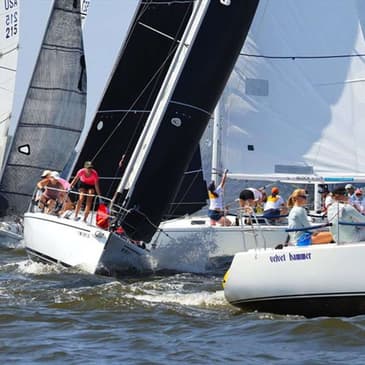
Check out this special episode of Sailfaster focusing on the upcoming Women’s J105 Regatta in Annapolis. Joining me on the pod were regatta organiser and long time advocate for women in sailing, Molly Wilner, along with top sailors Marie Klok Crump and Claire Ward, all sailing in the regatta. We discussed the origins and goals of the regatta and had a very interesting discussion about the differences between men and women teams, and the barriers that are often faced by women in the sport. And on a sombre note, this episode included a tribute to Maggie Flanigan, our dear team mate on London Calling, who unexpectedly passed away last week.
photo credit: Will Keyworth
[00:00:10] [SPEAKER_01]: Hello and welcome to Sailfaster, the number one podcast for racing sailors.
[00:00:14] [SPEAKER_01]: Before we get to today's episode, I just want to give a quick shout out to our great partners
[00:00:18] [SPEAKER_01]: at Spin Sheet who have been publishing extracts from some of Sailfaster's best episodes in
[00:00:24] [SPEAKER_01]: Spin Sheet's printed magazine.
[00:00:26] [SPEAKER_01]: I'm sure many of you are already avid readers of Spin Sheet's printed and digital editions.
[00:00:31] [SPEAKER_01]: It's the only publication I know covering the Chesapeake racing scene all year round.
[00:00:36] [SPEAKER_01]: There's a ton of great interviews with local racing sailors about their successes and what
[00:00:41] [SPEAKER_01]: the crews learned and so on.
[00:00:42] [SPEAKER_01]: I personally found great crew via Spin Sheet's Crew Finder.
[00:00:46] [SPEAKER_01]: I think that so many people attend the live crew party events in the spring, so
[00:00:52] [SPEAKER_01]: make sure you do that.
[00:00:54] [SPEAKER_01]: Also there's that great Spin Sheet newsletter which is full of great content.
[00:00:58] [SPEAKER_01]: You just have to sign up for that at SpinSheet.com on their homepage.
[00:01:03] [SPEAKER_01]: Also, I just want to say how much I appreciate the emails that I receive from you and also
[00:01:09] [SPEAKER_01]: those yells across the water when people tell me,
[00:01:11] [SPEAKER_01]: I just heard the latest episode with somebody, somebody.
[00:01:14] [SPEAKER_01]: I love hearing that and I'm thrilled to create some useful content for you all.
[00:01:20] [SPEAKER_01]: Our mission at Sailfaster as you know is all about uncovering and exploring how
[00:01:24] [SPEAKER_01]: people sail their boats faster than others.
[00:01:26] [SPEAKER_01]: And if you, of course, you have suggestions about who you think you want us to talk
[00:01:30] [SPEAKER_01]: to, please let me know and thanks for the suggestions I've had so far.
[00:01:34] [SPEAKER_01]: We've actually had some of those on the show so far.
[00:01:37] [SPEAKER_01]: Also, let me know if you have any questions you'd like me to ask or topics
[00:01:41] [SPEAKER_01]: you'd like me or guests to cover.
[00:01:44] [SPEAKER_01]: Just email me at pete at sailfaster dot net pete at sailfaster dot net.
[00:01:49] [SPEAKER_01]: It could not be easier, couldn't it?
[00:01:52] [SPEAKER_01]: And now to today's episode, which is sort of a special edition, which
[00:01:55] [SPEAKER_01]: focuses on this Sunday's women's J 105 regatta being held in Annapolis.
[00:02:01] [SPEAKER_01]: Here we go.
[00:02:07] [SPEAKER_01]: Hello, everybody, and welcome to one more episode of Sailfaster,
[00:02:10] [SPEAKER_01]: the podcast for those who obsess about sailing faster.
[00:02:14] [SPEAKER_01]: As you know, today we have a really interesting episode because it's all to do
[00:02:19] [SPEAKER_01]: with the women's regatta, the upcoming women's regatta in Annapolis
[00:02:23] [SPEAKER_01]: in a couple of weeks time.
[00:02:24] [SPEAKER_01]: And I thought this was a very sort of prescient time to bring together
[00:02:27] [SPEAKER_01]: three of the leading lights behind the women's regatta and competitors.
[00:02:32] [SPEAKER_01]: So with me, we have Molly Wilmer, who is outside having breakfast
[00:02:36] [SPEAKER_01]: in Newport, which looks and sounds good for those of you who can see the video.
[00:02:41] [SPEAKER_01]: We have Marie Klok-Krum and we have Claire Ward,
[00:02:44] [SPEAKER_01]: who neither of whom are outside having breakfast in Newport.
[00:02:47] [SPEAKER_01]: So thank you ladies.
[00:02:48] [SPEAKER_01]: Thank you very much for joining us.
[00:02:51] [SPEAKER_00]: Thank you for having us.
[00:02:52] [SPEAKER_01]: So why don't we do some introductions then to kick us off?
[00:02:56] [SPEAKER_01]: Claire, do you want to start?
[00:02:57] [SPEAKER_03]: Sure. My name is Claire Ward.
[00:02:59] [SPEAKER_03]: I am one of the owners of J105 Syndicate here in Annapolis.
[00:03:03] [SPEAKER_03]: So I drive about 50 percent of the time.
[00:03:06] [SPEAKER_03]: Usually I grew up sailing in Mississippi on the Gulf Coast.
[00:03:10] [SPEAKER_03]: I moved to Annapolis 10 years ago, started sailing on J30s and J80s here.
[00:03:16] [SPEAKER_03]: And then we bought the 105 about five years ago.
[00:03:18] [SPEAKER_03]: I've been on the committee with Molly for all three of the regattas.
[00:03:23] [SPEAKER_03]: So since its inception.
[00:03:26] [SPEAKER_01]: And your day job is the director of operations at U Spirit, right?
[00:03:32] [SPEAKER_03]: That's right.
[00:03:33] [SPEAKER_03]: But also, you know, sailing adjacent to the U Spirit Foundation
[00:03:36] [SPEAKER_03]: is a nonprofit that was created in memory of Jeff Uanssen,
[00:03:40] [SPEAKER_03]: a professional sailor who lived here in Annapolis and passed away
[00:03:44] [SPEAKER_03]: four years ago at the age of 50.
[00:03:46] [SPEAKER_03]: It was very shocking.
[00:03:48] [SPEAKER_03]: He was the kind of guy his wife, Mary Uanssen,
[00:03:51] [SPEAKER_03]: likes to say you would call in an emergency.
[00:03:53] [SPEAKER_03]: So our mission is to help people in need of urgent and immediate help.
[00:03:59] [SPEAKER_03]: So we raise funds.
[00:04:00] [SPEAKER_03]: We have a regatta that usually takes place in May.
[00:04:03] [SPEAKER_03]: The U Spirit Regatta, we've had four of those or three of those.
[00:04:07] [SPEAKER_03]: So I'm around town running and sailing in regattas.
[00:04:11] [SPEAKER_01]: Wonderful. Yeah, I see you out there on Syndicate, usually ahead of us.
[00:04:16] [SPEAKER_00]: So I am Molly Hughes-Wilmer,
[00:04:17] [SPEAKER_00]: and I've been the chair of this regatta for three years.
[00:04:20] [SPEAKER_00]: And it's not the first women's regatta I've run.
[00:04:23] [SPEAKER_00]: I've run the Rolex Women's International Kielbaut Championship
[00:04:26] [SPEAKER_00]: and the Ida Lewis Double-Handed Women's Junior Double-Handed Championship.
[00:04:30] [SPEAKER_00]: And I think there's something special about women's regattas.
[00:04:34] [SPEAKER_00]: But I love sailing in general.
[00:04:36] [SPEAKER_00]: I was born and raised in Annapolis.
[00:04:37] [SPEAKER_00]: I've been sailing since I was a baby because I was born in July.
[00:04:40] [SPEAKER_00]: And I believe it's a great lifelong sport,
[00:04:43] [SPEAKER_00]: whether you're competing or just sailing for fun.
[00:04:46] [SPEAKER_00]: I've sailed dinghies.
[00:04:47] [SPEAKER_00]: I've done the women's match racing circuit.
[00:04:49] [SPEAKER_00]: I've sailed tall ships.
[00:04:50] [SPEAKER_00]: I was just racing classic boats up in Maine.
[00:04:53] [SPEAKER_00]: I'm about to team race here in Newport.
[00:04:55] [SPEAKER_00]: There are just so many different ways to explore it.
[00:04:58] [SPEAKER_00]: And I've grown so much as a person through my experiences on the water.
[00:05:03] [SPEAKER_00]: And I blog about that and write about it.
[00:05:06] [SPEAKER_00]: And hopefully we'll publish a book about that someday.
[00:05:09] [SPEAKER_00]: In my real world, I run a boutique consulting firm
[00:05:12] [SPEAKER_00]: focusing on strategy, leadership, development and marketing and sales support.
[00:05:16] [SPEAKER_00]: And so much of what I've learned on the water
[00:05:19] [SPEAKER_00]: has analogies to what I do in my real world.
[00:05:23] [SPEAKER_00]: And I am definitely a better professional because of the things I've learned.
[00:05:28] [SPEAKER_00]: Working on teams, competing,
[00:05:31] [SPEAKER_00]: dealing with the trials and tribulations that the weather and mother nature
[00:05:35] [SPEAKER_00]: bring you and the need to take care of your boat
[00:05:38] [SPEAKER_00]: so that it can take care of you.
[00:05:40] [SPEAKER_01]: Thank you, Molly. Marie, how about you?
[00:05:42] [SPEAKER_02]: Thanks for having me on this.
[00:05:44] [SPEAKER_02]: Born and raised in Denmark.
[00:05:45] [SPEAKER_02]: I've been in the US for the past 20 years or so.
[00:05:49] [SPEAKER_02]: I grew up in a sailing family and led me to be a member of the Danish
[00:05:55] [SPEAKER_02]: national team and the Olympic sailing team with lots of great experiences
[00:05:59] [SPEAKER_02]: and memories. I grew up as a match racer primarily.
[00:06:04] [SPEAKER_02]: That was my my poor discipline.
[00:06:07] [SPEAKER_02]: And as I moved to the US, I had less opportunity for that.
[00:06:10] [SPEAKER_02]: And there's a lot more just fleet racing and team race.
[00:06:15] [SPEAKER_02]: And obviously offshore racing.
[00:06:18] [SPEAKER_02]: So it's been exciting to to really try all the different disciplines of sailing.
[00:06:23] [SPEAKER_02]: In my daily life, I'm a growth executive in the tech industry
[00:06:27] [SPEAKER_02]: and the small unit leadership that sailing teaches you
[00:06:32] [SPEAKER_02]: has been just instrumental in how I am as a as a business person,
[00:06:37] [SPEAKER_02]: as an executive typically in high growth
[00:06:40] [SPEAKER_02]: organizations where everything changes all the time.
[00:06:43] [SPEAKER_02]: The only thing that's certainty is three months from now
[00:06:46] [SPEAKER_02]: is going to be very different than today.
[00:06:48] [SPEAKER_02]: And that's very much the same you see on the on the race course,
[00:06:50] [SPEAKER_02]: the weather shift, the current isn't what you thought.
[00:06:52] [SPEAKER_02]: There's an override on the jet when you tack.
[00:06:55] [SPEAKER_02]: I mean, we've all been there.
[00:06:56] [SPEAKER_02]: It's lots of trials and tribulations getting around the race course.
[00:07:00] [SPEAKER_02]: So it's you don't always recognize it, but there is certainly
[00:07:04] [SPEAKER_02]: there are so many parallels and it's no coincidence that so many
[00:07:07] [SPEAKER_02]: so many phrases and sayings in business really relate back to
[00:07:11] [SPEAKER_02]: to maritime terms or sailing.
[00:07:14] [SPEAKER_01]: I love your analogy about sailing and business thing.
[00:07:17] [SPEAKER_01]: That's really it's really interesting.
[00:07:19] [SPEAKER_01]: I totally agree.
[00:07:20] [SPEAKER_01]: Sailing is about trying to peer into the future, understand
[00:07:23] [SPEAKER_01]: what's going to happen while everything around you is changing
[00:07:26] [SPEAKER_01]: the environment, the competitors, the weather is so
[00:07:30] [SPEAKER_01]: so similar to business world.
[00:07:31] [SPEAKER_01]: I love that.
[00:07:32] [SPEAKER_01]: Molly, can you kick off by talking about the women's regatta?
[00:07:36] [SPEAKER_01]: How you started it, how it's going and what's on the plan for this year?
[00:07:40] [SPEAKER_00]: Sure. Thank you, Pete.
[00:07:42] [SPEAKER_00]: So the regatta was started by the J-105 class
[00:07:45] [SPEAKER_00]: in large response to an initiative by World Sailing
[00:07:49] [SPEAKER_00]: to get more women on the water and sailboats.
[00:07:52] [SPEAKER_00]: And Nicole Brode at the time was the vice president of the J-105 class.
[00:07:57] [SPEAKER_00]: And she took that to heart and encouraged the class to encourage
[00:08:01] [SPEAKER_00]: the different fleets around North America to sponsor and support
[00:08:06] [SPEAKER_00]: events that got women on the water.
[00:08:09] [SPEAKER_00]: Toronto, the fleet in Toronto was the first one to take advantage of that.
[00:08:13] [SPEAKER_00]: And they hosted a regatta.
[00:08:16] [SPEAKER_00]: In 2021, and they had
[00:08:20] [SPEAKER_00]: 15 boats on the water, which is almost 100 percent of their whole fleet
[00:08:26] [SPEAKER_00]: on the water.
[00:08:27] [SPEAKER_00]: And so the next year, our fleet captain
[00:08:31] [SPEAKER_00]: reached out to all the owners and said, what's your interest?
[00:08:35] [SPEAKER_00]: And our owner, we have co-owners.
[00:08:38] [SPEAKER_00]: They knew that I had organized several women's regattas in the past.
[00:08:42] [SPEAKER_00]: And so very quickly, I was volunteered to be the chairperson of this regatta
[00:08:46] [SPEAKER_00]: and very happy to do so.
[00:08:48] [SPEAKER_00]: So we this has been growing every year.
[00:08:51] [SPEAKER_00]: This is going to be our third year of having the J-105 women's
[00:08:54] [SPEAKER_00]: regatta here in Annapolis.
[00:08:56] [SPEAKER_00]: Toronto still has theirs.
[00:08:57] [SPEAKER_00]: There's one in San Francisco.
[00:08:58] [SPEAKER_00]: There's one in Texas.
[00:08:59] [SPEAKER_00]: Seattle has a version.
[00:09:01] [SPEAKER_00]: There are a variety of different versions.
[00:09:02] [SPEAKER_00]: Every fleet has the right to make them look the way they want.
[00:09:06] [SPEAKER_00]: We have chosen to make ours women only in San Francisco, for example.
[00:09:11] [SPEAKER_00]: The requirement is just to have women's skippers.
[00:09:13] [SPEAKER_00]: And the goal is to get more women on J-105
[00:09:16] [SPEAKER_00]: that can be potential crew, potential drivers and potential owners.
[00:09:21] [SPEAKER_00]: So it really helps build women's interest in the sport
[00:09:24] [SPEAKER_00]: and also in this boat in particular.
[00:09:27] [SPEAKER_00]: And so we have the fleet, the support
[00:09:30] [SPEAKER_00]: of our local fleet and of the class financially
[00:09:34] [SPEAKER_00]: and in other ways with publicizing and recruiting
[00:09:37] [SPEAKER_00]: and getting volunteers and that kind of thing.
[00:09:39] [SPEAKER_00]: So it's been a lovely effort locally,
[00:09:43] [SPEAKER_00]: but also to have this North American group of women
[00:09:46] [SPEAKER_00]: that we collaborate with to brainstorm about how to make all of our regattas better.
[00:09:51] [SPEAKER_00]: And the idea is that maybe one day
[00:09:53] [SPEAKER_00]: we're able to host a North Americans Women Invitational Championship
[00:09:58] [SPEAKER_00]: where the winners of the regional regattas would go to
[00:10:03] [SPEAKER_00]: borrowed boat Invitational Championship
[00:10:06] [SPEAKER_00]: in one of the fleets that already host the regional regatta.
[00:10:09] [SPEAKER_01]: So I'm going to ask a naive question here as I tend to do that.
[00:10:13] [SPEAKER_01]: But was it the perception that there was a problem
[00:10:17] [SPEAKER_01]: that women were not becoming owners, not participating?
[00:10:21] [SPEAKER_01]: Because if I look on the water like last night's Wednesday night race
[00:10:24] [SPEAKER_01]: I bet 30, 40, 50 percent were women.
[00:10:28] [SPEAKER_01]: On my boat it's 80 percent.
[00:10:31] [SPEAKER_01]: But generally there's quite a lot of participation.
[00:10:34] [SPEAKER_00]: So, Pete, I wrote an article that was in Sailing World last November.
[00:10:38] [SPEAKER_00]: And that was an awesome episode.
[00:10:42] [SPEAKER_00]: Sorry. Awesome edition of Sailing World,
[00:10:44] [SPEAKER_00]: because it really talked about what's going on with women in sailing.
[00:10:48] [SPEAKER_00]: I had a man come to me at a grand master's regatta
[00:10:52] [SPEAKER_00]: and said he didn't understand why there were women's only events,
[00:10:55] [SPEAKER_00]: because he found out I was chairing one.
[00:10:58] [SPEAKER_00]: And I looked around and at that regatta that we were attending,
[00:11:02] [SPEAKER_00]: only 15 percent of the participants were women.
[00:11:07] [SPEAKER_00]: So there is a problem with underrepresentation of women in a sport.
[00:11:13] [SPEAKER_00]: That is a co-ed sport.
[00:11:15] [SPEAKER_00]: And it's a difficult problem
[00:11:19] [SPEAKER_00]: that people have a hard time talking about sometimes
[00:11:22] [SPEAKER_00]: because men have said to me,
[00:11:25] [SPEAKER_00]: the minute you say I'm sexist, everybody believes I'm sexist.
[00:11:29] [SPEAKER_00]: And just because I sail with all men doesn't mean I don't want to sail with women.
[00:11:34] [SPEAKER_00]: And it's a very difficult thing for some people to talk about.
[00:11:38] [SPEAKER_00]: I race on a boat where we have two women regularly.
[00:11:41] [SPEAKER_00]: But I have been since I started ocean racing, often the only woman on the boat.
[00:11:47] [SPEAKER_00]: So and there are many boats that won't even consider me to go offshore
[00:11:52] [SPEAKER_00]: because they're used to racing with all men
[00:11:54] [SPEAKER_00]: and they're uncomfortable having a woman on board.
[00:11:57] [SPEAKER_00]: So and then there's around the buoys and dinghies.
[00:11:59] [SPEAKER_00]: And so there are a lot of different kinds of sailing
[00:12:01] [SPEAKER_00]: and pretty much across the board, you will see that women are underrepresented.
[00:12:05] [SPEAKER_00]: So the idea of women's only regattas serves multiple purposes.
[00:12:10] [SPEAKER_00]: It gives women the confidence that they can do it for some women.
[00:12:14] [SPEAKER_00]: It just gives them the opportunity to shine,
[00:12:16] [SPEAKER_00]: to do what they know they're capable of.
[00:12:18] [SPEAKER_00]: It gives other people the opportunity to see what women are capable of.
[00:12:23] [SPEAKER_00]: It gives us the opportunity to create a women only vibe,
[00:12:26] [SPEAKER_00]: which is totally different than a coed vibe or male only vibe.
[00:12:30] [SPEAKER_00]: In my other life, I run a boutique consulting firm
[00:12:34] [SPEAKER_00]: and part of what we do is leadership development.
[00:12:36] [SPEAKER_00]: And right now, some of the biggest trends in leadership
[00:12:39] [SPEAKER_00]: are that the most effective leaders,
[00:12:42] [SPEAKER_00]: and this came out in the World Economic Forum in Davos in January,
[00:12:46] [SPEAKER_00]: are those that embody stereotypically feminine,
[00:12:49] [SPEAKER_00]: stereotypically masculine leadership traits.
[00:12:52] [SPEAKER_00]: And I was just at a regatta in Maine, a classic boat regatta.
[00:12:56] [SPEAKER_00]: And it's surprising to see when you live in the leadership
[00:13:00] [SPEAKER_00]: development world or other progressive worlds, supposedly progressive worlds,
[00:13:04] [SPEAKER_00]: how many people still embrace these very traditional
[00:13:09] [SPEAKER_00]: mindsets about how things should run and how things should be done.
[00:13:13] [SPEAKER_00]: So while you race on a boat that has a lot of women
[00:13:16] [SPEAKER_00]: and while I race with people that are very comfortable racing with women,
[00:13:19] [SPEAKER_00]: that is not the majority of boats out on the water
[00:13:24] [SPEAKER_00]: in almost any fleet that you'll encounter in North America.
[00:13:29] [SPEAKER_01]: Yeah, I get that.
[00:13:30] [SPEAKER_01]: The thing that's intriguing about this event is how competitive it is.
[00:13:33] [SPEAKER_01]: I read the results and observed some of it.
[00:13:36] [SPEAKER_01]: This is very, very competitive, close racing.
[00:13:40] [SPEAKER_00]: Well, there are a lot of amazing sailors in Annapolis.
[00:13:43] [SPEAKER_00]: And we have a and when when people's owners came up to me
[00:13:46] [SPEAKER_00]: and said, I'm not sure I can get a driver, I said, let's talk about that.
[00:13:50] [SPEAKER_00]: And some people came up and said, well, why aren't you letting pros race?
[00:13:55] [SPEAKER_00]: And I said, well, the idea is to get more women
[00:13:58] [SPEAKER_00]: who can crew for you year round, not just in this regatta.
[00:14:02] [SPEAKER_00]: And there are plenty of women that aren't pros that are incredibly qualified.
[00:14:06] [SPEAKER_00]: Like Marie, like Claire, like Ashley, like
[00:14:11] [SPEAKER_00]: Nicole. I mean, there are just tons of great names in Annapolis
[00:14:14] [SPEAKER_00]: that are amazing sailors.
[00:14:15] [SPEAKER_00]: We don't need to go to pros to fill our fleet with,
[00:14:20] [SPEAKER_00]: you know, a 20 boat fleet of all women.
[00:14:23] [SPEAKER_01]: It's also in the spirit of sort of the J 105,
[00:14:26] [SPEAKER_01]: which is quite Corinthian as a class as well. Right.
[00:14:28] [SPEAKER_01]: We're very restricted on not having pros, which is which is great.
[00:14:32] [SPEAKER_01]: And so what leads me to why the J 105,
[00:14:36] [SPEAKER_01]: were you connected with the J 105 class at the time?
[00:14:40] [SPEAKER_01]: Yes. Because one of the things you talked about was, hey,
[00:14:43] [SPEAKER_01]: maybe we can encourage women to be skippers of J 105.
[00:14:47] [SPEAKER_00]: So I'm not considered a backup skipper on the boat that I race them.
[00:14:50] [SPEAKER_00]: But I have been racing on Mirage, the J 105 since 2000.
[00:14:55] [SPEAKER_00]: So we've had a pretty much same core crew for 24 seasons now.
[00:15:00] [SPEAKER_01]: You have a ton of sponsors as well,
[00:15:02] [SPEAKER_01]: which is an indication of the interest in the women's regatta.
[00:15:06] [SPEAKER_00]: Yeah, we have Claire knows a lot of the names better than I do,
[00:15:09] [SPEAKER_00]: but we have sponsors that come forward with food and drink in kind
[00:15:13] [SPEAKER_00]: as well as cash.
[00:15:15] [SPEAKER_00]: So we have a lot of great giveaways for the participants.
[00:15:18] [SPEAKER_00]: What, what we looked at when we went out for sponsors,
[00:15:20] [SPEAKER_00]: what makes a great regatta? So we have Sandy Groesner,
[00:15:24] [SPEAKER_00]: who just came back from the Olympics as our PRO.
[00:15:27] [SPEAKER_00]: We encourage great sailors to be on the water.
[00:15:33] [SPEAKER_01]: How do, how do women get involved in the regatta?
[00:15:36] [SPEAKER_00]: So we recruit people and people find out about it organically.
[00:15:41] [SPEAKER_00]: We've got a Facebook page and we talk about it and we spread the word
[00:15:45] [SPEAKER_00]: among all our different groups of friends.
[00:15:47] [SPEAKER_00]: We want this to be similar to the way the Rolex International
[00:15:51] [SPEAKER_00]: Women's Heel Boat Championship was years ago,
[00:15:53] [SPEAKER_00]: where we have top level competitors as well as newer sailors.
[00:15:57] [SPEAKER_00]: So we encourage really great sailors to come out and have a very competitive
[00:16:01] [SPEAKER_00]: regatta.
[00:16:02] [SPEAKER_00]: And then we also want newer sailors and younger sailors to come out and either
[00:16:06] [SPEAKER_00]: crew on boats that are more experienced or to come out and bring a boat of
[00:16:10] [SPEAKER_00]: more amateur sailors out and do the best they can.
[00:16:14] [SPEAKER_00]: So there are a couple of boats that have been practicing all season and
[00:16:17] [SPEAKER_00]: they will end up being in the bottom half of the fleet and they will be
[00:16:20] [SPEAKER_00]: absolutely delighted because they will have learned,
[00:16:22] [SPEAKER_00]: they will have had support and we welcome them and we're encouraging them
[00:16:26] [SPEAKER_00]: and we're seeing them getting better.
[00:16:27] [SPEAKER_00]: So it's a really great spirit.
[00:16:30] [SPEAKER_00]: And one thing that we've seen too is that when we look at what makes a
[00:16:35] [SPEAKER_00]: great regatta and what makes a great fleet,
[00:16:38] [SPEAKER_00]: we need to have good Titian.
[00:16:41] [SPEAKER_00]: We need to have excellent race management.
[00:16:43] [SPEAKER_00]: So we've got Sandy Grovesner who just came back from the Olympics as our
[00:16:47] [SPEAKER_00]: PRO for really good parties.
[00:16:49] [SPEAKER_00]: And then we also try to have name tags where people can actually say,
[00:16:53] [SPEAKER_00]: well, I know your face, but now I know what your name is.
[00:16:56] [SPEAKER_00]: I've been seeing you at regatta parties.
[00:16:58] [SPEAKER_00]: Some people are too shy.
[00:16:59] [SPEAKER_00]: So we've really seen this regatta break down a lot of the barriers across
[00:17:03] [SPEAKER_00]: boats within our fleet.
[00:17:05] [SPEAKER_00]: And last year's party was one of the best regatta parties of the year.
[00:17:09] [SPEAKER_00]: So, you know, between great competition, great race management and good social
[00:17:14] [SPEAKER_00]: party afterward, we've really think we've nailed the formula for making
[00:17:19] [SPEAKER_00]: an amazing women's regatta.
[00:17:20] [SPEAKER_01]: Yeah.
[00:17:20] [SPEAKER_01]: Wonderful.
[00:17:21] [SPEAKER_01]: Claire, you know that to me, right?
[00:17:23] [SPEAKER_03]: Yeah.
[00:17:24] [SPEAKER_03]: The first of all, anyone listening and you're looking to become a sponsor
[00:17:27] [SPEAKER_03]: of the women's event, we will happily take your money and put up your banner.
[00:17:31] [SPEAKER_03]: We would love to have you support us.
[00:17:33] [SPEAKER_03]: But something that really speaks to the success that we've already had the
[00:17:35] [SPEAKER_03]: last two years is I've gotten so many messages from some acquaintances,
[00:17:39] [SPEAKER_03]: some people I know well, just sailors in Annapolis who want to do the
[00:17:43] [SPEAKER_03]: event because they've heard that it's tight racing.
[00:17:45] [SPEAKER_03]: They've heard it's a great party.
[00:17:47] [SPEAKER_03]: And I just, you know, I haven't been a part of that many events that
[00:17:49] [SPEAKER_03]: people are actively seeking out to do these days.
[00:17:53] [SPEAKER_03]: So that's pretty cool.
[00:17:54] [SPEAKER_03]: And, you know, our goal eventually is hopefully this will, like Molly said,
[00:17:58] [SPEAKER_03]: grow into something more, but, you know, if we can get a two day
[00:18:00] [SPEAKER_03]: regatta in another couple of years, I think that would be awesome too.
[00:18:03] [SPEAKER_03]: And we've also managed to increase our participation every year.
[00:18:05] [SPEAKER_03]: I think the first year we had 13 votes last year, we had 14.
[00:18:08] [SPEAKER_03]: Now we've got 15.
[00:18:09] [SPEAKER_03]: Hopefully we might even get a couple more in the next couple of weeks.
[00:18:12] [SPEAKER_01]: I did see that you had a hundred sailors last year.
[00:18:15] [SPEAKER_01]: That's a lot of, a lot of sailors on the water.
[00:18:17] [SPEAKER_01]: And I know that teams come, come from all over.
[00:18:20] [SPEAKER_01]: I mean, London calling my boat is going to be sailed by the Charleston
[00:18:23] [SPEAKER_01]: pirate princess racing team.
[00:18:25] [SPEAKER_01]: So you must have other boats coming from outside the area too, right?
[00:18:29] [SPEAKER_00]: Yes.
[00:18:29] [SPEAKER_00]: When we go to other regattas around the country, there's often discussion
[00:18:33] [SPEAKER_00]: of let's promote local women's events.
[00:18:37] [SPEAKER_00]: So Ashley Love has promoted it at the Fair Cup.
[00:18:40] [SPEAKER_00]: We promoted it at the San Diego Yacht Club's women's
[00:18:42] [SPEAKER_00]: winter and invitational regatta.
[00:18:44] [SPEAKER_00]: So it's on people's radar around the country and we get great press coverage about it.
[00:18:49] [SPEAKER_00]: So we get picked up in a lot of national media.
[00:18:51] [SPEAKER_00]: So people know about this regatta.
[00:18:54] [SPEAKER_01]: Are there any differences between sailing on a women's only team
[00:18:57] [SPEAKER_01]: versus sailing on a men's team?
[00:19:00] [SPEAKER_01]: And we've got hours if you want to talk about this, but seriously,
[00:19:05] [SPEAKER_01]: are there immediately any differences that come to mind?
[00:19:08] [SPEAKER_00]: I'll jump in first.
[00:19:10] [SPEAKER_00]: I think it's not all honey and roses.
[00:19:13] [SPEAKER_00]: Women can be just as aggressive, just as competitive and just as territorial
[00:19:18] [SPEAKER_00]: about their position on the boat and that kind of thing.
[00:19:21] [SPEAKER_00]: What I do find is that there is often, not always better
[00:19:27] [SPEAKER_00]: communication and pre-planning about it in terms of what everyone's
[00:19:33] [SPEAKER_00]: roles are going to be and the agenda and the schedule and who's bringing
[00:19:37] [SPEAKER_00]: lunches and usually that's much tighter in the beginning.
[00:19:42] [SPEAKER_00]: But what would you guys say, Claire and Marie?
[00:19:46] [SPEAKER_03]: I do agree with the communication.
[00:19:49] [SPEAKER_03]: Obviously we cannot speak in absolutes.
[00:19:51] [SPEAKER_03]: People are all people and they all have egos and opinions.
[00:19:55] [SPEAKER_03]: Both men and women that I seek to sail out and crew my boat with
[00:19:59] [SPEAKER_03]: are people that I get along with.
[00:20:00] [SPEAKER_01]: Can you describe how the communication is different?
[00:20:02] [SPEAKER_03]: We're just really clear on what we're doing.
[00:20:05] [SPEAKER_03]: We do things early.
[00:20:06] [SPEAKER_03]: We make smart decisions.
[00:20:08] [SPEAKER_03]: Whereas I think when you're a little more comfortable sometimes with people,
[00:20:11] [SPEAKER_03]: you just assume someone's going to know what you're doing and you pull the
[00:20:14] [SPEAKER_03]: trigger without having a good conversation around your plan.
[00:20:18] [SPEAKER_03]: So a little bit different, just that's kind of my personal anecdote
[00:20:22] [SPEAKER_03]: of sailing all the Wednesdays and then sailing the women's regatta.
[00:20:25] [SPEAKER_01]: How about you, Marie?
[00:20:28] [SPEAKER_02]: I've reflected on a lot over the years doing both all female and open
[00:20:32] [SPEAKER_02]: teams and also regattas where that's mixed.
[00:20:37] [SPEAKER_02]: I spent extensive periods of time competing in an all female format
[00:20:42] [SPEAKER_02]: at truly the highest level.
[00:20:44] [SPEAKER_02]: So I might have a different perspective than most other people who are trying
[00:20:48] [SPEAKER_02]: to do more female sailing and for all the reasons that there is for that.
[00:20:53] [SPEAKER_02]: When I started out match racing, we would compete against, I had an all
[00:20:57] [SPEAKER_02]: female team and we would be competing against the men.
[00:20:59] [SPEAKER_02]: There weren't many mixed teams, so to speak, either you have an all
[00:21:03] [SPEAKER_02]: female team or a man and we were the only person on the boat.
[00:21:07] [SPEAKER_02]: There were five crew on the men and a weight limit obviously.
[00:21:10] [SPEAKER_02]: And then we were allowed within the same weight limit to have six people
[00:21:13] [SPEAKER_02]: on the boat to make up for any potential physical differences.
[00:21:18] [SPEAKER_02]: Other than that, we were really out there competing against the
[00:21:21] [SPEAKER_02]: world's match racers, well, the top match racers in the world.
[00:21:25] [SPEAKER_02]: Past America's Cup skippers, current America's Cup skippers,
[00:21:28] [SPEAKER_02]: Olympic song sailors that were obviously at the time, the number of the top
[00:21:33] [SPEAKER_02]: match racers and we learned so much in that process.
[00:21:37] [SPEAKER_02]: At the same time, we were trying to get the 11th medal for the Olympics
[00:21:40] [SPEAKER_02]: to be about match racing, which we actually managed to do.
[00:21:44] [SPEAKER_02]: We got taken away in the last minute and turned into the youngling,
[00:21:47] [SPEAKER_02]: but we did have it on the program.
[00:21:49] [SPEAKER_02]: And so in that process, it was important to separate out
[00:21:52] [SPEAKER_02]: a women's ranking and that was great obviously for that purpose.
[00:21:56] [SPEAKER_02]: At the same time though, it actually excluded us from the open ranking.
[00:22:00] [SPEAKER_02]: We no longer got points on that ranking list.
[00:22:02] [SPEAKER_02]: I think in some ways the growth of those female match racers at the
[00:22:07] [SPEAKER_02]: time was sort of stifled a little bit.
[00:22:10] [SPEAKER_01]: So why was that decision made to separate the two?
[00:22:12] [SPEAKER_02]: There are all these rules that you need to have enough
[00:22:15] [SPEAKER_02]: participation across the continents, the globe and growth in the sport
[00:22:19] [SPEAKER_02]: and so forth, so for that reason, it was important to have a ranking list.
[00:22:23] [SPEAKER_02]: It's also important because you have to have certain grade level events.
[00:22:26] [SPEAKER_02]: It's not much different than when you think about tennis, etc.
[00:22:29] [SPEAKER_02]: When you have a sport that has a ranking list, you need to have
[00:22:32] [SPEAKER_02]: some kind of a ladder system for that.
[00:22:35] [SPEAKER_02]: So in female ranking list makes sense.
[00:22:38] [SPEAKER_02]: What didn't make sense is we no longer could participate
[00:22:41] [SPEAKER_02]: on the open ranking list.
[00:22:43] [SPEAKER_01]: I like this point about women can really compete against men
[00:22:46] [SPEAKER_01]: in most of the kill vote discipline.
[00:22:48] [SPEAKER_01]: It's not like swimming, track and field,
[00:22:50] [SPEAKER_01]: genetic difference players, but I know we're into
[00:22:52] [SPEAKER_01]: difficult genetic territory here in the modern world.
[00:22:57] [SPEAKER_01]: But I'd love to hear about that.
[00:23:00] [SPEAKER_02]: Well, sailing is a unique sport because women really can
[00:23:05] [SPEAKER_02]: compete against the men in most kill vote disciplines.
[00:23:09] [SPEAKER_02]: So it's not like swimming or track and field or only sports where
[00:23:14] [SPEAKER_02]: that genetic difference does play a significant part.
[00:23:18] [SPEAKER_02]: Sailing is both a physical and intellectual sport in a way where
[00:23:23] [SPEAKER_02]: the intellectual part and the analytical part is pretty
[00:23:27] [SPEAKER_02]: significant and typically also gets better with time.
[00:23:32] [SPEAKER_02]: I think we can all agree that women are just as smart as men.
[00:23:35] [SPEAKER_02]: For this event, I am actually doing it a little differently.
[00:23:39] [SPEAKER_02]: I'm passing it on to the next generation and I've assembled a
[00:23:43] [SPEAKER_02]: group of high school sailors who, along with, basically will be a
[00:23:49] [SPEAKER_02]: 50-50 mentor and high school sailors because I think young girls
[00:23:57] [SPEAKER_02]: don't necessarily get the same opportunity to jump onto a kill
[00:24:02] [SPEAKER_02]: vote with adult teams as often as young men probably do.
[00:24:07] [SPEAKER_02]: It's easy to pick a 16 year old tall strong boy and say,
[00:24:12] [SPEAKER_02]: come aboard and do mass for us or the pit or something.
[00:24:16] [SPEAKER_02]: And in that way, get introduced to a broader way of sailing than maybe
[00:24:22] [SPEAKER_02]: what you do in the junior program or high school sailing and so forth
[00:24:26] [SPEAKER_02]: in the dinghies.
[00:24:27] [SPEAKER_02]: So this was sort of the year I decided let's grab a group of
[00:24:32] [SPEAKER_02]: girls and take them out and help open their eyes a little bit because
[00:24:36] [SPEAKER_02]: there are certainly so many women that have come before me that I
[00:24:41] [SPEAKER_02]: really weren't necessarily recognized.
[00:24:44] [SPEAKER_02]: I mean, on this boat with me for the women's event, as one of the
[00:24:48] [SPEAKER_02]: coach mentors is Martha Parker who is absolutely one of the very
[00:24:53] [SPEAKER_02]: best sailors in the world that I know of and she, if any, has
[00:24:57] [SPEAKER_02]: always been breaking that glass ceiling and as a fairly petite
[00:25:04] [SPEAKER_02]: person but without a doubt one of the most respected bowmen as
[00:25:11] [SPEAKER_02]: we would say, right?
[00:25:12] [SPEAKER_02]: That I know of and I'm really excited to sail with her.
[00:25:15] [SPEAKER_02]: I've only competed against her and I can't wait for these young
[00:25:19] [SPEAKER_02]: high school sailors to really get exposed to someone who's been
[00:25:22] [SPEAKER_02]: there done that for decades and in a male dominated sport.
[00:25:27] [SPEAKER_01]: Marie, have you personally witnessed or faced barriers
[00:25:31] [SPEAKER_01]: into getting into racing?
[00:25:34] [SPEAKER_02]: Sure.
[00:25:35] [SPEAKER_02]: Absolutely.
[00:25:36] [SPEAKER_02]: I think any female sailor has and those who make it through are
[00:25:40] [SPEAKER_02]: probably the most tenacious because in many cases it seems
[00:25:44] [SPEAKER_02]: like you have to prove yourself another 200%.
[00:25:52] [SPEAKER_02]: When I put together my all female team for match racing,
[00:25:56] [SPEAKER_02]: we have lots of helpful male crews trying to give us pointers
[00:26:00] [SPEAKER_02]: on how to sail that particular boat or boat handling maneuvers,
[00:26:04] [SPEAKER_02]: et cetera.
[00:26:04] [SPEAKER_02]: And it was fun to see how that almost, it didn't just
[00:26:08] [SPEAKER_02]: It came to a complete halt with this knowledge sharing the moment
[00:26:12] [SPEAKER_02]: we beat them in a regatta and it took them probably a good year
[00:26:16] [SPEAKER_02]: or so to get over that and to knowledge sharing and making
[00:26:21] [SPEAKER_02]: all of us better.
[00:26:22] [SPEAKER_02]: So I think it's often that people will be very supportive
[00:26:28] [SPEAKER_02]: of these women's thing as long as it's the kind of the
[00:26:31] [SPEAKER_02]: women's and children kind of program and all of a sudden
[00:26:34] [SPEAKER_02]: when it shows up and it becomes a peer competition,
[00:26:37] [SPEAKER_02]: it takes a little bit of adjusting.
[00:26:39] [SPEAKER_02]: And I mean, one example I have was many years ago when I was
[00:26:44] [SPEAKER_02]: going through the Prince of Wales Cup, which is the national
[00:26:47] [SPEAKER_02]: match race championship in the US.
[00:26:50] [SPEAKER_02]: And I was racing with my husband, my brother, my crew.
[00:26:53] [SPEAKER_02]: We had won our regional qualifier.
[00:26:56] [SPEAKER_02]: We won the semi-final for the whole East coast.
[00:26:59] [SPEAKER_02]: We had won every step of the way and made it to the finals
[00:27:03] [SPEAKER_02]: halfway through the round robin of the finals.
[00:27:06] [SPEAKER_02]: We're sitting around waiting for Breeze in California and one
[00:27:10] [SPEAKER_02]: of the other skippers were like, wow, you haven't really gotten
[00:27:13] [SPEAKER_02]: ahead of this other skipper.
[00:27:15] [SPEAKER_02]: You really beat them.
[00:27:16] [SPEAKER_02]: That's quite impressive.
[00:27:17] [SPEAKER_02]: He's really good.
[00:27:19] [SPEAKER_02]: I said, well, yeah, I've never lost to him before.
[00:27:22] [SPEAKER_02]: I beat him in the regionals, in the semi-finals
[00:27:25] [SPEAKER_02]: and apparently they said two, number one and number two.
[00:27:28] [SPEAKER_02]: He was number two.
[00:27:29] [SPEAKER_02]: And they were like, really?
[00:27:31] [SPEAKER_02]: And it was very clear.
[00:27:33] [SPEAKER_02]: We thought you got a wild card to me because I was the only
[00:27:36] [SPEAKER_02]: female skipper.
[00:27:37] [SPEAKER_02]: It was such an odd situation.
[00:27:41] [SPEAKER_02]: And I try not to take offense to the, how can you even
[00:27:44] [SPEAKER_02]: be here because you're a female?
[00:27:45] [SPEAKER_02]: And I think I've just gotten thick skinned.
[00:27:47] [SPEAKER_02]: You've learned that over time.
[00:27:50] [SPEAKER_01]: Really interesting, Marie.
[00:27:51] [SPEAKER_01]: Hey, Molly, what for you is the goal of the regatta?
[00:27:55] [SPEAKER_00]: The goal of this regatta is to get more people into the
[00:27:57] [SPEAKER_00]: 105 fleet as integrated into the fleet, which is why we
[00:28:01] [SPEAKER_00]: don't have pros.
[00:28:03] [SPEAKER_00]: You know, the integration is key, not just in the sport,
[00:28:07] [SPEAKER_00]: but in life.
[00:28:08] [SPEAKER_00]: Studies show that teams that are integrated in multiple
[00:28:12] [SPEAKER_00]: ways, whether it's gender diversity, age diversity,
[00:28:15] [SPEAKER_00]: backgrounds are going to perform at higher levels.
[00:28:18] [SPEAKER_00]: So it's really just taking that science that we know
[00:28:22] [SPEAKER_00]: is out there and bringing it into our sport and
[00:28:24] [SPEAKER_00]: creating opportunities for more people.
[00:28:26] [SPEAKER_00]: But at the end of the day, this regatta is a
[00:28:29] [SPEAKER_00]: means to an end.
[00:28:30] [SPEAKER_00]: And we're making it a really fun means.
[00:28:32] [SPEAKER_00]: Sometimes when people talk about the female sailor,
[00:28:35] [SPEAKER_00]: they're celebrating the other rather than the likeness.
[00:28:39] [SPEAKER_00]: And I think we want to be celebrating the great sailors
[00:28:42] [SPEAKER_00]: that are in this regatta.
[00:28:44] [SPEAKER_00]: The fact that they're women is something else.
[00:28:46] [SPEAKER_00]: When you emphasize the woman too much,
[00:28:49] [SPEAKER_00]: it becomes about the other rather than the integration
[00:28:53] [SPEAKER_00]: that we're looking for.
[00:28:54] [SPEAKER_03]: Yeah.
[00:28:54] [SPEAKER_03]: I think after the first event a couple of years ago,
[00:28:57] [SPEAKER_03]: we all had to try to not be offended by this shock
[00:29:02] [SPEAKER_03]: that came from the fleet of like, wow,
[00:29:04] [SPEAKER_03]: it was so competitive.
[00:29:06] [SPEAKER_03]: I can't believe how great it was.
[00:29:07] [SPEAKER_03]: Like the racing was really tight.
[00:29:09] [SPEAKER_03]: Cause all of the women competitors were like,
[00:29:11] [SPEAKER_03]: what did you expect?
[00:29:12] [SPEAKER_03]: Especially someone like myself who drives the boat
[00:29:15] [SPEAKER_03]: all the time, you know, like, yes, thank you.
[00:29:19] [SPEAKER_03]: We're here.
[00:29:19] [SPEAKER_01]: Well, I just fell into that stereotype,
[00:29:21] [SPEAKER_01]: didn't I, by saying, I heard it was very competitive
[00:29:24] [SPEAKER_01]: and you know, I'm certainly sorry.
[00:29:25] [SPEAKER_02]: Thank you.
[00:29:28] [SPEAKER_02]: I'm just so excited that, you know,
[00:29:31] [SPEAKER_02]: the entry number of entries just keep going up.
[00:29:33] [SPEAKER_02]: And I think that's a testament to how successful it's been.
[00:29:38] [SPEAKER_02]: I mean, this is just gonna be the third year.
[00:29:40] [SPEAKER_03]: And just for the J105 fleet in Annapolis anyway,
[00:29:45] [SPEAKER_03]: it's pretty amazing how it's grown.
[00:29:46] [SPEAKER_03]: I mean, we've only had our boat for five years
[00:29:48] [SPEAKER_03]: and I think there have been 10 new 105s since then.
[00:29:53] [SPEAKER_03]: Like we've got 30 boats on Wednesday night.
[00:29:56] [SPEAKER_03]: It's kind of crazy.
[00:29:57] [SPEAKER_03]: So the fact that we can have this event
[00:29:59] [SPEAKER_03]: and get all these new sailors excited about 105s,
[00:30:03] [SPEAKER_03]: you know, we don't wanna take all the credit,
[00:30:04] [SPEAKER_03]: but I think we're doing a good job
[00:30:07] [SPEAKER_03]: for doing the fleet in that way.
[00:30:10] [SPEAKER_01]: Yeah, for sure.
[00:30:11] [SPEAKER_01]: And by the way, Claire,
[00:30:12] [SPEAKER_01]: I hope you're going to the J105 clinic.
[00:30:14] [SPEAKER_01]: I'm not sure if you guys signed up yet.
[00:30:16] [SPEAKER_03]: The, I'll have to see amusingly,
[00:30:19] [SPEAKER_03]: our boat partners also had a baby
[00:30:21] [SPEAKER_03]: I think like the same week that we did.
[00:30:23] [SPEAKER_03]: We've got five kids between us,
[00:30:25] [SPEAKER_03]: two of which are four months old.
[00:30:27] [SPEAKER_03]: So we're a little bit busy.
[00:30:29] [SPEAKER_03]: We had really great breeze last year.
[00:30:33] [SPEAKER_03]: I think we had a solid 15 and then, you know,
[00:30:35] [SPEAKER_03]: gusts from there, which was really fun
[00:30:37] [SPEAKER_03]: and almost uncommon to what we're normally dealing with.
[00:30:42] [SPEAKER_03]: And it was steady all day.
[00:30:43] [SPEAKER_03]: So hopefully we get some similar conditions this year.
[00:30:47] [SPEAKER_03]: That would be great.
[00:30:49] [SPEAKER_01]: And then you have,
[00:30:50] [SPEAKER_01]: there's quite a lot of the teams coming together
[00:30:53] [SPEAKER_01]: for sort of using Wednesday night races
[00:30:56] [SPEAKER_01]: and using the upcoming crab regatta as practice, right?
[00:31:01] [SPEAKER_00]: One of our goals with our crew was to try to get women
[00:31:04] [SPEAKER_00]: that we didn't know that well on the boat.
[00:31:07] [SPEAKER_00]: So we've got your navigator Pete sailing with us
[00:31:11] [SPEAKER_00]: and we've got a couple other people
[00:31:13] [SPEAKER_00]: we don't know as well
[00:31:14] [SPEAKER_00]: that don't race in the 105 fleet as often.
[00:31:16] [SPEAKER_00]: So we sort of reached beyond our usual circuit
[00:31:19] [SPEAKER_00]: to try to expand, again,
[00:31:22] [SPEAKER_00]: going back to the mission of the regatta.
[00:31:25] [SPEAKER_01]: Claire, you can add something too I think.
[00:31:27] [SPEAKER_03]: Oh, just that, you know,
[00:31:28] [SPEAKER_03]: for any listeners who aren't familiar,
[00:31:31] [SPEAKER_03]: the 105 fleet has the owner driver rule.
[00:31:33] [SPEAKER_03]: And so just as far as practices,
[00:31:35] [SPEAKER_03]: the fleet worked with us to help get some dispensation
[00:31:38] [SPEAKER_03]: so that people could drive in other regattas
[00:31:40] [SPEAKER_03]: and get practice because like I said earlier,
[00:31:43] [SPEAKER_03]: it is not the majority of owners
[00:31:45] [SPEAKER_03]: who are participating in this regatta.
[00:31:49] [SPEAKER_03]: So they've been really good working with us
[00:31:52] [SPEAKER_03]: to get like the crab cup regatta,
[00:31:55] [SPEAKER_03]: that rule has been eliminated so that crews can practice
[00:31:58] [SPEAKER_03]: like Friday night beer cans,
[00:32:00] [SPEAKER_03]: people are using that as practice.
[00:32:02] [SPEAKER_03]: So we've gotten good support from the fleet for that.
[00:32:05] [SPEAKER_00]: And the Saturday labor day regatta
[00:32:07] [SPEAKER_00]: can also be waived that owner driver rule.
[00:32:09] [SPEAKER_01]: So Claire, before we finish,
[00:32:10] [SPEAKER_01]: you've had perhaps a potential future crew member
[00:32:13] [SPEAKER_01]: just joined you there in the-
[00:32:15] [SPEAKER_03]: Not potential, he's already made it out on the water
[00:32:18] [SPEAKER_03]: a few times.
[00:32:19] [SPEAKER_03]: He did a Friday night race with us.
[00:32:22] [SPEAKER_03]: I was pregnant with him during the last women's regatta.
[00:32:26] [SPEAKER_03]: So yeah, this is Harrison,
[00:32:28] [SPEAKER_03]: he's already got his sea legs.
[00:32:30] [SPEAKER_01]: He is four months?
[00:32:32] [SPEAKER_03]: Four months.
[00:32:33] [SPEAKER_01]: Oh, lovely.
[00:32:34] [SPEAKER_01]: I remember that.
[00:32:35] [SPEAKER_01]: Amazing.
[00:32:36] [SPEAKER_01]: So Molly, Marie, Claire and Harrison,
[00:32:39] [SPEAKER_01]: thank you so much for joining us.
[00:32:41] [SPEAKER_01]: I really appreciate the time.
[00:32:42] [SPEAKER_01]: I know you're very busy.
[00:32:43] [SPEAKER_01]: I can't wait for the women's regatta.
[00:32:45] [SPEAKER_01]: Go London calling, come on Pirates Princess race team.
[00:32:47] [SPEAKER_01]: I wanna see at least they can win
[00:32:49] [SPEAKER_01]: some sort of trophy for our boat.
[00:32:51] [SPEAKER_01]: That would be delightful.
[00:32:53] [SPEAKER_01]: But really looking forward to the regatta
[00:32:55] [SPEAKER_01]: and congratulations in making it all happen.
[00:32:58] [SPEAKER_01]: Thank you very much for being on the show.
[00:33:01] [SPEAKER_02]: Thank you very much.
[00:33:10] [SPEAKER_01]: A final sad note,
[00:33:11] [SPEAKER_01]: we recorded this episode over two sessions.
[00:33:14] [SPEAKER_01]: In between, we learned the awful news
[00:33:17] [SPEAKER_01]: of Maggie Flanagan's sudden and unexpected passing.
[00:33:21] [SPEAKER_01]: Maggie was the heart of my boat London calling.
[00:33:24] [SPEAKER_01]: She'd sail with me pretty much every race and practice
[00:33:27] [SPEAKER_01]: since I brought the boat to Annapolis
[00:33:29] [SPEAKER_01]: a couple of years ago.
[00:33:31] [SPEAKER_01]: She made the role of pit her own
[00:33:33] [SPEAKER_01]: and this is essentially the center of a J-105
[00:33:36] [SPEAKER_01]: and through which everything flows,
[00:33:38] [SPEAKER_01]: whether we're going upwind, downwind
[00:33:40] [SPEAKER_01]: or in some cases round in circles.
[00:33:42] [SPEAKER_01]: And this role suited Maggie perfectly.
[00:33:46] [SPEAKER_01]: She could see everything was happening on our boat
[00:33:49] [SPEAKER_01]: and on the water around us
[00:33:50] [SPEAKER_01]: and she could relay and sometimes modify
[00:33:53] [SPEAKER_01]: bow to stern communications.
[00:33:55] [SPEAKER_01]: She could pick up body language and vibe
[00:33:58] [SPEAKER_01]: before any of us realized it.
[00:33:59] [SPEAKER_01]: She could see mistakes before they happened.
[00:34:02] [SPEAKER_01]: She could see patterns playing out among competitors.
[00:34:05] [SPEAKER_01]: She could find us clear attacking lanes,
[00:34:06] [SPEAKER_01]: wars of conflicts, gusts, whatever it was all
[00:34:09] [SPEAKER_01]: while spinning winches and reading lines at top speed.
[00:34:14] [SPEAKER_01]: And this is where I think she wanted to be
[00:34:16] [SPEAKER_01]: in the middle of the action,
[00:34:18] [SPEAKER_01]: wearing the biggest smile I've ever seen on anybody.
[00:34:22] [SPEAKER_01]: As well as being the center of the boat,
[00:34:24] [SPEAKER_01]: as I said, she was the heart of the boat.
[00:34:26] [SPEAKER_01]: It felt sometimes that she and I actually shared
[00:34:29] [SPEAKER_01]: ownership of the boat.
[00:34:31] [SPEAKER_01]: She'd take things off and she would fix them
[00:34:33] [SPEAKER_01]: in her own time.
[00:34:34] [SPEAKER_01]: She'd pump out the boat after heavy rains.
[00:34:36] [SPEAKER_01]: She'd recruit crew and on days of rough weather,
[00:34:40] [SPEAKER_01]: she pretty much made a call on whether we go out or not.
[00:34:43] [SPEAKER_01]: She'd just give me the nod or shake her head
[00:34:45] [SPEAKER_01]: and she was always right.
[00:34:47] [SPEAKER_01]: And no matter how badly I screwed things up
[00:34:49] [SPEAKER_01]: from the back of the boat,
[00:34:50] [SPEAKER_01]: she'd always find a list of positives to comfort us.
[00:34:55] [SPEAKER_01]: So Maggie will be dreadfully missed by so many.
[00:34:59] [SPEAKER_01]: I know our boat will be less colorful,
[00:35:01] [SPEAKER_01]: less vibrant, less loved
[00:35:02] [SPEAKER_01]: without her deepest condolences to her family
[00:35:06] [SPEAKER_01]: and many friends.