
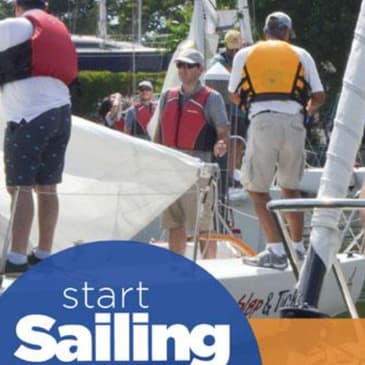
Racing sailboats can be cold, wet, and humbling—but also exhilarating, joyful, and life-changing. In this episode of Sail Faster, we explore how to start racing later in life, even if you didn’t grow up around boats. Host Pete chats with three experienced sailors—Beth Crabtree (SpinSheet), Jayne Durden (Sailing Happy Place, Commodore of Herrington Harbour Sailing Association), and Heidi Frist (J/30 class president)—about their own journeys into the racing world, and the advice they give to beginners. From joining a crew to skippering your own boat, from building confidence to packing a cooler, this conversation is full of honest insights, laughs, and practical tips for anyone curious about getting into sailboat racing.
[00:00:09] Hello everybody and welcome to another edition of Sailfaster. So it can be humbling, frequently wet, often cold, and at times searingly humiliating with only the briefest flashes of joy and jubilation. Now I'm not talking about watching my England football team at the World Cup, so that's a very familiar feeling. I'm talking about taking up racing sailboats in a competitive fleet as a beginner.
[00:00:36] So I know I'm painting a really dismal picture there. And yes, of course, it's far more joy and satisfaction and camaraderie than I'm letting on. We all know that. But I do get a lot of emails on this topic, how to get into competitive racing, particularly later in life. Quite often people have loads of sailing experience, but the jump to racing brings with it a fair degree of trepidation.
[00:01:01] So today, with the help of three fantastic guests, we're going to demystify racing for newcomers. We're going to share practical advice, whether you're thinking about joining a team, stepping onto a race boat for the first time, or campaigning your own boat, or welcoming a new sailor onto your crew. And hopefully we're going to ease a little bit of that anxiety, and hopefully encourage more people to give it a go, because it's brilliant.
[00:01:25] So joining me are three people with their own unique perspectives and a wealth of relevant experience. So first of all, we have Beth Crabtree, who is very well known, senior editor at Spinsheet magazine, and a host of the Start Sailing Now series, which this very much is sort of a reflection of. Also, we have Jane Durden, who is founder of Sailing Happy Place. She's a boat captain. She's commodore of the Harrington Harbour Sailing Association. And when she's not racing, she finds time to be an intellectual property lawyer.
[00:01:55] And then also we have Heidi Frist, who's also been on the Spinsheet Start Sailing Now series. Heidi's class president of the J30 Association and is a passionate racing sailor. So let's get into it. Now, Beth, if I may, I'm going to start with you. Can you tell us about the Start Sailing Now series in Spinsheet? What was the sort of intent behind it? How long has it been running for? Yeah, thanks, Pete. I'm glad you asked, because Start Sailing Now actually goes back to 2008.
[00:02:23] At that time, the intent was to provide a resource for adults who wanted to start sailing. A resource to talk about everything from how to get on a boat as crew, what kind of clothing and shoes should you wear, how do you find the right fitting PFD. And I should say, it was brainchild of Spinsheet Publishing's managing editor, Molly Winans. And she did a series for five or six years of seminars where she'd bring in local sailing experts.
[00:02:52] She did question and answer panels and brought new sailors into the fold that way. Probably around 2014, we started the Start Sailing Now series in which we would interview adults who started sailing. We wanted to tell personal stories. We wanted to prove that you're never too old or too young. It's not too late to start and showcase success stories and debunk any myths anybody might have that I had to grow up in a yacht club.
[00:03:21] I need a yachty family. I had to get the skill set as a kid. You know, just take all that away and tell stories. So we've been doing that for over 10 years. I've interviewed many people on the Sail Pastor podcast. And nearly all of them will tell you, I grew up sailing with my parents when I was three weeks old, that sort of thing. And I'm personally very, very envious of that. But it also builds up this intimidation factor. So I have the opposite experience, right?
[00:03:49] Over, you know, 100 sailors that I've interviewed. You might have dabbled in it as a kid, but it wasn't part of your life growing up. And yeah, it's great to be inspired by their stories of how they overcame any perceived obstacles. And, you know, if they can do it, I can do it kind of thing. Are there sort of common learnings that you've taken away from that? I think, first of all, there's no one way to do this. You might jump on as a crew. You might jump on as a boat owner.
[00:04:17] Some people buy a boat and then learn to sail. Some people want to learn by trial and error. Some people want to take every course out there that they can find. Some people love not owning a boat and being sailing on other people's boats. There's just no one way to do it. And that's, you know, I think one of the beauties of our sport is that it welcomes all kinds of people. And you can do it in all kinds of ways. Regardless of how old you are, regardless of your financial position, there's a way to get into sailing and racing.
[00:04:47] And specifically, it's very welcoming because race boats need crew. They need willing crew. The net that you've cast is people who've started sailing later. If you think of those who've started racing later, again, are any commonalities amongst that kind of person? Is there a particular psyche that suddenly at, you know, 40 or 50 decides they want to race sailboats? Anything common? Well, I often find they've done adventurous things earlier in their lives. They tend to be competitive. They're lifelong learners.
[00:05:16] They are often people who want to do things well, no matter what they're doing. They want to do it at a high level. And if you take up sailing, one way to accelerate your learning curve is to start racing. Smiling just a little bit because I think you just hinched us and our personality types, right, Heidi? Depending on what kind of racing you're doing, and mostly we're going to be talking about racing on boats with a crew of at least two people, maybe up to 10. And so there's a group dynamic.
[00:05:44] What I have seen is that people who race sailboats are team players. And so they have good communication skills because that's part of it. Jane, you talked about that matches your personality type. Why did you start racing specifically? I think you just hit on it with your question. It was the social aspect. It was the team aspect of this that I just love. So my first season, I was a main trimmer for a group of women who were racing a Catalina 320.
[00:06:13] And it was knowing that if I did my job correctly, I was helping us get across the line. If I did my little piece, it made the driver's job easier. It made everybody else's job easier. And now as a skipper and a driver, I am really aware of letting people sort of have that room to do their job. Six people coming on. I need every one of you to do this because for this boat, I cannot race her by myself.
[00:06:42] And I love that. I love the camaraderie. I have this incredible group of friends because every Wednesday night and most Saturdays, we go out and come rain, shine, wind or no wind. We go and kind of do hard things on a boat and get around three or four buoys in a bay. And have a great time doing it. When you're later in life, you have more experience at work, maybe leading teams, being part of a team.
[00:07:11] For me, that was really helpful because in order to have a functioning team or even high performing team, you have to put people in a situation where they can give their best. Just curious, Jane, if you felt the same. Completely. So in my day job, I work in intellectual property, but I work in business process assessments. And I used to run a consulting team. And I'd pick this team of people that were very complementary but very different skills. I needed all sorts of people that did different things.
[00:07:39] And we'd go into large law firms and go and do these three-day engagements. And you're exactly right. That is like very similar to what you're talking about when you're putting a team together to do an offshore race. We're prepping right now for the Annapolis to Newport race. You can't have a group of people that are all the same. It won't work. What you need is a group of people that are going to work together with complementary skills to make that boat go in good times and bad,
[00:08:07] to feed each other, to look after each other, and to figure out where we're going. I think the other thing that I do quite differently now than I would have done previously is at the end of a race, we do a lessons learned. We sit there at the end of the race and sit in the cockpit. Everybody talks through what happens. If something critical happens, we lose some equipment. We do a poor rounding. Something dangerous happens. We do a root cause analysis.
[00:08:37] All things that I do in my day job and all things that are really critical to kind of working a team of people. People have had their roles assigned before they walk onto the boat for the week. And then we talk through what our start strategy is going to be, who's doing what, what's happening. Again, I think I would have just sort of let things flow a little differently when I was younger, especially.
[00:09:00] Jane, I think building on what you're saying, when you're starting a little bit later in life, you're more self-aware of what your strengths and weaknesses are. Better able, hopefully, to communicate them, especially to your crew boss or your skipper. Letting people know where your comfort zone is so your teammates are aware of when you're outside of it because you will get outside of it at some point.
[00:09:23] And the other thing about starting when you're a little bit older is thinking about, you know, what can I bring in terms of what job on the boat? Being really clear with your skipper or crew boss. Maybe my balance isn't so great. Maybe the forward deck's not for me. Maybe I have a lot of strength and the main sheet's going to be a better place for me. So I think those are things that we are kind of aware of at a certain age in life that I at least wouldn't have thought about when I was 20 or 18.
[00:09:52] Sometimes I find that people have almost free pigeonholed themselves. I don't have the skills to do this. How do you know? We just haven't had a go. So we quite often actually kind of mix it up. So we'll do a three race weekend. I like the women's regatta. And now I absolutely intentionally switch people in their roles the second time around to try to make sure that people just don't keep going down it. Oh, I'm just a blah or this is my sweet spot. I'm going to do it. Awesome.
[00:10:22] Now let's see what happens if we move things around. So Heidi, I want to bring you into the conversation because you have a ton of experience on the J30. But what's your story? You started later, right? In life too. Yes. My story in a nutshell is that I was in my 40s. I moved to Maryland. Had no sailing experience. But being in a new environment, seeing that this is something that was happening in town. And I was curious. However, I do not like to be in water.
[00:10:50] So my friends had to convince me. To get me on a boat, they had to convince me that the boat's not going to, you know, flip over. They had to get a little model out and show me how it all works and everything like that. And so finally, we got on a J24, I think, I believe. And the first time I stepped on the boat, it was like a spiritual moment. It was like, oh my gosh, this is amazing how this felt.
[00:11:15] And then I got taken in under the skipper's wing as crew, being a complete newbie, not knowing anything. But it turned out that after a few years racing with them, I turned out to be one of his best crew people. I wasn't getting enough time on the water, so I decided to buy my own boat. So I got into the J30 fleet. What would your advice be for somebody, again, to looking in from the sidelines on how to be a great crew member?
[00:11:41] So in my case, I had to have a, you know, conversation with myself and say, I want to do this. So once I made that decision, I started to focus more on my skills, practicing my skills, getting out and crewing every single time that there was a race with my crew. The skipper that I had recommended that I take lessons. So he also recommended that I go away, not stay in town, which I did. And that was probably the best thing that I ever did.
[00:12:10] Taking a class like that gave me so much confidence. Do you think the way you started crewing for racing has changed the way that you view the kind of crew you have on? Do you bring on brand new sailors in the same way that you were brought on? I think it definitely influences the way that I bring crew on my boat. My boat is not one of the top performing boats in the fleet, only because I have a lot of newbies on my boat and I get people started in sailing. This year, I've got a teenager that's starting.
[00:12:40] We're going to train them up to do bow. They get started on my boat and then they move on. But what's fun is encouraging people to sail on the boat and they get excited about it. And then when they want to become more competitive than me, they move on to other boats. And that's kind of fun to see. That's one thing that I have found in common with many of the racing sailors and cruising sailors. Mentorship.
[00:13:04] Whether you're the mentor or the mentee, there's a lot of that going on formally and informally in sailing. Skippers want to bring on newbies and train them up and send them on their way. I mean, that says it all. It's never too late to start and we'll welcome anybody that wants to try. I generally have a dedicated crew set that are part of it, but life happens. So there's usually availability for a floating spot. Just keep calling.
[00:13:31] Turn up on the dock and turn up with beer and people would love to take you out and love to have you on the boat. Jane, one of the words you used is something I thought about before we started, which is you said a floating spot. And there's a job on a boat called a floater. So you don't have to have a great skill set to be a floater. And it's like the saying goes that there's no small parts, only small actors. You know, all the jobs are important on a boat.
[00:13:59] And if you're the floater and your team needs a knife and there's one down below, but none above decks, and you can run down and get it and get it to the person who needs it, that's invaluable. If a squall comes up and your skipper's jacket is way in the forward cabin and it's going to rain like heck and he's not going to be able to see or she's not going to be able to see, if you can run down there and keep them comfortable so they can keep their wits about them.
[00:14:25] And the floater job is one that I really didn't understand until one of the people who is a racing sailor that I interviewed for Start Sailing Now. And she really taught me the importance of that job as a great place to learn about all the other jobs, but also provide something of value that I'm not sure you find when you read about sailing. My first job on the boat was learning how to pack the cooler. That's a great role, Heidi.
[00:14:53] And trust me, there's a way to pack a cooler. Or pack a spinnaker. That was one that I found I could pack the spinnaker and knock on wood, I have 100% thumbs up that I haven't had one come out in a big knot yet. I had no idea how valuable that was when I first started packing the spinnaker. Oh, no, that's valuable, but I don't think they would give a newbie that job. No, the guy that we picked up on the dock, he's a tall swim guy.
[00:15:22] We had Bruce out there and on my boat, we've got no pole for downwind and I've got 140% Genoa. And Bruce was our pole. That was his job because our rules just say as long as you're only holding it out by hand. How amazing was it to have a six-foot something young guy that would be there holding out the clue of my Genoa? It was awesome. I think what we're talking about here is also an attitude about adding value. Even if you don't know how to trim a jib or trim a main or anything like that,
[00:15:51] there are so many jobs you can do, especially, I think, as you're getting the boat prepared and also packing the boat up. And Jane, I think when you and I talked about this a couple of weeks ago, you talked about observing who stays behind to help pack the boat and clean the boat. You know, when you come in, you're exhausted. And it's great if somebody says, what can I do? The attitude you need is that of being open, adding value. And I think also I would say that you can very quickly spot somebody who doesn't have that attitude.
[00:16:21] So my advice would be to really think about how you can add value in doing that. That aspect, for me, yeah, it's like somebody who comes during the winter to come and help, you know, service the winters. And when you do a crew call, they're always there. They're washing down the deck without you having to ask that sort of thing. So for me, if it's after a few times out, that person still verbally says, I don't really know what I'm doing and I don't feel like I'm contributing. You've got to get it.
[00:16:49] You've just got to get in there and you've got to do it. To your point, Pete, if you're not seeing yourself as being able to be part of that, maybe that's not the right fit at the moment. If you join a new boat and you don't feel after a couple of goes that you're adding value, it's probably partly you, but it's probably partly the team as well. It's probably just not the right team. So find another boat, I think, is the best thing to do in that state.
[00:17:15] And I would say that from the outside, a lot of these boats and teams, it seems really intimidating. These seem to be seasoned pros and they've got really confident and highly capable teams. And it can be quite intimidating, I think, to sort of step onto a boat like that. But I don't know about you, but I found that, you know, you find people who couldn't be more helpful or fiercely competitive, but they're also highly empathetic and highly welcoming to new crew members
[00:17:43] and also to incompetent skippers like me. And that's a great point because I'd never raced a 105 before I met you on that dock for the 105 women's regatta. I'm a good sailor. And it was so interesting for me to go and step on this boat that has its own language. It's like a completely different world. And so for me, I had to sit there and say, all right, I need to learn some of the 105 lingo and then I also need to let it go.
[00:18:11] But it was a little even intimidating for me to go, what you've got trim marks on your spreaders. I don't do that on a Beneteau. Okay, hold on a second. I've got to do it. So if I felt like that and I've done a lot of racing now, imagine what it feels like for somebody else stepping on a boat. But I've also noticed, for example, we talk about like college sailors. They've got all this great experience. They've also quite often got this quite narrow experience. They've had experience as one role on one kind of boat
[00:18:41] for the whole of their college career, which is amazing. But it was a real eye-opener for me to realize, hold on a second, just because that person was on a college racing team doesn't mean, Heidi, that they can helm the boat like you and I do or that they could do offshore nav or they could do any of these things. So yes, it's intimidating when you come onto a boat, but most people are learning something new in sailing at some point.
[00:19:08] Yeah, my other advice would be if you're starting racing as a crew member is jump on all sorts of different boats and all sorts of different crews. Don't be put off because sometimes it can be an unrewarding, humbling experience. And sometimes it can be absolutely fantastic. And much of it depends on the skipper. 80% of your experience, I think, depends on the skipper. It's like having a boss, right?
[00:19:35] Who your boss is, how they behave, has a massive impact on your enjoyment, your ability to do it well. I do want to talk about being a new owner, a new skipper, bringing a new boat into a competitive one design fleet. There's loads of webinars and YouTube channels and courses that you can take that can help you understand how to race a boat. But there's nothing like just getting out there and doing it.
[00:20:02] But it is very humbling experience to be trailing in last in a yacht race with your team looking at you and thinking, what the hell have I done to be on this boat? I wonder if you, Jane or Heidi or Beth, whether you have any advice for new owners in that situation. So for me, first of all, coming in last, which I've done lots of times, what I notice is my crew is like taking the blame. They feel the blame.
[00:20:31] And I have to say, no, you're not to blame. You're, you know, like individual people. As a skipper, I have to say... I blame them. I blame them. Definitely. No, no, I don't. I mean, you know, but now I'm thinking no. I mean, what I do is I usually say, you know, we're a team. We do this together. Let's get back to the dock and we'll have a chat about it, you know, and what we've done wrong or what we could have done better. Or maybe it was just luck. We just didn't have the luck.
[00:21:01] You know, a lot of boats, sometimes luck plays a lot of role in it. It is that getting back to the dock, as you both talked about, and then reviewing perhaps over a drink, you know, what we did, what happened, and what should we do differently next time. And I try and ensure that every person has a voice, that nobody's going away thinking, shit, we shouldn't have done it. We should have done it differently. And nobody asks me, you know, that's disastrous, right? I have a GoPro on my boat, so we're always bringing up like the little clip where we're like,
[00:21:31] I think that's where we messed up, you know? So we'll go back and we'll look at it. You know, a lot of times in my case, it's just tactics, you know, making one bad tack. That's all it takes is one bad tack. And now... So you don't know what it's really like to be in the back of the fleet. My boat has a perf rating of 182. So on a time of distance race, our fleet, I was for two years absolutely the last boat in. And for us, it was just trying to figure out if we were going to correct
[00:21:59] over the rest of the boat, which is mentally really hard, right? For a lot of crew, they've never, ever gone and figured this out. Who was the boat and the fleet that we were chasing? What did we know we needed to do? Was it pointing better? Was it downwind? But to your point, Pete, it was that talking it through afterwards and not being too attached to the outcome as well. Just listening to you there is, when I think about it, is same principle again at work, right? Make sure you hire people who know more than you, which in my case is really easy in both work and also sailing.
[00:22:29] That's very easy. But I think you have to do that as a newcomer and you have to feel good about it because it's your crew that gets you round the race course. You've brought some serious racers on to come and coach and come and give input and things on your boat, right? And you're doing this with the podcast. But I think, yeah, having a sailmaker, having somebody really serious, a coach, someone come on your boat is amazing. Just everybody learns so much from that.
[00:22:58] And doing that at least once a season is totally worth it. Yeah, and I think I found there are different kinds of coaches, right? There is Kristen Berry, who is very cerebral, I call him. And he can really think through the dynamics, crew dynamics, and how you get things done, which is absolutely, absolutely critical. There are others who sometimes you bring on experienced sailors and you really just want them to help me trim the main or trim the jib. That's all I want you to do. But they're so professionally competitive, they run around doing everything.
[00:23:28] So, you know, you come fourth and you don't feel great about it because you think, well, I only came fourth because that person drove, you know, did everything on the boat. So we bring my sailmaker coach on, Greg Kosky. And with Greg, you give him a strong drink and he sits on the rail and tells you what to do with the trim. But boy, is it amazing because he sits there. Bang, backstay, horse day. And you're like, okay. But he's just sitting on the rail. It's awesome.
[00:23:57] Actually, there is, I won't mention names, but in New Orleans, there is a person who works to one of the big global sailmakers. And he's a very, very, very good sailor. But he has a very southern accent. And he's been on my boat before and sitting right next to me. And he's yelling at me in this, in a nice way, in this accent. I have to get somebody else to translate. What did you say? And meanwhile, he's smoking cigarette. And these butts are piling up on the back of my boat.
[00:24:25] So I'm looking down thinking, I've got to clear that up later. I can't understand what he's saying. But he was very good. So I had Stephanie Roble on the podcast recently. She's a two-time Olympian. Brilliant. She's now an exec coach, starting out to be an exec coach. And one thing that she and I were talking about a couple of days ago was that there's a major difference between managing a sailboat team, a racing team, and managing a team at work. When you manage a team at work, you make lots of decisions.
[00:24:54] And you probably make final decisions. You take input from people and that sort of thing. One of the things I brought to her was that I feel like I lose situational awareness in the start line because there's so many things to think about. How close are we to the line? Are the sail trimmed in the right way? What decisions are we going to make? And she was very liberating for me because she was like, that's not your job. You've got one job here. If you're coming in on port and you're going to make that tack 30, 45 seconds before the line, your job is to nail that tack. You have a tactician.
[00:25:23] They're going to tell you what's going on. You don't need to look around. Just focus on that. And I found that very liberating. That was a sort of very big difference from managing a team at work where you really have to, you have to sort of understand and evaluate a whole host of things that are going on. In this case, it was just, no, don't do that at all. Your job is just to make that tack and then obviously get both speed. I thought that was, that was really interesting. I've just had the reverse reality. So I work for a very large company and I've been used to working for much smaller companies where I did.
[00:25:52] And I've at my job actually had to say, just drive the boat. Just, just do your thing because you're part of a much larger team that's involved. I think, I think you and Heidi have that too, because in your one design fleets, right? Your one design rules say that the owner has to drive, right? That's great. For me with the Perth, that's not the case. I do because I'm usually a better driver, but I had to consciously give tactics and sometimes
[00:26:20] even skipper to somebody else and then say to myself, I'm not the skipper today. I'm just the driver. That's all I am. I'm just driving. My role is to just get us there. One thing that people always told me was that, hey, what you want to do is in the bar or the party after the race or regatta, you want to find the top skipper and you want to talk to them and their crew about how they do it. I could never do that because I'm, I'm a massive, believe it or not, I'm a massive introvert. That would just kill me.
[00:26:49] It's one of the reasons I started Sailfast because I, because I thought if I can get somebody one-on-one and trap them onto a video for half an hour, I'll probably get a lot more than I would than if I was in the bar. But I know people tell me, go and talk to the top people in the fleet. And I found that everybody I've ever spoken to is more than willing to give you advice. They may be fierce competitors, but when they tell you perhaps how they manage their main
[00:27:15] and their jib going around a mark, they know that you're not going to be able to do it the way that they do it. So it's not an issue in terms of giving away any secrets, but people are very, very friendly and very, very open, I found, in the sport. Yes. The J30 fleet is very friendly. I mean, we're so friendly that we allow them, allow other people to jump on our boats and take measurements of our, you know, the rig tuning. They'll, they look at our rudders and say, you know, how dirty is your boat on the bottom compared to theirs?
[00:27:43] It's funny how the J30 fleet supports one another and the good skippers actually go out and support the new people. What are your thoughts on the best resources for, say, new skippers and also new crew members? I take advantage of the yacht club and the race committee as when they're off duty, you and you're friends with them, you can ask them all kinds of questions about racing and the rules, maybe interpreting rules for you if you don't understand them.
[00:28:13] I think it's mostly just being around other sailors and just talking to them. Beth, what do you, what do you think? Yeah, well. And you can't say Spinsheet Magazine. Well, you can. I've got to say that, don't worry. Well, and one thing I was going to ask, you know, I guess Heidi and you too, Pete, how do I have any idea if I've been a crew member, what fleet I want to join? Yeah. Do I just look for in my community, whatever body of water I'm sailing on where there's
[00:28:41] a large number of boats in a particular fleet? Is that in and of itself a good sign of a strong fleet? But I'm curious too, Heidi, with, you know, your leadership in your fleet is your, you know, the head of your fleets, are those good people to talk to? Oh yeah. I mean, so the J30, I'm sure most fleets have this. The J30 fleet has a website. They have blogs out there. People all over the country discuss various things about how to tune their boat, you know,
[00:29:11] what sail to use in this kind of weather. So there's resources through the class association. So I'm a YouTuber. I watch other people. I love it. It's my, it's my relaxation time. And so I'll put on some J70 race and watch them go around the mark and kind of pause it and go and have a look at it. But then I, I think that's all great. I think reading books are great. I think the North sales racing tactics books are great as resources and you've got to
[00:29:40] put it down and you've got to get out there. I think one of the things that people forget are exactly that. So we run racing rules seminars at Harrington Harbour at the start of the year. And people often forget to just read the racing documents, read the SIs, read the notice of race, read the rules. It's all there. And then doing race. So in our sailing association, everybody has to volunteer to do race committee at least once a season. And I think that is a great way of learning.
[00:30:10] It starts and used to sort of befuddle me as I'd listen to horns and watch flags. And when you've got to run a, you know, three start race and rolling, rolling five minute starts, all of a sudden you're like, oh, I get it. Okay. So go and do all of the things. Be the timer. Sit on the protest committee. Go and do it. Go to the trainings. Ask the people. But do the things, I think, is the biggest way that you learn.
[00:30:37] Local sailing media is going to point you towards crew parties and a list of people and that sort of thing. I got all my crew from the Annapolis area version of that, which is the spin sheet crew finder. It's really, really useful. As you say, Heidi, it just gives you an opportunity to try people out and test people and see if you can make that link over the phone. That worked well for me. You don't necessarily have to race to attend a regatta party.
[00:31:00] And that's probably a great way to go and see the awards and the camaraderie between the fleets, the skippers, the sailors, and just start talking to people. That's how I got into offshore sailing. I went to one of the events to prep for the Annapolis to Bermuda and just put my hand up and got picked back for a delivery crew position that turned into on-bay racing, that turned into all kinds of other things.
[00:31:30] And most of the time, just put your hand up and go and try it. I think it's okay. You don't have to. You're not marrying this. Well, in my case, my crew member is literally marrying me in a few weeks' time. But you don't all have to do that. It's okay as crew to find your spots. You need to be appropriate and you need to be polite. But I'm okay. I'm just fine if a crew member says to me, hey, I'm going to go and try racing on that other boat. Great. Just let me know.
[00:32:00] Beth, you touched on something beforehand around distance and where it's going to suit you. Are you driving hours to get there? Is that sustainable? Or can you find somewhere that's closer to you? Because that's just going to be an easier way of going and doing it. In my role as the Commodore at Harrington Harbour, we've been thinking really hard around who we are and what sort of selling association. We are very different from the big city just up north from us.
[00:32:27] So what is it that we can offer that might actually be exactly what people need and want? We are perf only. We don't have one design. We're a great place to learn and a great place to go and do it. And we run an annual women's regatta. We get about 20 boats a year. It doesn't matter how much experience you have or don't have. All we ask is that everybody steps up and does something that they haven't done before.
[00:32:55] So if you're really experienced and you're a great helmsperson, then try and sail a different boat. If you're normally a jib and main skipper, go out and go and try spinnaker racing. If you've never crewed before, amazing. Come and step on and be a jib trimmer. Come and do these things. And that's the spirit that we've taken in terms of trying to be pretty straightforward around what it is that we offer.
[00:33:21] One other place you might get started, I think, Pete, your idea of regional, local sailing magazines, sailing clubs. You know, see the resources that you can find. But don't forget community sailing programs. Many of them have racing. Many of them teach their members how to race. It's a great way to try a few different kinds of boats at an affordable price. And you've got all the networking there, right?
[00:33:46] Those people who are running those community sailing associations, they know lots of people in your local sailing community. And I've heard many, many times interviewing people. I started at this sailing school, my community sailing school. It was affordable. And from there, I met so-and-so on a boat. Or one of my mentors was this person. And they connected me with another boat. And they got me in a club in terms of getting on, you know, club racing boats. So, you know, you can definitely learn to sail at those places.
[00:34:15] But many of them have beginner racing programs if you want to dip your toe. I love the idea, Jane, of just try everything. Just do, just try a different experience of things. My advice would be, be really transparent about your knowledge. Because you'll get found out very, very fast on a boat when you've said you can do something and you can't. Unfortunately, it's that kind of environment. And it's okay, I think, to say, look, I'm happy to trim the chair. But that's the job you want me to do. Just be aware that I've only ever trimmed it for on Expo. I don't really know what I'm doing.
[00:34:45] Can you show me? And tell me what to do. Yeah, give me. It's like going to the dentist and saying I floss every day. You know, they're going to figure out pretty soon whether you do that or not. You're doing flossing. Same thing. You know, I know my first time being up on, you know, floor deck with my mentor who had always been on the boat with me and telling me what to do. And, you know, the first time he wasn't going to be there and I was kind of running things up front.
[00:35:10] You need to say, as we've been saying, hey, look, our regular guy is not in this position. I'm going to need a little more time or you're going to need to please over communicate with me as we come up to that mark. You know, let's make sure we talk it through. This is my first time doing this job or my first time doing it myself. And, yeah, that over communicating about your skill set's important.
[00:35:36] I learned that I had to talk to Maura, Maura Winston, who's my great tactician who I rely on enormously. But I realized that she didn't quite grasp how pathetically new I was. And so what I had to tell her to do is, can you stand next to me at the start? And can you just tell me what you're thinking? Because I'm not thinking what you're thinking. You know, you have to show some vulnerability and be prepared to say, I don't know how to do this, but I want to learn.
[00:36:05] We're going to do this a few times. I'm going to get better and better. Again, the worst thing is if you oversell yourself, it's much better to undersell yourself than it is to oversell yourself. I've seen people undersell themselves and they get found out too, you know. I think Sue actually knows a lot more than she's told us, but that's always appreciated. And I think vulnerable is a good word, a good way to describe that. But, you know, I would expect everyone here has had the same experience I have,
[00:36:34] that those people that intimidate you on the boat are so happy to share their knowledge. I've got something from what Beth said earlier that's just been, it really, really hit me. You said something about skills that you thought were going to scare you. When I bought my boat, I thought I wanted a J22 or something like that.
[00:36:58] I wanted no through holes and I wanted no diesel engine and I wanted limited electronics. And it's really funny. You were talking about what it was about being on a boat that you liked. I've turned into a complete diesel geek. I love the fact that I have figured that engine out and generally mastered it. And keeping that thing happy and healthy is actually something I really enjoy. And who would have known?
[00:37:27] Who would have known that before about it? So sometimes the things that scare you turn out to be the things that you get a lot of pleasure out of doing. And I'm really glad I figured that out in owning this boat. For me, it's geometry. Going back to geometry and wind shifts and ladder lines. That whole area that makes my head hurt. But having to learn that. And then the rules are absolutely ridiculously arcane.
[00:37:55] And who knows where the hell the three boat circle is? But it's so vital. That whole part of it is so interesting to learn. The rules change like they did for this year around them. Just as we're comfortable roughly with some of them. They change the bloody things. But we have Angelo on our fleet who is just the rules whisperer. But before we end here, I want to ask you, what's the best bit of advice you would give?
[00:38:23] Firstly, a newbie crew member. And somebody who's jumping on racing for the first time. And also to somebody who's got a keelboat dinghy. It doesn't really matter. And is thinking about joining a fleet. Who wants to start? You might be able to talk about a newbie joining as a crew member. First of all, I was going to say something like, if you enjoy or you think you enjoy sailing and you haven't tried it, try it. You should just go out and sail.
[00:38:52] It doesn't have to be a race. Just go out sailing. But if you feel like you want to race, before jumping on a race boat, have some knowledge, a little bit of knowledge. Know what starboard and port means. Know what halyards and sheets do. Kind of know how to wrap a line around a winch. You don't need to be a professional or anything like that. But just know a little bit would be very helpful. Yeah. Yeah. And on my boat, I have stickers. I have port and starboard.
[00:39:21] I mean, I don't care. I don't care if it makes me look less of a racer or whatever. But I'm like, I've got people on my boat that I'm teaching to sail. So I've got to have the little stickers. It helps me out too. Okay. I have to tell you that I had stickers I put on my boom. A red one and a green one. Yep. And I had somebody on my boat just saying, what the hell do you need that for? I thought, because in a moment of panic, I realized that we're okay.
[00:39:49] On a couple of different boats that were not mine, I've put on stickers. After listening, you know, a couple of weeks in a row to a crew say, wait, what line? The red one? Which one? What? I show up with stickers next week. This is our best advice from this episode is... Yeah. Get a label maker. Again, I was talking to Steph about the Olympics and she was talking about, she had checklists. And I said to her, did you write those down? She'll, yep, absolutely write them down or write them on the deck. And she's an Olympian, right?
[00:40:19] So that gave me some encouragement to do the same. Jane, what about you? What's your sort of best piece of advice for somebody? So step on and find the checklist. I've got checklists on my boat. And for me, I'm looking for a crew member. You want to come and crew? Come and make yourself invaluable. Turn up. Do the things. Get the boat ready. Because doing those things, you're not out there. You're not technically racing, but you're doing the things that are involved with racing. So go and prep the boat.
[00:40:49] Talk to the skipper. Ask to drive the boat out of the marina. Ask to bring the boat back in, those kinds of things, and step up and figure it out. And then just, just, just turn up. You said it before around being vulnerable, but I also appreciate for new crew members to sort of say, hey, we're, you know, I call a tack and for someone to say, tell me when you think that I've cheated in enough. Talk to me, talk, talk, talk me in on my trim. Amazing.
[00:41:17] I can do something with that, but I can't help you if you don't let me know exactly where you are, or I'm going to start, somebody's going to start telling you what to do. And that becomes difficult. So it's that openness, being open to learn, open to input. And yeah, just demonstrating that you're there to be part of the team. For me, my valuable crew are the ones that show up a half an hour early from dock time and they're putting the boat together.
[00:41:44] I know when I started, I was the first one at the boat because it gave me an opportunity to be alone with the boat and learn how to rig it. And that was so good for me. And I know that for me as a skipper, having that crew show up early and take interest in getting the boat ready and having that excitement to go out and race, to be the cheerleaders is awesome. I love that because I have somebody on my boat, Steve, who he's always there first.
[00:42:11] He's got the dehumidifier out on the dock, which is great. But I think as well, it's, I think it gives people a sense of ownership. If they have something, they know that when they get to the boat, they're going to do that. They become part of the team. I feel a sense of belonging and a little bit of a sense of ownership here. So this is great. I know I started with a very dismal review of it's humbling. It's humiliating. It's cold and it's wet, but you're just looking to create some progress step by step by step.
[00:42:39] I've got a, at least an hour drive between Washington DC where I live in Annapolis. And I had come back from those many, many races swearing at myself and thinking, fuck, why did we do that? Or why we, why did I do that? You know, if only we'd done that, we wouldn't have gone. But then there was what, you know this Beth, there was one weekend where we won ace. It was a, it's a secondary regatta. That joy and satisfaction, jubilation that lasted with me for about three months.
[00:43:09] So then probably the next race, we probably came last or something like that. But it's, it is a journey. It's a beguiling, fascinating, sometimes bewildering, amazing sports that I wouldn't swap for anything. It is an amazing sport. And what I like about it is that you keep learning. You never end the learning. The learning is always there. And that's what makes it fun. I'm going to go back to Beth. You said at the beginning, I asked you about what is there any common factor between people? And that's exactly what you said.
[00:43:39] Lifetime learners, competitive. They want to improve. And because you're quite right, Heidi, it's just, there's no end. There's no end point. You can't complete sailing, can you? You've got to, unless you're maybe Sir Ben Ainslie or Ken Reed. And every time you go out, it's something different. It's always, it's never the same thing. I think we're all missing the big thing though. It's that feeling of being on a beam reach and just screaming down the bay and going somewhere. We're doing that. We're making this thing go through the water. All right. Well, thank you so much for joining me.
[00:44:08] This is really interesting. I think we got some, we've managed to pull out some good advice out of a discussion. I hope people find that. I look forward to seeing you three on the bay or in the after race party. Know that I won't come up to you because I'm an introvert. So am I. Come up to me. Thank you all of you for taking part. Really enjoyed it. Yes. Thank you. Thank you. My pleasure. Thank you.