
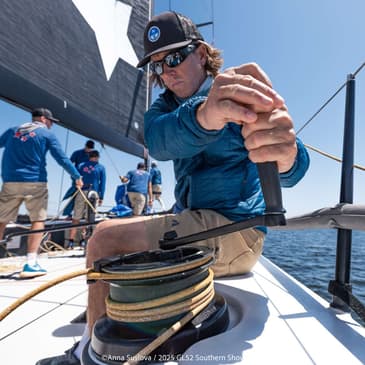
In this episode, world-class sailor and coach Steve Hunt shares hard-earned lessons from his career — from his early days sailing in Virginia to competing as tactician on TP52 Wizard. Steve opens up about the intense learning curve of big boat racing, the importance of preparation, and how even small adjustments in sail trim and decision-making can have huge impacts on performance. He dives deep into starting techniques, teamwork, mental preparation, and why trusting your instincts is just as important as trusting the instruments. Whether you’re racing dinghies or grand prix boats, Steve’s advice will help you think faster, sail smarter, and chase your best results yet.
[00:00:08] Hello, today on Sailfaster we're thrilled to welcome one of the most respected minds in American sailboat racing, Steve Hunt. Steve is a multi-time national and world champion. He's a former US Olympic campaigner and one of the most sought after coaches in the sport. From collegiate All-American at the College of Charleston to world championship titles in classes like the Etcholes and the Far 40, Steve has been there and won at every level of competitive sailing.
[00:00:36] He is also a gifted educator known for his work especially with youth and high school programs including Point Loma High School in San Diego where he led the team to an extraordinary eight national titles. Whether he's coaching at clinics, sharing tactical insights through his platform SteveHuntSailing.com or racing at the top of the sport, Steve is passionate about helping sailors get faster, smarter, and more confident on the race course.
[00:01:03] Steve Hurtz I managed to grab an hour with Steve on his recent return from Pensacola where he was calling tactics on Wizard in the GL52 series. Steve Hurtz So in part one of our discussion today, we're going to discuss pre-start manoeuvring and whether that's on a TP52 or a J70. We also dive into how he breaks down high level strategy for everyday races, his best advice for teams looking to level up, and what it really takes to win in modern one design fleets. Here we go.
[00:01:40] Steve, hello. Thank you so much for joining us. I've been really looking forward to talking to you because I've been trying to follow your excellent advice on Sailing World and your website for a while now. So I'm thrilled to have you on the pod. Thanks for joining. Steve Hurtz Well, thank you, Pete. It's a pleasure to be here. Steve Hurtz So let's start with the basics then. Steve, where did you grow up?
[00:02:00] Steve Hurtz I grew up in a little town called Picosin, which is beside Hampton, Virginia on the Chesapeake Bay. And I love sailboat racing. I spent time on the water. My dad was a fisherman and a big sailboat racer. Steve Hurtz Wow. Steve Hurtz He raced the Hampton one design, which is a local boat in Chesapeake Bay and won a bunch of national championships. I think I grew up enjoying the water because of my dad and wanting to do well like he did. Steve Hurtz Yeah. Got it. And then, so how did you get into racing specifically?
[00:02:26] Steve Hurtz I just fell in love with sailboats and then started to do regattas through the Hampton Yacht Club Junior program and really enjoyed it. Sailed J24s with my friends and my dad and Sunfish and FJs. And just really fell in love with it. I love being on the water. Steve Hurtz Yeah. Yeah. Yeah. I didn't know you're from Hampton, Virginia. Steve Hurtz I am. Yeah. And where are you? Are you in Annapolis or? Steve Hurtz Yeah. I'm in DC. Yeah. Washington DC.
[00:02:50] Steve Hurtz In DC. Yeah. Yeah. I love playing basketball too, but I was much better at sailboat racing than basketball. So here I am. Steve Hurtz Well, I'm glad. So am I right that you were just down in Florida on TP52s, right? Was it Wizard for the Pensacola? Steve Hurtz I was. Yep. Racing it in Pensacola, Florida at the Pensacola number two, which they renamed the Southern Showdown. Steve Hurtz Oh, I saw that.
[00:03:13] Steve Hurtz So Pensacola is becoming quite a hub for sailing now, isn't it? With America's Carb, with the TP52s, the GL52 stuff going on there. Were you, was it sort of obvious to you that they've got quite a lot of development down there? Steve Hurtz Yeah. The America Magic Camp is there. And I think the DeVosses and America Magic have brought the GL52 fleet there for two events. And it really was amazing. I had no idea. I'd never been there. And the venue is really nice. Flat water. The community opens up.
[00:03:40] Steve Hurtz
[00:04:21] Steve Hurtz Steve Hurtz You came second, right? Steve Hurtz Yes. A very painful second. Steve Hurtz I suspected that. What happened?
[00:04:32] Steve Hurtz Well, we came out firing on day one and two and sailed really well. The fleet's incredibly difficult. It's the beginning of our second season. And initially we weren't really competitive and we've gotten a lot better. And Fox is there who normally wins the regattas. They're eight years down the road on us. And many of the other boats. And they typically win with a race to spare or two races.
[00:04:54] Steve Hurtz Crush everyone basically. And the rest of us are fighting for second. And so this one felt different. We came out on fire. Won most of the races the first two days. Sailed really well. And then day three was an offshore, puffy, shifty, really weird day.
[00:05:11] Steve Hurtz And I feel like we had a little bit of unlucky circumstances. Two of the races we were in second on the second beat and fell back to fifth. We had glassed off. And people that were way behind caught up by getting to an edge. I'm still kicking myself over that one. Steve Hurtz And then the next race we were actually winning coming into the finish. And the wind died. And everyone behind caught up. And even the boat that was half a leg in last place won the race.
[00:05:36] Steve Hurtz It was challenging. And Fox was back there, I think, in fourth or fifth. So had either of those races gone better, we would have won. But, you know, I've trained myself to not get too upset about things you can't control.
[00:05:50] Steve Hurtz Couldn't control that downwind fleet inversion. But that was frustrating. Then the last day we sailed okay, but not great. And Fox just narrowly beat us by just a few seconds. So still feeling the pain from that one. But a big picture. As a team, we feel really positive about the experience because we're very competitive. A lot of the top tacticians and sailors in the world, high budget programs. And we're in the game and getting better and better. So our process is working.
[00:06:15] Steve Hurtz It's a great series, isn't it? They've done a very good job of taking video, drone video, and sort of boatside video and distributing it. It's really fun to watch. What's your role on Wizard? Steve Hurtz I'm the tactician. Calling the shots with help from others on the boat. Charlie Enright is the strategist. Steve Hurtz Yeah. Steve Hurtz And we have Simon Fisher, who's a legend, is the navigator. And Richard Clark is doing the runners and he gives feedback. We have legends on the boat. It's a lot of Charlie Enright.
[00:06:44] Steve Hurtz It's a round-the-world winning team was how it started. Peter Eskew, the owner's a great guy. It's a first-class program. And all the boats there have first-class programs. And they're doing a great job with running the series. And like you said, the drone footage.
[00:06:58] Steve Hurtz They have morning briefings. The American Magic coach, James Line, runs the whole fleet through a coaching session from the day before and shows us pictures of our sails. He shows us the starts from drone and talks about what's working, what's not. And he gives us a weather briefing for the day on what he thinks we should all look out for. It's really first-class and high-level. Steve Hurtz Sounds like a really good program.
[00:07:19] Steve Hurtz Yeah, it's amazing. And we had five boats the first regatta, six boats this regatta. And hopefully next year they said they might add a third event. And hopefully we get a few more boats coming down from the Great Lakes as well. Steve Hurtz You must have run into Sarah Stone, right? I think she was doing the strategy job on one or the other. Steve Hurtz On WindQuest, yeah. Sailing with Terry Hutchinson was their tactician, the DeVos boat. Yeah, we said hi on the dock a few times. They did a great job. And I loved her interview with you. It was really first-class. She's super bright.
[00:07:50] Steve Hurtz Follow her a little bit and be okay. Steve Hurtz It was a very interesting discussion. What are you enjoying most about your time on the TP52? Steve Hurtz So far, it's been the learning for me. I normally sail Etchells and I coach high school, which is in FJs and 420s. Coach a lot of youth sailing. I sail J70s a lot. So for me, being on a team on a bigger boat, I've done some far 40s and 52s, but really a first-class program where we do a whole season. This is my first time.
[00:08:18] Steve Hurtz And there's 14 people on the boat. So it's a lot of learning for me. The boat's very different than the J70 and Etchells. You know, at the end of the day, it's still sailboat racing, but there's a lot going on. Steve Hurtz And managing a group of 14 people to try to get a boat around the race course is very different than three or four. Having the instrumentation that they have on the 52s is amazing.
[00:08:39] Steve Hurtz For example, in the pre-start, you have the navigator telling you lengths to pin lay line, burn time to the starting line, lengths to boat lay line. You can ask him burn time to pin, burn time to boat. There's all sorts of information that is being fed to you from someone with a computer and others giving you info.
[00:09:00] Steve Hurtz And you have five other amazing tacticians calling the start with great drivers. And then, you know, there's pedestals and buttons and all sorts of sails. And when you sail offshore, there's more sails. And there's a lot that goes on to get the sails up and down. And my learning curve has been through the roof. So for me, that's the most exciting part. Steve Hurtz Having all that data, having all that instrumentation coming at you, does it make your job easier or harder?
[00:09:24] Steve Hurtz That's a great question. I think it's helpful, but sometimes it's for sure harder. And I've been learning. I talked to a couple of top tacticians before I started and they said, you know, Steve, all the instrumentation is great, but you got to use your eyes. Heading is still your friend. True wind direction can be screwed up right after you tack and it might just be wrong. It might tack as you tack. If you're reaching in the pre-start, true wind direction doesn't work that well.
[00:09:52] Steve Hurtz So you fall in love with the instruments and what's there. And then it's often wrong. And you might get a ley line wrong. You know, someone's calling length the pen ley line. So you trust it and you head up to win the pen. And then you don't lay. And you realize that you were just listening to length and you weren't actually looking at the pen and just feeling it like you normally do. So there's certainly a learning curve. I've learned to use it sometimes, but still force myself to get my eyes out of the boat and use my own judgment.
[00:10:22] And I've actually learned recently that's been very helpful. We do practice starts with no instruments and I drive just to get a feel for time and distance, the raw style. And then we add in the instruments and I use it with a grain of salt. And that seems to be a better process than just fully trusting it. That's really interesting as a way of thinking about doing that. My team will tell you that we have our best results when our instruments have failed.
[00:10:47] Totally. That's how I learned it. One day they just crashed and I had my best day and my ley lines were great. And I thought, what am I doing? What have I been doing? Listening to this box the whole time. That's wrong. It's just a computer making guesses, you know, and it tells you time to ley line, but you're three quarters of a mile away. And you jive on what it thinks is ley line and any shift you're not on anymore.
[00:11:10] And another difference from the small boats and big boats is there's no man's land in a TP 52 where you're 25 seconds away from the mark. And that's not enough time to jibe, complete the jibe, get the jib up, douse the kite. So you're in this quandary of what do we do? Whereas in a J70, you can just jibe, boom, kite down. It's easy. It doesn't really matter. So there's other constraints on a big boat and sometimes the instruments get you in trouble.
[00:11:39] So that no man's land, is that just because of the size of the boat? It is because everything takes longer and it takes longer to get the jib up. It takes longer to get the kite down. It takes longer to complete a jibe. Like the jibe probably takes in lighter winds and medium winds 20 seconds. So you're say 25 seconds from the mark and you do a full jibe. Now you're five seconds from the mark and you have to get the jib up and the kite down.
[00:12:06] And if you put the jib up before the jibe, you can't jibe. But you're locked in and when you jibe, the kite often doesn't fill because the jib is stealing its wind. So the solution is to go jib halfway up, jibe, then the other half kite down if you're in no man's land. So I've learned to jibe at about a minute to lay line or a little bit earlier if you're far away. And then if you get a big header, you end up laying.
[00:12:34] Or if you get a lift, now you're two minutes away and you have time to jibe and get the kite down. So there's been a learning curve for me. We're starting to get the hang of it. And it felt good to be competing against Fox as one ever regatta we've sailed against them and be in a great battle with them. So we're chipping away. I would think coming second in a major regatta does mean that you are getting it for sure. Now I'm going to have to go back and watch videos again with Mark Roundings based on what you just told me.
[00:13:00] The videos that I see, they have the music playing and it looks fantastically organized as well. You don't hear the shouting. You don't hear anything like that. Has your time on your T-52 changed how you think about coaching or anything? It has changed how I've asked people that I sail with on other boats like Edgell's and J-70s. The communication that we have. Because you fall in love with the data, even though sometimes it's wrong. Like having burn time to the start is amazing.
[00:13:28] And it's basically extra time. It's if you raced to the line right now, how much extra time would there be? How early would you be? And having that really frees you as a tactician to make decisions. If you have a minute to burn, you can do a circle. You can jive and head to the line. There's many things you can do. If you have five seconds to burn, you're pretty much racing. If you have 30 seconds to burn, maybe you have time to do a double tack or a half tack. And then go. You have a little bit of extra time. You have to slow down and go.
[00:13:58] And when you're sailing J-70s and Edgell's, you don't have that. Also having someone tell you lengths to pin lay line as you're coming into the starting box on port. Knowing when you can tack and lay the pin. Or if you're heading towards boat lay line. Having someone say four lengths to boat lay line. Three lengths to boat lay line. Knowing that you can now tack underneath it. And you won't be closed out by someone else. Whereas if you pass it in tack, maybe another boat hooks you and closes you out and you can't start. So having that data is great.
[00:14:26] So I've asked sailors on my other boats, crew members, to pretend they have a box and call lengths to lay lines. Burn time. Or since it's a calculation, I say just estimate time to the line is great too. You know, 30 to the line with a tack. And then I hear the timekeeper say one minute. Okay, we have 30 extra seconds. That's the burn time. And then maybe we dip a group and they'll say 40 to the line. And then someone says 50 seconds. And I think, okay, we only have 10 extra seconds.
[00:14:55] So that's been a change, which I think has helped us on other teams with smaller boats. Yeah. And then it also helps you as a tactician. If someone says 30 to the line, it encourages you to look and make your own judgment. There's an old story about naval warfare where if one person guessed the height of a cannon to shoot the enemy, they almost always missed. But if seven people guessed the angle to get the distance right, they almost always hit the other boat.
[00:15:25] So the group mind is typically better than one person doing it. So actually, if we had seven people estimating how long it would take to get to the line with a tack and we averaged it all, it'd be perfect. So that's great to have multiple people giving feedback. And then you have to have somebody to work out the average there. Yeah. There's one other big one in the 52 fleet. There's a lot of double tacking. And in a lot of other fleets I see on, there's less.
[00:15:52] And I had heard that 470 gold medalists, Matthew Belcher and Will Ryan were the masters of the double tack. And I've always wanted to learn more about it. And it's basically if someone's to lure it over you, you just tack twice before the start. And in the 52, the teams use those a lot.
[00:16:11] And if you have space to your right and someone close to lure it over you, the boats are so wide and they have so much bad air that you typically want to do a double tack to open up your gap before the start and have a hole to lure it. And there's this whole game around double tacks and nuances around double tacks and the tactics and strategy of using them that I have learned in the past season. And I have taken that to coach my high school kids to try to up their level because they hear the same things from me over and over.
[00:16:41] And in team racing especially, you use double tacks. So my knowledge of double tacks have really increased. And I've been sharing that with the high school team and having created some drills where they can practice that. If you want to dive into a little bit of the details, it's pretty cool actually. I'm surprised that you do double tacks close to the start line in a boat like a TP-52. I can see you doing dinghies.
[00:17:05] And in fact, I was watching one of your videos on stevehuntsailing.com, which had these dinghies in, I can't remember where it was now, but they were San Diego, double tacking again and again and again as they approach the start line. And I was thinking, great if you're in a two-person dinghy, but I was really surprised that a TP-52, you'll do that. Doesn't it slow you down a ton when you're going through the tacks? Or is that more important?
[00:17:29] It's more important to find that space to lure it at you than it is to worry about slowing down. Great question. So if there's enough time to do one, it's best to do one. And what we've learned is if you have probably 20 seconds to burn or more, there's plenty of time. If you're very slow, it takes longer. But if you have speed, you can do one with maybe even 15 seconds to burn.
[00:17:57] So the double tack is open if there's space to do it until a certain amount of burn time or extra times left. Once you've reached that minimum threshold, it's off. But if you're going to get pinched off anyway, it might still be better to do it. But it's critical to be on time for the start. So a couple of rules of thumb. If the boat to your right does one, you match. We go with. Yeah. And now when they come back, you come back. And now you're still tight to lure it.
[00:18:27] And they have no hole. The racing is also interesting. It's a pretty short beat for a big 52-foot boat. Probably an eight-minute beat, nine-minute beat. So we're doing one-mile courses, 1.1 miles. Yeah. And in the Etchols, we're doing 1.3 with a much smaller, slower boat. So you only have four or five minutes to lay line in the 52 before you have to tack. And everyone's pretty close in speed. So if someone has a gap to your right and it's a square line or boat favored, you're never going to get to them.
[00:18:56] And then when you exit the left, they're going to slam you. And the tacking penalty is pretty large in these big boats, like you just said. So if that happens, you have to tack twice. And now you probably don't beat that boat in the race unless it gets really weird. So having the tight to lure it on the boat to your right is huge. To flick them out before you get to lay line four or five minutes from now. I'm going to go back and watch those videos again now. Yeah. And then if you don't have enough room to double tack, you do a half tack.
[00:19:22] Whereas you head up and you backwind the jib and the boat slides to its right. And then you cut the jib and you rotate the bow back down and go. And that takes less time than a double tack. You don't quite travel as much lateral distance. But you do it. And there's all these, once you know that this is the game, there's all these subtleties of tactics. How do you defend a double tack? If they tack too close, you can hook. If you let someone cross, then you can half tap back up to them.
[00:19:49] It's this wonderful game between all these great tacticians of jockeying for position to get a great start and hurt the boat above you. So Steve, you are really well known as a top racing sailor, of course, and coach. But I think also what's different about you is your push to improve everyone's racing skills. And I'm thinking particularly about your website, stevehuntsailing.com, which is a fantastic resource for racing videos and tips and insights and learning. This is not meant to be an ad for your business.
[00:20:19] I love it. Thank you. Yeah, yeah. Well, there you are. It is an ad. But I do want to talk about it. How did you start that? I've always thought about doing one later in life. My goal is just to help as many people as possible become great at racing sailboats. And I've dedicated my life to the Point Loma High School sailing team. It's my 20th year coaching them. And we've done really well. We've won 12 national championships since 2010. And I've started to think as time goes on, you know, it'd be cool to help others.
[00:20:49] I've created all this content and PowerPoint slides and lesson plans. And I have 30,000 videos because I video every practice. I think that's the best way to learn. And I thought, you know, as I get older, I should probably branch out and just help more people learn how to race sailboats well and share this knowledge. And that's how it started. I've also learned with the high school kids that they love to watch video. And they like short and sweet video. So that's the purpose of the site is to teach these cool lessons. Try to keep it short and sweet. Have a video backdrop.
[00:21:18] So you can actually watch it. And it stemmed from that. And so far, it's going really well. People love it. Yeah, I'm not surprised. I was talking this morning to your friend, Patrick Wilson. Great. From the J70, you know, known for J70 fleet. And he, I said, you know, you'd be on the pod today. And he was just talking about how, for him, how important it is to sort of give back. That he, I think it's true of many, many racing sailors.
[00:21:44] I think there's a real sense of appreciation and gratitude that you're able to do something that you love and get paid for it. And, you know, such a beautiful sport in many, many ways. Can I ask you about all the sort of learning and videos that you have in your collection? Is there one standout piece of advice or video that people will tell you, this is what I learned the most from? It's hard to pick one. I think a lot of it depends on what the person is working on.
[00:22:11] Because we cover tactics, speed, and starting are the three big ones, as well as many other things. And I think if someone's struggling with speed or starting or tactics, they love that video the most. We have some pretty robust three-part lessons on each of those. But probably if I had to pick one, the best feedback I've received is the starting. And probably because starting is the most challenging part of sailboat racing, I think there's so many variables. It's a little bit random. And the ultimate starting guide is really robust and people love it.
[00:22:41] And then the high-level starting moves, which you maybe, I think, just talked about with the double tax and half tax and sliding to windward. And we have Charlotte Rose, one of the best laser sellers in the world. Awesome drone footage of her doing all those moves in a pre-start. And it really blows your mind. And I've received a lot of feedback from those. As we talked to when we first chatted a week or so ago, you're very good about decomplexifying the complex or making the complex simple, which I think is critical.
[00:23:09] But I want to move on to preparation. I want to talk about how you prepare yourself or teams that you're coaching, any age, high school, whatever, for regattas, for races. And I'd like to start off with sort of mental preparation, which I know is really important. Do you have a self-talk or anything like that that you use to overcome any confidence issues? You don't seem somebody who's stressed by confidence issues, but just curious about mental preparation for you.
[00:23:38] Yeah, I'm really into the mental game. I think it's really important. And I gave a speech to the U.S. sailing team during the pandemic on this topic specifically. I think it's important to visualize. Most Olympic athletes or all Olympic athletes visualize performing well. And I think your mind doesn't really know if you're doing it or not doing it physically. If you have really clear mental imagery is another way to say visualization. So I think it's important to visualize doing well, having success.
[00:24:07] Visualize starting well, tacking well, jiving well, going through your maneuvers. I like to picture myself and my team on the podium at the end of the regatta. And now first place goes to the wizard and they call us up. I picture that too. I think it's important to meditate. I think it helps clear your mind. Breathing exercises, a lot of people stress and talk about clearing your mind. I think helps you stay calm and make good decisions. So every morning I do those things.
[00:24:36] As a regatta is approaching, I start to picture the venue and that regatta and that boat and that team to help prepare myself mentally. I teach this to the high school kids too. I think when you go to regatta, you treat it a bit like a military mission, like full focus. You fly there and it's on. You're not distracted by a bunch of other things going on in your life. Ideally, you have your life somewhat sorted and no one has a life fully sorted and things happen.
[00:25:04] But if you look at your life as like spokes on a wheel, if a couple spokes are broken or missing, the wheel doesn't really work that well. So you try to have everything in your life organized and sorted and you go to the competition and fully focus on the competition. Those are some tips. Does it differ for you whether you're sailing on a J70 or whether you're doing tactics on a TP52? Is there any difference in your sort of mental preparation? I don't think so, no. No, not really.
[00:25:29] Just maybe the focus of what I need to do to do well might be slightly different. Like the 52 I have found is more difficult communicating well to the group because it's a bigger boat with more people. And everything in the pre-start seems to be a bit more slow motion. And if you make a mistake, there's no really way out of it. Whereas in an FJ or a J70, you can kind of boom, boom, boom, wiggle your way out of some trouble in a big heavy boat. Once you get in trouble, you're done.
[00:25:59] And the pain that you feel and you have 13 others on the boat that are witnessing your mistake and feeling that same pain with you, it just magnifies it. So I think I picture being a clear communicator more when I'm visualizing doing well in the 52 and thinking ahead more because, like I said, everything's slower. And if you get it right, it's great. And if you get it wrong, it's extremely painful. And you have to think two steps ahead, less free-forming in the bigger boat.
[00:26:29] Yeah, I know what it's like when my crew looks back at me when I've made a complete fuck up at the start. It lasts a long time as well. Exactly. Yeah. And then, yeah, you might feel it the whole race, especially if there's only six boats. That like to tack on each other. It's really hard to come back in that six-boat 52 fleet because all the top tacticians pretty much go the right way. And they know that if they hit you once at a critical time, you probably won't recover. So it's pretty brutal.
[00:26:56] I've been talking to Steph Roble, ex-Olympian now and executive coach, about getting the self-talk right on the way to a regatta, which has been a really interesting conversation about how do you remain positive? How do you remain focused? What are the things that you need to think about? What are the things you need to tell yourself at various aspects of the course? And I hope none of my crew hears any of this because I'll think I'm completely insane. But I absolutely need it.
[00:27:25] Let's talk about operational preparation. Do you have, regardless of the boat, is there a sort of standard checklist in your head or a set of actions that you always take to prep any boat? That sort of checklist that you go through on the morning of. And I'm sure if you do, it contains things like, you know, make sure the rig is tuned in the right way. But I'm just curious what yours looks like. I am fortunate enough to where most boats I sail on, we have a boat captain.
[00:27:56] Basically, the boat has to be perfect. You can't waste points on breakdowns. You need the proper sails for the conditions. I'm typically in charge of the mainsail, the battens in the mainsail and the rig tune, like you just mentioned. So getting down there early and going through all of that is critically important to go fast. But having the boat bottom cleaned, having all the equipment checked over so nothing breaks, having all the best equipment. If you want to win at the highest level, you have to have the best boat. So having a sweet boat is really critical.
[00:28:24] But yeah, we could talk for 30 minutes about the checklist of being prepared for a rigata. But again, you need the right housing. You need the right food. You need the right hydration program. You need the right amount of sleep. You need the best equipment. All of that is critical to doing well. So that wraps up part one of my fascinating discussion with Steve Hunt.
[00:28:51] I'm sure you'll agree it was packed with great takeaways, especially around pre-start strategy and what you need in terms of mindset. So in part two, we'll dive even deeper with Steve into tactical decision making and really next level race execution. And here's a bonus for SailFaster listeners. Steve is offering an exclusive 30% discount on a subscription to his premium rating content at stevehuntsailing.com.
[00:29:19] Just enter the code SAILFASTER30 at checkout to get the deal. That's SAILFASTER30 at checkout to get you 30% off. It's a great resource. Great, great resource. See you next time. See you next time.