
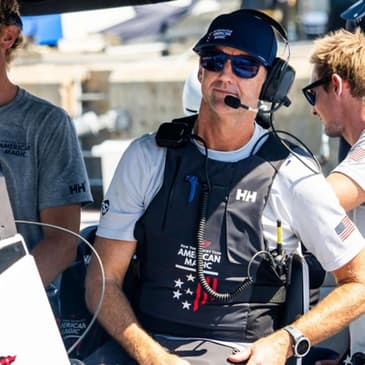
Tom Burnham, fresh off his America’s Cup experience with American Magic, joins us in the Sailfaster studio. With his extensive top-tier sailing experience, including five America’s Cup campaigns, "Supercoach" Tom has been a key asset to high-performance teams like Young America, Luna Rossa, Artemis Racing, and American Magic. In addition, Tom has also served as the head coach for the USA SailGP team and a part-time coach for Australia’s SailGP team. He's a world champion with multiple TP52 World titles with Quantum Racing, an ISAF Match Racing Worlds title, and a Student Yachting World Cup. In our conversation, we dive into the intricacies of the America’s Cup, key turning points that define regattas, teamwork, trust, team dynamics, and the resilience needed to succeed at the highest level. It’s a conversation you won’t want to miss!
[00:00:08] Hello and welcome to Sailfaster. Thank you for listening as always. I think this is episode 26 or 27 so we are rattling through them. And today I am thrilled to be speaking to someone whom Shirley Robertson refers to as the Supercoach. Tom Burnham is a seasoned sailor and coach with extensive experience in top tier sailing, a long involvement with the America's Cup especially, and probably a very familiar name to people who are listening to this.
[00:00:38] With five America's Cup campaigns and numerous world championships and other classes, Tom's expertise in both sailing and coaching makes him a highly sought after asset for racing teams. He's competed in the America's Cup with Young America, twice at Luna Rossa, and in 2017 became head coach for Sweden's America's Cup challenger Artemis Racing. Tom also served as head coach for the USA Sail GP team and part time coach for Australia's Sail GP team.
[00:01:06] His most recent assignment, of course, as everybody knows, was head coach of the American Magic America's Cup team, managing daily operations of the team's competitive strategy in Barcelona a few months ago. So you can see where he gets his sobriquet of Supercoach from. In his sailing role, pure sailing role, Tom also has multiple TP52 world titles with quantum racing. He has an ISAF Match Racing Worlds and Student Yacht World Cup.
[00:01:35] So, Tom, it's a real privilege to have you join Sail Faster. Thank you and welcome.
[00:01:41] Thank you for having me on. It's great to be part of the Sail Faster family here and be a part of the podcast.
[00:01:47] Yeah, I'm thrilled to have you. So, I know you've had an incredibly busy couple of years, so I'm glad that we've been able to catch you.
[00:01:55] But I do want to start with how did you begin sailing and when did it become a career and how?
[00:02:01] Yeah, it's sort of one thing leads to another kind of a situation, which I think is the case for a lot of people in sailing.
[00:02:08] You know, it's not something that, at least in my time, that you could have kind of targeted when you were 12 years old that you were going to be a professional sailor.
[00:02:15] But, yeah, it turned out this way and, you know, kind of started with some Blue Jay sailing on Sound when I was a kid and sailing a bit with my family.
[00:02:25] And then, you know, one of the things that I look back on quite fondly and, you know, amazed that I'm involved in the America's Cup,
[00:02:33] because as a 12-year-old, I was out on the water in Newport in 1983 watching, I think it was the second or third race of the finals with Liberty versus Australia 2.
[00:02:43] So, to be out on the water and watching that as a little kid and looking at those sailors on those boats saying,
[00:02:47] wow, I'd love to do that someday, to actually being able to go do it is a real dream.
[00:02:52] So, I'm really fortunate with what I've been able to do in my career.
[00:02:55] And, you know, a lot of it stems in the early days from small boat sailing, 4Ts and things like that,
[00:03:01] and going to a 420 World Championship when I was in high school and kind of getting my butt kicked
[00:03:06] and realizing how big the sport of sailing is and how many people are out there that are working hard and training
[00:03:12] and just realizing how much I had to learn and wanting to learn more and get more involved.
[00:03:17] And, you know, those were really formative times and really exciting to be a part of such a big family, which is sailing.
[00:03:26] And I'm still friends with people that I've met in those 420 days and raced in America's Cups against these guys
[00:03:30] that have risen girls that I sailed with in the 40s.
[00:03:33] And then moved into an after-school job of working at North Sails in Milford, Connecticut.
[00:03:38] And one of your most recent podcast interviewees, Tom Mac, Tom McLaughlin,
[00:03:43] was one of my mentors at North Sails when I was a kid and learned a lot from him.
[00:03:47] And, you know, able to be in high school and punch the clock for my $4.50 an hour
[00:03:53] and go out sail testing on a thistle with Chet Proctor and Dave Dellenbaugh
[00:03:58] was a pretty cool way to have my first day of professional sailing, let's say, for about $12.
[00:04:05] But, you know, it sort of went from there to college sailing at the University of Rhode Island
[00:04:11] where I was co-captain of the sailing team.
[00:04:13] And then after college just kind of rolled into match racing world tour
[00:04:20] and then had an opportunity to go for a sail on one of the Young America boats in Newport, Rhode Island
[00:04:28] in the summer of 97.
[00:04:30] Kind of after a day of riding around on the boat and getting a chance to trim the mainsail on day one,
[00:04:35] I got hired to be on the shore crew and worked my way to the sailing team within that campaign.
[00:04:41] And it kind of all one thing leads to another.
[00:04:45] And a couple of, you know, Olympic campaigns and five America's Cups
[00:04:49] and still in a lot of teepee sailing.
[00:04:52] And here we are.
[00:04:53] It's great.
[00:04:53] Very fortunate person.
[00:04:55] So many questions just based on that.
[00:04:57] I didn't know you were in 1983.
[00:05:00] That's such an interesting and uncanny connection, isn't it?
[00:05:03] In 83, you watched the Australians win the America's Cup in American waters.
[00:05:10] Yeah, it was really special.
[00:05:12] And that's, again, to tie it into another way that a few years later in that 420 sailing
[00:05:19] over the World Championships in France,
[00:05:21] I ended up becoming very good friends with another sailor that's my age named Adam Bieschel.
[00:05:27] And Adam, of course, is the younger brother of the tactician, I believe he was,
[00:05:33] on the America 2, Australia 2, sorry.
[00:05:36] And so he, you know, my friend Adam, who I met several years later,
[00:05:40] he was the little kid who pushed the button to raise Australia 2 out of the water
[00:05:44] when they showed the wing keel.
[00:05:46] And so, you know, and Adam and I have been good friends and raced against each other
[00:05:51] in the TPs and the America's Cup over the years.
[00:05:55] And so a lot of little connections.
[00:05:57] It's a really small world, this whole sailing industry.
[00:06:00] What was your first role then on Young America?
[00:06:02] On Young America, I kind of moved around a lot.
[00:06:05] I was involved that first summer.
[00:06:07] I was trimming the main most of the time, one of the test boats.
[00:06:10] And I was doing some sewer down in the pit, down below, packing spinnakers.
[00:06:17] And I didn't do much racing.
[00:06:19] I was one of the sort of B team guys and, you know, did a few races.
[00:06:24] And it was just a great experience.
[00:06:27] I kind of liken those years of the time I spent with three America's Cups,
[00:06:33] with Luna Rosa, with twice and Young America.
[00:06:35] It was like going to graduate school for sailing because there was such big sailing teams.
[00:06:40] We had 35 people on the sailing team, you know,
[00:06:43] were able to go testing and racing with two boats on a daily basis.
[00:06:47] So we had continuous training.
[00:06:50] And to be able to sit beside some of the greats of the sport,
[00:06:55] you know, Ross Halcro and Grant Spanakey, you know,
[00:06:59] some of these people that are just amazing sailors and trimmers and tacticians,
[00:07:04] Jim Brady, Kimo Worthington, Ed Baird, Ed Adams.
[00:07:08] You know, there are all these people that, you know,
[00:07:10] and then not to mention all the Italian group of Francesco DeAngelis and Torben Grail
[00:07:14] and just some amazing people that Jimmy Spithill,
[00:07:18] all these guys that it just,
[00:07:20] when you're living and breathing America's Cups sailing on a two boat program,
[00:07:25] you know, day in and day out for three campaigns straight is what I did,
[00:07:29] which amounted to 10 years of basically only doing America's Cup sailing for 10 years straight,
[00:07:35] was an amazing opportunity that I had and several people had of my generation.
[00:07:40] And I think it's something that is harder to come by now than it was at that time
[00:07:46] because of the two boat programs that we had
[00:07:48] and the amount of people on the sailing team that were just learning day in and day out
[00:07:53] and trying to push to make the boats better,
[00:07:55] but also learning ourselves as well from the people around us
[00:07:58] and from the designers and all the technicians that are involved in the sport at that time.
[00:08:03] It's really amazing.
[00:08:04] And you've commented a couple of times,
[00:08:06] I heard you talk about the explosion in size of those AC teams
[00:08:11] where there may be eight to 10 sailors.
[00:08:14] And as I heard you say in Shirley Robertson's podcast,
[00:08:19] there are 120 people sitting down for lunch.
[00:08:22] Yeah, no, it's true.
[00:08:24] And that's one thing that's definitely changed over in my career in the America's Cup
[00:08:28] was that we went from, you know, still similar number of people on the team
[00:08:32] of 120 to 150 people on each team.
[00:08:36] But the biggest group when I was starting out with the sailing team
[00:08:40] when there were 35 to 38 people on the sailing team
[00:08:43] to now down to 16 people on a sailing team.
[00:08:46] And it really kind of changed the balance of how the teams work.
[00:08:50] And also in those days with those cup boats,
[00:08:54] they were less, you know, there was technical boats, obviously,
[00:08:59] but it was different technical.
[00:09:01] Like now there's so much in the hydraulics
[00:09:03] and the computer programming and the electronics.
[00:09:07] Whereas at that time, you know,
[00:09:09] I was the boat captain of a boat, my first America's Cup.
[00:09:12] And we could be, you know, fixing winches and splicing halyards
[00:09:16] and, you know, tuning the rig and all those things that we could do.
[00:09:20] As a sailing team, we were quite heavily involved
[00:09:23] in the maintenance program of the boats.
[00:09:25] Whereas now the sailors are pretty hands-off in the maintenance program
[00:09:28] because it's just so specialized.
[00:09:30] So the balance has really shifted a little bit.
[00:09:33] And in good ways and bad, it's just different.
[00:09:35] So I want to explore those differences and similarities a little bit later.
[00:09:38] But I want to come back to you, actually.
[00:09:40] So you have a stellar career.
[00:09:42] What have been the sort of the best moments of your sailing career so far?
[00:09:47] Being a part of the America's Cup for the first time
[00:09:49] was really a special time.
[00:09:51] And to be involved in that level of the sport,
[00:09:55] you know, especially after going and watching the races 15 years before.
[00:09:58] So just being a part of Young America at the beginning was great.
[00:10:01] And probably the other couple of highlights
[00:10:03] would be winning the match racing worlds.
[00:10:04] That was a really special time.
[00:10:06] That was, we had a really good group of people on the boat.
[00:10:10] Ed Baird, Andy Horton, and a guy named John Ziskin.
[00:10:13] So the four of us went to Lake Garda.
[00:10:15] And at the time, the match race worlds were a standalone event.
[00:10:19] It wasn't like a tour type thing where you accumulated points over the season.
[00:10:23] It was a top 10 in the world get invited.
[00:10:25] And whoever wins that is the world champion.
[00:10:27] And so to be able to go in and, you know,
[00:10:29] we beat Jimmy Spithill in the final.
[00:10:30] And I think Russell Coutts was sixth or seventh place in the regatta.
[00:10:34] And, you know, a lot of the top names were of the sport at the time
[00:10:38] were there at that regatta.
[00:10:40] And to be able to win that event was really a special moment for sure.
[00:10:44] And then the other big one and a big part of a team
[00:10:47] that I really hold up in my mind,
[00:10:49] and I think a lot of people that were a part of it hold up
[00:10:51] as a really important part of our career,
[00:10:54] was the 2008 Quantum Racing.
[00:10:56] And that was the first year of the Quantum Racing TP52 program.
[00:11:00] And we kind of were a little bit of a band of misfits
[00:11:03] that got put together by Ed Reynolds and Terry Hutchinson
[00:11:07] and went over to race on the TP52 with a new boat.
[00:11:10] And we didn't really know what we had.
[00:11:12] And we struggled a bit in the first event or two.
[00:11:15] And then we found our stride halfway through the third event
[00:11:19] and ended up really having an amazing season
[00:11:24] with a great group of people to go on
[00:11:26] and win the Audi Med Cup for the year.
[00:11:28] And then to go to the World Championships,
[00:11:31] which was at the time separate from the Med Cup Series.
[00:11:34] So winning those both in the same year,
[00:11:37] and especially the way we won the Worlds that year,
[00:11:40] was pretty special with 16 boats, no discard.
[00:11:44] And we finished to win with a race to spare.
[00:11:48] So that was a pretty special way to end that season.
[00:11:50] And I still think about that crew
[00:11:53] and how everybody worked together so well.
[00:11:56] And it was a real team effort
[00:11:58] and a really great bond in that group
[00:12:00] that we were able to best some teams
[00:12:03] that had a lot more right to be beating us
[00:12:06] than we were to be beating them.
[00:12:07] We kind of really put together a good group
[00:12:09] with Morgan Larson as our tactician.
[00:12:12] And it was a great, great camaraderie in that program.
[00:12:16] So I'm interested in that
[00:12:17] because is that when you started to think about
[00:12:20] a career in coaching?
[00:12:22] Yeah, for sure.
[00:12:23] That sort of way that that team worked together
[00:12:27] has really shaped a lot of my approach to the coaching
[00:12:30] and how I try and approach sailing.
[00:12:33] And the sort of, I don't know,
[00:12:37] the shift or the sort of slow shift to coaching
[00:12:40] really started even all the way back
[00:12:42] in that first campaign for the 2000 America's Cup
[00:12:45] where I was also kind of tasked
[00:12:48] by some of the higher ups
[00:12:49] to keep track of the racing rules
[00:12:52] and to run a couple of debriefs
[00:12:55] when we had a chance and things like that.
[00:12:57] And that slowly evolved
[00:12:58] through the two campaigns with Luna Rosa
[00:13:01] where we had coaches,
[00:13:03] but I was interested in it enough
[00:13:05] that outside of my sailing,
[00:13:07] one of my roles was to compile
[00:13:09] the back then VHS tapes
[00:13:12] of the starts of all the different teams
[00:13:15] we were racing.
[00:13:16] And Rod Davis, who was a starting helmsman,
[00:13:18] he and I would go sit and look at tape
[00:13:20] just like you would as a, you know,
[00:13:22] sort of an offensive coach in football
[00:13:24] or what have you.
[00:13:26] And so I was already starting
[00:13:27] to put those things together
[00:13:29] and that was in the 2003 Cup.
[00:13:30] And then in 07,
[00:13:31] it became even a little more formal
[00:13:33] where we had a head coach
[00:13:34] named Robert Hopkins.
[00:13:35] And Robert was the coach,
[00:13:38] but I was running the debriefs
[00:13:40] and sort of putting together
[00:13:42] the tape and the video
[00:13:43] at the end of the sailing day
[00:13:44] that we could go through as a team.
[00:13:46] And I guess through those experiences,
[00:13:50] you know, it helped me learning
[00:13:52] and seeing how people worked
[00:13:54] and being a part of afterguard discussions
[00:13:57] that maybe I shouldn't have been a part of
[00:13:59] if I was just there on the sailing team
[00:14:02] and working on the boats.
[00:14:04] That helped a lot.
[00:14:05] And then a couple of years after that,
[00:14:07] I was asked to go start coaching
[00:14:08] the Artemis RC44 team in 2010.
[00:14:12] I think that was 2010.
[00:14:13] And so that was a good 10 or 12 years,
[00:14:15] I think I spent with Artemis
[00:14:17] on the RC44 program solely as the coach.
[00:14:20] I sailed a few times.
[00:14:21] You know, I guess one of the good things
[00:14:22] that I have going for me is even now,
[00:14:26] I think, hopefully I'm not completely over the hill,
[00:14:29] but I've got enough skills
[00:14:31] that I can be there coaching.
[00:14:33] But if somebody gets sick or injured,
[00:14:36] you know, I have a skill set
[00:14:37] that I can jump on board
[00:14:38] and trim a mainsail for a day or two
[00:14:40] while somebody's,
[00:14:41] if somebody's not available
[00:14:42] or do the bow or whatever might be needed.
[00:14:46] Do you think you have a different philosophy
[00:14:49] to when you approach coaching versus others?
[00:14:54] Not a very different philosophy.
[00:14:56] I mean, I think I approach,
[00:15:00] yeah, I guess I do.
[00:15:01] I do.
[00:15:01] I think a lot of it is in terms
[00:15:04] of presenting information.
[00:15:06] I try and be the set of eyes
[00:15:10] that are outside the boat
[00:15:11] that can see things
[00:15:12] that aren't able to be seen
[00:15:15] from inside the boat.
[00:15:16] You know, if off the start line,
[00:15:18] I can notice that,
[00:15:19] hey, every start,
[00:15:20] the lured end of the line,
[00:15:22] the pin end is open.
[00:15:22] So let's try and move down there a little bit
[00:15:25] or things that's hard to grasp from on board.
[00:15:28] I think I work a lot on the boat handling
[00:15:31] and communication side of coaching.
[00:15:35] I do, of course, do speed and mass tune
[00:15:38] and things like that and boat sail shapes,
[00:15:40] but that is not as much my focus, I guess.
[00:15:45] I mean, maybe I don't see it that way,
[00:15:48] but some teams I do that a lot with other,
[00:15:50] you know, I say that right now,
[00:15:52] but while I'm sitting here saying that,
[00:15:53] I've also helped like Olympic teams
[00:15:55] when they're trying to choose
[00:15:57] which sails and mass setup to use
[00:15:58] before they go to the game.
[00:15:59] So, you know, maybe I am doing that
[00:16:02] more than I think I am.
[00:16:03] But, you know, I guess, you know,
[00:16:05] I guess my philosophy is
[00:16:07] the tactics and strategy
[00:16:09] of getting around the race course,
[00:16:10] there aren't,
[00:16:11] it's really hard to get really right.
[00:16:13] And I think it's something
[00:16:13] that a lot of people think
[00:16:15] that the best guys in the world
[00:16:16] just know innately where to go.
[00:16:19] And they really don't.
[00:16:20] It's from my, at least from what I've seen.
[00:16:22] Some of them are very confident
[00:16:24] when they say they know what they're going to,
[00:16:25] where they want to go,
[00:16:26] but they really, it's a lot of it is,
[00:16:28] you know, a little bit of gut feel
[00:16:30] and intuition and reading the telltales
[00:16:33] that are out there on the water
[00:16:34] and flags and smoke and things like that.
[00:16:36] But it's still not 100% science
[00:16:40] where boat handling and boat preparation
[00:16:44] can be 100% science.
[00:16:46] You can know that those are better.
[00:16:48] Those things are, you know, dialed in.
[00:16:52] There's something that you have
[00:16:53] in your back pocket
[00:16:54] and you can pull off any maneuver at any time.
[00:16:57] And those are the things
[00:16:58] that help you get out of the situation
[00:17:00] where that, you know, 60% of the time,
[00:17:03] you know, or that percentage of the time
[00:17:05] where the tactics and strategy don't work out.
[00:17:07] Your boat handling and your boat preparation
[00:17:08] can pull you out of trouble.
[00:17:10] And that's a big piece
[00:17:12] that I think I find really important.
[00:17:15] The boat handling and boat prep
[00:17:16] are things that it's really the foundation
[00:17:18] for how you get a boat
[00:17:20] around the race course really well.
[00:17:22] And I guess that's sort of
[00:17:24] one of my driving philosophies
[00:17:25] when it comes to coaching and my sailing
[00:17:28] is making sure that we nail
[00:17:29] those things really well
[00:17:31] to give the tacticians
[00:17:32] the best chance possible
[00:17:34] when they make a mistake
[00:17:35] because inevitably there are mistakes
[00:17:37] made as a tactician.
[00:17:38] You have an OCS,
[00:17:40] you have a foul
[00:17:41] or you get the shift wrong
[00:17:43] and that's just part of the game.
[00:17:45] And it's how you react to that
[00:17:46] and how you come back from that
[00:17:48] and how you gain points
[00:17:49] when you're deep in the pack.
[00:17:51] And a lot of the time
[00:17:52] that's through good boat handling,
[00:17:54] good boat prep
[00:17:55] and good boat speed.
[00:17:56] So trying to give the tactician
[00:17:58] those tools to work with
[00:17:59] to make their jobs easier
[00:18:01] and have them be more confident
[00:18:03] that they can take some risks
[00:18:05] knowing that they've got
[00:18:06] a boat and a team around them
[00:18:08] that are ready to fight for them
[00:18:09] and to pull them back up
[00:18:10] when there's a mistake.
[00:18:12] Were there particular aspects of racing
[00:18:14] that you focused on
[00:18:15] as a sailor rather than a coach
[00:18:17] that enabled you to sail fast
[00:18:20] and others when you sail
[00:18:22] as a sailor now rather than a coach?
[00:18:24] Are there things that you look for,
[00:18:26] things that you think you look for
[00:18:27] that could be different from others?
[00:18:29] Yeah, I think that the thing
[00:18:31] that I look for that really,
[00:18:34] again, to give the tools
[00:18:35] to the tactician
[00:18:36] and the strategist and the helm
[00:18:38] is communication consistency
[00:18:40] and the fact,
[00:18:41] the way that you do
[00:18:42] every job the same all the time,
[00:18:44] no matter where you are
[00:18:46] on the race course,
[00:18:47] no matter what position you're in,
[00:18:48] you're fighting just as hard
[00:18:50] when you're in last place
[00:18:51] as when you're in first place.
[00:18:52] And keeping that mental toughness
[00:18:56] around the track is crucial
[00:18:58] because you never know
[00:18:58] where an opportunity comes up
[00:19:00] that you can take advantage of.
[00:19:01] And creating those opportunities
[00:19:03] and being in the right place
[00:19:04] at the right time
[00:19:05] when an opportunity comes up
[00:19:07] and being able to execute
[00:19:09] are just so crucial
[00:19:11] that it's really fundamental
[00:19:14] to the sport.
[00:19:15] And getting all those little things right
[00:19:17] are really what gets you
[00:19:19] the meters around the race course,
[00:19:20] the boat lengths here and there
[00:19:22] that make it possible
[00:19:23] to go win regattas.
[00:19:24] And I think it's something
[00:19:27] that a lot of people
[00:19:29] sort of miss sometimes
[00:19:32] when there's such a view
[00:19:34] of the big picture all the time
[00:19:35] when really,
[00:19:36] if you just end up
[00:19:37] tacking really well
[00:19:38] or one of the big areas
[00:19:40] that I think is really important
[00:19:41] in fast boats
[00:19:42] with asymmetric spinnakers
[00:19:43] is when you set the spinnaker,
[00:19:45] how you exit that top mark
[00:19:47] with your kite
[00:19:48] is such a huge area for gain
[00:19:51] that, you know,
[00:19:52] if you can hit the rail hiking
[00:19:53] and have the sail set properly
[00:19:56] and start planing
[00:19:58] 10 seconds before the boat
[00:19:59] behind you,
[00:20:01] you're going to gain
[00:20:01] four or five lengths so fast.
[00:20:03] And, you know,
[00:20:04] every little wind shift
[00:20:05] and every little thing
[00:20:06] that you do on an upwind leg,
[00:20:08] you might gain a half a length.
[00:20:09] But in that one moment,
[00:20:11] you can gain five or six lengths.
[00:20:12] And again,
[00:20:13] it's that same transition time
[00:20:14] at the bottom mark
[00:20:15] where, you know,
[00:20:16] getting the coming
[00:20:17] into the lured mark
[00:20:18] and being able to drop
[00:20:19] that kite at the right time
[00:20:21] and get around the mark
[00:20:22] hiking out with sail strim properly
[00:20:24] is another huge area for gains.
[00:20:27] And a lot of times,
[00:20:29] you know,
[00:20:30] the regattas are won and lost
[00:20:32] at those transition moments.
[00:20:33] That first top mark
[00:20:34] and this first lured mark
[00:20:36] are usually really big areas
[00:20:38] for gains and losses
[00:20:39] that can change the game.
[00:20:42] Have you noticed step changes
[00:20:44] in team performance
[00:20:46] after they have changed something,
[00:20:49] adjusted something,
[00:20:50] perfected something?
[00:20:51] Ah, that just gave us
[00:20:53] an extra boat length
[00:20:54] around the course.
[00:20:55] Yeah, for sure.
[00:20:56] There's lots of examples of that.
[00:20:57] Like, I mean,
[00:20:58] it looks so,
[00:21:00] it's so routine now,
[00:21:01] but when I started
[00:21:03] in the 52 class,
[00:21:05] there were no string drop systems.
[00:21:06] You know,
[00:21:06] we were manually
[00:21:07] dropping the spinnakers.
[00:21:08] So the first team
[00:21:09] that came up
[00:21:10] with string drop systems
[00:21:11] the same with the America's Cup.
[00:21:12] Like we didn't,
[00:21:12] we didn't have string drops
[00:21:14] on the old ACC version 5 boats
[00:21:17] till late in 2007
[00:21:18] and even after.
[00:21:20] I mean,
[00:21:20] we really were trying it in 2000,
[00:21:22] but we didn't have the winch speed.
[00:21:24] We didn't have the way to do it,
[00:21:25] but it was always out there
[00:21:27] as a possibility.
[00:21:28] And it wasn't really
[00:21:29] until after the 2007 America's Cup
[00:21:31] where we started
[00:21:32] even seeing any,
[00:21:34] any string drop systems.
[00:21:35] And, and,
[00:21:36] and that was a huge change.
[00:21:38] I mean,
[00:21:38] going to a string drop system
[00:21:39] in the TP 52
[00:21:40] or in the mini maxis,
[00:21:41] it's completely changed the game.
[00:21:44] I mean,
[00:21:44] now it's even,
[00:21:45] I've done it on J class boats.
[00:21:47] It's a,
[00:21:47] it's a total game changer
[00:21:49] and how you get around
[00:21:50] the race course.
[00:21:51] And of course,
[00:21:51] teams have,
[00:21:53] um,
[00:21:54] all adopted it very quickly.
[00:21:55] The gain from it for one particular team
[00:21:58] goes away pretty fast,
[00:21:59] but that's a little bit
[00:22:00] of the nature of the sport
[00:22:01] that,
[00:22:01] that you,
[00:22:02] you have an advantage
[00:22:03] for a short period of time
[00:22:04] and then that goes away
[00:22:05] pretty quickly
[00:22:05] when everybody else catches up.
[00:22:07] It's part of the deal.
[00:22:09] You mentioned the TP 52
[00:22:10] with,
[00:22:11] with Terry Hutchinson.
[00:22:12] I mean,
[00:22:12] that,
[00:22:12] that's been an amazing partnership.
[00:22:13] I think you've been
[00:22:15] the most successful team,
[00:22:16] the quantum racing TP 52 team.
[00:22:19] What's,
[00:22:19] um,
[00:22:19] what,
[00:22:20] how would you characterize
[00:22:21] that partnership
[00:22:22] that you have with him?
[00:22:23] I think,
[00:22:23] well,
[00:22:24] for me personally,
[00:22:24] it was,
[00:22:25] it was a great,
[00:22:25] I know I did eight years straight
[00:22:28] where I didn't,
[00:22:29] the boat never left the dock
[00:22:30] for eight years
[00:22:31] without me on board,
[00:22:32] which was pretty special.
[00:22:33] So one of the only guys
[00:22:34] that only team members
[00:22:35] that was on,
[00:22:37] on the team
[00:22:38] for the full eight seasons.
[00:22:39] And,
[00:22:40] and then since I've left,
[00:22:41] the team has continued
[00:22:42] to do very well.
[00:22:43] Um,
[00:22:43] and I've been in and out again
[00:22:44] since,
[00:22:44] since then I've done
[00:22:45] a couple of other,
[00:22:46] uh,
[00:22:47] seasons with the team
[00:22:48] since,
[00:22:48] since I left it,
[00:22:50] um,
[00:22:50] to go coach Artemis
[00:22:51] in 2017.
[00:22:53] But,
[00:22:54] um,
[00:22:55] yeah,
[00:22:55] it's a,
[00:22:55] it's a great partnership
[00:22:56] and something,
[00:22:57] you know,
[00:22:57] and still working with Terry now
[00:22:59] and with the DeVos family
[00:23:01] and Fowl through
[00:23:01] with Bellamente,
[00:23:02] who I also sailed with
[00:23:03] quite a bit extensively
[00:23:05] starting in 2008 also.
[00:23:07] It's,
[00:23:07] it's really shaped my career,
[00:23:09] the,
[00:23:09] the relationship
[00:23:10] with the,
[00:23:11] the quantum racing program
[00:23:12] and,
[00:23:13] and,
[00:23:13] um,
[00:23:14] and with my relationship
[00:23:15] with Terry really.
[00:23:17] What do you put the success
[00:23:18] down to?
[00:23:19] Is it that relationship,
[00:23:20] boat handling?
[00:23:21] I mean,
[00:23:22] this is one design,
[00:23:23] right?
[00:23:23] So.
[00:23:24] Well,
[00:23:24] it's kind of,
[00:23:25] it is one design in some ways.
[00:23:26] There's some,
[00:23:27] there's obviously development
[00:23:27] in the 52 class,
[00:23:29] but because the rules
[00:23:30] are so tight,
[00:23:31] the boats are also very close.
[00:23:32] So it's close to one design
[00:23:34] is with some development,
[00:23:36] which is really makes
[00:23:37] it a lot of fun.
[00:23:37] I think the success
[00:23:38] has to do with the,
[00:23:40] the people involved
[00:23:40] and,
[00:23:41] and the,
[00:23:41] the continual drive
[00:23:43] to improve
[00:23:43] that the team has always had
[00:23:45] and to keep pushing
[00:23:46] and to keep that,
[00:23:48] that sort of
[00:23:49] same attitude
[00:23:51] and mentality
[00:23:52] as we have,
[00:23:53] you know,
[00:23:54] we always had around
[00:23:55] the race course
[00:23:55] where even if you're
[00:23:56] not doing well,
[00:23:57] you're still pushing hard
[00:23:58] to,
[00:23:58] to,
[00:23:58] to improve
[00:23:59] and get better.
[00:24:00] That same mentality
[00:24:02] exists on a season
[00:24:03] to season basis
[00:24:04] and a year to year basis.
[00:24:05] And one of the other things
[00:24:06] that's the,
[00:24:07] that's really special
[00:24:08] about a team like that
[00:24:09] is the institutional knowledge
[00:24:10] that comes with a team
[00:24:11] like that,
[00:24:12] that there was never
[00:24:13] a wholesale change of,
[00:24:15] you know,
[00:24:16] there's,
[00:24:16] there's been a lot of rotation
[00:24:17] through the team
[00:24:18] through the years
[00:24:18] and that's by design,
[00:24:19] but there was never
[00:24:20] such a huge change
[00:24:22] that the,
[00:24:22] the knowledge
[00:24:23] didn't get passed along.
[00:24:25] And I think that
[00:24:26] that institutional knowledge
[00:24:27] of not just how to make
[00:24:29] a TP-52 go fast,
[00:24:31] but even just how to work
[00:24:32] as a team,
[00:24:33] you know,
[00:24:34] one of the things
[00:24:34] that was always amazing
[00:24:35] with,
[00:24:36] with the quantum team
[00:24:37] was we would just set
[00:24:40] a time to meet
[00:24:41] at the,
[00:24:42] for dock out
[00:24:43] and everybody just knew
[00:24:45] what time they had
[00:24:46] to be there
[00:24:46] to get their jobs done
[00:24:48] and knew what their jobs were.
[00:24:49] And,
[00:24:49] you know,
[00:24:50] as dumb as like
[00:24:51] just knowing that
[00:24:54] these two people
[00:24:55] are going to fill
[00:24:55] the water bottles
[00:24:56] and put them on the boat.
[00:24:57] These two people
[00:24:58] are going to do
[00:24:58] the spinnaker packing
[00:24:59] and have them ready.
[00:25:00] You know,
[00:25:00] my job every day
[00:25:01] was to go down
[00:25:02] and run the sheets every day
[00:25:03] and I made sure
[00:25:04] that the sheets
[00:25:05] were run perfectly
[00:25:06] every day
[00:25:07] and double checked them
[00:25:08] and triple checked them
[00:25:08] because if you go out
[00:25:09] and set the spinnaker
[00:25:10] and it's wrapped around
[00:25:11] a lifeline or something,
[00:25:13] you know,
[00:25:13] you're going to have a mistake.
[00:25:15] So just knowing
[00:25:16] that you could trust
[00:25:17] your teammates
[00:25:17] around you
[00:25:18] to do their jobs
[00:25:19] on and off the water
[00:25:20] without having
[00:25:21] to manage them
[00:25:23] is a really strong
[00:25:27] place to start
[00:25:28] when it comes to
[00:25:29] working as a team
[00:25:30] and a program.
[00:25:31] And I think Quantum really,
[00:25:32] the Quantum Racing team
[00:25:33] really fostered that
[00:25:34] knowledge
[00:25:35] and that institutional
[00:25:36] learning
[00:25:37] and that ability
[00:25:38] to keep,
[00:25:39] you know,
[00:25:40] pushing hard
[00:25:40] as a group
[00:25:41] throughout the years.
[00:25:43] So building on that thought
[00:25:44] about getting the team
[00:25:45] to work well together
[00:25:46] and ensuring everybody
[00:25:48] has the right responsibilities,
[00:25:49] when we talked a couple
[00:25:50] of days ago,
[00:25:51] you talked about
[00:25:52] the issue of
[00:25:54] Rockstar Sailors
[00:25:55] making that adjustment
[00:25:55] from being individuals
[00:25:57] and, you know,
[00:25:59] top racing and individuals
[00:26:02] to team players
[00:26:03] on an America's Cup boat
[00:26:05] or a America's Cup team
[00:26:06] and sometimes even being
[00:26:08] alternates on those teams.
[00:26:11] So how did that play out
[00:26:12] for you?
[00:26:13] Well, I think it's,
[00:26:14] again,
[00:26:15] it is hard.
[00:26:16] It's something that
[00:26:18] that transition
[00:26:19] from, you know,
[00:26:20] a lot of the people
[00:26:21] that are involved
[00:26:21] in the sport
[00:26:22] in the high levels
[00:26:23] now in the CLGP
[00:26:24] and the America's Cup
[00:26:25] are,
[00:26:25] a lot of them
[00:26:26] are coming from
[00:26:28] amazing Olympic careers
[00:26:30] and, you know,
[00:26:31] a big difference,
[00:26:32] obviously,
[00:26:32] in an Olympic career
[00:26:33] compared to being
[00:26:34] in the America's Cup
[00:26:36] is that team effort,
[00:26:38] that working
[00:26:39] within a bigger team
[00:26:40] and sometimes
[00:26:41] that means
[00:26:41] that you're not going
[00:26:42] to be the one
[00:26:43] on board the boat
[00:26:44] and that's a tough
[00:26:44] transition
[00:26:45] for somebody
[00:26:47] who's,
[00:26:47] you know,
[00:26:48] I've coached guys
[00:26:50] that are Olympic gold medalists
[00:26:52] that are,
[00:26:52] you know,
[00:26:53] on the bench basically
[00:26:55] and that's a tough transition
[00:26:57] and it's really hard
[00:26:58] and I give a lot of credit
[00:26:59] to the guys
[00:27:01] for being able
[00:27:02] to figure that out
[00:27:03] but sometimes
[00:27:04] it takes a little bit of time
[00:27:05] and it's a tough transition
[00:27:06] to make.
[00:27:07] I mean,
[00:27:07] I know it was difficult
[00:27:09] for me
[00:27:09] and I didn't come
[00:27:10] from the same,
[00:27:11] anywhere near
[00:27:12] the same sort of
[00:27:13] background
[00:27:14] of high performance
[00:27:15] Olympic sailing
[00:27:16] as some of these people are
[00:27:18] but so yeah,
[00:27:19] it's a difficult transition
[00:27:20] and it's something
[00:27:20] that I think
[00:27:22] would serve
[00:27:23] younger sailors
[00:27:24] really well
[00:27:25] to be involved
[00:27:28] in team sports
[00:27:29] while they're growing up
[00:27:30] at least,
[00:27:31] you know,
[00:27:31] maybe through high school
[00:27:32] or something
[00:27:33] just to get that
[00:27:35] team feeling
[00:27:37] and be able
[00:27:38] to work within
[00:27:39] a bigger group.
[00:27:40] If you wanted to go on
[00:27:41] and work in an
[00:27:41] America's Cup
[00:27:42] or something,
[00:27:43] having experience
[00:27:43] being in a bigger team
[00:27:45] I think is a really
[00:27:47] important thing
[00:27:48] and could serve
[00:27:50] younger people
[00:27:51] really well
[00:27:51] in their future
[00:27:52] if they want to be
[00:27:53] involved in bigger teams.
[00:27:54] Yeah,
[00:27:55] I think that's
[00:27:55] good advice
[00:27:56] for sure.
[00:27:58] Hey Tom,
[00:27:59] how do you prepare
[00:28:00] for a coaching session
[00:28:03] with say,
[00:28:04] you know,
[00:28:04] American Magic?
[00:28:05] How do you start
[00:28:06] doing that?
[00:28:07] I mean,
[00:28:07] I know there's a ton
[00:28:07] of data available today
[00:28:08] but when you're
[00:28:10] starting that role,
[00:28:12] how do you think
[00:28:13] about it?
[00:28:14] The big picture
[00:28:15] approaching it
[00:28:15] is to try
[00:28:17] and be the person
[00:28:18] who can see
[00:28:19] things from off
[00:28:20] the boat
[00:28:20] but also trying
[00:28:22] to be the person
[00:28:23] thinking ahead
[00:28:24] to where
[00:28:26] are the areas
[00:28:27] that we need
[00:28:28] to work on
[00:28:29] and get really
[00:28:30] good at
[00:28:31] before racing
[00:28:32] starts
[00:28:32] and make sure
[00:28:33] that we're working
[00:28:34] those scenarios
[00:28:36] and different
[00:28:37] pieces into
[00:28:38] the training
[00:28:39] as we go along
[00:28:40] and not
[00:28:41] find ourselves
[00:28:42] a week before
[00:28:43] racing
[00:28:44] and go,
[00:28:44] oh geez,
[00:28:45] we didn't do
[00:28:45] X, Y, and Z
[00:28:46] and I'd like
[00:28:47] to be the person
[00:28:48] that can see
[00:28:49] those things coming
[00:28:50] and prepare
[00:28:50] the team for those.
[00:28:52] Since the sailing
[00:28:53] now especially
[00:28:54] is so technically
[00:28:54] challenging
[00:28:55] and there's so much
[00:28:57] that we have to learn
[00:28:58] in terms of
[00:29:00] how we sail
[00:29:01] these boats
[00:29:01] and how we
[00:29:02] set them up
[00:29:03] and the testing
[00:29:06] is such an important
[00:29:07] part
[00:29:07] but we have to
[00:29:08] also balance
[00:29:09] the racing
[00:29:10] skills
[00:29:11] and the racing
[00:29:12] preparation
[00:29:12] and so
[00:29:13] there's a real
[00:29:13] negotiation
[00:29:14] that has to
[00:29:15] happen
[00:29:15] between
[00:29:16] the technical
[00:29:17] side of the team
[00:29:18] and the coaching
[00:29:19] side and the sailors
[00:29:20] to make sure
[00:29:21] that we're
[00:29:22] hitting on
[00:29:23] all the racing
[00:29:24] aspects
[00:29:24] as well as
[00:29:25] the technological
[00:29:25] sides
[00:29:26] and you know
[00:29:27] it's
[00:29:29] one of the
[00:29:30] perfect examples
[00:29:31] is over this
[00:29:32] past winter
[00:29:33] a year ago
[00:29:34] when we were
[00:29:34] testing
[00:29:35] sail testing
[00:29:36] on AC40s
[00:29:37] in Barcelona
[00:29:38] obviously the
[00:29:39] sail designers
[00:29:40] wanted to
[00:29:41] do all the
[00:29:43] same
[00:29:43] but have
[00:29:43] different
[00:29:44] sails
[00:29:44] and you know
[00:29:45] to be fair
[00:29:46] they were pushing
[00:29:46] us to do
[00:29:47] race laps as
[00:29:48] well to get
[00:29:49] the feeling
[00:29:49] of how the
[00:29:49] sails were
[00:29:50] working out
[00:29:50] in and out
[00:29:51] of maneuvers
[00:29:51] but there
[00:29:54] you know
[00:29:54] there's a
[00:29:55] big push
[00:29:55] from the
[00:29:56] sail designers
[00:29:56] to get
[00:29:57] the answers
[00:29:57] they want
[00:29:57] and you know
[00:29:58] I'm just
[00:29:58] using this
[00:29:59] as an
[00:29:59] example
[00:30:00] and that's
[00:30:01] their job
[00:30:01] they're trying
[00:30:02] to get the
[00:30:02] best sail
[00:30:03] they're trying
[00:30:03] to get
[00:30:03] that part
[00:30:04] but then
[00:30:05] on the
[00:30:06] flip side
[00:30:06] the sailing
[00:30:07] team
[00:30:07] were trying
[00:30:08] to also
[00:30:08] get practice
[00:30:09] starts
[00:30:09] and work
[00:30:10] on some
[00:30:11] you know
[00:30:12] rules
[00:30:13] engagements
[00:30:14] that we
[00:30:14] need to
[00:30:15] figure out
[00:30:16] and things
[00:30:16] like that
[00:30:16] so we
[00:30:17] kind of had
[00:30:18] to negotiate
[00:30:18] a little
[00:30:19] bit
[00:30:19] like
[00:30:19] okay
[00:30:20] you get
[00:30:20] we get
[00:30:20] an hour
[00:30:21] of sail
[00:30:21] testing
[00:30:21] and an
[00:30:22] hour
[00:30:22] of starts
[00:30:23] or practice
[00:30:24] so it's
[00:30:24] you
[00:30:25] depending on
[00:30:26] the wind
[00:30:27] speeds
[00:30:27] or whatever
[00:30:28] but we
[00:30:28] definitely
[00:30:29] there's a real
[00:30:30] balancing act
[00:30:31] because time
[00:30:32] is the real
[00:30:32] enemy
[00:30:32] in the
[00:30:33] America's
[00:30:34] Cup
[00:30:34] and so
[00:30:34] we had
[00:30:34] to really
[00:30:35] hone in
[00:30:36] on what
[00:30:37] was the
[00:30:37] important
[00:30:37] thing to
[00:30:38] do
[00:30:38] at those
[00:30:38] moments
[00:30:38] and not
[00:30:39] leaving
[00:30:41] things
[00:30:42] unchecked
[00:30:43] I guess
[00:30:43] yeah
[00:30:44] so
[00:30:44] interesting
[00:30:45] at that
[00:30:45] point
[00:30:46] because it
[00:30:46] was quite
[00:30:47] apparent
[00:30:47] as an
[00:30:47] outsider
[00:30:48] that some
[00:30:49] of the
[00:30:49] platforms
[00:30:50] were still
[00:30:50] learning
[00:30:51] how to
[00:30:53] get the
[00:30:53] most speed
[00:30:54] out of their
[00:30:55] boat
[00:30:55] even during
[00:30:56] the
[00:30:56] preliminary
[00:30:56] rounds
[00:30:57] and the
[00:30:57] Louis Vuitton
[00:30:58] Cup
[00:30:58] and you
[00:30:59] could see
[00:31:00] Ineos
[00:31:00] Britannia
[00:31:01] for example
[00:31:02] going from
[00:31:02] right at the
[00:31:03] back in the
[00:31:03] preliminary
[00:31:04] to all the
[00:31:04] way to
[00:31:05] the final
[00:31:06] they were
[00:31:06] learning as
[00:31:07] they were
[00:31:08] going
[00:31:08] that makes
[00:31:09] a lot of
[00:31:09] sense
[00:31:10] American
[00:31:12] Magic did
[00:31:12] quite well
[00:31:13] in the
[00:31:14] preliminary
[00:31:14] rounds
[00:31:15] did your
[00:31:17] growth
[00:31:17] stall a bit
[00:31:18] or plateau
[00:31:19] a bit
[00:31:19] while others
[00:31:21] accelerated
[00:31:21] their progress
[00:31:23] no I think
[00:31:24] our growth
[00:31:24] was still
[00:31:25] continuing
[00:31:26] maybe we
[00:31:27] probably
[00:31:28] hit a
[00:31:29] plateau
[00:31:30] before some
[00:31:30] of the
[00:31:30] other teams
[00:31:31] but we
[00:31:32] were continuously
[00:31:32] learning
[00:31:33] but the
[00:31:33] whole fleet
[00:31:34] was always
[00:31:35] learning too
[00:31:35] as you say
[00:31:36] and one of
[00:31:36] the hardest
[00:31:37] parts with
[00:31:37] the Cup
[00:31:38] as it is
[00:31:38] now
[00:31:39] contrary to
[00:31:39] what I
[00:31:40] was saying
[00:31:40] earlier
[00:31:40] about the
[00:31:41] kind of
[00:31:42] old ACC
[00:31:42] boats
[00:31:43] where we
[00:31:43] had two
[00:31:43] boat
[00:31:44] programs
[00:31:44] when we
[00:31:45] sailed
[00:31:46] the AC
[00:31:46] 75
[00:31:47] in the
[00:31:48] preliminary
[00:31:48] regatta
[00:31:49] it was
[00:31:49] the very
[00:31:49] first time
[00:31:50] we raced
[00:31:50] against
[00:31:51] another
[00:31:51] AC 75
[00:31:52] and we
[00:31:52] were able
[00:31:53] to get
[00:31:53] there was
[00:31:54] some
[00:31:54] data sharing
[00:31:55] going on
[00:31:56] not a lot
[00:31:56] but there
[00:31:57] was some
[00:31:57] pieces of
[00:31:58] information
[00:31:58] that you
[00:31:59] could get
[00:31:59] about
[00:32:00] the other
[00:32:00] boats
[00:32:00] that you
[00:32:01] could use
[00:32:01] to compare
[00:32:02] so all
[00:32:03] the teams
[00:32:03] were furiously
[00:32:04] digging
[00:32:05] through that
[00:32:05] data when
[00:32:06] we were racing
[00:32:06] against each
[00:32:07] other and
[00:32:07] trying to
[00:32:08] pick out
[00:32:08] little things
[00:32:09] and we
[00:32:10] were all
[00:32:10] picking out
[00:32:11] things that
[00:32:11] each other
[00:32:12] team was
[00:32:12] doing and
[00:32:12] learning from
[00:32:13] it and
[00:32:14] everyone was
[00:32:14] improving
[00:32:15] and yeah
[00:32:16] I think that
[00:32:17] we might have
[00:32:18] hit a little
[00:32:18] bit of a
[00:32:19] stall before
[00:32:19] the other
[00:32:20] teams but
[00:32:21] it's more
[00:32:22] nuanced than
[00:32:23] that in some
[00:32:23] ways in the
[00:32:24] sense that
[00:32:24] a lot
[00:32:25] you know
[00:32:26] if you
[00:32:27] if we
[00:32:29] each boat
[00:32:30] had its
[00:32:30] own
[00:32:31] strengths
[00:32:31] and
[00:32:31] weaknesses
[00:32:31] and
[00:32:32] different
[00:32:32] breathe
[00:32:32] strengths
[00:32:33] and so
[00:32:34] we could
[00:32:34] see in
[00:32:35] different
[00:32:35] sea
[00:32:35] states
[00:32:36] and wind
[00:32:37] that
[00:32:38] you know
[00:32:38] if we
[00:32:40] had met
[00:32:40] Lunarosa
[00:32:41] let's say
[00:32:41] if the
[00:32:42] whole week
[00:32:43] had been
[00:32:43] easterly
[00:32:44] we probably
[00:32:44] would have
[00:32:45] had a much
[00:32:45] better chance
[00:32:45] when there
[00:32:46] were some
[00:32:46] waves
[00:32:46] just like
[00:32:47] Ineos did
[00:32:48] better against
[00:32:48] Team New Zealand
[00:32:49] when there
[00:32:49] was an
[00:32:49] easterly
[00:32:50] and so
[00:32:51] there was a
[00:32:52] lot of
[00:32:52] I don't want
[00:32:53] to call it
[00:32:53] luck but
[00:32:54] a little bit
[00:32:54] of the
[00:32:55] draw of
[00:32:55] where you
[00:32:56] ended up
[00:32:56] in terms
[00:32:57] of the
[00:32:57] weather
[00:32:57] that each
[00:32:58] boat
[00:32:58] had its
[00:32:59] little
[00:33:00] piece
[00:33:00] here
[00:33:01] and there
[00:33:01] that made
[00:33:02] it better
[00:33:02] and you know
[00:33:03] and overall
[00:33:03] it certainly
[00:33:04] looks like
[00:33:05] Team New Zealand
[00:33:06] had a really
[00:33:06] strong package
[00:33:07] on straight
[00:33:08] line and
[00:33:08] maneuvering
[00:33:09] especially
[00:33:09] was where
[00:33:10] they did
[00:33:10] so well
[00:33:11] so you know
[00:33:12] we all
[00:33:13] spent a lot
[00:33:13] of time
[00:33:13] trying to
[00:33:14] get towards
[00:33:15] more towards
[00:33:16] the maneuvering
[00:33:17] of Team New
[00:33:17] Zealand
[00:33:17] and they just
[00:33:19] were ahead
[00:33:20] so it's
[00:33:20] hard to
[00:33:21] catch up
[00:33:21] when you're
[00:33:22] already starting
[00:33:23] from behind
[00:33:23] I heard you
[00:33:24] talk about
[00:33:24] the intensity
[00:33:25] of these
[00:33:26] falling boats
[00:33:27] whether GP
[00:33:28] SailGP
[00:33:29] or America's
[00:33:30] Cup
[00:33:30] and the impact
[00:33:31] on the
[00:33:32] cruise
[00:33:32] themselves
[00:33:32] I heard you
[00:33:33] talk about
[00:33:33] adrenaline rush
[00:33:35] in racing
[00:33:36] and between
[00:33:37] races then
[00:33:38] it becomes a
[00:33:38] challenge for
[00:33:39] you to say
[00:33:39] something constructive
[00:33:40] to get them
[00:33:41] prepared for
[00:33:42] the next
[00:33:42] race
[00:33:43] because they're
[00:33:43] just so
[00:33:44] I think
[00:33:44] buzzing
[00:33:45] as you put
[00:33:45] it
[00:33:45] how did
[00:33:46] you manage
[00:33:48] that?
[00:33:48] Yeah
[00:33:49] that is an
[00:33:49] interesting one
[00:33:50] and all the
[00:33:51] people are
[00:33:51] different
[00:33:51] there are
[00:33:52] some that
[00:33:52] are pretty
[00:33:52] calm after
[00:33:53] a race
[00:33:54] and some
[00:33:54] that are
[00:33:54] pretty fired
[00:33:55] up and
[00:33:55] excited
[00:33:56] it is
[00:33:58] it is a
[00:33:58] tough moment
[00:33:59] those that
[00:34:00] moment between
[00:34:00] races where
[00:34:03] your the real
[00:34:04] goal is to
[00:34:05] make sure that
[00:34:05] if there's
[00:34:06] anything that we
[00:34:06] can learn
[00:34:07] from the race
[00:34:07] before that we
[00:34:08] talk about it
[00:34:09] that we can
[00:34:09] that we can
[00:34:10] apply to the
[00:34:11] next race
[00:34:11] but also not
[00:34:12] spend too much
[00:34:13] time debriefing
[00:34:14] every little
[00:34:14] minutia of the
[00:34:15] race that just
[00:34:16] happened but
[00:34:17] thinking ahead to the
[00:34:18] race that's coming
[00:34:18] and so yeah
[00:34:19] a lot of times
[00:34:20] it meant just
[00:34:21] giving the guys
[00:34:22] a few minutes
[00:34:22] to just cool off
[00:34:23] and listening for
[00:34:24] a few minutes
[00:34:24] and letting them
[00:34:25] talk and having
[00:34:26] a drink and a
[00:34:27] bite to eat and
[00:34:28] just giving them
[00:34:29] a minute and
[00:34:29] then you know
[00:34:30] maybe if we
[00:34:31] have 20 minutes
[00:34:32] between races
[00:34:33] you know five
[00:34:34] or ten minutes
[00:34:34] after then we
[00:34:35] start talking
[00:34:35] about okay
[00:34:36] here's what's
[00:34:36] coming next
[00:34:37] and and
[00:34:39] it is I
[00:34:41] think that
[00:34:42] one of the
[00:34:43] disservices that
[00:34:44] that has always
[00:34:45] happened in the
[00:34:46] America's Cup
[00:34:47] is that it's
[00:34:49] no matter
[00:34:50] whether it was
[00:34:51] the older boats
[00:34:51] or these new
[00:34:53] foiling boats
[00:34:54] but how polished
[00:34:56] teams are once
[00:34:57] they get to
[00:34:58] racing you
[00:34:59] kind of miss
[00:35:00] how hard it
[00:35:01] is to do
[00:35:01] these jobs
[00:35:02] and even
[00:35:03] you know
[00:35:03] in 2007
[00:35:04] or 2003
[00:35:06] and the
[00:35:07] older boats
[00:35:08] the amount
[00:35:08] of spinnakers
[00:35:09] and spinnaker
[00:35:09] poles were
[00:35:10] dropping in the
[00:35:10] water was
[00:35:11] crazy and
[00:35:12] jibs that would
[00:35:13] come flying out
[00:35:13] of the head
[00:35:15] foil or
[00:35:16] ripped sails
[00:35:17] or whatever
[00:35:17] broken booms
[00:35:18] but by the time
[00:35:19] we got to
[00:35:20] racing we've
[00:35:20] ironed a lot
[00:35:21] of those kinks
[00:35:21] out and the
[00:35:22] same is true
[00:35:22] with these
[00:35:23] boats and you
[00:35:23] know Bermuda
[00:35:24] is a perfect
[00:35:24] example and
[00:35:25] Bermuda with
[00:35:26] Artemis I don't
[00:35:28] think there was
[00:35:28] any team that
[00:35:29] was doing
[00:35:29] full dry
[00:35:31] laps around the
[00:35:32] race course
[00:35:32] and foiling
[00:35:33] tacks and
[00:35:33] foiling jibes
[00:35:34] until about a
[00:35:35] week before the
[00:35:35] regatta started
[00:35:36] so the amount
[00:35:38] of effort that
[00:35:39] we all went
[00:35:40] through to get
[00:35:40] to that point
[00:35:41] that was a
[00:35:43] lot of work
[00:35:43] and these
[00:35:44] boats are
[00:35:44] really really
[00:35:45] hard to sail
[00:35:46] and a lot
[00:35:48] harder than
[00:35:50] these guys
[00:35:51] make it look
[00:35:52] and it takes
[00:35:52] a level of
[00:35:53] concentration
[00:35:54] and the
[00:35:54] level of
[00:35:55] intensity
[00:35:55] while they're
[00:35:56] sailing
[00:35:56] that there's
[00:35:58] not many
[00:35:58] people in
[00:35:58] the world
[00:35:59] that can
[00:35:59] handle it
[00:35:59] to be honest
[00:36:00] you know
[00:36:00] and they're
[00:36:01] pretty special
[00:36:01] breed these
[00:36:02] guys that can
[00:36:02] sail these
[00:36:03] boats around
[00:36:04] the track
[00:36:04] at this
[00:36:05] level
[00:36:05] in those
[00:36:06] circumstances
[00:36:07] that's those
[00:36:08] speeds and
[00:36:08] with that level
[00:36:09] of accuracy
[00:36:10] and risk
[00:36:12] involved
[00:36:12] so on
[00:36:14] that
[00:36:15] it's sort
[00:36:15] of clear
[00:36:16] that in
[00:36:17] today's
[00:36:18] sail GP
[00:36:18] and America's
[00:36:19] Cup a
[00:36:20] small mistake
[00:36:22] can end
[00:36:23] your race
[00:36:24] there and
[00:36:24] suddenly you're
[00:36:25] 600 metres
[00:36:27] behind
[00:36:27] whereas in
[00:36:28] the old
[00:36:28] America's
[00:36:29] Cup a
[00:36:29] small mistake
[00:36:30] a bad
[00:36:30] tack
[00:36:31] might put
[00:36:33] you in
[00:36:33] a slightly
[00:36:34] worse position
[00:36:35] but it
[00:36:35] wasn't
[00:36:36] a race
[00:36:37] ending as
[00:36:38] it is today
[00:36:38] the stakes
[00:36:39] are so high
[00:36:40] the pressure
[00:36:41] on those
[00:36:42] guys is so
[00:36:43] so high
[00:36:44] I mean
[00:36:44] you must
[00:36:45] have really
[00:36:45] felt that
[00:36:46] when they
[00:36:47] came off
[00:36:47] the course
[00:36:48] yeah
[00:36:49] and you
[00:36:50] know
[00:36:51] it is true
[00:36:51] the pressure
[00:36:52] on the
[00:36:53] team
[00:36:53] was immense
[00:36:55] but
[00:36:56] you know
[00:36:57] it's
[00:36:58] like
[00:36:59] a
[00:37:00] Michael Jordan
[00:37:01] that wants
[00:37:02] the ball
[00:37:02] for the
[00:37:02] last shot
[00:37:03] in the
[00:37:03] NBA
[00:37:04] championship
[00:37:04] game
[00:37:05] you know
[00:37:06] that's
[00:37:06] what
[00:37:06] these
[00:37:07] guys
[00:37:07] are
[00:37:07] built
[00:37:08] for
[00:37:08] and
[00:37:08] that's
[00:37:08] what
[00:37:09] they
[00:37:09] excel
[00:37:09] at
[00:37:10] and
[00:37:10] you
[00:37:11] wouldn't
[00:37:11] know
[00:37:11] that
[00:37:11] they
[00:37:12] were
[00:37:12] under
[00:37:12] pressure
[00:37:13] I don't
[00:37:14] think
[00:37:14] when the
[00:37:15] game is
[00:37:15] on
[00:37:15] and when
[00:37:16] they're
[00:37:16] in the
[00:37:16] moment
[00:37:17] I'm
[00:37:18] not sure
[00:37:18] how much
[00:37:19] pressure
[00:37:19] they feel
[00:37:24] they're
[00:37:25] feeling
[00:37:25] I think
[00:37:26] they're
[00:37:26] just
[00:37:26] trying
[00:37:27] to do
[00:37:27] their
[00:37:27] job
[00:37:27] the best
[00:37:28] they
[00:37:28] can
[00:37:28] and
[00:37:28] they
[00:37:29] live
[00:37:29] for
[00:37:29] that
[00:37:30] moment
[00:37:30] and
[00:37:30] that's
[00:37:30] why
[00:37:30] you
[00:37:31] do
[00:37:31] this
[00:37:32] you're
[00:37:32] in
[00:37:32] the
[00:37:32] game
[00:37:33] so
[00:37:34] the
[00:37:34] way
[00:37:35] that
[00:37:35] those
[00:37:35] guys
[00:37:35] could
[00:37:35] handle
[00:37:36] it
[00:37:36] and
[00:37:37] handle
[00:37:37] that
[00:37:37] pressure
[00:37:37] was
[00:37:38] it's
[00:37:38] really
[00:37:39] impressive
[00:37:39] and
[00:37:39] I'm
[00:37:40] continually
[00:37:40] amazed
[00:37:41] by
[00:37:41] that
[00:37:42] professionalism
[00:37:43] and
[00:37:43] it's
[00:37:44] easy
[00:37:45] to
[00:37:46] overlook
[00:37:46] how hard
[00:37:47] it is
[00:37:47] that
[00:37:47] what
[00:37:48] these
[00:37:48] guys
[00:37:48] are
[00:37:48] doing
[00:37:49] and
[00:37:49] what
[00:37:49] they're
[00:37:49] achieving
[00:37:50] out
[00:37:50] there
[00:37:50] on
[00:37:50] the
[00:37:50] race
[00:37:50] course
[00:37:51] it's
[00:37:51] really
[00:37:52] phenomenal
[00:37:52] It looks
[00:37:53] very
[00:37:54] hard
[00:37:55] so
[00:37:56] American
[00:37:58] Magic
[00:37:58] had a
[00:37:59] tough
[00:37:59] exit
[00:38:00] from
[00:38:00] the
[00:38:01] previous
[00:38:01] America's
[00:38:02] Cup
[00:38:02] with
[00:38:03] Patriots
[00:38:04] near
[00:38:05] sinking
[00:38:05] in
[00:38:05] Auckland
[00:38:06] had
[00:38:07] the
[00:38:07] shock
[00:38:08] of
[00:38:08] that
[00:38:08] faded
[00:38:09] by
[00:38:09] the
[00:38:10] time
[00:38:10] you
[00:38:10] arrived
[00:38:11] for
[00:38:11] AC
[00:38:11] 37
[00:38:12] was
[00:38:13] it
[00:38:13] still
[00:38:13] lingering
[00:38:14] was it
[00:38:14] something
[00:38:14] you
[00:38:15] needed
[00:38:16] to
[00:38:16] address
[00:38:16] or
[00:38:17] was that
[00:38:17] in
[00:38:17] the
[00:38:17] past
[00:38:18] different
[00:38:18] people
[00:38:18] they'd
[00:38:18] moved
[00:38:19] on
[00:38:19] just
[00:38:19] curious
[00:38:20] about
[00:38:20] that
[00:38:20] no
[00:38:21] in fact
[00:38:21] I think
[00:38:22] it was
[00:38:22] one of
[00:38:22] it had
[00:38:23] not
[00:38:23] passed
[00:38:23] and
[00:38:24] people
[00:38:24] hadn't
[00:38:25] moved
[00:38:25] on
[00:38:26] but
[00:38:26] contrary
[00:38:27] to it
[00:38:27] being
[00:38:27] a
[00:38:29] negative
[00:38:30] thing
[00:38:30] I think
[00:38:31] it really
[00:38:31] galvanized
[00:38:32] the people
[00:38:32] that were
[00:38:33] back
[00:38:33] from the
[00:38:34] Cup
[00:38:34] before
[00:38:34] and I
[00:38:35] wasn't
[00:38:35] involved
[00:38:36] in Auckland
[00:38:36] so to
[00:38:36] join the
[00:38:38] team
[00:38:38] fresh after
[00:38:39] that
[00:38:39] happening
[00:38:40] it was
[00:38:41] really
[00:38:41] galvanizing
[00:38:42] the team
[00:38:42] spirit
[00:38:43] within the
[00:38:44] bigger
[00:38:44] team
[00:38:44] the wider
[00:38:45] team
[00:38:46] overall
[00:38:46] was really
[00:38:47] fantastic
[00:38:48] and the
[00:38:49] people
[00:38:49] that came
[00:38:49] back
[00:38:49] really
[00:38:50] had a
[00:38:50] sense
[00:38:50] of
[00:38:51] unfinished
[00:38:51] business
[00:38:52] and
[00:38:52] I think
[00:38:54] they felt
[00:38:55] that the
[00:38:56] team
[00:38:57] exited earlier
[00:38:58] than it
[00:38:58] should have
[00:38:58] due to
[00:38:59] that accident
[00:39:00] and so
[00:39:00] trying to
[00:39:01] right that
[00:39:02] wrong
[00:39:03] was a big
[00:39:03] part of the
[00:39:05] push from the
[00:39:05] team
[00:39:05] and I think
[00:39:07] that the group
[00:39:07] did a really
[00:39:08] great job
[00:39:08] in a lot of
[00:39:09] ways
[00:39:09] and made a lot
[00:39:11] of improvements
[00:39:11] from where
[00:39:14] things ended
[00:39:15] in Auckland
[00:39:15] to how we
[00:39:16] ended in
[00:39:16] Barcelona
[00:39:17] I think
[00:39:18] you know
[00:39:19] I'm
[00:39:20] obviously
[00:39:21] upset
[00:39:22] and been
[00:39:22] spending
[00:39:23] last month
[00:39:24] trying to
[00:39:24] figure out
[00:39:25] what we
[00:39:25] could have
[00:39:25] done
[00:39:25] differently
[00:39:25] and
[00:39:26] spending
[00:39:27] a lot
[00:39:27] of time
[00:39:27] thinking
[00:39:27] about it
[00:39:28] but I'm
[00:39:28] also
[00:39:29] proud of
[00:39:30] what we
[00:39:30] achieved
[00:39:31] and I
[00:39:31] think we
[00:39:32] came a long
[00:39:33] way
[00:39:33] and a lot
[00:39:34] of amazing
[00:39:34] things at
[00:39:35] the same
[00:39:35] time
[00:39:36] it's sort
[00:39:37] of a
[00:39:37] strange
[00:39:38] feeling
[00:39:38] but
[00:39:39] obviously
[00:39:40] not having
[00:39:41] achieved
[00:39:41] the goal
[00:39:41] that we
[00:39:42] set out
[00:39:42] to achieve
[00:39:44] yeah
[00:39:45] like in
[00:39:45] any
[00:39:46] competition
[00:39:46] it's
[00:39:47] almost
[00:39:47] I mean
[00:39:48] American
[00:39:48] got to
[00:39:49] the
[00:39:49] semifinals
[00:39:50] right
[00:39:50] so
[00:39:50] it seems
[00:39:51] that the
[00:39:52] closer you
[00:39:53] get
[00:39:53] the harder
[00:39:54] is
[00:39:54] the more
[00:39:55] bitter
[00:39:56] the defeat
[00:39:56] is
[00:39:57] so
[00:39:57] presumably
[00:39:58] culture
[00:39:59] creating
[00:39:59] the right
[00:40:00] culture
[00:40:00] is a
[00:40:01] critical part
[00:40:01] of success
[00:40:02] for these
[00:40:02] teams
[00:40:02] especially
[00:40:03] when you're
[00:40:03] bringing
[00:40:03] athletes
[00:40:04] together
[00:40:05] who've
[00:40:05] been
[00:40:06] fierce
[00:40:07] competitors
[00:40:07] in some
[00:40:08] environments
[00:40:08] and now
[00:40:08] they're
[00:40:09] together
[00:40:09] on the
[00:40:09] same
[00:40:09] team
[00:40:10] how did
[00:40:11] you
[00:40:12] create a
[00:40:13] winning
[00:40:14] culture
[00:40:14] amongst
[00:40:15] that
[00:40:15] it is
[00:40:16] hard
[00:40:16] luckily
[00:40:17] in all
[00:40:18] of
[00:40:19] sailing
[00:40:19] or at
[00:40:19] least
[00:40:19] all
[00:40:19] in
[00:40:20] professional
[00:40:20] sailing
[00:40:20] there's
[00:40:21] a bit
[00:40:21] of that
[00:40:22] that happens
[00:40:22] all the
[00:40:22] time
[00:40:24] even
[00:40:26] within
[00:40:27] one season
[00:40:29] some of
[00:40:30] us might
[00:40:30] be
[00:40:31] racing
[00:40:31] against
[00:40:32] each
[00:40:32] other
[00:40:32] on a
[00:40:33] TP52
[00:40:33] and the
[00:40:34] next
[00:40:34] week
[00:40:34] sailing
[00:40:35] on the
[00:40:35] same
[00:40:35] team
[00:40:35] on an
[00:40:36] RC44
[00:40:36] so
[00:40:37] there's
[00:40:39] some
[00:40:40] of
[00:40:40] that
[00:40:40] happens
[00:40:40] anyway
[00:40:41] but
[00:40:41] one
[00:40:42] of
[00:40:42] the
[00:40:42] new
[00:40:42] innovations
[00:40:43] that
[00:40:44] Lunarosa
[00:40:44] started
[00:40:45] in
[00:40:46] Auckland
[00:40:46] that
[00:40:47] all
[00:40:47] the
[00:40:47] teams
[00:40:47] adopted
[00:40:48] this
[00:40:48] time
[00:40:48] was
[00:40:48] the
[00:40:49] two
[00:40:49] helm
[00:40:49] program
[00:40:50] and
[00:40:50] that
[00:40:50] was
[00:40:51] that's
[00:40:52] a
[00:40:52] difficult
[00:40:52] thing
[00:40:52] to
[00:40:53] manage
[00:40:53] a bit
[00:40:53] and
[00:40:54] overall
[00:40:55] team
[00:40:55] culture
[00:40:55] obviously
[00:40:56] is
[00:40:56] super
[00:40:57] critical
[00:40:58] and
[00:40:58] as I
[00:40:59] spoke
[00:40:59] about
[00:40:59] with
[00:40:59] quantum
[00:41:00] racing
[00:41:00] one
[00:41:07] not
[00:41:07] having
[00:41:08] to worry
[00:41:08] about
[00:41:08] the
[00:41:08] person
[00:41:09] next
[00:41:09] to
[00:41:09] you
[00:41:09] because
[00:41:09] you
[00:41:09] knew
[00:41:09] they
[00:41:10] were
[00:41:10] doing
[00:41:10] their
[00:41:10] jobs
[00:41:10] really
[00:41:11] well
[00:41:11] and
[00:41:11] that's
[00:41:11] the
[00:41:11] kind
[00:41:12] of
[00:41:12] culture
[00:41:12] that
[00:41:12] you
[00:41:13] try
[00:41:13] and
[00:41:13] instill
[00:41:14] on
[00:41:14] any
[00:41:14] team
[00:41:15] that
[00:41:15] you're
[00:41:15] a part
[00:41:15] of
[00:41:15] including
[00:41:16] the
[00:41:16] America's
[00:41:16] Cup
[00:41:17] and
[00:41:17] you
[00:41:17] know
[00:41:18] the
[00:41:18] wrinkle
[00:41:18] of
[00:41:18] the
[00:41:18] two
[00:41:19] helms
[00:41:19] was
[00:41:19] another
[00:41:20] something
[00:41:20] that's
[00:41:21] unprecedented
[00:41:22] and
[00:41:22] trying
[00:41:23] to
[00:41:23] figure
[00:41:23] out
[00:41:23] how
[00:41:24] to
[00:41:24] make
[00:41:24] that
[00:41:24] work
[00:41:25] with
[00:41:26] two
[00:41:27] people
[00:41:27] is
[00:41:27] really
[00:41:28] hard
[00:41:29] and
[00:41:29] some
[00:41:29] teams
[00:41:30] Luna
[00:41:31] Rosa
[00:41:31] did it
[00:41:32] really
[00:41:32] well
[00:41:32] because
[00:41:32] they
[00:41:32] did it
[00:41:33] with
[00:41:33] two
[00:41:33] campaigns
[00:41:33] and
[00:41:34] Jimmy
[00:41:34] and
[00:41:35] Francesco
[00:41:36] sailed
[00:41:36] together
[00:41:37] for a
[00:41:37] long
[00:41:37] time
[00:41:38] on the
[00:41:38] same
[00:41:38] teams
[00:41:39] each
[00:41:39] team
[00:41:39] had
[00:41:39] their
[00:41:40] challenges
[00:41:41] and
[00:41:41] that
[00:41:41] even
[00:41:42] a
[00:41:42] little
[00:41:42] bit
[00:41:43] of
[00:41:43] technical
[00:41:43] things
[00:41:44] like
[00:41:44] who
[00:41:45] takes
[00:41:45] the
[00:41:45] wheel
[00:41:46] when
[00:41:46] and
[00:41:46] what
[00:41:46] time
[00:41:47] during
[00:41:47] the
[00:41:47] maneuver
[00:41:47] and
[00:41:51] getting
[00:41:54] that
[00:41:55] relationship
[00:41:55] to
[00:41:56] grow
[00:41:56] between
[00:41:57] the
[00:41:57] two
[00:41:57] helms
[00:41:58] to
[00:41:58] the
[00:41:58] point
[00:41:58] where
[00:41:59] those
[00:41:59] things
[00:41:59] started
[00:42:00] happening
[00:42:00] innately
[00:42:01] takes
[00:42:01] time
[00:42:02] and
[00:42:02] really
[00:42:03] just
[00:42:03] working
[00:42:04] on our
[00:42:05] sort
[00:42:05] of
[00:42:05] sailing
[00:42:06] team
[00:42:06] room
[00:42:06] I guess
[00:42:07] if you
[00:42:07] want to
[00:42:07] call it
[00:42:07] like
[00:42:07] our
[00:42:08] debrief
[00:42:08] room
[00:42:08] that we
[00:42:09] had
[00:42:09] of
[00:42:09] trying
[00:42:10] to
[00:42:10] create
[00:42:10] an
[00:42:11] atmosphere
[00:42:11] of
[00:42:12] honesty
[00:42:12] and
[00:42:12] the
[00:42:13] ability
[00:42:13] to
[00:42:14] say
[00:42:14] tough
[00:42:14] things
[00:42:15] is
[00:42:15] hard
[00:42:15] and
[00:42:16] it's
[00:42:16] something
[00:42:16] that
[00:42:17] we
[00:42:17] continued
[00:42:18] to work
[00:42:18] on
[00:42:20] pain
[00:42:20] and
[00:42:20] as
[00:42:21] I
[00:42:21] said
[00:42:21] there
[00:42:21] were
[00:42:21] some
[00:42:21] days
[00:42:22] when
[00:42:22] it
[00:42:22] was
[00:42:22] amazing
[00:42:22] and
[00:42:23] some
[00:42:23] days
[00:42:23] when
[00:42:23] there
[00:42:24] were
[00:42:24] some
[00:42:24] struggles
[00:42:24] and
[00:42:25] that's
[00:42:26] part
[00:42:26] of
[00:42:26] the
[00:42:50] I
[00:42:50] know
[00:42:50] they're
[00:42:51] much
[00:42:51] more
[00:42:52] mixed
[00:42:52] up
[00:42:53] multicultural
[00:42:53] today
[00:42:54] than
[00:42:54] they
[00:42:54] used
[00:42:55] to
[00:42:55] be
[00:42:55] in
[00:42:55] the
[00:42:55] past
[00:42:56] did
[00:42:57] any
[00:42:57] of
[00:42:57] the
[00:42:57] national
[00:42:58] characteristics
[00:42:59] tend
[00:42:59] to
[00:42:59] bleed
[00:43:00] through
[00:43:00] into
[00:43:00] how
[00:43:01] they
[00:43:01] raced
[00:43:01] how
[00:43:02] they
[00:43:02] managed
[00:43:02] the
[00:43:02] team
[00:43:02] Yeah
[00:43:03] for sure
[00:43:04] there
[00:43:05] was
[00:43:05] definitely
[00:43:05] a lot
[00:43:05] of
[00:43:06] differences
[00:43:07] in
[00:43:07] the
[00:43:07] teams
[00:43:08] and
[00:43:08] Luna
[00:43:09] Rosa
[00:43:09] stands
[00:43:10] out
[00:43:10] as
[00:43:10] a
[00:43:11] team
[00:43:11] that's
[00:43:11] still
[00:43:11] going
[00:43:12] now
[00:43:12] with
[00:43:12] very
[00:43:13] much
[00:43:14] the
[00:43:20] So 24 years ago, you know, Max Serena, who runs the team now, was the mid-bow.
[00:43:26] And Max and I did a lot of match racing together.
[00:43:27] And so he's now the head of the team.
[00:43:30] And for sure, like the Italians do America's Cup and sailing in the Italian way.
[00:43:37] And it's different.
[00:43:37] And it's, you know, a bit more, there's a lot more emotion involved and more the culture around some of the aspects of the team are very Latin, I guess.
[00:43:49] And there was a lot of, you had to learn.
[00:43:53] I learned Italian while I was there because it was important to be able to understand some of the conversations that were happening, even though the team official language was English.
[00:44:02] So it's definitely, there definitely are differences.
[00:44:07] And, you know, and Artemis has a different atmosphere, you know, Swedish and also with the leadership of Ian Percy being English.
[00:44:14] So that team was very multicultural.
[00:44:17] And even Luna Rosa in the time was, there were a lot of people from all around the world.
[00:44:21] All the teams are full of people from all around the world, which is a really special thing.
[00:44:26] You know, and American teams are more American, a lot more American flags around.
[00:44:30] And, you know, starting earlier in the morning and working longer hours and less days off.
[00:44:35] And, you know, that's sort of, you know, that's a bit of, there's little cultural differences for sure.
[00:44:41] You know, the Italians.
[00:44:42] You're going to tell me that the Italians sort of got out with their cappuccinos and croissants.
[00:44:47] No, not quite.
[00:44:48] But I think at Luna Rosa, like in, we were more open to adapting to the schedules and when neat, when possible.
[00:44:58] And, you know, I remember in Valencia, I think during the summer, the sea breeze didn't fill in until two or three in the afternoon.
[00:45:04] So we were sometimes having our gym start at nine or 10 in the morning instead of 6 a.m.
[00:45:09] because then otherwise you would just hang out for five hours while you're waiting for the wind to fill in.
[00:45:15] So, you know, little differences like that.
[00:45:17] The, you know, the, you know, the pasta obviously was very important and the amazing lunches we had on the water.
[00:45:25] And, you know, those things were just a slightly different, nothing, nothing major.
[00:45:29] And, and, and always all the different styles are, can be successful as we can see.
[00:45:34] So it's, it is interesting though, to be a part of a few different programs and to be able to see how different people run programs and how different cultures can, can manage them.
[00:45:46] And it's, it's something that I'm really fortunate to have been able to do, to be a part of for over my career so far.
[00:45:54] You're so lucky.
[00:45:55] It does sound fantastic.
[00:45:57] And I'm going to bring you crashing down to earth.
[00:46:00] Okay.
[00:46:01] So I win the lottery tomorrow.
[00:46:02] I never actually buy a lottery ticket.
[00:46:04] So it's not going to happen.
[00:46:05] I win the lottery tomorrow.
[00:46:06] I call you up and say, okay, Tom, come and coach my J105.
[00:46:11] It doesn't matter what J105 or J2 or J22.
[00:46:14] It doesn't matter.
[00:46:14] If you came down to that sort of Corinthian level, what are the sort of things that you would look for straight away on day one?
[00:46:22] Yeah.
[00:46:22] I think that if, you know, coming to coach you, I think the thing that we would,
[00:46:26] I'd really want to sit and talk with you before I even arrived and find out what you think your strengths and weaknesses.
[00:46:32] I think one of the things that we all teams do in a certain degree, but, but in different manners are really identify, you know,
[00:46:42] what are the moments around the race course that are important?
[00:46:45] Where, where are you going to make the gains?
[00:46:47] Where are you going to, where are you, there's a potential for losses and, and try and prioritize, you know,
[00:46:53] what are the most important of those things and how are you at doing them?
[00:46:56] So we would talk about, you know, how are your starts?
[00:47:00] How is your holding your lane?
[00:47:01] How's your launch off the start line, you know, and different wind strengths as well.
[00:47:05] And, and try and figure out what are the key moments around the race course and which one of them are you good at?
[00:47:11] And which ones are you bad at?
[00:47:12] And then really just make a list of, all right, here are the top, the top list of the things that are really important for us to,
[00:47:20] to do well around the race course and the things that we're bad at.
[00:47:24] So let's go out and work on those things and try and pick that low hanging fruit and,
[00:47:29] and then continue to improve the things that you're already good at as well,
[00:47:32] but really sort of sharpen your focus as to what you're practicing,
[00:47:37] because it's, it's quite easy to get in a routine and go out and, and, and do,
[00:47:43] you know, a couple of launches off the line and a spinnaker set before the start every time.
[00:47:48] But, you know, how many people go out and just do lured mark roundings for a day,
[00:47:53] just to learn how to do lured mark roundings, you know,
[00:47:56] and that's one of the things that we did at Artemis.
[00:47:58] I remember we spent a couple of days where all we did was set a lured gate and we went,
[00:48:03] would set up upwind, turn downwind, get up on the foils, go around the mark,
[00:48:08] and then stop and talk for a minute, turn around and go back and do it again for a couple of days.
[00:48:13] And that repetition and that focusing on that one piece of the race course really locked in some learnings
[00:48:22] that we took into the racing that were really valuable.
[00:48:25] And just sort of drilling into that one, those,
[00:48:29] those singular moments can really lock in the learning because if you just go around a racetrack on a practice laps,
[00:48:36] it's pretty easy to lose the focus of what it is you're trying to achieve or only do two lured mark roundings
[00:48:44] in a practice session instead of 20 of them.
[00:48:48] We kind of compartmentalize training as a really important piece that identifying those,
[00:48:53] what are the moments, what do you need to work on?
[00:48:56] Identifying those and then having that list on your phone or in your notebook that,
[00:49:00] all right, it's eight knots a win.
[00:49:02] We know we're not real good at our roll tax and eight knots.
[00:49:04] Let's go out and do roll tax for the next hour and then go do the race or whatever it might be.
[00:49:09] That is fantastic advice.
[00:49:10] That was already playing out of my mind our spring weekends that we need to get out there.
[00:49:15] We need to get out there and do that for sure.
[00:49:18] Yeah, perfect.
[00:49:20] So, Tom, I know you've had a busy summer, obviously, probably a busy year, in fact.
[00:49:27] What's next for you?
[00:49:29] Well, right now what's next is it's a bit of downtime,
[00:49:33] a bit of I'm going to go down to Miami in a couple of weeks,
[00:49:37] or I guess it's just less than two weeks,
[00:49:40] to coach an Olympic development camp with some of the younger 29er and laser sailors.
[00:49:46] And quite happily, my son is also part of the group in the 29er,
[00:49:52] so it's kind of neat that I get to go coach him in Miami for a weekend.
[00:49:55] And then next year I'll be joining Artemis Racing again on the RC44 circuit as a coach and still,
[00:50:02] you know, trying to figure out what else is available for next season, a little bit of sailing.
[00:50:07] And all the while also, you know, staying in touch with American Magic and trying to work towards another campaign.
[00:50:15] So, hopefully we'll be back at it again in about a year's time.
[00:50:20] I think there was an announcement that said that no AC75 sailing can happen until next October as part of the rules.
[00:50:27] So, hopefully in about a year's time we'll be, you know, back up and doing some sailing in Pensacola, Florida.
[00:50:35] And back on the TP52 with Terry Hutchinson, I know you had a long partnership with him on American Magic and the Quantum Racing series.
[00:50:45] Is that in the future too?
[00:50:47] No, no, not next season.
[00:50:48] No, no Quantum for me next season of the 52.
[00:50:51] Potentially some stuff here in the U.S. 52 circuit with the same group.
[00:50:56] But the Quantum Racing, one of the things that's been really great in the last few years
[00:51:00] is there's been a real push to include more youth and women from America specifically.
[00:51:06] So, it's been the slowly rotating and changing crew to get more, to bring more younger people into that level of the sport.
[00:51:15] As, you know, as we've seen, it's a really great initiative that the teams put forward to keep growing it.
[00:51:22] And it's, you know, it's not exactly youth, but it's younger people.
[00:51:26] Because if you look at some of those fleets, they're all, a lot of it is, are the same,
[00:51:32] a lot of the same people that were sailing in the 2007 America's Cup before because of the experience level that that group all has.
[00:51:39] So, it's a really great initiative that the teams had to purposely bring in more youth and women into the program
[00:51:47] to expose them to that level of the sport.
[00:51:49] We had Cam Farah on, who was on the SailGP US team.
[00:51:56] And she told some fantastic stories about just being basically thrown on with no training.
[00:52:02] There you go.
[00:52:03] Exactly.
[00:52:04] Yeah.
[00:52:04] No, Cam's great.
[00:52:05] She's an incredible talent.
[00:52:07] And, you know, there's a lot of people like that out in the U.S. and in the world that need a chance.
[00:52:13] And so, it's great to see teams like Quantum Racing, you know, giving people like that a chance.
[00:52:19] And, you know, it's a little bit against me being able to go sailing, but that's okay.
[00:52:23] That's part of the deal.
[00:52:24] It's how the sport evolves and carries on.
[00:52:27] And, you know, and through my coaching, I'm hopefully able to help shape some of those people that will be there someday too.
[00:52:33] Yeah.
[00:52:34] I'm sure you will be for a few more years.
[00:52:37] So, Tom, thank you so much for taking the time.
[00:52:40] I appreciate you spending some time with SailFaster.
[00:52:43] No worries.
[00:52:44] And I hope you are able to continue your shopping, whatever you're doing outside that mall.
[00:52:50] But I really appreciate you taking the time with us.
[00:52:53] It was a fascinating discussion.
[00:52:55] Good.
[00:52:55] No worries.
[00:52:56] Thank you.
[00:52:56] I appreciate it.
[00:52:57] It's been fun to chat with you and I look forward to hearing it.
[00:52:59] Hopefully, Tomac will be proud.
[00:53:01] I'm sure it will.