
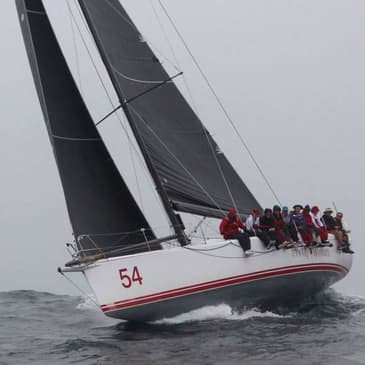
We’re switching to offshore racing in the Southern Pacific/Australia for this episode! Richard Hudson has racked up over 150 offshore races of 200 miles or more, including multiple Rolex Sydney-Hobart Races, 34 Sydney-Gold Coast Races, China Sea races, Hong Kong to Philippines, Hong Kong to Vietnam, the 600 mile New Caledonia Groupama Race and many more. Richard is the owner of Farr 45 Pretty Woman, a proud Corinthian and a member of the Royal Prince Alfred Yacht Club. He’s a winner of the Hobart race’s Corinthian division and Wild Rose division, as well as many podium finishes in IRC. Richard was awarded Cruising Yacht Club of Australia’s 2023 Ocean Veteran of the Year.
What makes Richard stand out is his emphasis on bringing younger sailors into the sport. Pretty Woman’s crew blends deep offshore experience with younger sailors from the Royal Prince Alfred Yacht Club, enabling many young sailors to experience offshore racing at its toughest.
A fascinating discussion with a top ocean racing veteran!
[00:00:06] Hey everybody, welcome to Sailfaster, the podcast for those who obsess about sailing faster than others.
[00:00:13] And I think today's episode we have a good example of somebody who is very successful obsessing about how to sail faster than others.
[00:00:21] So today I feel really privileged that I have Richard Hudson on the episode with us.
[00:00:27] So Richard Hudson is the owner of a Farr 45, which is quite a rare boat, I think, actually.
[00:00:33] And he's a very experienced racer and we're talking to him early in his morning in Sydney, Australia.
[00:00:40] So you've got a Brit talking to an Aussie, which hasn't happened so far on the series.
[00:00:46] Richard, good morning and thank you so much for joining Sailfaster. I appreciate your time.
[00:00:49] Good morning to you, Trayden. Thank you.
[00:00:51] So for those listening, we're going to have a delay issue here because we're going around the world.
[00:00:57] But I wanted to really talk to you about your immense experience in coastal and offshore racing in Australia, Sydney Hobart.
[00:01:05] But for you, it's more than that. You have a really interesting program that you do with Pretty Woman,
[00:01:10] which is the name of the Farr 45 that you have that I thought we'd be interested to talk about.
[00:01:15] A lot of introducing young people to the sport of sailing, which we obviously really need.
[00:01:21] And not just introducing the sport of sailing, but introducing them to some of the offshore racing,
[00:01:26] like Sydney Hobart, which is one of the most challenging offshore races in the world.
[00:01:31] But let's kick off, Richard. Why don't you tell us a bit about yourself?
[00:01:34] I know you just told me last couple of weeks you've done a thousand miles or I'm not sure it's miles or kilometers of offshore sailing.
[00:01:41] But tell us about you and where you're from and how you got into sailing.
[00:01:44] Well, Pete, I live in Sydney, which is a great sailing location at Sydney Harbour.
[00:01:49] And then north of Sydney Harbour, there's an inlet called Pitwater, which is off Broken Bay.
[00:01:54] And I live up what's known as the northern beaches of Sydney these days.
[00:01:57] And that's where I keep my boat is at the Royal Prince Alfred Yacht Club at Newport, about 10 minutes from my home.
[00:02:02] And we race casual racing up there, women's twilights and Wednesday afternoons.
[00:02:07] But for the major offshore sailing, we go down to Sydney Harbour and the CYCA and sail in their Blue Water Point score,
[00:02:13] which includes a race we just did the weekend before last called the Sydney to Gold Coast race or the Sydney to Gold Coast race, 384 miles.
[00:02:22] That's north, isn't it?
[00:02:23] That's north.
[00:02:24] So as we say, you go out of the harbour and turn left and end up on the Gold Coast, which is south of Brisbane.
[00:02:32] So Brisbane is the next major capital city north of Sydney, but the Gold Coast is south of that.
[00:02:37] So we had a good race up to there.
[00:02:39] And that was my 34th Gold Coast race.
[00:02:43] Wow.
[00:02:44] So you can know the way.
[00:02:46] And then the CYC Blue Water Series comprises that race plus some other shorter coastal races up and down out of Sydney.
[00:02:54] And then the last one being the Sydney to Gold Coast race on the 26th of December.
[00:02:58] So we were very happy with our results in the recent race.
[00:03:01] We got second in our division, IRC Division I, and second in division, IRC Corinthian Division.
[00:03:07] The Corinthian Division being the, we call it the amateur thing, so you're not allowed to have any professionals or paid crew on the boat.
[00:03:13] And I'm a strong believer in that.
[00:03:15] So we won that in the Hobart race last year.
[00:03:18] And there's also another division called the Wild Rose Trophy that the CYC gave out to the boat with the 25% or more female crew, which we have also won in the past.
[00:03:31] So my offshore experience is quite extensive.
[00:03:36] Probably nearly 150.
[00:03:38] I only count races over 200 miles.
[00:03:41] Probably done 150 of those, including a transbacker, an ARC race across the Atlantic, China Sea races, Hong Kong down to Philippines, Hong Kong Vietnam race.
[00:03:51] Auckland to New Mere.
[00:03:53] And then there's races around New Mere.
[00:03:54] 600-mile race called the Group Hama Race, which I've done a few of those.
[00:03:58] Are you a Sydney-sider originally or are you from the Russo?
[00:04:02] Tell us about that.
[00:04:03] And then how did you get into sailing and how did that lead to the offshore?
[00:04:07] I'm a Sydney-sider all my life, Pete.
[00:04:10] And I got into sailing small dinghies on the Parramatta River, which is a river that flows into the Sydney Harbour.
[00:04:16] So I sailed there for a while and then ended up sailing another larger dinghy, two-man dinghy, called the Vijay Walklews Jr.
[00:04:22] on Pitwater, which is where I referred to earlier.
[00:04:25] Then moved into sailing.
[00:04:26] If you remember, the sailing class from way back was then an Olympic class.
[00:04:30] It was very popular.
[00:04:31] Had good racing there and then moved from that into offshore sailing in half-tonners.
[00:04:35] They did a lot of miles in 30 to 31-foot boats, including two Hobarts.
[00:04:42] Boats that they probably wouldn't allow at the heads these days because from safety reasons.
[00:04:47] But we had a lot of success and fun in the half-tonners, but we were a lot younger then, Pete.
[00:04:52] We had a different perspective on things.
[00:04:54] So then through various yachts, ended up in 2002 becoming an owner of Pretty Woman, which originally was owned by a group of three, myself and two others.
[00:05:06] But I gradually bought the others out and have now owned the boat for 22 years.
[00:05:11] So it's a lovely boat.
[00:05:14] It's a Far 45, as you mentioned earlier.
[00:05:16] And they were originally a class called the Correll 45, and they predated the Far 40.
[00:05:24] So I think they built 22 of them.
[00:05:26] There's one in Melbourne, south of Sydney.
[00:05:28] There's mine in Sydney.
[00:05:30] There's a few in the UK and other places around the world.
[00:05:33] But I think that the Far 40 took over and, as you know, grew to a far greater extent.
[00:05:40] But it was originally built as a one-design inshore boat with some small offshore racing.
[00:05:45] But we've done a lot of modifications to make it good for offshore racing and spent time just working on the performance characteristics to get it going faster, which we've done successfully.
[00:05:56] So we're pretty happy with where it's at at the moment.
[00:06:00] So the Far 45, I know there were only, as you say, sort of a couple of dozen built over time.
[00:06:07] I was curious about the fact that that must mean there's limited resources.
[00:06:12] If you have a Mum 30 or iSailor J105, there's a ton of one-design experience.
[00:06:18] You know, there's so many documents and things that you can read.
[00:06:23] But did you find yourself pioneering some of the changes that you were doing?
[00:06:27] Yes, to a certain extent, Pete.
[00:06:29] There is information out there, but not a lot.
[00:06:31] Like I use the Far 40 data, for example, to help with rig settings.
[00:06:35] But as far as the rig's concerned, pretty well we've developed the rig settings ourselves just by trial and error and experimenting.
[00:06:43] We've done things like put a bow spread on the boat, onto bigger spinnakers, which we did quite some years ago.
[00:06:50] Put masted spinnakers on.
[00:06:51] Stuff like that that's not been mandated by anyone.
[00:06:54] I looked at what people have done around the world.
[00:06:57] I'd say we've got pretty well into this stage for what we're using it for, be one of the fastest around.
[00:07:03] Is it asymmetric or symmetric?
[00:07:06] Asymmetric.
[00:07:06] We did have asymmetrics, asymmetric A1 for a while and A5.
[00:07:12] But I've recently stopped.
[00:07:13] We don't use the A1 anymore.
[00:07:15] And we have a code zero instead.
[00:07:17] And we replaced the A5, which is a fractional chute, with a fractional S5.
[00:07:23] So it's a similar size sail, but it's asymmetrical.
[00:07:26] We just found it's all suitable for what we do.
[00:07:28] Yeah, I've watched the, as everybody has, you know, I've watched the start of the Hobart race and everybody rolling out those code zeros on, you know, Wild Oats and Law Connect on one side and then going through a tack and pulling it out on the other side.
[00:07:42] I was actually on Sydney Harbour watching the race and a friend of mine's powerboat.
[00:07:48] And it's absolutely spectacular to watch, let alone be on those boats.
[00:07:53] Fantastic to be part of it.
[00:07:55] It must be extraordinary because there's 150 boats trying to get to the start in different classes and there's hundreds of pleasure boats around.
[00:08:02] And then you go out through the heads and turn right and you're on your own from then on, really, aren't you?
[00:08:08] That's such an extraordinary transition.
[00:08:10] What's extraordinary, Pete, is you can be going out of the harbour with 100 odd boats that you're racing against.
[00:08:15] And then 12 hours later, it's dark.
[00:08:18] Daylight comes the next day and you might be the only boat around.
[00:08:21] Yeah.
[00:08:21] It's brilliant.
[00:08:23] You know that they're not, but it's not far away, but you just don't necessarily see them.
[00:08:28] So I do want to get into the Sydney Hobart a bit later, but let's talk about the programme around Pretty Woman because, you know, when I got in touch with the team, I think I had like two or three different people responding.
[00:08:39] And you have fantastic social media and I'll post all those links.
[00:08:43] But you've got quite a team there.
[00:08:46] Did you start like that and that was the intent or did that just sort of happen over time?
[00:08:50] It evolved, Peter.
[00:08:51] So we do the offshore racing, which I'm very strong about getting younger crews are part of the team.
[00:08:58] So, and it really is working.
[00:09:00] It's showing in the results, but also the retention rate of the team is very high.
[00:09:05] So we sailed this recent Gold Coast race with exactly the same crew we went to Hobart with in December, which is pretty good.
[00:09:11] But of the 12 crew, there's myself, who's the, we'll call the older person on board.
[00:09:17] And then we've got two others sort of in their early 60s.
[00:09:21] And then another guy, Rob Buchanan, who's mid-55s.
[00:09:25] And the rest of them are, the other eight, 31, I think is the oldest and 22 is the youngest.
[00:09:30] And they're just good sailors.
[00:09:32] And one key factor is that majority of them have come out of the Royal Prince Alfred Yacht Club Youth Development Programme, which I was involved in starting 25 years ago.
[00:09:41] I'm a great believer that we need to get the young people in the sport.
[00:09:44] And I think the reason it works is that the crew evolves.
[00:09:48] Like we've got a waiting list for our offshore team.
[00:09:50] I could find three people today who would join that team if I invited them, which is a good position to be in.
[00:09:57] I mean, your question was about how this evolves.
[00:09:59] We started out, you know, I started sailing the boat with people of my cohort 20 years ago.
[00:10:04] And obviously we were a bit younger then.
[00:10:06] But as, you know, we all got a bit older and I gradually brought the team out.
[00:10:10] I also started the Women's Twilight.
[00:10:12] We have a Royal Prince Alfred during Daylight Saving in summer.
[00:10:16] Tuesday evenings, they run a Women's Twilight Racing, which has been a great opportunity to get new people into the sport.
[00:10:22] We've done very well with that.
[00:10:23] We won that event last year.
[00:10:26] We've won it quite a few times in the past.
[00:10:28] But that's the way of introducing new women into the sport.
[00:10:31] But then I just started adding more younger people to the team for the major race.
[00:10:36] And it just, our results went up, Pete.
[00:10:39] You know, they're very good sailors.
[00:10:41] I can't speak more highly enough than the team I have at the moment for the offshore racing.
[00:10:44] I mean, they're just, they're really good.
[00:10:46] Yeah, I have mostly a female team on my J105.
[00:10:52] And I think it's just sort of accident, people introducing their friends and, you know, to join the team, that sort of thing.
[00:10:58] And I really like it because it's sort of low ego.
[00:11:02] Communication is really good.
[00:11:03] And they're very skilled at what they do.
[00:11:06] And they'll tell you.
[00:11:07] They're very good at communicating, telling me what to do, which works very well.
[00:11:12] I can see how that would work very well offshore as well.
[00:11:15] I was watching one of the recent videos.
[00:11:18] And they are very young.
[00:11:20] And so one of my questions actually was really about the responsibility that you must feel taking young people.
[00:11:26] You know, a very challenging, grueling race.
[00:11:29] I know you've done it many, many times.
[00:11:31] But does that weigh on you or is it just, you know, you're very organised, prepared and so on?
[00:11:37] Safety, obviously, without stating the obvious, is paramount.
[00:11:41] I encourage the team to do the sea safety at sea courses.
[00:11:45] And the majority of the crew have done that.
[00:11:48] That's a very good course to do before you venture offshore in offshore racing.
[00:11:52] But we're also very clear on what the responsibilities are safety-wise on the boat.
[00:11:56] And that's without holding back.
[00:11:58] We push that boat hard, but we still do that within the realms of responsibility and safe sailing.
[00:12:04] Like things like wearing life jackets and harnesses is just second nature on Pretty Woman.
[00:12:08] There's no debate.
[00:12:09] If the weather's at a point where it's time to do it or in the evening, everyone just does it automatically.
[00:12:15] I don't have to go on deck and say you need to put on your safety gear.
[00:12:19] Generally, they just do it.
[00:12:20] That's one of the beauties of the team is they're right across all that safety stuff.
[00:12:24] And we've been out with that.
[00:12:25] I've been out with that team in some pretty gnarly conditions.
[00:12:28] And I just handle it.
[00:12:30] It's obviously a boat that is very suitable for those conditions that you've done it.
[00:12:36] And by the way, it's really, you know, for a boat that is over 20 years old, they look very, very modern with that open cockpit design and so on.
[00:12:47] And non-overlapping head sails and that sort of thing.
[00:12:50] I was reading some of the specs about it.
[00:12:52] You know, you've got deep keels and deep rudders and you don't have running backstays and checkstays, that sort of thing.
[00:12:57] I'm guessing that makes it a lot easier.
[00:13:00] You'll reduce some of the complexity when you are in tough conditions in Hobart or anywhere, really.
[00:13:06] I was curious about the cockpit's quite open, isn't it, compared to others?
[00:13:10] I was wondering how that is in rough conditions.
[00:13:14] Are you just used to it or do you have any modifications around that?
[00:13:18] Well, there's a couple of factors, Pete.
[00:13:19] We don't find it a problem in rough conditions that we're used to it.
[00:13:23] You know, obviously we're very cautious and we're clipped on and we move around the boat carefully, particularly me.
[00:13:27] But coming back to the design of the boat you mentioned, the boat's actually 26 years old.
[00:13:32] It was built in 1996.
[00:13:33] And even today, it's still, I think that, you know, it's a very good looking design.
[00:13:38] It's a pretty boat.
[00:13:39] And it's just a good all-round boat to sail.
[00:13:42] It has a big rudder, which probably the more modern designs wouldn't have a rudder as big as what Pretty Woman has.
[00:13:47] And also the keel, it's not a tee keel like the modern boats as well.
[00:13:51] But look, the package works for us.
[00:13:53] Yeah.
[00:13:54] For what we're doing.
[00:13:55] So I was just curious about when you introduce new people onto the team, I know you're very experienced in this.
[00:14:00] Do you have like a standard position that, hey, when you're in those first few sails, we put you on this role and then we work you around?
[00:14:07] Or is it as sort of organized as that or is it more organic depending on who they are?
[00:14:11] So the standard team, when we're racing, obviously everyone has their roles.
[00:14:16] If we're doing a particular maneuver, then everyone goes to their standard position on the boat.
[00:14:21] But as far as the team generally is concerned, they're pretty flexible.
[00:14:25] So like we would have out of the 12, there'd be one, there'd be at least four, maybe more, who's quite capable of doing that.
[00:14:32] And then there's at least half a dozen who are very competent steers.
[00:14:35] And I think that's one of the things we've got is we do have a good pool of people who drive the boat.
[00:14:39] So ironically, in a race like the Gold Coast race, I do very little driving.
[00:14:44] I might do the start.
[00:14:45] I had a bit of a problem.
[00:14:48] Wow.
[00:14:49] No, he's not watching the video.
[00:14:51] Richard just showed me a heavily bandaged and strapped forearm.
[00:14:54] What's that about?
[00:14:55] So I took the boat down and there's a lesson for everyone in parking boats.
[00:15:00] So we're with the spot we have at the CYCA.
[00:15:03] You've got to reverse down the fairway between the marina arms.
[00:15:05] So you're in reverse.
[00:15:09] So the wheel grab, but the struff I've got or had holding the restricting the movement of the quadrant snapped when the wheel breaks.
[00:15:16] So the wheel spun around, did a sashimi slice on my hand.
[00:15:19] It's a real mess.
[00:15:21] Anyway, that's a diversion.
[00:15:22] But normally I'd spend most of the time working out, navigating and strategy, studying the weather and stuff and working out the sail combination.
[00:15:29] So this didn't bother me that much.
[00:15:31] I was able to do some steering.
[00:15:33] But the point I was getting to is that the guys are quite capable of sailing their boat fast.
[00:15:37] And one of the good things is they're not aerodic people.
[00:15:40] They swap around.
[00:15:40] So you don't get people just hanging onto the helm forever.
[00:15:43] You know, they swap around and make sure we've got it.
[00:15:45] Steering, as you know, in races like that is very important.
[00:15:48] Also getting the sail combinations right.
[00:15:51] I'm finding that, you know, I'll be sitting there thinking, you know, we need to do a sail change.
[00:15:55] And quite often I'll say we need to do X, Y and Z.
[00:15:58] They're right onto it as quickly as I am.
[00:16:01] Yeah.
[00:16:02] So they know the boat.
[00:16:03] But I think your question started about bringing new people into the group.
[00:16:08] We did generally slot them into the position that's available.
[00:16:10] They're all capable of trimming.
[00:16:12] So, yeah, it works.
[00:16:14] Do you have a favourite offshore race?
[00:16:15] I think for me the Hobart race is my favourite, which might seem a bit weird because it can get pretty horrible.
[00:16:20] Generally at some point, during all of them they are.
[00:16:22] But there's something about the Hobart race.
[00:16:24] You get, you know, all different types of weather and you can get some pretty bad weather.
[00:16:28] And to be able to successfully complete a Hobart race is, I think, pretty well something.
[00:16:32] I'm sure there are other races in the world that may match that.
[00:16:35] But things like the China Sea Race, Vietnam Race, other races I've done,
[00:16:39] don't quite give that same sense of achievement that when you get to the end of the Hobart race,
[00:16:43] you've really achieved something.
[00:16:45] You're crossing the Bass Straits.
[00:16:47] I mean, that's the Southern Ocean, isn't it?
[00:16:49] Roaring up from the east, from the west there.
[00:16:52] That always looks extraordinary.
[00:16:54] And I did watch the, you know, I watched a lot of the start and the finish.
[00:16:58] And the finish was extraordinary, wasn't it?
[00:17:02] In terms of the line on it, I think it was Law Connect and somebody else.
[00:17:06] I think it was the last few hundred yards where the race was sort of won and lost.
[00:17:12] But tell us, take it straight.
[00:17:13] What were the conditions like last year?
[00:17:16] It would have been boxing there, wouldn't it?
[00:17:17] The irony of it is that our finish was very similar to the one between Law Connect and Andu,
[00:17:24] except it was at 3am.
[00:17:25] And obviously we had another boat.
[00:17:27] So it was another boat near us.
[00:17:29] But what had happened is we sailed down and we got to the entrance to the Dewan near the Iron Pot.
[00:17:34] And it was getting very light.
[00:17:36] But there was another boat in there, a 44-footer, but a faster downwind boat than us.
[00:17:40] And a boat that should have been in front of us, so I wasn't worried about the fact that we set ourselves a goal.
[00:17:44] We said, guys, we're going to beat these guys across the line.
[00:17:47] And they were probably a mile in front of us at the time.
[00:17:49] And we got to within 10 seconds of them.
[00:17:52] We didn't meet them.
[00:17:53] And it didn't matter because they owed us time, you know, from a rating point of view.
[00:17:57] It was just more, you know, we'd been racing for however many hours, 60 hours or more.
[00:18:02] And what I was impressed about, the guys were sailing the boat as if we were doing a day race on Pitwater for an hour.
[00:18:08] And this is at 3 o'clock in the morning.
[00:18:10] We really worked hard.
[00:18:12] How was the crossing of the Bass Strait?
[00:18:14] Was it straightforward or was it not?
[00:18:16] It was pretty straightforward, yeah.
[00:18:17] It's interesting, Pete, you don't actually cross Bass Strait.
[00:18:21] Because Bass Strait is the body of water between Australia and the northern Tasmania.
[00:18:25] And we're going down more to the east of Bass Strait.
[00:18:27] So they're talking about crossing Bass Strait.
[00:18:29] But technically, we would have been six or seven miles east of where Bass Strait ended.
[00:18:33] But it also doesn't detract from that area of the ocean.
[00:18:37] It can get quite problematic.
[00:18:40] As you correctly pointed out, you know, the wind's coming from the west through the Strait or the south west as well.
[00:18:46] Yeah, we didn't have any problem with that this year.
[00:18:48] In fact, we had the hardest part of the race was when we got to the end.
[00:18:52] How many miles?
[00:18:53] Probably about 15 miles from Tasman light.
[00:18:56] We just got hit by this 30-knot southwester cold.
[00:19:00] So you've been going downwind or reaching in lighter winds and you're all comfortable with the world next year.
[00:19:05] Going up into this cold wind, it's quite a change in circumstances.
[00:19:08] But it didn't faze the team.
[00:19:09] In fact, we were on board front of the BAM and he got the award at the CYC for being the Youth Ocean Racer of the Year, which is pretty good.
[00:19:19] But the comment that I relayed to the race organisers was we were going across Storm Bay in this horrendous seaway.
[00:19:26] And when he turned around to the crew, this is just so much fun.
[00:19:29] Extraordinary experience, isn't it?
[00:19:31] Most of me would love to do it.
[00:19:32] Part of me would be terrified to do it.
[00:19:34] You know, that's extraordinary.
[00:19:35] So I know you've done that many times and thinking about the other coastal and offshore race you've done.
[00:19:40] What's preparation like for you?
[00:19:43] Presumably after, with the experience you have now, you know exactly what you're going to do three months in advance, two months in advance, a week in advance.
[00:19:50] And are there any things that you think you do differently from others?
[00:19:55] Well, Peter, I'm not exactly sure what everyone does, but I do know we're very thorough.
[00:19:59] So from a safety point of view, right down to the last detail, we make sure we've got safety years all on board and working and complies with the regulations.
[00:20:09] Sail preparation.
[00:20:09] We always go out a week or so before a major race.
[00:20:13] And so we get all the sails out, put them up, check them.
[00:20:16] We do practice reefing because reefing is something that can cause grief if it's not done properly.
[00:20:20] And you can go, well, we did two weeks before the recent Gold Coast race, we did our reefing training.
[00:20:26] We hadn't actually reefed in anger in a race for probably a year and we didn't reef in the last towboat race.
[00:20:31] So it's important that you practice that sort of stuff and make sure everything's working the way you want it to work.
[00:20:36] So we're pretty thorough in all of that.
[00:20:38] You must have to prepare for doing that at 3 a.m. or midnight, right?
[00:20:42] Middle of the night in heavy seas, your reefing.
[00:20:45] Do you sort of simulate that?
[00:20:46] No, we just, we do it so everyone's fresh on what the role is.
[00:20:50] And for a reefing, everyone's got a standard operating procedure and everyone knows exactly what their role is.
[00:20:55] And it was interesting doing the training we did because there were a couple of items there where we thought, oh, we hadn't done that bit correctly.
[00:21:01] So it was a great refresher.
[00:21:03] So we do that prior to every, the next time we'll do that will be pre-Hobo.
[00:21:07] Do you have all these sort of processes written down or is it just, you know what you do?
[00:21:11] I mean, I have done in the past, Pete, if we've got, if we had sort of a high component of new people, yes, I would write it down.
[00:21:17] I have done that.
[00:21:18] But at the moment, everyone knows their job there.
[00:21:21] So we talk about it.
[00:21:23] We discuss it.
[00:21:23] And their exchange of emails or WhatsApp notes post.
[00:21:27] WhatsApp comes alive with how about this or what about that sort of thing.
[00:21:32] So you've been very successful.
[00:21:34] I mean, you talked about coming second.
[00:21:36] You won the class and your IOC class and that sort of thing.
[00:21:39] What for you is the sort of secret to sailing fast on a Far 45?
[00:21:45] Obviously, my job is to make sure we're pointing in the right direction.
[00:21:47] That's a starting point in offshore sailing and it's where people can come unstuck.
[00:21:51] You want to sail as few miles as you need to sail.
[00:21:54] A couple with that, you've just got to be constantly making sure the boat is sailing fast.
[00:21:58] And that's where the guys are good.
[00:22:00] There's no let up.
[00:22:01] We're constantly measuring the performance of the boat against its polar targets, as you know.
[00:22:05] They're displayed on one of the displays on deck so the guys can see at all times this is our goal.
[00:22:11] So their job is to make sure that we're sailing the boat at least equal to or faster than the targets.
[00:22:17] And it's my job to make sure we're pointing in the right direction.
[00:22:20] And also sail selection, as I mentioned earlier in the discussion,
[00:22:23] that you've got to make sure you've got the right sails up at the right time and look after the boat.
[00:22:28] I imagine you have routing software, but also you've done these races so many times.
[00:22:34] Is there an element of you that you can interpret the routing software's options perhaps differently
[00:22:40] because you just know that you've done it so many times?
[00:22:43] Is that a factor?
[00:22:44] I think it is a factor, Peter.
[00:22:45] I don't live and die by the routing I use a lot.
[00:22:48] But I also question it because I think, you know, I noticed last, was it this high boat?
[00:22:53] Yeah, it was this high boat, I think, from memory, that we came out of the heads
[00:22:56] and the routing was telling us to go offshore.
[00:22:59] When I looked at there were some thunderstorms around and some squalls
[00:23:02] and I felt that just sticking to the rum line early on in the race was the way to go
[00:23:07] rather than what the routing software was telling me, which I did.
[00:23:10] And it turned out to be the right decision.
[00:23:12] Our sister ship from Melbourne followed the routing and we went down the rum line
[00:23:18] because I wanted to be in the right position relative to the thunderstorms.
[00:23:22] And by the next morning we were 10 miles ahead of it.
[00:23:25] Was that, was that, so what was that based on?
[00:23:27] Was that based on gut feel, knowledge or a guess?
[00:23:32] No, it wasn't a guess.
[00:23:33] It was an educated view.
[00:23:35] I use the Bureau of Meteorology, the Australian weather forecaster.
[00:23:39] They have a radar on there where you can see the thunderstorms on the radio.
[00:23:43] They have the same.
[00:23:43] And I use that a lot when there are thunderstorms around
[00:23:46] is to see which direction they're moving
[00:23:48] and where I want to be relative to the thunderstorms.
[00:23:51] And that's what informed my decision on that day
[00:23:53] because the routing software or the group files don't pick that sort of thing up.
[00:23:57] So you know that you want to position your boats in the front of the squall
[00:24:02] or behind the squall, whatever you're judging,
[00:24:05] where the winds are going to be more favourable, I suppose.
[00:24:07] But apart from that, I do look at the different weather models
[00:24:10] and study their, what their routing options are
[00:24:14] and make my own decision about whether to follow them.
[00:24:17] And this recent Gold Coast race was interesting
[00:24:20] because we tended to be more inshore than a couple of the boats that went wide.
[00:24:23] They did well, but they were more downwind boats than us.
[00:24:26] But I was thinking at one point,
[00:24:27] the routing software had me going out to where they were,
[00:24:31] but I worked out if I followed that advice or that recommendation,
[00:24:34] we were going to give away distance.
[00:24:36] And so I did a calculation to say, well, I can go out there,
[00:24:40] but I'm going to lose 10 miles.
[00:24:42] Or if I stay this way, I might be going half a night slow,
[00:24:44] but I'm not going to lose 10 miles.
[00:24:47] That sort of stuff.
[00:24:49] That's a quick way of talking about what takes a bit of time to work out.
[00:24:53] So that's what I spend the time looking at, that sort of thing.
[00:24:56] Thinking about the Hobart, what's been the best moments for you?
[00:25:00] Then also, I'd love to hear about what have been the worst moments for you.
[00:25:04] What do you want to sell the boat?
[00:25:06] Well, the best moment has been two really good moments.
[00:25:08] The best one last year was winning the Corinthians division on IRC.
[00:25:12] Amazing.
[00:25:13] That was pretty cool for us because one of my crew said,
[00:25:16] as far as he's concerned, that was winning the Hobart race
[00:25:18] because all the rest of the ones that beat us were professionals.
[00:25:21] Yeah, yeah.
[00:25:22] So that was pretty good.
[00:25:23] But then race before in 2022 was pretty epic where we had some solid nor'easters
[00:25:29] and we were pushing the boat hard for like 36 hours downwind,
[00:25:32] sitting on speeds of 20-odd knots at times.
[00:25:36] We hit a top speed we saw on the dial of 28.5.
[00:25:39] Wow.
[00:25:40] Which for a fast 45 like mine is, it should be arrested.
[00:25:44] Yeah.
[00:25:45] It was pretty extreme.
[00:25:47] I mean, that was an epic part of the race.
[00:25:49] So the guys sailed that boat like it was stolen.
[00:25:51] We did well that year because we were actually second in IRC Corinthians
[00:25:55] the previous year and we won the PHS Corinthians.
[00:25:58] So we had a few technical issues with the spinnaker pole
[00:26:02] at the later stage of the race.
[00:26:03] So we actually sailed quite a few hours without a spinnaker
[00:26:06] when we would have done a lot better if we'd had one.
[00:26:08] So we probably would have won that year as well,
[00:26:11] but we didn't and that's yacht racing.
[00:26:13] So the worst is hard to say.
[00:26:15] We've been adding some pretty epic wins in the Hobart race,
[00:26:18] but they've just been what they are.
[00:26:20] I think the worst race I did actually wasn't a Hobart race.
[00:26:23] It was an Auckland, a Nemea race on a Beneteau 44.7
[00:26:28] and we're up off Cape Ring in the north of New Zealand
[00:26:31] and the currents around there in the seaway.
[00:26:34] They're just shocking.
[00:26:35] It was just horrendous weather.
[00:26:37] But the crew, I was navigating for these guys.
[00:26:39] I didn't know them all that well.
[00:26:41] I shouldn't say too much, but the crew wasn't ideal.
[00:26:44] Let's put it that way.
[00:26:45] So the point where we were navigating, I was working out
[00:26:48] if we decided to pull the pin, where was a safe harbour.
[00:26:51] So I actually had that worked out.
[00:26:52] I didn't tell the owner that, but that was I'd rate
[00:26:54] as one of the toughest races I've done
[00:26:56] because I was nearly the last man standing.
[00:26:59] We get to New Mare and the electronics had all failed.
[00:27:01] We had to get in through the reef at 3 o'clock in the morning.
[00:27:04] It seems we had a number there at 3 o'clock in the morning,
[00:27:07] but then I was pouring with rain and all I had was an iPad
[00:27:09] to navigate on to get us in through the reef.
[00:27:11] And the iPad had no way of charging it,
[00:27:14] so I had to be very careful about the usage of it.
[00:27:16] Anyway, we got in safely.
[00:27:17] So I'd rate that as a pretty torrid race from my perspective.
[00:27:21] It's pretty broken at the end of it.
[00:27:22] Yeah, I love that Aussie insouissance about those conditions.
[00:27:28] So you're obviously an extremely tough character, Richard,
[00:27:31] no question about it.
[00:27:32] Where does that come from?
[00:27:33] Have you always been that way?
[00:27:35] I don't like giving in.
[00:27:36] And also don't get phased by bad weather or challenges.
[00:27:40] I think you've just got to,
[00:27:41] there's no point in getting phased or anxious about it.
[00:27:43] You've just got to get on and sort it out.
[00:27:45] It sounds like a winning philosophy for sure.
[00:27:48] So Richard, you're obviously an advocate
[00:27:50] for bringing young people into the sport, right?
[00:27:53] So where do you see that going in the future?
[00:27:56] I think it's very important for the continuity
[00:27:59] and growth of the sport.
[00:28:00] One of the things I believe that if you're getting young people
[00:28:03] on your boat, you've got to respect the fact
[00:28:05] that they can do stuff and they do have knowledge.
[00:28:08] I notice a lot that older guys of my vintage tend to have the view
[00:28:12] that they know more than young guys.
[00:28:15] So you get a young boat and they might only put two younger crew
[00:28:18] on board and then they'll stick them on the bow
[00:28:20] or they'll get them grinding winches or stuff like that.
[00:28:23] And quite often I find that these young people are better sailors
[00:28:26] than the boat that they're going on.
[00:28:29] So I think you need to have a greater cohort.
[00:28:32] So if you've got a crew of 12, you need six or seven
[00:28:35] because they're mates.
[00:28:37] I watch them at the end of a yacht race.
[00:28:40] They all socialise together and party together
[00:28:42] and it doesn't quite work if you've got only two out of 12
[00:28:46] and the other 10 are all other blokes.
[00:28:48] Oh, yeah.
[00:28:49] You're getting the mix right.
[00:28:50] But I think what is important is respecting the fact
[00:28:53] that these guys, these young people,
[00:28:56] and they're not young, they're 22, 23, 24 sort of age group,
[00:29:00] but they are very skilled and they do new stuff.
[00:29:04] So I think you've got to give them credit for that sort of thing.
[00:29:06] What an incredible experience to be on a boat doing Sydney Hobart.
[00:29:10] I mean, that's an incredible bonding experience
[00:29:13] that you'll keep for the rest of your life.
[00:29:15] And I guess they'll either want to do it again and again
[00:29:18] or the last time they do it.
[00:29:19] But either way, working with teams, relying on yourself,
[00:29:22] relying on others, putting yourself through that sort of test
[00:29:25] and pressure is amazing.
[00:29:27] But the way I look at it, Pete, is that I wouldn't be doing Hobart
[00:29:29] without the team that I've got.
[00:29:31] So as long as I can keep that together, I'll keep having a go.
[00:29:34] But if I had to rebuild or just wasn't confident in the team
[00:29:39] that I had, I wouldn't do it.
[00:29:41] I've got to respect the fact that I'm not as young as I was.
[00:29:45] It's hard to admit, but it's true.
[00:29:48] I know.
[00:29:49] What's your next race?
[00:29:51] Well, next event, I'm flying up to Airlie Beach in Queensland
[00:29:54] on Thursday, day after tomorrow, to sail on Antipodes.
[00:29:57] So Antipodes is at Santa Cruz 72 that I've done a lot of miles on.
[00:30:01] Oh, yeah.
[00:30:02] So I drive that boat for the owner, Jeff Hill.
[00:30:06] I mean, I'm not on my boat, so he does the races as well.
[00:30:09] So we'll go up and do Airlie Beach Race Week on that.
[00:30:11] And then I'll come back.
[00:30:13] And at the end of September, we do the next race in the Bluewater Point School.
[00:30:17] So there's three more Bluewater Point School races to do before the Hobart.
[00:30:21] So we'll do all of those.
[00:30:22] And then Daylight Saving or Summer will start over here
[00:30:25] and we'll get into the Women's Twilights.
[00:30:27] Did he say it was a Santa Cruz 72?
[00:30:30] I know there's 52s.
[00:30:31] I didn't know there were 72s.
[00:30:32] That was a hell of a sign.
[00:30:34] And then there was Santa Cruz 70s.
[00:30:36] This one was actually lengthened.
[00:30:38] So they were built to race, you know, the Transpac race.
[00:30:41] Yeah, yeah.
[00:30:42] It's quite a much bigger boat than Pretty Ormins.
[00:30:45] Yeah, it's twice the size.
[00:30:47] So starting it is a bit more, you've got a bit more circumspect.
[00:30:51] It's a good fun boat.
[00:30:52] So that's next week.
[00:30:54] Yeah, super.
[00:30:54] Good luck with that.
[00:30:56] Richard, thank you for taking your breakfast in lovely Sydney,
[00:31:00] one of my favourite cities in the world, to join Sailfast.
[00:31:04] I really appreciate the time.
[00:31:05] Good luck with the race.
[00:31:06] There's some great, great learning here.
[00:31:08] And I'll make sure that in our social media
[00:31:11] that we have links to your website.
[00:31:14] And there's plenty of stories there
[00:31:16] from some of the younger people and video and so on.
[00:31:19] So marvellous stuff.
[00:31:21] Thank you so much for joining us.
[00:31:22] Thank you, Peter, for the opportunity.
[00:31:24] Pleasure.