
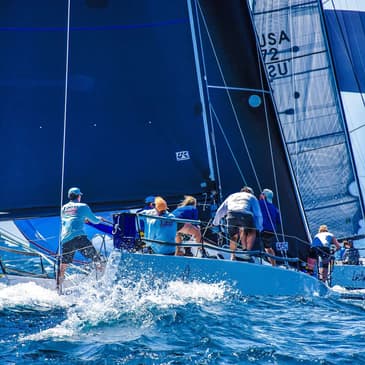
Really enjoyed my conversation with top Chicago sailors George Simkins and Mark Fruin about the famous Mackinac Race. With multiple podiums between them, you'll hear how they prepare their J111 and J105 for the race, how they think about routing decisions, dealing with tough conditions, avoiding the black flies, why sailing racing is worth investing time in, and finally how Sailfaster caused Mark to have an anxiety attack while flying to a wedding! Lots to learn from this insightful, fascinating and funny discussion!
[00:00:09] Hello and welcome to Sailfaster, which is the No 1 podcast for racing sailors like us.
[00:00:14] Today for a change we're actually talking about lake sailing, though I think the Chicago Yacht Club's race to Mackinac, which is the subject of today's discussion, can produce those weather conditions as abject as any coastal or near shore distance race that you find.
[00:00:29] The Mackinac is the oldest freshwater distance race in the world, I didn't know that, so I looked it up.
[00:00:34] It's, as most people know, 333 miles up along Lake Michigan.
[00:00:39] It's one of the great races in world sailing.
[00:00:43] And today to discuss the Mackinac, I have with me a couple of guys with a ton of experience in that race.
[00:00:50] Firstly, George Simkins, who has, I think, about 20 Mackinac under his belt with a decent number of podium finishes scattered in there on, I think, J109s and J111, you were telling me, both named Momentus.
[00:01:04] And, yeah, and also Mark Fruin, who is actually the one this year's J105 fleet on Nyctasaw to round out what was a pretty good year for you.
[00:01:13] I know you had wins in the Verve Cup and the previous year sailing world regatta.
[00:01:17] So I think I've got some true experts here to discuss this with us.
[00:01:21] Right. Hello, chaps, and welcome to Sailfaster.
[00:01:24] Hey, thanks, Pete. It's George.
[00:01:26] Appreciate being here.
[00:01:27] We're huge fans and I'm a fan of sailing in general, but your podcast is really making it great.
[00:01:32] Thank you. So glad you said that. Yeah.
[00:01:34] I didn't even have to pay you to say that. That's great.
[00:01:37] Yeah. And I'm Mark Fruin, a fellow J105 owner.
[00:01:41] So I've really appreciated your podcast and what you're doing with it.
[00:01:44] So happy to be a part of the conversation and looking forward to it.
[00:01:47] Great. Thank you. Thank you for taking the time.
[00:01:49] I know you're both busy professional people, so I appreciate you taking the time to do this.
[00:01:53] So let's start where we always do at the beginning, which is how did you get into sailing?
[00:01:57] Tell me the sort of origin story, as they say.
[00:01:59] So, George, why don't you kick us off here?
[00:02:01] Sure. I grew up in Marin County, California. I was surrounded by water.
[00:02:05] My dad, who had sailed at the Naval Academy, always said, one of these days we're going to get a boat and that never rolled around.
[00:02:11] But a friend of mine did.
[00:02:13] He had a Cal 25 and the 1970s tank of a boat and just great for the San Francisco Bay.
[00:02:20] And he just needed to play a partner, a friend.
[00:02:24] And really, from the minute I got on the boat, it was like, oh, this is something I'm going to do.
[00:02:28] I immediately told him what he was doing wrong and it extended from there.
[00:02:32] And then how did you get to Chicago?
[00:02:35] So my wife is from here.
[00:02:37] And that's interesting because so it was very soon after I started racing in, or I started sailing in San Francisco that I bought my own boat, which was a Ranger 23 designed by Gary Mull.
[00:02:48] I met my wife. She's from Chicago. We wanted to be together somewhere and she owned a boat here. So I thought, well, that's a nice transition.
[00:02:56] She had a CNC 27, a 1974 boat, and she had it with a partner.
[00:03:01] And she said, well, you can come sailing with me and you'll be friends with my partner.
[00:03:06] And he and I both looked at each other and said, well, we'll decide if we're going to be friends.
[00:03:10] And now 26 years later, something like that, he and I are our friends.
[00:03:16] He's the skipper of Momentus. And we just got into racing at that point.
[00:03:20] So it's been 20, 25 years of racing, of figuring it out.
[00:03:25] I have to ask you this, George. Was the fact that your wife owned a 27 foot sailboat any factor whatsoever in the wooing of her?
[00:03:35] Well, Pete, you might have missed this in your own development, but that is the best pickup line for anyone is, hey, would you like to go sailing?
[00:03:42] So we have the same pickup line for each of us.
[00:03:45] I did take my now wife on an early date across to Angel Island in San Francisco Bay on an old boat I owed there.
[00:03:53] And it worked very well. Nobody drowned and eventually we got married.
[00:03:57] So I know I do. I have the same story.
[00:04:00] That's another podcast.
[00:04:02] Mark, how about you?
[00:04:04] Yeah.
[00:04:05] I think some of the people talking about Mac experience might object because there's plenty of people with a lot more experience than me.
[00:04:14] I started my first sailing was I went to the BVI with some friends that next year a space and knew I like to travel a lot.
[00:04:23] So I went down with them and we is more of a booze cruise than a sail.
[00:04:28] We just went from place to place and had a lot of fun.
[00:04:31] So when I got back in the summer in Chicago, I took a basic keelboat class and enjoyed that.
[00:04:37] But found somebody who is crewing and I got invited myself onto the boat.
[00:04:42] They were crewing and crewed there for a while and just kind of loved it and tried to just kind of really filled a gap or just something that was missing.
[00:04:50] So I just love it and just been trying to sail as much as I can since then.
[00:04:54] And then I bought my boat four years ago, nonstop since then.
[00:04:59] So you're a relatively new J boat owner, right?
[00:05:02] So you're both J boat owners, right?
[00:05:04] Yeah.
[00:05:04] Yeah.
[00:05:04] I was really looking to buy a boat.
[00:05:06] And then Chicago, we have kind of like T10 class, 105 class.
[00:05:10] There's a J 109 class used to be 111s and then a Beneteau 36 7 class.
[00:05:16] And I just really liked the 105, just, you know, a little bit bigger than the T10, a little bit more comfortable.
[00:05:24] And then just kind of that lower price point really kind of sealed the deal.
[00:05:29] I just edited a podcast that we're publishing on.
[00:05:33] We, I am publishing on Monday.
[00:05:35] Like I've got a big company behind me.
[00:05:36] I'm publishing on Monday.
[00:05:39] With the Blackhawk guys, the J 105 Blackhawk out in San Francisco, which won the big boat series again and again.
[00:05:46] Yeah.
[00:05:46] I listened to, I forget who was the new, new, new.
[00:05:50] Russ and Randy.
[00:05:51] Yeah.
[00:05:51] Yeah.
[00:05:51] And I was like literally taking notes.
[00:05:53] So yeah.
[00:05:54] Many people told me that.
[00:05:55] Somebody even told me that they gathered their crew around their iPhone and played in, took notes.
[00:06:01] It's great.
[00:06:01] I had a debrief end of season party the other week.
[00:06:05] And that was a few of those takeaways from there were like connected to some things on the boat.
[00:06:11] So yeah.
[00:06:11] So let's talk about the Mackinac.
[00:06:13] What does this feature in sort of the sailing season for you in Chicago, which I know is fairly short.
[00:06:18] Is that the big race?
[00:06:19] Is that the one that you spend the year getting prepared for and getting psyched up for?
[00:06:25] So I'll take it, Mark.
[00:06:27] Yes.
[00:06:28] The Mackinac race lands smack in the middle.
[00:06:30] It's the Everest of your year, basically.
[00:06:33] And obviously, you know, there's two kinds of racing.
[00:06:36] There's buoy races, which you just go out and come back, you know, off your local waters.
[00:06:40] But then there's port to port races.
[00:06:42] And there are several interesting ones that happen on the lake here on Lake Michigan.
[00:06:47] But that's the big one that takes you the farthest distance away.
[00:06:51] And in the middle of your season, you might connect it to some other racing.
[00:06:55] So you could there's the port you're on Mac that also happens.
[00:06:57] They alternate weekends in the middle of July.
[00:06:59] And then what you'll try to do because you have to travel the boat and and Mackinac is not next to anything, is to do a regatta on the way back or to try to make something out of the way back.
[00:07:11] But, you know, that's the big allure is it's so big.
[00:07:14] It's so hard, you know, compared to everything else.
[00:07:16] And you're so far away that there's there's probably going to be some more sailing or experience attached to the race.
[00:07:23] Mark, same for you. Or do you look to do other regattas?
[00:07:27] No, it's I think it's the biggest deal of the summer since I got my boat.
[00:07:31] I've been looking at like the race to Mackinac safety requirements.
[00:07:35] So that way, whenever I make an up or like an upgrade or fix something that it like meets or exceeds those standards.
[00:07:42] Getting the boat ready has been like a multi year thing to get it ready to race offshore.
[00:07:47] And it's also has a certain weight to it because it can like people died during the Mack.
[00:07:51] So you also don't want to go into it without the proper precaution.
[00:07:56] But then there's also kind of like the biggest race of the summer.
[00:07:59] Hmm. Yeah.
[00:08:00] So I want to come into the Mack experience, the actual race experience.
[00:08:04] But before that is it is this question of preparing. Right.
[00:08:08] I know between you've got many of these under your belt and it's clearly not something that you take lightly or take for granted.
[00:08:16] And I was really interested in the conversation we had about even just provisioning, you know, how you guys think scientifically about what you bring on a race like that.
[00:08:24] You talked about flat packing food and freezing the water.
[00:08:27] And I thought it was super interesting to do you, George, you want to know you've done 20 now.
[00:08:32] You must have got it down to an absolute fine art.
[00:08:35] The name of the game in offshore sailings to make sure is to build advantage.
[00:08:40] And one of the advantages is to stay light.
[00:08:41] So we don't want a big ceremony around food to begin with.
[00:08:45] We don't want food that you have to take a long time to prep or a long time to eat or you have to boil water.
[00:08:51] That is a requirement, a safety requirement that you'd be able to boil water.
[00:08:54] We've never boiled water in 20 years.
[00:08:56] I mean, we just won't.
[00:08:57] In the old days, we learned the hard way by bringing a different kind of a lasagna, something that you put in the oven.
[00:09:04] It takes forever.
[00:09:05] It weighs you down.
[00:09:06] It's terrible.
[00:09:07] We've done catered meals where by the second or if you've been out there for three days, unfortunately, that stuff starts to mold in a marine environment.
[00:09:16] You know, usually they made it a day or two before.
[00:09:18] So what we've learned is get there hungry.
[00:09:21] You want as little weight as possible.
[00:09:23] You want to motivate your crew to finish.
[00:09:25] That means you end with a half a jar of peanut butter.
[00:09:27] That's the way to go.
[00:09:29] The other thing is space is limited on a boat.
[00:09:32] So you don't want lots of three dimensional things.
[00:09:34] You don't want a lot of things that can go badly.
[00:09:36] Fruits fine.
[00:09:38] You just put that in between the drinks and the cooler.
[00:09:40] But, you know, a loaf of bread is going to go bad.
[00:09:43] It's going to get squished and it takes a lot of room.
[00:09:45] So what we've done over the years is just turn into flat, flat, flat.
[00:09:48] So it's a tortilla, a slice of meat, a deli meat, maybe some lettuce that you can, you know, pull apart.
[00:09:56] So it's not a big ball, but you put it together and that's a nice flat pack.
[00:10:01] It doesn't take a lot of room in your cooler and you hand it to the person with the paper towel.
[00:10:06] So we don't want to create dishes.
[00:10:08] We don't want to create extra work that isn't associated to the race or to moving the boat through the water.
[00:10:13] And at the end, we actually don't generate a lot of trash.
[00:10:16] We tried to just go think less, think small.
[00:10:19] It applies to everything.
[00:10:22] It applies to what you bring with you, you know, what foul weather gear you're going to bring, how many, what you're going to bring for clothes, which really should be absolutely minimal.
[00:10:30] And I guarantee that you can look at any backpack and take half of it out, people that bring their gear bags on.
[00:10:36] So food, you want to make sure that you're going to bring enough stuff that you don't want, you don't want people lightheaded.
[00:10:43] And the food that you do choose to bring, I guess we could talk about there's two different strategies.
[00:10:47] You want nutrient rich foods, of course.
[00:10:50] A lot of people have a hard time, especially if it's a race to weather using the head or using a bucket.
[00:10:56] So some people for, you know, the two days that you're out there, people bring cheeses or they'll bring hard boiled eggs to sort of slow their system down a little bit.
[00:11:08] And I appreciate that.
[00:11:09] We've seen people bouncing in the head, you know, holding yourself in place.
[00:11:16] So that's a little bit of the strategy too.
[00:11:19] But in terms of how to pack, you know, think small.
[00:11:23] One of the things that we talked about was waters.
[00:11:26] And what we do is we bring jugs of water.
[00:11:28] We don't bring a lot of bottles, but the bottles that we do bring, we freeze.
[00:11:32] So that becomes our ice.
[00:11:33] So that'll melt over time and you're not bringing extra ice, which, you know, one gallon of water is eight pounds.
[00:11:41] So the fewer gallons that you bring them out.
[00:11:44] I'm intrigued by that idea of we don't like to make a ceremony around food, because there's another school of thought that you've been on the rail for, you know, three or four hours and you're cold and wet.
[00:11:55] You're really looking forward to the ceremony of food and having a warm meal.
[00:12:00] So how do you sort of cope with that?
[00:12:02] Or is it just eyes on the prize the whole time?
[00:12:06] We have gone through the Rubicon where it was eyes on the prize the whole time and you have some really disappointed and you can get some dejected sailors that way.
[00:12:15] So you can't be so specific.
[00:12:18] You can make your choices in that direction, but should you have some Oreos or some other treat?
[00:12:22] Maybe it's not something.
[00:12:24] One time someone brought, tried to bring ice cream or popsicles.
[00:12:28] And that was a terrible idea.
[00:12:31] Sometimes you get black lake flies out there that nobody talks about.
[00:12:34] But when you're out there, they don't stop biting.
[00:12:36] They love popsicles.
[00:12:37] That's a bad move.
[00:12:38] But you should bring the little.
[00:12:40] Yes, you can bring a little lift and make people feel good about it.
[00:12:43] When you hear stories from the cruising fleet that leaves on Friday night, there's a whole half hour that they do around Chile.
[00:12:50] And it's like, yeah, that would be nice.
[00:12:52] But it takes time away from the effort.
[00:12:55] And that Chile is going to be with you later.
[00:12:59] While you're hanging, hovering over the can with the black flies.
[00:13:05] Yeah.
[00:13:07] Yeah, it's a 300 mile race.
[00:13:09] But it's also sharing a studio apartment with six to 10 people.
[00:13:13] So, Mark, as you know, I have a J-105 and they're pretty cramped down below and no headroom.
[00:13:21] And just wondering what that's like over a distance race for you.
[00:13:27] Yeah.
[00:13:28] So, believe it or not, the kind of place where people sleep isn't in the main cabin.
[00:13:33] We actually, well, people can sleep there, but we actually put some cushions back underneath the benches.
[00:13:39] And there's a kind of next to the engine.
[00:13:42] And that's, we call it the coffin.
[00:13:44] But people end up fighting for those spots because you're kind of like stuck in there.
[00:13:49] And it's cozy.
[00:13:50] Yeah, it's cozy.
[00:13:52] So, that's kind of one of the things.
[00:13:54] And yeah, maybe it's a good motivator so people don't spend too much time below deck is if you're down there too long, you'll get a neck cramp.
[00:14:03] Maybe it'll counteract staring up at the spinnaker if you're trimming the spinnaker.
[00:14:07] But yeah, I mean, it's hard because then you're, you know, most of the time you're just going out for the day.
[00:14:12] You're just bringing lunch and a couple of waters.
[00:14:14] But then you have to all of a sudden bring all this gear extra, a lot more safety gear than you would have for like three class rules, like regular buoy racing day.
[00:14:24] And then just, you know, a lot more food and then like gear is just like everywhere because there's, you know, things get moved around at night.
[00:14:33] So, it does kind of get smaller every day of the race.
[00:14:39] This is an offshore race though, isn't it for you?
[00:14:41] This isn't, you're preparing for an offshore race even though it's enclosed Lake Michigan.
[00:14:46] Yeah. I mean, I guess you could be 20, 30 miles away from safe harbor at some points in the race.
[00:14:53] So, you need to be, you know, ready for that.
[00:14:59] People will say like, like the Coast Guard is like there and they kind of know the race is happening and monitoring it.
[00:15:05] But, I mean, if something you, there's a really bad weather, if there's a squall, they're going to have other boats also that are in trouble.
[00:15:11] This year it was, there was a squall line that went through and we thought we handled it really poorly.
[00:15:18] We wrapped our kite, but then we kind of recovered.
[00:15:21] Okay. But then two boats in the 105 section, multiple other boats had to drop out.
[00:15:25] One boat broke their bowsprit during that squall line.
[00:15:30] Another wrapped their spinnaker worse than us.
[00:15:33] So, you have to be, you know, ready to handle things on your own out there.
[00:15:37] Is it 30 hours, that sort of thing?
[00:15:39] I'm trying to guess what?
[00:15:41] I'd say for the 105, probably closer to 50 would be like average over 10 years, probably.
[00:15:46] And so, you were well-dutyed the class and you came in first after just three or four years.
[00:15:51] So, I'm really envious.
[00:15:53] How, how, what do you attribute that to?
[00:15:56] Well, apart from just brilliant sailing.
[00:15:59] Yeah, yeah, yeah.
[00:16:01] I mean, I have a lot of things I could say, but not yet.
[00:16:05] I guess we have time.
[00:16:06] I think one of the things I attribute to is like having crewed a lot.
[00:16:10] So then like, I kind of know the different positions.
[00:16:11] You know, I did J88 North American championships on competitive boat when he was in Chicago a couple of years ago.
[00:16:19] But then for like driving and starting races, I did Bill Gladstone's North U performance race clinic a couple of times.
[00:16:27] I think that that just, you know, really accelerated my learning.
[00:16:31] Our competitiveness as a boat was really kind of increased from that.
[00:16:35] And so, and then not, I mean, for the Mac itself, I took a couple weather classes from Chelsea Freya's.
[00:16:42] My next guest on Sailfast actually next week.
[00:16:45] Yeah.
[00:16:46] Yeah.
[00:16:46] Well tell her I accredit some of my success in the Mac to her weather courses that it took last winter.
[00:16:52] Yeah.
[00:16:52] But yeah, so I guess it's just like, you know, actively trying to learn and actively trying to get better and kind of being obsessed.
[00:16:59] I think I had a, I was a really competitive or ran track and cross country in high school and college.
[00:17:05] And I think after when I stopped doing that, I had this like competitive void that I didn't really know was, you know, yearning for an outlet that was like a reasonable one.
[00:17:15] Like it kind of, you can play like intramural, like softball or like frisbee with your friends, but it kind of feels weird to try that hard at it.
[00:17:25] It feels weird to like read books about, I don't know, pickleball or something, but sailing is kind of like big enough and it feels important enough.
[00:17:32] You can't help, but spend a lot of time if you're sailing, like you're committing your whole weekends, if you're doing a buoy regatta.
[00:17:38] So it just feels bigger and kind of like worth it to put that effort in.
[00:17:43] Yeah.
[00:17:43] So it's a really interesting point you make, isn't it?
[00:17:45] That there's plenty of sports out there, but this one is so complex and so dependent on conditions and environments and vague rules sometimes.
[00:17:55] I would be remiss if I didn't say also just like the other thing that I think is critical to our success is just me just having like a large network of folks that I can reach out to and sail with, like bring on the boat.
[00:18:07] You know, somebody can't make it.
[00:18:09] I usually have confined somebody to fill in that's, you know, a competitive sailor.
[00:18:14] So I think I'll tell my wife that going to the party after the race like pays dividends.
[00:18:20] Okay.
[00:18:21] Oh, you know what?
[00:18:21] I want to talk about routing because you brought up using Chelsea's weather prediction, weather advice, which I know is first class.
[00:18:31] Again, George, you've done this 20 times.
[00:18:33] Always the same route or does it always varies every time you've done it slightly different?
[00:18:38] Or is there a, you always prefer, hey, we always got Chicago shore or something and the crossover at this latitude?
[00:18:45] Yeah.
[00:18:45] Well, first, can I just mention that I tried to hire Chelsea for our routing this year and she was having a baby and she said, no, I can't do it.
[00:18:52] I'm not doing this here.
[00:18:54] But my thoughts about working with weather routers, it's helpful, especially if you don't have any skills in that department at all.
[00:19:02] And most of the people here will hire someone to help them with routing.
[00:19:06] That doesn't take the decision making away, but it gives you a general picture.
[00:19:10] But one thing that I've learned after 20 years is they're guessing just as much as anyone else.
[00:19:15] If it's obvious, they will all have the same recommendation.
[00:19:18] And if it's not obvious, they don't have enough information to actually help.
[00:19:22] So you're still going to have to make that decision and different.
[00:19:26] You compare notes.
[00:19:27] You were mentioning about the J-105s and a network.
[00:19:30] The J-105s all help each other.
[00:19:31] They're all friends, right?
[00:19:32] And it's nice to be able to compare notes.
[00:19:34] And I've done that beforehand and say, what is your, where do you, where are they sending you?
[00:19:38] Where they're sending us up the middle?
[00:19:39] And well, mine goes up Wisconsin.
[00:19:41] So there's, if, if they don't know, they really don't know.
[00:19:44] And I think that what Mark has said is like having an understanding of what, what the weather might do on this lake is super helpful.
[00:19:51] It's kind of a combination of a small lake because it's just not big enough to get things like swells.
[00:19:56] But there are regional patterns that happen.
[00:19:59] And then very localized things like around points and things that are worth listening to and paying attention to.
[00:20:05] You can get lulled into, by the way, you got to go from the bottom left of the lake to the top right of the lake.
[00:20:10] And you think rum line, right?
[00:20:12] Well, that's the shortest distance.
[00:20:13] I think Tom McLaughlin was saying, you got to just sail shorter distance if you can.
[00:20:21] Yeah.
[00:20:23] I think that's the first big decision is like, are you going to play the Michigan shore or not?
[00:20:32] Because I think, and maybe someone else will not say.
[00:20:36] I think it's really hard to play the Wisconsin shore.
[00:20:38] Or I think maybe like really larger boats can do it.
[00:20:41] But I think it's hard for the 105 to go all the way to the Wisconsin shore and have to come back.
[00:20:45] Do you like my map, by the way?
[00:20:47] If anybody's watching us on YouTube, I've put a map of that, that Mark, you suggested you can see that course.
[00:20:53] Yeah, come on.
[00:20:54] It's just bottom left to top right.
[00:20:56] Do you ever go the rum line?
[00:20:57] The only time that you would go the rum line is if you had a dead downwind race.
[00:21:01] So the winds coming from south, southwest.
[00:21:04] And that's what you would do.
[00:21:06] Besides that, you'll sail the shortest distance and you'll get there in the bottom half for sure.
[00:21:11] And so I think what I mentioned to you before was, even though this is not a buoy course, you have to think of it like it's a buoy course.
[00:21:18] The same ways you get leverage on people to your left or your right, if you know the wind is going to be coming from a certain direction, or you know that in 24 hours it's going to be coming in a certain direction and you want to decide where you want to be for that, you should leverage that out early.
[00:21:32] And one thing that I would mention, like Mark just said, it's hard to play the Wisconsin shore, but we got a second place fourth overall out of 300 boats by heading due north and waiting for that northwest wind to hit that we thought was going to come.
[00:21:45] We were 20 miles away from our fleet and one boat caught up, but that was it.
[00:21:51] We kind of get lulled into saying, can I get to Michigan?
[00:21:54] When the race is out there, it's where the wind is.
[00:21:57] And so it's one of the things that you do over time is to say, no, I need to just head to the advantage, head to the advantage the whole time.
[00:22:03] So here's an ignorant Englishman, but are there actual currents in the water? Do you get tides and currents? I mean, I notice it hugely.
[00:22:13] You don't get tides, but you can get a current. Sometimes the current comes with wind, but often what happens is we get a big blow for a couple of days and in the days afterwards the lake will train back.
[00:22:25] And there is something called the GLERL, G-L-E-R-L, that you can look up. It's a NOAA, it's a Great Lakes Environmental Research Lab.
[00:22:33] And they anticipate where, based on the wind in the previous days, where the current will go.
[00:22:40] Well, that must be so useful.
[00:22:42] It is if the current is above, say, half a knot. If it's half a knot or less, it's just a big bath, though.
[00:22:48] How about you, Mark? Any different experience of routing?
[00:22:52] I mean, I used Expedition and thought that that helped. And so, like, for me, the decision, the first decision is, like, do you want to play the Michigan Shore or not?
[00:23:10] And then after that, it's like, do you want to go inside the Manitous or outside the Manitous? There are two islands that are on the course. So I think that's, like, the second decision.
[00:23:19] And then just getting through, it's usually lighter up there, because you're kind of racing at night. And then trying to, like, find the air and kind of keep the boat moving usually happens at some point in the race.
[00:23:34] So I think being able to, like, keep the boat moving in light air also becomes important.
[00:23:40] I think, George, you talked to me about the trend is for every five races to have really rough weather. What's, when you get that, what's that like? Because you've obviously been through it. What's it, what the conditions look like and feel like?
[00:23:52] Yeah. And it's funny, I was thinking about that number. And I think it's probably still about right. Normally, the middle of July is light air in Lake Michigan or on Lake Michigan.
[00:24:02] With that said, you get two kinds of blows. Sometimes you get a squall will come through or some series of squalls and those you have to deal with temporarily.
[00:24:10] And that might be for a couple of hours. There might be a few of them. So it's in and out, in and out, in and out.
[00:24:17] Or every once in a while, you'll get something that's a sustained blow. And the worst would be when it's coming straight.
[00:24:23] It's a noser leak coming straight from where you're trying to go.
[00:24:26] And what happens to Lake Michigan, it's not big enough for organization of these waves. So there's no swell. So you can't like loop and loop over them as they come.
[00:24:37] It's just boxy waves that come at you like refrigerators in slow motion.
[00:24:42] And you have to pick your way through that. And the most important part of that is to try to stop, not stop the boat.
[00:24:52] Of course you're going to do it. You know, you're going to stop it every once in a while. But the idea is, you know, the very best drivers can just find efficiency to try to guide yourself through and pick the low points.
[00:25:02] That is sort of like the master class of trying to be in the zone. Because when you're, everything's tight, there's not a ton of sail trim or anything you're doing when it's blowing 30 and you're heading to weather and things are reefed and you're just bouncing away.
[00:25:16] Sometimes if you can drop the traveler, great, that'll make it a little bit easier. But a lot of times the traveler's already all the way down and you're still trying to pick through these things.
[00:25:24] You're a main trimmer, right? Am I right that you're a main trimmer?
[00:25:27] Yeah, I thought so. Yeah, yeah.
[00:25:28] I started in the front and then worked my way back. So, yeah.
[00:25:35] The J-boats have pretty low freeboard, don't they? So these are wet boats, right?
[00:25:39] I mean, we had an upwind once where the gasket around the pole had been distorted or rotted out.
[00:25:48] And every wave we hit, it was like someone took a bucket from somewhere in the front of the boat and just poured it down, it back into the back of the boat.
[00:25:57] And it's interesting, in that scenario, even the best sailors get seasick.
[00:26:01] And I think I told you about a time when out of eight of us, five people were throwing up.
[00:26:07] And that meant that the three people who weren't had to, if you're going to stay in the race, had to keep going.
[00:26:13] And so that puts a lot of pressure on the driver.
[00:26:15] Suddenly you're not doing a one hour shift on driving.
[00:26:18] You're doing a three or four hour shift.
[00:26:21] That's what leads to things like you're trying so hard to be zeroed in, but you can start hallucinating when that happens.
[00:26:29] And it really drains you.
[00:26:31] The other thing that can happen when that happens and you have a bunch of people throwing up and you're up top for hours, so you're not down below.
[00:26:37] You have to really worry about dehydration.
[00:26:40] We had a situation where about 24 hours of throwing up and we had a guy who was in bad shape.
[00:26:46] So it was just something we needed to watch.
[00:26:48] So tell me about the hallucination.
[00:26:51] I want to hear about what that's about.
[00:26:54] I can remember two distinct ones.
[00:26:57] This normally, with the heavy weather, it usually happens on a gray day.
[00:27:01] And you've got your hoods up.
[00:27:02] And a friend of mine was in front of me.
[00:27:04] I was driving.
[00:27:05] And he's got his yellow hood up, his fluorescent hood up.
[00:27:08] And my grandmother's face kept popping up in his hood and looking right at me.
[00:27:13] And she's been gone for many, many years.
[00:27:16] And you just have to keep shaking that off.
[00:27:19] You have to remind yourself that you just try to look out.
[00:27:22] You get a little tunnel vision.
[00:27:23] So you just look around, make sure that you're still doing what you think you're doing.
[00:27:26] Remind yourself where you are and keep going.
[00:27:28] But in a few more minutes, she'll pop back up again.
[00:27:31] And you just got to shake it out again.
[00:27:33] Actually, looking over you.
[00:27:36] She kept me.
[00:27:37] I was not one of the ones that was throwing up on that.
[00:27:40] So you guys are not painting a good picture.
[00:27:43] I've got black flies.
[00:27:45] I've got people hanging off trying to use the head.
[00:27:50] We've got hallucination, dehydration, projectile vomiting, buckets of water coming through the
[00:27:57] gasket.
[00:27:59] Hopefully this is only like one in four or five races.
[00:28:03] Here's what I'll say.
[00:28:04] Anything that you want out of sailing, you will get it on the Mac.
[00:28:08] There's every condition imaginable from the doldrums to champagne sailing, which happens
[00:28:14] a lot.
[00:28:15] So you got to go weather the storm for a little bit and then figure it out.
[00:28:20] Yeah.
[00:28:21] This last year was about as good as it gets with downwind sailing.
[00:28:25] And every actual observed was like four or five knots more than forecasted, it felt like.
[00:28:32] It was just like a really fast race.
[00:28:34] I'm worried my crew, who had a bunch of first timers, is going to be spoiled.
[00:28:40] And then next year is going to be like an upwind slog.
[00:28:42] And they're going to be like, what was this?
[00:28:44] This isn't what I thought it was going to be.
[00:28:47] You've also asked them to take the minimum amount of food and the minimum amount of clothing.
[00:28:51] So it sounds like a death ride.
[00:28:55] But one thing you talked about was because it's offwind much of the time, this is where
[00:29:01] J-boats have an advantage.
[00:29:04] They can sail deeper with good VMGs because they're asymmetric spinnakers.
[00:29:09] You want to take that first, Mark?
[00:29:10] Oh, yeah.
[00:29:12] Yeah.
[00:29:13] So like for the 105, for the distance racing, most boats in Chicago will have a smaller
[00:29:20] reacher kite, which is just kind of a weapon and just really fun.
[00:29:24] When we put it up, it's just like a blast to sail with.
[00:29:27] Is that class legal?
[00:29:28] So it's actually really nuanced.
[00:29:32] All the sails that we have are like buttoned with the class.
[00:29:35] There's a couple of rules with it that make it not fun.
[00:29:39] So like I think most sail makers would want to make the leech actually longer than what
[00:29:45] the class spinnaker rules allow.
[00:29:48] So it's kind of suboptimal.
[00:29:50] You know, it's still a very fun sail to use.
[00:29:54] Sorry, George, do you have anything to add to that?
[00:29:56] I was just going to say soup to nuts on J-boats on this race.
[00:30:00] Because it's an offwind race and J-boats are a sprint boat, you can carry kites closer
[00:30:06] to the wind.
[00:30:07] And so your inventory gets used and it's so much fun to be able to, you know, you carry
[00:30:12] a code zero up into the wind or a 1.5 in light air and you've still got that up and
[00:30:17] you're pumping and going, which is great.
[00:30:18] Because you've got a huge angle to sail in terms of the range of sailing you can do with
[00:30:25] that.
[00:30:26] Right.
[00:30:26] So symmetrical boats can't do that.
[00:30:29] And then just in my experience, the 109, when we had the 109, that boat, we could take
[00:30:36] it DDW.
[00:30:37] We could sail it by the least.
[00:30:38] So that boat would go very stable downwind, hard downwind, surprisingly.
[00:30:45] When we went up to the 111, that doesn't go downwind.
[00:30:49] But what it does do is it planes.
[00:30:51] And when you start planing at 22, 23 knots of wind and you're going 10, 12, 15 plus knots,
[00:31:00] that's a blast.
[00:31:01] And so if you needed a selling point, get a 111 and sail the Mack on the 111.
[00:31:07] Super fast and super fun.
[00:31:08] This is a nine or 10 ton boat, isn't it?
[00:31:11] I'm going to guess, right?
[00:31:12] It must be.
[00:31:13] Oh, no.
[00:31:13] It's about four tons, isn't it?
[00:31:15] Yeah.
[00:31:15] Yeah.
[00:31:15] Yeah.
[00:31:16] Yeah.
[00:31:17] So you guys are obviously successful in the Mackinac.
[00:31:19] Do you think you do things differently from other competitors, other similar boats?
[00:31:25] Are things that you're aware of?
[00:31:27] George, do you want to try that?
[00:31:28] The times we've been most successful on Mack races are when we've been in communication
[00:31:33] with one another.
[00:31:34] You have to do two things.
[00:31:36] You have to have your strategy and you have to manage the strategy.
[00:31:39] And then you have to have your tactics.
[00:31:41] And you can't let tactics run past your strategy.
[00:31:45] So you could be the first one over to the Michigan shore.
[00:31:47] But if that dies over there and the guys that are on the West are going faster, you've been
[00:31:52] the fastest one to last place.
[00:31:54] The way you prevent that is that you're never quiet on the boat.
[00:31:57] It's really great to have conversations.
[00:31:59] And this happens for buoy races too.
[00:32:01] Conversations about what are we doing now?
[00:32:03] But what do we want to be doing?
[00:32:04] And what do we think is happening next?
[00:32:07] If those conversations aren't happening or you're talking about popsicles, you are going
[00:32:10] to miss your opportunity to manage to your strategy.
[00:32:13] And I think that that's useful if you're in first place or last place.
[00:32:19] Sometimes when I'm on buoys and we're doing really, really well, I'll still just start talking
[00:32:23] to myself to start talking so other people join in so I don't forget something.
[00:32:28] So people will say they're getting headed up there or the wind's going to come from
[00:32:33] the right.
[00:32:33] It's a seal of death if everyone's quiet and they're not contributing.
[00:32:37] So I think a culture of speaking and speaking in ways that are both for the immediate piece,
[00:32:43] but what's the long-term objective of this race?
[00:32:46] I've had quite a few episodes recently where the number one thing people talk about is
[00:32:51] communication.
[00:32:52] And often it's to just put people on alert in terms of anticipating we may have to scramble
[00:33:00] here and do a crash jibe or tackle or that sort of thing, which was interesting.
[00:33:05] I did have a silent boat the other day only because we came around the last windward mark
[00:33:11] in second place to Ray Wolf, who is the J-Winify leader in Annapolis.
[00:33:16] And it's only then I still looked up as the helm and realized there's one boat between us
[00:33:21] and the finish.
[00:33:22] And it was fucking silence because nobody wanted to jinx it.
[00:33:26] Nobody wanted to say anything like Pete dancing.
[00:33:29] Has a no hitter going and everyone's like, okay, well, we can't talk to him.
[00:33:32] Keep quiet.
[00:33:33] The tactician was like, shut up.
[00:33:35] Don't say anything.
[00:33:37] Much more experienced than me.
[00:33:38] So anyway.
[00:33:39] Okay.
[00:33:39] So that's good.
[00:33:40] How about you, Mark?
[00:33:41] What do you think your guys are doing differently on a J-105 than your competitors?
[00:33:45] So I think one thing that I kind of like called out before the race with the crew was like,
[00:33:51] we have to, it's easy to get complacent at night.
[00:33:55] And when you're going downwind to not play the shifts, like we were talking about a buoy
[00:33:59] racing earlier with like, you know, going to the right or left, you also have to play
[00:34:02] the wind shifts.
[00:34:03] So I think my crew is making fun of me.
[00:34:07] There's three of us on deck.
[00:34:08] And I think I had us jibe four or five times from 1130 to 1am, which I don't think most
[00:34:15] boats were doing that.
[00:34:17] But then I think there's other little things like barber hauling.
[00:34:20] And so if you're off the breeze, but you can't put up your reaching kite yet, I think setting
[00:34:26] up that outboard lead just gives you better sail trim on the jib and makes you just work
[00:34:31] better.
[00:34:32] So if you can figure that out and then also like do it when you need to do it, I think
[00:34:37] that's kind of a way to just kind of get a few extra boat lengths on those legs.
[00:34:41] I'm a much newer sailor than you and at least less experienced and a new J-105 sailor.
[00:34:47] So we've improved quite a lot recently and managing the slot between the jib and the
[00:34:53] mainsail is probably one of the most important things we've done in terms of boat speed and
[00:34:58] learning.
[00:34:59] I don't know whether it's critical on a J-111 either, but certainly in a J-105, which
[00:35:03] is fairly underpowered, it's a critical tool to use.
[00:35:07] 100%.
[00:35:07] And I will say, since we don't spend a lot of time on port-to-port races, sometimes people
[00:35:13] don't think about it until you need it, the barber hauling or outhauling.
[00:35:17] And so that's a terrible time to set up your barber haul because normally there's not a
[00:35:21] pad eye there or the leverage point might be a little bit different or you might want
[00:35:25] to run it back to the cockpit.
[00:35:27] So you should set that up in the weeks ahead of the MAC or ahead of your offshore races
[00:35:32] so you're not just figuring that.
[00:35:33] You might bring the hardware and say, we do it like this every year and then it's time
[00:35:36] to put it together and you waste 20 minutes trying to figure out how do I open that slot
[00:35:40] up?
[00:35:40] So if you guys are interested about preparing this weeks and weeks before, are you thinking
[00:35:44] about this weeks and weeks before?
[00:35:46] Yeah.
[00:35:47] Do you wake up at the night thinking, we've got to get the barber hauling equipment?
[00:35:52] I had a list at Excel sheet with like 100 things I wanted to get done before the MAC.
[00:35:56] And I was actually going to a wedding in California with a flight and I actually downloaded like
[00:36:02] five episodes of this podcast to listen to.
[00:36:07] And everyone started talking about how important it is to prepare your boat.
[00:36:10] And then I'm just starting getting anxiety.
[00:36:12] Like, why am I wasting a weekend?
[00:36:14] I could be back at home getting the boat ready for this race.
[00:36:17] What am I going to do?
[00:36:18] I'm losing these days.
[00:36:19] So I do think you can't like, and you know, other people talk about, you know, you can't
[00:36:23] underprepare for a regatta.
[00:36:25] You really can't underprepare for an offshore race like this.
[00:36:29] I'm thinking of you, you're in the wedding, right?
[00:36:32] And you're everybody's seriously talking about how they met and you're thinking about,
[00:36:36] okay, do we take the J1 or the J2 chip and where are we going to stack it?
[00:36:41] Yeah.
[00:36:41] Yeah.
[00:36:43] Yeah.
[00:36:43] Pretty much that.
[00:36:44] But I mean, it all, it all worked out.
[00:36:46] And my wife's really patient with me.
[00:36:48] She's a sailor.
[00:36:48] So she gives me some leeway to obsess with it.
[00:36:52] So.
[00:36:52] You both married sailors.
[00:36:54] Yeah.
[00:36:55] It's made life so much easier.
[00:36:57] Yeah.
[00:36:58] Well, I have a very lovely and tolerant wife, but she's a, she's a runner.
[00:37:02] I, when I try to get her to go sailing, she's like, well, there's only two things I like
[00:37:06] about it.
[00:37:07] One is the wind and two, it heals over.
[00:37:11] Well, that's, that's, that's the definition of the very definition of sailing.
[00:37:15] Yeah.
[00:37:15] That sounds like the best day of sailing.
[00:37:17] Yeah.
[00:37:18] We, we had an interesting conversation a couple of days ago about the health of, of sailing
[00:37:25] in the U S and George, you were talking about the, you know, the, the decline in U S sailing
[00:37:31] in some classes.
[00:37:33] What, what do you guys, I mean, you're, you're right in the heart of the Midwest here.
[00:37:37] What do you guys think is the future of sailboat racing?
[00:37:39] And, and where, where are you seeing the opportunities, which are the healthy fleets and which aren't
[00:37:45] and just, what do you think?
[00:37:48] Yeah.
[00:37:49] To your point, we've come into fleets sort of at the moment that they start cratering.
[00:37:54] So we got, and, uh, they started selling because they were still had value.
[00:38:00] And then we got into the one 11 and you know, that's a very popular platform and people all
[00:38:05] over the country want them.
[00:38:06] And so the people here in Chicago, when they realized that they could have a really good
[00:38:10] resale, they would, they did that.
[00:38:11] And so we have a couple of one 11 owners who just last year, um, opted for the one Oh five.
[00:38:18] So they bought obviously used one Oh fives and, um, and our class has been diminished, uh, to
[00:38:23] the point where we're the only, uh, one 11 in Chicago anymore.
[00:38:27] And so we really need to do these offshore races to hook up with the other, uh, uh, members
[00:38:33] of the, uh, within the lake, uh, the other one 11s on Lake Michigan.
[00:38:37] And then we do some regattas up North, as I mentioned, but yeah, I think there's, when
[00:38:42] I first moved here, uh, Monroe Harbor had, uh, cans all over Monroe Harbor and there was
[00:38:49] a boat on every can, right?
[00:38:50] That these are the buoys where you are the morning balls.
[00:38:53] And now it's just the North side of, uh, Monroe Harbor.
[00:38:57] The bot, the South side has turned into, uh, sort of like a playpen and they call it
[00:39:01] the bathtub for people to go swimming and anchor up for the day.
[00:39:04] So it's, I think sailing everywhere has, has declined, but what we have seen like out of
[00:39:10] J boats, the J 88 class came up.
[00:39:13] So smaller packages, I think, uh, and of course the J 70s, right?
[00:39:18] So smaller one design fleets seem to be J boats is response to, to that.
[00:39:25] And then, you know, moth, right, right.
[00:39:27] For a little foiling packages that of course is going to be, uh, they're going to try to
[00:39:32] keep selling a lot of those, those little boats too.
[00:39:35] Right.
[00:39:36] I think those will be interesting to watch over the years.
[00:39:38] When I first got into sailing, it was in the nineties.
[00:39:42] And so all the boats were 20 years old because in, in the 1970s, they built these really big
[00:39:47] tanks cause they, the fiberglass was so thick and you could take those, run those aground
[00:39:52] and they would still keep sailing.
[00:39:54] You couldn't sink them.
[00:39:55] They were great.
[00:39:55] And those 1970s boats are still the boats that we see out here.
[00:39:59] We see a lot of those.
[00:40:00] So, uh, that middle market seems to be missing.
[00:40:04] Of course, it'll always be the, the wild oats, you know, and, and the, the big, beautiful
[00:40:09] boats and the fast net racers and the guys that have a lot of money and a lot of programs
[00:40:13] and there'll be the little guys, but it's that middle piece that's, I think getting skinnier.
[00:40:18] And, uh, if we call a one 11, especially our hull number 24 as a, as a modest one 11, um,
[00:40:25] those are getting, uh, fewer and farther between.
[00:40:28] So I hate to think that that's the case, but it doesn't seem like when I grew up, the middle
[00:40:34] class was all, you could still be a middle class person was going to have a sailboat
[00:40:37] and you don't see that as much.
[00:40:39] You don't have the, I don't have the same optimism for that at this point.
[00:40:43] Do you think also one of the factors is just the difficulty in getting crew together
[00:40:47] if you've got a JTA, you can probably three people, four people maybe versus, you know,
[00:40:52] there was some of those old Benetton's where you needed eight, nine people on it.
[00:40:56] Right.
[00:40:56] Or a J30 where you need that.
[00:40:58] It's even, that's hard, right?
[00:40:59] You guys know it's hard to get people to turn up in numbers.
[00:41:03] Yeah.
[00:41:03] I think part of that is just people's, it feels like people's lives are like bigger.
[00:41:08] Like my crew, like people have to go to weddings like all the time.
[00:41:12] So it's like, you know, let me know when your wedding's for you.
[00:41:14] Yeah.
[00:41:15] Yeah, exactly.
[00:41:16] But it's just like, let me know when your weddings are so we can make sure to fill that spot early.
[00:41:20] Cause it's like, you don't, you know, I'm not going to try to twist your arm.
[00:41:23] But then if you're, you know, the less you're sailing as a crew member, the less like, you
[00:41:28] know, you're not getting as good as quickly.
[00:41:30] And then you're probably less like invested in it long-term.
[00:41:33] Um, so I think it's, you know, I've been like kind of okay with my ability to like find crew,
[00:41:39] but I think other owners have like complained about, you know, the difficulty of like finding
[00:41:44] not like just somebody willing to go on the boat, but somebody who's like, you know,
[00:41:47] going to come out regularly and, you know, get better than like contribute.
[00:41:51] And yeah, that's tough today.
[00:42:15] Yeah.
[00:42:16] Yeah.
[00:42:17] So keep them fresh, stop them hallucinating about their grandmother.
[00:42:21] Yeah.
[00:42:21] What I will say, I think for the Chicago 105 fleet, I think we're doing pretty well.
[00:42:26] You know, we, we had, I think 16 boats enter the Mac and we, you know, we have 10, 10 or
[00:42:34] 11 boats, you know, doing buoy racing.
[00:42:36] I think that's going to grow over the next couple of years.
[00:42:39] My buddy, Josh is a guy who runs the fleet in Chicago.
[00:42:43] He's like really organized and, um, he's like, you know, supports, you know, everyone
[00:42:47] in the fleet just wants another boat in the fleet.
[00:42:49] So everyone's kind of supporting each other, um, getting up to speed and stuff like that.
[00:42:53] So I think as like the T-10 boats kind of start to fall apart, regrettably, I think,
[00:43:01] um, then the 105 kind of becomes the kind of most affordable like platform.
[00:43:06] Um, for, for people to get into keel boat racing.
[00:43:09] Yeah.
[00:43:10] It's right.
[00:43:10] It's robust and stable and can deal with, with pretty wide wind conditions.
[00:43:15] The San Francisco guys on Blackhawk were saying that the San Francisco J1F5 fleet, it continues
[00:43:22] to expand.
[00:43:23] It's a, it's pretty healthy fleet.
[00:43:25] And in Annapolis, same thing.
[00:43:27] We, we, I think around 30 boats.
[00:43:30] I'm jealous.
[00:43:31] Whenever I look at like race results and I see 30 boats, I'm like, oh man.
[00:43:34] One thing we've talked about was, um, that getting, moving from the bottom half of fleet
[00:43:41] to the, to the top half is quite difficult.
[00:43:44] It's easier to stay in the sort of the top half and move over the fold.
[00:43:48] What's that about?
[00:43:50] Yeah, I agree with that.
[00:43:51] I think it's kind of like just when you start like a race and have a bad start and then
[00:43:56] all of a sudden your options are getting smaller and smaller.
[00:43:59] But if you have like, you know, a really great start, then you get to like choose where you
[00:44:03] want to go and, and you know, the world's your oyster.
[00:44:06] So it's like after you, you know, win a regatta and then, you know, you need a crew for the
[00:44:11] next race.
[00:44:12] Cause somebody is going to a wedding.
[00:44:14] It's easier to find somebody to fill in because then they know you're probably won't be miserable
[00:44:18] sailing with you.
[00:44:19] You probably have a nice, you know, could be competitive, might learn something.
[00:44:22] So I think that, uh, that kind of virtuous cycle kind of builds on itself.
[00:44:27] And then, yeah, as you get more like competitive people coming in and out of your boat, then
[00:44:32] you're like taking information from them constantly.
[00:44:35] And yeah, it just kind of builds.
[00:44:37] Yeah.
[00:44:38] We've had a couple of good results recently, actually.
[00:44:42] Surprisingly, perhaps I've realized that when you're approaching the windward mark and
[00:44:46] you're in the top set of boats, it's a hell of a lot easier than it is.
[00:44:50] If you're five minutes later and you're at the back of the crowd and there's a huge parade
[00:44:55] going on, it's disturbed air everywhere.
[00:44:59] And then that lured mark rounding where you have to douse the kite is then you don't get
[00:45:03] to choose where you want to go.
[00:45:04] Yeah.
[00:45:05] So George, the Mackinac race must be constant rethinking and regeneration of tactics versus
[00:45:12] strategy.
[00:45:12] Cause you talked about, Hey, in some ways it's a, it's just a big buoy race, but that, that
[00:45:17] must be a constant sort of battle in your mind, right?
[00:45:20] A hundred percent.
[00:45:21] You don't want to be lured into the flashy thing, right?
[00:45:24] There's never a moment that tactics are not in play until they lead you away from your strategy.
[00:45:30] If you know that the wind is going to die in a certain place, you don't want to be the
[00:45:34] first guy there.
[00:45:35] You want to be able to make your move.
[00:45:37] So if I've been in situations where we were neck and neck with pro drivers and doing really,
[00:45:42] really well with that kind of guy or a boat that's faster than us, and we're hanging with
[00:45:47] them upwind and we're more efficient and doing really, really well only to find ourselves
[00:45:52] on the wrong side of the course.
[00:45:53] And the way you prevent that, I think there's two things that you think about.
[00:45:57] One is there has to be someone on the boat that's thinking about what happens after this.
[00:46:03] So that's not always the tactician.
[00:46:05] That's not always the sailmaker.
[00:46:06] The sailmaker, you get him on the boat and he, he knows everything about the boat.
[00:46:10] He'll make it go faster than anyone, but he's not necessarily thinking tomorrow.
[00:46:15] There's going to be a low pressure system that we need to think about, or a high is going
[00:46:18] to move in here.
[00:46:19] So we should be on one side of the other.
[00:46:21] He's thinking about right now.
[00:46:23] So yes, the strategy has to be your North star.
[00:46:28] That doesn't mean that a storm doesn't come in and blow it for everybody.
[00:46:31] It just means you have to reset the strategy versus sail the wrong direction or try to compete
[00:46:37] with the wrong person.
[00:46:38] You got to keep thinking about the, the end result.
[00:46:42] Yeah.
[00:46:42] I love that idea of having somebody who's always focused on the big picture, the strategy
[00:46:47] versus the immediate tactics.
[00:46:50] The guy that I think of that has done that on our boat the most is a friend of mine named
[00:46:54] John Beery.
[00:46:55] And he is a blunt in your face.
[00:46:59] He doesn't care if he hurts your feelings and the way he frames things really make you
[00:47:04] think twice about what your decision is.
[00:47:06] And he challenges you to prove your, your decision.
[00:47:10] He challenges you.
[00:47:11] Why is this the right thing?
[00:47:13] Why on earth would we do that?
[00:47:14] And he'll say it like that as if you've done something wrong.
[00:47:16] He might be in total agreement, but the way he frames it puts you on your heels and you
[00:47:21] think, okay, let me defend this for a second.
[00:47:23] And when you're doing that, you're active.
[00:47:25] That goes back to not being quiet on the boat.
[00:47:26] You're actively involved in the decision-making for the boat.
[00:47:29] You're thinking ahead for the whole boat.
[00:47:31] So as abrasive as that could be, it's completely helpful because someone is keeping an eye on
[00:47:36] what happens next.
[00:47:38] I love that answer, George.
[00:47:39] There's a couple of Instagram-worthy quotes there.
[00:47:43] So George and Mark, this has been a fantastic conversation.
[00:47:46] I've really enjoyed it.
[00:47:47] I've learned a ton.
[00:47:48] Thank you so much for being on SailFast.
[00:47:51] I'm not sure you've convinced me, George, that on my next trip to Chicago, I should join
[00:47:56] you with the black flies, the melting lollies, the food that's rotting, and the flat food.
[00:48:02] But it does sound brilliant.
[00:48:04] I'm in awe of your experience and your results here.
[00:48:07] I think it's tremendous.
[00:48:08] It's a crazy dumb thing to be good at.
[00:48:11] And we have the best fun.
[00:48:12] And you get to be with your friends.
[00:48:13] And you're doing something that nobody's doing.
[00:48:15] And you get into this time warp.
[00:48:18] And you come out the other side a little wiser for it.
[00:48:20] But yeah, come sailing.
[00:48:22] We would love to have you.
[00:48:24] Yeah, I'd be very happy to make the tea down below.
[00:48:27] Vomiting.
[00:48:28] Pete, if you don't want to do the Mac, but I'll consider you a part of my network now.
[00:48:32] So maybe you'll get a phone call from me.
[00:48:34] Hey, Pete, I need someone to trim Maine next weekend.
[00:48:37] Yeah, if you're absolutely desperate.
[00:48:39] Listen, guys, have a great week.
[00:48:42] Thanks again for being on SailFast.
[00:48:44] And hopefully one day see you on the water.
[00:48:47] All right.
[00:48:47] Thanks a lot.
[00:48:48] Take care.