
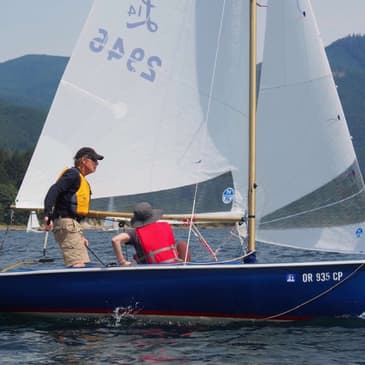
Tom McLaughlin's sailing career is enviable. Growing up in San Diego - then the hotbed of offshore racers -Tom was mentored by Dennis Connor, Buddy Melges and Lowell North. He’s raced in multiple Admirals Cups including the infamous 1979 Fastnet race, and gained deep experience of the America’s Cup through two challenger campaigns - he was training helmsmen racing for John Kolius in the New York Yacht Club's 1985 America II campaign, and Sailing Director of the 2007 AREVA Challenge in Valencia with Dawn Riley. All during a long career at North Sails. Tom's tenure in racing boats also includes maxis and super yachts, today however he's has found contentment racing Lido 14 one designs in Portland, Oregon.
In Part 1 we’ll hear Tom’s experience of the 1979 Fastnet tragedy, the evolution of sail design and its impact on racing performance, and the America II campaign.
[00:00:09] So welcome to Sailfaster. Today's guest brings what is an amazing career in sailing to Sailfaster. Hired by Lowell North while still in college, he became a mainstay of the North sales business for many, many years working in both US and UK in that time. He has an impeccable racing pedigree. And I know I'm just going to skim the surface here, but he competed in multiple Admirals Cups on one tonners back in the early 80s.
[00:00:38] For those not aware, the Admirals Cup was for many years known as the unofficial World Championship of offshore racing. Some incredibly grueling top class racing there. And of course, it included the Royal Ocean Racing Club's famous Fastnet race.
[00:00:53] Our guest also has, of course, deep experience of the Americas Cup. He was training helmsman for John Colias in New York Yacht Club's America 2 campaign in 1985, down under in Perth, and was the sailing director of the Arriva Challenge campaign in Valencia in 2007, which was run by Dawn Riley, who was a past guest of Sailfaster, as many of you know.
[00:01:23] You've heard that episode. He's also raced up team maxis and super yachts and like of that. But today, I think, has found contentment racing lead opens in Oregon.
[00:01:36] So Tom McLaughlin, for it is he. Welcome to Sailfaster.
[00:01:40] Well, thanks, Pete. And I'm looking forward to getting to know you better as well.
[00:01:45] Thank you. And you're known as Tomac, right?
[00:01:47] Yeah, it's there were three Toms working at North Sales when I first started as a young man, and everything was done on a PA system. So to differentiate all the Toms, it was got shortened from Tom McLaughlin, which McLaughlin always came out garbled on the old PA system. So it was just Tom Mac. And then when people would write it down on memos and things, it became Tomac. So I was stuck with it.
[00:02:12] You are originally from San Diego, right?
[00:02:16] Yes. Born and raised San Diego and fortunate to be there at a time when sailing in North America had one of its bright spots in San Diego with Lowell North and Dennis Conner and all these people who later got to be famous.
[00:02:29] Yeah. What a time that must have been. What a community that must have been. I've read three or four of Dennis Conner's books where he talks about that time. Was it obvious from an early age that you were going to get into sailing? Were you sort of part of that crowd at an early age?
[00:02:45] Oh, no. I mean, I didn't start sailing until I was 13. My dad was a woodshop teacher. So he decided that through the urging of a friend, we didn't live near the beach. So he sent away to Spartan and Stevens and got plans for a 13 and a half foot blue jay, which was like a small lightning.
[00:03:02] So we built that in our garage and my older brother and older sister. So five of us get into this 13 and a half foot boat. And my dad didn't want anybody. He was from the Midwest. So he didn't want anybody to sit on the edge of the boat because he thought that was dangerous.
[00:03:15] So we're all wearing our Maywest life jackets. Everyone has to sit like sardines inside this little boat. And then we took off in Mission Bay to go sailing and nobody knew how to sail.
[00:03:26] But my dad executed the perfect downwind landing, you know, so dead downwind, mainsail out, T-boning the dock. That was my introduction to sailing. It could have gone either way. I could have either hated the whole thing or realized that there's a lot to learn and it'd be fun.
[00:03:43] You were in college when you were recruited by Lowell North, right? How did that happen?
[00:03:50] Yeah, well, you know, I was lucky enough to get into a Sabbath like everybody else did in Southern California, a little eight foot boat and learned how to sail through mentoring by Carl Eichenlob and Dennis and a whole bunch of other people that I was able to crew with.
[00:04:04] And by the time I got to college, I was actually a pretty good college sailor.
[00:04:08] You know, we won the collegiate championship two years in a row and I won the single hand as one year.
[00:04:14] So Lowell North felt that I could provide some, you know, I would be a good trainee.
[00:04:22] And I was working in a boatyard at Carl Eichenlob's boatyard and I'd come home so bloody dirty from sawdust and fiberglass and everything that I realized that sail making was a lot cleaner.
[00:04:32] You know, the laundry bill went way down. So I started working there when I was a sophomore in college at with Lowell.
[00:04:39] And it was great. It was just like such a great learning experience because Lowell and particularly Pete Bennett, who was his number one sailmaker there,
[00:04:48] shared so much in how sails work and how boats go fast and so on.
[00:04:53] So it was great. Again, the luck of falling into time and place, you know.
[00:04:57] I was just reflecting on how fortunate you were to have sailing mentors like Dennis Goddard and sailmaking mentors like Lowell North and the rest.
[00:05:09] It's quite amazing.
[00:05:11] I'm guessing while you're working for North Sales, there was that great revolution in materials, probably, I imagine, sort of away from Dacron's to more exotic high-tech materials.
[00:05:23] It was mylar, that sort of thing. Am I right about that?
[00:05:26] Oh, yeah, absolutely. I wasn't there during the cotton and Orlon days, but Dacron was.
[00:05:31] I'm not that old, but Dacron was the staple and everybody made sales, you know, working sales out of Dacron and nylon for shoots.
[00:05:40] But Lowell actually pioneered the whole sail development with the sailcloth companies that were on the East Coast.
[00:05:50] Because in Southern California, the only person there making their own sailcloth was Kenny Watts up in Los Angeles.
[00:05:57] And he was doing it pretty much for his own business, Watts Sales.
[00:06:02] So Lowell was working with Saul Lamport and Howe and Bainbridge and, you know, a lot of the weaving companies on the East Coast.
[00:06:09] And they would send all their junk out to the West because shipping was expensive.
[00:06:13] So if they sent a bunch of rolls of cloth out to San Diego, they knew that even if it was crappy, they wouldn't get them back.
[00:06:19] So Lowell came up with a testing method, actually still in use today, where they test a sample.
[00:06:26] And he would actually quantify the stretch in the thread, you know, the warp direction and the fill and the bias and came up with standards.
[00:06:35] And he told Howe and Bainbridge, I'm going to reject this cloth if it doesn't meet my standard.
[00:06:41] But Lowell basically realized that the more he could stabilize the fabric, the more reliable his sail shape would be.
[00:06:49] So he first tried to do that with Dacron, and he was the first to move into the Mylar sales where you had a Mylar laminate.
[00:06:57] In fact, Saul Lamport came up with the cloth that Lowell first used, which had a half a mil of Mylar laminated onto a four ounce fabric.
[00:07:07] It was green.
[00:07:08] And so they called that the garbage bag.
[00:07:10] He made a sail for, I think, 12 meter in 1974, things like that, out of the garbage bag material.
[00:07:20] And everybody, when we built that sail, they all go, this is total failure.
[00:07:24] And yet it came out and began to change quickly into Mylar fabrics.
[00:07:29] So Lowell was at the front edge of that, as North has been for a lot of changes in sail making.
[00:07:35] That must have been quite a sort of revolutionary time where there were big step changes in sail performance and how they were made.
[00:07:45] But that slowed down, I would think, over the last couple of years.
[00:07:49] I mean, I know there's the 3DL, 3DI, whatever it is.
[00:07:52] Well, you know, there's been a couple of major revolutions.
[00:07:55] One was the change from Dacron to, let's say, laminates.
[00:07:59] And low-stretch laminates, whether it's Kevlar or Spectra or Carbon.
[00:08:03] So, you know, we make those jumps and all of it is in an effort to say, what if the fabric had no zero stretch?
[00:08:11] And this is where, you know, the famous Tom Snackenberg got involved with North sails back in the 80s.
[00:08:19] And Tom basically said, okay, I'll write a program that if you made a sail out of steel to do something with zero stretch,
[00:08:28] I can show you the exact amount of broad-seaming or curvature.
[00:08:32] And you can run those panels any way you want.
[00:08:35] You can make a radial panel.
[00:08:36] You can make it running from the head to the clue instead of the other direction.
[00:08:41] And you saw that in the America's Cup in, when was it, 1980, 480, 74, 75.
[00:08:48] Then the Australian challenger, Gretel II, had panels in their sails that were running from the head to the clue.
[00:08:57] So you were running the panels lengthwise, you know, instead of 90 degrees, which was the conventional perpendicular to the leech.
[00:09:05] I don't mean to get into the weeds because none of this was going to help your people sail faster.
[00:09:10] But for another time and another place, perhaps.
[00:09:15] But I think that the big jumps in innovation have been always moving toward lower stretch membrane.
[00:09:22] So if you look at the sail as a membrane, how do you make it lower and lower stretch?
[00:09:27] Because then the sail shape can be more precise.
[00:09:30] Look at the current America's Cup boats.
[00:09:33] They have a jib and they have a mainsail.
[00:09:36] They're both membranes, okay?
[00:09:38] Now we know that the faster the boat goes, the flatter the sail has to be.
[00:09:44] In other words, you get all the lift you want.
[00:09:46] Now you need to reduce drag.
[00:09:47] So you do that with a smaller foil and a flatter foil.
[00:09:50] So how are you going to keep that jib flat with zero stretch?
[00:09:55] That's how you do it.
[00:09:56] So using carbon in the sail, lots of carbon, so that the membrane won't balloon out.
[00:10:02] So the faster a boat goes through the water and the bigger the overall sail, the lower stretch
[00:10:08] the membrane has to be to provide a wide range of performance.
[00:10:12] So as far as my involvement goes, I was lucky enough to be there with Dacron cross-cut sails
[00:10:17] going through Mylar and Kevlar and then into carbon.
[00:10:24] So I've seen it all so far, but I'm sure there's going to be big changes that long surpass my knowledge.
[00:10:30] I'm sure.
[00:10:31] And hopefully there will also be changes in the durability of those sails over time.
[00:10:39] It's quite shocking how they deteriorate.
[00:10:41] Not just durability, but recycling.
[00:10:44] I think that's the push now is how do we make a responsible product?
[00:10:50] And I say we, boy, that's old.
[00:10:52] I've left North Sails about seven years ago.
[00:10:54] So it's in the blood.
[00:10:56] You can never leave North Sails.
[00:10:58] Yeah, I know.
[00:10:59] It's Hotel California, you know.
[00:11:02] I want to change gears to your racing career.
[00:11:07] Because I was really intrigued by your Admiral's Cup experience in the 79, I think,
[00:11:14] in 1979 and also the early 80s.
[00:11:17] You were over in UK at Hamble.
[00:11:20] Were you for North Sails at that time?
[00:11:22] Yes.
[00:11:22] I left San Diego when North Sails UK was opening
[00:11:29] and joined Ian McDonald Smith to help open and run the North Sails UK in the Hamble
[00:11:39] at Mercury Yacht Harbor back in 74.
[00:11:43] So that was a culture shock for me, but it was...
[00:11:47] Good pops, sir.
[00:11:48] Yeah.
[00:11:49] It was interesting.
[00:11:52] So, you know, at that stage, I had not had that much experience with larger boats
[00:11:58] because I'd sailed dinghies pretty much until 1977.
[00:12:02] Compared to most British sailors, I was pretty green.
[00:12:05] That's for sure.
[00:12:07] And obviously, I'm going to guess, you weren't particularly used to freezing cold waters
[00:12:11] at the Solent and during August.
[00:12:15] Yeah.
[00:12:15] Coming from California, Southern California.
[00:12:18] Yeah.
[00:12:18] Well, it isn't the water.
[00:12:20] It's the currents.
[00:12:22] Interesting in the Solent, you know, the currents coming in from both sides of the Isle
[00:12:26] of Wight and it swirls around and there's a lot of it.
[00:12:29] So that's what I learned when I sailed in the Admiral's Cup, that the inshore races were
[00:12:34] really tricky.
[00:12:36] You know, one thing about San Diego, it's sort of a very boring incubator.
[00:12:41] The wind is never too strong and it's never too light.
[00:12:43] And as the day wears on, the wind moves slowly to the right.
[00:12:48] So it'll shift 10 or 15 degrees to the right.
[00:12:50] It's predictable.
[00:12:51] That's what happens.
[00:12:53] So with that upbringing and most people in Southern California really focus on boat speed.
[00:12:58] If you can't go faster than the guy next to you, you're not going to beat him.
[00:13:02] So it was all about boat speed.
[00:13:04] Interesting that the San Diego sailors would go east and race on the East Coast or in
[00:13:09] the lakes in the Midwest or something.
[00:13:11] And suddenly the wind is shifting back and forth through 15 or 20 degrees and they're scratching
[00:13:16] their head trying to figure it out.
[00:13:17] Now, the really good guys would go fast and smart, but the guys that were just fast, they
[00:13:23] got more confused than they, let's put it this way, their trophy case was pretty empty.
[00:13:28] It's different.
[00:13:28] So England was almost like the East Coast of the U.S. on steroids sailing in the Solent.
[00:13:33] Even the Admiral's Cup day races inside the Solent and around the brambles and all that
[00:13:40] kind of stuff.
[00:13:40] That was tricky sailing.
[00:13:42] I remember sailing with Yves Pajot as the skipper of a French boat.
[00:13:47] There's maybe two people on the boat to speak English.
[00:13:49] And we came into a mark where the current was raging going out of, you know, out west
[00:13:56] in the Solent.
[00:13:56] We couldn't lay the mark.
[00:13:58] There's a crowd of boats.
[00:13:59] Eve just tacks in easily 10 boat lengths below the lay line and then just goes head
[00:14:05] to wind and luffs.
[00:14:06] And the current was so strong, we just push us all the way up around the mark.
[00:14:10] And then he bears off like nothing happened, you know, and all the people from out of town
[00:14:14] were sort of overstanding that mark.
[00:14:16] But it was, you know, again, if you keep your eyes open, no matter where you sail, you'll
[00:14:20] learn a lot.
[00:14:21] I would like to touch on the Fastnet Race 79 because that was that famous, unfortunately
[00:14:28] infamous event, wasn't it, where there was a serious windstorm that came through halfway
[00:14:34] through that regatta in the middle of the night.
[00:14:37] What was your memory of the 79 Fastnet?
[00:14:40] Oh, you know, John Rumanier wrote a good book called Fastnet Force 10.
[00:14:45] And it was interesting.
[00:14:47] The race started in pretty easy conditions.
[00:14:51] And it turns out at the end of it all, there were 11 people that lost their lives.
[00:14:55] And it prompted a big discussion for years to come on safety during sailboat racing, you
[00:15:03] know, as far as emphasizing man overboard drills and so on.
[00:15:06] So, you know, it had made quite an impact on the sailing community.
[00:15:10] But for me personally, I was sailing with a French team and everything was pretty quiet
[00:15:16] for the first part of the race.
[00:15:17] And the English weather forecasts at that time showed that there would be a small front that
[00:15:22] would come through and it wouldn't be too bad.
[00:15:25] The French forecast, on the other hand, said there was an additional front coming up from
[00:15:29] down south that would potentially join with the one that was predicted from the west.
[00:15:34] And that would cause an acceleration, you know, a really strong storm.
[00:15:38] So depending on which forecast you were monitoring, you were preparing for different things.
[00:15:43] And our boat, we knew it was going to get windy.
[00:15:46] And we got around Land's End and heading toward Fastenet Rock, which is on southwest corner
[00:15:52] of Ireland.
[00:15:53] And then the wind started to build pretty quickly.
[00:15:55] And the sun was just going down.
[00:15:58] Again, these are the long days.
[00:15:59] So it was roughly nine o'clock when the wind really started to pipe up, probably 35.
[00:16:05] And it's flown pretty damn good.
[00:16:07] And we've shortened sail and we're reaching along on this 40-foot boat.
[00:16:11] And it was one of the early boats that had an open transom.
[00:16:14] Up until those days, you know, you didn't have a, your cockpit wasn't wide open.
[00:16:18] So for old salts, you know, it looked sort of on semen-like, but at least when the wave
[00:16:23] would roll over the boat, most of the water would go out the back.
[00:16:26] So which was good.
[00:16:27] Anyway, I guess in hindsight, we were lucky enough that the boat broke down early because
[00:16:32] as you got closer and closer to the Irish shore, that was now the lee shore, the waves
[00:16:38] got bigger, more waves breaking.
[00:16:40] And so it was the small boats that really got hammered.
[00:16:42] The big boats got around fastened rock before it got really windy.
[00:16:46] And so they were sailing into deeper water, both boats reaching both directions.
[00:16:50] So it wasn't really an issue there.
[00:16:52] But anyway, we broke down.
[00:16:55] The rudder stayed attached and as did the rudder post.
[00:17:01] But the whole tiller assembly that was now flush with the deck, it was an aluminum weld
[00:17:07] that just broke.
[00:17:08] So now the rudder is free to just turn around whatever way it wanted to go.
[00:17:13] So we put out, we put up the storm jib to pull the bow down, to always make the bow go
[00:17:19] down wave.
[00:17:20] And we put out a bunch of fenders and things that we had out on warps out the back.
[00:17:25] And at the height of the storm, we'd have, you know, waves would break over the top of
[00:17:29] the boat and wash you away from your post.
[00:17:32] So you'd have this big, you'd hear these big crashing boom noises.
[00:17:36] And originally we didn't know what they were at the beginning.
[00:17:38] And then when we found out they're just breaking waves that would break over the boat, then
[00:17:42] that got a little scary.
[00:17:44] So the take of it was we were able to sort of direct the boat by putting the storm jib
[00:17:49] on one side or the other a little bit to steer the boat.
[00:17:52] So the drag that we put out the back kept the transom into the waves.
[00:17:57] And when the sun came up the next morning, we were lucky enough to be almost a beam of
[00:18:02] Cork, Ireland.
[00:18:04] So we were able to then put the storm jib on the other side and use our radio and call for
[00:18:08] a little help and get tugged in behind the breakwater and made it into the dock.
[00:18:13] And we got in about 830 and all the press was there because it was already seen as a nautical
[00:18:20] disaster.
[00:18:21] And the rumors were much bigger, like, OK, there's 40 boats that have sunk because you
[00:18:27] couldn't report in on the radio.
[00:18:28] They assumed you were in trouble.
[00:18:30] So it was it was blown out of proportion.
[00:18:32] Even for a bad event, it was made into something bigger.
[00:18:35] Well, the press realized that I was one of the few on the boat that spoke English.
[00:18:39] And when they found out that my name was McLaughlin, a good Irish name, and my mother's name's O'Brien,
[00:18:47] they just said, you know, you're a son of Ireland.
[00:18:50] And they marched me right up to the Royal Cork Yacht Club.
[00:18:54] This is like nine in the morning.
[00:18:56] And they've got this key that's about the size of a golf club.
[00:19:01] You know, they stick in this old door and crank the thing and open the bar.
[00:19:05] And they said, you know, the son of Ireland needs sustenance, something like that.
[00:19:10] And I think I lost the next day and a half.
[00:19:12] So that was my fascinating experience.
[00:19:14] But, you know, what I took what I took away from it, Pete, was that when you handle a situation
[00:19:20] or you're with a team that can get you through some really tough stuff,
[00:19:24] you look at all the rest of your sailing as manageable.
[00:19:28] So after that, any storm that came along, when it comes up, your confidence is already there.
[00:19:34] That if you keep a cool head, if you communicate well with your team, you agree on a plan that,
[00:19:40] yeah, you can get through it.
[00:19:41] So, you know, the fear of I'm going to die, I'm going to die, you know, all that goes away.
[00:19:46] So while I wouldn't recommend people go out and find a storm to build their confidence,
[00:19:51] I think that the end result is a successful conclusion is character building.
[00:19:57] It's good.
[00:19:58] Yeah, if you can survive the 79 plus net,
[00:20:02] you've probably seen some of the worst that sees can sees can throw at you.
[00:20:08] Can we talk about the America's Cup of the 1980s,
[00:20:13] which was probably the time when it was it sort of most glamorous.
[00:20:16] It was probably the age of its sort of first media attention and visibility that it had.
[00:20:23] It had those great characters of Dennis Connor and Bertrand and people like that.
[00:20:27] You were part of the New York Yacht Club campaign.
[00:20:33] What was that experience like and what did you learn?
[00:20:38] Yeah.
[00:20:38] Well, it's an experience like no other for me.
[00:20:42] I mean, I grew up sailing dinghies, then moved into slightly larger boats,
[00:20:47] but always the team was reasonably compact.
[00:20:51] So even sailing in in Admiral's Cups and so on, you'd have a team of 10 to 12 people.
[00:20:58] And those 10 to 12 people would be focused on a season's goal.
[00:21:03] You know, with the America's Cup, it was a three year project.
[00:21:07] We had lost New York Yacht Club, lost the cup for the first time in its history,
[00:21:12] 1983.
[00:21:12] And now the quest was, how are we going to get it back?
[00:21:17] And the New York Yacht Club really felt quite possessive at that stage.
[00:21:20] Like, you know, it's our cup.
[00:21:22] It's not necessarily a competition.
[00:21:24] Somehow somebody took it away and we're just going to go back and get it.
[00:21:31] So there was quite a push.
[00:21:33] And New York Yacht Club raised the most amount of money of any of the challengers.
[00:21:38] Remember that Dennis Connor and San Diego Yacht Club challenged,
[00:21:43] as did Heart of America with Buddy Melchis.
[00:21:47] And Newport Harbor Yacht Club with Rod Davis and a bunch of other guys.
[00:21:51] So there were a lot of people from America all wanting to go win it back.
[00:21:55] But the New York Yacht Club really felt that it was theirs.
[00:21:57] So John Coleus was seen as the rising star from the prior America's Cup trials,
[00:22:04] where he took an old boat, courageous, and actually pushed Dennis and his team
[00:22:08] right through the defender trials.
[00:22:11] So John Coleus also was a favorite son of Texas.
[00:22:14] And the Texans were wanting to throw a lot of money at it.
[00:22:17] So the New York Yacht Club was basically a syndicate with the Texans
[00:22:23] and the DeVos family and others in Michigan and the New York Yacht Club.
[00:22:27] So that was the basis of it all.
[00:22:29] And I got invited to be John Coleus' training helmsman when the second boat was launched.
[00:22:36] So we started with the first boat pretty much right after losing in 83.
[00:22:40] So by 84, they had a boat to sail.
[00:22:42] And that was hull 42.
[00:22:44] And it was sort of an erector set.
[00:22:47] The chain plates could move around.
[00:22:49] You could move the keel to different locations.
[00:22:51] It was seen deliberately as an experimental boat.
[00:22:56] Same hull shape, but move things around.
[00:23:00] Did the American teams feel they would have to be innovators
[00:23:04] because they expected the Australians to sort of push further down that sort of innovation trajectory?
[00:23:10] Well, that's a good point.
[00:23:11] I think it was more just they knew that the upside down keel,
[00:23:15] the winged keel was a big step forward.
[00:23:17] Looking back over the last 20 years of design information from Sparkman and Stevens and others,
[00:23:25] that chapter was blank.
[00:23:27] We didn't know anything about it.
[00:23:28] So we weren't quite sure how the boat would respond.
[00:23:32] Australia, too, was fast in most all conditions because it was a lighter boat.
[00:23:38] You could make the boat light.
[00:23:39] But by turning the keel upside down, basically putting all the lead as low as you could,
[00:23:45] you gained stability.
[00:23:46] So here you had a light boat that still had more stability than the heavier Liberty or conventional 12 meter.
[00:23:53] So that was their magic secret.
[00:23:57] And so all the other syndicates and Challenger would have a lot to learn.
[00:24:02] I wasn't in the syndicate at the time.
[00:24:04] I joined after the first year when they launched the second boat.
[00:24:07] And I was the perfect choice, to be honest, to be egocentric about it.
[00:24:11] I was the perfect choice to be the training helmsman because I was good enough to make the boat go fast.
[00:24:17] But I wasn't good enough to challenge John Coleus to be the helmsman.
[00:24:22] Remember that America's Cup history is full of backbiting and backstabbing.
[00:24:27] And everybody, you know, the syndicate walking up and dismissing somebody because he lost a race and bringing in a new skipper.
[00:24:35] So Coleus was pretty much conditioned to be paranoid that he could be replaced at any time.
[00:24:41] I sort of got universal approval to be the training helmsman because I wasn't I didn't have the resume to stab anybody in the back.
[00:24:48] What was it like, Tom, driving a, you know, America to 12 meter?
[00:24:54] It was fabulous.
[00:24:55] It was fabulous.
[00:24:56] Talk about a great dream jobs when we were sailing six days a week, whether it was in Newport, Rhode Island or in Fremantle.
[00:25:03] I got to do the easy job of driving the boat, set the trim tab, drive the boat, sort of find that Zen moment, you know, where you're just looking for try to feel the boat, feel the waves, feel the wind, you know, go up and down on your face, you know, the velocity.
[00:25:20] So that was great.
[00:25:21] That was one of those things where time would pass actually quite easily.
[00:25:26] Leave your worries behind and go out and steer 12 meter.
[00:25:28] That was just perfect for me.
[00:25:30] Was it the same principles?
[00:25:31] Was there anything different about it or the same principles of any sort of, they were about 60 foot long, right?
[00:25:36] 64, that range.
[00:25:38] But what I learned, Pete, more than anything was the importance of balance on any boat.
[00:25:44] If the boat doesn't balance, if you're fighting hard to either keep the boat going in a straight direction or you hit a little bit of chop or some bobble and the boat wants to go in a different direction.
[00:25:56] When a boat wants to go fast all by itself, then you're in the groove.
[00:26:00] When you're having to work hard to push the bow down or to let the bow come up with weather helm and you're making a lot of adjustments, then you're going slow.
[00:26:09] So my friend, my friend, Daryl Peck says, he's always quoting this and he says, our job as the skipper is not to slow the boat down.
[00:26:18] So he's basically realizing that if you can get the boat set up well, you're attuned to the balance of the boat, whether it's from where you have the crew sitting or the angle of heel to the horizon or the mainsail leech position and so on.
[00:26:31] Once you get it right, the boat wants to just build speed.
[00:26:35] It will continue to slowly compound its speed.
[00:26:39] And that's the spot everybody, every skipper should be trying to find that bit of nirvana with their boat.
[00:26:46] For me, when you get to that state, which isn't often enough in my case, the boat just feels like it glides.
[00:26:54] Yeah, that's a good description.
[00:26:56] So you were telling me earlier, there were three identical America Twos.
[00:27:02] I think, were they also all called America Two?
[00:27:05] And there were three of them, is that right?
[00:27:07] Yeah, there were three of them.
[00:27:08] They weren't identical.
[00:27:09] They all came out of the same design office.
[00:27:12] Okay.
[00:27:12] Okay.
[00:27:12] So it was hard because Olin Stevens of Sparkman and Stevens has a long career making winning America's Cup boats.
[00:27:20] And he was retiring and he handed over the head design position to Bill Langan, who was a young man and pretty much a strong science-oriented guy, engineering-oriented guy.
[00:27:34] But he was a young man, relatively.
[00:27:36] And he suddenly had this yoke on his shoulders of, okay, you've got to go win the America's Cup back.
[00:27:44] So...
[00:27:47] It was quite a yoke.
[00:27:48] Yes.
[00:27:49] And much like John Coleus, he wanted to make sure that he would get the credit.
[00:27:55] Because a lot of the New York Yacht Club guys had Freres boats and other designers for their own personal boats.
[00:28:03] And they were pushing to say, why don't we open up the design team to include a broader set of ideas?
[00:28:10] I found out after the fact, Bill Langan and John Coleus were quite strong with each other to say, look, I'll support you as a single helmsman if you support me as a single designer.
[00:28:22] Okay.
[00:28:22] So what I learned during that America's Cup campaign is how paranoid everybody was.
[00:28:27] They were really concerned because the history of the Cup was always somebody out of the New York Yacht Club downtown clubhouse.
[00:28:35] They'd get together and decide that somebody was somehow not up to the job anymore and then come and fire them.
[00:28:40] So they were all on the edge of their seat like, well, maybe I'm not going to make it to the end of the Cup.
[00:28:45] So they were forming these alliances sort of by the time I got there.
[00:28:50] And like I say, that's why I fit in so well because I wasn't going to take anybody's job.
[00:28:54] So anyway, that's what I learned from the America's Cup.
[00:28:57] I used to think that if you got on the boat and you really tried hard and you paid attention and you worked on your communication skills with those on the boat and you all had a shared goal, that you could go win races.
[00:29:11] Okay.
[00:29:11] That was a pretty easy formula.
[00:29:13] But what the America's Cup brought in at that time was a whole layer of politics of people that had a tremendous amount of power and authority that weren't on the boat.
[00:29:25] And in the case of Fremantle, maybe weren't even in the country.
[00:29:29] And so dealing with that, and I know that talking, you know, listening to your interview with Pip, where she talks about having to take time away from her effort to raise money or to placate sponsors.
[00:29:42] She doesn't really put it that way.
[00:29:44] She's much more politically savvy than I am.
[00:29:46] You know, it takes time away from what you really want to accomplish in your goal.
[00:29:51] But at the end of the day, it comes down to the same thing.
[00:29:54] If you don't have a fast boat, you're not going to be competitive.
[00:29:57] And we took the wrong path.
[00:30:08] Well, believe it or not, we're going to end this episode on that cliffhanger.
[00:30:13] To hear about which path the America 2 syndicate took and what transpired from that,
[00:30:18] make sure you tune in to part two of our fascinating conversation with Tom McLaughlin, which I'll publish in a few days.
[00:30:25] You will also hear some of Tom's lessons from the legends, such as Buddy Melgers and Dennis Connor,
[00:30:32] and his thoughts on driving a high-performance sailboat.
[00:30:35] Thanks for listening.