
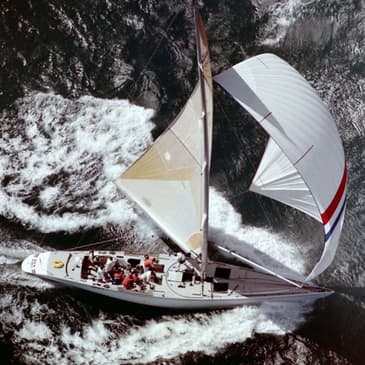
Part 2 of my thoroughly enjoyable conversation with Tom McLaughlin in which he recalled what went wrong with the NYYC's 1987 America's Cup campaign, along with great anecdotes about Dennis Connor, insights on Buddy Melges' helming, and the fundamentals of winning sailing races. Such an interesting, talented and gracious guest!
[00:00:10] Hello there and welcome to Part 2 of our wonderful discussion with Tom McLaughlin. We ended Part 1 on a bit of a cliffhanger, with Tom describing the path the New York Yacht Club took with America 2, which was their challenger for the 1987 America's Cup, which of course was held down in Perth following the Aussies' famous win in 1983. Again, Tom has got some great insights on the America's Cup, including how and why different design decisions were made, and some more great stories about some of the cup's
[00:00:40] famous combatants. So, back to Tom, and as always, thank you for listening.
[00:01:18] Tom McLaughlin People that had a tremendous amount of power and authority that weren't on the boat, and in the case of Fremantle, maybe weren't even in the country. And so, dealing with that, and I know that, you know, listening to your interview with Pip, where she talks about having to take time away from her effort to raise money or to placate sponsors. She didn't really put it that way. She's much more politically savvy than I am. You know, it takes time away from what you really want to accomplish in your goal.
[00:01:47] And we had a lot of that with the New York Yacht Club America 2 Syndicate. We had a lot of sidesteps. But at the end of the day, it comes down to the same thing. If you don't have a fast boat, you're not going to be competitive. And we took the wrong path. And that path was Dennis built three boats, just like the New York Yacht Club. He tested the boats in Hawaii, where it's windy, whereas we tested in Newport, Rhode Island, where it's not windy.
[00:02:14] And Dennis kept making boats that were bigger and fatter. The America's 12-meter rule, you can make a boat really big and heavy and wide in the back. But for every pound and all the prismatic coefficient that goes up with a big boat, you have to reduce sail area.
[00:02:31] So Dennis was making boats really geared for heavy air. And we didn't. We, in a New York Yacht Club, decided that just by putting more lead down low, bigger wings, heavier wings, we gained stability.
[00:02:44] But we couldn't go any faster than 8.3 knots upwind. Then the boat would start to shake. The whole boat would start to buff it, you know, because it reached its limit. It's almost like trying to break the sound barrier in a plane.
[00:02:57] You get right to that edge, 8.3, we'd start to shake. The boat would move around. The rudder would wobble. All kinds of things would happen. Whereas the boats that were bigger, by bigger I mean just fatter, bigger in the back end, bigger in the front end, they'd continue. Their calculated boat speed was faster.
[00:03:16] They'd put the bow down and go 8.7 and blast right through us. We'd win the start because our boat would spin easily. That was what Coley has told Langan he wanted. He says, give me a boat that can turn sharply and not lose speed and I'll win the start.
[00:03:32] Match racing, right?
[00:03:32] Match racing. And statistically up till that time, boats that had won the start won the races like 83% of the time.
[00:03:41] Did you know before you started the competition that your boat was slower?
[00:03:46] No. Interesting question. We, New York Yacht Club and America 2, Hull 46, we won the first set of trials in Australia.
[00:03:55] So they had three sets of trials. The first set you would get for every victory, you'd gain one point.
[00:04:02] So that series went on in October, I think. Then the second set of trials, every victory, was worth five points.
[00:04:09] Okay. And the final set of trials, each race was worth 12 points. And then cumulative points would say, okay, we'll take the top four boats at the end of that. And those are our semifinalists.
[00:04:22] Well, the first set of trials, we won, got a bunch of little one point scores because the wind was only blowing about 12 knots.
[00:04:31] Then the wind started to blow for the next set of trials. It was calculated that the Fremantle doctor, that reliable wind that would come in in the middle of their summer, would blow 20, 25 knots.
[00:04:42] And yet our boat really wasn't up to us. So when did we discover we were slow? After and during the second set of trials.
[00:04:49] Then it's too late. Then you say, what are we going to do to be better in heavy air?
[00:04:55] There wasn't much you could do. We had a second set of, I mean, a new set of wings, which are all filled with lead.
[00:05:03] They were 10 and a half feet, by my recollection, 10 and a half feet from tip to tip, solid lead that pasted on the bottom of our keel.
[00:05:12] Again, saying, if we add stability, we're going to be better, faster.
[00:05:16] So those had to be air freighted from Connecticut, where they were cast.
[00:05:21] So they went on an airplane and flew all the way to Australia.
[00:05:25] Now, nothing's more stupid than air freighting lead. It just doesn't make any sense.
[00:05:30] So the air freight bill costs more than the cost of the cast wings.
[00:05:36] Anyway, so we got those at the last minute. We pasted those on, said, OK, we got more stability.
[00:05:41] We've got to be doing better. And that was way too little, too late.
[00:05:44] I learned again from that, that if you make the wrong decision, OK, if your goal or the way the path you choose is the wrong path, you're never going to get there.
[00:05:57] And we made the wrong assumptions at the beginning. And I think that's true with America's Cup today.
[00:06:03] You know, I read an article that I think it was from April of this year where maybe Terry Hutchinson basically said, you know, the decisions made today, you know,
[00:06:12] the America's Cup is one it's already won by somebody.
[00:06:15] And it's going to be the person that came up with the right formula for speed and reliability in their boat.
[00:06:23] And I think that we in America's Cup effort way back in in 86, 87, that we had we had chosen the wrong path.
[00:06:32] So that was a learning experience that I used to think you just hike harder, sail more hours and you'll get better.
[00:06:40] And what I learned from that experience is it pays to stop and really think about are you on the right path and what is the next decision you as a team member and you as a team should make to get better.
[00:06:55] So planning and thinking about that is a much bigger component than what I gave it credit for as a young man.
[00:07:02] Tom, a lot of these ventures like this, right?
[00:07:04] You've got the project's got momentum.
[00:07:07] You've got people behind it.
[00:07:08] You've got vested interest.
[00:07:10] You've got a timeline that's or a clock that's ticking very, very loudly.
[00:07:14] I've been in various things sort of through in working career like that.
[00:07:18] It's really hard to to take time to stop and slow down and consider options because sometimes you've you've passed the point at which you can change.
[00:07:27] And there's just this momentum that keeps things moving, moving forward.
[00:07:32] I think the other thing as well, Tom, is that the America's Cup is and still is sort of the cutting edge of the sport.
[00:07:37] So as the last few America's Cups have shown that if you're off the pace technically, you're dead.
[00:07:44] And that's true of the America's Cup, right?
[00:07:46] It's quite it's quite unique.
[00:07:47] I don't think of any of the sailing classes really or competitions that have that sort of technical risk associated with them.
[00:07:54] What do you think?
[00:07:55] No, I think you're right.
[00:07:56] I mean, certainly when you sail a one design boat, you're quite restricted and nobody is going to make such breakthroughs that they think outside the box.
[00:08:05] And the beauty with a one design class as well is that the top sailors usually are very, very willing to share with a tuning guide or or ideas and tips on how to go faster.
[00:08:17] And so, you know, you're right with the America's Cup where they have basically a general guidelines and a rule.
[00:08:23] And everybody then brings in all their engineers and scientists and everybody else to try to maximize those variables.
[00:08:31] But your point about the momentum is correct.
[00:08:34] I think that that's where leadership comes in and the people that are willing to tell the emperor they have no clothes.
[00:08:41] That's important.
[00:08:42] But the bottom line is once the America's Cup effort begins to roll, there's never enough time and there's never enough money.
[00:08:50] And then as it goes closer and closer to the event, there may be plenty of money left in the drawer, but there's not enough time.
[00:08:59] And one thing I will say for, you know, the average racer, you still don't have enough time.
[00:09:07] Now, the one difference with the America's Cup, you don't, you know, as an individual amateur sailor, you don't have enough money either.
[00:09:13] How do you use your time better?
[00:09:15] That's what's really key because you look at the America's Cup boats and they plan out what they're going to test and how they're going to try their new systems and so on.
[00:09:24] Then they lose two days because of weather.
[00:09:26] Then they go out and start the testing and then something breaks.
[00:09:30] You lose more time.
[00:09:31] And yet the date on the calendar of your first race remains.
[00:09:36] So I think that doing these campaigns, I learned that the time you spend on the water is extremely valuable.
[00:09:44] So when I sail locally, either in my little 14-foot boat or I go sail with somebody on a 40-foot keelboat, I try to emphasize that we utilize all of the time.
[00:09:57] So we gather at the dock.
[00:09:59] We make the game plan of what we're going to do that day.
[00:10:03] When we leave the dock, we immediately start learning.
[00:10:07] Don't just reach around.
[00:10:09] You get close hold on starboard, close hold on port, get your compass headings, get the feel of the boat.
[00:10:14] Is it different on one tack to the other because of the sea state?
[00:10:17] You make small corrections.
[00:10:19] You try to line up against another boat because that's the only way to really gauge are you going fast or not.
[00:10:25] And this is where, you know, I learned so much from Buddy.
[00:10:28] Mel just sailing with him for a month in the SORC.
[00:10:32] He realized that everybody moves at their own sort of pace.
[00:10:35] So when you go practice, you'd have three people down below and, you know, making sandwiches and two other people hiking out and looking at the wind.
[00:10:43] And so on.
[00:10:45] And he insisted that everybody switch on and practice like hell, like it's a race.
[00:10:50] You hike as hard as you can.
[00:10:52] You trim the sails.
[00:10:53] You know, jib goes in and out through an inch and a half on the sheet.
[00:10:57] Communication is crisp and there's no unnecessary talking.
[00:11:00] And then he says, OK, switch off.
[00:11:02] So we would switch on for 20 minutes.
[00:11:04] Everybody working in harmony and with intensity.
[00:11:07] And then switch off.
[00:11:08] Then people could roam around and get a sandwich, get a drink, talk about what we learned.
[00:11:12] And then we'd do it again.
[00:11:14] So, again, that was that concentrated practice would lead to a discovery on how to make the boat go a little faster that given day and point to problems that may exist before the race starts.
[00:11:27] So using that time and Dennis Conner would always do this.
[00:11:31] When I sailed with him when I was young, I was 16.
[00:11:33] He was always doing time and distance.
[00:11:37] He'd see that a buoy up ahead.
[00:11:39] You know, we're just going out of out of the harbor to get to the race course.
[00:11:42] There's a government buoy.
[00:11:44] He says, how long to the buoy?
[00:11:45] I said, I don't know, a minute 20, something like that.
[00:11:49] He says, no, it's a minute 10.
[00:11:51] And we'd start to watch and you'd count it down.
[00:11:53] And it didn't matter who was right.
[00:11:56] The point is, he was always calibrating his time and distance.
[00:12:01] It's what he'd see versus what the time was.
[00:12:04] And so, you know, now we have software that tells you where the line is.
[00:12:08] You ping both ends of the line.
[00:12:09] It tells you time to get there.
[00:12:11] But back in the day, there wasn't any of that.
[00:12:14] And so what made some of these guys so good?
[00:12:16] They would constantly work on understanding the speed and how long it takes to get from point A to point B.
[00:12:28] How long is it?
[00:12:29] When is that puff going to come to us?
[00:12:31] Is it, you know, 40 seconds away?
[00:12:34] Is it a minute away?
[00:12:35] And it got everybody looking at the wind.
[00:12:38] And Dennis would draw people in.
[00:12:39] Dennis's favorite saying was, I'll bet you a buck.
[00:12:42] I remember Tom Whitten telling me this story that a grinder is grinding away on their own port tack.
[00:12:48] They're approaching another starboard tack boat that's quite a ways away.
[00:12:51] And he says to the grinder, he says, who's ahead?
[00:12:54] He says, us or them.
[00:12:55] The grinder looks up and he's just been sweating.
[00:12:58] He hasn't been paying much attention.
[00:12:59] Dennis says, I'll bet you a buck.
[00:13:01] And he says, well, I don't know.
[00:13:02] Dennis pushes him harder.
[00:13:04] He says, I'll take either side of the bet.
[00:13:06] He says, what do you got?
[00:13:07] He says, uh, he's ahead of us.
[00:13:09] Well, as they converge, it turns out they are ahead.
[00:13:11] And so Dennis whips out a dollar bill right then, hands it to the guy and says, fast pay makes fast friends.
[00:13:20] But what it did is it got everybody on the boat attuned and made them a better sailor and got their head into the race.
[00:13:28] If that grinder knew that he's got to watch out for ahead and behind with oncoming traffic,
[00:13:34] he could better prepare himself without anybody saying anything that maybe we have to do a crash tax.
[00:13:40] And Dennis got everybody on a boat attuned to the racing strategy and tactics and kept their head in the game.
[00:13:47] So he was quite good at motivating as well as teaching while he was doing it, while he was sailing.
[00:13:53] I remember reading that he would sort of practice time and distance while he was driving.
[00:13:57] That's a true story.
[00:13:58] We drove to Los Angeles from San Diego as you normally would.
[00:14:02] There was a lightning regatta up in Redondo Beach.
[00:14:05] You know, it's a two-hour drive.
[00:14:07] So I'm driving with Dennis and he's betting me on an overpass.
[00:14:11] He says, how long did that overpass?
[00:14:13] And I'd guess a time.
[00:14:15] And he'd usually hit it pretty well, but he was the guy driving.
[00:14:18] So he'd slow down or he'd speed up to make his prediction come in right.
[00:14:24] If nothing else, Dennis hates to lose.
[00:14:27] Yeah, clearly.
[00:14:28] That's the other thing I noticed of all the competitive sailors that I've sailed with.
[00:14:32] It stings.
[00:14:34] It hurts to lose.
[00:14:36] And in retrospect, I don't have that intensity.
[00:14:39] I shrug my shoulders and say, well, it was a good race and ruminate a bit on what I could do better.
[00:14:44] But I don't expect to win every time.
[00:14:46] But when I spend time with Dennis, Terry Hutchinson and people like that, they expect to win every time.
[00:14:54] And when they don't, they think something is a little out of whack.
[00:14:59] What is wrong?
[00:15:00] Not only am I good enough to win, I deserve to win.
[00:15:04] You know, and I'm not wired to really do that.
[00:15:08] You're probably healthier for that reason.
[00:15:11] Well, yeah, it's different.
[00:15:13] That's for sure.
[00:15:13] You were mentored by Dennis Connor and then you spent a lot of time with Buddy Meldridge.
[00:15:18] Was there marked differences in the way Dennis and Buddy and you drove a boat?
[00:15:23] I think so.
[00:15:25] I mean, Dennis was interesting because he'd always get in a big regatta.
[00:15:29] He'd get his hair cut and, you know, high and tight, you know, so his neck is sort of naked.
[00:15:36] And he would always sail with his head sort of at the same angle, you know, whether it's a star boat or whether it's a big keel boat or a 12 meter or something else.
[00:15:46] And he became very, very sensitized to the wind so that he could feel, obviously we all can feel the puffs, but he could feel around his eyes and his neck and stuff, feel the wind shifts and the subtleties of the wind.
[00:16:01] And when you think about it, if you feel that in advance, rather than waiting for the boat to respond by heeling a little bit more or standing up a little straighter or whatever, then you're just a millisecond or two ahead of the reaction that you should have in steering the boat.
[00:16:18] So he was quite good with that, Buddy, but he was of the same way.
[00:16:22] Buddy would always be the one who says that your boat should be locked in the same angle of the horizon as you're beating and stay that way.
[00:16:30] You can see the inexperienced sailor because every puff they heel over more and then when it gets lighter, they stand up straighter.
[00:16:37] Buddy was pretty, pretty rigid with trying to keep his boat the same angle of heel.
[00:16:43] And that turns out, you know, if you can do that and it gets the boat in balance, then just the fine feathering.
[00:16:50] So, you know, when you get hit by a puff, if you can sail, you know it's a lift because of geometry.
[00:16:56] It's going to be a slight lift on the sails, each puff, assuming the direction is the same, it's just a velocity increase.
[00:17:04] Buddy was able to work that and have the telltales, you know, on the windward side lift and spin around to keep the boat the same angle of heel.
[00:17:12] So that's called feathering, right?
[00:17:13] Have you, you've heard of pinching, right?
[00:17:15] Yes, it's the term that my tactician always yells at me to say, no pinching, no pinching.
[00:17:21] Well, the difference is that pinching and feathering are exactly the same thing, except when you're feathering, it works, meaning you don't slow down too much.
[00:17:31] It's exactly the same thing.
[00:17:33] You let the boat come a little closer to the wind, the front of the jib gets a little soft, the telltales start swirling around.
[00:17:38] And if you hit a wave at the same time, then you slow down, okay?
[00:17:42] That's when your trimmer is saying to you, no pinching, but it's exactly the same thing, except when you're feathering, that's a positive connotation of doing exactly the same thing.
[00:17:52] I presume, you know, when you're feathering, you're doing it as a result of the boat starting to accelerate anyway, right?
[00:17:57] The hit puff, heels over, rides up.
[00:18:00] Yeah, yeah.
[00:18:02] You get my gist, which is it's exactly the same mechanical function.
[00:18:06] But if you feel the puff first on your face, you allow the boat to come up closer to the wind, you know it's going to accelerate before it starts to heal over much more.
[00:18:16] When you're pinching, it could be the puff has already gone away.
[00:18:20] Now the telltales are acting exactly like a feathering, but in fact, the boat is slowing down and you're starting to get nagged on by all of your crew.
[00:18:29] Anyway, I guess the point I'm trying to make is that a lot of people, if they sailed with Buddy Meldes, then they'd go off to their own boat and they'd try to sail with the telltales lifting and a little bit thin, trying to point a little higher.
[00:18:42] But they would be doing it at the wrong time and therefore their trimmer would yell at them for pinching.
[00:18:48] So pinching and feathering, same mechanics, one works, one doesn't work.
[00:18:52] How's that for confusing?
[00:18:53] Well, that's sailboat racing, isn't it?
[00:18:56] Pretty much everything's confusing.
[00:18:58] It's the only sport I know where the rules are quite vague.
[00:19:01] The three boat circle, it's the only sport where a critical boundary is not visible.
[00:19:09] Everybody has to guesstimate and estimate where the three boat circle is.
[00:19:12] Every other sport has got diliniated lines.
[00:19:14] But anyway, so Tom, about 20 years later, you returned to the America's Cup with the Arriva Challenge, which was, I think, a French-American boat.
[00:19:23] I think you said where you were sailing director at the time when Dawn Riley was the overall GM.
[00:19:31] And that was Valencia in 2007.
[00:19:34] What was the contrast between 2007 and 1987 for you?
[00:19:38] Well, the biggest difference was that when we went to Australia in 86-87, the New York Yacht Club, the syndicate I was associated with, we had the most amount of money.
[00:19:52] Okay?
[00:19:52] We were the big player.
[00:19:53] We were the people coming in with the resources and the expectation to win.
[00:19:59] We were the challenger of record.
[00:20:01] With Arriva, I came in a year after they had already started.
[00:20:06] And they were one of the very poor resource teams.
[00:20:09] In other words, they didn't have a rich, rich, rich, rich pocketbook.
[00:20:14] They had bought an old boat, America True, from the ACC class, which followed the 12 meters as one designs.
[00:20:23] And so they had an old, old trial horse.
[00:20:26] And then they built one new boat.
[00:20:28] And the more serious players were able to build at least two boats, start with an old one and build two new ones.
[00:20:36] So from a development point of view, we had one shot at coming up with a competitive breakthrough boat.
[00:20:43] So that was one difference.
[00:20:44] What wasn't different was there was still this race against time where every day that you lost on the water due to a breakdown or something was time you weren't going to get back.
[00:20:55] So testing protocols, analyzing data was still extremely critical.
[00:21:01] And being honest with yourself at the end of each week to sort of say, did we make progress and are we going the right direction?
[00:21:07] Those questions were still, I would say, more seriously asked in 2007 than they were in, you know, the 80s.
[00:21:17] There was less, clearly no arrogance in our program that we were going to go out there and win.
[00:21:23] So the difference for me was really the size of the programs.
[00:21:26] The other thing is that the commercialism had gone in a little deeper with those programs where there were sponsorship.
[00:21:33] And the tried and true is still find a billionaire who wants to win, let them fund most of the program.
[00:21:40] And then that leaves you free to go sail and develop and build more boats and so on.
[00:21:45] That was still the successful formula in those days.
[00:21:49] True today.
[00:21:50] The other thing that changed was the nationality.
[00:21:52] It used to be a race among nations and you expected your boat not only to be designed according to the rule designed and built by the country of origin,
[00:22:01] but you also expected the sailing team to be from that country.
[00:22:06] And what had changed is that's the year that, you know, Russell Coots and Brad Butterworth,
[00:22:11] the successful skipper tactician team from New Zealand, joined Bertorelli and the Swiss team, Alenghi.
[00:22:18] Alenghi, yeah.
[00:22:19] So suddenly there's this confusion of, wait a second, these guys are New Zealanders and they're sailing with the Swiss.
[00:22:27] Well, you know, you look at America's Cup today and individual talent goes to where they think they have the best opportunity.
[00:22:34] So you have Jimmy Spittle sailing, you know, with the Italians and you have Kiwis, Australians, English all over the place.
[00:22:43] So that changed.
[00:22:46] Yeah, it's an interesting thought, isn't it?
[00:22:48] Because going back to 83, I mean, that was, as I've heard Australians talk about,
[00:22:52] that was the greatest moment in Australian sport at that point because they, you know,
[00:22:56] they won the America's Cup overseas with, you know, Australian boat and Australian, purely Australian talent, Australian backing.
[00:23:02] It was very much a sort of a patriotic, all Australian venture, which is very different from today.
[00:23:08] Yes, yes.
[00:23:10] Emirates Team New Zealand, it's a New Zealand boat, but that's the Abu Dhabi airline, isn't it?
[00:23:15] Emirates.
[00:23:16] Yes.
[00:23:17] Yeah.
[00:23:17] So that's changed.
[00:23:19] And I think that now what's different even today is that they've tried to make it,
[00:23:23] I mean, it's been a big push basically to make it a spectator sport.
[00:23:26] So before you would get somebody very wealthy or a group of wealthy people to fund a campaign and expect that money.
[00:23:35] That's where all the money came from.
[00:23:36] There was no revenue generated from the event.
[00:23:39] And now I think with television rights and so on, people are trying to pay for the event by charging the city of Barcelona.
[00:23:47] Basically, they have to fund the improvement to the ports and handle all of the any crowd control or anything else.
[00:23:55] And the individual boat sponsors are paying for their boats and so on.
[00:23:59] And then they have television rights and stuff that are negotiated that go to the organizing authority,
[00:24:06] which in this case is, you know, Team New Zealand.
[00:24:09] So that's changed.
[00:24:11] You know, it was always expected that the country that won would host it.
[00:24:15] They may argue about the city that they hold it in, but each country had responsibility to host the event.
[00:24:22] Yeah, I guess Alinghi was the first one to sort of break away from that, wasn't it?
[00:24:26] Lake Geneva wasn't the right venue for the Swiss event.
[00:24:30] But I'm curious, as a sailor, you know, you've been involved in Two America's Cups.
[00:24:37] What do you think, as a sailor, what do you think of the current, you know,
[00:24:40] we've got the final coming up between Ineos Britannia and Emirates Team New Zealand.
[00:24:44] And for me, I think it's spectacular as a television event.
[00:24:48] It is further away from pure sailing, obviously.
[00:24:51] But non-sailors have expressed to me how interested they are in it
[00:24:56] because of the ability of today's media to sort of track it around the course,
[00:24:59] multiple cameras, drones, superimposing graphics on the screen.
[00:25:02] It makes it quite interesting.
[00:25:03] But as a sailor, are you appalled by it or would you go along with it?
[00:25:08] Well, I'd go along with it.
[00:25:09] I think it's still a sailboat race.
[00:25:12] I mean, you can see by some of the mistakes that are perhaps made in pre-start and so on
[00:25:18] that play out on the race course.
[00:25:20] You know, it used to be, you know, an America's Cup race would take two hours, two and a half hours in some cases.
[00:25:27] And a fast race in Fremantle was still an hour and a half.
[00:25:32] And having 11 people run, jump around on a 12-meter and sails breaking and, you know,
[00:25:38] spinnakers blowing up and so on brought a human element into it much more than today.
[00:25:44] Today, it's somewhere between, you know, Formula One and sailboat racing.
[00:25:48] Here I am, 77 years old.
[00:25:50] I'm an old curmudgeon.
[00:25:51] But progress moves on.
[00:25:53] And if you look at the young kids today, they're sailing kiteboards with foils.
[00:25:57] They're sailing, you know, they're up and in foils.
[00:26:00] They don't want to get stuck in a Lido 14, you know, where you're going along at three and a half knots
[00:26:05] and you're hooping and hollering because you're passing somebody.
[00:26:08] I mean, tell me that's a thrill.
[00:26:10] But I think that this is going to be a good contest.
[00:26:13] I don't know.
[00:26:14] I really think it's sort of a jump ball here because it'll be interesting to see who prevails.
[00:26:19] And it's going to come down to who makes a mistake or has misfortune just in one or two spots on the race course.
[00:26:28] So this execution and doing it all under the gun of time, you think of the reaction time these people have to,
[00:26:35] you know, skip or crew, you know, the flight controller.
[00:26:39] What they have to drill in, they're only racing for 24 minutes.
[00:26:43] But it's an intense 24 minutes.
[00:26:46] And if their instinct or their training slips away, they get distracted or something happens that breaks on the boat.
[00:26:53] It's a small thing that now causes a huge distraction.
[00:26:56] Those are going to be the things that determine the event, I think.
[00:27:02] Yeah, you come off the foils and it's not like having a bad tack in it.
[00:27:06] Well, not even just off the foils.
[00:27:09] What if one of the foils, they put it down once and they get a garbage bag, you know, a trash bag on there.
[00:27:14] Suddenly it's like, oh, that's a distraction.
[00:27:16] Is it going to, it is slowing us down, but is it going to be the critical factor?
[00:27:20] And how much do I worry about it?
[00:27:22] You know, there's a lot of things that the boats are so complex now that there's lots that can be slightly out of adjustment or go wrong.
[00:27:30] So we'll see how each team fares.
[00:27:32] And I think this is why the shore teams, the maintenance teams that take things apart at night and make sure that they all go back together correctly.
[00:27:41] You know, looked at the Italians when they broke the traveler, you know, in the prior series.
[00:27:45] They came back from that pretty strong.
[00:27:47] But it can be smaller things that don't really stop the boat from working, but it impairs peak performance.
[00:27:54] And we'll never know about those things until the series is over because they won't talk about that.
[00:27:58] Anyway, it's going to be a good contest.
[00:28:00] Yes, it's not what I think of as, it's not a sailboat race that I would aspire to because it happens too quick.
[00:28:08] It's all, you know, too much of a video game for my history.
[00:28:13] As you know, I'm technically challenged.
[00:28:15] I have a hard time even getting on the phone.
[00:28:17] Tom, if you could go out tomorrow and sail the boat of your choice, thinking about all the different boats you've sailed, Maxi, Super Yachts, America's Cup, or current 14-foot dinghy.
[00:28:30] If you could sort of pull out of the dock any of those boats, which would have been your favorite?
[00:28:37] That's a tough one.
[00:28:38] You know, I got to drive way back.
[00:28:40] I got to drive PlayStation, that 115-foot catamaran off of New York.
[00:28:49] It's a record-breaking transatlantic boat, right?
[00:28:52] Well, it's had some records on and off, but, you know, it was a traditional catamaran, no foils or anything else.
[00:28:58] But to feel the power and stuff of that boat, it was a fabulous experience.
[00:29:02] But sailing the boat was like you were aiming, aiming the boat.
[00:29:07] So to come back to a boat that actually has a feel where you think the boat is talking to you, you're at one with the boat.
[00:29:15] I think a small performance dinghy is probably the best, for me, would be the right choice.
[00:29:21] Now, what is that?
[00:29:22] I don't know.
[00:29:23] But the actual pure joy of sailing the boat, it would be awful nice to sail something like a 505 or maybe perhaps the Melchis 15 or a boat that's a more modern version of that.
[00:29:35] But I like a tiller instead of a wheel.
[00:29:37] I like a boat that will accelerate when you get a puff instead of just heel over.
[00:29:42] I like a boat that would plane not easily, perhaps.
[00:29:46] You know, it doesn't have to jump up on a plane all the time, but you have to have those moments where you can coax it up onto a plane.
[00:29:52] I spent a lot of years as a kid in an OK dinghy.
[00:29:55] Coincidentally, Rod Davis, Olympic medalist Rod Davis and coach and everything else, he's sailing an OK dinghy now.
[00:30:02] And here he is 70 years old.
[00:30:04] What do you think of that?
[00:30:05] You're all purists, aren't you?
[00:30:08] Tom, you said something to me really interesting about looking back on your sailing career.
[00:30:14] It's the people, the wide variety of sailors who are most memorable.
[00:30:18] The racers, not as much.
[00:30:20] I thought that was really interesting.
[00:30:21] Well, you know, that's why my career has been, for me, a perfect fit, because, you know, I got to race boats competitively when I was young.
[00:30:31] And I stayed with it.
[00:30:32] And I found that the teams that I would join would push me, push my competitive zeal more than me pushing them.
[00:30:39] If you follow me, I mean, it was like I wanted to win and do my best because of the people around me.
[00:30:45] What I learned when I go sailing with bigger and bigger boats, the days that there's no win, you sit there and what are you going to talk about?
[00:30:53] And sailing with people that were diverse in their careers and some of them quite successful would share some of their issues.
[00:31:02] You know, I sailed with the man who was the head of United Technologies that makes, you know, jet engines and elevators and all kinds of things here in the U.S.
[00:31:12] And he would lay out some business problems for us, for the crew.
[00:31:16] We're sitting there drifting around.
[00:31:17] And he says, OK, guys, I've got a business that loses money on everything they make.
[00:31:22] And yet, you know, it's got a long history and it's got a long heritage.
[00:31:26] What do I do with a company like that?
[00:31:28] And I say, oh, you sell it.
[00:31:30] You get rid of it.
[00:31:31] Take it out of your stable.
[00:31:32] And he says, however, he says, once we sell one of those jet engines, then we get the service contract.
[00:31:39] Now, in the service contract, we make a lot of money.
[00:31:42] Anyway, the point is he would take us away from our mundane little life and allow us a window into what his businesses or thought processes were.
[00:31:54] And so when I'm able to sail with people of all walks of life, you get that.
[00:32:00] If you're willing to listen, you sit down, keep your mouth shut and ask open-ended questions.
[00:32:05] Then actually, it was a very fantastic conversations along the way.
[00:32:09] By the time I went into the super yacht market, you know, I found that I wasn't so much racing.
[00:32:16] I was in the entertainment business.
[00:32:17] You know, I'd get on a boat with 50 people on a 180-foot boat, of which about eight of them knew how to sail.
[00:32:24] But all the guests of the owners wanted to know what's going on and, you know, where's our next mark?
[00:32:30] And they said, how are you going to pass this guy?
[00:32:32] Hey, Tomac, what's your strategy here?
[00:32:34] How are you going to pass this guy?
[00:32:35] And I'd say stupid things like, we're just going to run over the top of him like a bug.
[00:32:40] So we'll just squash him.
[00:32:41] And they'd go, oh, that's good.
[00:32:43] That's good.
[00:32:44] Let's go do that.
[00:32:45] It was just being in the entertainment business more than trying to do what I did in competitive days.
[00:32:52] Does that make sense?
[00:32:52] It does.
[00:32:53] Well, I mean, this has been a really fascinating conversation.
[00:32:57] I love those stories from the America's Cup in those days.
[00:33:02] And to have met somebody who was right involved and right in the middle of that is fascinating.
[00:33:08] Well, Pete, I'd like to make one comment, if I can, that a lot of weekend sailors and everybody else, they get bogged down in a lot of the details and miss the big picture.
[00:33:22] And I think that if you think about the sailboat racing, there's only two components to the sailboat racing.
[00:33:28] One is if you're going to win, there's only two components.
[00:33:31] One is you have to sail as fast or a little faster than the other guys.
[00:33:36] Okay.
[00:33:37] And that's where your 10,000 hours come in.
[00:33:40] That's where you spend your tiller time and 10,000 hours doing it, learning, doing it, learning it.
[00:33:47] And you develop the feel that the top guys have.
[00:33:51] So that's the sail faster portion.
[00:33:53] And the other is how do you figure out how you're going to sail a shorter distance around the race course?
[00:34:00] Okay.
[00:34:00] If you're always a fast guy, but you miss a lot of wind shifts or you poke your bow out into the current, you're not going to beat them.
[00:34:08] The sail smarter, sail the shorter distance by tacking on wind shifts and what is a fake wind shift and what's the real one.
[00:34:15] Those kinds of things, you can learn that in a lot shorter period of time because that is a game of probabilities.
[00:34:22] You can never control how much and when the wind is going to shift.
[00:34:26] You can guess, but what you can control is your separation on those wind shifts.
[00:34:32] Obviously, the further away you are from the guy you're trying to beat, if the wind shifts in your favor, you beat them by a lot.
[00:34:38] That's why you cover on the last beat.
[00:34:40] If you're ahead, you get between them and the mark.
[00:34:42] It's logical at the end of the race.
[00:34:44] But at the beginning of the race and during the middle of the race, control your position on the race course, your separation, so that when the wind shifts to the left, you still have enough race course to tack.
[00:34:55] Back to port and wind shifts to the right, you still have enough race course to use that shift getting on starboard tack.
[00:35:02] So I guess what I would recommend to your racing audience is continue to put in the hours to try to go faster.
[00:35:10] Continue to get that zen position steering your boat and coordinating with your crew.
[00:35:16] But on a more cerebral level, figure out how you're going to sail a shorter distance than the other guys.
[00:35:22] Because if you go the same speed and you sail a shorter distance over the bottom of the ocean, you're going to get there first.
[00:35:28] So simple.
[00:35:29] Two things, right?
[00:35:30] It's so easy.
[00:35:32] You know what?
[00:35:33] I don't know why people get so bunched up about it.
[00:35:37] Perhaps it's the execution.
[00:35:39] I don't know.
[00:35:40] Perhaps.
[00:35:41] Perhaps it might be an element of that.
[00:35:43] Yeah.
[00:35:44] Tom, this has been a fantastic conversation.
[00:35:46] It's been an absolute privilege to spend time with you.
[00:35:49] I really appreciate you spending time with SailFaster.
[00:35:53] Thank you.
[00:35:53] Thank you so much.
[00:35:54] Well, thank you, Peter, for putting up with an old guy and a bit of history.
[00:35:58] And I hope at some stage that some of this helps your weekend racer.
[00:36:03] I hope it does.
[00:36:04] I'm sure it will do.
[00:36:05] Yeah, there's lots to take away from this.
[00:36:07] And as you know, it's as we talked, it's execution, right?
[00:36:10] You can hear somebody talk about, here's the thing to do.
[00:36:13] Here's how to get around the mark.
[00:36:14] Here's how to choose different gates.
[00:36:16] But when you're on the race course and the pressure's on, it's quite a different proposition.
[00:36:22] But yeah, that's the point of SailFaster.
[00:36:24] That's why I started this to basically just try and learn from the best great sailors to
[00:36:29] understand as a relative newbie how to accelerate my performance path.
[00:36:35] And yeah, it's been really, really wonderful.
[00:36:38] So it's all selfish on your part, is what you're saying?
[00:36:41] Well, I think if it was selfish on my part, I would just write it all down and wouldn't publish it.
[00:36:45] Okay.
[00:36:46] Well, Peter, thanks for taking the time.
[00:36:47] And if I can help you at all, let me know.
[00:36:50] Well, definitely come out to Annapolis.
[00:36:52] Come and teach me how to drive.
[00:36:56] I'm sure we can cut it down to 5,000 hours for you.
[00:37:00] Well, I'm about 200 in so far.
[00:37:03] I've got a long way to go.
[00:37:04] But Tom, thanks so much.
[00:37:06] And thanks to your wife for being very patient, trying to get this hooked up from the beginning.
[00:37:10] Well, maybe I'll have to get a new phone so that I can join the modern world.
[00:37:14] Thank you.
[00:37:14] Your phone seems to work very adequately.
[00:37:16] Thanks, Tom.
[00:37:17] Take care of yourself.
[00:37:17] Okay.
[00:37:18] Bye-bye.
[00:37:18] See you.
[00:37:19] Bye.