
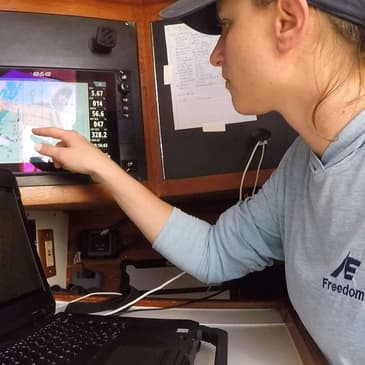
Today’s guest is Chelsea Freas, a highly sought-after expert in weather and routing forecasts for sailors of all kinds—offshore racers, regatta competitors, cruisers, and even Olympians. She’s the founder of SeaTactics, offering marine weather solutions like weather routing, regatta forecasting, navigation, consulting, and education—check out www.sea-tactics.com - it includes some excellent free courses!
Chelsea shares how she began her career in weather forecasting, the forecasting challenges she tackles and the sailors she supports. We’ll also dive into topics like wind shear, sea breezes, which racing locations are harder to forecast than others, and her favourite weather apps.... Fun fact: Chelsea is not only a competitive sailor herself but also a new mom!
[00:00:05] Hello and welcome to another episode of Sailfaster. So today's guest is Chelsea Freas, who is one of the most sought after weather and routing forecasters in the US. And she does that work for all kinds of sailors, including offshore racers, regatta competitors, cruising sailors, and also Olympians, as you'll shortly hear. She is the founder of SeaTactics, which is her business, which provides marine weather solutions, including weather routing, regatta forecasting,
[00:00:35] navigation, weather consulting, and education. And if you go to SeaTactics.com, there's some really good free courses there as well as other seminars that Chelsea offers. So I'm hoping that Chelsea is going to tell us how she got started in weather forecasting and the kinds of weather and routing challenges she gets to solve and for whom. And I'm hoping, of course, that we learn about the difference between wind shear and gradient wind and sea breezes along the way.
[00:01:04] Because I know my phone is terribly confusing. And, and oh yeah, by the way, Chelsea is also a very competitive sailor, as well as being a new mom. So congratulations, Chelsea, and welcome to Sailfaster.
[00:01:16] Thank you. Thanks for having me, Pete. It's really good to talk to your audience.
[00:01:20] Yeah, I'm glad. I'm glad you're here. I did hear from a number of people actually who said to me, can you please include Chelsea? So you have lots of fans, and obviously lots of satisfied customers out there.
[00:01:31] That's awesome.
[00:01:32] So come on then, tell us your, your origin story. First of all, how did you get into sailing?
[00:01:37] Yeah, so I grew up here where I live now in Sarasota, Florida on the West Coast, for those that aren't familiar, the Gulf Coast. And, you know, I basically just needed a summer camp for my to get away for the summer. And my parents put me in sailing summer camp here. And I fell in love with it from then. That was the summer camp we always wanted to go back and do again.
[00:01:59] So when I got into high school, I started the racing program in the local yacht club and, you know, in Club 420s. So 420 was my first first racing boat. And I just yeah, I really loved it. I love being out on the water. And I wanted to continue doing it through college. So, you know, I just kind of followed that trajectory of youth sailing through college sailing and, and onward.
[00:02:21] But yeah, it was really just the predictability of the sea breeze every day here where I'm from in the summertime. And, you know, thunderstorms developing every day in the same spot that really kind of kept me coming back out on the water, but also started to pique my interest in, in the weather and what the wind was doing.
[00:02:38] So when did you start sort of having an academic interest in the weather? Because I know you have a, you have a degree in meteorology. Is that right? From the University of Florida?
[00:02:48] Yeah, a bachelor's degree from University of Miami, actually.
[00:02:52] Oh, sorry.
[00:02:52] Right.
[00:02:53] And yeah, it's a funny story, because a lot of meteorologists, they're like, you know, I was interested in weather since I was five years old. And I want, you know, watch the weather forecaster on TV. And I just don't really have that that same story. I was in high school, I remember the day actually, specifically that I was sitting there, it was in study hall, and I was sitting there. And, you know, time to start thinking about college and where you're gonna go and what you're gonna do. And I'm like, well, what can I study? Like, what do I like?
[00:03:18] And I'm just kind of sitting there racking my brain. And I'm like, well, I like sailing. And I'm like, huh, I wonder if I can study weather. And so I literally just I remember typing into Google in my study hall, and I studied, I typed in weather college degree. And it was like, and meteorology came up. And, and University of Miami was actually one of the first ones that popped up. And I was like, you know, my, my goal was to go to college where I could sail and where I could study weather.
[00:03:48] And so there was only a handful of schools where I could, I could do that and still be in Florida close to home and stuff. So it worked out.
[00:03:54] Not only close to home, but in sunshine and blue skies.
[00:03:59] And you can sail year round. Yeah, that was a big deal too.
[00:04:03] Did you say you must sail in Biscayne Bay?
[00:04:05] Oh, yeah.
[00:04:07] Biscayne Bay, we got real familiar with that. And probably my two favorite places to sail are going to be are Biscayne Bay. And then here where I grew up in Sarasota, they're both just beautiful and consistent.
[00:04:18] How was that hurricane that came through a few days ago?
[00:04:22] Yeah, it was, it was bad, not as bad as we had anticipated it could be. So, you know, definitely, we were all really lucky, I think, especially in the Sarasota area, the surge wasn't quite as bad as they were potentially predicting.
[00:04:36] But there was some damage, you know, especially the barrier islands and things. But my family and everyone I know was all fine. And, you know, everyone's safe, which is the most important thing.
[00:04:47] But I was just reading yesterday that the red tide is back because of all the debris and nitrates and everything that runs off the land into the into the Gulf.
[00:04:56] So that's kind of a bummer, but also just part of it, I guess, when you have hurricanes that come through.
[00:05:02] Did you find yourself looking at the hurricane forecast to the eyes of your own sort of expertise? And were you able to sort of make different interpretations perhaps of that?
[00:05:12] I think I know maybe more than the average person does when it comes to like looking at the different models and such and some of the lingo. So, you know, I followed the development really closely.
[00:05:23] And I have a couple of hurricane specialists that I really, really trust and admire their expertise.
[00:05:31] And they use some technical language. So, you know, it's maybe a little bit dense for the average person to listen to.
[00:05:39] But I like listening to that and following that way and then kind of maybe kind of looking at the forecast myself and trying to make some interpretations.
[00:05:46] But I'm certainly not a hurricane expert. And yeah, I enjoy like researching hurricanes and learning about them.
[00:05:53] Not so much when they're coming down on my house.
[00:05:56] Yeah. Hey, models, we must not forget to talk about models, whether it's the GFE, the GFS, the Euro this, the Euro that.
[00:06:05] I always click on blend, but I'm not really sure.
[00:06:08] The alphabet soup. Yeah, the alphabet soup of acronyms.
[00:06:11] We have to talk about that. So with your expertise in weather forecasting and being a sailor as well,
[00:06:20] do people always ask you to navigate for them, for their boats?
[00:06:24] I mean, it's like having an expert on the boat.
[00:06:26] I do get a lot of requests and, you know, it's something that I love doing.
[00:06:30] So I think I was I was asking people, you know, a lot at the beginning to like, hey, if you need a navigator,
[00:06:35] you know, I'm interested in hopping on board or even just being I've gone on a few boats as as navigator dedicated job.
[00:06:42] And then I've gone on board and kind of just been like a weather expert with and worked alongside their existing navigator.
[00:06:48] Just someone to kind of be on deck.
[00:06:51] If the navigator is down below deck and, you know, running routes, I can be on deck and saying like, hey, the clouds look like maybe the front's pushing through faster.
[00:06:58] Maybe we should, you know, tack or whatever the strategy is.
[00:07:01] I can kind of provide a little extra, a little extra info.
[00:07:05] So, yeah, I do get some requests for that.
[00:07:07] I'm in a little bit of a break period here with sailing offshore, but offshore sailing is one of my favorite things.
[00:07:13] Honestly, that's more of my passion.
[00:07:15] I mean, day sailing is great and going around the buoys is fun to be able to do on a weekly basis.
[00:07:19] But longer distance offshore and like being being out in blue water is something I'm super passionate about.
[00:07:24] I did the first blue water wasn't really a race, but adventure, I guess you could say that I did was in college.
[00:07:30] I did sea semester and so I spent, we spent a month sailing from Hawaii to San Francisco on a big tall ship.
[00:07:38] So like double mast wooden 130 foot ship with like 20 other students.
[00:07:43] And we did science along the way.
[00:07:45] So we took 28 days going across the Pacific garbage patch and collecting data.
[00:07:51] And we weren't allowed to use really like modern navigation tools as being students.
[00:07:56] So we did celestial navigation using sextant, which was awesome.
[00:07:59] I got to learn that.
[00:08:01] And that just, yeah, was such a cool experience.
[00:08:04] I still am super close to a lot of my shipmates and my captain and stuff from that project, from that adventure.
[00:08:11] And so that really like set the foundation for me where I was like, I want to do this.
[00:08:16] I want to do navigating.
[00:08:17] I want to be offshore.
[00:08:18] I want to be looking at the weather facts coming in.
[00:08:21] Has there been an offshore long distance race where you have realized before others, because your expertise, that there was weather changes happening and were able to take advantage of that?
[00:08:34] I think so.
[00:08:34] Yeah.
[00:08:35] You know, it's hard to know what's going on so much on all the other boats, but definitely there were times where like the crew kind of had their idea of what maybe they wanted to do.
[00:08:44] And I was like, no, listen, like I see this cloud line.
[00:08:46] One example that I can think of just off the top of my head was a Miami to Nassau race.
[00:08:53] I'm going across the Gulf Stream into the Bahamas.
[00:08:56] It's just an overnight race, like two days.
[00:08:59] And we were across the Gulf Stream already and near the Bahamas.
[00:09:03] And we were expecting a wind shift.
[00:09:06] And I thought at first, before the race started, that it was going to be maybe a persistent wind shift and kind of a slow veering of the wind from northeast to southeast.
[00:09:15] And when we got out there, it wasn't really doing that so much.
[00:09:19] It wasn't veering.
[00:09:20] It was not happening slowly.
[00:09:21] And then all of a sudden, around that time where I thought we might see that shifting, there was a cloud line and a little bit of rain in the cloud line, a kind of dark cloud.
[00:09:31] But you could see to the other side of the clouds that it was blue sky on the other side.
[00:09:35] So it was a really thin line.
[00:09:36] And I was like, that's interesting.
[00:09:38] OK, there's something going on there.
[00:09:39] So I thought about it.
[00:09:41] And the models weren't showing anything, you know, that high resolution of where the wind shift would have occurred.
[00:09:46] But I was like, I bet you that's the shift.
[00:09:48] Because basically, you'd have the two different wind directions converging, creating a little bit of an updraft and a cloud and potentially a little bit of rain with it, too.
[00:09:58] So I said, you know, I bet that's the wind shift.
[00:10:00] I think we should sail.
[00:10:01] We got to get to the other side of that cloud line.
[00:10:03] And the crew was kind of like, oh, but the breeze is so good here.
[00:10:06] It's great.
[00:10:06] We're doing fine.
[00:10:07] I'm like, yeah, but we got to get to the shift before everyone else.
[00:10:11] So, yeah, we did.
[00:10:12] It was there was one area where it was raining and we wanted to stay away from that raining area.
[00:10:18] But I was like, kind of stick to where you see the clouds and where you see the blue sky on the other side.
[00:10:22] And we got to attack and we got to go over there now.
[00:10:24] So we hit a little bit of a light patch.
[00:10:26] But then we got through and we got the shift, I think, before everyone else, if I recall.
[00:10:30] I think I've seen one of your videos about clouds and about the difference between rain clouds and clouds without rain and what the advantages are for sailors.
[00:10:41] That's fascinating stuff.
[00:10:43] So tell us about your professional business then.
[00:10:47] What kind of forecasting do you do and for whom?
[00:10:50] Yeah, so I really am catering mostly to racing sailors.
[00:10:54] In my previous jobs, before I started Sea Tactics, you know, I worked with everyone from offshore oil and gas companies to delivery captains to, you know, just cruisers going around the Caribbean.
[00:11:09] So I sort of have that to inform what I do now.
[00:11:13] But my passion is working with racing sailors because that's obviously where my passion is as well.
[00:11:17] So I have kind of my everyday clients.
[00:11:20] Those are usually, you know, pretty serious racers.
[00:11:23] Many of them are professionals.
[00:11:25] They don't have to be pro sailors.
[00:11:27] But they usually have, you know, organized programs where, you know, weather is kind of an important piece of that program.
[00:11:33] And so they'll kind of work with me for that racing season or if they're leading up to a big event.
[00:11:39] So like a Worlds or some kind of nationals or something.
[00:11:44] And so that's day racing a lot, a lot of the time, just around the buoys, but also distance racing.
[00:11:50] So I do a lot of the, you know, New England summer times, like the vineyard race, Block Island race, all that.
[00:11:57] The SORCs in Florida in the winter.
[00:12:00] So I love that.
[00:12:01] I love doing the distance race forecast.
[00:12:03] Like I said, it's kind of, that's kind of one of my biggest passions.
[00:12:05] But then beyond that, I also have, like you mentioned, courses.
[00:12:09] So really my, my business was founded on educating.
[00:12:13] I had started out sailing with teams, you know, in, I was in the Etchells, Biscayne Bay series and sailing with a couple of teams there and teaching them about how to kind of spot things on the course.
[00:12:24] And this was, this was pre-COVID.
[00:12:26] And so I thought, oh, it would be really cool to have, you know, like a webinar or an online course or something.
[00:12:33] And this was kind of like pre-COVID, there wasn't as much of that going on.
[00:12:36] So that was always my goal is to educate sailors on things that I kind of knew about.
[00:12:42] And so when COVID hit, I started my business at like three or four months before COVID.
[00:12:46] So it actually kind of worked out perfectly because I had this idea and I was like, let's just launch, launch into it during the lockdown.
[00:12:53] And it worked out well.
[00:12:54] I just did a, you know, a whole bunch of webinars and that was the foundation for my online course.
[00:13:00] And now it's gone through many iterations.
[00:13:01] Now I think I'm on my third iteration of the online course and I just renamed it Windwise.
[00:13:07] So that's like my flagship course that you can take.
[00:13:10] But I only run it once a year because I like to do a live component with it where I can sit in with people and do Q&As, have discussions like this and, you know, interact more than just kind of setting people off on their own with a course they may not ever watch.
[00:13:24] How do you start your forecasting process?
[00:13:27] Do you sort of start big and go small, you know?
[00:13:30] Yeah.
[00:13:31] Yeah.
[00:13:32] Yeah.
[00:13:32] And it really, it starts well before the race.
[00:13:35] You know, I know many of the navigators start watching the weather, you know, weeks in advance.
[00:13:40] I really don't start honing in until about a week before.
[00:13:43] I think it's a little bit too far and too much noise before a week.
[00:13:47] But within about a week, I start paying attention to the weather patterns.
[00:13:50] You know, a lot of it is kind of which models have been performing well lately, which haven't.
[00:13:55] And that kind of informs what, which models I'm going to, I'm going to use a little bit more closely.
[00:14:00] And it is starting with big picture stuff.
[00:14:03] So I think a lot of the weather information out there is too detailed for sailors to understand in a practical way.
[00:14:10] And so what I like to do is touch on the big forecast, big picture forecast, but really spend most of the time on the details that are going to matter to the sailor, such as visual clues that they're going to be able to see happening or local effects that they might not have thought about otherwise.
[00:14:28] And so another one is model uncertainty.
[00:14:32] You know, if the models are showing this front coming through, what could go differently?
[00:14:38] Could it happen a little bit faster?
[00:14:39] Could it happen a little bit slower?
[00:14:41] I will talk a lot with my clients about, well, the models have been progressively speeding up on this front the last three days.
[00:14:47] So therefore, you're going to expect it probably to come sooner than what the models show.
[00:14:51] And I call that we're kind of always adjusting based on what's actually happening in reality.
[00:14:57] Presumably, there are places like San Francisco, where it's pretty predictable that at some point in the afternoon, the breeze is going to start pouring through that slot.
[00:15:07] And it happens again and again and again.
[00:15:10] Are there places that you've had to forecast which are just so difficult to forecast that don't seem to have that sort of regular pattern?
[00:15:18] And also, let me ask part B of that.
[00:15:20] Is it true that San Francisco has that consistency?
[00:15:23] Yeah, I'll start with the part B.
[00:15:25] I think there is a good bit of consistency to San Francisco when you're in certain regimes.
[00:15:32] Like, okay, we're in this regime where this high pressure isn't moving.
[00:15:36] And so it's going to be the same thing for multiple days in a row.
[00:15:39] But then eventually something does shift and you're like, okay, today's a little different.
[00:15:43] And you have to know when that shift is going to happen to something that looks similar, but actually might be different.
[00:15:49] I was forecasting for a client out in San Francisco for the, it was the Opti team trials.
[00:15:56] And they had the same consistent weather for like a week and a half.
[00:15:59] And then right, of course, when the regatta started, it was something completely different pattern.
[00:16:04] So we had to kind of adjust them.
[00:16:06] Okay, I know this looks like it's the sea breeze, but it's not.
[00:16:09] It's a gradient that's coming in.
[00:16:10] But it is a lot of times in places like San Francisco or even Miami, it's predictable enough to where the locals especially will have a handle on what what is going to happen and how it's going to unfold.
[00:16:24] But there are, there's definitely some venues that are more difficult than others.
[00:16:29] And one that comes to mind is the Marseille venue that we just had for the Paris Olympics, that that was a very difficult place.
[00:16:37] It's very localized.
[00:16:38] So a lot of local geography and different water temperatures coming in and out, you know, mistrals coming through.
[00:16:46] And just without a lot of data around that area, it's hard anywhere that there's not a lot of data.
[00:16:54] It's very difficult to get a good forecast.
[00:16:57] Really, actually, the Tokyo venue of Enoshima was also really difficult, not because it was anything in particular locally that was difficult about it.
[00:17:07] There was just no data.
[00:17:09] We had to run our own high resolution models because there were no regional models.
[00:17:13] There were no high res models.
[00:17:15] And so we had to basically start from scratch building our own.
[00:17:18] And it took a long time to gain confidence in the model that we built rather than using like if you're in the U.S., you use like the NAM or you use the HRR, which are the high res models that are established.
[00:17:29] And we know they're pretty good.
[00:17:31] So, yeah, anywhere that's international is definitely harder.
[00:17:34] In the U.S., there's plenty of data to work from that makes it a little easier.
[00:17:37] So for Marseille, you were doing it for the U.S. Olympic team.
[00:17:40] Yes.
[00:17:41] No pressure.
[00:17:42] No pressure.
[00:17:44] If I can use a terrible pun.
[00:17:47] Yeah.
[00:17:48] And I mean, and this Olympics, too, you know, was a little bit of a shorter runway than most Olympics are because we had Tokyo that happened in 2021.
[00:17:57] And then suddenly we have, OK, we have three years really to focus on Marseille.
[00:18:01] So I think we did a great job.
[00:18:03] And I'm really happy with where we ended up with our Olympic weather program for Marseille.
[00:18:10] We eventually did get to a point that we had an awesome playbook.
[00:18:14] And essentially, that's one of my roles with the Olympic team is to it's a really a great job.
[00:18:22] It's super fun and multifaceted, but it's everything from venue environmental research.
[00:18:27] So just figuring out, OK, over the last 20 years, what has the wind historically done and from what direction?
[00:18:33] And then establishing technology and putting instruments around and taking, you know, real time data from the area to build that.
[00:18:41] The education piece for the sailors and teaching them all of this information and then actually forecasting, you know, on a day to day basis there for several summers.
[00:18:52] So I was there for two summers leading up to the Games, 2022, 2023.
[00:18:56] Oh, interesting.
[00:18:57] So you went out two years earlier to at the same time to start to understand how it works.
[00:19:04] So you answer some of this question, but how do you actually start from scratch?
[00:19:09] So there must be plenty of data from, you know, it's, Marseille has been a, you know, Marseille's been a maritime port for probably a couple of millennia.
[00:19:18] So there's data there, but it's not in the format that you need to create a model.
[00:19:23] And then what kind of software do you create your model on?
[00:19:26] Yeah, so it's a lot of, and this goes a step beyond my expertise, but basically there's a platform called WRF, Weather Research and Forecasting Model.
[00:19:38] And people call it the WRF, but it's something that was created that is like a, you can think of it as like a template or like a framework for building your own weather model.
[00:19:48] So you have to know how to code.
[00:19:50] It takes a lot of, you know, like IT computer knowledge and being able to write code.
[00:19:54] But if you know how to code and you know how to like write up a WRF model, essentially, you can create your own localized model and then adjust it and tweak it from there.
[00:20:05] Now, I, we worked with professionals that are much better at that than I am.
[00:20:09] I'm more about the day-to-day stuff rather than the tech side.
[00:20:12] But yeah, it's, if you're, if you're versed in that universe, it's not too terribly difficult to get, to get a WRF model going.
[00:20:20] And then you basically have to verify it against real-time data.
[00:20:27] So then we're collecting wind observations on a daily basis and collecting information from the coach boats as they go out, you know, with their wind, wind poles, wind instruments on the coach boat and comparing that to the model and saying, okay, did the model do a good job?
[00:20:41] Where is it doing well?
[00:20:42] And where is it not?
[00:20:43] You were telling me that there was a venue in Canada, was it Nova Scotia or somewhere that had no records whatsoever.
[00:20:50] And you had to go and forecast for that.
[00:20:53] Yeah.
[00:20:53] In 2022, they had the Skiff Worlds in Nova Scotia in Hubbard's Bay, which is right near Halifax.
[00:21:00] And there's just no weather stations in this, in this bay.
[00:21:03] There's plenty of information near Halifax and even in Mahoney Bay where they do like Chester Race Week.
[00:21:09] And there's, they're sailing in that vicinity, but not in that particular bay.
[00:21:13] It's a lot of cruisers coming in and out.
[00:21:15] And so it was interesting and just super fun.
[00:21:19] I think one of the most fun challenges I've had to do is, you know, the team basically said, hey, this is where our world is.
[00:21:25] We don't know anything about this area.
[00:21:27] Tell us, you know, as much as you can.
[00:21:29] So I did a little research.
[00:21:30] There wasn't a ton out there about this bay.
[00:21:33] But we showed up early to the regatta and went out every day and watched, watch what happened and took, took information, took down information from the coaches every day and got real time wind data from the, the anemometers and our, all of our instruments and dropped in current buoys and figured out what the currents were doing.
[00:21:51] And basically by the time we were a couple days into the regatta, maybe even a little bit before the regatta, we sort of had it, had it figured out.
[00:21:58] We were kind of like, okay, we know that when the wind comes in from this direction, this is what happens when it comes in from this direction, this is what happens.
[00:22:05] And then it started to repeat.
[00:22:06] We were like, all right, now we have a repeatable pattern.
[00:22:09] And then essentially, once you have that, you have confidence and you have a playbook that you can, you can draw from.
[00:22:14] And that's, that's what the sailors need from, from me as a weather forecaster is a playbook, but something that they're confident in that they can actually use and not, well, we're not sure you want to, if you're going to use it as a playbook and say, you know, on this day, you're going to bang the right.
[00:22:30] You want to make sure you're actually banging the right for the good, best reason.
[00:22:34] I want to know what it feels like when you have seen that you absolutely nailed the forecast and which enabled your clients to, you know, sail to their maximum abilities.
[00:22:45] Is that, does that happen often?
[00:22:48] It does happen, you know, fairly often.
[00:22:51] And of course it feels good to be, to be right and to, to help.
[00:22:54] But I think I get so much satisfaction from talking to clients and hearing clients that were like, learned something new out of it or that they felt like something clicked for them.
[00:23:06] Like, Hey, when you said to look out for the clouds and that it would cause a left shift, I actually saw that happen and it clicked for me and, you know, it helped us.
[00:23:15] And that's where I get, you know, the satisfaction from is hearing, hearing how people are learning and having fun with it and getting success out of it.
[00:23:25] So it does, it happened.
[00:23:26] Of course, people for people generally, you know, remember the misses more than the, than the, the, the strikes.
[00:23:35] But even, even when I get it right, a lot of clients are really good about, you know, chiming in and saying, Hey, you did a really great job on the forecast today.
[00:23:43] So I always appreciate that.
[00:23:46] That's good.
[00:23:47] Do you find yourself just glued to the numbers as the day progressed and thinking, yes, there it is.
[00:23:55] There's a shift.
[00:23:57] Yeah.
[00:23:57] Whenever I can, whenever I can see it, some of these events, you're kind of blind.
[00:24:01] Like I'm watching the tracker and I usually don't know what the wind is doing.
[00:24:04] Like on these distance races, for example, I can watch the tracker and see, you know, you can kind of maybe see, oh, maybe they're getting a lift or something, but you don't really know.
[00:24:12] So, but you know, wherever I can, I will follow it and follow what the, what the weather's doing.
[00:24:17] And that's where it's not only fun to, to watch and see what happens, but that's where the learning happens.
[00:24:23] And so everything that I've learned, you know, in my career doing this has come from watching what has actually happened.
[00:24:30] And then when it doesn't go to plan, figuring out why.
[00:24:35] And so that's a huge component of why I like to have relationships with my clients and discussions about all of this.
[00:24:41] And I love having debriefs after the fact, because, you know, it doesn't do any good for me to send a forecast and then never think about it ever again and just send it off.
[00:24:51] Really, the learning happens between both of us, the client and myself, when we can say, hey, okay, that didn't go exactly the way we thought.
[00:24:59] So let's figure out why.
[00:25:01] And usually we both learn something out of it.
[00:25:03] Yeah.
[00:25:04] Yeah, it's really interesting.
[00:25:05] I have to ask you about models.
[00:25:09] And as we were saying earlier, when you go to, you know, PredictWind or any of the wind alert, that sort of thing, it'll give you choices between the GFS, the EFG, the whatever it is, the NAM or something like that.
[00:25:23] Three kilometers, 10 kilometers or the blend, which because I'm a coward, I just click on the blend and see what happens.
[00:25:30] Is there a model that you always go to as a bit of a bellwether?
[00:25:35] Yeah, this is probably the most common question that I get is everyone says, what's your favorite model or which model is the best or which model should I look at?
[00:25:44] So, yeah, and super understandable because it can be really overwhelming.
[00:25:49] Like I said, the alphabet soup and the number of different models that are out there and a lot of them are newer and haven't been proven with time.
[00:25:58] So it really depends a lot on where you're looking at.
[00:26:02] First of all, like I said, in the US, we have like a whole bunch of different models.
[00:26:07] A lot of them are quite good.
[00:26:08] And generally, you want to also look at the resolution of those models.
[00:26:14] So I like to look at a mix of high resolution and more medium resolution models to basically get an idea of what the models are saying.
[00:26:23] And what you're looking for is agreement amongst the models or consensus.
[00:26:28] And so the more models you can look at, you know, it's better because you can start to see if they're agreeing with each other.
[00:26:34] But I also caution to not go crazy with looking at like 12 models.
[00:26:39] Like even myself, I limit it when I'm doing a forecast.
[00:26:41] I don't look at more than three.
[00:26:42] And so depending on where I'm forecasting for, I will look at usually like a global model.
[00:26:49] So like the Euro or the GFS are kind of the two big ones.
[00:26:52] And then I'll maybe glance at a medium range like the NAM or something like that.
[00:26:58] But most of the time, honestly, I'll just go straight into the high res and I'll look at the HRR, which is kind of the gold standard in the US for high res models.
[00:27:07] And then if there are any additional models, maybe proprietary ones, like you mentioned, PredictWind, SailFlow has two kilometer resolution models coastally across most of the race areas.
[00:27:18] Or, you know, some of these places even have specialized models.
[00:27:23] Like in California, they have a few from some universities that are nearby that are running different models.
[00:27:29] So anyways, I'll just kind of take a glance through them and see if there's agreement and consistency.
[00:27:35] And if there is, then, you know, OK, pretty much we're we're rock solid here with the forecast.
[00:27:39] If there's big differences among them, that's, you know, a red flag to say, OK, well, which what is going on here?
[00:27:47] Why is this one showing something different than this one?
[00:27:50] And that's where it takes a little bit more nuance.
[00:27:52] But yeah, I think in terms of which model is best, there's always different weather patterns that there's there's different weather patterns that the GFS will be better in.
[00:28:01] And there's different weather patterns that the Euro will be better in.
[00:28:04] And so part of my job is knowing, you know, well, this summer the GFS has been nailing, you know, the backdoor cold fronts or, you know, this summer the European has not been doing great.
[00:28:17] So we're going to, you know, maybe take that one with a grain of salt.
[00:28:21] So a lot of it just comes from paying attention to what's been going on, what's trending and how that's been going on for a long period of time.
[00:28:29] I didn't realize that sometimes the models do have a pattern that's working out.
[00:28:34] It's accurate.
[00:28:35] And then other times they won't be so accurate.
[00:28:38] And that's sort of trending.
[00:28:39] Is it?
[00:28:40] Yeah, we see that a lot.
[00:28:42] I mean, just a simple example of that is like the GFS on the shoulder seasons.
[00:28:46] It always wants to overdevelop tropical systems.
[00:28:49] Like in the seven to 10 day range, it always will spin up some kind of, you know, hurricane or something that almost never materializes.
[00:28:56] And so if you've been watching weather forecast long enough, you know, okay, that happens all the time in the spring and the fall.
[00:29:02] And it's almost never true.
[00:29:04] So you just kind of start to understand some of those things after a while.
[00:29:07] What are the most common questions you get from clients?
[00:29:11] What do you tend to hear from clients who are trying to understand what's going on in LA or the Chesapeake or wherever?
[00:29:17] Yeah, I think in terms of the most commonly asked about phenomenon or and I would say even probably the most commonly misunderstood or mix up is between sea breezes and onshore gradient winds.
[00:29:34] And I think when you're especially first starting to kind of wrap your head around these weather terms and the different phenomena that we experience during the day, it's sort of easy to get trapped into.
[00:29:45] Oh, okay.
[00:29:46] Well, it's two o'clock.
[00:29:47] The breeze came in.
[00:29:48] Must have been a sea breeze.
[00:29:49] Right.
[00:29:50] And especially if it was, you know, no wind in the morning and then suddenly it comes it comes up.
[00:29:53] You're thinking, okay, sea breeze came in.
[00:29:56] Whereas.
[00:29:57] And you're thinking, no, you idiot.
[00:30:00] Why don't you listen to me?
[00:30:02] It's a gradient.
[00:30:04] How do you know if it's a sea breeze or a gradient breeze?
[00:30:07] Yeah, yeah.
[00:30:08] So a sea breeze is like a very specific type of breeze that's driven entirely by the temperature difference and the quote unquote thermals, you know, developing over the land.
[00:30:18] So you have to have that differential between the water temperature and the land temperature.
[00:30:24] And you generally have to have also a pretty weak gradient scenario.
[00:30:30] And by gradient, I basically just mean the winds that are occurring from the high pressures and low pressures around you.
[00:30:35] So if there's not much going on in terms of gradient wind and it's fairly light or it's even a little bit offshore, like coming off the shoreline, then that actually helps the sea breeze get going.
[00:30:48] And so in that scenario, you know, you would check the land temperature, water temperature.
[00:30:53] And if there's at least a four or five degrees difference there and the gradient scenario is also favorable, then you're thinking, okay, this is prime for a sea breeze.
[00:31:04] And you may also see the cumulus clouds building over the land.
[00:31:07] That's usually a giveaway.
[00:31:09] A lot of sailors know about that one.
[00:31:10] So there's some visual clues.
[00:31:12] That's the air rising over the land and creating clouds.
[00:31:15] So then in those scenarios you talked about, is that the sea breeze is sort of combined with the gradient breeze?
[00:31:23] And is that?
[00:31:24] Yeah.
[00:31:24] And since the gradient is essentially helping the sea breeze circulation when it's coming a little bit off the shoreline.
[00:31:31] But there's all these nuances that I never knew about when I was really growing up sailing or even, you know, my early career.
[00:31:39] And it was just fascinating to me to learn about the angle at which the gradient wind is happening with the shore affects what the sea breeze does.
[00:31:49] And so that's what I go into a lot in my online course.
[00:31:52] And you can understand the basic concept of this in the book Wind Strategy, which is a great book.
[00:31:57] I love that book by David Houghton.
[00:31:59] And it talks about the four quadrants and basically how the gradient breeze is coming in, whether it's from the left of the shoreline, the right of the shoreline, and at what angle helps you figure out how the sea breeze is going to develop.
[00:32:11] So I was just fascinated when I first started reading that in college and just out of college about gradients and sea breezes and the angles.
[00:32:21] So I heard on the Chesapeake that when the tide changes, it changes the, it can create a wind shift.
[00:32:27] It can, it can like either help or hinder breeze coming in.
[00:32:32] So, and that happens actually in San Francisco.
[00:32:35] And it's usually only when there's a big water temperature differential.
[00:32:39] We're not, usually it's not like a degree or two.
[00:32:42] It has to be on the shoulder season when like really cold water is coming in or like it happens in San Francisco when the tide comes in.
[00:32:50] And a lot of times it brings the breeze with it essentially when that cold water comes in.
[00:32:55] So that is something that is such a localized effect, but can have a really big effect on the, on the racing.
[00:33:03] So help an idiot like me try and understand that.
[00:33:06] Is it because when the cold, it's colder water comes in, it cools the air on top of the water and that creates a sort of a bit of a downflow or?
[00:33:15] Yeah, I'm trying to think about how.
[00:33:17] How to explain to an idiot.
[00:33:18] No, no.
[00:33:19] Well, we know that when there's more mixing in the atmosphere, when there's warm below and cooler aloft, it creates mixing.
[00:33:27] And that brings the air down towards the surface, right?
[00:33:30] So that would basically mean that if we have warm water coming in and the air is cooler, that's going to cause the breeze to come in, you know, mix more and come in with that.
[00:33:42] The other thing is that the wind, I've heard this term before, it's not super scientific, but the wind will tend to stick to the water surface more when, you know, when there's basically the temperatures align, right?
[00:33:57] So when you have like the cold water, that air wants to sink and it's going to quote unquote, like stick to the surface of the water more.
[00:34:06] You, this rings a bell because you, in our conversation we had a couple of days ago as prep for this, you talked about sometimes people will request sort of the, the wind at different altitudes.
[00:34:17] Yes. Yep. And so one of the things I think that is a little bit slightly more technical, but a lot of people do ask about it is wind shear.
[00:34:27] And it's, I always tell people this when you're interested in, in learning about how the wind is going to change and what the wind is going to be like on your race course, you have to look in the vertical.
[00:34:37] And so people are always kind of thinking horizontally spatially, but you have to start thinking in terms of a vertical movement of air.
[00:34:45] So how is the wind different at 500 feet above the surface, a thousand feet above the surface and two, 3000 feet above?
[00:34:53] That's the area where we're generally talking about and working with that's called the boundary layer.
[00:34:58] And so, yes, it's maybe helpful to look at what the airplanes use and those upper air charts, but for the average sailor, not super important.
[00:35:08] You're just kind of looking at that bottom layer.
[00:35:10] You know, it helps to know what the wind shear is doing at 2000 feet, because if you have a lot of mixing or a lot of instability,
[00:35:17] that's basically causing that breeze to come to the surface, that's going to be where your big gusts are coming from.
[00:35:23] Right.
[00:35:24] It's really interesting.
[00:35:25] Interesting. So for something like the Shazapik Bay and say we have a weekend regatta, I mean, I can go to Pridik Wind or, you know,
[00:35:34] I think I have Windy or Windy, you know, any of those apps.
[00:35:38] And you can start to see the, certainly the velocity of the wind is going, is, you know,
[00:35:43] they're forecasting eight knots at 10 o'clock and 12 knots at two o'clock, that sort of thing, with some idea of direction.
[00:35:49] So you get a feel for it.
[00:35:50] But what do you do that is on top of that?
[00:35:54] Or, you know, what do you do differently from that?
[00:35:56] Yeah, I don't generally use any tools that are really all that more advanced than free websites.
[00:36:05] So, I mean, when I'm in the US, it's simple because there's just so much data, you just kind of have to know where to find it.
[00:36:11] But I use Windy a lot. I use Sailflow a lot.
[00:36:15] You know, I do use Expedition to put some GRIB files in there and look at different layers.
[00:36:21] But in terms of data from NOAA that comes out, there is just a ton of availability of different layers of wind data that you can look at on forecast.
[00:36:33] And so, you know, I'll use Expedition for a lot of those different layers to get the GRIB files in there.
[00:36:39] But other than that, I mean, I'm also reading other people's expert opinions of different venues.
[00:36:46] You know, the National Weather Service is an invaluable resource.
[00:36:50] And I know that they get maybe kind of a bad rap for sailboat forecasting because it's so general and it's so generic.
[00:36:56] That's not really their niche.
[00:36:58] But if you learn how to read their discussions, I always encourage people to read the discussions that they write every day that talk about some of these things.
[00:37:06] And they talk about wind shear.
[00:37:07] They talk about at the bigger picture what's going on.
[00:37:10] And that actually, if you start to do it often enough, you can develop your own predictive model of like, oh, they're talking about a cold front with heavy turbulence behind it.
[00:37:20] And every time that happens, the wind blows 20 knots, you know, above what the forecast is or whatever the adjustment is there.
[00:37:29] So and the National Weather Service is great because they're so they're the ultimate experts in that one specific area.
[00:37:36] So I maybe am an expert in many areas, but not quite to the level of like the Chesapeake Bay forecasters that that's all they look at all day, every day.
[00:37:46] And I'm like in France and in Miami and, you know, all over the place.
[00:37:51] So not as tuned in to what exactly is going on in one specific spot.
[00:37:54] For you, it's sort of pulling from all these these sources to give somebody a more nuanced, intelligent view of what could happen over over a few days, I suppose.
[00:38:04] Yeah, which could be crucial if you can, you know, forecast a shift earlier than anybody else.
[00:38:09] Obviously, that's.
[00:38:10] Yeah, or just know what to look for in terms of if the if if there is going to be a shift, we're going to see we're going to see it because there's a cloud line coming or something.
[00:38:20] Yeah, yeah.
[00:38:21] Really interesting.
[00:38:22] And then the long distance racing, the the routing for the transatlantic race or, you know, that sort of thing.
[00:38:29] That's an incredibly dynamic business, isn't it?
[00:38:33] And I follow Pip Hare, the British offshore race who was on Sail Faster a few weeks ago.
[00:38:40] The decisions that she makes about how to steer away from fronts or towards fronts and squalls and that sort of thing.
[00:38:47] What's the sort of longest duration forecast do you do?
[00:38:52] I mean, really, I think well, I think that depends on how long the race is.
[00:38:57] The short, you know, I do everything from like the day racing, the distance.
[00:39:01] A lot of the distance races are overnight or two to three days, something like that.
[00:39:06] I think the Annapolis, the Annapolis Newport is like three nights, four days.
[00:39:09] But I have some experience doing a few projects with people that are, you know, trying to set records for long distance races or just distances.
[00:39:19] Even if it's not a race, they're just trying to set like the distance record from, let's say, Chicago to Mac.
[00:39:27] Or, you know, I think we had somebody else that was trying to do a record transatlantic at one point a few years ago.
[00:39:35] But they didn't end up setting it.
[00:39:36] And then Cole Broward, right?
[00:39:38] You helped Cole Broward around.
[00:39:40] Yeah, that was going to be where I was going with that.
[00:39:43] So Cole is someone I met through the Magenta Project, which is the nonprofit that works towards getting more women involved in a lot of these different offshore positions.
[00:39:55] And she came to me and said, I'm going to do the Global Solo Challenge, which is nonstop around the world.
[00:40:04] And I need a weather router.
[00:40:05] And we're allowed to have weather routing the whole way.
[00:40:07] And I said, wow, OK, let's do it.
[00:40:10] So and I thought that was going to be awesome because I have sort of done a lot of international forecasting everywhere from Brazil and South Africa and China and Australia.
[00:40:22] So I sort of have done all these different land masses.
[00:40:25] And I've worked with people that have cruised around the world.
[00:40:27] So I know the cruising routes.
[00:40:29] And it was fun to try to put a competitive spin on this and try to be as competitive as possible.
[00:40:38] So that was fun because we started off basically doing a seasonal routing analysis in Expedition.
[00:40:44] And so we looked at like 10 to 12 years of weather grips from around the world and historically what the routes looked like and which routes were going to be fastest historically.
[00:40:55] So that was the first thing we did.
[00:40:58] And then obviously we did her delivery from the US to Spain and then the race started in Spain.
[00:41:04] And that was just nonstop for four months.
[00:41:07] I'm going to get the timing wrong, but four or five months of nonstop weather routing for her, which was challenging, but so fun and so rewarding.
[00:41:17] It was really cool.
[00:41:19] So Chelsea, you said there's quite a lot of weather forecasting and routing capabilities available to people on the web, right?
[00:41:26] Yeah, we have a ton of resources on our website.
[00:41:30] You can get the free weather resource guide where I kind of walk you through what the major models are, how to access them, and what all of my favorite websites are and my favorite apps.
[00:41:41] Because people, that's the other question I get a lot is what's my favorite weather app?
[00:41:43] And so I have all my favorite apps on there too.
[00:41:45] And you can get that on our website.
[00:41:46] Which is c-tactics.com?
[00:41:48] Yeah, c-tactics.com.
[00:41:51] c-tactics.com.
[00:41:53] Okay, good, good.
[00:41:54] Well, hey, this has been a fascinating hour with you.
[00:41:58] It's such a technical subject, isn't it?
[00:42:00] That must be very rewarding and fascinating to have that as a career.
[00:42:04] So I envy you.
[00:42:05] I think that's brilliant.
[00:42:06] I got really lucky to find something that I love doing as much as this.
[00:42:10] Yeah, I love the fact you Googled sailing weather college.
[00:42:16] Oh, that's a career that's worked out well for you.
[00:42:20] You met your husband through sailing, right?
[00:42:22] Did you say that?
[00:42:22] Yeah, we met on the Annapolis to Newport race, which was my first offshore race that I ever did.
[00:42:28] Were you below navigating and vomiting?
[00:42:31] I did not get sick on that one because it was relatively light, but I was navigating.
[00:42:34] It was my first navigating gig.
[00:42:36] It was my first offshore race and first time navigating.
[00:42:38] So it was a momentous race.
[00:42:40] Yeah, very important.
[00:42:41] We came in second.
[00:42:42] We got second place.
[00:42:43] Oh, well, there you go.
[00:42:44] Yeah, it was good.
[00:42:45] So Chelsea, thank you so much for taking the time.
[00:42:47] It's been a fascinating hour talking to you.
[00:42:50] We could have gone on for even more, but really appreciate your time.
[00:42:54] Yeah, thank you so much for having me.
[00:42:56] I'm looking forward to hopefully doing it again.
[00:42:57] Yeah, we'll have to do that.
[00:42:59] Thank you.
[00:42:59] Take care.
[00:43:00] Take care.