
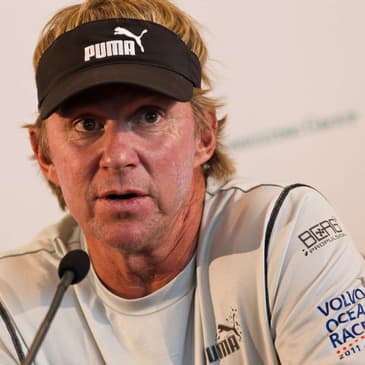
What separates the best sailors from the rest? In this episode, Ken Read—multi-time world champion and President of North Sails—shares the mindset, habits, and hard-won lessons that fuel real improvement—on club lines and world stages alike. From the power of curiosity to the pain of lost championships, Ken opens up about his journey through America's Cups and Volvo Ocean Races, his obsession with learning, the power of the speed loop, and how to truly feel the boat. Whether you’re racing a Tuesday night series or dreaming of an offshore campaign, this is a masterclass in how to get better—one decision, one sail, and one shift at a time.
[00:00:08] This week on Sailfaster, I'm chuffed to welcome a true legend of the racing world, Ken Read. With a career that spans multiple America's Cups, Volvo Ocean Racers and more world titles than most of us have had hot dinners, Ken is quite simply one of the most accomplished sailors of our time. As a tactician, helmsman, team leader and now president of North Sales, he's been at the sharp end of the sport for decades.
[00:00:34] In the first of two episodes with Ken, we get into what drives performance at the very top, lessons from the toughest ocean legs and why even now he's still obsessed with sailing faster. Good morning, Ken. Great to see you. I'm thrilled to have you on the Sailfaster podcast. Thanks for joining.
[00:00:57] Pete, it's a pleasure. It's always fun to talk about sailing and that kind of deflects the real world a little bit for a short period of time anyway. So nice to be here. We definitely need some of that right now. I agree with you. So let's kick off with your sort of origins in sailing. So I heard you talk with Shirley Robinson on her excellent podcast about how you actually hated sailing at the start. How did that change? You had a great story about that.
[00:01:26] It's friendship. I always tell I talk to juniors a lot and young sailors and I really enjoy it. First of all, it's kind of part of giving back. But for me, it was friendships. I was our family. We played hockey in the winter and we sailed in the summer. That's what we did. And my parents helped run the hockey programs and help run the sailing programs.
[00:01:50] But for some reason, well, sailing was outside of our town. I lived in a little landlocked town in Massachusetts called Seekonk. And the closest yacht club was Barrington Yacht Club in Rhode Island. And I didn't know anybody. And it was just kind of lonely, you know, and it was pretty clicky. And all these kids went to Barrington School Systems together and I knew nobody. And for the first couple of years, it got worse and worse. I just I just didn't like it.
[00:02:20] And, you know, we're young kids and maybe I was shy. I don't know. But anyway, it wasn't until another hockey player showed up at the beginning of one summer. And that and that turned into a friendship, which turned into, hey, let's go hang out, which turned into let's go sailing together. And before you know it, we're we're sailing. This is back in the days of Sunfish.
[00:02:42] We're sailing Sunfish doubles as little tiny kids and start beating up all the old kids, you know, that kind of fun. And it got addicting. And yeah, the rest is history. Just it just never stopped, never slowed down. But the guy I always I always give Al Gerard a lot of credit for my career. I see him every once in a while. And yeah, that was the guy.
[00:03:07] And so it wasn't for Al Gerard. My my life might have taken a very, very different turn. Was it inevitable that you would end up in a career in sailing? I know your father was a sailor. Your mother was an athlete. Was that was that inevitable or did you have no fault? I went to university. I went to Boston University. I was naive enough to think I could play hockey and sail, you know, because we were just our whole life was sports.
[00:03:35] And when I grew up and Lord knows I wasn't very good scholastically. So you had to be good at something. Was it inevitable? I don't think it was inevitable because I didn't realize. Otherwise, certainly the coach at BU, a guy named Skip White, none of us realized that I might have some talent or at least kind of let's call it varsity talent in sailing.
[00:04:00] So I showed up first day freshman year in a in a boat and had the captain of the team. It's a senior guy named Brad White. And Brad, I always call Brad also instrumental. He crewed for me for two races and we won two races, the first two races at practice. And we actually came in second that year in the nationals. So this is a really good team. I was stepping into a good team, but we won the first two races. And then Brad got out and he stuck somebody else in.
[00:04:30] And as he was leaving, he said, you know what? If you really work your ass off, you could you could be an All-American by the time you're a senior. And so I just remember going back to my tiny little dorm room that night and sitting there and kind of staring at the wall like a sailing poster and thinking, screw that. I'm going to do a way sooner than that. So it kind of the fire got lit right then and there, that first day of Boston University practice.
[00:05:00] And it never stopped. We won the freshman New Englands and won all the freshman stuff and and did a little bit of varsity sailing, but not a ton that year. And then starting sophomore, sophomore, junior, senior year, All-American and college sail of the year. And like I tell kids also the same thing, just if you win, stuff happens. You know, just people, the phone rings. If you keep winning, the phone rings and you never know where it's going to take you. And so college sailing was very important.
[00:05:29] And and and I was one of the junior year. The phone was ringing from companies. You know, this is before pro sailing. Really, there was very little pro sailing. So you went to work for a sailmaker, a boatbuilder, a mass maker here. You know, here in town, we had Hall Spars with Gertz. We had Harkin was here in town. We had Shore Sails. And so I went to work for Shore Sails because that's they gave me a J24 to race the year before.
[00:05:57] So I thought they were the coolest people in the world. But so, yeah, again, rest is history. All of a sudden, sailmaking kind of turned into a career. But but as a senior, I got to say, it was pretty nice knowing you're going to have a job. Very few kids that I went to college with knew that they were going to have a job when they got out of school. So that was that was very interesting. We took my son on a college tour of BU a few months ago.
[00:06:22] So I went to I did an NBA at Northeastern across the other sort of the beanpot divide. I love exactly. I love being in Boston. It's great. BU won the beanpot the other night, by the way. Oh, did they? Yeah, BBC four to one. But who's counting? Really? You know, yeah. Yeah, I went to see it a couple of times. Let's talk about your racing career. Yeah. So thinking about that fairly meteoric rise, I think, through college sailing, what did you do differently from others?
[00:06:51] Did you have greater intensity? I mean, I know you're known for great intensity when you're sailing. Did you practice more? Did you prepare better? Could you put your finger on on what happened and why? Well, it would be mental preparation as much as physical. So I don't ever remember missing a practice ever because I loved it. It was fun. It was a chance to go out and try to win in the course of the day.
[00:07:17] You hear of some athletes and, you know, they'll try to beat you in tiddlywinks or, you know, pick up basketball or whatever the case may be. I think my brother and I are both those people. I mean, we just go we race for fun these radio control boats these days here in Newport in the wintertime.
[00:07:34] And it becomes pretty interesting for the rest of the group watching my brother and I sing together in a lousy little radio control race because, yes, it becomes a death match pretty much from time to time. So there's no question that especially I think my mom's genes, you know, my mom was like a five sport athlete and my dad played hockey, but he was also a sailor.
[00:08:03] And obviously the combination of the two gave us a bit of a bit of an edge to us. And so, again, whether it was a Barrington Yacht Club Tuesday night series race, you know, a beer can race or going to the J24 North Americans, it was just kind of this hunger to get better, to understand really. And I think that's also that's really misplaced sometime in our sport is you can't just go practice.
[00:08:32] You have to understand what what makes a boat go fast or you have to understand what, you know, weather factors in local knowledge actually come into play. You have to understand the balance of a boat. And so I would read I remember reading an article. This is when Steve Benjamin was sailing for 70s. I read an article about pre-bent from Steve Benjamin. This is back in I think it was yacht racing and cruising or something like that. Yacht racing, cruising.
[00:09:02] And so I used to actually write for them some. And and it just like a light bulb, like, holy crap, I didn't understand what pre-bent was. So the next day I had the painter on a flying junior at practice around my mass and I'm creating pre-bent in light air and all of a sudden just winning races by a mile. So it just you just had to keep having a hunger up to today, by the way, a hunger to get better, but also understand not stand pat.
[00:09:32] So as my dear friend Peter Eisler would say, after every day training and for the America's Cup, what did we learn today? What did you learn today? He'd come in, he'd come by me, what did you learn today? And so that's kind of been my mantra from day one. You got to learn something every day that you go out in the water. If you don't, you're just wasting your time. What were the what were the breakthrough moments for you in your career? 24s for sure. J24 worlds.
[00:10:00] I mean, J24 and Solings, you know, and Stars, they were the kind of global classes. And when I got out of school, so I got out of school, went to work for Bill and Doug Shore at Shore Sales. And they essentially gave me a lightning and gave me a J24 and said, go win races. And then I'd come back. I learned how to work on the floor. I learned how to sell. I learned how to communicate.
[00:10:31] And after I think it was three or four years, they offered to sell the company. It was a small sell off. But we were getting we were starting to make some inroads. They offered to sell it to a guy named Dan Neerai and myself. And Dan became pretty close up. He retired a couple of years ago. Up until then, we were using my life. I spent more time with him than I ever did with my wife. I mean, it was, you know, Dan was my partner in crime forever.
[00:11:02] And and I think I would have had a bit of a Olympic career if it weren't for buying that company, because, you know, we were we were surviving every day on what we sold. We had two or three of us that sold. We were learning how to sell. We're learning how to market. We're learning how to manufacture. We're trying to make money. We're trying to pay off a debt to the bank where, you know, it was it was cut and dry. So J24s were the ticket.
[00:11:30] So if I want to if I won the world's, it was literally, you know, a three or four hundred thousand dollar boost to the bottom line to the to the revenue line of this small company, which was massive. You know, that was make or break stuff. So I couldn't mess around. I couldn't go do my own thing like like a solo campaign or something like that. But J24s were the ticket. No question. I could win regionally or nationally pretty much.
[00:12:02] At the time, if I if I if I wanted to put my mind to it, I could do it. I had to learn how to win a world championship because that was different. I learned how to screw up a few world championships of which we were the fastest boat and just a young, cocky kid that didn't understand how to how to how to how to win at that level. And then it was the I think it was the world's in 1985. I'm dating myself. 1985 and at Sumi Bay, Japan.
[00:12:30] And we learned how to win a world championship. And then then there was no stopping. It's like, OK, this is this has got to happen every year and kind of tried to make it happen every year. And that was again. And then the phone call started, you know, and then you get you're doing this big boat and this and this and this and then Dennis Connor calls. And then then you get a Puma sponsorship. And it just, you know, once once you push the snowball downhill, it just it just kept getting bigger.
[00:13:00] And damn, it's been a hell of a ride. Hasn't stopped yet, by the way. You know, I see that you have a charmed career and a very enviable career. But I want to go back to what you said about winning a world championship. You learned how to win a world championship. What was what's behind that notion? I think the biggest difference is is winning a series versus winning a race. So if I went even to the North Americans or the nationals or the districts or whatever, just go win every race.
[00:13:29] It's pretty simple. It's pretty brainless. And we were quick, you know, and it was going to be either ourselves or a rival from Marblehead and a guy named Dave Curtis. And Dave Curtis was a little older than I was. And he was a spectacular sailor and actually a really good sailing sailor as well. And and it was going to be one of the two of us for a long time there. And we're sailing in 100 boat fleets. And, you know, it was it was the real deal.
[00:13:58] And I just didn't know how to win a series. I knew how to win races. And then, you know, we went to pool. I think it was 1983, maybe the world's in pool and pool. I think it was a little bit of a race. I mean, it was a little bit of a race, you know, and we drank more beer at night and and we went out and just tried to win every race instead of kind of thinking through the process of how to win a regatta.
[00:14:28] Hey, let's not get in a protest here because it was totally irrelevant to the big picture and figure out how to not get DSQ'd and figure out how to not be over the line early by pushing it too hard and learn how to win this series. And that's really what it took. And it was a big lesson. It was a big lesson for me, not just then, but now, you know, it's learning how to win a series. And Moose McClintock is also kind of a mentor of mine.
[00:14:58] He was a guy. He worked for Shore Sails, great sailor, especially around here, but had a real international reputation. And Moose used to crew for me all the time. And we used to talk a lot about backing off sometimes and not getting so stressed because he'd get really stressed. Oh, we didn't win that race. It's like it's probably OK. So we kind of wound each other up for a while. And then I think we backed away and learned how to not win each other up as much heading into the future.
[00:15:27] What race or regatta or series gave you the most satisfaction to to win? The best regatta I've ever sailed in my life was Etchell's Worlds in 2003. And I guess it falls under don't poke the bear. But we had a tough, tough to America. Well, a great America's Cup program with Dennis in 2000. And then we had a tough one in 2003. Just sank a boat.
[00:15:56] We never got fast. We really didn't. It wasn't organized very well. We had some bad breaks. We had a really talented group, but I'm not so sure. I did a very good job in kind of running the overall sailing side of things. But we were we were slow. And Dennis got tough on me. He was tough. And essentially, one night he took me out to dinner. And I'll never forget as long as I live.
[00:16:23] He said, you're not even the best sailor on this team. Never mind one of the best sailors in the world. He goes, if you if you went to an Etchell's Worlds, you'd get your ass kicked by this guy, this guy. And and he pointed at himself and me. Don't poke the bear, dude, because we won every race at 100 Boat Regatta. We won every every race at the Etchells Worlds that next year. Just out of spite. It was absolutely out of spite.
[00:16:51] And it's an interesting driver for sure. Well, you've got to have something right. So. So, yeah, it was Dennis. I learned a lot from Dennis. He's an he was an interesting is an interesting character. I learned a lot of good and I learned plenty of tough love from from Dennis at the same time. He gave me he gave me my break. He gave me a huge break. And I think the first like I said, in 2000, we were we were broke.
[00:17:21] We had one boat. We barely had enough money for a new sail every once in a while and came within a race of making it to the of the Challenger finals. You know, so that we we completely blew away expectations that year. So we came back with New York Yacht Club and a little more money in a two boat campaign. It just never really happened in 2003 for a variety of reasons. Yeah, that Etchells Worlds. I knew we were going to win when during measurement they measure the boat, they measure the sails, and then they measure the crew weight.
[00:17:51] And then they had a list of 100 boats up there. And it started with who was kind of closest. Like the first person in the list was who was closest to each of the tolerances in our boat. Our boat was to the kilo on on minimum weight. We were the only boat in the fleet that had managed their sail card to the point where we were the only boat that had all brand new sails.
[00:18:15] Because it was a two year process of managing a sail card versus your boat and the newness of your boat and when you could purchase sails. We had all brand new sails, all measured in right on minimum weight. And our crew weight was to the kilo on maximum weight. So it's like, OK, we we've out prepared people. If it hadn't been that way and we were top of the list right there, if it hadn't been that way, I'm fuming at myself. That was that was not shit.
[00:18:42] And sure enough, we were that was good. So let me ask the corollary of that, which is, was there a race? What race gave you the greatest frustration? I know you talked about America's Cup and I've got a load of questions about America's Cup. I want to come to because that's such a fascinating story. But is there a race that you can think of in your career that was the opposite that gave you the biggest frustration when you when you look back? Yeah, sure. And that's that's also an easy one.
[00:19:10] Unfortunately, these the highs and the lows are easy to know because I still think about them all the time, especially the lows. And I heard Tom Brady say something last week during the Super Bowl hype that he learned far more from the losses than he did from the wins. And that's 100 percent the case, I believe. Yeah, it was leg one of Volvo Ocean Race leg one second time around.
[00:19:37] We're halfway across the South Atlantic heading for Cape Town, went off watch, went downstairs, sitting there with a bowl of food, getting ready to hop in my bunk and biggest bang you've ever heard in your life. And the mass is laying in the water. And, you know, we had a really good Volvo race the first the first time we did it with Puma. And, you know, second beating some two boat programs, some much better funded programs. And we were a brand new designer.
[00:20:06] The boat team office did a great boat for us. But we were we were new and fresh and we end up second overall. And frankly, it was good. It was it was a good result. And so sure thing Puma loved it. They love the whole experience. They come back in. We got one K. We got a kind of, you know, we've kind of jazzed up the group a little bit with some really good sailors who have winning pedigrees. We did some great training.
[00:20:33] La Ciota training, heavy air training for a month and a half, two months before the regatta. 10,000 miles on the boat before the regatta. Two mast program. We put in our new mast with about two months to go. Just went sailing. Everything was great. Sail program was just meticulous. And I think we were 10 miles behind in second place, 100 miles ahead of third place on that first leg. And the mast falls over and the mast falls over.
[00:21:02] And, you know, it's kind of like you're I think I said at the time on camera, even it's like seven years of your life. You just watched evaporate. It's still it haunts me that I hear that. I hear that mass falling down almost every day. So if all of a sudden I get a twitch, people that work with me here, they know that they know what's going on. Oh, mass just fell down, didn't it? Yeah. Yeah. Mass just fell down right here in my head, in my brain.
[00:21:33] I talked to Pip Hair on the podcast a few weeks before she went on the Globe on Day. And of course, you know, she had this dismount thing. And I just felt, I mean, everyone just feels to somebody who the same thing. They've spent, you know, years and years trying to get funding and that sort of thing.
[00:21:53] So but on the Volvo Ocean Race, you really helped elevate that American teams in a race that has been pretty much dominated by Europeans before that. And, you know, you came back from this musting and other setbacks to to get podium places. So that the Volvo Ocean Race is obviously a very different environment from America's Cup or even the Hobart race. Right.
[00:22:21] And because you were managing it required strategic and tactical skills and brilliance and leadership and resilience. Did that come to you naturally? Or was it something that you had to learn and adapt to during the race? Just curious about that. Oh, no, no, no. I it was especially the first race that the first race. I remember leaving Alicante and it was blowing about 30 that morning.
[00:22:48] And we're about and we have to do this like import race. And then we take off and it's windy. It's proper windy. I have up on my wall a photo. I got a note from the CEO, Jochen Zeitz, that night from onto the boat saying, well, you can come back now because we have all the photos we need because it was it was proper windy. And I got I got on the boat that morning. And I remember I remember like it was yesterday saying to myself, you have no idea what you're doing here.
[00:23:16] It finally kind of dawned on me as I stepped on the boat. And sure enough, I didn't. And I think the crew, I don't know if they could sense it or not, but I went right. I said, hey, you guys, I got to go up. I left some up in the container, went up and threw up behind the container. I was just terrified. I'm like, for God's sakes, what have you gotten yourself into? This is insane. And and we took off and all of a sudden we were second on that first leg and and we sailed hard.
[00:23:44] But I still didn't know what I didn't know. I mean, halfway through the race, there was, you know, almost a mutiny. It was a hard race. Had to had to replace some people. I kind of we kind of put an all star team together because I didn't know any better. You know, I had to I had to just get as much talent around me as possible on how to sell these things and how to sell these things for, you know, 10, 20, 30 days at a time. The longest leg on that on that race was 42 days. You know, so this is this is pretty decent.
[00:24:14] This is pretty decent leg lengths. And it was over about halfway around the world when I finally started to figure it out a little bit. I have the ultimate respect for the people who do these races, whether it's single handed or crude, because we all know how hard it is. It's really kind of a brotherhood, sisterhood of people who know kind of the hell that everybody has been through, because you never stop. You never slow down. You never take your foot off the pedal.
[00:24:44] It's like, you know, it's doing a day race and you come in from a day race off of Newport and you're exhausted. Well, guess what? You got another 32 day races to do in a row. So you better not be tired. And so you have the ultimate respect. But I also learned a lot about chemistry and camaraderie. And, you know, we had a couple we had one leg where two guys on the same watch didn't even speak to each other.
[00:25:11] And it was you had to figure out the chemistry. So an all star team wasn't necessarily the right way to go. There had to be. Yeah, there had to be that chemistry and kind of pulling for each other. Because, by the way, your life kind of depends on it, too, because it's not just winning a race. But you know what? It's the fan. And you better be surrounded with people you trust, you love, you want to be safe.
[00:25:38] As I said a million times in talks I did, the last thing on earth. And it was a really scary proposition to have to make that phone call to your wife, to a parent, your father, your husband, your son is not coming home. I just that wasn't an option for me. So, you know, you have all these things kind of spinning around your brain all the time. And it took a while.
[00:26:04] I'll be the first to admit I was pretty off base that first time around for a good half of it. The second half, once we kind of got a bit of a better mix of chemistry, it may not have been a better talent. It may not have been more talented, but certainly a chemistry mix. We were dominant at the end.
[00:26:27] And the last several legs in that, you know, we had like a one, two, one, two or something like that. We lost the last leg in St. Petersburg, Russia by a boat like a half. Wow. So anyway, it was a huge learning experience and a life experience. And by the way, guys like Tom Wynn from North Sales used to push me out of the nest as much as possible to go out and do that stuff.
[00:26:51] Because then it was going to help you put together a team when you were helping kind of run different parts in our sales at the same time. So everything builds on each other. Everything happens for a reason. I'm totally convinced of that. But then everything builds on each other to the point where you finally get your act together. And all of a sudden the light bulb goes off. When that happens, it's kind of a fun day. So Ken, you have been fortunate to work with some real legends.
[00:27:19] You know, Tom Whedon, Dennis Connor, and probably many others. From whom did you learn the most? Well, Tom has been certainly a bit of a mentor over the years because I think Tom and I are pretty similar people. We grew up in a non-professional sailing era. We had to work as well as sail.
[00:27:49] And we both figured out ways to combine our passion. Tom, I think, would be the first to say that he always kind of saw a bit of me in him and vice versa. So he pushed. And by the way, I consider Charlie Enright right now kind of the same. We're almost the same age groups away from each other. Charlie's probably a little younger than I am away from Tom. But, you know, kind of using what, hell, it's worked pretty good for me. And I think Tom was of the same opinion.
[00:28:18] Hell, this has worked pretty good for me. I need somebody to help kind of take over when I'm done. And, you know, he was a premier One Design sailor. He was a premier kind of coastal offshore sailor. And then he became, obviously, the premier tactician in America's cup history.
[00:28:43] And at the same time, he had to sell sales, you know, had to figure out how to run this company, sell sales. He went from Sobstad sales in the late 80s when he was doing the cup down in Australia to north. And then they had to figure out how to balance, you know, selling and production and manufacturing. And then they came up with he and a guy named Jay Hansen, product differentiation, which meant how do we get an advantage? Let's just not make the same thing as everybody else. And so we kind of have those same genes.
[00:29:13] I still today, like when I get off the line with you today, I'm working on some product upgrades. You know, I still love that stuff. I love it as much as anything. And Tom does too. Tom does too. So when he kept shoving me out the door, and by the way, he came and he was a strategist for both of those America's Cup programs with Dennis because we called them our adult supervision. Because, you know, we were still the kids in Dennis's eyes.
[00:29:41] And he just wanted Tom around to make sure that we didn't screw things up too bad. I got to know him very well then. We went through some really high highs and really low lows in that. And we saw how each other adapted to it. And then since then, it's kind of dealing with big clients. It's dealing with big programs. It's thinking big picture. It's helping the sales force.
[00:30:05] And he and I have really, we're pretty in sync when it comes to how to do all that stuff. I guess it's not a coincidence because I kind of learned a lot of it from watching him. So, you know, Tom and I, every once in a while, we want to kick each other in the teeth probably. But at the same time, I think we've appreciated having the other around all these years. And hopefully we've made each other's careers a little more vibrant because of it.
[00:30:33] Well, it certainly looks and sounds like that. So let's change gears for a second then. Let's talk about preparation. I mean, I know you're an old hand at preparing for races. But how do you prepare for a big race or a big regattas mentally, emotionally? And, you know, any tips or advice you pass on to good club racers who are the majority of SailFaster listeners? It's kind of like running a business. It's a people business, right?
[00:31:00] So you've got to be surrounded with people that you trust and that who can do the job. So that's number one. People like sailing with their friends. And you can intermix your friends with good local club sailors that can help you get around the course. And then it's building a camaraderie as a team. So first of all, it's the team. And you can have the fastest boat in the world. And if you don't have the right team in place to actually get around the race course, you're just you're lost. It's not going to happen.
[00:31:28] For me personally, listen, it's start for shift. And again, I keep reverting back to radio control sailing, which, by the way, I am addicted to. I now have this custom one meter radio control boat that I am having so much fun with. But people keep asking, what's the success of sailing something as small as a radio control boat or as big as I'm going to Antigua tomorrow to go race hunter fighters?
[00:31:56] It's exactly the same principle. Exactly. And that's win the start, get the first shift. It's pretty simple. If you do that and you've prepared everything else so you know where your both strengths and weaknesses are, you know where you have to take chances, you know when you don't have to take chances, more importantly. And it's about getting a good start and getting the first shift. It sounds easy. How do you do that?
[00:32:21] So for sure, I spend a lot of time kind of visualizing and thinking it through and positioning. What's the communication, especially with owner drivers? It's much easier if you're driving yourself because you just do it. It's much, much harder. I give people who have become kind of owner driver whispers at very high level. I give them a ton of credit because it's hard sometimes. It's really hard.
[00:32:47] But it's what we do and we have to grow the sport and it's a big part of the sport. Why is it hard, Ken? Is it frustrating to be watching somebody, an owner driver who is not doing what you would do? No, it's not. It's not frustrating at all. In fact, it's hopefully just the opposite. It's hopefully makes you really feel good because you've done it right.
[00:33:15] I remember at a talk once and it was a question about, do you think it's fair that pros race against amateurs? And I said, well, let me turn it to the audience. What do you guys think? Somebody put up their hand and they said, I have always wanted to play tennis with John McEnroe, but I've never been able to. And I would give my left leg to play tennis with John McEnroe because I want him to kick my ass and I want him to yell at me at the same time and I want the whole experience. And he goes, I get to go.
[00:33:45] When I go sail against you, I get to go play tennis with John McEnroe. All I got to do is sign up. You pay your hundred bucks. I pay my hundred bucks and we go race against each other. So it's more that a lot of the owners, especially of these super big boats, they don't have a lot of time. If they have a super big boat, they're likely workaholics and they're very successful at what they do.
[00:34:09] So they expect success, yet they really don't have the time to kind of put in to become an elite sailor. So that's what they hire people like me for. Like, hey, get me around the race course and help me out here. It's one of the few places in the world that I, and so many like wives or friends have said, holy shit. Like Mr. Smith, who's driving the boat.
[00:34:39] Nobody talks to him in the world. Like you talk to him. It's like, it's like, well, you know, if he was playing right guard for the, for the Philadelphia Eagles, they'd be talking to him the same way. And, you know, you gotta, you know, you gotta be part of the team and you gotta, there's an X, Y, Z as to how to do things right and wrong. At least the way that in our playbook, the way that it all works. And it's difficult sometimes. It's quite difficult. They, um, they expect to win. They've been super successful in life.
[00:35:09] They don't have the time to go sailing nearly as much as we do. And they expect people like me to get them around the race course. So you have to be not just anticipating and holding the wheel in your own hand, but you gotta be anticipating what's going on in their head right now. What are they thinking? Are they nervous? Are they not nervous? Do they know what the next step is? I don't want to say too much. I don't want to say too little. So in the people who are really good kind of owner whispers are very good at it, are very, very good at it.
[00:35:37] And it's become a real big part of our sport. And I think it's going to be, it's going to remain a big part of our sport for a long time. So I can relate to that. I have a J105. I'm the only driver on it. I've only got a couple of years of experience of racing it. I have a guy called Guillaume, who is a whisperer. And with him next to me, it was just, it was revelatory that I didn't know how to drive until I did. And it was so much to do with him just helping me all the time with, oh, okay.
[00:36:06] So when I'm coming down here, you want me to stay up a little bit so we can scallop it. But I never thought about that. But then it's remembering, right? Then you got to remember it. That's the hard time. Now you're hooked for life. It's like, it's like me on the golf course. You know, you hit that one good drive and it's, you're going to spend more money on golf. I'm being bad at golf for the rest of your life. So now you've hit your one good drive in the J105 class and you're screwed. It's over.
[00:36:31] I know, but in golf, there's so less complexity of what's going on, right? Then anyway, but I don't want to take too much time here. But I'd love to talk about driving because we just sort of brought this up really. And I'd love to talk about your driving technique. If you think you have technique or style. Well, I'd love to ask you about what do you, what do you focus on when it comes to driving a keel boat?
[00:37:00] Easy balance and rudder load. And, and it all relates to the same. I've gotten on boats where people are struggling to drive and there's no weather help. There's nothing. There's no little bit of force against your hands. So, so here, so our bodies and our hands and our balance and everything else that goes along with it, that helps make a good driver or a bad driver. I'm totally convinced.
[00:37:29] And here's, here's another sport analogy. So it's very, it's very trendy on the highest level, the PGA tour for not just the person putting, but the caddy who is about to give you a little bit of advice on break of a putt. They walk with their feet on either side of the putt line towards the hole to see if they can feel any nuance in, in what may break the golf ball or not break the golf ball.
[00:37:59] I think sailing is exactly the same. It's the balance. It's the heel angle. It's the, it's the pressure against your hands. What's too much pressure? What's too little pressure? What's too much heel? What's too little heel? Can you be inside the telltales? Do you have to be a little wide? Like understanding how to communicate with the jib trimmer. Hey, give me a little burp here because I'm really struggling to get up to speed. Main trimmer, same thing. Hey, just give me an inch. Give me two inches.
[00:38:25] Because very, because very often the sail trimmers are relying on the helms person to give that feedback. And again, this is, this is a really interesting part of the owner driver phenomenon because the best tacticians now, or the best kind of owner driver whispers are good enough to feel the boat without touching the helm. And, and, and that means, Hey, Hey, Johnny, he's, he's a jib a little bit for a second because,
[00:38:53] because you see the owners struggling to pop it or the heel angle is at five and it should be at three. So anyway, I'm making a short story very long. So no, it's balance, balance, pressure, feel, and you have to develop a feel. When I see people get up and just grab onto a wheel like this and hold on and go like that, they don't have any feel. You could tell in two seconds, uh, that they have no, no feel whatsoever. They're just, they're, they're driving a bus down the road.
[00:39:21] But when you see people kind of turn their hands sideways and lighten up their grip a little bit, Gary Jobson, who I used to do commentator work with, uh, way back when back in San Francisco, he used to say, look at his hands, look at his hands. Like, you know, is it, is it grip it and rip it? Or is it, is it feel? And I think the feel part of it cannot be underestimated. Do you have any sort of mental flow that goes on from heel angle, tell tales, wind and water?
[00:39:49] Is it, is it just sort of intuitive or do you deliberately have that sort of flow that some, some people do? Oh, I think it's a constant revolution of everything you're talking about right now. Right. Once your legs and your hands and your body gets used to, let's call it like on this hundred footer next week, we, we sail up wind at 23 degrees of heel. Um, if we're at 24 or 25 or 21 or 22 month, I heal, heal, heal, because heal very much kind
[00:40:18] of takes everything else into account. And then the second one is rudder angle. And these big boats have, uh, all the gauges in the world. So we know exactly what the rudder angle is and we can see what the rudder angle averages. Rudder angle average is too low, you know, down in the like zero to one and a half degree range. That means there's not enough. Hell. There's not enough feel.
[00:40:41] So rudder angle and heal are two things that, that on a one design boat, you got to get used to. On a big boat, you probably have gauges to tell you and the gauges also tell the trimmers. So the trimmers can be, can then start reacting to rudder angle and heal at the same time. And the speed loop is formed. So you can almost say to the owner at that stage, concentrate on your boat speed, your
[00:41:08] target boat speed and tell tales and let everybody else do the rest of it. And, and so goes the speed loop. And then the speed loop is formed and off you go, hopefully consistently at a high speed. The trimmers are taking notice of heel at that point, right? Exactly. And they're helping, they're dialing in the feel for the owner. So we're not relying on the owner to say, Hey, this thing is, has a ton of helm because on the big boats, anyway, you got gauges that can help tell the trimmers that.
[00:41:36] So hopefully they get to it before the owner is having a hard time. So tune in next time for part two of my session with Ken Reed, where he gives me advice on race boat preparation priorities, and also talks about his revolutionary thoughts on how to maximize the fun in yacht racing. Thanks for listening. And special thanks to Ray Wolf for making the connection to Ken. See you next time.