
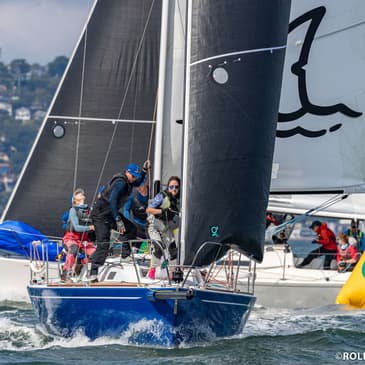
Prepare to hear from Randy Hecht and Russ Silvestri’s masterclass on the finer points of sailing a J/105! Randy and Russ raced their J/105 Niuhi to back-to-back North American championships on the breezy waters of San Francisco Bay in 2022 and Rye, New York in 2023, only the latest in a long career of sailing success. From collegiate sailing in California to being pipped by Dennis Connor in the 1976 Olympic trials and winning the Pacific Coast Championships in the Etchell class, Randy was a regular on the West Coast racing circuit, but after coming second in the Etchell Worlds he took a 35-year break from sailing to concentrate on work and family. He jumped back in the game a few years ago on the Knarr, and then the J/105, winning championships in both classes on board boats named ‘Nuihi’ in partnership with long-time sailing partner Russ Silvestri. Russ’s sailing CV is equally impressive – he competed in four Olympic Trials, won five US titles and a Pan American Games silver medal in the Finn in 1999. He represented the USA at the Sydney 2000 Olympics in the Finn class. He also participated in the US Challenger series for the 1987 and 2000 America’s Cup. He was a member of Tom Blackaller’s 1987 America's Cup team that raced in Perth with USA and its revolutionary foils, losing to Dennis Connor in the semifinals. Russ’ AC experience continued in 2000 when he was part of Paul Cayard’s America One team. Russ also won the 2014 Lipton Cup and the Grundig Cup in 2009 and 2010 and raced Laser boats at the World Masters Championships in 2002 and 2011.
So, two very accomplished sailors and as I found out, super nice guys too!
[00:00:09] Hello everybody and welcome to another episode of Sailfaster. Once again I'm really thrilled by how lucky we are that we've got some great breasts today and I feel like I'm in the presence of sailing royalty, certainly J-105 sailing royalty. It's Randy Hecht and Russ Sylvesterie from
[00:00:25] the West Coast, from Northern California and they are, among many other things, Olympians and so on, they are the sort of the double back-to-back J-105 national championships. So Russ and Randy welcome to Sailfaster. Thank you, happy to be here.
[00:00:41] Great to have you. I know it's morning there in Bogy San Francisco, I know the sun will come out later, but let's kick off with perhaps Russ, we start with you. I mean you have an amazing sailing resume
[00:00:52] obviously. I know you're an Olympian. How did you get started? Get started way back when I think you know if you had a family boat it was you know cruising with the family and racing with the
[00:01:05] ad and chasing boats around the bay. At an early age probably starting at six or seven, oh six years old. And then I did the junior program, had kind of a not too great start in the junior program but the next year
[00:01:19] I removed to a place where I could sail every day on the equivalent of a lake, a lagoon and spent a lot of time doing that and you know kind of developed I guess a love for sailing
[00:01:31] and the real enjoyment for it. And that's after that I started racing a laser you know 12 years old so I've been at it for a long time. I love that comment you just made about you develop a love for it. Was it
[00:01:44] not love for a sight? Was it like this is what I'm supposed to be doing and then you go into it or how did that happen? I think it was a little bit, I enjoyed it you know the being outside
[00:01:54] aspect, being on the water. I probably didn't realize that until later but the freedom but then it really ended up being the competition and once I you know had good results I kept doing it and so is
[00:02:06] that competition I think really at the end of the day that drove me to keep you know pursuing it even though I enjoyed the time out in the water I really enjoy the time training. I mean when we're out
[00:02:17] training I never get tired of it's not like oh okay I'm bored let's go in I mean it's usually you know let's keep going especially when we're not winning the training sessions and then we really want
[00:02:27] to go more. And tell us about how you got what was your road to the Olympic? Well it was long and since that I raced in the 84 Olympic trials and it was a back and forth the situation as to who would go I didn't end up going. John
[00:02:38] Bertrand did even though I won the Regatta but there was a protest and then 88 got to the Olympic trials got close to winning didn't win was an alternate on the 88 Olympic team. Then in 89 got a real job and started working and then in 96
[00:02:58] Brian Ledbetter who's been a long time friend of mine what got a silver medal in 92 you know it was kind of in a similar situation married and you know having kids and stuff and so the two of us teamed up in 96 and I was winning the Regatta the
[00:03:13] last mark going to the finish kind of there was four before Bozwick who won the trials and one guy Will Martin went from 25th to 6th by banging a corner and he ended up beat me. So that was 96 then 2000 Olympic trials were in
[00:03:29] San Francisco Bay and won the trials with I think one or two races to spare and got me to the Olympics in 2000. So long story but you know a lot of ups and downs along the way but at the same time it was always in the Fin
[00:03:44] and you know it was a great group of guys and both that you know it's technical and I think really you develop a feel you know for for a boat and getting that helm just to you know get that feedback loop being driven through the helm.
[00:03:59] And you will set involvement in America's Cup right? I did yes I was a member of the 87 America's Cup team with Tom Blackholler we raced in Perth we had the one with the forward rudder we were fast didn't quite get through Dennis
[00:04:14] in the semifinals unfortunately and then in 2000 I was also part of the America one team with Paul KR down in New Zealand. So that was an exciting time one because my youngest daughter Catherine was born in New Zealand and it was a real family kind of
[00:04:32] adventure to do the 2000 America's Cup. Wonderful and just going back to 87 that must have been an incredible atmosphere in in Perth right? Yeah I was in Perth you know I guess the one in Valencia in 2007 I think probably rivaled it but you know I think
[00:04:50] we had 18 boats or 16 boats you know the teams and I was a lot younger then and the America's Cup was you know coming off the 83 victory for Australia and you know it was just a lot of
[00:05:03] action. I mean you go down there every night you know they'd have a half an hour show of the highlights of the of the racing on TV so it was always um it was a great experience and the
[00:05:15] competition was good you know windy what I think I really learned there was preparation and Dennis you know that last round he put on the shark skin on his boat and he went from being a little bit
[00:05:28] slower than us to a little bit faster and that was really the difference and you know they just did a really good job of optimizing. Yeah yeah wonderful great history one of my best friends was working that event
[00:05:42] as a I think a college person down in Perth so he talks about it to this day about how wonderful it was. So thank you so Randy let's turn to you um how do you same question how did you start? Yeah very different from us I had no
[00:05:58] sailing in my family background I got invited to a lake up in the sierra is called Pinecrest Lake and they the family owned a sailboat rental business up there I fell in love with sailing started teaching sailing up there they had
[00:06:15] daily races and El Toro's around the lake and that was my introduction to sailboat racing and the love of sailing. I was also playing basketball in the University of California Santa Barbara to play basketball and
[00:06:30] realized during the middle of the UCLA game that wasn't going to work out too well and one of the guys in the team was on the Santa Barbara sailing team and we went to next day to Mission Bay and
[00:06:40] sailed FJs on Mission Bay and I converted quickly to you know sailing collegiate sailing and really dove in with both the including an Olympic campaign when I transferred to Berkeley and continued sailing the sailing team at Berkeley we had a tempest and
[00:07:01] so that was 1972 we did the Olympic campaign though that didn't work out so well in the end got the attention of Argyle Campbell I teamed up with Argyle in 1976 and finished second in the Olympic trials in the tempest class in 76 with with Argyle we lost to Dennis
[00:07:20] Connors in the last race. Wow. Dennis good competitor, Dennis I remember at the end of the regatta he looked at me and said the reason that you guys didn't win was you guys didn't look in the mirror and what he meant was you didn't you really didn't examine
[00:07:38] every little weakness you had and and do something about it and that was a lesson that was I carried the rest of my life in terms of how operate businesses operate sailing and operate life so that was a really important lesson
[00:07:56] for me and then I after the 76 Olympic trials I sailed in the Ethel class won the Pacific Coast Championships finished 6th second American in the 1981 Ethel's World Championships on San Francisco Bay and then decided that I couldn't I took a 35 year time out from sailboat racing to concentrate
[00:08:17] on work and family and then when I was 65 years old decided to get back in called Russ up to the sail on Wednesday night racing a boat called a canar which is a lot like a natural it's a heavier
[00:08:30] older version and uh is that background noise too much dog's drinking some water now he's finished I was absorbed in the story I didn't hear anything at all it's okay so Russ came down from Tinsley Island to sail with me on a Wednesday night
[00:08:47] race and he drove we won that race and we've basically been in the boat together ever since and from you know we've won five season championships and then to kind of our class and then we decided I decided I needed more reps and so bought a
[00:09:06] J105 to get more experience to the San Francisco fleet typically has 20 to 30 boats on the line and so we we jumped into that boat basically brought the same crew over with a few more a couple more people
[00:09:20] because the J105 has a larger crew and ended up winning the Rolex J105 division and won the North American Championship in San Francisco and then won the the North Americans in Rye New York you've only worked together on a boat relatively
[00:09:36] recently right it's not you don't have a 20-year history of working so real quickly on that I met Russ when he was about 16 years old a regatta up at Clear Lake in California and I was sailing 505s and he
[00:09:52] didn't have for some reason he didn't have a boat and I had brought along my laser just to have to sail on the lake you know this little 16 year old guy comes up to me and says listen I don't like to borrow your boat and there were like 100
[00:10:05] lasers racing in this regatta up there I said sure you can borrow it but it's not very fast and so he said well I might make a few modifications tape this up tape that up and so I gave it to him for
[00:10:16] the weekend and then weekend was over he'd won the regatta and showed me the boat was actually quite fast and so that was the beginning and then I hired Russ to work for our firm what year was that Russ 89 89 so
[00:10:31] I've known Russ a long long time and always followed his career in sailing his career in business and he was always a performer at everything he's ever done so so I'm gonna interrupt you for a second because I know that you're I think together you you're both in
[00:10:49] finance of investing one sort another is there anything from that world that you that translates into into sailing for you just curious yeah I would actually put it the other way around the sailing was incredibly good training ground for what you have to do to be successful
[00:11:06] and the investment world and or just the business world because there's so many facets to sailing that you have to and you have to be attentive to all of them you can't just be good at one thing
[00:11:18] and that will carry you through it you really have to have balanced in your skill set and you always have to be in the process of trying to get better of becoming better because the other guys are trying to get better and that was very similar to sailing
[00:11:35] certainly at the olympic level it was you're either getting better or you're getting worse there's no kind of just staying in the middle I'd add to that I worked on the sales and trading side and
[00:11:47] you know you're trying to predict which way the market's gonna go or at least make a bet which way the market's gonna go and it's a lot like you know picking sides of the course you know you have
[00:11:56] you know your pre-start you kind of figure out with the wind shifting or is it trending you know what's going to cause it you know oh there's a cloud over there that's going to make the wind go left or right so
[00:12:06] it really heightens your awareness and you know gets you focused on multiple factors and you know drive decisions and obviously sometimes you know that cloud that's coming is going to outweigh that little shift on the right side that is happening right now and sometimes you know there's
[00:12:21] leverage when you you know it's going to you know shift 20 degrees and you you know you end up overseeing the mark and so you know you have to you know play the course it's the same as in business I think the one difference is in business the clock
[00:12:36] really doesn't run out on you as it does you know in sailing or in the race you you know how you do you win or you lose but you get that feedback yeah that's really that's really interesting I was sort of noting what
[00:12:48] people were saying to me over the last few episodes about how to manage a team a sort of sailing team and there's it's absolutely the same as managing a team in the in the business world wherever you are
[00:13:01] so I love those parallels that you've you've pointed out between there between the two worlds I think that's probably an episode of this in the future but I'd like to talk about so can you can you talk about how you work together
[00:13:13] on the boat Russ are you the tactician and Randy is the driver have I got that right in the j105 that's the case but we switch back and forth on the canard where Russ drives and I drive and we you know alternate the job of tactician
[00:13:28] so Russ you can describe how we yeah so on the j105 um yeah I basically do the main sheet and the tactics everyone on the boat really actually I wouldn't say I'd do the tactics there's you know a person in the middle of the boat is
[00:13:41] you know really responsible for everyone's got a job right and so that's kind of a theme that we always have is do your job and you know build Velocheck of the Patriots kind of always said that too
[00:13:50] so you know if you have someone in the middle of the boat whose job it is laylines and you know relative speed to other boats then you know we have the bow guy calling the wind pressure and you know most people do the same thing
[00:14:03] um but we hold each other accountable and you know it's kind of you know before the start it's like well how much time back to the line you ask the bow guy you ask the person in the middle and everyone's oh I think it's 35 and I'll
[00:14:14] say I take the over and so we're always kind of you know working together in that regard um as a team and do your job so the other thing that I'm responsible for on the boat and I think this is probably you know thinking
[00:14:27] about this call in the j105 I think what we do you know that probably people do in the beginning of the regatta but they might not do it after the third or the fourth race is a really really attentive to the rig and um you know
[00:14:40] so tuning it you know the race ends it's like okay what do we want to do with the rig and you know make the changes for the rig that race or the next race you know knowing what we now know what should we do
[00:14:50] differently and so I'd say that's my my job is you know from tactician is also sitting at the rig um so one of the things going back to the jobs we actually wrote down the job description for every position on the
[00:15:05] on the boat exactly what their responsibilities were and are and one of the benefits from that is it takes pressure off everybody if everybody knows what their job is and and there's they're really focused on their job you don't have to focus on other people's jobs you're not
[00:15:21] really trying to to save somebody else and that that means in a pressure situation that are mark rounding or at the start if long as you just do what you are supposed to do and you roll and you
[00:15:33] believe the person next to you is going to do what they're supposed to do you know you're going to have a great outcome and your brain doesn't start working too fast and you make a
[00:15:40] mistake and I think we just don't make mistakes or we don't make very many that's for sure so I talked to Alan Togun of North sales last week on the pod and he was talking about he has this sort of 95 percent when he's working with clients
[00:15:56] um as he often does it's uh he has this sort of philosophy of getting to the you want to get to the first you want to get the sort of to 95 percent efficiency that's a that's if you can get there that's fantastic that extra five percent is where
[00:16:10] top sailors like you guys you know that that's what they focus on do you if you understand that sort of concept I'm sure you do the things like rig tuning between races is that for you that extra five percent
[00:16:21] that you have to be doing to get yourself in the in the front of there in the front of the j-1 if that's you know whether it's j-1 or five or the canafleet just I don't I don't think we've ever used
[00:16:32] any terminology that would get us close to a 95 percent rule or a five percent rule we are trying to play at the highest level we can all the time and so it's and there are parts of the race that are more
[00:16:45] important than other parts of the race um and so we have a pre-race routine that we go through that we repeat every single time and that focuses on the start and the first weather leg if we can get a start and have room to lured where we can
[00:17:03] hold our lane for the first five minutes or have the option to attack without being pressured to do so and and we're able to execute on that plan and we're up at the weather mark first weather mark in the top five
[00:17:16] we're we're pretty good for that race and that regatta so the the lure their run doesn't really matter I mean it matters in terms of how you end up finishing in the top five but
[00:17:26] it the back of the you're not in the back of the fleet so we're much more focused on what's important at at the various stages of the race and how are we going to do well which is also part
[00:17:39] of the process of the rig tune obviously the rig tune affects your ability to go upwind and when you're coming off the line everybody's bow to bow and you're looking for inches to get over the top of
[00:17:51] the guy that's to lure to you or keep the guy from weather from crawling over the top of you that's where that rig tune really makes a difference you want to head to that rest yeah I just going back to adding you know to the
[00:18:04] everyone does their job and we have a guy on our boat his name is Spencer and Spencer's relatively new to sailing and when he first wrote down all the job description goes that seems kind of overkill but now he's like
[00:18:15] oh that was really a good idea and you know Spencer's now he's basically our tactician downwind he's looking back for the wind you know as our air clear you know he's he's he's gone from you know no sailing experience to now being a really
[00:18:29] you know helpful bow person that you know day in and day out takes a lot of pride in his job and you know he enjoys the winning part of it he enjoys our team and you know he's the enthusiasm is great you can always
[00:18:44] ask him to go he always says yes and then what tell me about the communication between you two and again I know you swap roles so that's quite a bit quite interesting but are you at this stage really tuned into each other so you sort of can finish
[00:19:00] each other's thoughts on the on the race course or you know how does communication work between you and the rest of the boat yeah I'd say so I mean I would have in the J105 I think Rainey gives me a lot of
[00:19:13] the technical tack now type of thing I don't think he's questioning the tactics his job is to make the boat go fast the one thing now on the J105 is you know we crossheathe the jib so
[00:19:24] you know doing the main I can let the jib out you know we have we have marks that we pull it to and you know the cheating the winward jib sheet a little bit and getting that roundness in the foot
[00:19:34] of the jib is critical so I'm doing that and you know we kind of hit the marks you know get to the marks quickly and then I'm trimming the main but it's a traditional you know speed loop in
[00:19:46] terms of you know how's the helm feel I think you know we really focus on the helm and you know Rainey what you can talk a little bit about that in terms of the J105 just you know that feedback you
[00:19:56] you know through the rudder is really what we use I mean but we do use this bit on her a lot of the knot meter quite a bit too so yeah tell us about that and I'm intrigued um sorry for those who aren't
[00:20:07] J105 sailors who are listening to this but there's a difference people always say between those with a tiller and those with uh with the wheel the wheel is less feel it adds you know hundreds I think 100
[00:20:20] pounds of weight at the back of the boat sort of thing so just curious about which one you have and then can you tell me about um that sort of conversation that happens through the tiller that you
[00:20:30] you feel and report out sure when I bought the boat it had a wheel and I had to take it out and put a tiller in I didn't even sail the boat with the wheel ever so the first time I went out I had the tiller and that's
[00:20:42] just I've sailed with a tiller most of my life and it was comfortable with that and didn't want to really learn how to to steer with a wheel and I didn't think about the weight I was just thinking about the feel of the boat because ultimately
[00:20:56] I think the feel of the boat is what um you have to have to go fast it's the feedback loop with the rust is rust will trim the sails and I'll say to rust well I've got a little bit too much weather helmet I try to
[00:21:09] sail with as a neutral helm as possible which means I'm pushing the tiller away from me a fair amount of the time in order to keep the bow up and but as you watch the our knot meter the goal is to get around seven knots going
[00:21:25] upwind and if you're at seven you're you're beating the rest of the fleet it's very hard to get to seven and stay at seven all the time you can't do it with weather helm so when when I got into sailboat racing
[00:21:41] you know when I was sailing etchels and everybody sailed with a fair with some weather helm that was the the understanding of the way you went fast in those days today in the etchels class and in the canara class and the j105 class we're sailing with as little
[00:21:57] helmets we possibly can get away with and it takes a while to learn how to keep the nose up because you really have to anticipate the nose dropping and rust will tell me you know you're letting the nose drop a
[00:22:08] little bit the bow drop a little bit and you know that'll get me back on track but yeah I think it all it all comes down to the balance of the boat yeah I think I understand when there's a lot of times where the bow starts to drift
[00:22:22] and it's like you know keep the bow hunting you know keep the bow up and you know especially when you see the next puff coming and you find that a lot in the j105 wherever you're going along pretty even with the guy and they're they're doing
[00:22:34] you know just as well as you and then all of a sudden little shifts in the wind that lightens up particularly and you know they just see the bow drop down maybe a degree or two and you gain a couple feet
[00:22:42] you keep the bow up you know you install the top of the main and you know you get that good enough weather helm so that you you know you do you know keep the bow hunting
[00:22:53] so you're saying so many interesting things there that I have to go back to a couple of things so seven knots in a j105 um is about half a knot over over the sort of the target speeds
[00:23:05] on my little placard that I've got on my boat and that's deliberate right you're deliberately are you are you tend to foot off more than um maybe absolutely not there's a an adage we learned in the tepid class which is
[00:23:21] the faster you go the higher your point and we apply we apply that in the j105 class yeah so it's it's we might have a fast veto too makes us feel good no I don't think so
[00:23:36] I don't think it's too basic you're right no I I think the things that we do different as we sail with more neutral helm than most people do than the vast majority of people do I think they have become reliant on having
[00:23:47] some weather helm and that acts as a break and I think the other we're very conscious about angle of heel and uh buddy melgus once said in his book uh that there's a an absolute correct angle of heel for every boat you got
[00:24:02] to figure that out and keep it on that and so in the j105 class it's somewhere between 18 degrees of heel and 22 degrees of heel and we are very strict about staying within those parameters assuming you have enough wind to heal the boat over that far
[00:24:18] and then keeping um a neutral helm does that mean that you don't have your main uh you know trimmed in as much as others perhaps is that so yeah I say but it's just a little bit it you know the harder part with no helm
[00:24:32] is you don't you're not getting feedback right when you have weather helm you're getting feedback you kind of know how you're doing you know at that point because you have a little bit of weather helm when you go to neutral
[00:24:41] helm you're not giving as much feedback and oftentimes if you if that feedback you know lends the bow to you know drifting to drifting off I say it's really um balancing you know be weather sheet the jib um and
[00:24:54] that views quantum sales it's that makes just a huge difference um it's you know in the certain you know in the I'll call it the 12 to 18 um and the other thing we really focus on is the mains should never backwards
[00:25:10] right and we do that on the on the canard too the gypsies if the mains backwinding either your rig's too loose in the middle you know you're oversheeted down the uh on the jib or maybe you have too
[00:25:21] much backstay but you should never have backwind in the main ever even in 25 knots I mean you just you know get the rig tighter um and let the jib out a little let the jib out and we don't we don't uh
[00:25:33] weather sheet the jib not a lot of money right but the tricky part with whether seeing the jib is you got to run the lead further aft on the lured side to get the lead in the right place to get the
[00:25:45] leech right and that's just it's it's an art that if you haven't seen a lot of sales I think you know it's it's challenging for a beginner yeah and I say the other part in terms of neutral helm is that we
[00:25:58] really manage the backstay actively all the time that will relieve the leech tension of the main if you're you have more backstays you're not necessarily relieving pressure on the mainsheet as much as you're bringing the backstay in you're letting the backstay out to
[00:26:13] get some more um some more feel out of the helm and then we'll use the bang uh to bend the the the mast at the lower parts of the mast as well so um I imagine there's a bunch of j-1-0-5
[00:26:26] sailors pausing this every now and again right right next down but um so um the question I have for you is you know what have you what have you learned together that you think that's a secret to your
[00:26:38] success together I mean I think you probably give me a lot of that now but it's anything else that you I'm interested in there's sort of the dynamic you have as much as the sort of the technical as well but
[00:26:48] is there anything to talk about that I think both of us have sailed in really big regattas and you can't underestimate how how much that comes into play when you're you know you're down to the last race and you've got to start you've got to
[00:27:05] make you've got to have a good start and how do you calm yourself before that start more so than the guy on the other boat who's facing the same situation and part of that comes
[00:27:18] that's where I come back to delegation of duties and you're confident in all the people around you you surround yourself with what you think are the best crew in the in the fleet and you have confidence in their ability to execute when the pressure is on
[00:27:37] hey the other thing is our boat is really really well prepared um you know the bottom is in good shape and you know everything works and you know Randy's Randy hasn't you know held back in making
[00:27:50] I mean a J-1 if I was not that complicated I mean you have spinner sheets, jib sheets, you've got the furler you know and the traveler and we have a nice traveler set up that's worked out pretty well but you know everything works well on the boat
[00:28:05] you know we do the basics you know the props lined up um but I mentioned earlier but just being getting the rig right and focusing on that main backwind I think is something that you know people
[00:28:16] just as a similar setup and you know looking at their lured shrouds are the lured shrouds, cap shrouds are they loose dangling you know it's probably too loose if it's you know uh you know kind of a little bit of tension it's just about right
[00:28:30] and I would say the other thing is having a pre a pre race routine that you go through checking the wind directions making sure you know what the oscillations are go up wind against somebody that's a pretty
[00:28:42] good competitor just make sure you're in the ballpark for your rig tune and how your sails are set do it do several time and distance approaches to the starting line I would say that you should always get that in understand which is the end of the
[00:28:57] line is favored which end of the line is favored in an oscillating wind which isn't necessarily which what end of the line is favored at that particular moment you know things like that become really important it's a sport that plays out in the future
[00:29:15] it's a sport that plays out 30 seconds ahead of where you are now or more and the top sailors I mean all good sailors have that ability to be able to see what the chessboard is going to look like in 30 seconds time as you you know pressure mark or
[00:29:30] or whatever there's something that I mean I'm a relative newbie as my second year on a j105 and and that's you know apart from many things that's a key difference I just can't see what's going to happen 30 seconds ahead of me much to the
[00:29:44] chagrin of my my my crew but that's I find is a key characteristic of visualizing what's happening and I think it's true of all sports people good would you agree well absolutely I think you know the more you get your crew involved too I think is
[00:30:01] like in the big boats series we have some long races and you know you get a little bit of chatter on the on the rail it's just you know not everyone's engaged because you know we're on the same
[00:30:11] tack for the next you know five minutes so it's those types of times I mean where you might be more demanding of the crew for a shorter race and there's a mark coming you can sometimes let those things just go
[00:30:23] and Randy and I are working on the speed and you know things are going pretty well you know we do have a mark coming up but you have to kind of bring people back to getting totally focused but in that
[00:30:34] pre-start part of the game everyone's got to be focused on their job and you know it kind of goes back how do you add value and you know everyone's adding value on the with their role if you think that the start is worth 50 percent of the race
[00:30:50] that that's you know where 50 percent of the value who's going to win who's or where you're going to finish in the regatta then you're really racing 10 minutes before your gun goes off because you're setting up you're doing an approach to line you're
[00:31:05] checking where the wind is you're assessing how large the fleet is and how long the line is and where the opportunity is it worth it to try to go for a pin or a boat or is it in this case is that
[00:31:20] you just want room to lure relatively close to this side of the line or that side of the line all those decisions are getting made before the race actually you know officially starts so let's switch gears this is wonderful stuff let's switch gears to
[00:31:38] san francisco bay which is your home territory and obviously that's known for its high winds under the goldgate bridge but you've also been super successful elsewhere i think you take your boat to other places as well by the way i can never pronounce your boat is it
[00:31:54] new newie new new newie newie sorry um tell us about going from the high winds of san francisco bay relatively high winds from san francisco bay to other other venues is that a big sort of gear change for you and mindset change or
[00:32:11] is it same fundamentals just slightly different tuning um i think looking back on the last year's north americans um and kind of some of the things i do with randy that i as a tactic that i realized
[00:32:25] the mistake i make oftentimes is i put them in a call more difficult situations where i might be comfortable handling it and you know you can probably thread the needle um i in the first race to the north americans i
[00:32:38] put randy in a situation there where i thought we could make it and we probably could have made it but we hesitated and we didn't make it and we had a bad start and after that we just kind of made it a lot simpler than you
[00:32:48] know starting line was long okay let's just get a place up work towards the favorite end well you know there's whatever there were 30 boats and you know if you get ahead of the in the front pack you know you can
[00:32:59] you know pick people off one by one but if you're in that backpack it's hard to kind of break into the into the lead pack but um so take answer your question i mean we got the boat to uh rye last year i don't know probably
[00:33:11] a week in advance or thereabouts and re-arrived two or three days in advance and the voodoo team was there and a couple of other teams were there um setting up the rig was definitely going to be important because we hadn't
[00:33:23] had that side-by-side testing um and we did a little training with the voodoo team and we were okay we were we had you know good crew work we were of speed um so he gave us confidence in the
[00:33:37] beginning for sure even though we had the for the bad first race then to come back from that was um really quite nice um so to you know answer your question it was really confidence one in terms of speed
[00:33:50] um you know two i think we even changed a few equipment items we got some really light air spin-off sheets um which helped a quite a bit and so um and then the other thing is you know we all live in the same house
[00:34:03] and i think that you know for the moment you wake up at whatever six in the morning you're thinking about sailing we're talking about sailing or you know playing the game all day long um the good news is we get long
[00:34:16] along well enough that uh we're able to you know enjoy each other from morning to noon tonight so i'll i'll take a little different cut on that san francisco is a lots of tide lots of wind sailing venue the race courses
[00:34:31] tend to be very narrow because of the tide and so yes the skill set that allows you to do well in san francisco is a different skill set than what allows you to do well in ryan new york
[00:34:44] but i would say that russ and i have both sailed enough in southern california and around the world and light uh lighter moderate conditions that at least in my case i'm very comfortable sailing in light air or actually my least comfortable is as moderate because everybody kind of
[00:35:01] goes the same speed in moderate air so i you know if you have my preference i'll take light air or i'll take heavier i feel like i'm gonna be an advantage in both situations um and then you know moderate air you gotta be
[00:35:14] a little bit more on your game than the starting line and gotta be in that front you got to really be in the front row and you got to hit the first you gotta hit the shifts right in order to be able to
[00:35:24] eke out a lead but i no i i think that you have to if you're going to be a good san francisco sailor that travels well to other events you have to sail a lot outside of san francisco to get all those skills
[00:35:40] yeah i think what randy said in the race course being narrow in san francisco is really critical i mean there's you know if you win the pan and you went near the first of the shore you're gonna do pretty well
[00:35:49] and so there's that you know i can tell you that you know what the tide's doing okay and you know the start's there you know if you start you know at the boat and tack you're probably gonna be
[00:36:01] you know that side's gonna win that means try and favor the lure in a lot to make up for it but in general um if you know the first way they can even up the starting line but the second time
[00:36:13] up when you know you go around the lure mark you're going the winner mark you can't really have that you know leverage factor so the race you know tends to you know be a parade for that matter because you know okay it's
[00:36:25] anti san francisco you round to port you you know you go out to the star attack lay line and you know try and hit it in one attack and no one's gonna pass you by going to the left of you
[00:36:37] it just doesn't happen so um i think that that's probably you know worst-class detriment because you get kind of okay we're on the right side and and you're not necessarily tacking on the shifts or you know yeah so that that i think is the challenge for us
[00:36:56] i was out at the i happened to be in san francisco and on christy field for the big boats who is um i guess it was last year and i was watching the j-1 if i tack up along the city front and across
[00:37:09] you know along christy field upwind and they were really short tacking so i presume this is the you know maybe the tide is turning and it turns the christy field faster but i was thinking the same thing that you
[00:37:22] were when you're you're sort of constrained there so it's less about that's about being able to tack on shifts when you're in that narrow sort of corridor that you're trying to you know beat up against and more about
[00:37:33] uh just trying to figure out how not to run out of room and uh and end up on christy field beach yeah i mean i will say that on the city front there are a fair
[00:37:42] number of shifts that roll through so it helps but in general i would say the starts are more important on san francisco bay than they would be um you know in ryan new york but like on that incoming tide you gotta be
[00:37:59] between what is the need of rock and uh you know st francisco you gotta be near the shore and after that it opens up a little bit the tides relatively same the shifts are a little bit bigger so you just gotta know when to kind of
[00:38:11] play the game um you know like if you round the lured mark and it's you know it's a flood tide to get a bad rounding you gotta just suffer you're gonna have to you know you have to get to the beach and then you can
[00:38:23] play the game but you're you know you're gonna be in pain because if you tack it's gonna only be worse so there's a lot of situations like that where you know if you tack it's gonna be worse and you just gotta
[00:38:34] suck it up suck it up i think one thing we did well in the north americans in san francisco is when we did get in those uncomfortable situations um we were comfortable we were comfortable with the uncomfortable when you know a guy might
[00:38:46] be on a lead bow pinching you know it's like okay instead of panicking here attacking right away we're on the lift attack so let's just you know take a few deep breaths let's keep going keep going keep going okay wind heads a
[00:38:59] little bit now we now we can step away and so that being comfortable with the uncomfortable was a theme that cared for us and now we got it there's a particular leg where you guys are looking at each other or that even
[00:39:12] needs to look at each other and think this is where we catch boats it's when we get around that windward mark and we're coming down or mark roundings or starts just curious about whether you have you're super comfortable with one particular aspect of the course
[00:39:28] well speaking for myself i like the i like the weather legs because that's where all the technical skills of making a boat go through the water fast come into play but having sailed with rust for the last eight years he is spectacular in all situations but downwind it's
[00:39:48] it's uncanny how fast he is downwind so um i don't know if you feel this that that's your favorite i would just say you know the shifting winds is kind of fun because you can climb the ladder right i mean the last day in ryan york it was
[00:40:02] windy and it was shifty and we just you know we re-thrived i mean we you know hit the lifts we you know tacked on the headers and you know and we did that downwind too yeah
[00:40:13] we did that downwind i mean i have to say we have really we have instruments that tell us the true wind direction and that's kind of a little secret weapon that makes life a little easier like
[00:40:22] oh okay it was 260 at the top and now it's 270 at the bottom it's like okay winds gone right a little bit so let's you know look at the go left gate so that that true wind direction is is an instrument that we use that's pretty
[00:40:37] pretty uh handy russ and randy you you talked to me before about the importance of tactical imports of wing on wing uh which to me sounds super tricky to do on a j105 in uh heavy air in san francisco bay i'd love to know about
[00:40:54] about how you think about that yeah so i the heavy air wing and wing is is less difficult than the light air wing i think you got to have at least be 10 knots where you can even start to think about it um and then you know over that
[00:41:11] then it just becomes a little bit easier but it's just you know working the sheet and the skipper's gotta you know focus on it it's just something you practice and you'll get it down um and the crew you know has
[00:41:22] you know various jobs you know grabbing the sheet holding it out you know jiving the boom um instead of the instead of the kite i think for us we found it easier to go wing and wing by jiving the main as opposed to jiving the spinnaker
[00:41:38] um so that's that's kind of been our go-to move and then you know we then flop back the other way so we might be coming into it on say you know the booms out on the port side uh or on the starboard side we're on port
[00:41:52] tack and then you know we'll just bear off and then we'll throw the boom over um onto starboard jive and you know have the kite held out i think that's been you know something we've done and you know
[00:42:03] the trimmer's obviously you know coordinating you know when you first do that square back you gotta pull the you know what was the sheet back a little bit more you don't ease it out um typically at least um
[00:42:16] tell me about the you know for a neophyte i mean i suppose the tactical advantage that to my mind is that hey if you're coming into a gate then you know you can speak it over and suddenly you're on starboard tack right
[00:42:28] through what what are the other tactical advantages of doing it um i'd say that's that's probably number one you're you know you're kind of looking like you want to go left gate but you the guy
[00:42:39] you know might be close to crossing you on on port and you're you then throw it over to starboard you turn them then you turn back and you you know you get that left gate the other situation is you're able to you know soak in on a
[00:42:52] guy like if you're trying to make that again left turn um you come from behind and you know he's got a conventional setup you go wing and wing you can just stay right down inside inside him to lure
[00:43:03] and inside the lures also need room on them so and i would say thoroughly you can get out of bad air it's a way to get out of bad air if you can by going lower you can clear your wind and
[00:43:14] and so you may do that temporarily to get in a different lane yeah you get the wind further behind the guy's kind of sitting on you and he's above you you go wing and wing you get you know he let him roll forward
[00:43:26] you roll lower now you have clear behind him um so that's the other time to use it the San Francisco guys will tell you that from 12 to 18 wing and wing is as fast or faster just going down
[00:43:39] the the the the track so you don't use it other than tactically above 18 and you don't use it below 12 because it's too hard to keep the kite up keep the kite full it's on moderate winds then your the vmg is
[00:43:56] as good as sailing the angles yeah that's what they say and that's what Russ has the erudite rule thumbs the 10% rule and i've kind of forgotten that also exactly how it applies yeah but the other thing is i think if you
[00:44:08] have a guy in front of you who's not very good at doing wing and wing it makes him nervous and also these things you kind of met with wing wing and they don't want to go for it because they know they can't do it and you're like okay
[00:44:21] and they you know we had a regatta last year where the guy was in front of us and we came in wing and wing behind them they tried to do it and we just we smoked them so and the other
[00:44:33] technique going down wind that's very effective is getting as many people on the weather rail as you possibly can to to lean the boat over so that the kite will move around the front of the boat and be more exposed to the
[00:44:47] wind you definitely go faster doing that and even to the point if you want the guy that's trimming the on the winch for the spinnaker sheet to be that winch to be on the weather side as well so you keep everybody on that side of the boat
[00:45:03] we also have a very loose vang compared to most people going downwind and i think a lot of people are overvanging downwind so you're you're getting some do you even get weather heel
[00:45:18] to protect do you ever get as far as that or was it just about trying to keep it flat no we're weather heel absolutely yeah I know other people talked about in Chesapeake about doing that that seems to be a go-fast ploy for jay one advice for sure
[00:45:34] yeah and one other thing downwind you know that I learned actually from Jeff Thorpe and you know experienced it in the well say congressional cup no the lifting cup down in San Diego is you're always trying to go low and you're maybe in the conventional set but
[00:45:51] you always have someone on the vang and if you ever collapse the kite you got to let the vang go and so i think that's something for someone who's relatively new to the fleet just on downwind sailing if you've
[00:46:02] ever collapsed your kite let your vang ease your vang you know whatever four five inches because that it'll help the kite get come back much quicker how does it do that though I think yeah from the main or something that then
[00:46:15] yeah your your kite stalls out because you usually what happens is you get you go too low the kite gets behind the main and you know the spinner collapses and you know with the vang
[00:46:27] if the vang is a little all tight you get you know it's more stalled air behind the main so if you just blow the vang you know that keeps the the leash freeze up and it'll fill your kite and I think that's the other thing
[00:46:37] that Randy mentioned in the lighter wind we definitely are a lot looser on our vang and that top telltale is always flying I'm learning so much from this that as we talked to you there's a huge difference between hearing it and then putting it to practice of course
[00:46:54] but yeah I would go one step further and say we have the vang off enough so that the top of the main is square to the you know it's 90 degrees to the boat so even if it's flowing we want the the the the main out because because
[00:47:11] the shrouds hold the boom from going out to 90 degrees so we want the enough vang out so the the top of the sail is twisted to the point where it's 90 degrees to the wind so
[00:47:22] the fastest way to get faster in a j105 and I understand that there's a money component to this but you know people like Jeff Thorpe are at quantum are extremely helpful in terms of translating all the things that Russ and I have been talking about into
[00:47:43] actually being out on your boat and helping you make the boats go faster and so I I you know we had Jeff out on our boat one time he showed us the the cross-cheating that Russ has been referring to inboard cheating
[00:48:00] and we of course picked it up understood exactly what he was talking about but I'm not sure you know it would have taken us a while to have gotten there without his help so I think there's a real value to professionals that are
[00:48:13] dedicated to a class and you know quantum has spent a lot of effort in the j105 class let's just dig into that for a second so we do um weather cheating um but we don't
[00:48:25] tend to do cross-cheating uh in terms of running the uh jib sheet to the you know around the winch into the to the sort of the weather rail are you were you talking about that or were you talking about both both both
[00:48:40] yeah both good by having it on the weather rail you have it you know you have it all accessible to you without having to without having to go down to the lured side of the boat
[00:48:50] and that that makes a big difference as well but I'm just saying in general these you know not north has guys and other sailmakers doil and whatnot they all have professionals but
[00:49:01] when a professional spends a lot of time in a class they can cut you know if you run up against an obstacle or you're you're frustrated because you just can't break through on a particular
[00:49:13] issue you have some point of sale they can get you through that a lot faster and a lot less frustration I mean hopefully we're able to do that for some of the folks here today yeah that's
[00:49:25] what we're trying to do but I'm just saying if you get frustrated rather than decide to you know try another class I think the you know when there are professionals there they're
[00:49:33] to be utilized so Randy Hecton Russell Estre thank you so much for joining sail fast I know it was a little bit early in the morning relatively in in San Francisco your insights and ideas and history is
[00:49:47] just absolutely fantastic so I really appreciate you coming on board I really enjoyed the discussion I normally say I'll see you on the water but I'm not sure I will because I won't be
[00:49:57] actually sailing in San Francisco but thank you thank you again for taking part and I hope it was enjoyable for you yeah sure it was and hope it's enjoyable to your audience
[00:50:09] it will be it's super stuff so thanks a lot and enjoy the fog burning off in in San Francisco you're over now it's not about 10 o'clock isn't it yeah it's happening