
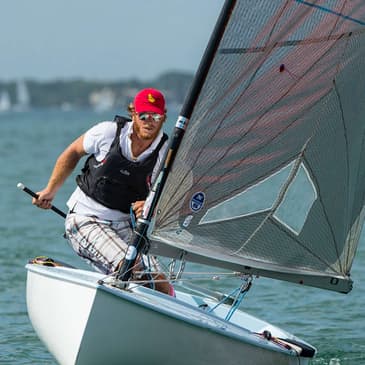
Multi-time world champion Luke Lawrence talks to Sailfaster podcast about the visualization techniques that are a key part of his preparation for top regattas. It’s clearly working for him as his record attests: Star junior world champion (with Alexei Selevenov) and 2021 star Western Hemisphere championships with the great Paul Cayard plus the Etchells North Americans, the J24 US Nationals, the J24 Worlds and in his younger days the 2010 Finn junior world title. Tune in to hear Luke talking about visualization, tuning preferences and how he comes back from bad starts by subscribing to Sailfaster wherever you get your favourite podcasts!
To contact Luke for coaching, call him on 772-260-2437. You’re likely to get his voicemail as he’s always out sailing…
[00:00:09] Hello and welcome to sailfaster. Today's episode goes back to our roots focusing on how top one design sailor's prepare and race and win.
[00:00:20] And I think I can safely say that today's guest to holds four world titles is going to be a great help in our quest.
[00:00:27] And so here we are with the multi-talented Luke Lawrence, who I think is in Portland main right now. Welcome to sailfaster Luke.
[00:00:35] Yeah thanks for having me. Yeah it's great to have you glad you can spare the time. You are in Portland right?
[00:00:40] I'm in Portland main for the lobster ball, which is one of my favorites top of the list.
[00:00:46] The Tality and a fun club and a fun group of people so I'm really glad to be here again this year.
[00:00:52] Wonderful. Luke that said that is a lovely part of the world I was there with my wife a couple of weeks ago. I've been Portland beautiful beautiful place lots of very expensive lobsters.
[00:01:01] So looks of Floridian by birth and these are fourth generation sailor and not surprisingly therefore became involved in competitive sailing from a really young age initially competing in lasers before transitioning to the fin and later the start class where I know Luke you found significant success including winning the inaugural star junior world championships in 2019 with Alexey Sullivan off.
[00:01:27] And two years later with the great Paul Coyard winning the 2021 star western hemisphere championships and you've also have a trophy cabinet full of other things like you won the net actual North Americans, the J24 US nationals and the J24 worlds.
[00:01:43] I also heard that you had won the 2010 fin junior world title coached by the famous John Bertrand. Is that right?
[00:01:52] That is right. There's actually multiple famous John Bertrands. There's the Australian one that took to cut from Dennis and then the one that coached me was the 1984 silver medalist American John Bertrand.
[00:02:09] So two bad asses from the same era of generation and yeah I was fortunate enough to have him help me out in San Francisco which was his hometown and that was a really cool experience to see how he operates out there.
[00:02:26] Yeah for sure I didn't know there were two John Bertrands obviously any of the Aussie one is everybody does. Well that's really interesting you're very fortunate and so luckily for the rest of us Luke shares his expertise as a top sailing coach and I want to talk about that in a minute but first Luke tells about what for you have been the highlights of your sailing career today.
[00:02:49] Look I've been very fortunate to have a lot of really cool opportunities. It's hard to put a finger on one so my default is to go to the boats I love and thank doing it when the star campaign.
[00:03:04] I'm doing a full on star campaign and the one that I put together with my crew at the time Ian Coleman for the.
[00:03:12] I believe it was the 2016 world at star worlds in Miami which was my home where I grew up and to kind of pull it together last second and end up fifth and that regard at home.
[00:03:27] It was definitely definitely coming to top of the list in my mind other than that second second at the actual worlds in Hong Kong you know at the time and for the last few years after it was a heartbreak.
[00:03:42] You know winning the North Americans and getting Ben's Steve Benjamin nominated for a Rolex yachtsman of the year award which he got that year and now in hindsight it was one of the better things that had happened to me mentally psychologically how I approached the game.
[00:03:59] What was different about your approach than how did it differ from previous.
[00:04:03] I think I was just a kid then I'm only 34 now, but I started it's such a young age of that a lot of opportunities to mess things up and see how they actually work now I'm more trying to learn and master the the tranquilo effect.
[00:04:21] Trying to keep everything chill no matter how intense everything is around me all the time or how intense it may be perceived.
[00:04:29] So that was a bit of a turning point for you in terms of preparation and getting yourself mentally and operationally prepared.
[00:04:36] That one we in my mind we over trained for but that was the way Steve Benjamin ran his program, you know and he's obviously he's also got a silver medal in the Olympics and he's he's done a lot of big high quality wins in the last few decades so you know to learn something from that at that level of intensity was pretty cool.
[00:04:58] I mean, I mean, 18 days straight in Hong Kong without a single day off that kind of really put a damper on my my performance ability can't come race day so explain that because you just exhausted by them.
[00:05:11] Just mentally, yeah, just you know needed a day off.
[00:05:15] I just could feel myself hitting the edge of burnout you know before a six day of any even started started with a long trip all around the world and all the way to Hong Kong and then straight into but work and training and sailing on the water every single day for weeks we definitely put it more time than any of the other teams there.
[00:05:33] Another highlight was when in the J-22 worlds in Kingston with Mike Marshall on North Stale Sky and at we've very fortunate to put the put a good team together with Todd Hiller and and be able to go out and win that was my third world title.
[00:05:54] So actually one three out of four of my world titles on or within a day of my birthday.
[00:06:02] So like 20th birthday one the Finn silver cup in San Fran my 24th birthday on the J-24 worlds in Newport with little wells my 26th birthday won the J-22 worlds with Mike Marshall yeah the fourth one fell random.
[00:06:20] You know when we talked a couple of weeks ago you talked about returning to pro sailing what was the why did you take a break there why are you going back now.
[00:06:30] I took a break because I was at a level of extreme burnout for what I was doing and I actually got to a point where I hated sailing like just despised having to go do it every day and for good or for bad I learned a lot from my time off on how I would want to do it if I ever went back to.
[00:06:49] And that being sailing with people I enjoy and then the other part of that is doing the club based coaching for smaller fleets locally and trying to bring a higher level to these guys front door.
[00:07:06] And that all kind of came about because my family and I live full time in an RV so we're traveling around the country.
[00:07:14] Is that traveling full coaching assignments and sessions and things.
[00:07:18] So the way I'm doing it now is we my family and I have a map and kind of a general direction we want to go with with bucket list items and we get a couple months planned out in advance and I go through fine local yacht clubs and go through my roll of decks and just reach out to hey so until I remember him from a few years ago and there and wherever they are close to where we're heading anyway and yeah I try to book it on the schedule and that's usually 10 to 15 boats.
[00:07:47] And I have a fixed price per boat whether it be one day of that or two day event pretty much cater the whole session to whatever the local fleet wants to improve on.
[00:07:58] You know if it's a starting clinic we do starting clinic and a lot a lot more chalkboard stuff and then there's on the water direct tuning related stuff.
[00:08:07] I just did a little combo of that here in Maine Tuesday I went out and had seven atials out of the 20 for the local fleet Tuesday night and did a nice little hour and a half before on the on the chalkboard and then I got to go out in the coast boat and do video and send that out to everybody and then do a nice two hour debrief in the classroom and that seemed like everybody really enjoyed that and then.
[00:08:33] I did a tuning appointment where I go down and I get into the boat and make sure the mass is straight and go through everything and set up in this one for the actual set up to my personal guide and then explain to everyone and everybody got to write it down you know I try to keep it as simple as possible and that's just for myself not just for coaching.
[00:08:55] I think there's a big part of that that allows you to actually go raising the boat instead of worrying about your rig tune constantly.
[00:09:03] So Luke that sounds like an idealistic experience what we can what I'll do is I'll when I post this episode on to social media I will.
[00:09:10] I'll include a link to your self under something so that people can ping you if they're interested in doing what are those sessions with you.
[00:09:17] Yeah, that works perfect. Okay, who would you look at yourself with jump attract but trying the American jump a trend and pull kale but.
[00:09:25] Who do you think has had the most influence on your sailing racing career?
[00:09:30] My mom honestly my mom was my biggest driving force and my biggest support all the way through junior sailing and she she unfortunately she passed away.
[00:09:39] It'll be three years this Christmas finding the fun in the second one I guess you could say with with her support from up above kind of keeps me pushing a little bit harder now.
[00:09:50] She had work ethic like nobody I've ever seen and she instilled a lot of that in the mean all the times I wanted to quit sailing I can't even count of whether begrudging me or not on my on my end I went back to it and I just kept sticking it out and you know I learned a lot of kind of on not only had an navigate sailing in the race course but just life in general. So yeah, my mom was a huge huge influence on on my sailing.
[00:10:16] It seems you have had a bit of a love hate relationship with sailing over the years.
[00:10:20] Yeah, I loved it when I got to do it for me when I got to do my programs the way I wanted to and I ended up in prosailing the first time as kind of a side effect of quitting a limpic sailing after I didn't win the trial and the only way to bank roll Olympic sailing for somebody who's not coming from some pretty heavy means.
[00:10:41] That's financially that you have to you end up sailing with a lot of wealthy guys that would or only willing to donate to your 501c3 and then you end up having to exchange days for enough money to be able to go sail your fin.
[00:10:57] I know all of a sudden doing 100 whatever days of year trying to fundraise and then barely still having enough to sail the fin certainly not enough to play at a high level around the world.
[00:11:08] And then when that stopped after a loss of trials, people kept calling this and they'll pay your regular way if you keep coming sailing on on big boats with us and that kind of turn one thing into another and there you go.
[00:11:21] Who is the best person that you've sailed with and it can be because of that great sailor human being just just curious.
[00:11:30] Well Paul obviously has had a big influence on why I even got into a higher level sailing and why I wanted to.
[00:11:42] When I was a kid the way on the world race came into Lauderdale and I just remember going down there with my parents I think it was 97 98 race and just seeing that boat back in and having everybody around on the dock and then looking down and I just remember saying I want to be that guy and it turns out it was Paul.
[00:12:02] So really yeah so I got pushing and pushing and actually that Paul first on the shockwave program on a mini maxi 72 mark mental black another really talented sailor out of Miami tapped me in for that because he couldn't make it so I got the trim man on a mini maxi when I was like 21 or something.
[00:12:24] Super high level programs so that was incredibly fun you know sailing a boat like that that high performance and Paul and I's passed separated for a little while and then I got into star sailing more.
[00:12:36] My early 20s you know 22 23 we were down there in Miami and I got a decent program together and we went out we had a good regard.
[00:12:46] I think Lars Grail was first we were second and Carrard was third and Carrard came up to stay nice for God and I cut him off and said I will wash your shoes I do not care.
[00:12:56] Just get me on to a big boat program and two weeks later my star crew he had an iron down in St. parts on the bow of the super yacht because he needed a couple of gorillas and we just said yes you know the rest is kind of history we kind of hit it off sailed well together and up in the bucket for a few years one that together on our class and then I just kept pestering them about crew and four men stars I'm a little jealous of freedom right now he's over there hanging off the side of the boat for Paul.
[00:13:23] But I wasn't quite the right way for him. I'm a little light to recall in the world's level way in regard to Paul was definitely a huge influence as far as people to sail with there's so many different aspects of what you appreciate sailing with my brother my younger brother was five far away.
[00:13:42] My most favorite time we went a lot of regards together he did bow for me on the actuals and we just didn't have to talk you know so we could go and flow I wouldn't even count down tax you know I would just go sailing like I was sailing a laser a thin and had my star crew in the middle.
[00:13:58] You can come in and my brother on the bow and that was some of the some of the coolest flows sailing I ever got to do where you just kind of black out for three or four hours and you come in with a bunch of top three finishes.
[00:14:10] So how do you prepare for a gauticism do you think you do anything differently from others?
[00:14:16] No, I think I focused on the basics as the number one priority. I check off that the boat is competitive and you know whether either had the bottom done or properly or is a newer newer boat with all the new toys I checked that off and then next to sales so once I know that the program's going to have the right sales new sales and then third I check off is the crew the crew going to make way easily because I hate running.
[00:14:46] And parking lots everybody does just to just to make way in for one regard. So no and that it's going to be stress free before the regard takes a lot of the edge off then after once those three things are checked off the boat the sales and the crew then I kind of go into a mental preparation mode.
[00:15:03] You know, I started visualizing a lot visualizations a huge part of my method months and months in advance sometimes. So yeah so tell us more about that because I agree it's a really interesting technique that top athlete use.
[00:15:17] I haven't hit them going back months and months. So what does that look and feel like for you when I was doing it when I was younger it seemed like the only way that I could manage to get myself and keep myself in that mode with some level of isolation whether it be from the crew or from just everything around me in a relative sense not to say being anti social but spending a lot of time away from distractions that would otherwise kind of impede your
[00:15:46] mind the ability to go where it can go you know cell phones computer TV all that sort of stuff I think just kind of ways valuable call it mental structuring or restructuring time.
[00:16:02] I'm getting in balance with your way of length and what's going on inside your own head.
[00:16:08] And that was always a huge part and then especially during the regard as like the world championships that we won as a team I spent I never spent time with the team after sailing.
[00:16:20] As soon as we got off the water and everything was done I kind of just went back to my room where I was staying and I don't know I meditated a lot you know and kept myself at the the mentally that I wanted to be at and just eliminated as many distractions as possible.
[00:16:35] Now there's a lot of chatter in the boat park and this and that other people's drama there's no room in my mind or room for that if you're going to you got one goal in mind which is winning world titles.
[00:16:48] So for you this period is about getting into the right mental frame of mind and ensuring you sort of are able to have as much sort of energy and consciousness possible.
[00:16:59] And it sounds like it's less about the traditional visualization which is I can see myself in the boat we're approaching the top mark.
[00:17:08] Is it less that and more about just getting you into a place of sort of calm?
[00:17:12] It was definitely about a place of calm. I mean though that at the end of the day when you're up playing at that level that going around the mark and the sheet angle of the measurements and all that that's all muscle memory by that point.
[00:17:25] If you're having to think about that constantly it's kind of hard to make the next jump.
[00:17:31] So you obviously practice meditation then.
[00:17:35] Yeah it's a practice is a great word for it because there's no switch to be able to just tune in do it or at least I haven't found it yet.
[00:17:44] I've gotten more efficient at it getting in and out of it and I can kind of do it now standing in you know the center of a giant city with all the horns going on.
[00:17:53] It doesn't matter to me I can flip into it and kind of reset.
[00:17:57] And what I'm thinking about in that visualization process and I say months beforehand is I actually kind of do the pyramid upside down where I actually start with picking the regatta.
[00:18:11] I want to win say X World Championship and I immediately write this speech because to me that is the most stressful part of it is having to stand up in front of a group of people and remember to thank everybody and thank the right people.
[00:18:23] And this and that because there's no going back on that you get one shot up there with the mic.
[00:18:27] You know to nail your speech at the end. So to me that was always the most stressful part of a world championship so I just started by crossing that off.
[00:18:35] So interesting that you started with the that final moments in mind that's that's quite amazing so for you it regatta preparation is just getting three fundamental sorts of out.
[00:18:47] Then getting your mind calm getting yourself ready for it to the extent of even thinking about the acceptance speech how that work because one of the first things you do so so interesting.
[00:18:57] And so let's move on to what for you probably feels like the very ordinary part of it which is actually sailing faster than others.
[00:19:05] What do you think that you do that makes you self-assess which obviously you do to one to win multiple will titles?
[00:19:13] Simple answers I had a lot more time in the boat than a lot of people and boats in general.
[00:19:19] I was very fortunate to grow up on a river in Stewart and having the laser behind my house and being able to sail two or three days a week for years and years and years on end.
[00:19:30] You know that kind of took away what I guess a lot of people would look at is is is the things they have to think about you know the hasn't become muscle memory for them yet.
[00:19:39] So outside of time in the boat well there's no real short answer for the end of the day the people that are.
[00:19:46] When in big regatta's in the class that you're trying to win in there's a pretty high percentage chance that they've just spent more time in the boat.
[00:19:54] They've had more opportunity to mess it up than you have is the way that I look at it nobody goes out there and just does everything right at the end of the day, you know you look at Michael Jordan and you see how many shots he missed to get to that one game winning shot.
[00:20:08] So time in the boat obviously really critical I totally get that it's just natural to you you get the feel of boat totally get that.
[00:20:16] But are there any other things that you do differently and in terms of boats set up and and so on?
[00:20:21] Yeah, I think there's a lot of different variables and then in rig tuning and set up I obviously focus a lot on having to boat set up for whatever you think that first beat is going to be not necessarily the whole rest of the race.
[00:20:37] But if you're ever going to get into the front you kind of have to be set up at the right tune for what's going to be coming on that first bit, you know it can make a break.
[00:20:47] Yeah, so I got a couple basic tools like in classes where you can't adjust the shrouds after the start like Jay 70s and the J24 and the J22 and I'm sure the 105 might be the same you're not allowed to touch the shrouds after whatever it is four minutes.
[00:21:02] So I got a pretty basic rule and this works in any of the classes where you can't adjust it during the race.
[00:21:09] So you go out there before and you're sailing in quote unquote perfect conditions, you know there's nobody around you you get to dial in you feel like you've got plenty of power.
[00:21:19] So you set up for that. So my rule that is always suited me well and the J22 and the J24 especially those woke championships was whatever that is that you feel like you're at when you're all by yourself.
[00:21:32] Just automatically come down one step before the start whatever that step may be for your tuning guy just come down one because friction of big class of boats always slows down the velocity of the wind and it's very rare that you're going to be set up in a spot right off the line where you're in that same maximum velocity that you were during the warmup.
[00:21:55] That's always a good rule and then things like the etchels where you can adjust I use other basic rules like it's a lot easier to loosen the rig than it is tightening when you're going up wind.
[00:22:06] So I'll find out where my super sweet set up is before the start when I'm all by myself and then I will leave that with the goal being that I can get off the line get my nose clear and be into that similar velocity that I had during the warmup and put the bow down and go.
[00:22:24] As soon as if I don't have that proper position where my nose is out and clear or say the wind comes down a couple of knots I immediately have my bow guy Andrew dump off a full step on the rig immediately turn it down because there's a lot like I said it's a lot easier to loosen it under load than it is to try and crank those turns back on so that'd be the only variable if you were allowed to adjust the straps in the J20 and the J boat you probably would do it that way as well.
[00:22:48] I love that thought about rule that the rule of backing off slightly.
[00:22:53] Gee back off your chip sheets as well or was it just the tune.
[00:22:56] Just the tune if you're a sailor that uses the marks and that's something that I started doing more and more is using the marks but they're at the end of the day there are relative you say you're tacking on the number nine on your sheet gauge there on the side of the boat and.
[00:23:14] You know you just know that that's a good angle to come out and finish the tack and then you're going to be squeaking it on to ten ten and a half eleven you know the jib marks is always a relative for the condition during that's more just to have replicable settings be close enough but at the end of the day you got to look.
[00:23:31] Through the main either have your jib guy go down the lure and take a look even when you're racing sometimes or ideally you have the main window up there by the spreaders where you can see that leech telltale that leech telltale's kind of mission critical for for upwind jib trimming.
[00:23:47] I'm going to put that as close as you can where before it starts to stall I'm a big fan of a hundred percent flow on the jib leech telltale and as a driver in the star and the actual it doesn't matter I think I'm constantly looking at that telltale to try and speak a little bit more on because it gets rid of the helm.
[00:24:08] That you might be feeling as well as allows you to kind of point a little higher but it's a double ed sort because you get too high or you want some more power and you ease the backstay when you ease the backstay the leech closes on the jib so you got a really work and sync with your jib trimmer especially if you're going through major.
[00:24:28] Major changes where there'd be the traveler the backstay some boats have a master arm that allows you to pre-bend down low which is an amazing tool by the way.
[00:24:38] The actual we didn't have that for the longest time and now that I use it I don't know how I ever did it with the old stairs depth chalks and blocks behind and a big old bungee and it was definitely some evolution that's made the boat a lot more fun to say.
[00:24:52] Terrific so if you being mentally prepared is obviously absolutely vital to this for any athletes.
[00:24:59] Do you do you ever worry about sort of becoming too intense not anymore I've learned how to provide the proper amount of intensity for every situation.
[00:25:07] It leased in my mind I'm a lot better at it than I used to be and that's kind of my goal every day.
[00:25:11] It's just be better than yesterday whether it be about sailing or life you know everybody sat there on the dock at the end of a race whether they wanted or not and thought back to where they gave away 10 seconds here or two seconds here or a second like that you know I kind of.
[00:25:26] Look at life like that a little bit I try to flow with everything whether it be driving in traffic or whatever it is and you're kind of slowly taking little tidbits from where you may or may not have done things right or wrong and trying to use that historical knowledge to flow through life looking forward instead of always worrying about what's behind you but not forgetting that it was there because it's pretty useful to have that little role of the acts of things I mentioned that you messed it up a lot of times before you're really good.
[00:25:56] You have a great philosophy so what about other Luke Lawrence rules you got to have fun at the end of the day we're not out there solving world hunger a lot of people try to take themselves maybe a little too seriously and forget about the basics of why we're all out there and for me I'm out there for fun.
[00:26:14] That was a big thing that kind of shied me away from prosailing the first time was I was just saying yes to everybody that was willing to you know pay me to do it and all of a sudden I got all this stuff on my calendar and I might not actually be enjoying the process you got to enjoy the process of building that team and finding your friends and actually look forward to going out on on your local weeknight your local club sailing and I think that was the that mine.
[00:26:44] That shift was a big part of what's allowed me to build my confidence coming back into prosailing is I know I know how to have fun now and still be able to perform and you know take it seriously but like I said at the end of the day if you're not having fun you're not going to be able to do it for very long.
[00:27:02] So Luke you must have been successful every element of the course in order to win world well titles but is there is one part of the race course that you think yourself here we go I know how to do this part really well.
[00:27:13] Yeah my opponent head that is my most top of the list favorite place to be on the course is in the back of my opponent head where they're thinking about me but I'm not thinking about that if they're worried about you they're not confident in their own abilities necessarily and that tends to lead to snowball disasters when they're worried about other things instead of just the basics of what's going on around them and living in the moment.
[00:27:42] This is the most interesting answer to the hat.
[00:27:45] Give us a sense of how that plays out for you on the race course.
[00:27:49] Well give you an example when I was at the U30 Star World in Miami and that was one I'd already written a speech for in my mind and done my whole upside-down pyramid thing and I was at the boat I was getting ready to go out and I forgot my American flag in the truck for after when we want and I remember casually walking back to the truck and getting it and
[00:28:12] Having it stick out of the you know out from under my arm I had to fold it up. I wasn't like wearing my Captain America suit down the dock, you know, but I had it tucked away and one of the guys who think he was either leading or yeah he was winning the regard on
[00:28:26] He looks over and he sees it underneath my arm and I just saw his eyes go straight down he went fuck and that was it and I was already in his head and he went out and tanked immediately
[00:28:36] I made it crystal clear that there was only one position I was getting that deck. He knew it. I knew it
[00:28:42] Great, great sailor. You know we went to the games and whatnot, but he definitely like I said that ties back to my favorite spot on the course is in my opponent's head
[00:28:51] Because I don't worry about them. You know, I say I pay attention to the points, but at the end of the day that's what they are there a point
[00:28:57] I don't see a face with it. I see a piece of fiberglass and lead between myself and a shiny trophy
[00:29:03] What's your sort of philosophy and the action that you take when you need to recover from a really poor start?
[00:29:10] Yeah, immediately I hit the reset button and I literally I will say reset on the boat. That's my my go to especially when the entire crew
[00:29:19] Start focusing on the things that aren't gonna get us out of that situation and I immediately stopped dwelling on the past and focus on the basics that are they're gonna give you a shot at it
[00:29:44] When they're in a bad spot and they'll tack and they'll duck eight boats in a row right off the line and that's just a guaranteed loss
[00:29:51] Where if you just sat there and sucked it up for another 45 seconds six out of those eight boats are gonna panic and tack
[00:29:57] And then all of a sudden you're clear and you're already ahead of those guys and then paying attention to things like am I going the right way or is the fleet going the right way
[00:30:08] Because they're like Velcro ten boats will sit together and they'll sail a ten or fifteen degree header all the way you know just micro focus on the boat right next to them instead of taking a step back and looking at the big picture I always have a tendency to find my way back out of those situations not necessarily just because of the boats beat even though boats beat helps a lot.
[00:30:31] It's being situationally aware and using the basics of what you know the fleet can and most likely will do and then just how to counteract that and you know sailing is not a sport about who does the most right it's about who does the least wrong.
[00:30:49] And just because you got off to a bad start doesn't mean that 24 boats in front of you aren't going to completely bonehead and go the wrong way.
[00:30:57] You know I've want to raise the star worlds after being 50 fifth at the first top mark just because the entire fleet decided they were going to go one way and it was a huge shift coming from the other direction that you could see three miles out like all the cruising boats turned everything started changing on the other's in everybody just follow each other into a hole and we still around the whole fleet.
[00:31:17] Sometimes you gotta be willing to take a little flyer but those opportunities don't present themselves as often as human nature which is people will mess up and it's okay to mess up just mess up a little less than the other guy and they'll give you a trophy.
[00:31:32] You make it sound so easy Luke when you're coaching what are the most common things you see that need to be fixed when you step on to about the your coaching or a team that you're coaching with.
[00:31:42] Yeah, I think from a coaching point of view I mean once depends on the level of what your your coaching right you know when you get to the local club level a lot of it is just the rig tune.
[00:31:54] You know, I think the mistake a lot of sale maker and salesmen do is they they go around and they try to get new rags on but all the sticks that get local clubs because they see their commission and they see there that but I mean but they don't stick around and help people tune the boat properly.
[00:32:11] Or learn what they're looking for not so much here's a tuning guide but here's how to use it. Here's how to feel it that that's a big thing that I bring when I come to smaller local fleets or even when I get on to.
[00:32:24] So bigger high-end pro programs I mean you'd be amazed at some of the high level stuff or just if they just did the basics a little better.
[00:32:32] They'd be a whole mother a whole another gear you know so sometimes it's that simple basic attitude to bring to a fleet that can kind of completely reset everything for people.
[00:32:43] A lot of people get hyper focused on thinking that those ten boats are the only thing that's happening in the world you know but in reality if you look around you pay attention and you see birds taking a lot of money.
[00:32:54] off somewhere over in island maybe there's a thermal coming you know like looking at the big picture things around you instead of being so hyper focused kind of can make it a lot easier to not be surprised when that big ship comes in like no I saw the airplanes on the runway change direction half an hour ago the breezes coming from over there.
[00:33:14] So it's interesting you said that the sometimes those fundamentals apply to the bigger programs as well as sort of you know club sailors.
[00:33:23] Yeah, I mean I remember getting on some programs you know and you know you end up with all these pros yelling at people and this and that and you know that was probably.
[00:33:32] The biggest reason I got out of protest day on the first time is because I swore I'd never.
[00:33:37] Be that I never wanted to do that when I really enjoy helping people I'd rather go to a small club and coach ten local boats that are in the back of the fleet on the national level.
[00:33:49] Because everybody on that boat all 10 boats you know 30 people or whatever are going to sit there at the end of the day with their notebook.
[00:33:56] And listen to everything I say and I appreciate it.
[00:34:00] So that's actually a great way to wrap this up. Thank you so much for taking the time really enjoyed having you on the on this podcast.
[00:34:07] Yeah, thanks for having me.
[00:34:08] It was a pleasure and thanks to all of you for listening if you like what you hear don't forget to tell your sailing friends make sure you subscribe to the sale faster series.
[00:34:17] You can find it on apple podcast Google podcast Spotify and wherever you get your favorite podcast when you do that to be great if you could give me a good review or thumbs up on the apple or stuff.
[00:34:31] And then let me know as well if there's a gastro topic you'd like us to cover it's very used to find me as many of you have I'm just Pete at sale faster.net.
[00:34:41] Pete at sale faster.net.
[00:34:43] Thank you very much once again for listening and see you out on the water.