
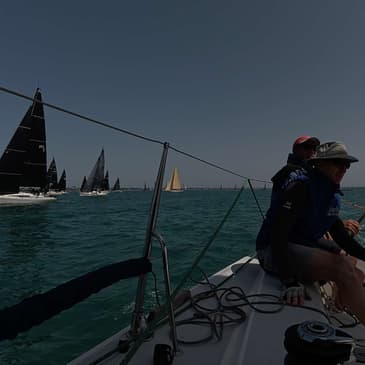
Racing under handicap can feel frustrating—but is your rating really the problem? After joining the J/105 Javelin for the IRC Europeans, I came away convinced that the best teams don't spend their weekends complaining about the rule. They focus on preparation, communication, boat handling and relentless improvement. Drawing on conversations with owner Richard Newsom and navigator Tony Owen, this episode explores how top crews play to their strengths, trust their race plan, build repeatable systems, and keep searching for the next tenth of a knot. Whether you race IRC, ORC or one-design, these lessons will make your team faster.
[00:00:07] Hi everybody and welcome back to Sailfaster. Thank you so much for your emails and messages, I really appreciate them and I love hearing that you're using what you've learned on the pod, it's great. I have attempted to vary the topics over the last few months as you may have noticed. Let me know if it's working or if it's not working and always be in touch with ideas and suggestions as many of you are.
[00:00:31] This episode is going to be all about racing under handicap and what you can do to mitigate your rating disadvantages or perceived disadvantages. So a couple of months ago I was fortunate to get a call from one of the UK's masters of this art, Richard Newsome. He is the owner of Javelin, a J105 that's a well-known racing boat out of the Royal Livington Yacht Club, which in case you don't know that part of Britain is on that beautiful stretch of England's south coast opposite the Isle of Wight.
[00:01:00] It's a spot I know well personally as my parents had a home on the island, which is a quiet, beautiful place that was always a welcome respite after long overnight flights from California. Anyway, Richard invited me to join his team for the IRC Europeans in the spring. I have to say it turned into a really fun and memorable long weekend. The Javelin team made me feel incredibly welcome. The venue was beautiful. The weather was fantastic, although we could have perhaps done with a bit more wind.
[00:01:28] The racing itself was highly competitive. We had JPKs, J99s, J109s, Sunfast in the IRC2 fleet that we were in. But, you know, what I found most interesting was the chance to watch a team like Javelin in action. And it wasn't just their boat handling, which was excellent, but also the way they approached race strategy and tactics. Seeing how they communicated, made decisions and executed under pressure was really fascinating. And I came away having learned a great deal. We all know what it's like to race under handicap, right?
[00:01:57] After almost every race, someone will eventually say it. Our boat doesn't sail to its ratings and its conditions. Or we have an unfair rating. And sometimes that's true. Every rating rule has, of course, winners and losers. But after spending a weekend aboard Javelin, I'm not convinced that's the most interesting issue anymore. So Richard and his crew are quite sanguine about the J105's ratings. The J105 isn't generally considered the obvious choice for winning under IRC.
[00:02:25] Yet Richard and his crew are consistently at the front of the fleet. And what emerged wasn't really a story about handicaps at all. It was a story about how high-performing teams are built through preparation, trust, curiosity, and the endless search for improvement. Let's kick it off with Richard Newsome discussing playing to your strengths as being a key factor in competing under IRC rules.
[00:02:49] So Richard, one thing we talked about was playing to your strengths when the IRC system doesn't necessarily give you a big ratings advantage for a boat like a J105. Sure. It is a struggle, as you saw, in some conditions to reach our IRC handicap. But downwind, we have good strengths. We feel really confident downwind. Our A2 is a wonderful sail. And we're able to accelerate nicely around the windward mark. And often we catch boats right at the top there.
[00:03:16] So the other thing about the A2 is that we can point up slightly higher downwind. That sail will actually, in light airs, run to about a true wind angle of maybe 110, maybe 100 even. And so we can catch a boat, we can put our dilettors over the boat, slow the boat ahead, and then come up to wind with them really smartly, cranking our tack line down and just leaping forward.
[00:03:40] And that's very, very difficult to defend against, particularly if they're a square-kited yacht and we're going in the same sort of direction. They find that very difficult because they can't come up with us. The other time that we absolutely love is a blow. Javelin really comes alive, 25 knots plus. True wind angle, maybe 125, 120. The A5 goes up and we're away. We're away to the races and we're planing. And the rest of the fleet doesn't plane that easily. So that for us is a super strength.
[00:04:10] We're always looking to capitalize on that because our boat speed will go from sort of 9 knots to 16 knots in a few seconds. And if we have a 2 or 3 mile leg like that, we'll be through our fleet and then through the fleet ahead of us as well. So that for us is a really nice point of sailing. So it's kind of knowing your boat, knowing your sails, knowing your crew and trying to put it all together.
[00:04:37] Here's more from Tony Owen, Javelin's navigator, on how to succeed in a mixed fleet. Tony, one of the challenges that I saw on the lowest rated boat in the fleet is that no matter how good your start is, sooner or later, the other boats that start with you are going to overhaul you and sort of push you into a decision corner where you have to tack away from them.
[00:05:01] In one design, if you have a good start and you maintain that speed, you can generally perhaps pull away from the rest of the pack and you don't have that issue. Yeah, yeah. I mean, the toughest part of the race is trying to get yourself in a position where you're not losing a ton of ground before you've barely started the race. It's sometimes just a toss up between going the right way slowly and just sitting in that dirty air or going the wrong way, tacking out and going the wrong way. And either way, it doesn't feel good sometimes.
[00:05:30] I mean, a downwind start helps. We tend to do much better if we have a downwind start because then the boats will still go past you, but at least then you've got clean air and the fleet tends to press a little. And that's one of our stronger sailing points is off the wind. I mean, the IRC system depends on varying conditions and varying courses.
[00:05:56] And one of the things that we find most disappointing at the moment is that race committees seem very reluctant to set reaching legs. We did the Cows Regatta last year, so seven days of racing, and we didn't get our reaching kite out once. There wasn't one reaching leg in seven days of racing. And I think that skews it a little bit. That skews things and makes it a little unfair. For IRC to be really fair, you've got to have a mixture.
[00:06:23] It relies on a mixture of strong winds, light winds, windward lured, reaching legs, upwind, downwind. And once you get that balance, it starts to become, I think, fairer. Does the best-sailed boat always win? Well, the answer to that is probably no. But I've never heard anybody really complaining about the IRC system. I think everyone accepts it as the fairest way of organising mixed fleet races.
[00:06:53] It's certainly a lot better than the other systems we've placed under. As soon as the course comes out, I look at the course, I know the conditions. You get a feeling for whether it's your day or not, whether or not it's going to be a day, whether you're going to be competitive or it's a day you're going to struggle. But coming back to your question about the start, I mean, we will tactically in those situations, we'll look at it. And you saw it a little bit when you were on board. But we make a decision that we know that, let's say, the pin end of the line is heavily favoured. So we know there's going to be a lot of people there.
[00:07:22] There's no point us going there because we know that even if we get the great start, we're going to soon be buried. So better off to move somewhere else on the line and try and find some clean air. Because the clean air really is important, certainly at the beginning of the race, but sometimes impossible to actually find. And you've got to be sailing fast. And we, as you know, last weekend we weren't sailing. We weren't hitting our polars by, we weren't even close to our polars. So that sort of compounded the problems.
[00:07:50] I mean, as the race develops, you find yourself, you're going to decide what you're trying to do. Are you trying to stay as close to the leaders as you can, or are you going to actually roll the dice and maybe split with the fleet, do something a little different, and hope that you get a shift that brings you up? Most of the time, the leaders are in the lead because they're going the right way. And if you go the other way, you probably end up losing more ground on them.
[00:08:20] A big thing for me is that as you're approaching the windward mark, you'll see there's a kind of procession of boats all on starboard lining up for the windward mark. If you're one of the slower boats, the last place you really want to get to is at the back of that line, on the lay line, sailing in everybody else's dirty air, losing more and more time.
[00:08:42] So one of the things we try to do is we try to come into the mark on Port Tatt, close to the mark, which is high risk, because if there's not a gap, you can end up in a really bad place. But it at least gives you the opportunity of keeping clean air until you're at the mark. And that's one thing we do. The other thing is, if you can't do that, is to actually overstand a little and at least give yourself clean air all the way there.
[00:09:09] And maybe there'll be a little header and you'll gain from overstanding slightly. Do you think there's that sort of temptation or, in fact, the imperative to do things differently when you're a low rated boat? You have to do things differently. Yeah, I think you have to do something a little different. Unless you manage to unlock some speed that allows you to stay in close company with the faster boats.
[00:09:40] Richard's first instinct wasn't to talk about what the boat can't do. He talked about what it does brilliantly, which in the case of J105 was heavy air reaching, fast downward angles, that sort of thing. And every decision he made is about getting the boat into the conditions where it can hurt the competition. And that's a really important mindset. Every boat has weaknesses, right? Fast teams know their strengths even better.
[00:10:03] Putting your boat and your team into a situation where you can play to your unique strengths no matter the conditions is the first step. As is knowing your weaknesses, right? You might be fast off the line. But if other boats in your fleet are simply quarter of knots faster around the course and they're going to overhaul you and eventually gas you, you need a starting strategy that keeps you away from the bulk of the fleet in those vital first minutes, notwithstanding the probable narrowing of tactical options a little later on. So maybe knowing strengths and weaknesses is fairly obvious in some ways.
[00:10:33] But have you ever done a considered inventory of those? It's probably worth thinking about. And it's not confined to handicap racing, of course. If you want to be Prima Centipares in one design, it might be worth thinking about that too. The second factor, as always, is preparation, right? I think over nearly 80 episodes of Sail Faster, we've all learned the time and effort that top sailors put into preparation. Here's Tony talking about how preparation helped them win a coastal race.
[00:11:01] The Weymouth race for me was a fantastic, fantastic race because it started very, very light. And we were sailing into it. We had a strong tide on the nose. So we started from cows and you know cows. So we were short tacking up along the beach pretty much all the way until we got to the needles. We were hugging the shore trying to stay up the tide. And that was a very interesting dynamic between me as navigator and Richard as the owner of the boat because we have a discussion pre-race.
[00:11:31] So pre-race, if we know we're likely to be tacking in shallow water, I'll talk to him and I'll show him how far in I think we can go. And we kind of draw a line on the chart and I say, I won't take the boat inside this line. Well, in that race, we spent almost the whole of that windward leg inside that line beyond where I told him we'd go.
[00:11:51] So we did that because we had the opportunity a few months prior to this race to walk along the promenade from cows to gurnard. And it was pretty low tide. So we could actually spot some rocks and we knew the height of tide. So we had quite a lot of data. So we marked up a chart to where the rocks were. And we kind of knew that they were the only rocks that were awash at that height of tide.
[00:12:18] So that gave us a lot of information for that first part of the race. So we could confidently go into water that our competitors weren't going into. And every time you went an extra 10 yards in, you made big gains. So that was the first part. And then further on, we went past Gurnard trying to actually bring the boat through little gaps in the mud banks, being a little bit more bullish, going in closer where we didn't expect to see any rocks,
[00:12:45] keeping close eye on other boats so we could see where other boats had gone. So we kind of used them as our kind of pathfinders. If they went there, they've got a deeper keel than us. So we should be able to go there. And that was going on the whole time. And that was fantastic. And then as we came out of the needles, we were pretty much in the first three. So that's one of my favorite stories, right? Before one major race, they literally walked the shoreline at low tide, noting the rocks that weren't exactly where the chart suggested. They marked everything up, saved the information,
[00:13:15] and later used it to sail confidently in water that their competitors perhaps wouldn't touch. So preparation in their world doesn't begin on race morning. Sometimes it begins months earlier with a notebook, a chart, and a walk along the beach. Here's something else from Tony. Trust your plan. And then from there, we made big tactical error. We went the wrong way. We lost quite a lot of ground. But then we got back onto our execution, our plan. So we had a plan before the race about where we were going to go and take the boat.
[00:13:45] We got distracted by trying to sail with other boats. Our plan is to go right, and then nobody else is going right. So we end up sailing off with the rest of the fleet. And then it turns out that going right was the right thing to do. And so we've done that a few times. But so we went off plan. Then we got back on plan again. The wind picked up. It was 15, 20 knots. It was on the nose pretty much the whole way to Weymouth. And really not our conditions. We like to reach. We're strong as a reaching boat.
[00:14:12] But we were fast, and we got it right. And then we arrived. I mean, it's amazing under this IRC racing system. You've got the boats that are closely rated together. And after nearly eight hours of racing, we arrived at two miles from the finish. And we were alongside one of our main competitors, a boat we often have close finishes with. And so with all that sailing, we hadn't seen them for probably an hour. And suddenly we came together just before the finish.
[00:14:39] And with the rating system, we needed to beat them by, I think, 57 seconds to win. And we beat them by 59 seconds. So we took the win after nearly eight hours of racing by two seconds. So this struck me because it's something every crew experiences. You spend hours planning a race. Then five minutes after the start, you begin reacting to everyone else around you. That's what you do. And Tony was refreshingly honest. They abandoned their strategy. They lost ground. They recognized it and returned to the original plan.
[00:15:09] So good preparation only matters if you trust it when the pressure comes on. And then, of course, there's boat handling. So boat handling on Javelin was truly outstanding. Over the course of three days, we must have made hundreds of hoists, drops, tacks, jibes, mark rounding, starts, finishes. I only remember one screw-up, and that was down to me not ensuring the spinnaker hallowed was free to run. But let's not mention that ever again. Here's Richard talking about boat handling.
[00:15:37] The other thing that was really interesting to me was just the coordination of your crew. I know you have a crew of people who are pretty experienced, but that was really flawless boat handling. And again, when you're a little bit handicapped by the handicapped system, you really can't afford to make any boat handling errors. That must be something that you've really focused on over the last couple of years. We have been working at that and focused on that. And that has been a strength for us.
[00:16:02] So if we can come around a mark and we're putting the kite up, if we can get the kite up 10 seconds before the next boat, we're away. And then we can stretch that lead down the windward leg. And so we've realized and understood how important it is. We've seen some wonderful douses and wonderful raises with the TP-52 fleet in the Solent. And they've come around us and dropped a kite in five seconds. That's just a thing of beauty.
[00:16:29] So, you know, that sets a level of competition standard for us that we've been really thinking about how to try and match or how to get close to that. And that's a combination of me being sensitive to the foredeck and monitoring their progress. The pit, being very careful when they do drop the kite because an early drop or a too fast to drop, the kite will go in the water. And then that's very slow. And then the foredeck, working out their biomechanics. And, you know, I often do it by numbers.
[00:16:59] We do our lives by numbers, don't we? So like there's five big handfuls of the foot in and then we can bring it down. So they know exactly how many, you know, where they need to put their hands. So that's, for me, you know, a part of what we've been doing. We also video ourselves, Pete, as you know.
[00:17:18] You haven't been to one of our video feedback sessions, but it is really, really, really useful to sit and watch yourself helm or, you know, trim the mane or trim the kite or trim the... And it just gives that immediate personal feedback, which we then can take on board, adjust our own behaviours. So I think that video has been really, really important for us. And also having some fantastic boats sailing around us in different fleets, but in similar waters.
[00:17:47] Here's what Tony had to say about boat handling. For every boat, boat handling is absolutely key. But again, if you can minimise the time that you're in transition, if you can minimise the time that you're in the middle of a manoeuvre, that's so important, right? In a fleet where other boats are going to sail faster than you, especially when you come to those convergence points around Mark. But in a mixed fleet, low-rated boat, you've got to get those manoeuvres correct.
[00:18:15] Yeah, yeah. I mean, you can make big gains if you can round tightly on a mark and very, you know, keep your kite up and then spin around the mark very tightly. You can make big gains. I mean, we had a few mark roundings where we did that and we made four or five boat gains. I think the other thing is, I mean, you know, we had that situation where we believed we had an overlap and the other boat didn't think we had an overlap.
[00:18:40] I think that one of the things, when we do it well, we'll have somebody on the bow, you know, waving their hands to say we have an overlap. So announcing to the other boat that we have an overlap. So that sort of thing is important. And I think that the other aspect is context. So we were in effectively an 11 race series. So one of the things we talked about was let's not be OCS and kind of blow it on the first race.
[00:19:08] And then the risks that you might take will increase as you get towards the end of the series. Ideally, you'd be trying to win the series and maybe you need, you know, you need a good result at the end to win the series or maybe you need a good result to climb up the rankings. But that's the time to take this bigger risk where if you get it wrong, you could end up at no point. So the thing I noticed about Javelin, you know, was the choreography. Nobody rushed, nobody shouted.
[00:19:37] Every maneuver flowed. You heard Richard speaking about gaining 10 seconds of the hoist. Tony talked about making four or five boat length gains for a clean mark roundings. These are big improvements. And over a season, I bet they're worth more than a new set of sales. So let's talk systems. Richard is an ophthalmic surgeon by craft. So precision, repeatable sequences, coordination are just second nature to him. And it showed.
[00:20:04] I was really impressed by the sort of standard operating procedure for Javelin that you sent. It was very intimidating, to be honest, just going onto a boat with that. So I tried to learn all the ones I was supposed to learn. I thought maybe I'll stick it in my buy pocket, but it just shows the commitment that you have to, apart from the investment in the boat that you've made, but just that commitment to getting things right. And also related to what you were saying earlier, I thought, I know you focus heavily on comms as well, right?
[00:20:32] Hearing you communicate with those across the boat was really instructive. Well, that's very kind of you. It's something that I haven't always been good at. And your self-assist podcast has emphasized time and time again to be the traffic controller type of it. And that's kind of where we're trying to go with our communication. We're still not perfect. And the forelet will always tell me if the communication is breaking down.
[00:20:58] So we try and relay the communication forward, whatever we're doing. The playbook is something that we thought about, but it's also something that will change. So we're going to change some of our hoist communication after last week's race. So we need clearer timings on the hoist. So we're going to have to put that into the playbook as well. Yeah, it's a learning thing. And that's one of the things with Javelin that I've really enjoyed.
[00:21:24] We're not international racers per se, but we're learning and becoming more competitive. And one of your podcasters said, we're worrying the front of the fleet. And that's what I'll be doing. I'll be worrying the front of the fleet. And a good day will be really competitive. But we still make mistakes and it still holds us back. To be close or close enough to worry the front, I think it's a very nice place to be.
[00:21:50] As you heard, Richard has built detailed operating procedures so every crew member knows exactly what's expected. Tony complements that with technology, routing software, live data and sail crossover predictions. So what impressed me is that neither relies on instinct alone. Decisions are supported by preparation, good systems, clear communication. And technology doesn't replace judgment. It just sort of sharpens it.
[00:22:15] Perhaps the most revealing part of my conversations with Richard and Tony was their attitude to improvement. I think that's one of the things that we love about sailing, isn't it? I mean, your podcast is called Sail Faster. And it doesn't matter how fast you're sailing, there's always something extra you can get. And we always search. And there's quest for glory. Yeah, I look back at last weekend and I know that the boat had more speed. I know that if we could have unlocked the right sail trim, we had speed.
[00:22:43] We probably had speed to be much, much more competitive than we were. And that's what keeps us going, really, isn't it? It's that sort of sometimes you find it, you get it and you know it's there. Other times, other times it's more elusive and sometimes it's very small changes. I think our philosophy is that, I mean, you know that we're a bunch of friends.
[00:23:08] Most of us are retired now, which means that we've got the time to focus on sailing. So we spend a lot of time thinking about it and looking at it. And it's a sort of journey. We started probably 12 years ago and we were at the back of the fleet and it was just awful. And then slowly, slowly, slowly, slowly you learn and you get the boat better prepared. And it's that journey that we really enjoy.
[00:23:32] So even when we have weekends like in Poole last weekend where it doesn't go well, that in itself is an opportunity to actually capture some learnings and say, well, why didn't it go well? And try and move forwards. But I don't think there is an answer to the question of if you're the lowest rated boat in the fleet, how do you mitigate that off the start line? You just have to try and do all the things that you want to do anyway.
[00:24:00] Hit the line at speed, hit the line in clean air. It helps sometimes if the faster boats are a lot faster than you because they're not... They get out of the way. They get out of the way. It's a little tougher when the banding is much closer. You've invested quite a lot in updating, modifying Javelin, which as a prior One Design J105 owner I'm very envious of. What are the one or two adjustments that you made that you felt really made a difference?
[00:24:29] One of the big adjustments was we've upgraded the fall stay. So it's a slightly thicker cable coming into the fall stay, which enables us to put a little bit more tension in the fall stay, enables us to point it off a bit better. So instead of a 5mm, I think we put a 7mm cable in there. But we're not done yet.
[00:24:48] I think we will be taking the roller reefer system off the fall stay and just trying to get that extra bit of pointing from that because we do occasionally get sailed over, even after a good start. And then that's not the race gone, but it's hard to come back from a position where you've been easily sailed over.
[00:25:07] So we're still working at that and working with our sail trim, particularly pointing in choppy seas, how we get a nice, you know, a high angle and a relatively fast, powerful sail setup. We're still working on that. Put a new rudder on. It's so light to touch. New helm, didn't you, Peter, as well? Do you know what I found? It was so light. I found it quite hard to stay in the groove.
[00:25:31] So, I mean, I know you're used to it, but compared to the sort of the barn door that was previously on the J105, it was so much lighter. I think that's given us 0.4, 0.3 of a knot. And I think it's helped us. Wow. It's been a significant improvement. The other thing that we are meticulous about now, I'd say, is the hull preparation. And many of your contributors have said, you know, you've got to get meticulous about the hull preparation.
[00:25:58] So, we now have the boat out of the water before every major regatta. We're, you know, very meticulous about trying to get that hull as smooth as possible. And we've taken advice from boat builders about how to do that. So, the crew is fully committed to that. We polish the uppers as well. So, the uppers get a bit of polish. So, again, we're trying to maximize. Because the uppers are in the water, you know, to a large part of a normal race. So, those are the sort of things that we've looked at.
[00:26:28] We bought some new sails this year. Interestingly, some of them are worked out. Some of them haven't. So, we've got to work out how to use those sails to their best ability. I think the other thing that we've been doing, you're talking about detail. You know, detail planning of events. I mean, Tony's been amazing with navigational detail and meteorological detail. So, we really work at that. And then we do some team reflections and team meetings in the morning. So, we try and set the boat up.
[00:26:58] And we will have an agreed setup for the boat and an agreed plan for the day. So, yeah. So, the communication doesn't have to be so intense on board. A lot of that should be done before we get on board. The only other thing is that because we sail in ILC, we're allowed to have a wider selection of sails. And Javelin won a really, really light airs race last year where we basically anchored several times in the race. You can tell. Tell us on a race. We anchored seven times.
[00:27:27] So, we sorted out our anchor processes pretty clearly. And we have a most amazing Code Zero sail. It's a huge, large Code Zero sail. Nearly the size of the RE2 kite. So, and that, when it gets powered up, it powers up in about five knots to breeze. And that gives us a huge advantage over slightly heavier boats. We're talking about the difference between maybe us and a 109. 109 is over a ton heavier.
[00:27:53] And once we get that sail going, we will float away from them quite nicely. So, as you've heard, this is a journey of fine-tuning processes and systems. And, of course, that never ends. If you want to move from the back of the fleet to consistently competing at the front, as Javelin has done. Every race weekend becomes another opportunity to learn and build some improvements piece by piece.
[00:28:22] So, maybe at the end of the day, it's more about persistence than perhaps perfection. It's also about being part of a supportive sailing community, too. Richard talked about how much you'd learned from William Newton and Andy Roberts, who are two other J105 owners at the lovely Royal Livington Yacht Club. I know that they would welcome any new owners to the small but growing fleet of 105s in Livington. And if you're interested in learning more, of course, I'd be happy to connect you to Richard.
[00:28:52] Or you could, I'm sure, reach out to the Royal Livington Yacht Club. So, by the end of this marvellous weekend, I stopped thinking about handicaps altogether. Of course, the rating matters. Of course, some conditions suit boats better than others. But, you know, listening to Richard and Tony and the rest of the crew, it's clear that success comes perhaps from somewhere else. Knowing your boat. Knowing your people. Preparing obsessively. Reviewing honestly. Trusting the plan.
[00:29:19] And coming back next weekend to try and find that extra tenth of a knot. Tony said something that could almost be the Sail Faster motto. No matter how fast you're sailing, there's always something extra you can find. That's a philosophy worth talking about wherever you race. So, finally, thank you to Richard and Tony and the Javelin team for a fantastic weekend. Thank you for having me. And I do hope to sail with you again. See you on the water.