
Modern sailboats have evolved dramatically—but has yacht racing kept up? In this episode of Sailfaster, Pete talks with Andraž Mihelin, co-founder of Seascape and the force behind the Beneteau First range, and offshore racer Charles-Etienne Devanneaux. Together they explore why today's boats are faster, lighter and easier to sail, yet racing often remains rooted in another era. They discuss the rise of double-handed sailing, the philosophy of "effortless joy of planing," why fun should come before handicap rules, and what the future of sailing could look like. Whether you're a racer or cruiser, this conversation offers a fresh perspective on where our sport is heading.
[00:00:07] Hello everybody. Today on Sailfaster we're joined by two sailors at the forefront of modern performance sailing. Andras Michelin is a lifelong sailor, entrepreneur and co-founder, as many of you will know, of Seascape, the company that really challenged conventional thinking with fast, lightweight, fun-to-sail boats that would eventually become part of the Beneteau First Range. Alongside him is Charles-Etienne Devenot, an accomplished offshore racer and owner of California's
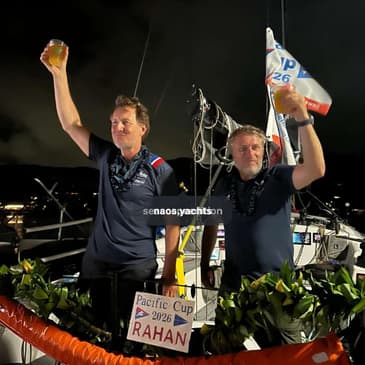
[00:00:37] Neos Yachts. Charlie has logged thousands of offshore miles on first boats and most recently he and co-skipper Fred Kurubble double-handed Rahan has stripped down Beneteau First Series, the smallest boat in the fleet, to second over the line in the 2025 Transpac. Together, Charlie and Andras have spent years asking a simple question, how do you produce exciting boats that make people want to go sailing more often and that give them that unforgettable day on the water
[00:01:07] that we're all looking forward. Today we're going to talk about the evolution of modern sailboats, why traditional race formats may longer fit the way people want to sail, the rise of double-handed racing, and why the future of the sport may be less about sailing around the cans and more about adventure, accessibility and fun. Andras, Charlie, welcome to Sailfaster. Charlie, I know it's early morning in Southern California, sorry about that. Andras, it's late afternoon in Slovenia, you're probably looking
[00:01:37] to go to a little bit more to go to a cafe or something. So, um, yeah. There you go. Watch the world car. um okay, so, uh, let's get into this, right? So boats have evolved enormously over the last 20, 20 years. Uh, but racing hasn't. Modern boats are faster, lighter and more fun than ever. But are we still racing them like it's 1985?
[00:02:03] Well, we do, don't we? One boat is cruising, two boat is racing. So you try to go faster all the time. I don't think the principle has changed a lot. It's still the same. It's just now we go faster between two points. That's what it is. The principle is still the same. We have to ask ourselves what is, uh, we treat human laws as nature laws, you know? So we think sailing, sail racing only exists in Olympic format.
[00:02:31] If you think of it, you know, we use the flags, we use the five for one start procedures. Uh, there is no other sport where, you know, like in running people don't typically recreationally run on a hundred meters or hurdles. They do marathons, uh, because they're personal challenges and they would do a New York marathon or a Boston marathon or whatever, but they wouldn't do a hundred meter sprints.
[00:02:56] But as you pointed out in your opening, you know, we, we don't have this restriction on the product design on how we develop boats, but we, for some reason impose this restriction on how we develop the race formats. You know, to a point where, when America's Cup went from, you know, the P flag to the five, four, three, two, one, zero, which makes sense for most people watching it.
[00:03:21] There was a big uproar, you know, like, wow, this is not racing anymore. This is just bullshit. So, so I think for some reason we tend to be 10 times more conservative on the race formats than we are on boats. And, um, I don't have a strong opinion why, but it just what I observed.
[00:03:38] Well, we talked a few days ago, you, you brought up the point that there used to be this sort of clear pathway in sailing that when you watched America's Cup or the Admiral's Cup or the big offshore events, club racing was the same formats, same keel boats, that sort of thing. So you could see that sort of pathway from your local club racing all the way up to America's Cup. You could recognize it, you could replicate what they were doing on the course, or you could try to.
[00:04:04] Do you think that sailing and racing was sort of healthier back in those days? Was it working? Yes, I guess so. I mean, I was doing the recent analysis of sales numbers for the first range because we have 50 years of range next year. So part of it is understanding the past, even though I want to talk about the future. But, uh, in the first 10 years, you know, from 77 to 87 or around like 90s, there were 10,000 firsts produced.
[00:04:34] You know, mostly there were small ones, but also mid ones like the 30s, 35s. I do believe, you know, there was a natural complementarity of these different disciplines from Olympic sailing. Something I could add compared to the past is when I was a kid, there was a wheat bread, there was the admirals cup, there was the route du rhum. It was the beginning of the Vendiglob. So sailing was a kind of the pinnacle, you know, something to achieve.
[00:05:02] Now it's unfortunately one sport or one activity among so many possibilities. So sailing is just, it's not just for us, it's our passion, but for a lot of people, it's an outdoor activity. And then after sailing, we have this little niche, which is called racing, which is our niche. I mean, as a, again, as a passion, you have the Olympic sailing, you have the offshore sailing.
[00:05:33] Then you have the big races, you have the small local races, and most of them are also becoming offshore because it's less complicated to organize. I see that in the Bay Area, in San Francisco. I mean, every time you want to have a fleet racing, I mean, it's a big organization. And so you have less and less staff to take care of an event. I would like to pick up on Charlie's thoughts, you know. So I agree.
[00:06:03] I think we do have vast, larger competition on other activities. But then internally, the competition also, you know, evolved. So we have foiling and, you know, different types of sailing, which don't overlap. So sailors get split into different forms, like skiers became snowboarders and skiers. And yes, some new people came in because of that. But like all in all, we are not benefiting from that.
[00:06:31] And then the third thing, in my opinion, the one which is close to what I do and where I think we can make an impact is boats became less fun. Like in the old days, old days, like 80s, 90s, 2000s, your racer cruiser was a very fun boat to sail, you know, compared to other boats around you. There were no foilers. There were very little planing boats. So all the boats were displacement boats.
[00:06:58] So to have a well-balanced, well-designed displacement boat and have some pads inside and a galley and stuff, that was the way to go. Like first 40.7 or 36.7, if I stay in our brand. All the Jays or the, you know, there were like good boats around. And that was it. You know, that was like the pinnacle of the boat evolution. If you looked outside, yes, an Erica's Cub boat was a little bit way more efficient upwind and downwind VMG. But essentially there was a keel, the mast, the winches.
[00:07:28] People were going up and down. You had a spinnaker pole. And so everything was pretty much the same. And now I think what started to happen is as the boat for evolving, the handicap systems, of course, have a purpose to keep as many people sailing as possible. Which is fair enough. But what happens is if you want to be competitive in this kind of environment, you have to handicap your boat. You have to cut away half of your arm to be competitive.
[00:07:57] And especially in smaller boats, below 45 feet. And especially with lures. Offshore, it's a bit different. So I think what it's sort of like a negative spiral, you know. One is the environment is not super friendly because people want to have simpler things, not complicated rule books and all that stuff. Then there is internal competition between different like wing foils and all that stuff. And then if you go through all that and you say, okay, I want to race.
[00:08:28] You just cannot afford to buy a very fun boat like a Pogo or something like that. Because you're not able to race with this boat. Because it's too handicapped. I mean, it's too penalized. So at one point you just have to cut it and say, all right, so we're not going to play this game. Which is going to make the best, easiest to sail, most fun planing boat we can design. And then, yeah, we can create versions which can do well in racing.
[00:08:54] But essentially we want to bring people back to the water and enjoy sailing. That's where I see there is room to work, let's say. In the U.S. and everywhere else perhaps, the yacht racing rating authorities really have an impossible problem, right? They're trying to, in some cases, create a handicap system to cover so many different classes of boats today. They could be foiling, planing or plane displacement boats. So that's a problem.
[00:09:20] We had Kenny Reid on the pod probably a year or so ago now. You know, he talked about having to radically change windward-leward sailing. Because those regattas, he felt, were, they were monotonous. It took enormous amounts of time. Logistics were complex. And also you spent a lot of time on the water. But between all sorts of different black flags and waiting for things to happen, you spent a lot of time just sitting around on the water. And he just felt that's just not interesting to people.
[00:09:49] The other factor for me is when you have a boat that needs a full crew, people are really busy. They are the type of people who go sailing. Also, as you know, have other activities. They run, they bike, they ski, that sort of thing. It just makes it pretty difficult. Charlie, you said something really interesting there about San Francisco Bay. And maybe it's easier to organize a coastal or offshore race versus a one design regatta in the bay. That's really interesting. I hadn't really come across that before.
[00:10:18] I see it in California, whatever, San Diego or LA, but San Francisco because it's a windy area. And basically, when you look at the yacht club, you may have on the weekend 15, 20 boats. They are small. They are big ones. So that means you have to organize free classes. Free classes is free starts, you know. And you have to put the buoy in the bay and so on.
[00:10:42] So I see that inshore is fairly easy because you just give one start line and you give a two waypoint and people, they go around and they come back to the bar at four o'clock. And this is also where we see short-ended sailing because, like you just mentioned, it's hard to find today a full crew. So you start to have some short-ended division, you know, like with two, three or four guys on the boat.
[00:11:07] And they just go to turn around an island, a mark outside of the bay. And then they come back and they cross the finish line. They take their own time, which is more and more often, you know, that we take our own time at the finish line because it's just less a problem to organize. I saw an ad recently about this new GPS system for the starting line and for the finish line. And I think that's the future, basically.
[00:11:37] It's going to be like video games. You kind of start or finish whenever you want and you have to beat the best time. Maybe that's the future to give a little more freedom and less constraints to the sailor. We need to make that easier, you know, if we want to bring back people to the sports. Yeah, we had the guys from Vakaros on the pod recently. Vakaros, that's exactly where I was at. Yeah, thank you. I'd like to turn now to the first series.
[00:12:06] And I know a lot of those boats in the first series came out of Seascape. Andras, tell us about Seascape's approach, Seascape's philosophy. And then how did that feed into the current Beneteau first series? Seascape and first is a little part of that bigger story we're talking about. So we realized we don't want to play this double game.
[00:12:31] You know, at one point, create boats where we do a lot of concessions to keep the boat heavy and unstable to do well on Oars Sea. It's a game which is getting more and more complicated with less and less clients at the end. So if you're a niche brand like JPK, you can afford to go, you know, like quick evolution of your model. That's going to always be on the pinnacle of the rule of the rule beating shape.
[00:12:56] But we are now the Beneteau first and the Beneteau first is the mainstream of the mainstream in terms of what were the racer cruisers. You know, 25,000 boats produced in 50 years. I would dare say there is probably the most boats of that type on the market. And therefore, we said, no, we're going to start from a different angle. As I said before, I think we should do the same with events and environment.
[00:13:22] We said, all right, we have this design brief sentence, which is effortless joy of planing for everyone. You know, so everything we do, we see, does it support this claim? And it's a very precise claim because effortless is key because it shouldn't be too complicated. Joy of planing, it should bring you joy. So it's a combination of many factors that have to be built in the boat, including the interior and this kind of stuff.
[00:13:49] And then there is the for everyone, which means we have to be really careful about the costs and about the compromises we do in terms of technology. It's easy to make a carbon fiber planing boat that's also easy to use, but can you make it affordable? So that's pretty much where we are at. You know, we tried that formula on the first 30. I think that the boat I'm most proud of at the moment.
[00:14:13] And that was a combined effort between, you know, all the Benetton's know-how and relationship they have with the suppliers and industrialization. You know, they're super good at that. And then linked to the agility and passion of our team here at Seascape. And it turns out that if you do a boat like that, even in a market which looks to be dead and not moving at all, people still want it. So it seems it's not the people.
[00:14:41] It seems that we are not doing our job, the boat producers and the race organizers and the clubs. You know, if I expand it, you know, to what we are talking about. I think it's not the problem that people change that much. It's just we fell asleep on the wheel. So it seems that that philosophy fits really well with the Benetton first series. We are very good at effortless job planing at Seascape. And of course, we are doing smaller boats, but they were really a little bit more high tech.
[00:15:10] They were a little bit more exclusive. Even though with the 18s, we managed to sell 700 boats. So that's something. But we have this vice of over-engineering and overthinking our boats because we are passionate. We are like a light version of Charlie, I think. You know, Charlie is, I love to have Charlie as our dealer and also having the 36 because he's the essence, I think, of what we are at Seascape. And, you know, it just keeps us, I think, on the course. We don't lose it.
[00:15:39] But then what Benetton brought to the table was this sort of grown-up stuff, you know. So how do you make it for everyone? And therefore, I think we unlocked something. I mean, we created something which is really remarkable. And now we have a platform and now we can build on this. We can go up, down, sideways. I have a friend who sails on Lake Geneva, a very experienced sailor, who bought the first 27. It took him, I think, about eight months to get delivery.
[00:16:08] But he was so excited for months about that coming. So it was really infected with the enthusiasm for this boat that he hadn't even seen yet. So it strikes me that it's working. These boats do have a sort of a sense of excitement around them. Yeah, this is, for me, the best part. I'm just going to say that. For me personally, you know, when you have a brand which is so well-defined, which is so narrow in a way in what we are selling, you know, which was having joy of selling,
[00:16:37] sure, we race as well and we win races and we're happy. That's not why we do it, essentially. And then this connects people in a way that... I'll give you an example. We did the Fastnet race a few years ago, the 2023. So we had an owner who had a 36 and we said, let's do a Fastnet together. Then we gathered eight guys from eight different countries. We never sailed together on a boat and we did the 23 Fastnet, which was really shit.
[00:17:03] I mean, the weather was obnoxious, especially on the start. And because we all come through that filter of this, you know, like, let's call it the brief, you know, of this prison. I mean, there was zero problems on the boat. It's not that we didn't have disagreements, but there were no assholes. It was really people sincerely passionate about sailing with egos, which are in check. You know, they don't have to prove themselves. It's such a gift. And I think everybody enjoys that, you know, who now enter the first range.
[00:17:33] I think they enjoy that same privilege. A question for both of you, really. Is it important to you that these boats can win races? I mean, the first 36 won the Middle Sea race, as obviously you know. Even if racing is not the primary message, is it still important that they perform well on the race course? It is important. But for me, it is not the priority. Today, if you want to bring back people on the water, you have to propose them a boat that is simple and that is fun.
[00:18:02] And then with the fun, they will start again. Like I was saying, one boat is cruising, two boats is racing. If you have a fun boat that is going faster than your neighbor, then you start to think about racing. Racing has been in a lot of sports. The competitiveness has been killing the sport because it became too expensive. Because in our sports, you had to buy two general. You had to buy five spin acres.
[00:18:31] You had to buy the whole set. If you wanted to win, you just had to spend thousands and thousands of dollars just to be competitive. So when we come back to the first where we try to, it's not a one design, but we try to have a simple boat. Let's take the first 30. We have one main, one fun in jib, one jinnaker and one spin acre. And you call it of the day. Simple boats and just having fun. And then if you want to go racing, you go to the next step.
[00:18:58] That's what I have done with my first 36. And then you just unleash the beast, you know. You start to change and upgrade. The manufacturer provides a fantastic base. And then depending on what you want to achieve, you start to upgrade and go racing. Again, I understand, agree with Charlie. I think it is more about the sailor than the boat. So racing is a very undefined term. We also have to acknowledge that.
[00:19:27] So for me, racing is one design racing or box rule. I think that that's racing. Everything else, it's whatever we call it, club racing, whatever is an activity on the water, which most people take too seriously, in my opinion, for the actual fairness of the competition. Because as you said, one number, which is equalizing a 30-year-old or 50-year-old cruiser
[00:19:51] with a modern high-performance racer in wind conditions, which vary from, you know, on the race field. So it's just, we have to just take into account that's not the same thing. You cannot compare it to one design racing or to this kind of stuff. So in my opinion, myself, you know, like Charlie, I'm a racer. So whenever I'm sailing any of our boats, I want to win. And I don't want to be on a boat, which is, you know, I raced on a pogo.
[00:20:21] And that was depressing because you knew that with the rating you had, you had minus 10% chance. So, yeah, I think for me it is important, but not, we shouldn't be constrained building a boat around it if you have to compromise. And therefore we have the SE range, you know, which actually Charlie started with the modification of his first 36.
[00:20:45] So we said, okay, today it's very hard to make a boat, which is a fun boat, a racer cruiser and all that stuff. So let's split it. So let's have a very fun boat to sail easily, effortless joy of planing for everyone, which can do races if you optimize it. But let's do the real boat for racing, which has a better handicap, which is faster, which has all that stuff.
[00:21:10] And then you have what we call the TP36 from Charlie, which can do crazy stuff on the trans pack. Or, you know, is getting 10 seconds per mile benefit from a normal first 36, even though she's more than half a ton lighter. So we like to play this game, but in a little corner where the fun should be. So guys, if the first half of this conversation is about how sailing has changed or racing has changed,
[00:21:37] the second half needs to be about where we think it's going. And that question for me is to you guys is why is double handing exploding or has exploded in Europe and is really starting to catch on in the US? What's going on there? Well, what we can see from a dealer standpoint, and I am a club member, the members are aging. Some people are getting out of racing. It's more and more complicated to get a crew.
[00:22:05] So that's, I think, one of the first reasons that double handing and short handing is starting to develop a lot because it's hard to build a crew. And having done some race to Hawaii or in Australia, just to gather seven or eight people on the boat is expensive. And being only two is less expensive. It's only two flight tickets to come back to Hawaii instead of eight. And for many reasons, and I don't think it's only the budget.
[00:22:32] It is also because it's hard to build full crew. If you look at the Transpark or the Pacific, back in the days, 10, 15 years ago, I mean, it was only fully crewed. Boats, you know, the sleds, there were like 10, 12, 15 people on the boat. And today, the biggest class are going to be in the 45 feet range because you can go to Hawaii with only seven people.
[00:23:00] And when it's become more complicated, then you take under 40 feet and you go double handed because it's easier. We like to challenge ourselves. We have less time. So when we're doing an experience, we want it to be more intense. And being shorthanded, it is more intense than being fully crewed. So I think all that together results into what you observed.
[00:23:25] Yeah, I think also that you boat builders have designed boats today that you're able to double hand or shorthand, where in the past it just wasn't possible the way that the boat was laid out. I think that's a key thing as well. The other thing about shorthanded is that you get to do multiple jobs, right? You're not stuck doing bow or stuck doing jib trim or something like that. You have to be... Or meet on the way. Yeah, yeah.
[00:23:51] So Charlie, tell us about the modified First 36 that you took to Transpac and you did hugely successfully in that. I know a First 36 is equally capable of having a full crew or shorthanded. So it's not exactly designed purely for shorthanded. But I'd love to know how you modify a 36 flat. You talked about unleashing the beast. So what was that about?
[00:24:14] So first, my best friend who is racing with me, Freddie, this year is going to be our Transpac, our Pacific Cup number nine together. And he's a naval architect. And he's also an aerospace engineer. And it was always our dream to one day to build our own boat. So it's too complicated to build your own project. Now, we have actually done a couple of designs together, you know, for our boat.
[00:24:42] And when the first 36 came out of the box, we were like, you know what? That could maybe be a good base. And then we talked to Andras and said, oh, could we make a special version for us? And we asked you, could we remove this? Could we remove that? Could we do this? Could we do that? So it's like Netflix, you know, you have like a few seasons. So the first season was Seascape. Can you build us the boat without this, without that?
[00:25:10] And make it lighter. So that was season one. Season two, we asked Marichal to build a special carbon mass with light speed rigging to save a lot of weight on the rigging. And the boat came in with basically nothing, no steering system. And we basically started to fit the deck because the boat is originally made for a crew.
[00:25:38] And we make it to be fully double-handed. I mean, the cockpit is so concentrated in two square meters between the eight winches and the steering. And then Freddy designed the kill to get way more power in the boat, especially on reaching. And that was season one. A light boat with more power due to a higher aspect ratio of kill and rigging.
[00:26:08] And then that was last year. And during the winter, we did season two or season three. We made some new orders and modified the bow to be like more like a IMO car type, you know, with a spatula just to help the boat to bounce back when we were on planning. Because we were reaching a couple of high speeds like in the 20s.
[00:26:36] And the boat would not fly as a third wave because we had a little more too much buoyancy on the bow. So that's how we unleashed the beast. We gained about 800 kilos. But our writing moment was increasing by something like 20 something plus degrees. We actually cut the sails this year to save on handicap. And we because we had too much power on the boat.
[00:27:04] And at the end of the day, what we just want is to have a fun boat. And the boat is fun. We were not looking too much about handicap. We were just looking at how we can make the boat faster. So this year we designed a new a new staysail. Some we cut the sails. And something I didn't mention is that we also make the bow sprint one meter longer, which is also a big improvement.
[00:27:34] So we did not really increase the sail area. We actually decreased it. But we made the boat easy to sail, double-handed, and also fun to drive and fun to sail. And, you know, the best thing is that it's sort of what I always dreamt about is this loop between a producer and a passionate racer owner, where a lot of stuff that Charlie did ended up on the 36 SE, which we are selling.
[00:28:03] It is not as extreme, but it is pretty extreme. You know, we do have a paint inside Charlie's boat that it's not painted inside. But we do have a two-meter bow sprint like Charlie and a spatula bow and all this stuff. So for me, you know, that's the best part where we don't have the budget or the resources to afford the, let's call it the R&D stuff that Charlie is doing.
[00:28:32] But, you know, with some sort of partnership, we can develop our boats to its full potential. Like he said, unleashing the beast without restraints and then offer it to people who want it. And when we came up with this 36 SE version, Seascape Edition, we sold five boats, four boats from the block. And then, you know, they go on. So I guess, you know, what I want to say is going back to my original statement.
[00:29:02] I think if we do our job, you know, if we create boats, which are fun to sail, which are amazingly fun to sail, then people will buy it. I mean, there is a video on the YouTube from a colleague of mine, TIT doing 20 knots on a 36 SE. So basically, we joked with Charlie, if the 36 SE is the Porsche 911 GT3, you know, he has the RS version.
[00:29:30] And we just have the GT3. The Le Mans. The Le Mans. Yeah, exactly. But, you know, you see that video and it's clear. I mean, there's two guys being completely like in control and calm and they're not professional racers. And they're doing 20 knots on a 36 SE looking like a Volvo Ocean Race stuff. And it's a boat that you can buy from Priceless. It's not a custom or semi-custom racer.
[00:29:58] So that for me is why I love to do what I do. And I think that's what more producers should be doing, I think. So before we wrap up here, I've got a question for you because you're both, you know, innovators in our sport. If you could change one thing about the sport of sailing today, what would it be? I'm afraid it's not one thing. I think it's almost everything. Yes, we picked up on double-handed, more offshore, more, you know, adventure racing more.
[00:30:27] But I think this is just what we already see. These are the known knowns or how is it, you know. So I think there is a lot of unknown unknowns around. Nobody really tried millions of things. We are all stuck with the Olympic format of, you know, the rules of racing and all that stuff. And I think then you have the extremes like SailGP, which is doing their own thing with their own rules and all that.
[00:30:56] But that's so niche, you know, it's so hard to connect to that. And while everything else is, again, it's Olympic sailing. And I don't think that works in any shape or form. So, yeah, I think it's boats, it's the format, the teams, how we put them together is the, I don't know. I don't have a good answer except that we have to focus on the sailing experience, you know,
[00:31:25] in connecting people with the sea and the wind. And if we have good boats, that helps. If we have race formats where you can see a sunset in the morning after like a hard racing overnight with three other, four other boats, I think that's better than fixing your boat after a collision on a windward lured course. You know, like I think there is a lot of this stuff which just fits so much better with a modern man or woman.
[00:31:56] And I think the clubs should be pushing on that more. And I'll leave you with what I saw in Denmark. You know, Denmark hosts the biggest single-handed race in the world called the Silverrather. And that's a race that started six years ago or seven years ago. It might be 10 because I'm old and, you know, the years are compressed. But it's a new race. We started with 10 boats on the year one. We joined with our boat with Seascapes on the year two where it was 100 boats.
[00:32:25] And now they have a limit of 400 boats because that's how much they can stuck into the harbor. And it's sold out in, I think, like two minutes. You know, it's like the fast net. And the beauty of that race is that it's extremely simple. There is an island which is about 140 miles around. You start from a port. You finish at a port. The only thing is you go clockwise or anticlockwise. You have groups by size, no rating. So just by length.
[00:32:53] And you would think that's stupid because it's not fair. But handicap racing is not fair as well. So at least here you don't have other stuff. And it's amazing. I mean, it's just people keep coming for that. I think it's really like New York marathon. They come to finish this lap. And then if they win, they win. If they don't win, they don't win. And so it's a race that was created from the air by Morten Brandt, a Danish journalist.
[00:33:19] And from something which was basically a dead racing scene, it's this huge event where the whole city is now behind it. And so I think that's what I'm talking about. It sounds a little bit like the three-bridge fiasco in San Francisco Bay, which is an older race. But they got a huge, huge turnout of both sides because it was fun. It didn't really matter for 90% of the people what result it was going to be. It was just being in a beautiful place, doing it together.
[00:33:48] So I love that. The other piece that's interesting in terms of the evolution of the sport is you look at places like Southern Florida or Florida generally where sailing is, there are some real hotspots there, especially where young people are doing sailing there. So there's lots of hope for the future. But look, thank you so much for spending time with us. I've really admired both Seascape and the Bellatose first series from afar.
[00:34:15] I've never owned one, but definitely an aspirational boat. I love where you're going. Come sailing on the West Coast, you know? Yeah, I need to move back to, this reminds me, I need to move back to San Francisco at some point. But yeah. Planning under the bridge in the afternoon at the tide. That's always something, you know, like... I love that. But for me, it was beating up towards the bridge on a winter's day. That was frigging miserable sometimes.
[00:34:45] But then you do the turn and you, you know, you come to the top mark and then you'd come down. And it was sunny and warm and beautiful. And the city unfolded as you went down. It was completely different than whether you're going upwind or downwind. But lovely, lovely place to sail. Thanks for having us, Pete. You know, like talking boats is my favorite thing. Almost my favorite thing. So thanks for giving me the space. Total pleasure. Great. Thank you, guys. Take care. Thank you. Bye-bye.
[00:35:15] Bye-bye. Thank you.