
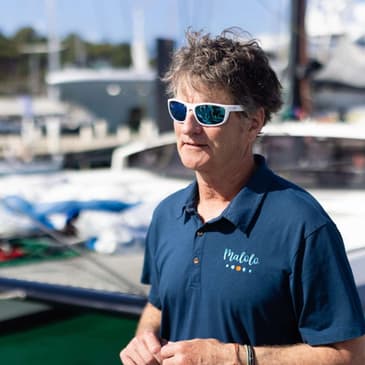
Tom Kassberg's the owner of Malolo, one of the fastest performance cruising catamarans in the world, with victories in the ARC and class honours at the Caribbean 600. In this episode, Tom joins Pete to unpack how he built a championship offshore racing program from the ground up—from choosing the right platform and assembling an elite crew to developing boat-specific performance data and making high-pressure decisions at sea. They also discuss the unique demands of racing high-performance multihulls, managing risk at speed, weather routing with Vendée Globe sailor Will Harris, and why preparation, teamwork and continuous learning are the real competitive advantages. Please forgive the dodgy sound quality!
[00:00:05] So, here we are again. It's me, Pete Boland from Sailfaster, the podcast for those who obsess about sailing a little faster than anyone else. Thank you for your kind feedback over the last few days or few weeks. I'm so glad that people find it useful. My aim is always to have from every episode some takeaways that you can perhaps utilize on your next race, whether that's a Friday night beer can, a four-day regatta, a race across an ocean, or around an Olympic course.
[00:00:34] So I hope that works. So on Sailfaster, as you know, we talk about what it takes to perform when it counts. And today's guest has spent years doing exactly that. Tom Burnham is a West Coast-based biotech executive with a long track record on high stakes environments like that. And he brings that same intensity and focus to sailboat racing.
[00:00:55] Tom's the owner of Malolo, I hope I'm pronouncing that right, a race-winning Marsodden ORC 50 that he campaigns in the Atlantic and the Caribbean. We're going to chat about decision making under pressure, sailing a high performance catamaran, reading sea and weather conditions, and building a crew that can execute when everything is on the line.
[00:01:15] But we're also going to unpack how Tom built his catamaran racing program from the ground up and what it takes to go from a perhaps non-traditional entry into the sport to competing at the highest levels. And how that journey led to Malolo dominating the Atlantic and the ARC recently and going head-to-head with top multi-holes in the big Caribbean 600. So Tom, great to see you. Thank you so much for joining us.
[00:01:39] Great Pete, thanks for having me on. I'm an avid listener so it's truly a pleasure to be here and actually talk about my experiences and share some of what I've learned along the way. We go back a few years. Our boys, when they were very small, were at elementary school together in Northern California 15 years ago or something like that. It's hard to imagine our kids are both in their 20s I think now, so it's been a few years.
[00:02:05] What does it take to build a racing program that can win things like ARC and go toe-to-toe with the best multi-holes in the Caribbean? You have to have a pretty clear vision about what it is you're trying to achieve, right? And so mine sort of, I'm sure we'll get into this a bit, developed from early experiences sailing tri-marine or multi-hole in the race to Alaska. And sort of built on that, realized that I wanted to advance my sailing to the next level.
[00:02:32] And for me, kind of where I was in my career, my life, I had sort of one more shot at sort of doing a serious bigger boat program. And it was obvious to me from my experiences that that should be a multi-hole. So then that became the search that I undertook to understand, okay, within that world, does the highest level racing go on? What type of boat should I be considering?
[00:02:56] And sort of started a whole search really around building a program, but starting with the boat, the location, where we would be sailing and racing. Where is the most competitive place that you'd want to race and sail? And then, you know, thinking through all the elements you typically talk about that sort of follow from that boat, the sails and sail performance and crew and putting that all together. I think it was really having that vision and then the commitment to kind of work through that. And I'd say the other thing is I didn't undertake it alone.
[00:03:26] I think it's very tough just to say, okay, I'm going to do this. I had, you know, kind of trusted partners that kind of helped me through this, helped me evaluate the different boats, the different manufacturers, think about all the different things that we're going to talk about. So it was kind of a combination of those things, but starting with kind of a clear vision about what I wanted to do and then sort of laying out the steps as you would and how are you going to get there? I know you're very active in the racing world in San Francisco, but did you grow up sailing?
[00:03:56] You know, I'd say it's one of the things that I think about when I listen to your pod. A lot of the folks that come up particularly into pro sailing and were very excellent amateurs come up through the college sailing ranks. And my experience was kind of opposite to that, maybe more typical of some club racers, right? I didn't really start sailing until my 20s. My first sailing experience actually was in England, believe it or not.
[00:04:19] I was on a small dinghy that my dad had purchased and we dropped it into the River Thames and went back and forth. I think really where I got into sailing more specifically, I went to college in, you know, the wheat fields of Minnesota. There was no sailing going on there. But my parents had moved to Puerto Rico. My dad lifelong had wanted to own a cruising sailboat and he bought a sort of traditional Cape Dory 30 that we kept in Puerto Rico.
[00:04:48] And then he allowed me to take that to the Virgin Islands and sail all around. And then I moved after college to Connecticut. And Connecticut, as you know, Long Island Sound is kind of a great place to land if you want to get into, you know, big boat racing. I got connected there with, ended up being a work mentor, but also the first sort of team that I raced with on Long Island Sound. He had a succession of boats. The position that I dropped into, as many young people do, was Fordec.
[00:05:17] And so kind of my approach was, okay, you know, I don't know as much as I'd like to about the tactics and strategy and all the things that happen at the back of the boat. But I kind of focused on where I could contribute, right? So I thought Fordec, I was reasonably athletic. I didn't mind getting wet. I didn't mind getting yelled at. Basically, that was my early racing experience. I did a number of Bermuda races, Block Island race, Halifax race. Wherever I could, I'd jump in and try to get on boats.
[00:05:45] But it was always sort of starting at the front end of the boat. Somewhere in my mid-20s, I moved to Hong Kong for work. Got plugged into the Etchells racing that was out of the Royal Hong Kong Yacht Club. I ended up sailing with the team there for about three seasons and sort of got my feet wet in the One Design world. See, Tom, when we were both at those preschool fundraising events, I didn't know any of this. I wish I'd known that. I could have had some good conversations with you. Yeah, no, I've thought about that, Pete.
[00:06:15] I knew you were a big windsurfer. I never talked to you about that either. Well, we're doing it now. So very often I found that the sailors have that engineering mindset or a planning mindset. You're obviously driven, self-directed, and curious as well. Do you have that engineering mindset? Yeah, it's a great question. One I've thought about, because that's never really been a strength of mine. You know, I'm very much more in the planning, organizing, strategy. You know, I think those are strengths and things that I do with my work.
[00:06:45] And where I found, like in my current program, I try to attract those engineers to my program. People that want to re-engineer the mainsheet system or, you know, are constantly trying to figure out things on the boat. I find that's a good partnership for me. But it's not, you know, in some smaller classes like the 505 as an example, right? You need to be an engineer. You're constantly tweaking and adjusting and fixing your boat. That isn't my strength. Maybe partly because it takes a lot of time.
[00:07:13] And so my energy I have and time I have, I try to put into the actual sailing and organizing of the sailing of the boat. And then hopefully sail with people that I hugely respect that are more of these engineering types. That makes sense. I had skipped over that part of you doing one design. I think you told me you were on Melchized as well as J-105, right? Yeah. Yes. My first boat ownership or program was a J-105, similar to you, right?
[00:07:39] So I moved to San Francisco, I think in 1995, 105 class was just getting going. I had like boat number eight or something in the bay and talk about like building crew and some of the challenges. But I moved to San Francisco. I didn't know anybody. And I bought a boat. I'm like, okay, who's going to race with me, right? So I started, I think I advertised in Latitude 38 for crew. You know, that's the kind of thing I, and talk to people at work and put together a crew, but it's kind of a little bit backwards, but I'm sure you can relate to that.
[00:08:07] And then, so I did that for about eight seasons, got better and better at it, but really started at the bottom. I was that probably marshmallow that people talk about you want to start next to, right? I really wanted to get better. So I kept working at it and kept going with it. One of the things, and you know this too, the limitations in the 105, you can't sail with pros, right? It's an amateur only. I stepped down first into the Melges 24, which is, you know, a smaller crew. You are allowed to have a pro.
[00:08:37] And I felt like that was a better learning platform at that point, right? To get my sailing to the next level. I did that for about two, three seasons. One thing I don't like about the Melges 24 is, you know, if your crew hiking on those things is pretty uncomfortable and, you know, they're great boats otherwise, but it's just, again, a little bit hard to entice crew to go hang out in the bay. And I stepped down to the Melchized 24. I crewed for a friend of mine in Florida. I came back to, this is an amazing boat.
[00:09:06] Only three people, legs in. It had a lot of advantages. So I bought a Melchized 20 and did that for about four seasons. That's probably where I got, you know, the biggest learning curve in terms of one design racing, strategy, tactics, rules, you know, just constantly learning. But the commitment there, you know, living on the West Coast is all the racing was, you know, Charleston, Florida. So constantly traveling was the downside. But I had two crews, so it was very easy to coordinate. I really enjoyed it.
[00:09:34] My last sort of one design was J70. I bought a used J70 and did the worlds in San Francisco and, you know, kind of moved with the fleets as they went in and out of fashion. But, you know, that grounding kind of gave me a lot of experience in big fleet starts and tactics and driving in particular. My focus for me was to become the best driver that I could be because at least I couldn't do everything. And so that was my focus. And I think, you know, that's been my continued focus, even with Malolo.
[00:10:03] So, but that's kind of how I went one design. And then this thing happened of the race to Alaska, which opened my eyes and put me on a different course, right? You picked this very large, very sophisticated, very fast catamaran as your platform. So I'm just curious about that. And you started off by saying that the race to Alaska was the thing that perhaps triggered that for you. I never thought about multi-hauls as something I would ever do, to be honest. I mean, I was always thinking traditional, more racing, performance-oriented mono-hauls, right,
[00:10:33] would be something if I stepped up into a bigger boat. My former bowman from my J105 days had this desire to do the race to Alaska, had tried, I think in 2017, on an open multi-23s, a small trimarang. And they had to abandon the race. It's hypothermia, log strikes, various bad things happened to them. And they concluded that to do this race, they needed a bigger boat and maybe need someone with some financial capital as well to help.
[00:11:00] So they approached me and talked about this race. And I immediately said, that's outrageous. I need to do that. That's really cool. And we started then, we put together a budget, budgeted like 75K for a boat, 75 to 100K to a boat. There were three of us involved as the partnership. We did a global search, basically, just looking for the right boat. There were boats that, like the Sea Cart 30, but it didn't fit our budget. So we ended up finding this very much like a mini Orma 60.
[00:11:27] It's kind of a Franken boat in a way that was in New Zealand. And then we brought it back to actually up to Canada. And that was my first multi-haul experience, stepping on that boat when we took delivery and the first sail. And now the way I think about it is, this is super cool. You know, we're ripping around in the high teens, just learning the boat. It's just fantastic to sail. It had a, you know, canting mast. It had sea foils.
[00:11:57] You know, it's kind of a miniature version of an Orma 60. As I mentioned, so you had all this complexity running backs and you sail shorthanded. So there's like great learning curve and a lot of excitement for me around just that experience. We would, you know, sail in races against 50-foot boats. There'd be three of us on this primer ring and we'd sail by them, right? And I mean, you sort of, I'm laying on the tramp watching all these guys hiking. And I'm like, this is pretty cool. Yeah, to me, that opened my eyes.
[00:12:26] And then that experience, I developed a close relationship with Duncan Gladman, this Canadian sailor racer who's a multi-haul specialist. And then that kind of led to, okay, I want to do another bigger boat. It was just natural to look at multi-hauls. And we went with catamaran because there's, I think, more opportunity there for cruising and racing. Catamaran still tend to be a little specialized, I think. So we focused on catamaran.
[00:12:52] One thing that you and I were talking about a few days ago, which is the obvious thing, is that heightened risk that you have with a catamaran at speed racing. I just read an article in the Financial Times a couple of weeks ago, and I pulled it out again. It was Alexia Barrier, who, she has an all-woman team who just finished the Jules Verne around the world race. And she was talking about in one of these multi-hulls, if you make a mistake, it's the end.
[00:13:19] And you don't just, you know, you capsize, but it's the end of the entire program. Was that something that took you a while to get used to? Yeah, no, absolutely. So... By the way, I'm sorry to start off with risk rather than the joy of sailing at very fast speeds with stability. You're starting at the right beginning because that was my trepidation, right? It's like, you know, I didn't like that idea.
[00:13:45] The exact concept you just described, right, that you make a mistake and your boat's upside down. You know, that's kind of the end of things, right? And big insurance mess and life-threatening potentially. I think it's absolutely true. Multi-hulls require a much higher level of diligence to be safe, right? And the problem with multi-hulls generally is not when you're cruising, right? I can take Malolo shorthanded and big breeze and waves and be very comfortable and very safe. You shorten sail.
[00:14:13] You still, you know, do 12, 15 knots. You know, you're still going to be moving through the water, but you're safe. The problem is that I've learned is that when you're trying to push the boat, right, trying to push for performance, because then by nature, you're going to be on edge at some points of sail or at some moments in the race, right? Because that's what you need to do to be at optimal speed. But that also puts you in kind of sometimes in a risky position.
[00:14:39] We raced about three years on Dragon, which is the 34-foot trimaran that is up in Canada. We did a bunch of races. And to be honest, the first year, extremely nervous about, you know, just going out on that boat on a breeze. I think we all were. But what we learned is, is we worked together as a team that there are ways that you can mitigate things and you can sail safely, even, you know, as you're pushing for performance. It doesn't mean you can't make a mistake.
[00:15:08] And I can give you some examples of that. You know, so I got confident in my, the people I was sailing with and my knowledge of the boat. But it was a, it was a process, you know, reading, understanding and sailing the boat, probably three seasons of that. And then when I stepped up to ORC 50, which we talk about is probably on the higher performance end, right? Of sort of a 50-foot performance catamaran. I had that same sort of trepidation. Now it's just a big, powerful boat. And you feel it.
[00:15:38] And it took a while to get comfortable with that. But when I say that, it's in a racing setting, right? At this point, you know, my wife and I could go sail in the Caribbean and I'm very comfortable, right? And, and handling that potentially, but racing by nature, again, you're pushing the boat. So that took some time to get used to that. And I think I still, you know, always being cautious and aware of that is really important. But the other thing that I would say, and I'm a Lolo, we put the best people on the traveler,
[00:16:07] the person on the sheet, whatever sail you have up in the front. And you don't really have time sometimes to communicate that you're overpowered or that, you know, the person just has to sense it and ease it. Developing that confidence with the team is really important. So that also means it's hard to rotate a new crew. You have to be careful. Others coming in, they may be great sailors in other settings, but you kind of want to work with them to get them up to speed on the operation of the Malolo or Dragon or whichever boat you're talking about.
[00:16:36] I wonder if there are fewer queues when you're starting to approach a limit on a monohull. It's really obvious what's happening. And you've got obviously the environmental queues. I just wondering if in a high performance catamaran where you have to be more on alert and look for maybe more subtle queues when you're starting to approach that, that sort of limit. I think where you get in trouble is the sudden acceleration, right? And wind, it isn't sort of like building wind where you can adjust and shorten sail or
[00:17:06] make adjustments. It's the, you know, you're sailing in 20 knots and it gusts into the higher 20s, right? That can be challenging. So, but you can look for those things, anticipate those things around land masses or areas where wind can accelerate. At night, it's more difficult. You can't see things as easily. One of the things that we're going to put on the boat, which would help with that, you can get load sensors on the shrouds, right?
[00:17:31] So you can actually see, you know, where you are on the loads and you can set sort of limits and sort of, it's a, it's a, it's sort of an advanced indicator how things are going and how the boat is doing. But it is more difficult. And I think, yeah, you're absolutely right. On a monohull, right? You get hit with a breeze. You've got that big lead keel down below and the boat keels over and you sort of get, you get this warning. On the multi-haul, basically the boat just loads up. You get hit by a gust.
[00:18:00] It doesn't necessarily tip up, but for sure the boat is getting loaded. And that either translates into more speed or potentially you start to elevate or lift a hull, right? Which is what you generally don't want to do. So, so kind of figuring that out in each boat's a little bit different as part of the challenge. And you want, you got to be with people that know the boat, right? It's hard to bring on new crew and just be comfortable. But we try to put the most experienced people in those positions and kind of helps with things.
[00:18:28] I read that in the ARC last year and which you did a rising job on, you hit 28 knots. I mean, that's what's at 35 miles an hour. That's a hell of a speed to be doing in the middle Atlantic. Yeah, that was one of the things that, you know, at night you couldn't, you couldn't see the wind build quite as easily. And so we were a little bit caught up. I think we had the A2, which is our big running kite up.
[00:18:52] I was driving and yeah, everything was fine, but it was pretty, you know, pretty, pretty intense sort of 30 seconds of, of boat sailing. But, you know, at that point, it wasn't one where we were worried necessarily about, you know, something catastrophic happening. We felt pretty in control. There are other times where, you know, different settings, but I could always steer down, right? If, if things got too powered up, we were running essentially.
[00:19:19] So I could, you know, if I could steer away to depower the boat, which is what, you know, we would do in that setting. It was pretty exciting. Yeah. We were sort of at a competition. I think the previous high was 25 knots and the owner never was supposed to get the top speed, right? So I kind of, I kind of remind people of that. So, so can we talk about the ORC 50, the platform itself, actually, Malolo? I was, I was reading there, I'm repeated to be among the fastest livable multi-holes in
[00:19:48] the world right now, but very lightweight, lots of carbon. I'd say it really has a carbon rotating mast. What's, what's that about? Yeah. It's one of the options that we have on our boat. You actually, I don't know the exact percentages, but by having a rotating mast, you can essentially get additional working sail area, right? So if you're going upwind, rather than having that mast straight along the center line, you ease it off. Typically 35 degrees is sort of the max that we rotate to, but that actually gives you some
[00:20:18] additional functioning sail foil, if you will. When you have it rotated, it sort of becomes one part of the main. Hard to know exactly how much you gain with it, but I know that you do gain something doing it. Basically, the Marsden ORC 50 is a semi-custom boat. So to your point, you know, what we tried to, what I tried to prioritize was putting carbon everywhere we could that really, you know, translate to performance.
[00:20:43] So we had carbon cross beams or carbon cross beam, carbon rear beam, carbon coach roof, carbon dagger boards. You know, these were all options that we decided were things that we wanted to put on for performance. But, and it does, it does make a difference, I believe, in terms of the stiffness of the boat as well as the lightness, if you put the carbon pieces in the right area. So that was, yeah, something we chose to do.
[00:21:08] And yeah, I think your comment at the beginning about, I think it's a very accurate sort of, when I think about it, description of the boat, like maybe at the high end or one of the fastest, you know, performance cruising catamarangs. I think that's true. And I think the important thing is that it is, you can cruise it, right? It's not, it's not a stripped out, we've got two heads, you've got, you know, three cabins.
[00:21:34] Everything's done very lightweight, but it isn't a stripped out sort of racing boat, which is, was part of the reason that was appealed for me, right? Because we did want to cruise it as well. It's not an exclusive racing catamarine. I mean, there are versions where, you know, the boats that completed in the Route de Rhum, right? The last edition of that was won by an ORC 50. But, you know, that boat probably had a bucket for a head, right? It had pretty been pretty stripped out, I'm imagining. I think they had a taller rig.
[00:22:03] So there are modifications that are out there, but we're sort of a more standard production boat, but with carbon. They're beautiful boats. The color scheme that you have on Malolo is striking. It looks like a serious, serious racing boat. Yeah, no, it's not a stripped out boat, but we did make those kind of choices with the builder. You know, one of the areas where we actually upgraded that I'm glad we did, this is more around the sailing hardware, right? So the winches, they offered sort of a standard winch package, which we felt was undersized.
[00:22:31] We had no real experience except from other boats and talking to, you know, people with expertise in the industry. So we ended up upsizing everything and we ended up putting electric Harkin primaries, right? Because the loads are, now that I own the boat before I took possession, I didn't understand this, but the loads are incredible. Like to try to hand wind, you know, a big A0 or something like that on a primary winch is pretty hard or a J1, right?
[00:22:59] So I think having the electric allows us to play those sails more. So it's actually a performance thing in the end because you ease the sheet, you press the button, you wind it back in. So versus, you know, get the handle out, you know, and try to get, you know, muscle it back in. So we'd made those kinds of things. I think mostly we made good trade-offs, but the hard part building the bow was just you had to make all these choices. And it was during COVID. We lived on the West Coast, the yards in France.
[00:23:27] And so we were, you know, at times we were mocking stuff up with like masking tape, right? Here's what the chart table looks like. Here's where we want the instruments. And so we literally like masking tape. It was hard, but we were actually really happy how everything came up. We've already mentioned the transatlantic, the ARC from Las Palmas to St. Lucia in 2022. You did a horizon job on the rest of the fleet. Was that from the start or how did that come about? I can't say we set out to even necessarily take line honors.
[00:23:56] I think we had very performance focused effort, but I think we were, you know, maybe as surprised as some others that we, I think we were three days ahead of anyone else in the fleet or the next that was an Otromer 55, I think was three, three days and something behind us. So yeah, we were pretty surprised that we could have such a great crossing. Maybe it gets back to, we were very methodical. First of all, I should say everybody in the ARC is not racing, but there is a subset that is quite serious about it.
[00:24:25] And there are a lot of, you know, I think there were 40 multi-halls and some were, you know, serious performance multi-halls that potentially could compete. I think we were probably at the far end of things in how we approached it. We aren't the only boat, but weight management, we shipped our dinghy, our engine, our, you know, all the extra gear, we put it in a container. We didn't take it with us. You know, we were, you know, so very weight conscious. We approached it as an off, a serious offshore race.
[00:24:53] And even in terms of cruise selection, right, it's a, it's a long, mostly one board or downwind race, let's say. So we kind of prioritized, we wanted good drivers, right? We, we, we didn't have a lot of sail handling or, you know, necessarily like you would get on a more tactical race like the 600. It was really a drag race. We put a heavy emphasis, spent a lot of time, not me personally, but Duncan Gladman, who was
[00:25:20] navigating into the routing and, and weather for that race. And that is actually what probably set us apart, right? And you mentioned Will Harris. L'Oreal, first of all, if you've never been there, is an incredible place. It's just the hub or the center of offshore sailing, French offshore sailing, but some Englishmen show up too, like Will. And it's just an incredible place. You can get any, any, any, any industry expert is going to be within a stone's throw of the marina there.
[00:25:49] And we met Will, actually Duncan met Will through just, I don't know, some, at a bar or something in Lorient. And we stayed in touch with him and he offered to give us some advice around routing. And so we jumped on that. So we engaged Will to help us first learn. We used a software called Adrena. Adrena is more what the Europeans and French offshore sailors use, I guess.
[00:26:14] So we, we went with Adrena and then Will was sort of coaching us how to properly use the software, take advantage of it, download WeatherGribbs. I did one session of that and realized I'm not going to be able to learn this time for the race. I just, I was working. I was just like, there's no way I've got to do every, you know, a bunch of other things. So downloaded that to Duncan and he was, he was great. He became a total student, studied past races, looked at, and then he had about two, three more calls even the day before we took off with Will Harris.
[00:26:44] I mean, I don't think too many other boats in the arc were probably consulting with someone of Will's expertise and experience. So that really helped us. But it was also a learning process. We were trying to develop a racing program, right? That wasn't just about the arc. So this was all kind of building to the kind of prep and approach that we wanted to take to racing, right? So it was really helpful. So that sort of sent us further. We were the furthest south boat, right?
[00:27:09] We just kept diving south, which is hard when you see some boats in the beginning were more rum line and were doing pretty well, right? And we were sort of still digging south. And of course, the routing was correct. And we, you know, around day three or day four, it was pretty clear that we were in the right place. And then we were going west while others were still trying to get south. And that was how we kind of pulled away in that race. So, you know, weather and routing really was, you know, we sailed the boat well, I think.
[00:27:38] And we, you know, but, but to be honest, you know, I think in that kind of race, the dominant factor of how you do is probably routing. Yeah. Deep preparation and understanding of the weather and sea conditions. Yeah. You got to be able to manage, you know, things break on, you know, we had some things that we had to deal with on the boat. You got to be able to fix and maintain and keep the boat running and it's at its, you know, top performance, but you got to be in the right place on the ocean. And that's the same. I've done the pack cup. It's the same for all these distance races, right?
[00:28:07] The Caribbean 600 was a very different proposition. I imagine a lot more upwind probably. Absolutely. It's a, it's a great course. It basically winds. You think about it. It's just like winding through the Caribbean islands, right? You have to all, all different angles of sail. You've got to have a mode for, right? And then because of all the islands, there's all kinds of tactical considerations, right?
[00:28:32] Because the islands had, you know, they block the trade wind, they create holes, they create acceleration areas and lifts and whatever, right? So there's a lot of tactical, which is again, maybe we'll talk about that where I think we did well as we did. And we had Will Harris for that race as our tactician. And so that certainly helped us, but that was kind of a key factor there was how you navigated these islands, how you got around and how you kept your boat sailing at top speed.
[00:28:59] Did Will have experience of that before or did you have to research and know that, hey, the site of Antigua or whatever has these types of winds? Really impressive, Pete. Because he would, he was there for about five, six days before the race started and he would every night do a PowerPoint presentation and then give it to us in the morning where he would, you know, talk about the race, the weather, what he was expecting, where he'd expect some
[00:29:29] areas we could gain. Extremely well researched. I believe he'd done one other. I think he's, he's now three and oh, and he did a, I don't, it was a monohull program that he did previous 600. I think they won their class. And I think he just, I think he won his class this past year as well on another monohull. But so he's done a few of these races now, but what struck me and what I really learned
[00:29:54] from like kind of how professional approaches this is just, he would go back and look at the, all the previous editions of the race. Now you have race trackers, right? So you can go back and see like where were the gains made? And where was the, you know, you can also look at the weather at that, you know, what was happening on the course at that time. So there's so much data that you can crunch. And it's just a question of, you know, and he did a great job sort of digging in and sort
[00:30:18] of understanding like going up Antigua right off the start, you know, basically said there's two areas we can make gains, right? It's like this, this place here on the island and this place. So we're going to tack in there and we're going to, and you know, those things generally played out. It was just, it was impressive. And for me, I learned quite a bit about what, you know, potential gains you could make with, you know, good smart tactics around, around that kind of race course.
[00:30:45] So in case you haven't actually said this, Will Harris was on an episode of Sail Faster about maybe three months ago. So it was terrific. He's aiming for the Bondi at some point. So that was a really fascinating episode. Young British sailor, super, super smart. Yep. So if you're listening, go find it. So the end of the 600, you won your class, right? You won the multi-hole class. Yeah, we won the class.
[00:31:13] We were about 20 minutes behind the line honors boat, right? It was a boat called MG5, which is Marc Guimau, a pretty well-known French offshore sailor, great sailor. And on paper, his boat, I guess, uncorrected, we had about three hours. If we finished within three hours of him, we would, right at the last mark, there's a last little island you turn around and you head to Antigua and we could basically see him chomping down on us.
[00:31:41] Clearly, he was gaining on us and we rounded this little island and we're still ahead, maybe half a mile. And then he slowly just kind of ground by us, which was painful because we thought at that point, maybe we could take line honors. But what I really liked about it, Pete, was it's hard to get a lot of very competently well-sailed large multi-halls together, right? And the Caribbean does that. Unfortunately, on the West Coast of the U.S., I don't know about the East Coast, but it's
[00:32:08] larger multi-halls in terms of a class and putting together something like that is hard. So that's why we're in the Caribbean. It's also a nice place to be. But we had nine or 10 boats in our class. There was a variety of boats, but all generally pretty serious about the racing. So it was, for us, a kind of validation that, okay, we did well in this race, right? Sometimes there are various reasons why you did well or didn't do well.
[00:32:36] But I think we just had a good race. So that was nice. Nice. I'm interested in your thoughts, Tom, on what separates a winning program like Malolo's from programs that don't win. What are you doing differently, do you think? You know, first starts with the boat. A boat like Malolo or any sort of larger multi-hull, you don't have a lot of comparative boats that you can really measure against to know how you're doing, right?
[00:33:04] So you need to be very good at developing your own set of polars, your own sort of understanding of how those polars need to be adjusted in different conditions that you sail in, you know, wave conditions, sea conditions, and understand the modes on your boat. So to do that is not easy. Coming from one design, you know, small one design back or even J-105, North sails will give you the, here's what you need to do, Pete, right? Yeah, exactly.
[00:33:34] On Malolo, we didn't have anything. So we had to really kind of build that. And that was a key component. And we're still working on it, right? I mentioned we're putting load cells on the shrouds as to give us more input, more information, know when to, you know, we should be shifting gears. But building that, and we did a lot of like optimizing of that when Will Harris is with us because he's quite good at that. So looking at the change, when do you change over to a different sail, different mode, right? So that's maybe falls in the bucket of preparation, right?
[00:34:02] It's the boat, how you set it up, what sails you put on board. And, you know, do you have the right sails and understanding of when to use them, right? So that's a big part of it. And I think the other piece that's, you know, and then there's, of course, strategy and tactics. We talked about that, right? That's really important in a race like 600 or the arc, rooting, you know, those things are, you need that too. But I think the third piece is crew, right? And that's where it's true in any boat I've been in.
[00:34:31] Ideally, the way I feel like I'm really comfortable and I can do well is when I have very competent crew that I've sailed with that I know, that know me. And that's hard to develop. What's cool about having an ORC 50 is it's a cool boat. So, you know, people want to sail on it versus a J-105 where it's like there's a dozen of them. But ORC 50 in the Caribbean, would you like to come and race with me, right? It's kind of, yeah.
[00:35:01] Who's going to say no? A throwaway comment, but it's actually, you know, really helped, right? To have a cool program that, or a cool boat and where you set the boat up to win, right? If you're cutting corners or there's things that break on the boat, you know, those things aren't great. So I have very, knock on something, you know, pretty consistent crew now. Stuart Dahlgren, his wife, Joy. Stuart runs North Sails up in Sydney, BC. He built the sails for Dragon or helped us design and build them. Also did the sails for Malolo.
[00:35:30] He loves the boat. He sails with us, right? So that's continuity. He comes out and knows the sails, knows what we have on board, and we're constantly iterating and thinking about that. So that kind of, you know, having crew continuity, especially on a multi-haul, separates. Because I think we talked about there's some unique aspects of how to trim those boats, how to stay safe in those boats. But it gets stressful if you have new people and you're trying to explain these things. You need to know that, okay, we're on the edge.
[00:36:00] Because it may not be obvious, like it might be in some other settings. That reduces the available crew. Because you want people who have experienced high-performance catamarans. On a monohull, if you're on a J105, somebody comes and offers, you know, a Beneteau first. Fairly similar, right? Or from J24, any of the J-class. But they know what to expect. You know what to expect. It's not that huge shift in formats and platform that you get.
[00:36:27] Yeah, I think the way to think about it, the way that we do it, is that you can't rotate out four people. But you can bring on one or two new people that are good sailors. You know, I just did that in the Caribbean multi-haul challenge, the last race that we did. I had a good friend of mine, Cameron McCluskey, sailed the front of my JMLGIS 20, right? He's an amateur sailor, but a good, great sailor.
[00:36:52] I invited him down at the Caribbean, put him on the spin sheet, did a great job. But my point is, you still need to have a core group of people that really kind of know the boat. And if things get on the raggedy edge, you can get safely through that. So you rotate one or two people. It's hard to bring on a group and say, let's go racing. The other thing I was thinking about was that in a OneDesign class, it's very easy to do tune-ups with similar boats.
[00:37:19] It must be hard when you don't have so many other boats in that class locally. So I'm just curious about how much sort of boat-on-boat competitive practice do you get? Or is it just confined to the race itself? Yeah, no, it's more the latter, Pete. I wish there were like three ORC 50s or something that we could go out and match against and actually learn more about the boat and how to sail the boat. That's not possible.
[00:37:49] You're doing your best with the knowledge you have to kind of figure things out. When we show up to Caribbean 600, you can look at the ratings, right, of the different boats. But you really don't know in this upwind or in any particular angle of sail, really, who might be quicker. It's kind of an interesting aspect. Maybe a bit unique to the kind of, for example, the Caribbean Multi-Ault Challenge. We had like an Orma 60-type boat, fully foiling.
[00:38:17] We had a fully foiling 40-foot catamaran. We have a 70-foot gunboat. All professionally sailed, as far as I could tell. I think there were a lot of pro sailors on board and us and two other boats. You're trying to handicap those things. And each one of those boats will do well in certain conditions against handicap. Your boat's similar to a gunboat. Same manufacturer, is it?
[00:38:41] Yeah, if there were a 50-foot gunboat, they tend to be 60, 70-foot raised against. I'm sure there is a 50-foot gunboat, but they tend to be larger. So they're naturally giving us time, right? So we had a good tussle with actually Brian Thompson, who's a very well-known British multi-all sailing. Yeah, yeah, of course. The gunboat 70, and they were probably our closest competition, even though it was a lot larger boat in terms of protected.
[00:39:12] But yeah, part of the challenge. So a couple of quick questions for you. What was your scariest, or what has been your scariest multi-hole moment? Yeah, no, can I mention two? Yeah, of course. Yeah, so both, I guess both examples, because they stand out, I think about them all the time. So it happened in Dragon, so not in Malolo. We're trying to keep Malolo on its feet.
[00:39:38] So in the first, the R2AK that we did, there was a moment like third night, pitch black, pouring rain. We're sailing in kind of a narrow channel, doing about 9, 10 knots, and 3 a.m., and loud crash, bang. It's dark, get our headlamps up, go up front, boat stop. And we're just, all three, you know, the center part of the boat, the two amas, were just fully launched on sitting on a huge tree trunk.
[00:40:06] So that was kind of scary, because, you know, we were worried we were holed, we were going to sink, and we're like, middle of British Columbia somewhere. And we lost our instrument. And this was like, we thought the end of the race, but we, you know, we got going again, and we put some duct tape on the AMA, and we kept going. You know, so that was certainly maybe a scary moment.
[00:40:27] But then the one sort of actually on the edge sailing, it was a different race, Swisher, Regatta, their race, again, up in Vancouver Island. Coming down, I guess, the Juan de Fuca Strait in a pretty good breeze. We were over, we had our A0, which is our big, big kite, full main, and the breeze was picking up. We knew we were on the edge. There's actually, I posted some video on Facebook when things were all good, right? We're having a great time hooping and hollering.
[00:40:57] And then, you know, like 30 minutes later, things kind of went pear-shaped, really planted the boat. So the, I'd never experienced this before, but, you know, the whole stern where we're all kind of clinging goes up, you know, like a 45-degree angle. Wow. I was looking around trying to figure out, you know, what am I going to, what am I going to do? Where am I going to climb to? But the weird thing is, knock on something, you know, the boat then settled back down. It just plopped back down. We all kind of looked at each other like, oh, my God.
[00:41:26] Brimmed on, and off we went again. Malolo, that would not be a good experience. You know, this boat, I guess we push a bit more. But, yeah, I do not want to do that on Malolo. So those are two moments anyway. Sorry, long answer. Good answer. So, Tom, this has been a really interesting discussion. What's your next challenge? We'll do the 600 again next year is the plan. And then I think the BVI spring regatta will be on the books, I hope.
[00:41:55] What we learned is you do one, you get the boat all ready, and then you fly home. And then, you know, it makes sense to do two or three events. So we're going to try to do more events next year, maybe three. Excited for that. Also excited to do some cruising. So we've got some of that planned as well. There is a map that gets published in the sailing media every year. I don't know who sponsored it, maybe the Royal Ocean Racing Club. But it shows how you could basically spend the winter and spring going from regatta to regatta,
[00:42:24] from Antiqua Sailing Week to Heineken, the 600. For me, that just looks like a dream to be able to do some of those. I'm very happy for you and also very envious at the same time. If you want to come down to the Caribbean, we'll get out and sell. You don't have to even ask that. I make a pretty good cup of tea, I mean, and sandwiches. So I'd be happy to make that my primary role. How about gin and tonic? Yeah, well, there's that too. I can definitely do that. So, Tom, it's brilliant to talk to you.
[00:42:53] Great to see you after quite a long time. So good luck to you and thank you so much for coming on to Sail Faster. And I do hope I will see you on the water in the warm breezes of the Caribbean sometime. Okay, well, let's plan on it. Thanks, Pete. It's been really fun talking to you and great to see you again.