
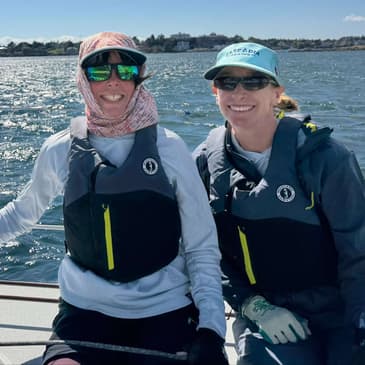
What happens when 11 sailors who’ve never raced together take on one of the world’s top women’s one-design regattas? You buy the only IC37 on the West Coast and start practicing.
Pete talks with Cascadia Sailing’s Joy Dahlgren and Chris Wolfe about building a battle-ready Canadian-American team for the New York Yacht Club International Women’s Championship. They talk teamwork, offshore lessons, data, communication, the quirks of sailing an IC37—and why Americans and Canadians apparently can’t agree on how to pronounce “buoy.”
A lively conversation about talented sailors, steep learning curves and turning 11 individuals into one seriously gritty team.
[00:00:07] Hello everybody, today on Sailfaster we're talking about preparing for a major One Design regatta. Nothing particularly unusual about that, except that this campaign came with a few added complications. For starters, what happens when you have the only One Design boat of its kind on the US West Coast, but the regatta is on the other side of the continent? And how do you bring together 11 sailors who have never raced together before, with very different sailing backgrounds, and turn them into a high-level sailor?
[00:00:37] A highly competitive team. And along the way we'll talk about what transfers from offshore sailing to round the cans, the shift from double-handed to fully crewed sailing, and how you identify and close any skill gaps you might have in a new team. So to talk about all of that, we have Joy Dahlgren and Chris Wolfe from Cascadia Sailing, which is a Pacific Northwest team spanning the US and Canada, formed to campaign an IC37 at the inaugural
[00:01:07] New York Yacht Club International Women's Championship in September 2026. So Joy, Chris, welcome to Sailfaster. Thank you so much, Pete. Really appreciate the opportunity to talk to you, Pete. I'm so glad that you could find some time to chat, because I know you're prepping hard for the International Women's Championship, so I appreciate that. Joy, let's start with you for a second.
[00:01:29] I believe that you were the person who got this campaign started. You run the North Sails Loft in Victoria with your husband, Stuart. You're well-known locally as a Moore 24 sailor, but you also have a huge amount of offshore experience, including four Hawaii racers aboard the Santa Cruz 70 Westerly, and a second overall, the 2022 Pack Cup. But tell us about how did you get started in this sport?
[00:01:55] Yeah, so I've been sailing my whole life. I started cruising in the Caribbean as an infant with my parents. I started racing only 17 years ago, but really I've become obsessed with it, especially because it's something that my husband and I do together. So yeah, we're always chasing the next adventure.
[00:02:16] Yeah, so I've done four Hawaii races. I've done a middle sea race. I've done three Caribbean 600s and yeah, just lots of sailing in the Pacific Northwest, some Van Al 360s and just all the local racing and love one design racing on the moor as well. What a beautiful area to do it though.
[00:02:37] Yeah, I'm also doing a lot of women's only events. It has really expanded my knowledge. I'm just really excited about it as a mentee and a mentor. It just gives great opportunity to women. Love it. All right, turning to Chris. So Chris Wolfe will be familiar to many listeners as the 2023 Rolex Yachtsman of the Year. Chris is an offshore double-handed specialist who races with her husband and sailing partner, Justin, as the Red Ruby Project.
[00:03:06] She was the first female skipper in the 2023 Rolex Fastnet race and the top finishing female skipper in that fleet of about 500 boats. She also finished second overall under IRC and first under ORC in the 2023 Rolex Middle Sea Race. So tons of achievements for both of you.
[00:03:25] And Chris, you're no stranger to inshore racing either, having owned and raced extensively the J11 Raku as well as J70s over the time. But Chris, beyond that, what's your origin story? My origin story. I began sailing as a teenager in keelboats and then did dinghy racing in college.
[00:03:47] I did a lot of non-endurance and non-sailing endurance sports for a while. And then I returned to racing sailboats in longer offshore races. Typically, overnight races, Hawaii races, a transatlantic, some of the Rolex 600 milers, like you mentioned, the Middle Sea Race and Fastnet. But I've also done a lot of sailing in the Pacific Northwest. Van Isle 360 is one of my favorite races.
[00:04:14] And then, as you mentioned, some inshore J70 races and J111, J120. Okay, let's talk about creating the Cascadia team for the New York Yacht Club International Women's Championship. Can you walk us through how a team like this actually comes together and then how that sort of roster takes shape from there?
[00:04:35] Yeah, so I'll start at the beginning. So in October 2024, I was just sitting on the couch one night and a co-worker at North Sales messaged me about this new Women's Championship that had just been announced. Right away, I recognized that there was something pretty unique and exciting about this event. The caliber of the event was going to be incredibly high of Olympians, world champions, really some of the most accomplished women in the sport,
[00:05:01] including skippers like Katie Spihill, Sarah Douglas, Anna Sweat, Nicole Brult. The New York Yacht Club already has this very prestigious Invitational Cup, which is built around Corinthian sailors representing the Yacht Clubs. But this new Women's International Championship was a bit different. You didn't have to build a team entirely around Van Yacht Club or one country or even only Corinthian sailors,
[00:05:31] which is actually how I got involved because through my work as a sailmaker, I'm considered a professional sailor. So anyways, that night when I mentioned the event to my husband, he half jokingly said, you should put a team together. And of course, when somebody says something like that, especially your husband, you start thinking about it. So I started going through people in my head of who I wanted to link up with. And pretty quickly, I thought about Chris.
[00:05:58] I had followed Chris's sailing for a long time and really admired her. Through my work as a sailmaker, I had the opportunity to build sails for her and Justin. And yeah, we had hung out at Kaneohe Bay after the Pacific Cup in 2022. We had never sailed together. We certainly hadn't planned a campaign together yet.
[00:06:24] That night I sent her a message and the next morning she got back and she was like, let's do it. Just like that. Yeah, just like that. Yeah, we started thinking about who we knew and respected and who might fit into what we were trying to build. It was going to be a big commitment. So we were looking for people that were ready to commit to something for the next year and a half or two years.
[00:06:48] I know we're going to go into the people in your team a little bit later, but can you just tell me where you got Cascadia sailing from? Was that easy? That's the area, right? Cascadia is the bioregion of the Pacific Northwest that spans the Canadian and U.S. border. And it includes the Salish Sea, which is where we all sail. Because of that, it felt quite representative of who we are. The sailing community here is incredibly interconnected.
[00:07:17] People and boats are constantly crossing the border for regattas. And we often do regattas together, Canadians and Americans. So it's a big part of the community. We think that Cascadia has really grown to become a little bit more than just representing this single event. It's become more of a program and an identity for the community to follow.
[00:07:46] We're pretty excited about what it has grown to become. Yeah, I'm not surprised. It sort of sounds like sailing without borders, right? Half your team is Canadian, half of them are American, right? Well, actually, exactly. Because five of us are Canadian, five Americans, and there's one that's dual. So it's exactly. Okay, so you had a team, an invitation, and now a name. What were the key next steps in putting the campaign together? Obviously, we needed to train.
[00:08:14] We needed to fundraise. We needed to figure out travel, housing. But probably the biggest thing was figuring out how a Pacific Northwest team was going to prepare for an event like this, being sailed in identical IC37s on the other side of the continent. So we reached out to Ben Mumford, who owns the only IC37 on the West Coast.
[00:08:39] Ben had owned the boat for a couple of years, so that his Royal Van Yacht Club team could train, because they did last year's New York Amputational Cup, where they finished third. Yeah, so we initially reached out to see if we could charter the boat for some training. But he had actually listed the boat for sale. And in a pretty weird turn of events, my husband and I ended up acquiring said boat. So, yeah. You couldn't resist, right?
[00:09:08] They're beautiful boats, IC37s. So, yeah. All of a sudden, we had the only IC37 in Victoria, which solved a pretty big major problem. But it also led directly to the next one, which was none of us had ever sailed an IC37. What was that learning curve like starting from near zero experience? And I'm also intrigued about, were there any surprises that are either good or bad? So it was definitely a steep learning curve.
[00:09:37] The funny thing about the IC37 is that in some ways it feels like a dinghy. The crew weight matters a lot. Relatively small changes can make a noticeable difference. But then we have 11 sailors on board. So from a coordination standpoint, you're dealing with something that feels much more like a big keel boat. We actually had a lot of help from Ben Mumford and his team, Hunter Loudon, Nicole Johnston.
[00:10:06] Yeah, they were really generous with us in their time. They helped us get started. They gave us a copy of their playbook and targets for the boat. It gave us a good starting point rather than having to take a guess at absolutely everything. And Chris, even though you hadn't sailed an IC37 before, at least I don't think you had, was there anything from the boats that you'd sailed previously that sort of gave you a bit of a head start? Yes. I had done some sailing in the UK where they have a large K31 fleet.
[00:10:36] Those boats are also designed by Mark Mills, who designed the IC37. And from seeing that class, I had some sense of the performance side of what the IC37 might be like. Most of my keelboat experience is on similar sized boats, though, like the Sunfast 3300, the J111, and the J120.
[00:10:57] What I didn't fully appreciate at first, though, was how important all of the roles on the IC37 are to sail the boat well. And some of that admittedly probably comes from me being used to sail the O-handed. Looking back a year and a half ago, we did as much as we could with the resources that we had to focus on learning maneuvers well,
[00:11:24] absorb as much knowledge from their friends at Royal Vancouver Yacht Club, the team that went to the Invitational Cup, and others in the region who have similar experience with boats that sailed similarly to the IC37. And then we started building systems that were specific to our own crew. And those systems included things like having common language on board because communication is super important.
[00:11:50] And then building routines for pre and post race. Having 11 people on board is a lot to coordinate, a lot to think through. That sort of journey of working together as a team through communications must have been really interesting. It was very interesting.
[00:12:07] And I think I would say that that was one of the bigger challenges that we took on because 11 crew members and trying to funnel information forward and back on the boat. You need to be thinking about communications efficiently and effectively. Everybody needs to know some things. Not everybody needs to know all things.
[00:12:31] So this project on the IC37 has really been about how do you communicate what you're feeling and making sure that we're understanding each other. We've actually built a lexicon for the IC37 that was quite intentional to make sure that we weren't using extra words and that we all agreed on the meanings of what terms we were using.
[00:12:59] We also didn't want to introduce anything that could be interpreted incorrectly. So we try not to say no and go because those could be completely opposite of what we intended. Yeah, that's really interesting. Of the teams and top players I've talked to, communication is number one in terms of the sort of press they put on it during racing situations.
[00:13:25] Communication, it's always going to be one of the most important skills that a human has. What we're finding is that we have an amazing group of women that have been sailing with us for almost two years now or at least engaged in the project for almost two years. And we built a lot of confidence together and that has led to trust.
[00:13:52] And we're hoping that that is going to really result in the best outcome, the best performance that we can put together as a team for the Women's International Chai Mansion. Did you deliberately spend time on this as well as all the other things you have to do? And did you confine that to when you're on the boat or offshore as well, when you're on land? Did you talk about this role play and practice situations?
[00:14:19] Yeah, we actually have specific terms that we use on the boat and our tactician, Jen Morgan Glass, has a professional background in team building.
[00:14:31] And we have done some role playing exercises within our team off the water to help us appreciate what all of the different roles are doing and also to help us understand how we might be thinking, how we might be reacting in a stressful situation and things that motivate us. You had the only IC37 on the West Coast.
[00:14:57] So that means you don't have a local fleet you can sharpen your skills and racing against. But how have you worked around that? Yeah, so with the help of Roel Van, but also we had to bring in some coaches. So we've had Richard Clark, Jonathan McKee, Carl Buckham, Steve Erickson, who's going to join us in Newport. And then we actually went to an event in Newport in August.
[00:15:25] We went to the Safe Harbor Regatta and that has really helped. But you weren't able to find a similar boat in the Northwest to train against? So we had the opportunity to do a couple of local regattas under a PHRF rating system. But the IC37 is unique enough to where there's really nothing that is as closely similar to the IC37, at least in the Pacific Northwest.
[00:15:53] You started with sailors from different boats, different sailing backgrounds, different yacht clubs, of course, and also a couple of different countries. But how did you turn this into a team? It's been a bit of a social experiment. So, yeah, bringing a group of people that have never sailed together across the international border and taking ferries on and off the island.
[00:16:19] Yeah, and learning a boat and becoming a crew is a challenge. We spent a lot of time together, like over the last two years, getting to know each other's quirks. And I think everyone bringing something different to the team. You talked at the beginning about logistics, getting people on planes and hotels and that sort of thing. But from that first meeting, turning them into a team, I guess it's, was that really easy?
[00:16:46] And because you had some very, very skilled women on board to do that. Or was it harder than you expected? I think it has gone really well. But there have been a number of challenges. We've got some incredible talent on the team, including people who are looking to pursue Olympic campaigns, who are sailing at the world championship level in other classes.
[00:17:10] And so one of the biggest challenges was starting to think about a schedule that works for all 11 of us across two countries. And some of the logistics have just been amazing. We're fortunate that there are some fast ferries from Seattle to Victoria. And we have sponsorship from that particular organization.
[00:17:36] So we're super appreciative of FRS Clipper for supporting the Cascadia teams because it made it something that we could do once a month during the sailing part of the year to be able to meet up. We also relied a lot on Zoom meetings. The video for the Invitational Cup that Friends for Royal Vancouver Yacht Club participated in was fantastic.
[00:18:04] Yacht Club really did a great job showing how sailing on these boats could be so exciting because there was on-boat or videography. And we could do a lot of reviewing of that and make improvements to our maneuvers. You may have a few more things to add, but I think that it's been challenging, but I think that we've done a lot to really get our team ready.
[00:18:32] You know, we're all from the Pacific Northwest and we speak the same language. But funny enough, there's a lot of interesting colloquialisms that we use that have been part of the richness of the cultural exchange that we've had on this team. So, for example, Canadians use words like toke, which in the U.S. we would call a beanie, and runners, which in the U.S. we would call tennis shoes or sneakers.
[00:19:01] But then it never fails that every single practice we get together, we all laugh about one word in particular. And the Americans call this word a buoy. And Joy, how would you call this word? I feel like I also call it a buoy. This is news to me. The others call it a buoy. Maybe this is not something that's useful to share, but it's so funny where some of the Canadians are like,
[00:19:29] look at the buoy in the water and the Americans are often like, there's no child in the water. So maybe cut that heartbeat. But I laugh about it every single time. Decision making must be super hard, right? You've got some really hot shot racers on your boat. I'd love to sail with this group of talented people because I would defer all decisions to them. But how does that work for you?
[00:19:56] Yeah, so that's definitely something we've gotten better at as the campaign has gone along. Early on, I think there was naturally a tendency for everyone to be involved in everything. But obviously, with 11 people, you quickly realize that it's not necessarily and it's not very efficient. So yeah, we started doing, thinking about things in like a smaller, smaller groups.
[00:20:20] So obviously, there's the bow team and then there's the speed loop, which include Chris and the trimmers and even the runner trimmer. And obviously, there's the tactical loop as well. As an example, we were having some problems with our spinnaker hoists and getting twists during safe harbor. And the bow team got together the following morning before we even went sailing.
[00:20:48] And they had their own conversation about what they wanted to change. And it was crazy. The next hoist was, I swear, like a hundred times better. And I don't even... It changed? Yeah, that's how it should work. Like on a team like this, like one of the perks of a big team is having people be able to focus in on certain positions. Yeah, and solve it for themselves, right?
[00:21:17] I think that's having sub teams, whether it's speed or process and so on, just to solve it for themselves. That takes a big weight off the skipper of the boat, right? Decision makers to do that. I'm interested in the fact that like most serious teams, you've put a lot of emphasis on targets and settings and data. And, you know, you mentioned a few days ago how important this has been for your team.
[00:21:43] Do you have any guidance for listeners on what's really worked for you there? Yeah, I mean, the biggest thing is to have a common language. You know, if someone says the boat doesn't feel quite right, there are 11 people on board who can interpret that 11 different ways. But if we know we're below target speed, we're carrying too much heel or we're trying to sail on a particular mode, suddenly everyone has some objective to respond to. And it's not only the trimmers who need that information.
[00:22:14] The IC is very weight sensitive, like from side to side and also fore and aft. So if the boat needs to change mode, then maybe something the trimmers need to change, like Chris needs to change, but also the rest of the crew, their bodies. So having target speeds and settings really gives everyone a way to understand what we're trying to achieve. And especially when we're practicing on our own.
[00:22:41] And even now that we've had a chance to sail against other boats, continuing to update those sheets as we find what works. Yeah, I like that. That notion you talked about data being this sort of the common language, numbers being the common language that everybody can understand. And if you know what targets you're working to, then it's a lot clearer. So really, really interesting. So I want to change text a little bit. So you both have a ton of offshore experience, right?
[00:23:08] So I'm really curious about what specifically have you taken from your offshore racing into this kind of short course, one design regattas? I know you've done a ton of that in both of you in your past as well. But I'm just, you know, just curious about what comes from offshore into this sort of environment. I'm used to doing two to three day events for around the buoys. And with this championship being five days long, and then we're also going to be there for five days of practicing. It definitely feels more like a marathon.
[00:23:38] So I feel like I need to prepare myself more like an offshore race. You know, sailing is definitely a workout. But if you don't get all your steps in a day, you know, your body gets a little bit sore. And so. So that's one thing you took was that sort of resilience and energy management from offshore and looking after yourself physically as well as mentally in that time. Chris, same for you. Yes. Yes.
[00:24:06] Although I think one of the biggest things I take from the offshore sailing is the importance of focus. I really think about racing as an opportunity to try to make meaningful gains in a fraction of the time that we might have had in a longer race.
[00:24:25] So thinking about the inshore racing compared to an offshore race, got less time to try and transfer, you know, the millimeters that you might make on the race course into miles or meters. I think of the races as many chapters. So I think about the start, the first beat and so on. And by breaking down the races into those smaller segments, it just helps me focus and keep the concentration up.
[00:24:52] I think it's going to be super important for our team to really minimize distractions and to be thinking about this regatta as a big effort that's broken down into much smaller pieces. And that we can get through those smaller parts of the regatta and hopefully put the whole thing together and be successful. That's really interesting. There's a technique I was reading the other day about eating the elephant.
[00:25:22] How do you eat an elephant? One chunk at a time or something. When you have a huge task in front of you, you break it down to that. So can you unpack that a little bit about how you think about a race course like this? And you break it. I mean, obviously, there's a start from the first beat. Is it beyond that or any more complicated than that? Absolutely.
[00:25:41] And this was something that we actually practiced at the Safe Harbor Regatta in August was everything from arriving at the airport and how we're coordinating with our team to how are we making our dinners and breakfasts and what team members were doing what.
[00:26:01] Making sure that all of that pre-race activity was done, you know, so that we're making it off the dock at the preordained time that we had decided. But all of those tasks are all part of the bigger picture and they all need to be done well to make sure that we're in the best position we can be to actually execute on the race course.
[00:26:26] And that's where we're thinking about the pre-start, what routines we're doing in the pre-start, what do we need to be doing even before we get out to the starting line. And then, you know, when the gun goes off and we're past the starting line, what we're thinking about on the first beat, first mark rounding, that sort of thing.
[00:26:48] And all of those chapters individually comprise the book that we're writing for the regatta that we're in. Is there anything about round the cans racing that's actually made you better offshore sailors? Or has it really been, you know, in one direction? In other words, offshore onto round the cans? Yeah, I think it definitely runs both ways for sure.
[00:27:18] It's all about being a more rounded sailor, really. Round the cans gives you the intensity that you often lose in the marathon of an offshore race. You have so much less time to make a decision, right? You might have, assuming an offshore race, you might have half a day to make a decision. I don't know. And, you know, you've got seconds in round the cans often. Has your appreciation of making short course decisions helped you with offshore yet? Or have you not put that into practice?
[00:27:45] No, I haven't been offshore since, well, I guess the Caribbean 600 was the last time. So, yeah, I'm actually curious going back offshore. Chris, did you have anything to add to that? Yeah, I would add that I think it absolutely makes you a better sailor. As a reminder, the IC37 does not have wind instruments, which is very similar to sailing with J70 or Dengies for that matter.
[00:28:10] And so it really requires you to go back to first principles when you've learned sailing. And I think that's incredibly valuable and will certainly make me a better offshore sailor as well. Yeah, when I did the sail on the IC24s at Performance Race Week, a similar, much smaller boat, you know, more like a sort of J70 size, no wind instruments at all, which I wasn't used to.
[00:28:38] I used to have that crutch of having some instruments. But what was interesting after four or five days, when we actually found that there was a wind instrument, there was a puck that we could put, you know, on the mast, we found one in the boat that worked. We never looked at it. We just got so used to not using it that it was quite a revelation, actually. Anyway, so one thing we talked about when we spoke a little bit ago was about the sort of technology that you've brought from offshore.
[00:29:07] And so I'm curious about the tools built for offshore routing and performance tracking, you know, target speed, structured data. You know, Expedition is a good example of that. They are increasingly showing up in inshore, one design regattas and teams. For you then, what offshore technology have you brought into IC37 training, if any, that may be typical around the buoys, around the buoys, race that the team may not typically use? Yeah.
[00:29:37] I know I mentioned that the New York Yacht Club IC37s do not have wind instruments, but on Westerly, which is Joy's IC37, there actually is instrumentation. And we've been able to utilize those wind instrument data through data logging through Expedition.
[00:29:59] And what that has allowed us to do is really review information in a pretty detailed way after we go out and go sailing. There's performance software like Regatta Playbook and SailNyord that allow you to integrate the instrument data with video from, say, a GoPro and audio.
[00:30:22] And we've been able to look at some of our maneuvers, some of our races, some of our practice times together to make improvements after we go sailing. Were you able to then build polars for, for example, the IC37? Or did you have those anyway? There must be a data bank. Yeah.
[00:30:48] So you must have realized at some point that offshore experience alone wouldn't cover what you needed for the IC37. And then this probably goes back to sort of forming the team. But how did you go about identifying who to bring in and for which roles? Well, we're fortunate to have some top talent on both sides of the border in the Pacific Northwest.
[00:31:08] And I had Jen Morgan Glass, who did an Olympic 470 campaign and holds championship titles in multiple classes in mind from the get-go to help start building the team with Joy and me. She was interested in the project and we began to reach out to other potential teammates on the U.S. side, including Lindsey Bergen, who is the current TASAR world champion and was 2020 J70 Mixed Plus national champion.
[00:31:37] Anna Lucia Clarkson, who's had multiple top 10 world finishes and J70 and dinghies. And then Jamie Mack, who competes internationally in dinghies and J70s. From the Canadian side, I invited Sarah Turpey, who I did a bunch of women's invitational events with. She did a 470 campaign in her youth. And we have Tara Galanka.
[00:32:00] She was a 49er FX person campaigning of her sister, but she's recently made the switch to 470. And we have Kate Sargent, who is a dinghy coach from our area. She helps a lot on board, getting everyone up to task. And we have Zoe Falsetter, who is actually new to the area. She moved here for school, but she's been sailing in the moor.
[00:32:29] And we have Becky Kelly, who's in the marine industry. She actually is one of my crewmates on the RC-50. Sounds like quite a team. One word to describe the Cascadia team right now. Battle ready. Battle ready. What about you, Chris? Gritty. I think we're an amazingly lucky team. So gritty and battle ready. That sounds great.
[00:32:57] What about your biggest surprise so far in IC37 prep? Well, at first, because we didn't know the boat, the boat just felt really different and that it was going to take forever to know it. But I mean, it's just a boat. It's not as different as you sort of feared. Yeah, exactly. Chris, biggest surprise? There are plenty of things to do to keep 11 people on board busy.
[00:33:22] And we're taking advantage of all of the people that we have to sail the boat as well as we can. That's a heck of a lot of people. I can only imagine. Yeah. And you have to keep in mind, the class rules require a certain weight limit. And so we made a strategic decision to sail with 11 and not 10, not 9, like some boats are doing. And finally, what else should we know about Cascadia sailing?
[00:33:50] I would love to give a shout out to New York Yacht Club's commitment to make the Women's International Championship as Sailors for the Sea Clean Regatta. Four of the women racing this regatta on three different boats have been volunteers with me for years for Sailors for the Sea. And I think it's just fantastic that Megan, Grafengetter, Rednick, Emma Jansen, Maya Hoffman, and I will all be racing at this event. I wanted to say one more thing.
[00:34:19] I'm really proud that we've pulled together a Canadian-U.S. team. It's pretty easy to look at geopolitics and find lots of reasons to be disheartened. This project, Cascadia Sailing, it gives me a lot of hope and it reminds me that the relationships we build really do matter. And where should listeners go to learn more about Cascadia Sailing? Yeah, so we have a website. It's CascadiaSailing.org.
[00:34:47] And then you can find us also by searching Cascadia Sailing on Instagram, Facebook, and started using YouTube as well. So, Chris and Joy, thank you for coming on SailFaster. I know you're in huge preparations for the regatta, which is only a couple of weeks away now, maybe three weeks away. So, don't want to add to your stress. But thank you so much for taking time. It's great to see you. And very best of luck in the regatta. I certainly will be following it day by day. So, thanks for coming on.
[00:35:16] Thank you so much, Pete. So nice talking to you. Really appreciate the opportunity. Thank you for listening to SailFaster. Make sure you subscribe wherever you get your favorite podcasts. And be sure to follow us on YouTube too. If you're enjoying these conversations with some of the best racing sailors on the planet, then leave us a rating or a review. It really does help. And, of course, we'd love to hear from you.
[00:35:44] Until next time, race hard, sail smart, sail fast.