
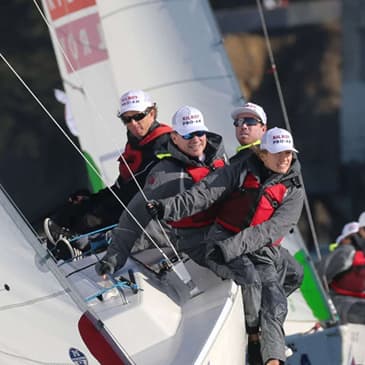
In Part Two of our conversation with three-time world champion Steve Hunt, we go deep into the tactical decisions that separate good sailors from great ones. Steve starts with a deceptively simple idea: keep it simple. Sail in more wind. Sail towards the mark. But then he takes us deep inside the decision-making process of a world-class tactician. We're pretty much aboard the race boat as he talks us through shifts, pressure, current, course geometry and boat-speed modes — explaining not just what he would do, but exactly why and when. We also explore how to categorize the racecourse, connect the dots in puffy conditions, balance shifts against a favored side, and recognize when the smartest tactical decision is simply to do nothing and sail fast. A practical masterclass in racecourse tactics. REMEMBER - SailFaster listeners get 30% off SteveHuntSailing.com with code SAILFASTER30.
[00:00:07] Steve Hunt Hi everybody, welcome back to Sailfaster and to part two of our conversation with Steve Hunt. As many of you will know, Steve is a three-time world champion. He runs the most successful high school sailing program in the country and he's still out there racing and winning at an international level. Steve's been on the show three times now because every conversation reminds me just how much practical racing knowledge he has to share with us. And to get more of that, you can also seek out stevehuntsailing.com.
[00:00:37] which is packed with content featuring Steve and an entire bench of world class guest coaches, including people like Dave Ullman and Jonathan McKee. And it covers everything from starts and boat speed to boat handling and of course the mental side of racing, which is so crucial. And importantly, it's all broken down into things that you can actually take away and use on the water this weekend. Don't forget that excitingly Sailfaster listeners get 30% off membership.
[00:01:05] Just use the coupon code sailfaster30 at stevehuntsailing.com. I'm a member. I love it. I urge you to do the same. Now, if you listen to part one, you will have heard Steve talking about the first of his three fundamental rules principles that work at every level of the sport, whether you're racing at your local regatta this weekend or you're at a world championship. And the first two were sail in more wind and sail towards the mark.
[00:01:35] Deceptively straightforward, I know. But so often our carefully thought through race strategies get thrown off by events. Events, dear boy. Events, a bad start. What the other boats around us are doing. Sail trim issues, crew communications, you name it. And suddenly we're consumed about what's happening in the next 10 meters rather than keeping our eyes on the big picture, which brings us rather neatly to another of Steve's fundamentals that we're going to talk about today.
[00:02:04] And perhaps the one that makes all the others possible. So, Steve, let's talk about keeping it simple. So keep it simple, in my mind, it means two things. One, it means a simple race is usually your best race. When you think back to a beautiful race you had, you probably didn't tack and jibe a million times. If you pictured it on a chalkboard, you started, you sailed, you got in a puff, got a header tacked, went all the way up to starboard lay line, tacked back, rounded the mark, jibe once, went to the gate, you're gone.
[00:02:33] So keep it simple means that. If you find yourself doing a million maneuvers, it's probably too much. The other big part of it is don't foul. Don't be OCS. Don't have drama on the race course. You know, don't be yelling and screaming at people. Don't stick it in there at the weather mark with five, five other boats yelling at you like those things ruin regattas.
[00:02:56] And I created that rule for myself because I've ruined so many regattas with fouling or being OCS. And when you coach high school, there's no drop. So when you watch these high school events, you see these regattas just fall away from your team from someone being OCS and not going back. Or someone coming to the land and saying, hey, coach, I just got in a protest. And I say, okay, what happened? Oh, I was the windward boat or I was the port boat.
[00:03:23] So I created a rule. You are not allowed to come tell me that you're in a protest and you're windward or port. That's violating keeping it simple. You have to spin. Or if you ask for tack or cross, cross or tack, and they say nothing, or they say starboard, you leave out. You don't foul people. And that's what keep it simple means.
[00:03:43] It means probably minimize maneuvers unless it's a super crazy shifty day. And then it means visualize all single digit numbers in your score line. You don't have DSQs. You don't have OCSs. And what that makes you do is be disciplined. So when you have those tight situations where you're almost crossing and you're not, and you really want to, because if you do, you're gone. Like that's where I screw it up.
[00:04:10] And I'm like, oh, I'm just going to go for it. And they dip and yell protest. And then you're done. If you don't spin, you get chucked. And if you do do a 720 or a 360 these days, depending on the rules, you lose 10 boats. Where had you just leave out, pinch them off and then tack back, you're still top five. But that's what keep it simple means.
[00:04:31] So when you're competing at the very top of the sports with so much data available and such tight margins, how hard is it to stick to that idea of keeping things simple? Do you ever have to sort of catch yourself and get yourself back to the fundamentals at that level? All the time. And that's why I created the rules. It's easy to get anxious. It's easy to be impatient.
[00:04:55] It's easy to get confused and lost in details of boat speed and rig tune and driving and communication and chemistry on a boat. And someone's being mean and you get upset. And like, there's so many things that can happen in a race where you just had a bad start, like we talked about. And now you're fighting for lanes. It's so nice to just have a really basic framework. You know, I travel around the world to all these different venues. Sailing in more wind and sailing towards the mark will get you in the top of the fleet almost every single time.
[00:05:23] That's the number one mindset. Get in the wind, sail towards the mark. Get in the wind, sail towards the mark. If that's all you ever think for the rest of time, you will never do poorly. Now, you also think, is there a current favor somewhere? And often there's not. Hardly ever is there a true, like massive current favor like San Francisco. If there is, you have to give that some priority and you have to figure out how much priority you give it. The other thing is a geographic shift. I've flown home from a lot of events around the world thinking,
[00:05:53] what was I doing? Like, I should have gone to the land. Like, often if land is on one side of a course and you can sail at the land at a 45 degree angle, it's almost always good. And you'll see the locals going over there, too. So that's the other consideration. And you have to give it a weight. OK, seems like it's just go to land. And maybe that's all you have to think about all day long. Just start, go to the land, start and go to land. And that's all you do all day. And it makes it real simple.
[00:06:21] So it's sailing more winds, sail towards the mark. Then you ask yourself, is there a favorable current? Is there a favorable geographic shift? And you factor that into your recipe of tactics. And then we could go high level and talk about like balancing those. Like, that's the simple version. Now let's say it's shifty, but there's also a geographic shift.
[00:06:47] Like, like where my high school kids sail, often starting and going straight to Southwestern Yacht Club docks, there's a lefty over there. But it's always incredibly shifty. So if you just blindly sail to Southwestern Yacht Club docks on a massive header, you're going to get smoked. The kids that do well, they say, OK, I want to go to Southwestern Yacht Club. But if I get a big header, I'm just going to tack and sail the lift attack. And then they're itching to go back to Southwestern Yacht Club.
[00:07:17] So they might take a neutral number over to Southwestern Yacht Club, but they're not going to sail a big header over there. And that's the simple way to think of it when it's shifty and puffy. Like, I'm going to honor the puffs and shifts. I'm going to work towards the favorite thing if I can. But if not, I'm not going to. And a beautiful thing that I do when I see great sailors like Tom Slingsby, I go up to them and I say, and I did this to him. I said, hey, I coach high school. Can you tell me how you think about tactics?
[00:07:46] And he said, sure. He said, I stand up at four minutes and I look for more wind. And I think, OK, I'm going to sail towards more wind. And then when the start goes off, I do that if the shift lets me. I'm like, what else? He goes, that's about it.
[00:08:08] And so what he means is that if he sees wind somewhere and he starts, but he gets a massive header, he just sails the lifted tack. I've asked so many great sailors, like, what were you thinking today? Ian Burroughs. I asked Ian Burroughs the other day, you know, bronze medalist. And like, how do you? I said, you're so good upwind. You're like a master of sailing upwind. What do you do? And he said, I just try to sail the lifted tack. I'm like, anything else? He goes, no, that's about it.
[00:08:39] So he just sails towards more. And Tom Slingsby said the same thing. I'm like, OK, thank you. And so you can keep it simple. And then you just have to factor in, you know, is there some other major race course feature that's going to give you some huge gain? And if there is, you might have to honor that. We had Tom on the pod a couple of months ago. It was a really, really interesting insight into the champion's mindset. Yeah, I want to watch that.
[00:09:06] You've talked before about Andrew Campbell's ability to call paths and shifts in really plain language. Remind us of that? Yeah, I've noticed some of the best sailors I've ever sailed with, and they're super high level, like Andrew Campbell. And Will Ryan is another one, the 470 gold medalist. They have the ability to tell you what the wind direction is going to be when a puff hits.
[00:09:26] And I'm not exactly sure how they do it, but when I've asked them, they say, if you're sailing upwind, a lift typically comes from your windward side, like over your shoulder. Or if you're facing outboard hiking, it's coming at your face. A header typically comes at your bow. And so when they see these puffs coming, they say, hey, hey, team, puff in 10, probably a header. And then a little bit later, they say, two, one, here's the puff.
[00:09:55] And you see your jib bubble and your inside telltale lift because it is a header. And so that helps me as a tactician to anticipate what I might do. You know, I'm getting near the left side. I'm thinking about tacking anyway. Andrew Campbell would say, really nice puff coming. It's going to be a header. Two, one, here it is. And I say, tacking in two, one. And it also helps you go faster. With Will Ryan last year in the J70, our skipper's name was Kate. He would say, hey, Kate, going well here?
[00:10:24] We got a nice gentle lift coming in eight seconds. It's going to be a small up. Puff in three, two, one. Here's your lift. Let's take it up. Nice. It lasts for another five seconds. Get ready to come back down. Two, one. It's going away. And he's just helping her steer by letting her know what's about to happen. Also, a really high level tip. If you're going upwind and you get a lift, you could, let's say, you get a 10 degree lift sailing upwind.
[00:10:52] You could push the tiller hard and head up 10 degrees, but that's draggy. And also, when it first hits, you're now over trimmed. If you get a lift upwind, it's as if you bore away 10 degrees. And now you're over trimmed and you're tight reaching with tight sails. So what Will is doing and what Andrew is doing is allowing us to also go fast. When he says 10 degree lift coming in three, two, as it's hitting, we ease main and jib together.
[00:11:20] Skipper starts turning up and then we trim the sails back in. And what you actually get is a massive speed boost because it's as if you're tight reaching for a second with ease sails. And the boat speed just spikes. And you head back up, you trim back in and you're off. Conversely, a header, here comes a header. When the header hits the boat, I think we've talked about this maybe one other time on a podcast. You could either just roll into a tack when the jib bubbles and tack through, say, 80 degrees instead of 90 degrees.
[00:11:51] Or when the header comes because you're super long and you want to keep going straight, you can just bear away. But if you're really high level with the sails, you could actually trim in a couple clicks as that header hits. Because you're actually pinching when it hits. You're above close hold. So you trim sails tight, boat comes down to close hold, you ease the sails back out. And now you're as fast as possible during that transition. So calling puffs and shifts allows you to go faster and make good tactical decisions.
[00:12:19] So in essence, it's not just about having someone who can make those calls. It's also about having a crew that understands how to respond together in a coordinated way, right? Right. And so for the average listener, here's the thought process. Okay, here comes a puff. Are we sailing bow at it? It's probably going to be a header. Anticipate what to do when that happens. It's either bear away a little bit, trim sails and bear away a little bit if you want to be great. Or it's rolling to attack if you're already thinking about tacking.
[00:12:48] Or puff coming from above you from your windward side. When that happens, it's probably going to be a lift. And we might ease sails a little bit and head up into it and trim back in. And that's the short version. The masters really know what it is. The rest of us kind of guess based on the direction that's coming towards the boat. And that just helps you call better tactics and be faster. And the more time you spend doing it, the better you'll get at it.
[00:13:16] Also, you'll get a pattern for the day. Like you can start to feel patterns. And sometimes it's super weird. Lake sailing, puffs are dropping down. Like say sailing at MIT and the river in Boston. It's totally random and weird. And at least it tells you like, okay, be ready for anything. And if you don't know, you say, okay, here comes a puff. Let's be ready for anything. I'm either going to bear away in the header or head up in the lift. I'm either going to trim sails in if it's a header or ease sails if it's a lift.
[00:13:44] And at least knowing that bare minimum helps you go faster and make better decisions. And it also ties into sailing towards the mark. It's a beautiful thing how all of these things kind of intertwine. Boat speed tactics, sailing in more wind, sailing towards the mark, playing your sails, driving well. You can mix it all together for this beautiful recipe of doing better than everybody else on the race course. So you've already touched on this notion of categorizing the day, which is something that I learned from Stephanie Roble a few years ago.
[00:14:13] I would love to hear more from you about how you assess the day in advance and then how your race strategy decisions flow from that. So again, I asked Jonathan McKee, hey, I coach high school. You're a gold medalist. How would you teach tactics to a high school team? And he said, well, I think you go out to the race course and you categorize the day. Is it an ocean breeze, stable wind?
[00:14:41] If yes, you know that it's probably not going to be, there's not going to be many shifts. It's probably a game of attrition. You start in the front row, you go fast, and you don't do many maneuvers. And that's going to be your day. Maybe there's a five degree shift, but it's pretty much, you know, stretch it out. If you get behind, it's going to be hard to catch up. That's the priority of the day. It's going to be a boat speed day. Not many maneuvers, boat speed. But let's say you go out and you're near land. The wind's blowing off land. It's super shifty.
[00:15:11] That's going to be a connect the dots, sail in more winds, sail towards the mark day. And that's your main priority. Boat speed's less important. The start is probably less important. It's all about connecting the pressure and sailing towards the mark. And if you can master that for the day, you'll crush everyone. So by categorizing those two days, it gives you a mindset of what you need to focus on. The steady ocean breeze is you wrap your head around, okay, I got to get a good start. I'm probably not going to tack that much.
[00:15:41] I'm probably not going to jibe that much. I'm going to focus on speed. If I get behind, it's going to be hard to catch up. Or, wow, it's really shifty. Like, boat speed's probably less important. It's all about keeping my head out of the boat, looking where the wind is, putting my boat in it. When I get in it, if I get lifted, I'll go straight. If I get headed, I'll tack. And now I'm searching for the next big puff. I'm going to try to connect with that one.
[00:16:08] And then the third category would be what we just talked about before. Is there some race course feature like in San Francisco that just overrides everything else? Like, the current is so strong. And there's wind everywhere. It's not that shifty. It's all about the current. And that category would be must sail somewhere. Like, I must go to the beach. It's all about starting and getting to the beach. Whoever gets to the beach first is going to win. You know, and San Francisco is like that.
[00:16:36] Or there's land on one side and it's a day where you just must go towards land. And that's the day. And that sets your mind around like, okay, how do I start and get to that feature? And I'm going to need to be patient. It's not a tick, tick, tick up the beats. Get in the middle. Get ready for the next header deal. I got to take a deep breath and be patient if you're an impatient person like me. I love shifty crazy. I don't like send it out to a corner because I feel like it's risky.
[00:17:05] But there's days you got to suck it up. And I've noticed where people are from makes a big difference. Like, I heard Tom Slingsby grew up on a lake and he's the master of like puffy shifty. You go sail against some Europeans in the Mediterranean where there's land on one side and they are so patient. And they will just go all the way to Leyla and just dig deep. And they don't care because that's what they grew up doing. And that's what you got to do.
[00:17:28] And so I feel like if you want to be like the master, you have to be a chameleon and be a Tom Slingsby in puffy shifty. Be a Vasco Vascada in the Mediterranean when you got to go bang a corner, you know, and you just categorize the day to figure out what's needed today. You always make it sound so easy. Well, it's not. But you know what? Victor on my website, he says, and you guys should watch his video on my website. He teaches how he's so good. And he's one of the best sailors I've ever sailed against.
[00:17:58] He says, 60% of the time, I do not know what to do. He just said, I start a third down from the boat. If the line's square, if the line's favorite, I go start at the favorite end and then I sail towards the mark. But if the line's square and I look up wind and there's nothing obvious, there's not more wind somewhere that's obvious, which is often the case. There's no land on one side. There's, you know, there's no current. I have no idea what to do. He said, I just start a third down from the boat and I focus on boat speed.
[00:18:28] And I just sail fast. So good to hear that. I thought it was just me. No, no, no. And I often don't know what to do. I just start near the favorite end and sail towards the mark and just look around for more wind and just let it develop. Another huge tip for your listeners is that you come up with a strategy and your confidence varies. Like Morgan Rieser is the best coach in the world by far. He tells me, Steve, put a confidence level on your strategy.
[00:18:58] Like zero to five. Five is super confident. You know, it's race three of the day. Looks exactly the same. The left's paid every single time because there's less current. I'm a four out of five or a five out of five. I got to go left. But other times you're like, yeah, I have no idea what to do. Confidence is low. And then it helps guide you. Like just start, Victor says, start a third down from the boat and just go fast and see what develops. And when in doubt, just go with the flow of the fleet, you know, and sail towards the mark, sail more wind.
[00:19:25] And that's often a pro tactician's thought before the race. If someone's paying you and they don't like that insecurity, you just make it up. Oh, yeah, guys, we start a third down from the boat and go straight. That's the plan. You have no idea. You just go. And then if everyone tacks, you tack. If everyone goes straight, you go straight. You just focus on boat speed. And you talk about the notion of connecting the dots.
[00:19:52] And I'm guessing you're talking about connecting between puffs, that sort of thing. So for me, literally thinking about connecting the dots as you work your way up towards the mark is quite a helpful mental picture of the race course. It's probably really obvious to you, probably really obvious to people listening. But for me, I find that really helpful. No, that's a beautiful segue to you should picture the race course from a drawn person. You have videos on this, don't you? Yeah. Yeah.
[00:20:20] Or if you want to picture a whiteboard in the junior room at your yacht club, the mark and the start and little magnetic boats. I literally think about it in those terms. So you're out there. You do a couple practice starts and you're like, oh, I'm aiming at the pin. The pin's favored. You do a head to wind and you're aiming at the pin. Okay. Picture on the chalkboard. The wind, the magnetic arrow on the chalkboard is over here. You know, it's a left shift.
[00:20:45] And that leads you to the next thing of, okay, usually the race committee sets the weather mark, you know, square to the starting line upwind. So if the pins are a favorite, usually it's a long port. So then in your strategy, you think, okay, it's probably the winner is probably going to start near the pin and tack and sail upwind on port towards the mark. And so now you say, okay, how do we execute that? And then what I was going to say earlier is once the start goes off, all bets are off.
[00:21:15] The best tacticians are open-minded to change. And like sailboat racing is complicated and it changes. I actually had, I'm not going to say who it was. I was teaching the U S sailing team and I had one of the athletes say, Hey, Steve, what if you and your coach determined that you should go left on the first beat of the metal race and you start. And a minute into the first beat, you get a big header.
[00:21:42] And you were taught as a kid to tack on headers, but you and your coach came up with a strategy to go straight to the left side. Like, what do you do? And I instantly thought to myself, you're probably not going to win a medal. I didn't say that out loud, but I thought you, you have to have these basic fundamental strategies in your mind. If you want to be a great tactician, you have to sail on more wind and sail towards the mark. The clear answer there is you tack. If your plan is to go left and you start and you get a huge header, you tack.
[00:22:13] Because sailing more wind and sail towards the mark are the two number one rules that there are. And often there's not obviously more wind somewhere. So it's sail towards the mark. And now you go up the beat for a while. And that's what Tom Slingsby said. He said, Oh, I see more wind somewhere. I want to go to it. If I go to it, if the shift lets me, which means sail towards the mark. And now you're sailing upwind on a long tack on a 20 degree lift. And you're thinking, well, I'd love to go left.
[00:22:40] Like my coach and I talked about for whatever reason that you have in your mind. And you're thinking, well, I'll do it at the first reasonable opportunity. I'll wait for the header. And maybe even wait. You don't even wait for the 20 degree header. You might wait for it to come back 10 or 12 degrees. And that's enough to when now both tacks are pretty even. And now you can say, okay, now I'm going to go left and execute my strategy because I'm not going to be sailing some huge header over there. And that's how great tacticians think.
[00:23:11] Here's the dilemma often for me is that it's a shifty day. You're sailing the lift attack. A header comes. How do you decide how big a header you're willing to wait for versus tacking on a smaller one? You know, that always happens, right? It's like not this one. Let's wait for a bigger one. I think this is huge for most sailors. Is there a way of thinking about that? Totally. So now we're getting into like the nitty gritty, which is the more complicated part. Or it's the, you know, some people are just amazing at it and some people aren't. Like what are they actually doing?
[00:23:41] And so, and even like someone that has a clear structure in their head might be better on some days than other days. So it's a bit of a reading mother nature, which is challenging. But what you actually want to do, and the textbooks say this, you know, you go upwind on starboard before the race and you get a feel for the range. So let's say your range is from 200 degrees on starboard up to 220. And you notice it's shifting about 10 to 20 degrees every few minutes, you know. And I don't try to actually time it.
[00:24:09] Some people do, but I let it kind of all go into my subconscious to kind of get a feel for the day. And so you're going upwind, 220. Oh, this is a good number. You say it out loud. This is a good number. This is a lifted tack. You get down to 210. You're just patient. You get down to 200. Say, let's tack and see what a lift is on the other board. So you tack. And let's say you're tacking through 90 degrees. Let's say 80 degrees like a lot of boats. So you tack off a 200. You're now aiming 280 on port. That's a lift.
[00:24:37] So you say to yourself and the team, okay, 280 is a lift. And you can just guess now that 20 degrees down is probably a header on this tack. So you get down 10, 290. Down 10, 300. So you say, okay, that all jibes. You know, 280 to 300 is the range on port. 200 to 220 is the range on starboard. Now you know that's your range. You know, the median numbers are 210 on starboard and 290 on port. And now you have that math in your head.
[00:25:07] It's okay to write it down. Some of the top tacticians put like white duct tape on the boom and write down the numbers. Starboard 200 to 220. Port 280 to 300. Or sometimes there's a really smart mathematician type person on the boat. I'll say, hey, can you help me remember the range? And they're like, yeah, no problem, Steve. I love doing that. Like, sweet. And now you're racing. And the short version is when it's the median numbers, you're fine going straight because you're literally like square to the course.
[00:25:36] It doesn't really matter which way you're going. If you're headed below that, you should probably be on the other board. So 209, 208, 207, you would tack for sure. If you're on port and it's 280 to 300 is the range. You're going to win at 290, everything's fine. You get down to 291, 292. It's better to go the other way. Now, so you're basically sailing towards the mark.
[00:26:02] Where the art form comes in is, is there somewhere to sail to? Like, let's say, Pete, you and I are sailing together in Annapolis. It's like coming from the Bay Bridge and there's an ebb tide. And we're out by that lighthouse. You go out and take a right down there by whatever that lighthouse is called. I've sailed on that race course. There's land on the left. And there's less current on the left. And so I say, hey, Pete, I've seen this movie before. We want to get left.
[00:26:30] Like, probably the boat that bangs the left corner gets out of the current first is going to win. The line's square. Whoever wins the pin is probably going to win the race. But let's say it's really shifty. So we start. And we get, bam, massive header. So we're going to tack and sail the lift attack. And now we're lifted. And I was like, hey, Pete, I know the plan was to go over there to get out of the current. But this is a huge shift. Let's sail it.
[00:27:00] And we're up 20. Now I'm thinking I'm more willing to tack off of a lesser header to get back to the left because we love the left because there's less current. So we're in our previous numbers example. This probably doesn't line up with Annapolis, but let's just do it for ease. We're 280. We're 20 degrees up. We're ripping up the beat. We're kind of aiming towards the mark. Look, I like the left, but I'm not going to sail a 20-degree header over there because I'd be like sailing off the race course, especially with the current against us.
[00:27:29] So I'll say, hey, Pete, let's just go fast here. Next header, we're out of here. And it comes down to 285, 287. I might tack off that. Even though it's slightly up from the mean, it's still a decent enough shift to warrant going back to the less current. And this is the high-level conversation. Okay, it's close enough to mean to go get out of the current. Let's go.
[00:27:58] If we went from 280 to 300, it's like a tactical home run. Woo-hoo! That's huge. Boom, boom! Boom! And now I'm on this 200 degrees, massive lift, sailing to the left, which is what we wanted in the first place. I'll say, hey, Pete, baby, bow down. Let's rip. And this actually brings in another high-level tip of moding. So we're up 20 degrees. We're going left. There's less current left. I might say to you, hey, stream the telltales, Pete.
[00:28:25] Hey, let's crack the jib of hair and crack the mane of hair and just go bow down at just a degree or two and just freaking rip in your J105. And go 6'3 instead of 6 knots and just get to the left. And we're probably going to get a header at some point. But now here's high-level. We start to get a little header. And now instead of aiming 220, we're aiming 210. I would say jib trimmer. Let's trim into close halt here. Pete, let's go normal mode. We trim our sails in.
[00:28:55] You go back to dancing the inside telltale of hair and we go 6 knots again. And I'm not willing to foot because we're not 20 degrees up anymore. Now we'll go normal mode. But I still like the left. We're at 210. Sails are in. You're dancing inside telltale because it's blowing 10 knots. It's the perfect mode. And now we get a header to 208. Okay, we are down from mean 2 degrees. But we love the left because of current. I'll keep going.
[00:29:24] And now say we go to 207. I might even say, hey, Pete, let's just sail a click higher now. Like in mode. Moding helps you sail towards the mark. I might say, Pete, dance that inside telltale. Just a hair more for me. Let's go 5.9. But no slower. And I know I'm down 2 on mean. I'm 208. And now it goes to 200. Tacking. Boom. Boom. Or let's say we get lifted back up to 220. And we're still going left to get out of the current.
[00:29:53] I'll say, crack sheets. Let's go fast again. 6.3, Pete. And we just start footing to the left. Now, in this example, now we're getting near Port Ley Line. We've gotten out of the current. We're in the top of the fleet. I'll say, okay, Pete, back to normal mode. I'm kind of itching to tack now because we're getting near Ley Line. I might tack off a 2.12. It's not even in the mean. But I'm getting near Ley Line.
[00:30:21] Like the geometry of the race course and the real estate that's left. There's not much time left. And we've got to tack and go to the mark at some point. We've gotten out of the current. If we got a 200, I'm happy as a clam. We tack. But the dilemmas are, you know, okay, we're down to 2.12. If I'm getting near Ley Line, just tack. But if I have a minute left, I'll wait. And if we have one minute left to Ley Line, and I know the current's strong and a big factor, I'll say, Pete, we're getting warm on attack, buddy.
[00:30:51] But we got a minute left to Ley Line. And then I'm just praying. And then you start praying, please, God, give me a 210. Give me a 208. And then if you get over there and you get a 220, you're like, ooh, I screwed that up. Damn it. I should have tacked on the 2.12.
[00:31:17] Could be a geographic shift, which is in this Annapolis example, it kind of is too because there's land over there. Or it could be more wind. So to simplify that super complicated story, you sail the lift to tack towards the mark. And then you hedge towards a favorable side of the course or a favorable race course feature, such as less current or more wind. And you do that by massaging when you tack, what you're willing to tack off of,
[00:31:45] what you're willing to sail on to get to that favorable thing. But you never sail huge headers towards favorable things. You just got to suck it up and sail towards the mark. So the notion of sailing towards the mark overrides a lot of other considerations unless you get to extremes. That wasn't complicated. I was right there on that boat with you in that race. I think we did well. I know we did. We won the beat, baby. Nice job. And now we round the weather mark and we think, okay, what current shift are we in? And we know because we're on Port Leyland.
[00:32:15] So we're coming up. We're either 280 or 300. We're in a lefty or a righty. We also know when we round the weather mark, there's more current now. If we jibe and go out into the middle of Chesapeake Bay, because if we go straight downwind towards the shore, there's less ebb tide going with us. Now we have favorable current with us. So as a tactician, you got to factor all that in. You also have to factor in the penalty of jibing underneath the fleet. Cause you and I, Peter, you crushed the start. I crushed those tactics. We're winning.
[00:32:43] If we jibe, we're going to sail underneath the whole fleet. And I do want to jibe to go out into the current, but if I'm in the left shift, I don't want to jibe off a header. And I probably don't want to jibe and sail underneath the fleet. So I would probably say to you, Hey man, let's set and go straight and assess. Get away from the weather mark. And the current will help us. We'll just flush right out of there. And then we assess, are we lifted or headed? Should we jibe to go out to the middle of the Chesapeake Bay?
[00:33:12] And from there, we can probably put together a great race. And now we get down to the gate. I'm going right gate, send it to the fricking beach again, baby. Like it's our choice. We're winning, you know, let's go do that. And then if we round that gate and we're on a huge header, I'll be like, damn it. Kind of wanted to go to the beach again, but we got attacked. And then we'll exact same scenario as the first beat. Now we got it. We're itching to get back to the left. We're willing to tack on a neutral number to get back there. I want to talk about light air base for a couple of minutes.
[00:33:41] Because you emphasize the need for patience and for picking a side. And I've sailed on boats where at the start of the race, we've deliberately picked a side because we wanted to stay in the breeze and avoid the middle of the course where there's going to be so much disturbed air. But then you find that later in the race, you come, you know, you're coming back down, downwind perhaps. And the tactician suddenly wants to cross through the middle to get to the other side. And I always cringe a little at that because I'm thinking, hang on, we agreed an hour ago, let's pick a side.
[00:34:09] And now we're going to sail straight through all this disturbed air. I think sometimes that principle of picking a side gets forgotten as other tactical considerations come into play. Is that a common mistake or is that just me? No, that's a tough one. So whenever I have a really tough decision, I've learned, rewind the tape of the race until I could have made a different decision back here to have more options. So in your situation, let's say in our race, even we go straight downwind,
[00:34:36] the wind starts to dive, we go straight downwind and we do one and in and we're aiming at the right gate and we overstood the left gate basically. And there's boats over there. So we have to round the right gate. That's a common situation. Or we jived and we went all the way to the corner, come back and we're aiming at the left gate and we overstood the right gate. That's forcing us to a gate. It's light air, it's lumpy, boats are coming downwind. That's the dilemma you're talking about.
[00:35:04] It's like, okay, we got around the left gate and now we're going right upwind and there's all these downwind boats coming. It's choppy in the middle, it's light air. You kind of have to just wait until all the boats get out of the way. All the downwind boats get out of the way. It's so painful. It's so painful. And then you know you're supposed to stay out of the middle. So this is again where like a top tactician might make a good decision versus an amateur or someone that's just struggling.
[00:35:33] And a top tactician will get this wrong too. You know, there's no great answer here. It's a tough one. Usually the top tacticians will just wait. They'll be like, screw it. The middle's so bad. I'm just going to be patient. And just sail straight for a while. Just get away from the gate, away from all the downwind, away from all the bad air. Like five, six, seven minutes. Even if they think the other side's favored. And then they start asking themselves like, you know what? I still think the other side's favored. I'm just going to suck it up and tack here.
[00:36:04] But they probably won't round the gate and be like, oh, I like the other way. I'm just going to tack and sail through the middle and all this bad air and all the chop. And you might just stop. And like, you're still out there, you know, if you make that decision. So because that was a tough decision, you're making the best decision you can at the time. And it's probably be patient and still stick to an edge because the middle just is always horrible.
[00:36:28] Or you wait long enough to where tacking and going across, it's just empty. Like there's no one there. Then you're okay. Yeah. If you were leading around the gate. But if you're mid-fleet, same situation, mid-fleet, that's a really hard one. You know, maybe you tack early and just cross and go all the way to the left corner. Or maybe you round and just go straight all the way to the right corner. But that one edge is going to pay. My dad grew up on the Chesapeake Bay, actually, in Hampton, Virginia.
[00:36:57] And he told me, he was a light air master. And he said, Steve, you got a 50-50 chance of guessing the correct side in light air. And you have 100% chance of being wrong in the middle. Yeah. Interesting. It's the only time to just accept this big risk. But he framed it in that way to make me realize there's not actually a lot of risk. The risk is going up the middle. So you have to pick an edge in light air. I sailed with a guy called Paul Beaudry.
[00:37:26] He was a brilliant sailing coach in Florida. And he had a great bit of advice, which is when you're in those situations where you're not sure what to do, do nothing. Just keep sailing fast. Just focus on sailing fast. Don't do anything. Just settle down. Sail for two or three minutes. Do nothing. Then think about what to do, which was really useful. I agree. Before we wrap up, a couple of quick questions for you. Firstly, what's the one tactical habit every club racer should steal from your highly trained high school sailor?
[00:37:55] Make seeing and finding wind a massive priority. Put your boat in it. And then if you get lifted, go straight. If you get headed, tack. Sail towards the mark. Put your boat in the wind and then sail towards the mark. And make that a massive priority. You've sailed so many boats, right? What's the favorite boat you've sailed and why? You know, I love sailing so much. My favorite boat's often the boat I'm sailing during that time. Right now, it's probably the Etchels because I grew up sailing J-24, so I like heavy keel boats.
[00:38:23] And on the Etchels, you can tweak the sails so much. You can make the main and jib and the forestay sag anything you want. And I love that. Like the art of making a boat go fast and transitioning through different pressures. And you can do anything. Whereas the J-70, it's a deck-stepped rig and you can't really bend the mast that much. All you have is backstay and bang. But the Etchels, you have all these controls. So probably the Etchels right now.
[00:38:48] So let's end by talking about stevehuntsailing.com for a moment. As I said at the top of the episode, it's a fantastic resource for racing sailors. And there is that 30% discount for SailFaster listeners. So just enter the code SAILFASTER30 when it prompts you. It's outstanding value. Steve, I know you've been expanding the content quite a bit recently. Right. Well, I've had a revelation that I don't want it to just be me coaching.
[00:39:16] I want to reach out to the best sailors in the world. So I've been adding more staff to the site and more great, amazing sailors. And as you mentioned before, I just had Justin Callahan, who's like the Tiger Woods coming out of college sailing. He's won everything. Most successful college sailor of all time. And he's actually won more championships or tied with me on championships. He's 22 years old. I think he's won three worlds, 22 nationals and five continental championships. And the guy's 22 years old. He's starting an Olympic campaign.
[00:39:44] And then I just interviewed Marbella Marlow, who was the crew of the year a couple of years ago from Harvard. Jonathan McKee is now on board, a gold medalist who we're doing lessons. We have a meeting tomorrow to talk about a new one. I just hired Dave Perry to be part of the website for rules. Oh, wow. And he has a series called Ask Dave. And I've had him go through and make a short and sweet rules, lessons on the most commonly misunderstood and abused rules in sailboat racing from my observation. That's amazing.
[00:40:13] And we're constantly getting new people on the site and it's, it's, it's getting really, really good. There's so much on there. And now we offer first month free as well as a coupon called first month free. And you get your first month free and sail faster 30 is better because it's 30% off forever. I'm allowing people to join for free now and people are loving it. It's really blowing up. I'm not surprised. And I also, I just also interviewed a mental performance coach and I have another one lined up for another interview.
[00:40:40] So yeah, I'm bringing in more coaches on all things sailing, especially the mental side. Yeah. Because when I've interviewed some of the top sailors that so much of it is at that level, their mental fortitude, their mental preparation, how they make decisions. And that separates them from other top sailors or by, you know, by inches or seconds. So it's so, so interesting. Well, Steve, great to see you. Thank you so much for taking the time to be on Sail Faster again. Thank you, Pete. I really appreciate you having me. Thank you.
[00:41:10] I love your podcast and you're helping a lot of people. So well done to you. We all love it. Oh, thank you. That's really kind of you to say. And thank you everybody for listening. Please subscribe and follow wherever you get your favorite podcasts, whether it's Apple, Spotify, YouTube, Pocket Cast or wherever you like to listen. And if you're enjoying the series, I'd really appreciate a positive rating because it really helps. You can email me at Pete at SailFast.com. I read all your emails and take note of what you have to say for sure. So thanks very much, everybody.
[00:41:40] See you all on the water. Bye.