
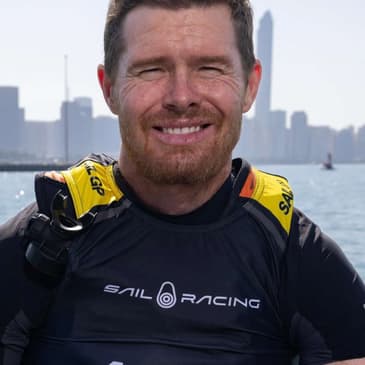
Olympic gold medallist, America’s Cup winner and SailGP superstar Tom Slingsby joins Sailfaster from San Francisco airport for a fascinating deep dive into what it takes to perform at the highest level of sailing. From surviving one of the toughest and most dramatic SailGP race days of his career to the mindset shifts that helped him overcome Olympic heartbreak and become a world champion, Tom shares the lessons, habits and psychological edge behind his success. He reveals why sailing is really a game of marginal gains, how he makes split-second decisions at 100 km/h, the single performance metric he obsesses over, and the leadership lessons learned during Oracle Team USA’s legendary 2013 America’s Cup comeback. Packed with insights on pressure, preparation, competition and continuous improvement, this is a masterclass from one of the greatest sailors of his generation.
[00:00:07] Tom Slingsby Hi everybody, well today's guest is none other than Tom Slingsby. I managed to catch Tom at San Francisco Airport for a few minutes fresh off his New York Sail GP win. Tom of course is one of the most successful sailors of his generation, Olympic gold medalist, America's Cup winner, I mean who can forget that incredible 2013 turnaround, and he's leader of Bond's Flying Ruse Sail GP team.
[00:00:31] Tom of course is a great pleasure to have a great pleasure to have a great pleasure to have a great pleasure to have a great pleasure to have a great pleasure. As you're going to hear, Tom talks about why elite performance isn't necessarily about perfection, it's about relentless improvement. It's about finding gains in every gust, every wave, every maneuver, every decision. We explore how he approaches pressure, what high-speed decision-making really feels like in Sail GP, and why the best sailors are often the best learners.
[00:00:53] Along the way, Tom shares lessons from Olympic heartbreak, the 2013 America's comeback, and the psychology that still drives him today. This is a conversation about sailing at the highest level, and about how great performers think. I do hope you enjoy it as much as I did. And as always, thanks for listening.
[00:01:13] Hello, Tom. I'm thrilled to have you on Sail Faster. I know you've got a mad schedule, so I'm really happy that you found time at SFO Airport this morning. Thanks for having me. I just watched back the New York Sail GP final between New GBR and North Star Canada. That was the most exciting race I think I've ever witnessed in Sail GP or Formula One. It was amazing.
[00:01:38] I still don't quite see how it wasn't an infringement when Dylan Fletcher crossed you just before the final mark and turned. Did they look clear ahead from your point of view? Did you have that visibility? Yeah, I didn't think they were across, is my two cents. Yeah, we obviously protested it. It was given a green flag. When you look at it back on an umpire app, it looks like there's a good chance they could have crossed, I guess.
[00:02:08] But at the same time, umpire app isn't compared to what we are seeing on the boat are quite different. And when you're at these speeds and a boat just turns at 90 degrees in front of you, you think you're going to hit. But I didn't think he was across. I think if that was in a normal part of the race course and not right at the finish where he had to go, I don't think he would ever have pushed that. Um, but to me it was a just, just a penalty, but I can also see why it was deemed a green flag as well.
[00:02:39] You said afterwards, I heard you say afterwards, it was one of the hardest days of sailing you've ever done. You've done a lot of hard days of sailing. What made it so hard? Was it physically, mentally, tactically being on the back foot as you were early on or just the overall intensity of the Sail GP? Yeah, I think, um, a few things, obviously heading out the day before and two minutes into our warmup, we had a big crash and, and really badly damaged the boat.
[00:03:07] And we put the shore team and the tech team under a lot of pressure to get the boat ready. They were working through the night to get the boat ready to go for the next day. I don't think anyone really realized how bad the damage was, but it was, it was quite significant. And then, um, and then we headed out to the racetrack. Um, and within, yeah, at first practice lap, we hit something under the water.
[00:03:31] Um, we, we have no idea. It was very hard, like a, almost felt like a door or something like that. It was very hard, whatever it was. And we broke the rudder. We broke the tiller head on the rudder. Um, so we had, I think 35 minutes to the start and we sat there for about 32 minutes, um, waiting and the shore team and the tech team coming to fix everything.
[00:03:56] So we hadn't really done any warmup. Whereas the other teams had, and then, um, the breeze, and then we went into the race and it was, yeah, obviously we didn't have a good first race and we're on the back foot. And then it just felt like we were sort of clawing our way back into it. And finally, uh, finally we, we managed to make the final and, and then in the last race, it was just all a bit of a blur, but it was just one of those really stressful days.
[00:04:24] And yeah, but fortunately we got there. I want to come later on in the conversation to decision-making at those kinds of speeds. Cause I find that fascinating, but I want to go back to your beginnings for a moment. Cause I heard that you were a promising Sydney tennis player before you went racing on Martin White's 505. Why did that change everything for you? What, what did you kind of discover?
[00:04:48] Um, yeah, I was a tennis player. Um, and that was always going to be my career. I think I was always going to be more of an athletic type, more than an academic. And then I, yeah, I was a junior sailor at Gosford sailing club and I did go for a sale on Martin White's, um, 505. I don't think that moment sort of changed anything for me. Uh, the moment that really changed everything for me was the Olympics in Sydney in 2000.
[00:05:13] Um, I was, I just, I was falling out of love with tennis at 15 years old. I had like multiple coaches and, uh, I was traveling and a lot of pressure on me and I just sort of burnt out from tennis and I wanted to do something different, but I didn't really know what it was. And I ended up, um, watching the Olympics on Sydney Harbor. And, and I just remember falling in love with the sport there, like more so than I was.
[00:05:41] And I used to train in tennis twice a day, um, before school and after school at that time. And I remember I just quit tennis. I didn't pick up a tennis racket for probably 10 years. And I started using all my tennis training time before school and after school to sail. And my sister was a good sailor, Alana. And, and so we would train before school. We'd get up at five o'clock and go rig our boats and go out with whatever wind was there. And then as soon as school would finish, we'd meet, meet at the club and, and get out there as well.
[00:06:10] So I think that's where everything sort of changed for me was watching the Sydney Olympics. And I remember saying to myself, I'm, I'm going to be the first Australian to win a gold medal in the, in the laser class. And yeah, I just dedicated my life to it from that point on. Going back to your early racing days, what separated you, do you think from the other talented sailors around you?
[00:06:32] Um, I think I definitely brought over a different work ethic to sailing, um, compared to other junior sailors. Cause with my tennis, I realized what sort of hard work and professionalism needed at a very young age. I knew I had to train hard. I had to eat right. I had to, I was doing two training sessions a day, as I said, and I don't think junior sailors were really doing that at the time.
[00:06:56] So when I sort of brought over that professionalism from tennis, I think it really helped me a lot and I was able to, to improve really quickly. So, um, for sure I'm unbelievably competitive. And, um, I mean, everyone's seen my onboard at SailGP. It's one of those things where I, I'm pretty fiery and I don't, I'm not happy sort of making mistakes, I think is people see.
[00:07:23] And so I've got a really, a high work ethic and I was obviously extremely competitive and, and that sort of worked for me. I listened to the Double Bay Yacht Club, uh, uh, interview that you gave. And I love that story about how your dad taught you about gusts. That was really very funny. And I also loved hearing you say that persistent shifts are a weakness or were a weakness of yours, which sounds incredible given your success.
[00:07:49] But that was, that was a really interesting interview that I think I'll pin to, uh, um, to this as well. So more people can hear it. Um, across your Olympic sailing, America's Cups, LGP, Martin offshore racing, what skill do you think has transferred best between each of those disciplines? I mean, always having the laser background, I guess, of, uh, that's tight tactical racing and, and I guess fighting for every meter.
[00:08:17] It doesn't matter if I'm in a, a Moth and F50 or a laser, I'm literally fighting for every meter, um, as much as I can. And I think also having that sort of tactical knowledge and, and really good baseline of like, um, big fleet racing, even if you're not in a big fleet, I think just understanding positioning coming into marks and, and how I can gain an advantage.
[00:08:44] I mean, all these boats are very different and technically they're very different to sail, but once you get through the technical side of it, it comes back to sailing wind on water positioning. How do I beat my competitors? And so I, I just really focus on that. I obviously have to focus on changing the way I sail each boat, whether it's a Moth or a laser. And, but once I pick up the technical skills for that boat, it just comes back to positioning and tactical ability.
[00:09:12] And so I think that's the thing that transfers over no matter what, it doesn't matter what sort of boat you're in. If you're smarter at positioning, um, you're going to, you're going to be pretty good. So just to follow up on that, then if you think about what has actually driven your success most, is it boat handling, strategy, decision-making, preparation, and psychology or, or, or, or, or leadership, uh, or combination of all of those, depending on what format you're racing?
[00:09:40] Or is there one thing that you think I'm brilliant at strategy and that's what gets me through? Uh, I'm definitely not brilliant at anything, but, um, I think psychology for sure. I mean, as we know, we're sailing, I mean, depending on what type of boat it is, but it's a 90%, uh, psychological game.
[00:10:02] It's, uh, once you have the skills and on an F-50, for example, the skills, anyone could drive. Like it's, it's not a physical thing. It's understanding obviously where all the buttons are and, and understanding the boat and having experience and all that. But to me, that all sort of comes under psychology, but if you've got the right mindset to always be improving, I think that's the biggest thing.
[00:10:28] There isn't one day I go out on the water that I don't come in and have learned something. I can go out coaching optimist kids and be out there and then just see something that a way some, one of the kids position themselves and whether they made a gain or a loss that goes into my knowledge bank of, Oh, you've got to be careful here because if you position yourself here, you, you, you're at risk of losing boats on this side or that side.
[00:10:54] And I really believe that I'm, I'm, I learn every single day I hit the water and, and I've also got that mindset. And to me, the mindset of always, always trying to improve. I'm, I'll never go out there and say, I'm the best out there. I go out there and just go, Hey, what do I need to do to get better? And, um, it doesn't matter.
[00:11:18] I'll be when I'm 75 and sailing twilight races at my home club, I'll still be going out there trying to improve and get better. Um, and I'll never get to where my goal is, but it's just that journey. And that sort of mindset of always, and always getting better. You're known for being obsessive over small detail, just like all top sports people are. Would you say there's a small detail that elite sailors obsess over that club sailors miss?
[00:11:48] I love that Victor Kovalenko story that you, you from Barcelona that you told recently about, uh, you know, making incremental gains on every wave. Um, I thought that was really interesting, but is, is there a small detail like that you think that separates elite sailors from club races? Yeah, I think, I think so.
[00:12:07] So I think, yeah, like as I, I spoke in that interview and what Victor taught me is like every wave is an opportunity and, and it's, it's one thing to sort of say it, but another thing to actually go out there and action it. Because whenever I go out there, I'm literally trying to think, how can I make, make a gain here?
[00:12:30] Whether it's a wave, whether it's a gust, whether it's a, a mark rounding, I I'm literally sitting there going, how do I gain like another 10 centimeters? How to, how do I do that better? How can I, how can I get a little bit further ahead here? Cause in sailing, it might be steady breeze and, and, and then, and everyone's going, oh, we're all going the same speed.
[00:12:51] But if I can, if I can get a couple of meters on my competitor, then it builds, let's just say I gain 30 meters in speed throughout a leg. Like that gives me a buffer. If I miss a shift, if I don't pick something up. And so I'm all, I remember another story when I was 15 years old and I was trying, and this is the time I dedicated that I want to be a cold medalist is we're doing a cold medalist.
[00:13:21] And we finished a race and came in and, and a guy came up to me and said, you, you were ahead in that race, right? I said, yeah, yeah. I won the race. And he said, so I saw you near the end of the race and you missed a tack and you started yelling. And I said, yeah, I was pissed off. I stuffed the tack up because the result sheet said you won by seven minutes over second place. Why are you yelling at yourself for missing a tack?
[00:13:50] I said, well, I could have been seven minutes, 10 ahead if I made that tack. And, and I remember him just sort of baffled. And I just said, look, I'm not competing against them. I'm competing against myself. And I don't want to make silly mistakes. To me, winning is not enough. It's about sort of the personal thing and, and, and having success for yourself and knowing that you sound a really good race, regardless of the result is really important.
[00:14:20] I think that's what elite people do. They don't sit there and just say, okay, it's about feeding that guy. It's about being better than I was yesterday. And so that just, as I said, that constant evolution to get better. I know you have access to so much data today, but is there one piece of data that you will obsess over maybe post race or even before the race? And has it changed over time? Just curious. Um, I don't think there's one piece of data. Yeah.
[00:14:50] I mean, I'm, yeah, no, in, in sailing, I don't think there's one piece, but I mean, for me, angle of heel and a number we always get is, is heel stability. Um, no matter what boat I sail, it's, if your math in the air is more stable, let's just say it's a degree wrong, a degree too much heel than the optimum.
[00:15:16] But if it's stable and not going back and forth, um, I think that's a huge game. So I remember when I was sailing moths a lot and I'll get a, someone would take a video from behind us. I used to like not even look at who the person was on board the boat. And I just watched the rigs of the boat and, and I'll try to pick whose rig is not moving as much. Who's like, when you hit a lull, that's not coming into windward as much.
[00:15:43] When you get a gust, it's not going to lull it as much and just keeping really locked in and stable. And it was amazing without even looking at who the boat was, that boat would always win the lineup. And I think that, and I remember doing it the same in lasers and even in, in sail GP, the person who's locked in the most with their heel stability to me is always going to be a fast boat. So if I had to pick one thing, it would be heel stability.
[00:16:13] Um, it's the most important thing, no matter what type of boat I sail and no matter what the optimum number is, it's just so important. It's so interesting that it's not just a heel angle, but heel stability. I get that because I suppose if you're, if it's wavering around, you're creating turbulence there, which is breaking up the lift that the airflow is creating. So I, so I get that. So to your mind, you could be a couple of degrees off the optimum heel angle, but if you've got stability and you locked into that, that can really make the difference.
[00:16:44] Yeah, I believe that because if you, if your heel changes, you've got to start steering to counter that and you've got to start changing your trim to counter that. So there's a lot of effects from it. Yeah, for sure. Um, do you know, I want to talk about decision-making, right? Cause this is my favorite subject really, but, and obviously you are super, whatever you're going to say, but you're superb at decision-making in racing.
[00:17:06] Uh, over the years you proved that, but when it comes to GP and you know, the AC coming up as well, um, how do you manage decision-making at those kinds of speeds at 80 to 100 kilometers an hour in sail GP? Are you, are you, are you still racing competitors or is it mostly about managing risks and the sort of decisions around that?
[00:17:27] Yeah, I think in, in sail GP, obviously with the F50, we're moving very quickly and maybe I'm getting older, but it, the, the decision-making part and the risk versus reward sort of battle that you face. Um, I, it, it gets a bit tougher. I mean, as, as the driver of the team and the CEO of the team, I'm responsible for these guys, the safety of my team on board.
[00:17:52] Um, you know, um, you're, uh, obviously you've got to push for every gap and you've got to push and keep trying to fight for every meter. But if you have a crash in sail GP, um, you get penalized quite heavily. Um, your boats can be damaged. You can be out for an event and also the athlete safety. You've got to really look after your team on board and these boats are dangerous. So there are times there where you do have to take your foot off the pedal, which is not, hasn't, wasn't my nature in the past, but it's, I've had to adapt to that.
[00:18:22] Um, just with the nature of these boats and the nature of this league with a season point score going all year. And then you could just got to win the last race. So one, one event can put you out of that final at the end of the year. So you've got to really know times when to back off. I'm intrigued about decision-making, right? Because presumably you're making some of the decisions that you've always made tactical and strategic decisions, except you have so little time now to make those decisions on, uh, on those kinds of speed.
[00:18:52] Does that mean that you changed the way you make decisions or is it just the same? You've just adapted to the speed. Do you know what I mean? I'm probably not asking that very clearly. No, I get it. Uh, yeah. I mean, I, I don't think I've changed the way I make the decisions. Um, obviously, um, things change really quick at a boat tack when you don't expect it in sail GP and the closing speeds are high.
[00:19:17] You've got to, it's not like a keel boat race where you've got plenty of time, but I think I still make the same, it's the same decision-making process. And, but sometimes I have to make it a bit quicker. Yeah. And I guess it's one of those things that like, once you make your decision, no matter what type of boat it is, the decision's done and you've just got to work your ass off to make sure, even if it's a loss, to minimize that loss. Uh, but I don't think I've changed the way I make decisions. No.
[00:19:47] So when I listen to sail GP, you often hear, um, teams talking about where the wind is on the course, like Hannah Mills will say, it's on the right-hand side of the course. But so I get, I get that, but can you react to individual gusts at those kinds of speeds that you would do if you were in a dinghy or a keel boat? You know, you'd know, okay, here's a lift coming, or this is going to be a header. Those speeds, you, can you actually react to gusts like that?
[00:20:11] Yeah, absolutely. Um, no, on the, on board you, every gust, as I say, like even on the F50, every gust is an opportunity. So, and every lull is an opportunity to transition better than your competitor. But if I, if I've got a gust coming down, Tash Bryant says, okay, good gust coming here. And in five, I'll generally look at the gust and try to decide whether it's a header or a lift.
[00:20:35] And then I'll look at where my competitors are or know where my competitors are and go, okay, well, I want to get forward or I want to get depth here to make myself stronger. So when that gust comes on in two, one, I'm like, okay, I need depth here to get stronger on the, on the lay line, which will, which will hurt my competitor because he'll have to split. And then I, I, I try to do that.
[00:21:01] The gust hits and I go, okay, riding high here, we want a deep mode and we want to, we want to get down on this lay line and we'll use that opportunity. Um, and then the same thing for a light patch coming. Okay. Tash calls a light patch here in five. I say to Goobs, okay, I want a high groove here because we go high groove through this lull. We'll get to the new pressure faster instead of sailing a bit lower.
[00:21:28] And I'll try to transition through that gust and, and gain a few meters on the boat next to me. So yeah, I, every gust on it's no matter what the boat is, once you learn the tech, the technical aspects, it's exactly the same sailing. That's why you saw myself, but Ben Ainslie, Jimmy Spithill, all these guys who aren't fast foiling sailors historically.
[00:21:54] That's why we adapted well to these boats is because it's, we just got our head around the technical side and then we got to use our skills from our earlier sailing days. Um, this kind of sailing has become more of a sort of a systems and engineering competition as much as a pure sailing competition. But does that make it more interesting for you personally? Uh, yeah, it does. Um, I, I'm just all for the promotion of sailing.
[00:22:20] And I know for me personally, like an example is F1. I tried to get into the F1 for 20 years and just couldn't really get hooked on it. But then I saw the drive to survive, secrets. And, uh, and then all of a sudden I was hooked. Now I, I watch every race. Um, it's just the personalities and the stories behind the scenes. I think that's, it's just, it adds an emotional element to, to, to the sport.
[00:22:50] And that's, that's what gets me hooked. And yeah, so I think that's sort of part of the way our sport's going is just telling these different stories. And obviously the sailing is always going to be a big part of it, but you've got to create the sort of full story around the race as well. Drive to Survive did that massively for F1, especially in the U.S. where, where I live. Um, and I think SailGP is getting that way, isn't it?
[00:23:15] Between the races, they have the, the background interviews, which are, which it just humanizes sports people, right? So you, you kind of root for human beings. Okay. So all this said, right, America's Cup, SailGP, highly technical and seem to involve as, as much data and engineering as, as, as act one. Leading that kind of team for you, you're a CTO as well as a CEO and a sailor and that sort of thing.
[00:23:39] Do you ever yearn for simplicity and a return to sort of raw sailing skills? I don't really, but I, I love, if, if I get asked to go do a twilight race in a 20 foot boat on Sydney Harbor, I generally will say yes. I, I love the simple sailing and ropes and winches and, um, small crew and boat handling and moving your weight around the boat. I do love that stuff.
[00:24:08] Like that's, that's why I was born and raised off being a laser sailor. But at the same time, I'm, I just sort of always look at myself as so lucky to, I'm, I'm part of the era that got to do everything. I feel like I got to sail blazers at the Olympics. So I got to do all the TP 52s, RC 44s, FAR 40s, and then I sailed super maxis. And then now I get to sail this new generation of boiling boats.
[00:24:37] Um, and now what I'm doing right now, it's, it's unbelievably like rewarding. And yeah, I'm, I'm just so grateful really for the opportunities I've been given and, and yeah, that's, that's all I saw the way I look at it these days. Can we talk for a moment about the 2013 America's Cup? I was on the water in San Francisco. I was lucky enough to watch it from one of the chase boats there.
[00:25:06] I heard you talk recently about the team's incremental boat speed and handling gains that finally turned the tide. But what did that series teach you about pressure? Because there must've been leadership lessons from 2013 that influence perhaps how you run your SailGP campaign and team today. Yeah. I mean, I've had some interesting lessons of pressure over the years.
[00:25:32] I mean, uh, in 2008, I was the, the favorite at the Olympics and, and choked, um, in front of everyone. And then I had to sort of put those demons to bed in 2012 and, and sort of come back from that. And, and I was able to be successful. Um, I think, and then in 2013, when we were down eight, one in, uh, in the America's Cup, but it, every situation is,
[00:26:02] always a bit different. And I remember, I remember a coach said to me one time in tennis, I was about 13 years old. And I, I had, I just started like choking basically, um, and losing matches. I shouldn't lose in like the final of little tennis tournaments. And, and he said to me, you, why do you think you're losing these matches? And I said, I don't know. I'm, I'm choking. Like, and goes, if you played that guy in the first round, would you have lost?
[00:26:32] And I said, no way. He said, well, why are you losing in the final? And I said, because I'm, I'm feeling the pressure of it all. And he said, well, it's not pressure. You're feeling it's like, because it's a situational thing because you're in the final, it feels like pressure. But he goes that you shouldn't be feeling pressure. What you should be feeling is adrenaline. There's that feeling, that sort of tingling and that butterflies you're feeling for being the final. You've got to turn that into a positive.
[00:27:00] And the fact that you're in the final is you, is your body excited about that. And he said, so it's not pressure, it's adrenaline. And you've got to embrace that feeling and enjoy that feeling. And because I remember he said, when you're, when you're done and retired from tennis, you look back on this moment and wish you could have that feeling again. And he goes, when you're 60 years old, what you would pay for that feeling that you're feeling.
[00:27:25] And I, what that taught me was to turn that feeling and the nervousness and the butterflies into a positive. And then I, at the Olympics, when I choked, obviously, and then I was able to come and turn around, that was a big part of it. When all the journalists are coming up to me saying, are you going to choke again? And, and all the attention on me, I remember just going, okay, I've got to embrace this because this is a cool moment. And I've got to turn this into a positive.
[00:27:54] And it was the same when we're down eight one. It was a bit of a weird situation for me because I, it's one of those things where it was my first America's Cup. I was pretty just happy to be there. I'm in a room with Russell Cootes, Jimmy Spittle, Grant Simmer, Ben Ainsley, and as the afterguard of our campaign. And I remember Russell Cootes is yelling at me saying, how did you miss that shift or something like this?
[00:28:17] I think I had a big grin on my face because I'm literally just sitting there going, Russell, I'm sitting in a room with Russell Cootes, Ben Ainsley and so on. And, and yeah, but it's one of those things where you've just got to turn the situation into a positive. And if I sit there and start thinking, oh my God, if I mess this up, if I lose this, inevitably what you're thinking you'll create happen. So if I'm thinking I'm going to mess up, you'll mess up.
[00:28:46] If I'm thinking I'm going to go out there and do my job and execute my job as well as I possibly can, I believe you you'll do that. So sorry, it's a bit of a long winded answer. No, it's so interesting. When you're in those high pressure situations now, can you hear your tennis coaches voice in your head? Yeah, I can. I actually can.
[00:29:05] I actually smiled at myself and I usually next to a team member, my wing trimmer or hash behind me and like when we're in the final or something and just, I just say to them, let's go have fun. Because either the moments we'll remember later in our career or we'll remember being in the grand final and no matter how it goes, let's just enjoy the moment.
[00:29:27] Because if we sit here and put too much pressure on ourselves and think of what happens if we mess up, yeah, it's not going to go our way. So let's make it lighthearted and enjoy the moment. If you came racing on my boat tomorrow, what is the first thing you'd likely change about how I sail it? I know that's a huge question. I know you don't know anything about how I sail.
[00:29:52] Well, it's just like a general sort of, when you jump on the boat, what are the things that you immediately look for? So I look at every role on the boat and just say, are you doing everything you possibly can? Just say your jib trimmer is doing a great job and he's got the jib trimmed exactly perfectly how I would trim it. And it's as good as it could be.
[00:30:18] But if he's, then I say, okay, well, is he getting up into position and on the rail as quick as he should be? Okay. Through the trend, how long is it taking him to get that jib to the right spot? Is it taking 10 seconds when he could get it there in eight seconds? And then after he's got it in the right spot, how long is he checking it for before he gets up and hits a rail? Is he checking it for 10 seconds?
[00:30:46] He could check it for eight seconds. And then it's just every single piece adds up, even though it doesn't feel like it does. If I'm behind you, you're steering the boat absolutely perfectly. Like I'll sit there and just go, oh, can you just move outboard just a tiny bit more? As long as you're comfortable. If you moved out on the windward side a little bit further, are you comfortable there?
[00:31:13] The bowman, when he goes to check the spinnaker or to put the pole out, like, hey, do you reckon you could hold that off another three or four seconds and stay on the rail? I think you've got enough time there. Do you reckon you could push it a bit more? Okay. And like, it's all these incremental gains. Obviously, if you jump on a boat and there's big problems and they're trimming the boat wrong, they're steering the boat wrong, whatever. Like, they're the easy ones.
[00:31:41] But there's so many gains out there. Every time I, if I'm, if let's just say I'm trimming the main and I'm trimming the main to the best of my ability and, but I'm taking too long to get it to set up in, in through the maneuvers and taking too long to get my weight up. Different things like that. That's, that's where I find my sort of strong pointers. Essentially, in a polite way, nothing's ever good enough. And you're, you can always be better than you are.
[00:32:12] And it's just having that. And I, I think I had sort of teach people that, that there's no such thing as a perfect race. There's no such thing as perfection in our sport. And you've just got to continue to try to, no matter what part of your job is, you can get better and just keep trying to keep that mindset and improving all the time. And that's kind of where my sort of strength lies is finding those really, really small gains all the time. I love that, that mantra, just constant improvement, constant learning, constant pushing.
[00:32:42] I know you, you need to dash to get a flight. Hopefully you haven't missed it, but it's, it's brilliant to talk to you and good luck the rest of the SailGP season. And as you work on your America's Cup entry, that sounds really exciting as well. So thank you so much for sharing your thoughts with SailFast today. No worries. Thanks for having me. Cheers.