
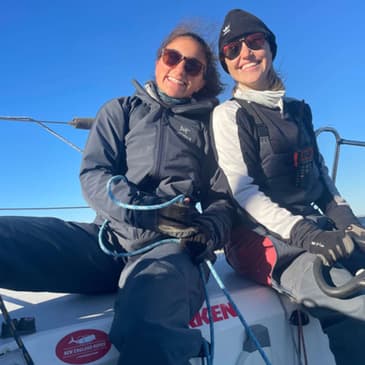
Offshore racing has long been seen as one of sailing's toughest frontiers—physically demanding, technically complex, and historically dominated by men. But Emma Rosenbaum and Marianna Fleischman of Spite Sailing are working to change that.
In this episode of SailFaster, we dive into the story behind their women-led offshore racing campaign, their journey into short-handed sailing, and their ambitious goal of competing in the Bermuda One-Two aboard a Mini 650.
Emma and Marianna discuss the barriers that still exist for women in sailing, why access and representation matter, and how they're creating a performance pathway to help more sailors progress from local club racing to offshore competition.
[00:00:06] Hi there and welcome back to Sailfaster. So, offshore racing has for a long time carried a certain reputation. It's tough, technical, physically demanding and historically dominated by men. That image is shaped not just who shows up at the start line, but who even imagines they belong there in the first place.
[00:00:27] But every so often a team comes along that doesn't just accept the status quo, they question it. They look at the barriers, the culture, the unwritten rules and decide to build something different from the ground up. So, today we're talking to Emma Rosenbaum and Marianna Fleischmann from Spite Sailing. What they're doing as young sailors goes beyond results in the water.
[00:00:50] So, yes, they're racing offshore and doing it seriously, but also challenging long-standing assumptions about access, opportunity and representation in our sport. So, over the next hour we're going to get into how Spite Sailing came together and what it actually takes to set up and run a campaign like this and how those lessons can translate to everyday club racing.
[00:01:13] Because even if you're not lining up for a major offshore race, the questions they're asking about building teams, creating opportunities, lowering barriers, apply at every level of the sport. This is a conversation about competition, but also about culture and what it looks like to push both forward at the same time. Hello, Emma and Marianna. Welcome to Sailfaster. Thanks for having us. You made us sound amazing.
[00:01:39] So, let's start with what actually is Spite Sailing and where does that name come from? Yeah, so Spite Sailing is a woman-led shorthanded offshore team. We have our eyes set on Bermuda 1-2 in 2027 and we're sailing on a mini 650. The whole idea of the campaign is to be a performance pathway, so we want to get more women out on the water, specifically in leadership roles. And I'll let Marianna talk about Spite Sailing in the name.
[00:02:09] You know, it's kind of an angry or kind of a negative word, but I also think it's a very relatable feeling. Anyone who says they've never done something in spite of or to spite something or someone is lying. Like, we've all been there, right? And really, what Spite is about is this notion of overcoming difficult things.
[00:02:28] And sometimes when you need to really dig into something to motivate yourself, sometimes, if nothing else, you got spite to spite the people who told you you couldn't, to spite any negative things that you've experienced. But the other thing we really lean into is also in spite of the barriers that exist in sailing. There's a lot of things that make this sport difficult. I mean, there's the physical side and the technical and the challenges everyone has experienced.
[00:02:58] The wind, the waves, the weather, just all the technique and the skills you have to learn. And you have to continue to grow in spite of all those things being very challenging. And then there's the side that not everyone experiences, which is discrimination or feeling lesser than or not welcomed in certain spaces. And it's about showing up in spite of those things as well. So how did this idea come together? So take us back to the origin. It's really Emma.
[00:03:27] Emma could take this because it was entirely her fault. I mean, her idea. No, it's my fault. I actually had a dream one night and I saw Mariana and I sailing offshore. And it was I've had many dreams in my life, but this one felt very instructive and very clear. So we were with a bunch of friends at Pussers in Baltimore. And I pulled Mariana to the side and I was like, listen, I have this idea. I have this dream.
[00:03:56] I don't know what you're going to say, what you're going to think about it. And I pitched it very hesitantly. And I was like, all right, we're going to do a shorthanded woman led campaign. And then I like backed away very quickly. And Mariana did not. She really just pulled the pin on the grenade and threw it. Yeah. And Mariana did not hesitate at all. She looked at me and she's like, we're in like, let's do it. This is definitely going to happen. And that was last July. And here we are.
[00:04:24] We're just we're pushing and we're creating this thing. But it wasn't as if you were thinking of just getting a women's crewed boat for Chesapeake Bay sailing, right? This is offshore Figaro stuff. Yeah. Was that part of the dream or did that come later? The dream was very vague. So it's funny. I feel like I had a vision of some sorts. But I always say Mariana added color. So I came up to her.
[00:04:54] It was a very broad pitch. And I said, we're going to be in the ocean. We're going to be racing. It's just going to be the two of us. And then Mariana would start to send me texts. And she was like, what do you think about this boat? And she said, I think the first boat you sent me or one of the first boats you sent me was a mini 650. And then she said, what do you think about this race, the Bermuda 1-2 in 2027? And I was like, that's great. You're doing the solo leg. But I would love to do that.
[00:05:22] And then she just kind of added the color of like the name, the race, the type of boat. So I would really say like it was a mix of both of our ideas. And it's shaped into this full-fledged campaign. Mariana, had you always wanted to do an offshore race? I love offshore racing. I've done a little bit of fully crewed offshore racing at this stage. By the time I met Emma, we actually met doing the Annapolis to Newport race. And we had a great time doing that.
[00:05:52] It's one of those things like when you do a race like that, you think or you hope or you dream. Like, I wonder if I could do this myself. I wonder if I could do this on my own boat. But I had never really seriously considered it until Emma put that thought in my head. And then I realized how much I had wanted to do that. So you've both talked about barriers for women in offshore sailing. What exactly are those barriers really in sort of practical terms?
[00:06:20] I think the biggest thing with sailing, and especially for women, but certainly anybody trying to get into the sport, is just this idea of access because, you know, not everyone has a boat. A lot of people who have boats already have crews that they like to sail with. Sometimes getting onto those boats is really hard and the positions are limited. And beer can, you know, you got your beer can racing and maybe you can get a spot on there, right? But then that cone just narrows and narrows as you get into more serious racing.
[00:06:48] When you get into offshore racing, when you get into serious offshore racing, it just continues to narrow. And more often than not, women aren't the first people that are being invited on board. Or if they are, it's because they weigh less and they're trying to make crew weight, right? And not always, but like it is kind of true. And I think the other thing too is just about like picturing yourself there, right?
[00:07:13] Like if you don't see other women or see people who look like you doing something, you can't picture yourself in that space. You don't necessarily aspire to it, right? Like I think Emma, myself, I'm sure Pete, you have someone you have looked up to in your sailing career. Someone doing something on a boat and you said, wow, that's really cool. I would love to do something like that.
[00:07:38] And more often than not, that person shares some qualities with you because you can see yourself in them. And I think it is just sort of like this self-perpetuating kind of problem where because there's not a lot of women sailing or, you know, there's not always women aspiring to that kind of sailing. Luckily, we have more and more of those professional women sailors to look up to. And not that we haven't always, right?
[00:08:06] But it is great to see that there is more. But the Magenta Project has a great statistic that something like 5% of the maritime industry is comprised of women, which is quite low. And that, of course, includes like marine trades and things like that. It's not just sailing specifically, but I think it is certainly a staggering statistic that makes you stop and wonder about these things.
[00:08:33] And then I don't know what we say is I don't know if the statistic exists officially. But if you look around at like the average regatta, right, like what percentage of the crew that you see is women? And then what percentage of the skippers you see or are registered in yacht scoring are women? And it's not as high as it should be. And I don't have the answers as to why that is.
[00:08:54] But I know part of the solution is just getting more women out on the water and also having more women like Emma and myself and anyone else. Like, go for it. Get a boat. Go sailing. And see what you're capable of. There are inspiring women sailors out there, aren't there? I think of Ali Bell and also Pip Air in the UK. Sam Davis. There's quite a few. Like you said, there are amazing sailors out there who are women.
[00:09:24] Just to shout out some more. We've got Cole Brower. I mean, Francesca Clavis. Yeah, like there's so many. Yeah. But there is also a level to which they're almost like too high. And so in some ways, those sailors feel very far away. But it's like who in my own community can I look up to? Who here in Baltimore, in the Chesapeake Bay or, you know, East Coast offshore racing, which is, you know, our sort of bread and butter.
[00:09:52] You know, how many of those people that are sort of that like achievable level of of sailing success? Like how many of them are female skippers or young women that we can see ourselves in? And that's kind of also the mold we're trying to fill, I guess. So you've talked about building a pipeline for women offshore sailors. But what does that actually look like to you? So we just recently partnered with a nonprofit. I actually work there, the Downtown Sailing Center. That's where I learned how to sail.
[00:10:23] And they offer amazing memberships where you can go and get great sea time. You can sail three times a week and you can work your way up to being a skipper. I also learned how to race there. So they have Thursday night one design racing on J22s. And through them, I made connections to sail and BCYA, Baltimore City Yacht Association, where I started to get on bigger boats.
[00:10:46] And then from there, that's how I met more and more people that sail outside of Baltimore who connected me to the offshore deliveries. So in theory, we're trying to replicate that process for everyone. So through this partnership, we want to encourage more people to get memberships at the Downtown Sailing Center. And then we want to encourage them to work their way up and learn how to be good crew, be good skippers. And then we want them to start racing and Thursday night racing.
[00:11:15] And then we want to bring them out on the mini for Tuesday night racing through Baltimore City Yacht Association. And then eventually get them crewing on offshore races and maybe inspire them to get their, maybe get their own mini. And we'll have a fleet of minis that will go up and down the bay and then maybe up and down the coast as well. As you say, it's quite a torturous route to get to racing a mini 650 offshore. So I love that, that you can actually create specific pathway to get there.
[00:11:45] That's really interesting. Yeah, it's about setting those stepping stones, putting them in place so that people don't necessarily have to go find them. Because sometimes people have the interests but don't necessarily have the connections. But if we can say like, we have a pathway for you, we can make those introductions. We can give you the sea time or the little resume builders that you'd like to qualify for or apply for or approach a boat you're really interested in crewing with.
[00:12:14] And you can say, hey, I've done this bay race. I've done this Tuesday night on a mini. That can help be that stepping stone to whatever their goals are. Hopefully offshore. We want to build out a performance pathway. So many people have these dreams and they just don't know how to do it. So we want to show people our journeys are good examples of starting from zero, not knowing how to sail, learning in your 20s, and then working your way up to like high level, shorthanded, offshore performance sailing.
[00:12:44] And truly anyone can do it if they have enough grit or spite. Who knows? So let's talk about shorthanded racing because it's obviously growing fast, especially in Europe. What have you learned about that style of racing? What's fun about shorthanded sailing is you've got two and usually one of them is on the helm, plus an autopilot, right?
[00:13:04] So I think what's great about that and why it's growing fast is one, unfortunately, you know, it's harder and harder to find nine people to show up regularly on a Tuesday. But also technology has advanced so much that you can get away with shorter crews. But what I think really appealed to Emma and I about that is you just have ownership over everything in the boat. You really have to be an everyman or an everywoman, being comfortable in every position. Emma is a rock star on the foredeck. My comfy spot is the pit.
[00:13:34] But you can't just sit there in your happy space, right? You've got to be able to do everything, especially in shorthanded racing, like long distance. And someone's going to be sleeping mostly. So you're really kind of up there alone. And I think you just have a lot more ownership over every part of the boat instead of being like tactics are someone else's problem. You're like, no, it's actually my problem now. Yeah, I think it just makes you or it forces you rather to be a more well-rounded racer.
[00:14:04] And I think it gives you a lot of perspective and empathy of sorts for other positions on the boat. I think that cross training is really valuable. I think that's what's cool about shorthanded sailing. So let's talk about the boat. Let's talk about the racing platform. It's the mini 6.5 meters. There must be only a handful of these in the U.S. right now. There's very few of them that have made it to the States or have stayed in the States.
[00:14:29] Because I believe people will do the transat that finishes like Guadalupe and then they put them on a shipping container and take them home. But a couple of them trickle through and make their way up to North America, which is where we got ours. This is a tiny boat to go offshore in. Why did you settle on the mini 6.5? So we looked at a couple things that fit the bill. What was the bill for you?
[00:14:55] The bill was asymmetric kite set up for double handing or single handing. Something manageable. Recognizable. Obviously sea-worthy, heavy, good for offshore. And ideally with its own autopilot already. Originally we were thinking like 28 to like 35 feet range. Like that's initially what we were thinking. Maybe 32. As small as 32 is because we were looking at like some Figaro's. That was kind of our dream boat for a while.
[00:15:22] So what we sort of went through a phase where we looked at really conceding on a lot of those wishes because we just didn't have the funds. And so we were looking at like Trip 30s and these, you know, boats that are like pretty cool, you know, offshore capable boats. But, you know, probably older, rely on crew weight. Like it wouldn't have been really suited for shorthanding, but like we would have made do kind of thing.
[00:15:50] And then we were really lucky to sort of become connected with Peter Gibbons Neff, who I believe you've also had on the pod. We're about to. About to. Okay. We are his biggest fans. Truly cannot say enough nice things about him, but basically a mini was one of the boats we had dreamed of because it is exactly essentially purpose built for what we're trying to do. Yeah. Proven platform. Exactly. Proven. They're safe.
[00:16:19] I mean, they're inherently buoyant, which my mom loved, but you know, they're expensive. They're cool little race boats, you know? So it just, it felt like a faraway dream, but Peter was nice enough to let us take his, his boat out for a couple of sails just for fun. No promises made. No, nothing just out of kind of the kindness of his heart. And he saw that we were really passionate, interested in doing something similar to what he had done. And we were very fortunate that, I mean, we fell in love with the boat immediately.
[00:16:49] Oh yeah. We, our first sail is pretty sporty. It was 25 gusting 32. And it was just wipeout after wipeout. We were learning the boat and I, I loved it. Like every wipeout, I was like, okay, like we can get this. We're going to figure it out. But the boat is just so responsive. It's so nimble. It truly felt thrilling. I was like, okay, Mariana, this is our boat. We, we really thought it was our boat. And then it just like fiscally was not going to work out.
[00:17:17] So we started to look at other boats and then we are now leasing the boat. So it, it works out better for us financially. So we'll do two years on this platform. We'll race her in the Bermuda one too. I think a lot of people, when they're getting into these, uh, these platforms are into performance sailing. There's this idea that you can't make a mistake. Like you have to be perfect. You have to know exactly what you're doing. That's not the case at all for either of us.
[00:17:45] Like we both have years of sailing experience. We both have sailed on great boats, but we want to show that it's okay to be, to learn, to make mistakes, to look to your community, to help you. And to also encourage people to try something new. Like maybe take one step that you wouldn't have before somewhere where you're typically uncomfortable. And ideally in a leadership role. I think what we, we often found when we were building out this campaign and we were ideating
[00:18:13] around what it would look like is there just aren't a lot of opportunities for people to get leadership positions, to make calls that they normally wouldn't make on someone else's boat. So that's, I think that's the true origin is like, we want a chance to, to make the right call and maybe make the wrong call as well, but at least we're learning. And we now tried it. What we've learned and like what I think we felt in, in the like sailing we've done on it already is like that boat is fine.
[00:18:42] That boat is more ready for the race than we are. And she wants to go fast and she's just like waiting for us to catch up, you know, she's like, they'll get there because it is a very forgiving boat. She's fast and she's so like responsive that like when you're doing something right, you know, you know, very quickly because she just takes off, you know, she hits this groove and you're like, Oh, I've done it. Like I, you know, we're trimmed correctly, you know? Um, so yeah, she is a great boat. I love her.
[00:19:09] What do sailors find that's so different about the mini? I think a mini, at least for me coming from, you know, just large keelboat racing and sailing in general is the mini has so many controls, just so many more things to play with and trim and dial in. And, and I mean, the whole cabin top is, is clutches of different controls. And I think it is, it's, it's one of those things where it's, it's a sailboat.
[00:19:36] So it's, it's easy to sail in the sense that like to get it going is not hard, but it's hard to master, you know, to learn all of those little intricacies. And it really forces you to appreciate and understand the science and all the technical sides of sail trim and weight distribution and even like sail cut and the tactics around which, you know, which sail to use when. And I didn't start sailing with check stays.
[00:20:06] The running back stays are an ongoing frenemy, I would say. But I think that's really it is there's just so many controls on the mini and that's what makes it very fun. Once I'm sure like, you know what you're doing, you hit a flow state and you understand like, oh, if I tweak this two inches, it'll, you know, and it's not that other sailing doesn't have that. There's just like much more of it, I would say on the mini and because of the scale of it, everything really matters.
[00:20:34] And, and you really feel the difference, uh, you know, because it's such a light boat and all these little things. Like if you, you know, you're a little over trimmed on your back stay on a 45 foot sailboot, you may or may not notice right, right away. But I think on the mini, like all these little things really add up and it's, it's a fun challenge to, to try to learn it all. Yeah. It's funny. We, we do one thing, like we'll set the kite and, uh, with all the controls on the cabin
[00:21:01] top, there's a 20 lines of spaghetti coming down and it's hilarious. Like you finally set the kite, you're feeling good. Everything is like rock and you're in that groove. And then you look down and you're like, we need to clean for the next like two to three minutes nonstop. So it's just always that thing of like, you get in your groove and then the mini is like, nope, don't forget that. Don't forget that. And you do this. But it's again, what makes it so fun is like, we are always doing something.
[00:21:28] And, uh, Mariana and I have been training like outside of this, we've been like going to the gym so much more thinking about our nutrition. We are, we are getting ready for the mini again. She, she's ready. We're getting ready for her. In nearly every one design class, right? There is some information as YouTube. There's a ton of things there. Most class association websites have advice and tips and that sort of thing. But did you have that on the mini? I mean, it's still quite a small class, especially over here.
[00:21:57] Or did you have to find out for yourselves? There is material out there. A lot of it is in French, which neither of us speak fluently. Our main resource thus far has been really Peter. We have a WhatsApp chat with him and we'll send him photos of like, did we rig this right? Or this looks weird. Are we wrong? You know? And he's, he's, he'll just respond when he can and be like, oh, you got to do this or that. And then, yeah, go ahead. Yeah. I mean, we got the new wrap on today. Our haul is a sparkly purple glitter.
[00:22:28] And I was driving home today and I, I was thinking about how the whole number had to be a certain height. It had to be a certain font. It had to be just every aspect of it had to be a certain way. So we're, we're trying to keep the mini to its class standards. So it's just funny, like little things like that pop up. Let's turn to training and preparation. I think people would be really interested in how you're doing that.
[00:22:54] With your eyes on the Bermuda one, two next year, sort of is your goal. Tell us how you're building your skills right now. And then what does your training actually look like from a day-to-day perspective? I think we'll be on the water more than we'll be on land this year, which is very much part of the training. So we're going to do Tuesday night racing, uh, shorthanded, uh, through BCYA, Baltimore City Yacht Association.
[00:23:21] Uh, we're going to try to do all the down the bay races we can, all the local races. Um, but then after that, we kind of pivot into, um, doing some boats we have history with. So we'll both be doing Annapolis to Bermuda on Aurora, uh, which is an X482. And you were in performance race week in St. Thomas, right? Yes. We went to North Hughes performance race week in St. Thomas, which was an incredible experience.
[00:23:48] Not only is St. Thomas one of the most beautiful places you can go sailing, but they had just world-class coaches teaching us so many things. You wake up, you go sailing, you come in, you have lunch, you go back out, you go sailing, you come back in, eat dinner. It was at times like very brain overload because you're just trying to download it all. Um, and cause it's a mixture of like brain, like downloading, but also like trying to get muscle memory to take hold. But it was, it was an awesome, awesome time.
[00:24:17] I highly recommend it. So I know you're racing lots of different boats right now, but in preparation for a double-handed offshore, you presumably you're starting to practice how you make decisions together and what happens when you don't agree. Am I right? Or am I way off base? That never happens. No, no. We don't disagree. Yeah. It's interesting. There is a level to which like that is kind of still an unknown quantity because the season has really just started.
[00:24:44] We've been very much in like business prep side of things all winter and now spring is here and sailing season is starting and we're going to find out. Um, but, uh, I would say like all of the lead up to this and like starting a business, starting a sailing campaign, designing logos and merch and emails and slide decks. And there's a lot of like teamwork that has already happened that has nothing to do with sailing really.
[00:25:11] But we've definitely found out a lot about our, I guess, ability to work together and make decisions already. Just maybe not on a sailboat, but, uh, Emma, what do you think? We are really great partners. Mariana is really good at thinking of like all the marketing stuff. I come from an operations and finance background. So I, I feel like I understand that side really well.
[00:25:37] It translates to the boat where I feel the most comfortable is up on four deck. Mariana, one of the best pit people you'll ever meet. That girl will have like 10 things going on and it's all organized. It's also the whole idea of the campaign is to like push ourselves into areas that we typically don't go into, but it's finding that new brain meld. I find, uh, like having a curious open attitude seems to be the best. And I think that's, what's really cool about both of us.
[00:26:07] Our thinking is so unique is so curious. We're not judgmental people. We're relatively perceptive and open and we don't have a fixed structure of thinking. And I think that's been imperative to building this campaign. There was so many times we thought this campaign wasn't going to happen. And then Mariana would call me and she would say, oh, like I just got this lead or I just, I, this boat could be a good fit.
[00:26:32] It's kind of trusting the natural rhythm of our like business partnership of our sailing partnership. And now we joke, the momentum is beyond us. We couldn't even stop this campaign if we wanted. We're, we're on the boat and we're going. And it's been such a cool, interesting journey. And I've learned more about myself than I ever have in my entire life. I think there is this tendency in sailing to kind of puff up or, or, you know, kind of
[00:26:58] just kind of grimace through something and, and act like either you got it when you don't. We've both had those moments where like we say, I'm not comfortable with what's happening right now. Or I don't feel that confident in this decision we're making. The harder thing sometimes is, is expressing the negatives. That's something that we have really held each other through. And Emma is very in touch with navigating those conversations.
[00:27:26] And she's really helped me be better at that as well. I would ask about the, you know, creating a campaign like this, right? Because presumably there's three big parts of this. One is getting the boat ready. Two is getting yourselves ready physically and mentally for this. And then also finances, right? The campaign for that, all the, all the PR and fundraising need to do for that. Which of those elements is the hardest for you?
[00:27:53] So I come from a background working in a nonprofit and working in operations. So in a way, the fundraising is very natural. I'm talking about something I deeply believe in that's uplifting so many people. And I think that's been something we've been trying to carry throughout this whole campaign is like, it's not about us. I think it's about everyone around us and how we can lift them up. Yeah. It is hard though.
[00:28:21] So I think at least for me, the thing about fundraising, the thing about trying to get sponsorship or whatever is your, your core of the question you're asking is, do I seem like the sort of person worth spending money on? Right? Like at the end of the day, that's kind of the question you're asking. And, and yes, we have a bigger mission. Yes, we, we think it's a good one. And like Emma's saying, like it is bigger than us, but we are the ones asking the questions, right?
[00:28:50] And it comes with this horrible imposter syndrome at all times, because essentially you have to convince people that you have this like inherent worth. But that to me is the really uncomfortable thing about any fundraising is, you know, when you distill that question, that ask down, you're kind of like putting your, you're laying yourself there to this idea of like, do I seem worth it?
[00:29:18] And gosh, I hope so. But it is uncomfortable. There's a lot of worthy things for people to spend money on. And it doesn't have to be sailing. But it is, it is an unfortunately necessary evil to get a project like this off the ground. You know, Emma and Mariana, you have a really inspiring vision here for not only getting women into the sport, but just getting people into the sport and creating a pathway. It's just what our sport needs.
[00:29:46] But it's not free, obviously. How do people get in touch with you if they're interested in contributing and learning more about that? What should somebody do? If you want to get in touch with us and talk about a bigger partnership, feel free to reach out to spite sailing team at gmail.com. If you're feeling motivated and you want to already give back to the campaign, you can go to give butter dot com backslash spite and all donations will actually be tax deductible.
[00:30:16] And 5% of all donations will go directly to the downtown sailing center and will fund women's performance pathways. So it'll go towards scholarships for getting more women members in, getting more women out racing. And then overall, we're happy to talk about sponsorships. We just got a new pull wrap on. And if you want your name on it, let us know. I'm coming to the price.
[00:30:42] Um, but yeah, we, we want to get out on the water and we want to carry brands and believers as best as we can. Also, I know you have a really big social media presence. So is that where people can catch what you're doing? I would say our Instagram is our main place to find us Instagram slash spite sailing. And then we're also hoping to expand into the live streaming space. So you can find us also at twitch.tv slash spite sailing, where we're hoping to build up a
[00:31:11] live streaming presence there. What's great about Twitch is it's like a purpose built live streaming platform. So it's got, you know, live chats and emotes and it's just more set up as the sort of infrastructure that better supports live streaming. So give it a whirl. Hopefully you'll see us on there and we're hoping to get that started soon. You can join us virtually for all of our racing, including Tuesday nights and down the bay. Well, this has been a really inspiring 45 minutes or so with you guys. Really, really interesting story that you have.
[00:31:41] Thank you so much for coming on to Sailfaster at Emma and Mariana and good luck with your endeavors. I look forward to hearing more about it. So thank you for taking the time. Thank you so much. This was so fun. And we'll all see each other in St. Thomas soon, I'm sure.